INTERNATIONAL JOURNAL OF ENGINEERING SCIENCES
& MANAGEMENT
PERFORMANCE ANALYSIS OF SPEECH ENHANCEMENT USING
DIFFERENT ADAPTIVE FILTERS WITH DIFFERENT MODULATION
TECHNIQUES
Vaishali Sharma
1,Prof. R. B. Gaikwad
21
PG Student,
2Asst Prof
Department of ECE, Ujjain Engineering College, India
[email protected]ABSTRACT
Adaptive filtering has become a vast area of researchers since last few decades in the field of electronics and communication. Adaptive noise cancellation is a method used for noise reduction in the speech signal. In this paper, deals with cancellation of noise on the speech signal using two old algorithms i.e. Least Mean Squares (LMS), Normalized Least Mean Squares (NLMS) and one new Unbiased and Normalized Adaptation Noise Reduction (UNANR) algorithm. The UNANR algorithm model does not contain any bias unit, and the coefficients are adaptively updated by using the steepest-descent algorithm. The Amplitude Modulation (AM) and Frequency Modulation (FM) are used separately in combination with Additive White Gaussian Noise (AWGN) channel. The channel signal quality parameter Peak Signal to Noise Ratio (PSNR) and Root Mean-Square Error (RMSE) are measured and compared. The simulations result of LMS, NLMS and UNANR are compared and shows that the performance of the UNANR based algorithm is superior to that of the LMS algorithm in noise reduction.
KEYWORDS:
Adaptive filtering, LMS, NLMS, UNANR, PSNR, RMSEINTRODUCTION
Speech is the vocalized form of communication in daily life. Speech is most natural form of human communication [1]. It existed since human civilizations began and even till now [2]. The perception of speech signal is generally measured in terms of its quality and intelligibility. The quality is a subjective measure that indicates the pleasantness or naturalness of the perceived speech [3]. Intelligibility is an objective measure which predicts the percentage of words that can be correctly identified by listeners [4], [5]. Enhancement means the improvement in the value or quality of something. In this paper, the speech enhancement of voice signal using various adaptive filters. The speech signal is first mixed with a noise signal then it is modulated with two kind of the analog modulation techniques i.e. Amplitude Modulation (AM) and Frequency Modulation (FM); one at a time [6]. Then Additive White Gaussian Noise (AWGN) channel is chosen as a communication channel in configuration with one of the modulation technique [7]. Then at the receiver side demodulation is performed and filtered with adaptive filters. The same process is also done with the Rician fading channel [8]. The different kinds of filters which are used i.e. Least Mean Squares (LMS), Normalized Least Mean Squares (NLMS) and Unbiased and Normalized Adaptive Noise Reduction (UNANR) [9], [10].
SPEECH ENHANCEMENT
Fig. 1: Basic System of Speech Enhancement
MODULATION TECHNIQUES
Modulation is the process of varying some parameter of a periodic waveform in order to use that signal to convey a message [2]. Normally a high-frequency sinusoidal waveform is used as carrier signal [3]. For this purpose, if the variation in the parameter of the carrier is continuous in accordance to the input analog signal the modulation technique is termed as analog modulation scheme [4].
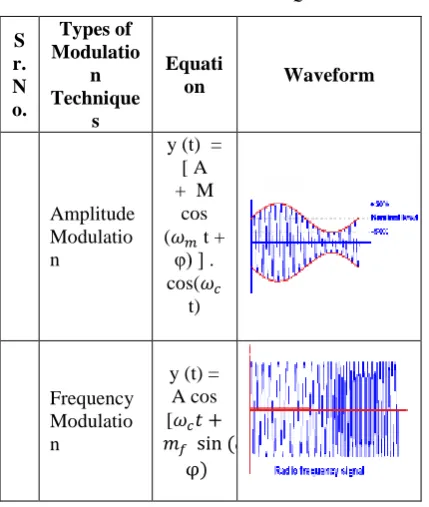
Therefore, the types of modulation techniques along with their mathematical expressions and waveforms are tabulated in Table 2.
TABLE-1:TYPE OF MODULATION TECHNIQUES
Sr. No.
Type of Analog Modulation Techniques
Short Form
01 02 03
Amplitude Modulation Frequency Modulation Phase Modulation
A.M. F.M. P.M.
ADAPTIVE FILTERS STRUCTURE
The basic idea of an adaptive noise cancellation algorithm is to pass the corrupted signal through a filter that tends to suppress the noise while leaving the signal unaltered [15]. This is an adaptive process, which means it does not require a priori knowledge of signal or noise characteristics [16]. The Adaptive noise cancellation (ANC) efficiently attenuates low frequency noise for which passive techniques are ineffective [17]. The basic adaptive filter structure is shown in figure 2.
TABLE-2:TYPE OF MODULATION TECHNIQUES
Fig. 2: Adaptive Filter Structure
Let us consider an adaptive filter with a primary input i(n), that is noisy speech signal S(n) with additive noise C(n). While the reference input is noise r(n), which is correlated in some way with C(n) [11]. If the filter output is f(n), the output of the summer O(n) is nothing but the error signal and it is written as, filter error given as
e = {S(n) + C(n)} - f(n), (1) then, mean square error (MSE) is obtain as
𝑒2= {𝑆(𝑛) + 𝐶(𝑛)}2− 2𝑓(𝑛){𝑆(𝑛) + 𝐶(𝑛)} + 𝑓(𝑛)2 (2)
= {𝐶(𝑛) − 𝑓(𝑛)}2+ 𝑆(𝑛)2+ 2𝑆(𝑛) 𝐶(𝑛) − 2𝑓(𝑛) 𝑆(𝑛) (3)
Since the signal and noise are uncorrelated, the mean-squared error (MSE) is
𝐸[𝑒2] = 𝐸[{𝐶(𝑛) − 𝑓(𝑛)}2] + 𝐸[𝑆(𝑛)2 (4)
S r. N o.
Types of Modulatio
n Technique
s
Equati
on Waveform
1.
Amplitude Modulatio n
y (t) = [ A + M
cos (𝜔𝑚 t +
φ) ] . cos(𝜔𝑐
t)
2.
Frequency Modulatio n
y (t) = A cos [𝜔𝑐𝑡 +
𝑚𝑓 sin (𝜔𝑚t +
Minimizing the MSE results in a filter error output that is the best least-squares estimate of the signal S(n) . The adaptive filter extracts the signal, or eliminates the noise, by iteratively minimizing the MSE between the primary and the reference inputs [13], [14]. Minimizing the MSE results in a filter error output f(n) that is the best least-squares estimate of the signal S(n) [15], [16].
Therefore, different kinds of Adaptive filter Algorithms with mathematical equations are listed in Table-3.3 [12], [17].
Table 3: Adaptive filter Algorithms
Sr. No
.
Algorithm s
Adap tive filter
Equation
1.
Least Mean Square
L M S
𝑤(𝑛 + 1) = 𝑤(𝑛) + 𝜇 𝑖(𝑛)𝑒(𝑛)
2.
Normalize d Least Mean Square
N L M S
𝑤(𝑛 + 1) = 𝑤(𝑛) +
𝜇(𝑛) 𝑖(𝑛) 𝑒(𝑛)
3.
Unbiased and Normalize d
Adaptive Noise Reduction
U N A N R
𝑤̂𝑘(𝑛 + 1)
= 𝑤𝑘(𝑛 + 1) ∑𝑀𝑘=1𝑤𝑘(𝑛 + 1)
SIMULATION RESULTS DISCUSSION
Firstly speech enhancement is done with stored voice data. There can be total four possible configurations for this experiment because we have two types of modulation techniques i.e. AM and FM and here AWGN is used as communication channels. Consider the case of stored input speech signal first. In this case AM and FM are selected as modulation technique one by one to transmit the whole speech signal after addition of background noise at the transmitter side. AWGN channel is considered as channel for transferring the speech signal. During the speech signal propagation through AWGN channel, channel noise gets added to the speech signal. At the receiver side, first AM and FM demodulation is performed one by one then speech signal is passed through one of the adaptive filter i. e. LMS, NLMS and UNANR filter is selected and the values of signal parameters i.e. PSNR and RMSE are recorded at different values of SNR in dB.
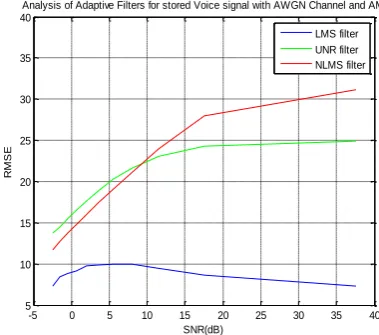
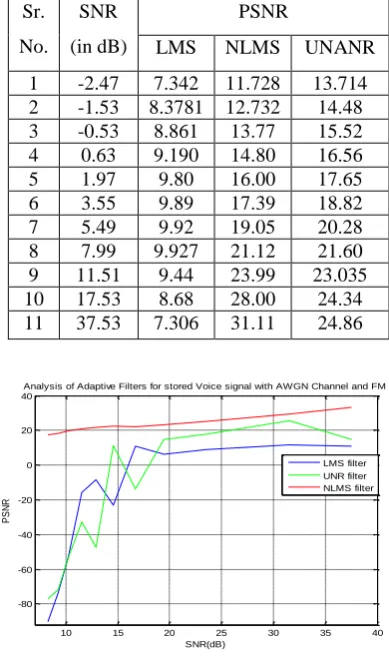
The Performance of LMS, NLMS and UNANR are shown for AM and FM modulation technique with AWGN channel and graph is plotted between PSNR v/s SNR as shown in Fig. 3 & 4 and tabulated in Table 4 & 5.
Fig. 3: Adaptive filtering for AM with AWGN channel for stored voice
-5 0 5 10 15 20 25 30 35 40
5 10 15 20 25 30 35 40
Analysis of Adaptive Filters for stored Voice signal with AWGN Channel and AM
SNR(dB)
R
M
S
E
It is clear from Fig. 3 and Table 4.2 that NLMS and UNANR perform much better performance than the LMS filter. Though performance of NLMS and UNANR are in same pattern but UNANR gives best results.
Table 4: Measurement of Parameters of Adaptive Filters between PSNR Vs SNR
Sr.
No.
SNR
(in dB)
PSNR
LMS NLMS UNANR
1 -2.47 7.342 11.728 13.714 2 -1.53 8.3781 12.732 14.48 3 -0.53 8.861 13.77 15.52 4 0.63 9.190 14.80 16.56 5 1.97 9.80 16.00 17.65 6 3.55 9.89 17.39 18.82 7 5.49 9.92 19.05 20.28 8 7.99 9.927 21.12 21.60 9 11.51 9.44 23.99 23.035 10 17.53 8.68 28.00 24.34 11 37.53 7.306 31.11 24.86
Fig. 4: Adaptive filtering for FM with AWGN channel for stored voice
Table 5: Measurement of Parameters of Adaptive Filters between PSNR Vs SNR
Sr. No.
SNR (in dB)
PSNR
LMS NLMS UNANR
1 10.23 -52.99
19.75 -53.32
2 11.51 -15.59
20.79 -32.79
3 12.92 -8.43 21.64 -47.41 4 14.60
-23.04
22.46 11.08
5 16.70 10.82 21.97 -14.02 6 19.47 6.24 23.17 14.56 7 23.55 8.90 25.04 17.62 8 31.51 11.75 29.31 25.66 9 37.53 10.98 33.11 14.79
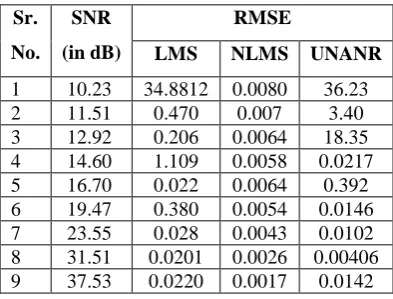
The performance of LMS, NLMS and UNANR for AM and FM modulation technique with AWGN channel are plotted between SNR and RMSE v/s SNR as shown in Fig. 5 & 6 and parameters recoded in Table 6 & 7.
It is evident from Fig. 5 and Table 6 that NLMS and UNANR perform much better performance than the LMS filter. Though performance of NLMS and UNANR are in same pattern but UNANR gives best results.
10 15 20 25 30 35 40
-80 -60 -40 -20 0 20 40
Analysis of Adaptive Filters for stored Voice signal with AWGN Channel and FM
SNR(dB)
P
S
N
R
Fig 5: Adaptive filtering for AM with AWGN channel for stored voice
Table 6: Measurement of Parameters of Adaptive Filters between RMSE vs SNR
Sr.
No. SNR
(in dB)
RMSE
LMS NLMS UNANR
1 -2.47 0.032 0.020247 0.0161 2 -1.53 0.029 0.018037 0.01473 3 -0.53 0.028 0.01600 0.0130 4 0.63 0.0271 0.014204 0.0115 5 1.97 0.0252 0.0123 0.0102 6 3.55 0.0250 0.0105 0.0089 7 5.49 0.0249 0.00873 0.00756 8 7.99 0.02451 0.006866 0.00649 9 11.51 0.02632 0.00493 0.0055 10 17.53 0.0287 0.003107 0.00473 11 37.53 0.033 0.002172 0.004463
Fig. 6: Adaptive filtering for FM with AWGN channel for stored voice
Table 7: Measurement of Parameters of Adaptive Filters between RMSE vs SNR
Sr. No.
SNR (in dB)
RMSE
LMS NLMS UNANR
1 10.23 34.8812 0.0080 36.23 2 11.51 0.470 0.007 3.40 3 12.92 0.206 0.0064 18.35 4 14.60 1.109 0.0058 0.0217 5 16.70 0.022 0.0064 0.392 6 19.47 0.380 0.0054 0.0146 7 23.55 0.028 0.0043 0.0102 8 31.51 0.0201 0.0026 0.00406 9 37.53 0.0220 0.0017 0.0142
-5 0 5 10 15 20 25 30 35 40
0 0.005 0.01 0.015 0.02 0.025 0.03 0.035
Analysis of Adaptive Filters for stored Voice signal with AWGN Channel and AM
SNR(dB)
R
M
S
E
LMS filter UNR filter NLMS filter
10 15 20 25 30 35 40
0 0.05 0.1 0.15 0.2 0.25 0.3 0.35 0.4 0.45 0.5
Analysis of Adaptive Filters for stored Voice signal with AWGN Channel and FM
SNR(dB)
R
M
S
E
CONCLUSION
In this paper, work presented the speech enhancement through LMS, NLMS and UNANR. Performances of these filters are measured with respect to PSNR and RMSE v/s SNR when speech signal is affected by both background and channel noise. The comparison and analysis of performances of these adaptive filters have been done through plotted graphs. From all the performed experiments it is apparent that NLMS and UNANR filters have better performance than LMS. There is a fight between in NLMS and UNANR filter’s performances in most of the graphs. As soon as the SNR improves performances of the filters get improved and when background noise level gets increased then performances of LMS, UNANR and NLMS filters gets degraded.
REFERENCES
I. A. B. Carlson, P. B. Crilly and J. C. Rutledge, “Communication systems,” 4e, Mcgraw-Hill, Singapore, International Edition, 2002.
II. A. Mishra, R. Saxena and Y. M. Gupta, “Digital Modulation Techniques,” Indian Journal of Telecommunications, vol. 53, no. 5, pp. 34-47, Sept.-Oct. 2003.
III. A. V. Oppenheim and R. W. Schafer, “Discrete-Time Signal Processing,” Prentice Hall International, ISBN 0-13-216771-9, 1989.
IV. B. P. Lathi, “Modern Digital and Analog Communication Systems,” 3e, Oxford University Press, YMCA Library Building; Jai Singh Road, New Delhi-110001, 1999.
V. Divya, Preeti Singh and Rajesh Mehra, “Performance Analysis of LMS and NLMS Algorithms for Noise Cancellation” International Journal of Scientific Engineering and Technology, Vol.2, No.6, pp. 366-369, September 2013.
VI. H. C. Huang and J. Lee, “A Variable Step Size NLMS Algorithm and its Performance Analysis,” IEEE Transaction on Signal Processing, vol. 60, no. 4, April 2012.
VII. J. G. Proakis, “Digital Communication,” 4e, McGraw-Hill Series in Electrical and computer Engineering, Irwin/Mc-Hill companies, Inc 1221 Avenue of Americas, New York NY, 10020, 2001.
VIII. Jyoti Dhiman, Shadab Ahmad and Kuldeep Gulia, “Comparison between Adaptive Filter Algorithms (LMS, NLMS and RLS)” International Journal of Science, Engineering and Technology Research, Vol.2, Issue 5, May 2013.
IX. Md Zia Ur Rahman, Sk, Khaja Mohedden, Dr B. V. Rama Mohana Rao, Y. Jaipal Reddy and G. V. S. Karthik “Filtering Non-Stationary Noise in Speech Signals using Computationally Efficient Unbiased and Normalized Algorithm” International Journal on Computer Science and Engineering Vol.3 No. 3 Mar 2011
X. N. Stallings, “Data and Computer Communications,” 5e, Prentice Hall of India Pvt. Ltd. New Delhi, 2001. XI. Narendrapurapu V. D. Mahesh and Dr. I. Santhi Prabha, “ Noise Free Speech Enhancement using Fast Adaptive
Kalman Filtering” International Journal on Emerging Technology and Advanced Engineering, Vol. 3, Issue 8, August 2013.
XII. Priyanka Gupta, Mukesh Patidar and Pragya Nema, “Performance Analysis of Speech Enhancement Using LMS, NLMS and UNANR Algorithms” IEEE conference on computer, communication and control, MGI Indore, INDIA. September, 10 December, 2015.
XIII. S. Haykin, “Digital Communications,” 4e, Jhon Wiley & Sons, Inc. Replika press Pvt. Ltd. Kundli 131028, Delhi (India), CA-2003.
XIV. S. A. Hadei and M. lotfizad, “A Family of Adaptive Filter in Noise Cancellation for Speech Enhancement” International Journal of Computer and Electrical Engineering, Vol.2, No. 2, pp. 1793-8163, April 2010.
XV. Sk. K. Mohedden, Mohammad Zia-Ur-Rahman, K. M. Krishna and Dr B. V. Rama Mohana Rao, “Battle Field Speech Enhancement using an Efficient Unbiased Adaptive Filtering Technique” International Journal of Computer Science and Communication Networks, Vol.1(1), September-October 2011.
XVI. Quanshen Mai, Dongzhi He, Yibin Hou and Zhangquin Huang, “A Fast Adaptive Kalman Filtering Algorithm for Enhancement” IEEE International conference on Automation Science and Engineering Triste, Italy-August 24-27, 2017.