STRATEGY IMPLEMENTATION PRACTICES AND THE PERFORMANCE OF HIGHER EDUCATION LOANS BOARD IN KENYA
RACHEL GATAKAA BAINI
D53/CTY/PT/33110/2014
A RESEARCH REPORT SUBMITTED TO THE SCHOOL OF BUSINESS, IN PARTIAL FULFILLMENT OF THE REQUIREMENT FOR THE AWARD OF
MASTER OF BUSINESS ADMINISTRATION, KENYATTA UNIVERSITY
DECLARATION
This research project report is my original work and has not been presented for a degree in any other university or for any other award.
Signature………Date……… RACHEL GATAKAA BAINI
D53/CTY/PT/33110/2014
This project has been submitted for examination with my approval as the university supervisor.
Signature………Date……… Dr. Evans Mwasiaji,
DEDICATION
I would wish to dedicate this research project to my Husband Mr. Muthure and my two handsome Boys; Emmanuel and Hanniel. Their prayers, sacrifices and support was a great encouragement to me in the entire research process.
ACKNOWLEDGEMENT
I would like to acknowledge with gratitude my supervisor namely; Dr. Evans Mwasiaji for his tireless assistance and supervision during my research work and preparation of the project. I also acknowledge my classmates for their moral support in my academic pursuit.
I would also like to thank the librarians at the Kenyatta University Library for their support with the books used for literature review and other valuable information that they provided to aid in the completion of this project.
TABLE OF CONTENTS
TITLE PAGE ...i
Declaration ... ii
Dedication ... iii
Acknowledgement ... iv
Table of Contents ... v
List of Figure ... viii
List of Tables ... ix
Abbreviations and Acronyms ... x
Operational Definition of Terms ... xi
Abstract ... xii
CHAPTER ONE: INTRODUCTION ... 1
1.1 Background of the Study ... 1
1.2 Statement of the Problem ... 5
1.3 Objectives of the Study ... 6
1.4 Research Questions ... 6
1.5 Significance of the Study ... 7
1.6 Scope of the Study ... 8
1.7 Limitations of the Study ... 8
CHAPTER TWO: LITERATURE REVIEW ... 9
2.1 Introduction ... 9
2.2 Theoretical Review ... 9
2.4 Summary of Literature Review ... 17
2.6 Conceptual Framework ... 19
2.7 Interpretation of Variables ... 20
CHAPTER THREE: RESEARCH METHODOLOGY ... 22
3.1 Introduction ... 22
3.2 Research Design ... 22
3.3 Target Population ... 22
3.4 Sampling Procedure and Sampling Size ... 23
3.5 Data Collection instruments and Procedure ... 23
3.6 Data Analysis and Presentation ... 24
3.7 Ethical Consideration ... 25
CHAPTER FOUR: DATA ANALYSIS AND PRESENTATION ... 26
4.1 Introduction ... 26
4.2 General Information ... 26
4.3 Influence of Commitment of Top Management on Performance of HELB ... 28
4.4 Influence of Resource Management on Performance of HELB ... 30
4.5 Influence of Effective Communication on Performance of HELB ... 31
4.6 Influence of Technology on Performance of HELB ... 32
4.7 Performance of HELB ... 33
CHAPTER FIVE: SUMMARY, CONCLUSIONS AND RECOMMENDATIONS ... 36
5.0 Introduction ... 36
5.3 Recommendations ... 40
5.4 Suggested Areas of Further Research ... 41
REFERENCES ... 42
APPENDICES ... 47
Appendix 1: Cover Letter ... 47
Appendix 2: Questionnaire for the Staff ... 48
Appendix 3: Sampling Frame ... 52
LIST OF FIGURE
Figure 2.1: Conceptual Framework ... 20
Figure 4.1: Respondents Sex………33
Figure 4.2: Level of Education……….33
LIST OF TABLES
Table 4.1: Response rate………...…26
Table 4.2: Commitment of Top Management on Performance of HELB………29
Table 4.3: Resource Management on Performance of HELB………..30
Table 4.4: Effective Communication on Performance of HELB……….31
Table 4.5: Technology on Performance of HELB………32
Table 4.6: Performance of HELB……….33
ABBREVIATIONS AND ACRONYMS HELB : Higher Education Loans Board
RoK : Republic of Kenya
MSEs : Micro and Small Enterprises
KCB : Kenya Commercial Bank
HELF : Higher Education Loans Fund
UNESCO : United Nations Educational, Scientific, and Cultural Organization
HLM : Hierarchical Linear Model
LR : Loan Repayment
DB : Defined Benefit
DC : Defined Contribution
CEO : Chief Executive Officer
IDEP : African Itinerant College of Culture, Development and
OPERATIONAL DEFINITION OF TERMS
Performance: performance was measured in relation to amount of funds disbursed to the students, debt recovery from past matured loans and effective communication in the organisation.
Strategic Management: This is a process of analyzing and learning from the internal
and external environments in order to establish direction and create strategies to
achieve business goals. Strategic management includes the following steps; analysis,
direction setting, developing strategies, implementation and control.
Strategy: This is a long term plan set in advance to achieve set goals of an
organisation.
Governance: This is the systems and processes concerned with ensuring the overall direction, effectiveness, supervision and accountability of an organisation.
ABSTRACT
CHAPTER ONE INTRODUCTION 1.1 Background of the Study
A strategic plan is a set of processes undertaken in order to develop a range of strategies that will contribute to achieving the organizational goals, objectives and direction (Martin, 2010). Coherent document which will guide the efforts of all the stakeholders outlining what the organization will achieve and how it intends to achieve it is normally formulated. In every organization strategies can be formulated in three distinct levels. They includes corporate, business and functional level. Top level management and board members formulate corporate level strategies (Yabs, 2010). Strategic planning is a management tool for helping the organization visualize the projected future desires of an organization and organizes the present on its basis. It is usually organization's road map from where it is now to where it intends to be in five or ten years from now. Strategic planning comprises the procedures of defining objectives and strategies to attain those objectives so it is very necessary for every company or department to have it.
According to Chatty (2010), valuable organizational strategies are not all executed because they are faced with failure and problems in the implementation stage and not that they are poor strategies or ideas. Strategy implementation is the main challenge in strategic management as compared to strategy development or formulation stage. There are impeders affecting the successful implementation of the strategy which include: organization structure, organization culture, motivation and reward systems, information and communication technology and reporting systems, providing adequate resources, decision-making processes, education, effective communication, capabilities and skills according to (Mashhadi, Mohajeri, and Nayeri, 2008).
1.1.2 Performance of Higher Education Loans Board
a organisation are relative to the context in which an organisation carry its operations and the already laid down objectives being pursued. Strategies are usually formulated and implemented in each organisation for it to achieve its performance. Most organization whether government or private institution have set mechanism to evaluate or measure performance. These enables the organization to their annual, semi-annual, quarterly or any other desired evaluation and compare its achievement in relation to the expected standards.
The context or field in which an organization operate is used to develop the actual measurement tools for the organizational performance and achievement of strategic objectives (Akinyi, 2012).There are major strategic management problems experienced in different countries when they want to implement their strategies which are similar to each other which include : lack of communication, lack of commitment to the strategy, lack of proper awareness of the strategy ,improper coordination and sharing of responsibilities, presence of unaligned organizational systems and resources, lack of adequate capacity and capabilities and other uncontrollable factors like environmental factors as established by researchers like (Mwawasi, Wanja & Mkala, 2013). Regionally, countries like Nigeria, Mali, Botswana, Uganda, Tanzania and many other countries financing higher education is mainly done through the government agencies. All these African countries are faced by the same strategic challenges that face other countries globally in their strategic management practices and their performances. These difficulties include inadequate finances, high population, poor management skills, poor policies and many other management practices.
In 2009, the World Conference on Higher Education of United Nations Educational, Scientific, and Cultural Organization (UNESCO) noted the progress made in Africa since its previous conference, in 1998, but it acknowledged that many challenges still existed and has to be met in the 21st century. Mwawasi, Wanja & Mkala (2013) in their research established that organizations both private and public organisations are committed to train their top level management to improve their skills and competencies .This has made budget to rise in the new millennium. Therefore, companies invest substantial time, money and effort in senior management strategic management program because management team is a very critical resource of the organization (freedman, 2013).
difficulties like inadequate resources, weak management roles in implementation of its strategies and many others (Kimani, 2010). Bigler (2011) in his study established that for managers to be able to manage people working in an organisation they require analytical skills for both self and others, motivation to motivate others to complete their assigned task, delegation and decision making. All these factors can be achieved through effective strategic management practices in an organisation.
1.1.3 Strategic Management
Strategic management is process that involves implementation of activities step by step to
achieve desired performance (Chetty, 2010). Strategy can be viewed as the direction and scope that is followed by an organisation to achieve its advantage in a changing environment by linking its competences and resources with the aim of attaining stakeholder's expectations over the long term (Brenes, et al., 2007). According to Patricia (2014), Strategic Management practices is a set of processes that are already laid down and employed to ensure that significant changes are implemented in an orderly, systematic and controlled manner to effect organizational expected change in every organization.
Patricia (2014) categorized strategic management practices as looking in-the act of assessing organizational systems for managing human resources, finances, and other essential scarce resources of the organization, looking out in the context to mean looking beyond boundaries of an organisation to set realizable objectives, and looking ahead which is the art of bonding structures and resources to reach policy goals, monitoring the progress and making the necessary adjustments where necessary. The new public management (NPM) reform has recognized strategic management practices in public institution while offering services to the public. Human resource management and development (HRM/D) has embraced by NPM as critical strategic policy elements in implementation of reforms in already developed, transitional and developing countries (Analoui, 2007).
1.1.7 Technology
manage its interdependencies and determine drawbacks among departments and strategic business units in an organisation in strategy implementation process (Rochart & Short, 2008).
1.1.8 The Higher Education Loans Board
HELB is the main government body that lends loans to students of higher learning. It also recovers the loans when they are through with their education. It was established as a state owned corporation in 1995 by an Act of Parliament by the statute known as The Higher Education loans Board Act, 1995 and legally as established as Act number 3 of 1995.HELB came into existence on the 21st day of July 1995 through the Kenyan Gazette Supplement (Cap 213A). The history of Higher Education Loans Board dates back in 1952 when the colonial government awarded loans under Higher Education Loans Fund (HELF) to Kenyans pursuing higher education in universities outside East Africa mainly Britain, the USA, the former USSR, India and South Africa.
Government advanced loans and not scholarships to students that were pursuing education in universities outside East Africa against securities such as Land Title Deeds, Insurance Policies and written Guarantees. Due to heavily subsidized primary and secondary education provision of education expanded dramatically by 1974 and also most Kenyan families yearn for education. Consequently, the demand for higher education became high to an extent it was becoming increasingly difficult to adequately finance university education by providing full scholarships and grants from the Government. University Student Loan Scheme (USLS) was established by the government and managed by the Ministry of Education to finance students in Nairobi, Makerere and Dar es Salam to cover their tuition and personal needs which they would repay when they complete their studies.
There has been a rising demand for higher education in Kenya and the amount recovered and amount from the exchequer does not meet the demand hence some of the applicants ends up not getting any allocation from the agency even though they are needy .Strategic management practices on performance of Higher Education Loans Board in Kenya is very vital and an indepth study need to be done. The proposed study therefore is intended to bridge the identified gaps in order to enable the Higher Education Loans Board (HELB) effectively deliver on its mandate upon successful implementation of the recommendations.
1.2 Statement of the Problem
Various scholars have done studies on various aspects of strategic management such as; Mutegi (2012) who did a study on the effects of strategic management on the performance of Micro and Small Enterprises (MSEs) in Nairobi and found out that SMEs practice strategic management in an unsystematic and uncoordinated manner. It was also established that during the initial stages of strategic management practices, higher prominence is recorded and down to the evaluation stage fewer SME's are involved. Lotay (2016) carried out a study on strategy implementation in microfinanance institutions and he based his study at Kenya Women Fund Trust.
The study focused mainly on coordination of activities in the organisation and the contraints that women face constraints in lending institutions when they want to access finances from them and concludes that women are less favored than men in such deals. It also found out that commitment by top management of the organisation is one of the major factors in strategy implementation but it failed to analyse the effect of top management practices in strategy implementation in reference to the performance of the organisation. Researchers like Mwawasi,Wanja & Mkala (2013) focused on strategic plan implementation in state corporations and public institution but none had major focus on HELB. Atandi (2010) studied strategic plan implementation at HELB and found out that there is no one best way of implementing strategic plans in all organizations. All these studies focused on various aspects of strategic management but failed to address the gap on strategy implementation practice and performance of HELB in Kenya.
students who applied for the loan for the stated period above were 178547,192418 and 239579 respectively and the number of students that were successfully allocated the loan in their loan application for the analyzed year above were 147134,169680 and 177775 respectively. This is an indication that there are some practices that are being implemented by HELB that are not efficient enough to cater for the increasing number of the students that are being enrolled in the institutions of higher learning. This poses a knowledge gap which this study sought to fill by analyzing strategy implementation practices and performance of Higher Education Loans Board in Kenya.
1.3 Objectives of the Study 1.3.1 General Objective
The general objective of the study is to analyze strategy implementation practices and performance of HELB in Kenya.
1.3.2 Specific Objectives
I. To establish how commitment of top management affects the performance of HELB in Kenya.
II. To analyze how resource allocation affect performance of HELB in Kenya.
III. To assess the role of effective communication on the performance of HELB in Kenya. IV. To establish the effect of technology adoption on performance of HELB
1.4 Research Questions
This study sought to answer the following research questions.
I. To what extent does commitment of top level management affect performance of HELB in Kenya?
II. To what extent does resource allocation affect the performance of HELB in Kenya? III. To what extent does effective communication affect the performance of HELB in
Kenya?
1.5 Significance of the Study
Considering the rate at which discern for higher education is expanding in Kenya, there is a need for HELB and its stakeholders to be informed about the challenges affecting the management in order to think of the ways and means of attaining the solution together. There is high demand for higher education from both within and outside the country. The government and private institution are affected by a series of factors limiting their success. These factors range from financial resources, human resources and political interventions. However, there are limited studies that have been carried out on government financial institutions. Hence, strategy implementation practices and performance of government financial institutions need to be assessed; else the provision of higher education is likely to be in jeopardy.
Normally, it is through strategic management practices that things can be changed. According to Lambert (2009) states that it is only through an efficient management system that performance at all levels can be achieved. HELB is particularly chosen because of the challenges they are experiencing both internally and externally. In this research the researcher wishes to establish the way forward on improving the strategy implementation practices and performance of HELB in Kenya.
This study will may be of great importance to Higher Education Loans Board management to redress their problems affecting the strategy implementation practices by consolidating on their strong areas and improve on their weaknesses in its performance. HELB may use the findings of the study to make their strategic policies, the ministry of education policy-makers at both county and national government levels will use the study results to formulate and implement proper policies regulating the management of public organizations and evaluating the performance of HELB.
1.6 Scope of the Study
The study was carried out at the headquarters of Higher Education Loans Board located in Nairobi County. The Higher Education Loans Board is located in Nairobi's city Centre, along University way in a building called Anniversary Towers 19th floor. In the inclusion criteria, the study targeted the management staff which includes the top management, middle management and all team leaders at Higher Education Loans Board. These were selected because they are all involved in key decision making for the organization. The study however excluded the lower cadre and support staff such as cleaners, security staff and messagers were technically excluded because they are not involved in key decision making of the organisation.
1.7 Limitations of the Study
The researcher used semi-structured questionnaires to collect data whereby the closed ended questions usually have the disadvantage of limiting the responses. Normally, the respondent was compelled to answer questions according to the researcher's choice.
CHAPTER TWO LITERATURE REVIEW 2.1 Introduction
This chapter covered theoretical review, empirical review as well as the conceptual framework in line with the study objectives of the study. An in-depth review of other researchers’ scholarly work relevant to the current study was carried out so as to identify the research gaps to be filled by the current study.
2.2 Theoretical Review
The study was anchored on the following theories; Agency Theory, Resource Based View Theory and Participatory Communication Theory.
2.2.1 Agency Theory
Agency theory is a management approach where one individual (the agent) acts on behalf of another (the principal) and is required to advance the principal's goals (Jean, 2002).The agent is required to advance both the interests of the principal and his own interests in that particular organization. Normally, a balance of these interests should be combined so that the objectives of the organization can be achieved through the agent because he/she is in charge of the vast resources of the organization.
According to Laffort and Martimost (2002) it was affirmed that the agency theory of strategic management is very important since the action chosen by an individual (the agent) affects not only one, but several other parties (the principals). The role of an agent in strategy and the overall strategic management process and practices cannot be underestimated. They say that the firm is often characterized as a nexus of both explicit and implicit contracts linking the management and its different stakeholders, including employees, customers, bondholders, suppliers, unions and the state among others.
management. Hence, the behavior of principals and agents relationships in performance contracting in management is explained
The agency theory tends to be more considered against other strategic management theories. Krueger, (2004) in his paper in strategic management and management by objectives postulates that the plethora of strategic management is the agency theory in practice at all levels of the strategic management process. He argues that starting from the corporate strategy to operational strategy the objectives designed at all these levels must be supervised by the agents or managers for an organisation to achieve its organisational objectives.
For the organization to attain its objectives , management by objectives which observes that organization must formulate objectives at all strategic hierarchy levels according to the studies by Henry (2006) which upholds that, for these objectives to be achieved there has to be joined efforts between the managers as agents and the subordinate staff in the organization.
Top managers are required to provide clear and visible support to the strategic management Program. Without that support of the managers as the agent the synthesis between the individual and the organization goals does not develop. Krueger, (2004) upholds that strategic management depends upon a team approach that flows from the corporate level to the functional level of the organisation. Therefore, the process depends on input from all levels of
management both (top to bottom and bottom up). The Chief Executive Officer (CEO) as the agent should highly embrace synergy by searching for information resulting in an evaluation of the task to be carried out (strategy formulation) and also to proposes a strategy to the board (principals), for their agreement and then carry out the agreed task (strategy implementation) in order to gain competitive advantage and perform well in relation to other similar firms in the same field of operation.
In conclusion, the Agency theory of strategic management stands to be superior to any other
theory of strategy when it comes to strategy management hierarchy. This is an affirmation
that at each level of the strategic formulation hierarchy, there has to be an agent charged with
the responsibility of representing other stakeholders at other levels. For the organization to
achieve its objectives efficiently and effectively it is therefore prudent to put into
particularly at the strategy formulation stage of strategic management and to the overall
process of strategic management generally to enhance the organizational performance. HELB
acts as an agent to the government of Kenya in its mandate to the public in providing its
services. The government of Kenya acts as the principal. HELB also acts as the agent to its
shareholders who include students, banks and suppliers among others.
2.2.2 Resource Based View Theory
Crook et al, (2008) affirms that firms compete in an ever changing and dynamic business
environment. It is through the employees an organization can attain and achieve a sustainable
competitive advantage according to Barney (1991). This is usually realized when a firm has a human resource pool that cannot be imitated or substituted by its rivals or competitors in the same field of operation. The RBV as a basis of competitive advantage lies mainly in the application of the bundle of valuable resources at the disposal of the firm. Firms usually identify the key potential resources which should fulfill the criteria of being valuable, rare, in-imitable and non-substitutable by the firms’ competitors (Galbreath, 2005) in the area in which the firm operates.
The firm’s resources are the fundamental determinants of competitive advantage and performance of a firm according to Resource-Based View (RBV). According to (Barney, 1991, Peteraf and Barney, 2003) it adopts two assumptions in analyzing sources of competitive advantage. The model assumes that firms within an industry (or within a strategic group) may be heterogeneous with respect to the bundle of resources that they control. Also it assumes that resource heterogeneity may persist over time reason being, the resources used to implement firms’ strategies are not perfectly mobile across firms (i.e., some of the resources cannot be traded in factor markets and are difficult to accumulate and imitate).The heterogeneity (or uniqueness) of a Resource is considered as a necessary condition for a resource bundle to contribute to a competitive advantage.
competition. The resource-based theory, dynamic capabilities and real options research may develop into a paradigmatic approach to strategic management, an important contribution to the evolving science of organization. Hence, there is clear indication there is a need for rigorous empirical research to establish both the nature and the impact of dynamic capabilities on sustainable competitive advantage. For dynamic business environments capabilities that can prove especially useful are operational and strategic flexibility.
2.2.3 Participatory Communication Theory
Participatory communication theory holds that development projects and programs success is hinged on their ability to involve the people and ensure that they are part of decision making (Onino et al, 2015: Karl, 2000). Participatory communication calls for inclusive and dialogue in decision making as the only sure way to attain sustainability where communities appreciate the need and owns the project. Karl (2007) asserts that the only way interventions will achieve results is through involving stakeholders and communities (Onino, et al, 2015: Karl 2007). This outlines the importance of entrenching participatory communication systems as well as decentralized institutions to enable communities to have more control and to take active roles in solving their problems (King and Stivers,1998).
Paulo Freire, an educational theorist, in his pedagogy of education focuses on the premise that, in order for communication to achieve its objectives and to be effective, it is important for it to be based on the principles of participation, dialogue and mutual understanding of exchanging views (Freire, 1970). Therefore, in this context, participatory communication is essential in building relationships with the community through genuine engagement at all levels from decision making to implementation (Pedro, 2013).
This implies that HELB calls for consultative fora with the stakeholders who include banks, suppliers, government, credit reference bureaus and also student leaders from various universities and colleges among others. The student leaders are usually invited to give ideas on behalf of other students on their expectations and requests that they need to be addressed by HELB in getting their services. Thus, the interaction of HELB with its stake holders will help
2.3 Empirical Review
2.3.1 Strategy implementation practices
Strategic management practices are the art and science of formulating, implementing, and evaluating cross-functional decisions that enable an organization to achieve its objectives. Gitau(2015) carried out a study on adoption of strategic management practices at Kenyatta University. The research study adopted a descriptive survey approach. This specific study established that it was essential both during and after an organizational change to timely communicate information about organizational developments to all levels. The study also found out that understanding of strategic management, leadership style of managers, customers and staff not fully appreciating the strategy, difficulties and obstacles not acknowledged, recognized or acted upon and the dominant values, beliefs and the norms
affected strategic management practices.
Ngugi (2010) carried out a research on factors affecting implementation of strategic plans in Local Authorities in Kenya at Nairobi City Council. The study adopted descriptive survey research design. This study established that most significant factors affecting implementation of strategic plans in local authorities in Kenya were; resource allocation, organizational structures and communication. To strengthen and position employees in an organisation and make them part of the strategy execution /implementation process in an organisation a clear
and a formal strategy should be available Bossidy & Charan (2009). The study also upholds
that formal and clear strategy formulation can be able to take away all shortcomings associated with strategy implementation and have a successful process. Strategy implementation requires participation of top management and the whole organization due to its complex process. At times it also require people outside the organisation to participate Zaribaf &and Bayrami (2010).
2.3.2 Commitment of top level management
main objective was to find out the major challenges that HELB encounter in striving to fulfill its mandate and what the top management ought to be done to solve the challenges encountered.
The researcher adopted qualitative research and established that there is inadequate fund to finance needy students hence management need to be more vigorous and come up with ways of lobby for more finances for the organisation. It is usually the expectation of middle managers to get direction and support from their top management.Once they receive the guidance they are able to offer the necessary support for the strategy in return. Sterling (2013) argues that failure of some strategy implementation practice is because there is low buy-in of ideas by those responsible in its execution. Main obstacles of a well-formulated strategy are lack of strong and effective pool of skills, human capital and poor management. All these are extremely important resources for strategy success (Cater & Pucko, 2010).
2.3.3 Resource allocation
According to Polatajko (2011), resource is the ladder for an organisation to implement, monitor and achieve its strategies. Resources of the firm include money, time, technological, structure, human resource and many others. Mango( 2013) for an organisation to support the implement of its strategies, sufficient funds and enough time is highly required. The cost
incurred to committed staff to achieve the goal ,cost incurred from the actual strategy
implementation and additional cost incurred above what was expected is the true cost of the
strategy. Resources should be matched with departmental and organisational operations so
that they can be enough for the strategy implementation. He also outlined in his study that
poor resource allocation is among many reasons for failed strategies implemented in an organisation.
Engede (2015) carried out a study to establish strategies used by HELB in loan recovery from loan beneficiaries. This research indicated that loan collections have consistently improved in regard to the number of the loanees paying, the total loanees and abnormal collections are recorded during the amnesty period but still there are more loanees who have not paid their loans .The research established that HELB had policies and strategies that governed the loan lending. Polatajko (2011) carried out a study to examine the effectiveness of allocating state resources to state public institutions of higher education by comparing results from performance. He analyzed his data by use of Hierarchical Linear Model (HLM).
Upon his analysis between the university and community college institution types, the method of funding was shown to be statistically significant predictor of graduation rate at the initial status for community colleges and retention rate at the initial status for universities. In Kenya, most government institutions lack the right personnel with the required skills to carry out duties effectively. It is the role of an organisation to make sure that it has the right people on board. Most organizations lack adequate funds to implement their strategic management
hence taking long to accomplish their projects. Consequently these institutions don't provide adequate training to their work force. If there is any training much of it is offered to the top management. Insufficiency of resources hinders implementation of management practices and performance of an organisation (Onsongo, 2007).
2.3.4 Effective Communication
According to Simwa (2011), effective communication is where the intended message is successfully delivered, received and understood by two or more persons. Communication involves verbal and nonverbal transmission of information where the sender sends the information to another party who is usually the receiver, who receives the information through a communication channel. Saleemi (2007) in his research he established that for strategy implementation to take place specific channel is required to transfer of information from one person to the other. Most developed countries internationally have succeeded due to effective communication like Singapore according to Shanmugam in his talk in the NS50 appreciation ceremony.
of the message should be understood. According to Rapert et al., (2007) always in strategy implementation information flows in all direction which includes top to down, down to up and literally and employees have strong and open communication atmosphere. Ayusa,(2016) did an in depth study on communication and strategy implementation in telecommunication firms in Kenya. The specific objectives of this research was to determine the forms of communication adopted by telecommunication firms in Kenya and the influence of the channels of communication used by telecommunication firms in Kenya and how they affect strategy implementation.
Descriptive research design was employed in this study. The study established that verbal communication, non- verbal communication and written communication were the main form of communication in use by telecommunication firms in Kenya. Temesi (2012) carried out an in depth investigation of the role of corporate communication in organizational growth at National Oil
Corporation of Kenya. This specific study was based on qualitative research methodology and the
findings were that corporate communication activities played the four major strategic roles of
organizational communication as outlined by the communication paradigm (ECP) model namely aligning, visioning, energizing and constituting. In general there was need for corporate
communication function to be enhanced through increased funding and expansion of its scope to
include emerging issues of practice such as lobbying and proper positioning with the organization.
Understanding of strategy and knowledge of strategy are two different concepts that have to be integrated for a strategy to be successfully implemented. A well-conceived strategy communicated to an organization is equivalent to an executed strategy while a poorly communicated strategy has strong negative impact to strategy execution (Beer & Eisenstat,2010).
2.3.5 Technology
The technical means to solve environmental problems with intentions to improve the
and Oslen (2007) argue that development of IT capability is one of the important tasks of e-business in implementation of strategy and the capability of the organization.
2.4 Summary of Literature Review
Generally, scholars have studied the concept of strategy implementation in both private and public organizations .Gitau 2015, sought to examine how adoption of strategic management practices affect performance in institutions of higher learning in Kenyatta University while Ngugi (2010), focused on factors affecting implementation of strategic plans in local authorities in Kenya. Ngugi and Mulary, (2003) examined effect of communication as a management practice to the efficiency and success of the banking industry in Kenya a case of ABC bank limited. On the other hand Ayusa (2016) research was based on Telkom Kenya Limited’s communication and strategy implementation in telecommunication firms in Kenya.
Summary of Literature Review and Research Gaps
Author/year Findings Focus of Study Knowledge
Gap(Compared to the study undertaken) Gitau(2015) The author found out that
strategic management practices can only be successful if only difficulties
and obsta-cle not
acknowledged be recognized
and acted upon, believe and norms affect strategy implementation.
The study looked at the major connection
between strategic practices and performance of the organisation
Wachira(2009) It was established that there is inadequate fund to finance needy students and there is a problem on how to minimize default rate on mature loans
This study
focused on
challenges facing
HELB in
financing higher education in developing
countries.
The study did not address importance of strategy impleme- ntation practices and performance of HELB
Endege(2015) The study found out that the organization has policies and strategies that govern loan lrnding
The study
focused on
strategies used by
HELB in
recovering
matured loans from its past benefeciaries.
The researcher failed to address the stategy implementation practices such as resource allocation and the performance of the firm
Kuria(2011)
The researcher found out that there is high demand for education loan as compared to what the organization has to disburse and there is rise in non-performing loans due to factors such as incompetency and poor management of loan
researcher studied on effectiveness and efficiency of recovery
mechanism of Kenyan student loan scheme as compared to other financial
The study failed to address how loan recoveries from past loans affect the strategy
portfolio, political interference and poor quality of lending among others
institutions like banks
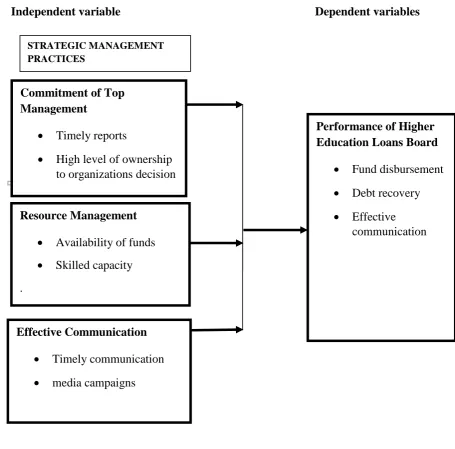
2.6 Conceptual Framework
Figure 2.1: Conceptual Framework
Independent variable Dependent variables
Source: Researcher, 2018
2.7 Interpretation of Variables
2.7.1 Performance of Higher Education Loan Board.
Implementation of effective strategic management practices in an organization lead to organisational performance. Performance of HELB was measured by funds being disbursed and loan collection from the past loanees. It is also reflected by the way information is passed to its stakeholders.
ATM Networks Commitment of Top Management
• Timely reports
• High level of ownership to organizations decision
Resource Management • Availability of funds • Skilled capacity .
Effective Communication • Timely communication • media campaigns
Performance of Higher Education Loans Board
• Fund disbursement • Debt recovery • Effective
communication STRATEGIC MANAGEMENT
2.7.2 Commitment of Top Level Management
Top management includes the chief executive officers, owners and other middle level managers. Committed top managers enable the organization to perform its mandates and achieve the set goals. They must be willing to own organization’s strategies and also being loyal to the organization.
2.7.3 Resource Management
These are available resources for the organization that help it implement and achieve it organizational strategies. They help an organization achieve its expected performance more effectively. They include finances, technology, and skilled capacity among many others.
2.7.4
CommunicationCHAPTER THREE RESEARCH METHODOLOGY 3.1 Introduction
This section describes the research design and methodology of the study. In this stage decisions were made about how the research was executed and how respondents were approached as well as where and how the research was completed. The chapter therefore entails the way the study was designed, the population, the type of data and its collection techniques and the method used for data analysis.
3.2 Research Design
The study adopted a descriptive research design since it allowed a detailed description of all the items under study. According to Donald and Pamela (1998) a descriptive study is concerned with finding out the what, where and how of a phenomenon. Descriptive research design is selected because it enables the researcher to generalise the findings to a larger population. Descriptive research design helps in describing the status of a situation as it is. Descriptive research includes surveys and fact-finding enquiries of different kinds. The major purpose of descriptive research is description of the state of affairs as it exists at present. This will help the researcher understand the situation at the HELB in the strategy implementation. According to Mugenda and Mugenda (2010), it is appropriate to use data where subjects are observed in either natural set up without manipulating the environment. It can be used when
collecting information about people’s attitude and opinions. It is an efficient way to obtain
information needed to describe the attitudes, views and management of staff of Higher
Education Loans Board on strategic management practices affecting performance of HELB.
3.3 Target Population
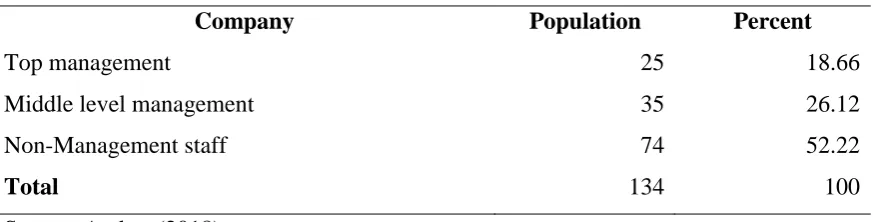
Table 3.1: Target population
Company Population Percent
Top management 25 18.66
Middle level management 35 26.12
Non-Management staff 74 52.22
Total 134 100
Source: Author (2018)
3.4 Sampling Procedure and Sampling Size
The researcher first of all used stratified random sampling technique into various department based on their functions. Then purposive random was then be used to select top and middle level managers in each department at HELB. This is because they are key decision makers and hence have the required information in the study. Simple random sampling was used to select individual respondents within the cadre. This ensured that every respondent within the cadre has equal probability of being selected.
According Mugenda and Mugenda (2010), a representative sample should be between 10% and 30% in a descriptive study. This study adopted 30% as the sampling percentage hence the sample size was 40 respondents (30% of 134) as shown in the sampling frame in appendix five.
3.5 Data Collection instruments and Procedure 3.5.1 Data Collection Instruments
Primary data was gathered directly from respondents and for this study, a semi structured,
questionnaire was utilized. The research instrument was organized based on the objectives of
the study. The questionnaire consisted two sections, where the first part mainly contained
information on the organization background, while the second part focused on strategic
management practices and performance HELB in financing higher education in Kenya.
Secondary data on the core Loan recovery and fund disbursement variables was used in this
3.5.2 Data Collection Procedures
The researcher obtained a letter of introduction from the university and research permit from the Ministry of Higher Education, Science and Technology. After this the researcher visited the HELB office to book an appointment with chief executive officer to seek clearance to
conduct a research in the organization. The researcher employed drop and pick method as
opposed to mailed questionnaires in order to enhance high response rate. The respondents
were assured of the confidentiality of their feedback.
3.5.3 Reliability
Reliability of the instrument is established when a research instrument is able to produce consistent results after repeated trials. Mugenda and Mugenda (2010) points out that reliability is about accuracy and precision of a measurement procedure. The items in the questionnaire that were found not to give the desired information were discarded or altered in wordings.
3.5.4 Validity
Validity is the extent to which the research instrument measures what it is meant to measure. Mugenda and Mugenda (2007) argued that validity is the degree to which results obtained from the analysis of data actually represent the phenomena under study. The researcher strived to minimize factors that may affect validity of data through a thorough assessment of instruments of data collection.
3.5.4.1 Piloting
A total of 13 respondents of the total population which represent 1% of the total population were used for the pilot testing and their questionnaires were not be included in the final study.
3.6 Data Analysis and Presentation
After the field work, the collected data was coded and analyzed. Data analysis was done using both quantitative and qualitative techniques. Quantitative data was analyzed through
both descriptive statistics which include frequencies and percentage. Multiple linear regression will be used in order to establish the relationship between dependent and independent variables. This was done with the aid of Statistical Package for Social Sciences (SPSS) computer software. Qualitative data was analyzed using content analysis method. The
data was presented using bar graphs, pie charts, tables and figures.
Equation 3.6.1: A Multiple Linear Regression Model One
Y= α0 +β1 X1+ β2 X2+β3 X3+ ε
Where: Y –Performance of Higher Education Loans Board (Dependent variable)
X1-n - Strategic management practices (Independent variables) whereby X1=commitment of
top level management, X2 =Resource allocation, X3 =Effective communication,
α0 - alpha coefficient/constant β1, β2 and β3 are regression coefficients e - error term.
3.7 Ethical Consideration
The research was conducted following the Kenyatta University’s ethical guidelines. The researcher completed the ethics expedited checklist to understand the ethical policy and obtained approval before conducting the study. This helped to prepare researcher in a better position to address the political and ethical challenges that may arose during the research while ensuring adherence to the University’s ethical policy, standards, and guidelines.
CHAPTER FOUR
DATA ANALYSIS AND PRESENTATION OF RESULTS 4.1 Introduction
This chapter analyses the data that was collected as per the set objectives in Chapter one. The main objective of the research project was to determine the strategy implementation practices and performance of Higher Education Loans Board in financing advanced education in Kenya. The four specifc objectives were to determine influence of commitment of top management, resource management, effective communication and technology on performance of higher education loans board.
4.1.1 Response Rate
Out of the a sample of 54 questionnaires issued to the respondents, 52 of the filled questionnaires were returned. This means that the response rate was 96.29%. 2 of the respondents could not be reached due to their tight schedules and frequent meetings; an effort to reach them through the contact person established was not successful. The data is presented on table 4.1 below.
Table 4.1: Response rate
Response Rate Frequency Percent
Questionnaires issued 54 100
Questionnaires returned 52 96
Questionnaires not returned 2 4
Research Data (2018) 4.2 General Information
General information was collected from the respondent so as to act as a guide on the gender, education level and the number of years the respondent have worked for the HELB.
4.2.1 Respondents Sex
Figure 4.1: Respondents Sex (Research Data, 2018) 4.2.2 Level of Education
Out of the respondents 52 respondents 7.7% were diploma holders, 46.2% undergraduates and 46.2% postgraduate. Consequently, 4 respondents were diploma holders and 24 for both undergraduate and post graduate holders. The data is displayed on the diagram 4.2 below.
Figure 4.2: Level of Education Research Data (2018)
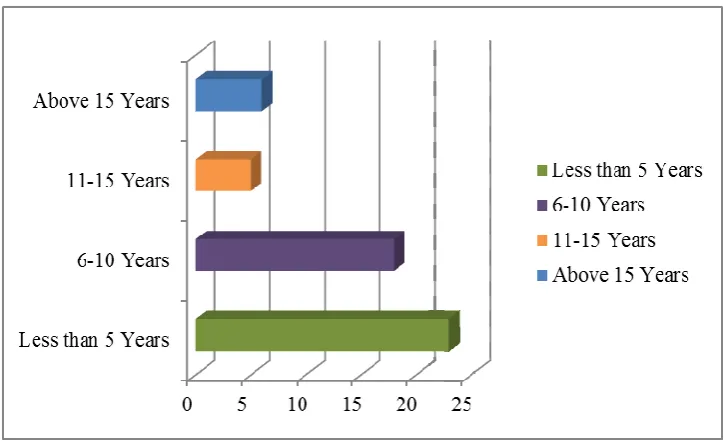
4.2.3 Years Worked at HELB
to have worked at HELB above 5 years.The total for all respondents who have worked for HELB for over 5 years are 29, which is 55.8%. As per the figure 4.3 below, 23 of the respondents have worked at HELB for less than 5 years, 18 of the respondents between 6 and 10 years, 5 of the respondents between 11 to 15 years and 6 of the respondents above 15 years. This means 44.2%, 43.6%, 9.6% and 11.5% of the respondents have worked at HELB for below 5 years, 6 to 10 years, 11 to 15 years and above 15 years respectively. This shows that the respondents had the capacity to respond on the research questions on this study.
Figure 4.3: Years worked at HELB Research Data (2018)
a) Descriptive Statistics
4.3 Influence of Commitment of Top Management on Performance of HELB
Table 4.2: Commitment of Top Management on Performance of HELB
Statement Mean Std.
Deviation Commitment of top level management to strategy implementation
practices is very important 4.0385 1.04715
Top level management must demonstrate willingness to own
organisation’s strategies 4.1923 0.99091
Lower rank employees lack support and encouragement if top
management lack commitment in performing their responsibilities 4.0769 1.06359 Top management should not spare more effort to persuade the
employees to get into their ideas for strategy implementation practices to be effective
2.9038 1.49849 Lack of adequate backing of the strategies by top management inhibit
strategy implementation 4.2692 1.01199
(Field Data, 2018)
4.4 Influence of Resource Management on Performance of HELB
The respondents were asked on the influence of the resource management on performance of HELB. A five point likert scale was used where 5.000-4.100 = Strongly agree; 4.000 – 3.100 = Agree; 3.000-2.100 = Neutral; 2.000- 1.100 = Disagree and 1.000 – 0.000 = Strongly disagree
Table 4.3: Resource Management on Performance of HELB
Statement Mean Std. Deviation
Adequate resources affect implementation of
strategies and performance of HELB 3.8077 1.29915
Inadequate resources affects strategies and
performance of HELB 4.1346 1.06695
HELB must concentrate on company’s resources for its strategy implementation practices and performance
4.1154 1.06004
Lack of resources inhibits implementation of
strategy 4 1.08465
Lack of resources affect employees performance
in carrying out their day to day duties 4.0577 1.19498 (Field Data, 2018)
4.5 Influence of Effective Communication on Performance of HELB
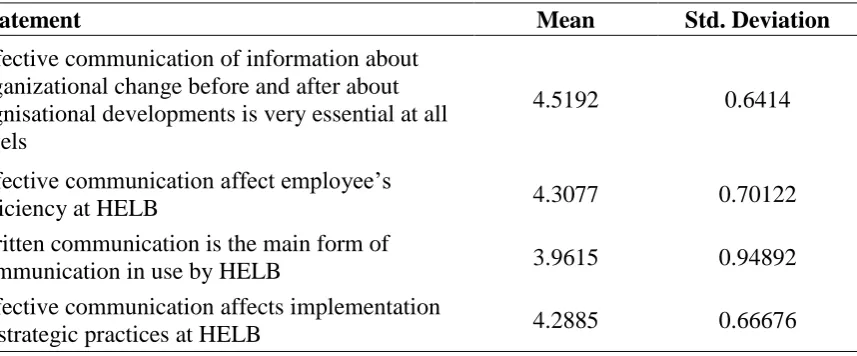
The respondents were asked on the influence of effective communication on performance of HELB. A five point likert scale was used where 5.000-4.100 = Strongly agree; 4.000 – 3.100 = Agree; 3.000-2.100 = Neutral; 2.000- 1.100 = Disagree and 1.000 – 0.000 = Strongly disagree
Table 4.4: Effective Communication on Performance of HELB
Statement Mean Std. Deviation
Effective communication of information about organizational change before and after about orgnisational developments is very essential at all levels
4.5192 0.6414
Effective communication affect employee’s
efficiency at HELB 4.3077 0.70122
Written communication is the main form of
communication in use by HELB 3.9615 0.94892
Effective communication affects implementation
of strategic practices at HELB 4.2885 0.66676
(Field Data, 2018)
4.6 Influence of Technology on Performance of HELB
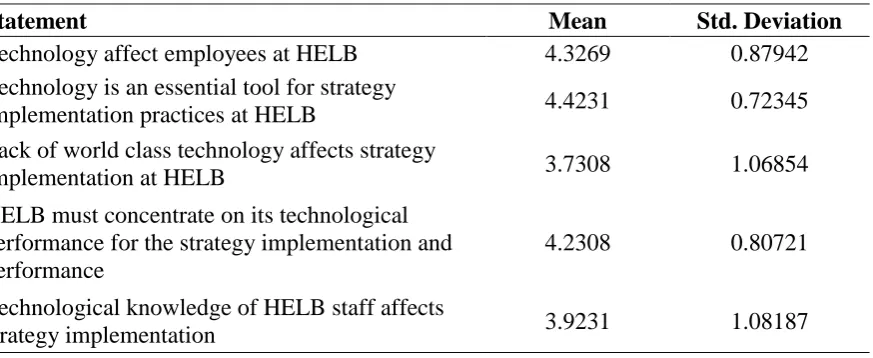
The respondents were asked on the influence of the technology on performance of HELB. A five point likert scale was used where 5.000-4.100 = Strongly agree; 4.000 – 3.100 = Agree; 3.000-2.100 = Neutral; 2.000- 1.100 = Disagree and 1.000 – 0.000 = Strongly disagree. Table 4.5: Technology on Performance of HELB
Statement Mean Std. Deviation
Technology affect employees at HELB 4.3269 0.87942
Technology is an essential tool for strategy
implementation practices at HELB 4.4231 0.72345
Lack of world class technology affects strategy
implementation at HELB 3.7308 1.06854
HELB must concentrate on its technological performance for the strategy implementation and performance
4.2308 0.80721
Technological knowledge of HELB staff affects
strategy implementation 3.9231 1.08187
(Field Data, 2018)
4.7 Performance of HELB
The respondents were asked to rate the performance of HELB in Kenya. A five point likert scale was used where 5.000-4.100 = Strongly agree; 4.000 – 3.100 = Agree; 3.000-2.100 = Neutral; 2.000- 1.100 = Disagree and 1.000 – 0.000 = Strongly disagree.
Table 4.6: Performance of HELB
Statement Mean Std. Deviation
Performance of HELB in Kenya has increased
over period of time 4.4038 0.66449
Prudent resource allocation has a positive effect to
performance of HELB 4.3269 0.61743
Performance of HELB is measured by the amount
of fund disbursement to students 3.5577 1.05558
Effective communication has an effect on the
performance of HELB 4.4423 0.53919
(Field Data, 2018)
From the table 4.6 above the respondents strongly agree that performance of HELB in Kenya has increased over period of time as represented by a mean and standard deviation of 4.4038 and 0.66449 respectively. The respondents strongly agree that prudent resource allocation has a positive effect to performance of HELB as represented by a mean and standard deviation of 4.3269 and 0.61743 respectively. The respondents agree that Performance of HELB is measured by the amount of fund disbursement to students as represented by a mean and standard deviation of 3.5577 and 1.05558 respectively. The respondents strongly agree that effective communication has an effect on the performance of HELB as represented by a mean and standard deviation of 4.4423 and 0.53919respectively. availability of funds contributes to strategy implementation.
b) Regression Analysis
Table 4.7: Regression Coefficients
Model Unstandardized
Coefficients
Standardized
Coefficients T Sig.
1
B Std.
Error Beta
Constant 0.417 0.984 1.101 0.017
Commitment of top
management 0.737 0.537 0.334 2.679 0.006
Resource management 0.695 0.441 0.029 3.093 0.027 Effective communication 0.196 0.695 0.065 2.758 0.048
Technology 0.48 0.258 0.681 3.247 0.018
(Field Data, 2018)
p<0.05,dependent variable; commitment of top management, resource management, effective communication and technology. From the table 4.7 above the coefficients of the regression are used to come up with the following regression equation:
Y = 0.417 + 0.737 X1 + 0.695 X2 +0.196 X3+ 0.480X4
Where X1, X2, X3 and X4 are commitment of top management, resource management, effective communication and technology respectively. The study established that taking all the factors at constant at zero, the performance of HELB is 0.417. The findings presented also show that holding all other independent variables at zero, a unit increase in commitment of top management would lead to 0.737 growth in performance of HELB, a unit increase in resource management would lead to 0.695 in performance of HELB. A unit increase in effective communication would lead to 0.196 growth in performance of HELB, a unit increase in technology would lead to 0.48 in performance of HELB.
An increase in quality resource management would lead to a positive strategy implementation and organization performance. An increase in effective communication would also lead to positive strategy implementation and organization performance and quality technology would lead to positive strategy implementation and organization performance.
CHAPTER FIVE
SUMMARY, CONCLUSIONS AND RECOMMENDATIONS 5.0 Introduction
This chapter presents the summary of findings and conclusions made. In this chapter the findings gathered are summarized and the conclusions made of the study done. Recommendations are also laid out in this chapter.
5.1 Summary
5.1.1 Influence of Commitment of Top Management on Performance of HELB
The study established that commitment of top management is very important to strategy implementation practices. In addition to this the top level management must demonstrate willingness to own organisation’s strategies in order to have a successful strategy implementation. The lower rank employees lack support and encouragement if top management lack commitment in performing their responsibilities, therefore the top management should act as a guide to the lower management. The top management should spare more effort to persuade the employees to get into their ideas for strategy implementation practices to be effective. According to Kandie et al., (2015) the content factors that affect strategy implementation include stakeholder involvement in strategy development and quality of strategy whereas contextual factors comprise of organization structure, organization culture, organization learning, strategic leadership and alignment of strategy to market conditions. The process covers operational planning, monitoring and review of progress, teamwork, resources allocation, people strategy fit, effective communication, strategic and management control systems and information resources. The factors that affect strategy implementation include organizational structure, culture, resources, top management commitment and communication (Mwangi, 2014).
adequate resource required in strategy implementation thus dragging projects. The employees are not well motivated as the strategy performance measurements are not well aligned. Training on managerial and leadership skills has been done but not consistently. Pursuit of personal endeavors in expense of organizational goals and expense has greatly affected strategy implementation. The commitment on employee welfare affects performance of employees and thus should be prioritized by financial support. Also ensuring prudent management of resources entrusted to them at their disposal to maximize value for all stake holders involved. Organisational culture and change management has influences the strategy implementation and overall performance of HELB.
5.1.2 Influence of Resource Management on Performance of HELB
Availability of adequate resources affects implementation of strategies and performance of HELB. Resources are meant to boost strategy implementation in the organization. Therefore inadequate resources diminish strategies and performance of HELB. HELB must concentrate on company’s resources for its strategy implementation practices and performance. This is through recovery of loans issues to students or increased allocation from the treasury. Lack of resources inhibits implementation of strategy. Lack of resources affects employees performance in carrying out their day to day duties to a great extent. According to Ngeche (2017) the institution needs to put aside enough funds that would ensure a successful strategy implementation process. However, proper mechanisms should be put in place to ensure that the funds are used for the intended purpose. Where applicable the institutions should adopt innovative IT strategies and e-business to enhance competitiveness of the firm in the dynamic sector.
budget implementation has affected strategy implementation process which has also been contributed by misuse, pilferage and misdirecting the resources other than the planned activity.
5.1.3 Influence of Effective Communication on Performance of HELB
Effective communication of information about organizational change before and after about orgnisational developments is very essential at all levels for strategy implementation. Effective communication affects employee’s efficiency at HELB, thus influencing strategy implementation. Written communication is the main form of communication used by HELB it is considered faster and formal. The study by Ngeche (2017) revealed that relationship with employees influences goal achievement and communication facilitates achievement of sufficient results. In addition, it was also revealed that utilization of performance contracts was critical in realization of goals and commitment enhanced achievement of sufficient results. Lack of adequate information sharing from the management downwards has affected strategy implementation as staff feels left out in the process.
5.1.4 Influence of Technology on Performance of HELB
HELB uses technology thus an essential tool for strategy implementation practices at HELB. However lack of world class technology affects strategy implementation at HELB. Therefore HELB must concentrate on its technological performance for the strategy implementation and performance. In addition to this technological knowledge of HELB staff affects strategy implementation creating a need for continuous training. The challenges faced in strategy implementation include limited financial resources, negative organizational culture, slow technological advancement, and slow pace in changing of structure to cope with change in strategy, poor organizational communication and coordination. These issues affect the operational efficiency which forms the basis of strategy implementation (Kerubo, 2010). The technology used HELB is unstable thus requirement of a new system that require modification to meet the right customer service. Proper training should be conducted so as to achieve more knowledge and skills. When there is a system down time there is no backup plan. The management should have a backup plan for the purpose of flow of activities. The unstable technology affects performance of an organization and implementation of the strategies. User friendly and up to date technology should be considered for the purpose of management of operations in HELB.
5.2 Conclusions
The study concludes that all the four independent variables influence strategy implementation practices and performance of HELB in Kenya. Thus commitment of top management, resource management, effective communication and technology influence strategy implementation practices and performance of HELB in Kenya. The top management should ensure commitment so as to act as a support system to the low level staff. Technology should be improved to enhance monitoring and recovery of loans disbursed. Effective communication is important in strategy implementation thus the management should enhance top down and down top communication to pass quality information. Allocation of resources to be upgraded so as to ensure that all the strategies are implemented as per the organisation’s plan.
findings that there is a positive relationship between strategy implementation practices and the performance. Organisational structure is the most important ingredient for strategy implementation thus ensure that structure is aligned to their strategy which then will lead to improved profitability and reduced costs.
5.3 Recommendations
The study established that the main inhibitor of performance is the system. Management should look for an alternative that is sustainable in the long run. HELB should establish fully functioning regional branches and station marketing and compliance officers in all counties. This is for the purpose of recoveries and responding to various enquires. The treasury should increase the funding due to the upcoming technical and vocational education training loan has raised up the number of client that want to benefit hence more fund required . The students need a higher amount of loan award to cope with current cost of living. The management of HELB should properly allocate resources that are within the organization. Proper choice of communication should be established and more information should be shared on other funds like Afya Elimu. The employees of HELB should be motivated through trainings, rewards and enhance career progression.
recommends that communication should both be vertical and horizontal so that information reach all the staff involved in strategy implementation. Quality technology enhances the strategy implementation process. Thus organisations should implement in technology the contribute positively towards the strategy implementation.
5.4 Suggested Areas of Further Research