Volume-5 Issue-1
International Journal of Intellectual Advancements
and Research in Engineering Computations
Optimized virtual machine placement algorithm for both
energy-awareness and SLA violation reduction in cloud data centers
1
S.Poovizhi, 2N.Jayanthi
PG Scholar1, Associate Professor 2 Velalar College of Engineering and Technology1,2
Abstract— The establishment of large-scale virtualized data centers has results in the high energy consumption ,resulting in the high operating cost and carbon-di-oxide emission. Virtual machine placement is a process of mapping virtual machines to physical machines .In order to reduce the energy consumption in cloud data centers many adaptive algorithms have been designed, which uses historical data from resource usage(such as CPU ) by VMs . In the proposed work a new parameter is introduced (RAM utilization) along with CPU utilization history in threshold calculation, in order to reduce the number of VM migrations, so that the SLA violation will be reduced. The heavily loaded and little loaded hosts are migrated and the moderately loaded
and lightly loaded are kept unchanged in
ATEA(adaptive three-threshold energy-aware
algorithm).Based on ATEA, an adaptive threshold algorithm and VM selection policies are proposed. The proposed work is tested using cloudsim toolkit. The experimental results shows that our method reduces SLA violation and energy consumption more efficiently than the available methods.
Keywords— over loaded host, Server consolidation, SLA violation, threshold, virtual machine.
I. INTRODUCTION
The Cloud computing model provides on demand provisioning on resources on a pay - as - you - go basis through virtualization technique. IT organizations which in need of computational power such as hardware and software can outsource their requirements from cloud data centers, so that they no need to purchase, upgrade or maintain software and hence save their costs from high up fronts. In Cloud computing model , a large pool of systems are connected in private or public networks, to provide dynamically extensible infrastructure for the customer applications, data and file storage as a service over the internet. The cloud computing services provided by Cloud Service Provider are reusable. The services provided by cloud computing are Software as a Service (SAAS), Platform as a
Service (PAAS) and Infrastructure as a Service (IAAS) .
The construction of large scale datacenters meets the computational demands on one hand and consumes a high energy consumption on the other hand. The high energy consumption of data centers lead to series of problems, including energy wastes, system instability and more carbon - di -oxide emission.
Servers operate only to 10% to 50% of their full capacity most of the time. But even the ideal server consumes 70% of their peak power. It is highly inefficient to keep servers underutilized. In order to improve the resource utilization cloud computing uses a technique called Virtualization. But efficient resource management is required.VM consolidation can improve resource utilization, but aggressive consolidation may lead to performance degradation and SLA violation .
In this work the main focus is to reduce the high energy consumption by reducing the number of VM migration during consolidation , thereby reducing the SLA violation.
II.RELATED WORK
There are four major steps involved in server consolidation, they are Host over-load Detection, Host under-load Detection, VM Selection and Migration and VM placement.
The VM placement algorithms are of five major classifications, They are constraint programming, Bin packing problem, stochastic integer programming ,Genetic algorithm and adaptive algorithms.
Constraint programming technique for virtual machine placement is proposed by Zhang et al.[1] , which reduces the total cost on resource usage but does not violates the Quality of service requirements.The performance measures and workload types are considered and fulfilled by the author.
Y.Zhang et al[2], proposed a heuristic algorithm for VM consolidation which includes the heterogeneity aware resource allocation. Dominant-Residual Resource aware FFD algorithm is used.The performance evaluation shows that its performance is same as dimension-aware heuristics but with the same cost as single dimension heuristics.
A dynamic server migration and consolidation algorithm was introduced by N.Bobroff et al[3]. The amount of physical capacity required was reduced to reduce the SLA vioation .The management algorithm (MFR) dynamically remaps VMs to PMs required, so as to reduce the SLA violation. The combination of Bin packing heuristics and Time series forecasting techniques are used to reduce the number of physical machines used.
A modification of Ant Colony System (ACS) algorithm was proposed to minimize resource wastage and power consumption during VM placement by Gao et al. [4] .The residual resources were effectively balanced along different dimensions on the servers. This combinatorial problem is modeled as a multi-objective algorithm named VMPACS.
Anton Beloglazov and Rajkumar Buyya [5], proposed a adaptive utilization thresholds, which ensures a high level of meeting the Service Level Agreements .They used a modified Best Fit algorithm .The technique outperforms in terms of SLA-violation .
Beloglazov and Buyya [6] proposed an energy efficient resource management system, which includes the dispatcher, global manager, localmanager, and VMM (VM Monitor). In order to improve the energy efficiency, Beloglazov et al. put forward a new VM migration algorithm called Double Threshold (DT) ;
A three-threshold energy-aware algorithm named MIMT is proposed to deal with the energy consumption and SLA violation. However, the three thresholds for controlling host’s CPU utilization are fixed. Therefore, MIMT is not suitable for varying workload.
Thus in the previous work Zhou Zhou1.2[7],proposed a adaptive three-threshold energy -aware algorithm in order to reduce the high energy consumption and SLA-violation .Here the data centre is divided into four classes and Energy aware Best Fit Decreasing algorithm is used. This paper shows that dynamic thresholds are more efficient than fixed threshold.
Therefore in this paper a new adaptive threshold work is designed by including more parameters for threshold calculation, thereby reducing the number of VM migration and to reduce SLA violation.
III.POWER MODEL, COST OF VM MIGRATION,SLA VIOLATION
METRICS AND ENERGY EFFICIENCY METRICS
A. The power model.
The power consumption in cloud data centers are directly related to CPU , memory and band width. However CPU utilization and RAM utilization have linear relationship with the power consumption . Here we used the data for power consumption from the SPEC power bench mark.
B. Cost of VM Migration
Through VM migration the energy consumption and the SLA violation can be reduced in the data centers .Since each VM migration will cause some SLA violation ,more number of VM migration can also lead to performance degradation .Hence it is vital to minimize the VM migration .
The cost of VM migration and the performance degradation can be calculated as,
∫ ( )
(1)
,
C is total performance degradation caused by VM j, K is the average performance degradation by VMs which is approximately (0.1),
Function
( )
corresponds to the CPU utilization of VM j,represents start time of migration,
is completion time,
represents total memory used by VM j, represents the available bandwidth.
C. SLA Violation Metrics
SLA violation metric is an important factor for VM migration algorithm,
1) PDM (Overall performance degradation caused by VM migration)
∑
(2)
M represents the number of VMs in data center, represents the estimate of the performance degradation caused by VM j migration,
total CPU capacity requested by VM j during its life time.
2) SLATAH (SLA violation time per active host)
∑
(3)
N represents the number of host in data center, is the total time during which host i experienced 100% CPU utilization,
is the total time during which host i is in active state.
SLA violation can be evaluated by both PDM and SLATAH independently,
SLA = PDM * SLATAH (4)
D. Energy Efficiency Metrics
The energy efficiency of the data center will be improved when their is less energy consumption and reduced SLA violation.
(5)
E is the energy efficiency of data center, P is energy consumption of a data center,
SLA represents the SLA violation of a data center
PHYSICAL SERVER 1 PHYSICAL SERVER 2 PHYSICAL SERVER 3
HYPERVISOR HYPERVISOR HYPERVISOR
VM
1 VM1 VM2 VM1 VM2 VM3
VM
2 VM3 VM3
SELECTING VM’S FOR MIGRATION
HEAVILY LOADED SERVER
LITTLE LOADED
SERVER LOADED SERVERMODERATELY (CPU and RAM)
Utilization history
Figure 1. Architecture Diagram of proposed system
IV.ADAPTIVE THRESHOLD ALGORITHM,VM SELECTION POLICY AND VM
DEPLOYMENT ALGORITHM
E. Dynamic Consolidation steps
1.Determining the overloaded host 2.Determining the underloaded host 3.VM Selection and VM migration 4.VM placement
The determination of over loaded and under loaded host can be done by calculating the threshold values through KAM(K- means clustering ) algorithm using CPU utilization history and RAM utilization history. The VM selection and migration step can be achieved through maximum correlation policy.Energy best fit decreasing algorithm is used for VM
placement.The consolidation steps are detailed in the following sections.
F. Adaptive Threshold Algorithm
In order to calculate the threshold value to obtain the over loaded and under loaded host optimised ATEA algorithm is used . The proposed optimized ATEA sets three thresholds Tl , Tm and Th using CPU utilization history and RAM utilization of hosts in the data center.
Algorithm1[pseudocode for determining threshold value(kam)]
Step1: Take data center host's CPU utilization history and RAM utilization.
Step 2: Let the number of cluster points be three(C1,C2,C3).
Step 3: Find the nearest points of CPU utilization history and RAM to the cluster points.
Step 4: Find the mean value of each clusters of CPU and RAM utilization.
Step 5: Apply MAD on mean values.
step 6: Apply calculated MAD value in the below formula,
let r=(0.5-3), (Aggressiveness of system consolidation)
Tl = 0.5 (1 - r * MAD) (6) Tm = 0.9 (1 - r * MAD) (7) Th = 1 (1 - r * MAD) (8)
When the RAM utilization is also used along with CPU utilization history in determining threshold values, the number of host sort listed will be more accurate and the number of VM migration will be minimized. Hence SLA violation will be reduced.
After obtaining the threshold value the data center hosts are divided into four classes : host with little load, light load, moderate load and heavy load .When the CPU utilization and RAM utilization of a host is less than or equal to Tl then it is little loaded , In order to improve the energy efficiency the VMs in these hosts are migrated to other host and are put in sleep mode. When the CPU utilization and RAM utilization are between Tl and Tm then host is considered lightly loaded, in order to avoid performance degradation due to over migration the VMs in lightly loaded hosts are kept unchanged. When the CPU utilization and RAM utilization are between Tm and Th then host is considered moderately loaded , and the VMs are kept unchanged to avoid high SLA violation. When the CPU utilization and RAM utilization are higher than Th then host is considered heavily loaded and some VMS are migrated to other host to reduce high energy consumption.
utilization is also included for threshold calculation so that the number of VM migration will be reduced and hence the SLA violation will be reduced.
G. VM Selection Policies
As discussed before the some of the VMs in over loaded hosts have to be migrated to other hosts, for energy efficiency. In order to decide which VM to migrate? Minimum Correlation(MC) policy is used.
MC (Maximum Correlation) Policy
The maximum correlation policy is proposed by Verma et al.[8] . Here the higher probability of server overloading is depicted as higher the correlation between the resource usage between the applications. Based on the highest correlation of CPU utilization with other VMs, we are migrating VMs from overloaded hosts. In order to calculate the highest correlation between the CPU utilization of VMs, we are using multiple correlation coefficient. Multiple correlation coefficient is defined as the squared correlation between the actual values of the dependent variable and the predicted value . It can also be calculated as the proportion of the variance of the dependent variable explained by the independent variables.
H. VM Placement Algorithm
Here the bin packing problem is used for VM placement. In this problem in a finite number of bins of capacity 1, things of different sizes should be packed so that the number of bins used should be minimized. Here we are considering each VM's as objects(things) and Hosts as the bins to fill in the objects. And the resources should be allocated in an optimized manner so as to reduce the number of hosts used. Energy - Best Fit Decreasing algorithm is used.
Algorithm 2
Input: 𝑙, 𝑚, ℎ, VMlst, Hostlst Output: migrationMap
1. VMlst.sortByCpuUtilization( );
// sorted in descending order( CPU utilizatioin ) 2. for each vm in VMlst do
3. minimumPower = maximum value;
// minimunPower variable is assigned a maximum value
4.DestinationHost = null; 5.for each host in Hostlsts do 6.if (host is good for VM (VM) then
7.utilization = getUtilizationAfterAllocation(host, VM);
8.if ((CPUutilization < 𝑙) || (CPUutilization > 𝑚)) then
9.continue; 10.end if
11.EnergyConsumption(destinationhost)= getPowerAfterVM(host, vm);
12.if (EnergyConsumption < minimumPower) then 13.minimumPower = EnergyConsumption;
14.DestinationHost = host; 15.end if
16.end if 17.end for 18. end for
19. return DestinationHost.
Once the over loaded and under loaded hosts are consolidated, the overloaded host list will be created and the VM selection policy will be used to choose the VMs to migrate. Once the VM selection list is created VM placement algorithm will be called, it first sort all the VM's CPU utilization in descending order. Then the "minimum power" is allocated a maximum value. Then a under loaded host is checked to accommodate whether it is suitable for the VM (of over loaded host) and allocated .Function 'get power after VM allocation' is used to obtain energy consumption after allocation of VM.
V.EXPERIMENTS AND PERFORMANCE ANALYSIS
As the Cloud computing environment consists of infinite number of resources for the user , it is difficult to evaluate the proposed resource allocation algorithm on large-scale virtualized data center .Since it is difficult to conduct repeatable large-scale experiments in cloud data center , inorder to ensure repeatability of experiments , stimulations toolkit have been chosen as a way to evaluate the performance of the proposed algorithm. Here the simulation uses cloudsim toolkit, which is a modular and a extensible open source toolkit which has built-in capability to implement and compare various energy - aware algorithms in cloud environments.
START
obtain values of Tl,Tm,Th
Get value of host CPU utilization &
RAM utilization
U<Tl
All VMs are migrated to other
host and put in sleep mode
U<Tm N Y
Figure 2 Flow chart of Proposed System
VI. RESULTS AND DISCUSSION We have simulated a data center with 800 heterogeneous nodes , one half consists of HP ProLiant G4 and the other half consists of HP ProLiant G5. It consists of 1054 VMs , comes under five VM types (High-memory extra large , High CPU
medium insance , Extra large instance , small - instance and micro instance )
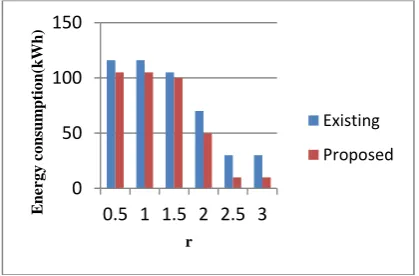
Figure 3 Energy Consumption of Existing and Proposed System
Here 'r' is the parameter that defines the aggressiveness of the system consolidation. When 'r' is high, then high energy consumption but less SLA violation due to VM consolidation. It is depict that the energy consumption is low in proposed algorithm(due to the Maximum correlation VM selection policy) when compared to the existing algorithm.
The SLA violation during varying 'r' parameter is provided in the graph ,which shows that the proposed algorithm(due to the inclusion of RAM utilization during threshold calculation) reduces the SLA violation better than the existing.
Figure 4 SLA violation of Existing and Proposed System
VII.CONCLUSION
This paper proposed an optimized method for reducing high energy consumption and SLA violation in cloud data centers based on adaptive algorithms and VM selection policies, by reducing the number of VM migrations during resource consolidation. The work is expected to be applied in real - world cloud platform , in order to reduce the energy consumption and SLA violation.
REFERENCES
[1] Zhang, L., Zhuang, Y. and Zhu, W., 2013. Constraint Programming based Virtual Cloud Resources Allocation Model. International Journal of Hybrid Information Technology, 6(6), pp.333-344. [2] Zhang, Y. and Ansari, N., 2013, December. Heterogeneity aware dominant resource assistant heuristics for virtual machine consolidation.In Global Communications Conference (GLOBECOM), 2013 IEEE (pp. 1297-1302). IEEE.
[3]. Bobroff, N., Kochut, A. and Beaty, K., 2007, May. Dynamic placement of virtual machines for managing sla violations. In Integrated Network
Management, 2007. IM'07. 10th IFIP/IEEE
International Symposium on (pp. 119-128). IEEE.498
Zoha Usmani and Shailendra Singh / Procedia Computer Science 78 ( 2016 ) 491 – 498
[4] Gao, Y., Guan, H., Qi, Z., Hou, Y. and Liu, L., 2013. A multi-objective ant colony system algorithm for virtual machine placement in cloud
computing.Journal of Computer and System Sciences,
79(8), pp.1230-1242.
[5] Beloglazov, A. and Buyya, R., 2010, November. Adaptive threshold-based approach for energy-efficient consolidation of virtual machines in
cloud data centers. In Proceedings of the 8th International Workshop on Middleware for Grids,
Clouds and e-Science (Vol. 4). ACM.
[6] Wood, T., Shenoy, P., Venkataramani, A. and Yousif, M., 2009. Sandpiper: Black-box and gray-box resource management for virtual
0 50 100 150
0.5 1 1.5 2 2.5 3
E
n
er
gy
c
on
su
m
p
tio
n
(k
Wh
)
r
Existing
Proposed
0 10 20 30 40
0.5 1 1.5 2 2.5 3
S
L
A
V
IO
L
A
T
IO
N
(
10^
-7)
r
Existing
Proposed
VMs on the host are kept unchanged
U>Th
VMs on the host are kept unchanged
Some VMs on the host are
unchanged
END Y
machines.Computer Networks, 53(17), pp.2923-2938.
[7] Zhou Zhou,1 Zhigang Hu,1 and Keqin Li2, Virtual Machine Placement Algorithm for Both Energy-Awareness and SLA Violation
Reduction in Cloud Data Centers,,in Hindawi Publishing Corporation, Volume 2016, Article ID 5612039.
[8] Verma A, Dasgupta G, Nayak TK, De P, Kothari R. Server workload analysis for power minimization using consolidation. Proceedings of the 2009 USENIX Annual Technical Conference, San Diego, CA, USA, 2009; 28–28
[9] Ghribi, C., Hadji, M. and Zeghlache, D., 2013, May. Energy efficient vm scheduling for cloud data centers: Exact allocation and migration
algorithms. In Cluster, Cloud and Grid Computing (CCGrid), 2013 13th IEEE/ACM International
Symposium on (pp. 671-678). IEEE.
[10] Alahmadi, A., Alnowiser, A., Zhu, M.M., Che, D. and Ghodous, P., 2014, March. Enhanced First-Fit Decreasing Algorithm for Energy-Aware
Job Scheduling in Cloud. In Computational Science and Computational Intelligence (CSCI), 2014 International Conference on (Vol. 2, pp.
69-74). IEEE.
[11] Dong, J., Wang, H. and Cheng, S., 2015. Energy-performance tradeoffs in IaaS cloud with virtual machine
scheduling. Communications,China, 12(2), pp.155-166.
[12] Gambosi, G., Postiglione, A. and Talamo, M., 2000. Algorithms for the relaxed online bin-packing model. SIAM journal on computing, 30(5),
pp.1532-1551.
[13] Wang, M., Meng, X. and Zhang, L., 2011, April. Consolidating virtual machines with dynamic bandwidth demand in data centers
In INFOCOM, 2011 Proceedings IEEE (pp. 71-75).
IEEE.
[14] Chen, M., Zhang, H., Su, Y.Y., Wang, X., Jiang, G. and Yoshihira, K., 2011, May. Effective VM sizing in virtualized data centers.
In Integrated Network Management (IM), 2011
IFIP/IEEE International Symposium on (pp.
594-601). IEEE.
[15] Rieck, B., 2010. Basic Analysis of Bin-Packing Heuristics. Publicado por Interdisciplinary Center for Scientific Computing. Heildelberg
University.
[16] Srikantaiah, S., Kansal, A. and Zhao, F., 2008, December. Energy aware consolidation for cloud computing. In Proceedings of the 2008
conference on Power aware computing and systems
(Vol. 10).
[17] Li, K., Zheng, H. and Wu, J., 2013, November. Migration-based virtual machine placement in cloud systems. In Cloud Networking
(CloudNet), 2013 IEEE 2nd International Conference on (pp. 83-90). IEEE.
[18] Paul, I., Yalamanchili, S. and John, L.K., 2012, December. Performance impact of virtual machine placement in a datacenter. In Performance
Computing and Communications Conference
(IPCCC), 2012 IEEE 31st International (pp. 424-431). IEEE.
[19] Singh, A., Korupolu, M. and Mohapatra, D., 2008, November. Server-storage virtualization: integration and load balancing in data centers.
In Proceedings of the 2008 ACM/IEEE conference on
Supercomputing (p. 53). IEEE Press.
[20] Singh, A., Korupolu, M. and Mohapatra, D., 2008, November. Server-storage virtualization: integration and load balancing in data centers.
In Proceedings of the 2008 ACM/IEEE conference on
Supercomputing (p. 53). IEEE Press.
[21]Lin, C.C., Liu, P. and Wu, J.J., 2011, December. Energy-efficient virtual machine provision algorithms for cloud systems. In Utility and
Cloud Computing (UCC), 2011 Fourth IEEE International Conference on (pp. 81-88). IEEE. [22] Optimal online deterministic algorithms and adaptive heuristics for energy and performance efficient dynamic consolidation of virtual
machines in cloud data centers
[23] Ferdaus, M.H., Murshed, M., Calheiros, R.N. and Buyya, R., 2014. Virtual machine consolidation in cloud data centers using ACO
metaheuristic. InEuro-Par 2014 Parallel Processing
(pp. 306-317). Springer International Publishing. [24] Buyya, R., Beloglazov, A. and Abawajy, J., 2010. Energy-efficient management of data center resources for cloud computing: a vision,
architectural elements, and open challenges. arXiv preprint arXiv:1006.0308.
[25] Mishra, M. and Sahoo, A., 2011, July. On theory of vm placement: Anomalies in existing methodologies and their mitigation using a novel vector based approach. In Cloud Computing (CLOUD), 2011 IEEE International Conference on
(pp. 275-282). IEEE.
[26] Gao, Y., Guan, H., Qi, Z., Hou, Y. and Liu, L., 2013. A multi-objective ant colony system algorithm for virtual machine placement in cloud
computing.Journal of Computer and System Sciences,
79(8), pp.1230-1242.
[27] Camati, R.S., Calsavara, A. and Lima Jr, L., 2014. Solving the virtual machine placement problem as a multiple multidimensional knapsack
problem. ICN 2014, p.264.
[28] Tao, F., Li, C., Liao, T. and Laili, Y., 2015. BGM-BLA: a new algorithm for dynamic migration of virtual machines in cloud computing.