R E S E A R C H
Open Access
The computer for the 21st century:
present security & privacy challenges
Leonardo B. Oliveira
1*, Fernando Magno Quintão Pereira
2, Rafael Misoczki
3, Diego F. Aranha
4,
Fábio Borges
5, Michele Nogueira
6, Michelle Wangham
7, Min Wu
8and Jie Liu
9Abstract
Decades went by since Mark Weiser published his influential work on the computer of the 21st century. Over the years, some of the UbiComp features presented in that paper have been gradually adopted by industry players in the technology market. While this technological evolution resulted in many benefits to our society, it has also posed, along the way, countless challenges that we have yet to surpass. In this paper, we address major challenges from areas that most afflict the UbiComp revolution:
1. Software Protection: weakly typed languages, polyglot software, and networked embedded systems. 2. Long-term Security: recent advances in cryptanalysis and quantum attacks.
3. Cryptography Engineering: lightweight cryptosystems and their secure implementation. 4. Resilience: issues related to service availability and the paramount role of resilience. 5. Identity Management: requirements to identity management with invisibility. 6. Privacy Implications: sensitivity data identification and regulation.
7. Forensics: trustworthy evidence from the synergy of digital and physical world.
We point out directions towards the solutions of those problems and claim that if we get all this right, we will turn the science fiction of UbiComp into science fact.
Keywords: UbiComp, Security, Privacy, Cryptography, Forensics
1 Introduction
In 1991, Mark Weiser described a vision of the
Com-puter for the 21st Century [1]. Weiser, in his prophetic paper, argued the most far-reaching technologies are those that allow themselves to disappear, vanish into thin air. According to Weiser, this oblivion is a human – not a technological – phenomenon: “Whenever people learn something sufficiently well, they cease to be aware of it,” he claimed. This event is called “tacit dimension” or “com-piling” and can be witnessed, for instance, when drivers react to street signs without consciously having to process the letters S-T-O-P [1].
A quarter of a century later, however, Weiser’s dream is far from becoming true. Over the years, many of his
*Correspondence:[email protected]
1UFMG, Av. Antônio Carlos, 6627, Prédio do ICEx, Anexo U, sala 6330 Pampulha, Belo Horizonte, MG, Brasil
Full list of author information is available at the end of the article
concepts regarding pervasive and ubiquitous comput-ing (UbiComp) [2, 3] have been materialized into what today we call Wireless Sensor Networks [4,5], Internet of Things [6, 7], Wearables [8,9], and Cyber-Physical Sys-tems [10, 11]. The applications of these systems range
from traffic accident and CO2 emission monitoring to
autonomous automobile and patient in-home care. Nev-ertheless, besides all their benefits, the advent of those systems per se have also brought about some drawbacks. And, unless we address them appropriately, the continuity of Weiser’s prophecy will be at stake.
UbiComp poses new drawbacks because, vis-à-vis tra-ditional computing, it exhibits an entirely different out-look [12]. Computer systems in UbiComp, for instance, feature sensors, CPU, and actuators. Respectively, this means they can hear (or spy on) the user, process her/his data (and, possibly, find out something confidential about her/him), and respond to her/his actions (or, ultimately,
expose she/he by revealing some secret). Those capabil-ities, in turn, make proposals for conventional comput-ers ill-suited in the UbiComp setting and present new challenges.
In the above scenarios, some of the most critical chal-lenges lie in the areas of Security and Privacy [13]. This is so because the market and users often pursue a system full of features at the expense of proper operation and protec-tion; although, conversely, as computing elements pervade our daily lives, the demand for stronger security schemes becomes greater than ever. Notably, there is a dire need for a secure mechanism able to encompass all aspects and manifestations of UbiComp, across time as well as space, and in a seamless and efficient manner.
In this paper, we discuss contemporary security and
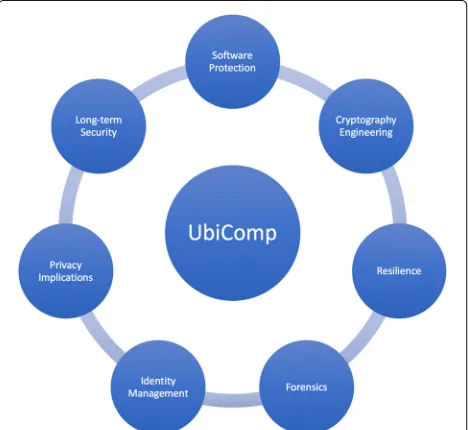
privacy issues in the context of UbiComp (Fig. 1). We
examine multiple research problems still open and point to promising approaches towards their solutions. More precisely, we investigate the following challenges and their ramifications.
1. Software protection in Section2: we study the impact of the adoption of weakly typed languages by
resource-constrained devices and discuss mechanisms to mitigate this impact. We go over techniques to validate polyglot software (i.e., software based on multiple programming languages), and revisit promising methods to analyze networked embedded systems.
2. Long-term security in Section3: we examine the security of today’s widely used cryptosystems (e.g., RSA and ECC-based), present some of the latest
Fig. 1Current security and privacy issues in UbiComp
threats (e.g., the advances in cryptanalysis and quantum attacks), and explore new directions and challenges to guarantee long-term security in the UbiComp setting.
3. Cryptography engineering in Section4: we restate the essential role of cryptography in safeguarding computers, discuss the status quo of lightweight cryptosystems and their secure implementation, and highlight challenges in key management protocols. 4. Resilience in Section5: we highlight issues related to
service availability and we reinforce the importance of resilience in the context of UbiComp.
5. Identity Management in Section6: we examine the main requirements to promote identity management (IdM) in UbiComp systems to achieve invisibility, revisit the most used federated IdM protocols, and explore open questions, research opportunities to provide a proper IdM approach for pervasive computing.
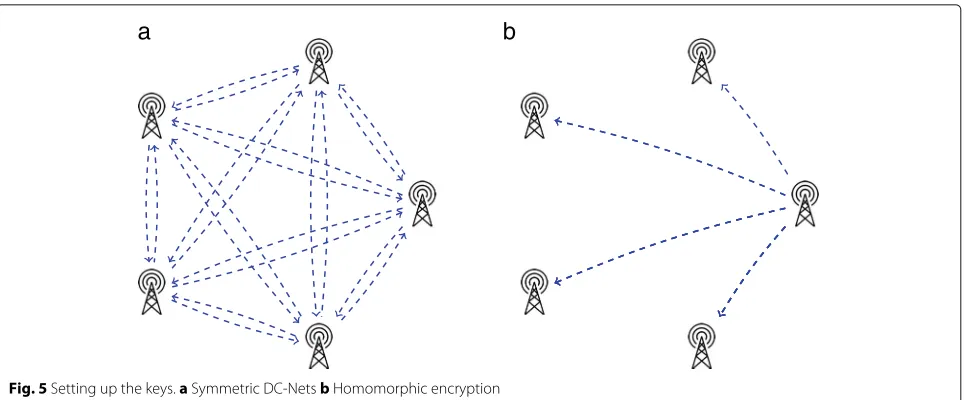
6. Privacy implications in Section7: we explain why security is necessary but not sufficient to ensure privacy, go over important privacy-related issues (e.g., sensitivity data identification and regulation), and discuss some tools of the trade to fix those (e.g., privacy-preserving protocols based on homomorphic encryption).
7. Forensics in Section8we present the benefit of the synergistic use of physical and digital evidences to facilitate trustworthy operations of cyber systems.
We believe that only if we tackle these challenges right, we can turn the science fiction of UbiComp into science fact.
Particularly, we choose to address the areas above because they represent promising research directions e cover different aspects of UbiComp security and privacy.
2 Software protection
Modern UbiComp systems are rarely built from scratch. Components developed by different organizations, with different programming models and tools, and under dif-ferent assumptions are integrated to offer complex capa-bilities. In this section, we analyze the software ecosystem
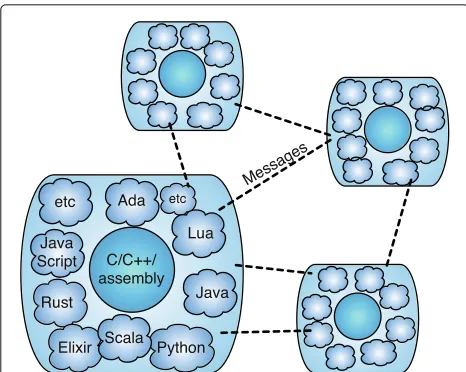
that emerges from such a world. Figure 2 provides a
Fig. 2A UbiComp System is formed by modules implemented as a combination of different programming languages. This diversity poses challenges to software security
2.1 Type safety
A great deal of the software used in UbiComp systems is implemented in C or in C++. This fact is natural, given the unparalleled efficiency of these two program-ming languages. However, if, on the one hand, C and C++ yield efficient executables, on the other hand, their weak type system gives origin to a plethora of soft-ware vulnerabilities. In programming language’s argot, we say that a type system is weak when it does not sup-port two key properties: progress andpreservation[14]. The formal definitions of these properties are immate-rial for the discussion that follows. It suffices to know that, as a consequence of weak typing, neither C, nor C++, ensure, for instance, bounded memory accesses. Therefore, programs written in these languages can access invalid memory positions. As an illustration of the dangers incurred by this possibility, it suffices to know that out-of-bounds access are the principle behind buffer overflow exploits.
The software security community has been developing different techniques to deal with the intrinsic vulner-abilities of C/C++/assembly software. Such techniques can be fully static, fully dynamic or a hybrid of both approaches. Static protection mechanisms are imple-mented at the compiler level; dynamic mechanisms are implemented at the runtime level. In the rest of this section, we list the most well-known elements in each category.
Static analyses provide a conservative estimate of the program behavior, without requiring the execu-tion of such a program. This broad family of tech-niques includes, for instance,abstract interpretation[15],
model checking [16] and guided proofs [17]. The main
advantage of static analyses is the low runtime over-head, and its soundness: inferred properties are guaran-teed to always hold true. However, static analyses have also disadvantages. In particular, most of the interest-ing properties of programs lay on undecidable land [18]. Furthermore, the verification of many formal properties, even though a decidable problem, incur a prohibitive computational cost [19].
Dynamic analyses come in several flavors: testing (KLEE [20]), profiling (Aprof [21], Gprof [22]), sym-bolic execution (DART [23]), emulation (Valgrind [24]), and binary instrumentation (Pin [25]). The virtues and limitations of dynamic analyses are exactly the oppo-site of those found in static techniques. Dynamic analyses usually do not raise false alarms: bugs are described by examples, which normally lead to consis-tent reproduction [26]. However, they are not required to always find security vulnerabilities in software. Fur-thermore, the runtime overhead of dynamic analyses still makes it prohibitive to deploy them into production software [27].
As a middle point, several research groups have posed ways to combine static and dynamic analyses, pro-ducing different kinds of hybrid approaches to secure low-level code. This combination might yield security guarantees that are strictly more powerful than what could be obtained by either the static or the dynamic approaches, when used separately [28]. Nevertheless, neg-ative results still hold: if an attacker can take control of the program, usually he or she can circumvent state-of-the-art hybrid protection mechanisms, such as control flow integrity [29]. This fact is, ultimately, a consequence of the weak type system adopted by languages normally seen in the implementation of UbiComp systems. There-fore, the design and deployment of techniques that can guard such programming languages, without compromis-ing their efficiency to the point where they will no longer be adequate to UbiComp development, remains an open problem.
2.2 Polyglot programming
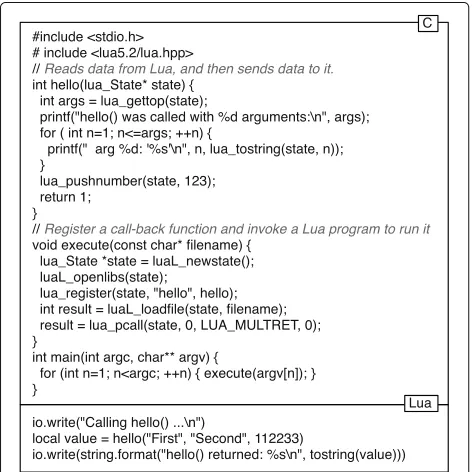
Polyglot programming is the art and discipline of writing source code that involves two or more programming lan-guages. It is common among implementations of cyber-physical systems. As an example, Ginga, the Brazilian protocol for digital TV, is mostly implemented in Lua and C [32]. Figure3shows an example of communication between a C and a Lua program. Other examples of inter-actions between programming languages include bindings between C and Python [33], C and Elixir [34] and the Java Native Interface [35]. Polyglot programming complicates the protection of systems. Difficulties arise due to a lack of multi-language tools and due to unchecked memory bindings between C/C++ and other languages.
An obstacle to the validation of polyglot software is the lack of tools that analyze source code written in differ-ent programming languages, under a unified framework. Returning to Fig.3, we have a system formed by two pro-grams, written in different programming languages. Any tool that analyzes this system as a whole must be able to parse these two distinct syntaxes and infer the con-nection points between them. Work has been performed towards this end, but solutions are still very preliminary. As an example, Maas et al. [33] have implemented auto-matic ways to check if C arrays are correctly read by Python programs. As another example, Furr and Foster [36] have described techniques to ensure type-safety of OCaml-to-C and Java-to-C bindings.
A promising direction to analyze polyglot systems is based on the idea of compilation of source code partially available. This feat consists in the reconstruction of the
Fig. 3Two-way communication between a C and a Lua program
missing syntax and the missing declarations necessary to produce a minimal version of the original program that can be analyzed by typical tools. The analysis of code par-tially available makes it possible to test parts of a polyglot program in separate, in a way to produce a cohesive view of the entire system. This technique has been demon-strated to yield analyzable Java source code [37], and com-pilable C code [38]. Notice that this type of reconstruction is not restricted to high-level programming languages. Testimony of this fact is the notion of micro execution, introduced by Patrice Godefroid [39]. Godefroid’s tool allows the testing of x86 binaries, even when object files are missing. Nevertheless, in spite of these developments, the reconstruction is still restricted to the static semantics of programs. The synthesis of behavior is a thriving dis-cipline in computer science [40], but still far away from enabling the certification of polyglot systems.
2.3 Distributed programming
Ubiquitous computing systems tend to be distributed. It is even difficult to conceive any use for an application in this world that does not interact with other programs. And it is common knowledge that distributed programming opens up several doors to malicious users. Therefore, to make cyber-physical technology safer, security tools must be aware of the distributed nature of such systems. Yet, two main challenges stand in front of this requirement: the difficulty to build a holistic view of the distributed application, and the lack of semantic information bound to messages exchanged between processes that communi-cate through a network.
To be accurate, the analysis of a distributed system needs to account for the interactions between the several program parts that constitute this system [41]. Discov-ering such interactions is difficult, even if we restrict ourselves to code written in a single programming lan-guage. Difficulties stem from a lack of semantic infor-mation associated with operations that send and receive messages. In other words, such operations are defined as part of a library, not as part of the programming lan-guage itself. Notwithstanding this fact, there are several techniques that infer communication channels between different pieces of source code. As examples, we have the algorithms of Greg Bronevetsky [42], and Teixeira et al. [43], which build a distributed view of a pro-gram’s control flow graph (CFG). Classic static analyses
work without further modification on this distributed
the channel-inference problem. In the actor model chan-nels are explicit in the messages exchanged between the different processing elements that constitute a dis-tributed system. Nevertheless, if such model will be widely adopted by the IoT community is still a fact to be seen.
Tools that perform automatic analyses in programs rely on static information to produce more precise results. In this sense, types are core for the understanding of software. For instance, in Java and other object-oriented languages, the type of objects determines how informa-tion flows along the program code. However, despite this importance, messages exchanged in the vast major-ity of distributed systems are not typed. Reason for this is the fact that such messages, at least in C, C++ and assembly software, are arrays of bytes. There have been two major efforts to mitigate this problem: the addi-tion of messages as first class values to programming languages, and the implementation of points-to analy-ses able to deal with pointer arithmetics in languages that lack such feature. Concerning the first front, sev-eral programming languages, such as Scala, Erlang and Elixir, incorporate messages as basic constructs, provid-ing developers with very expressive ways to implement the actor model [45] – a core foundation of distributed pro-gramming. Even though the construction of programming abstractions around the actor model is not a new idea [45], their raising popularity seems to be a phenomenon of the 2000’s, boosted by increasingly more expressive abstractions [46] and increasingly more efficient imple-mentations [47]. In the second front, researchers have devised analyses that infer the contents [48] and the size of arrays [49] in weakly-typed programming languages. More importantly, recent years have seen a new flurry of algorithms designed to analyze C/C++ style pointer arithmetics [50–53]. The wide adoption of higher-level programming languages coupled with the construction of new tools to analyze lower-level languages is exciting. This trend seems to indicate that the programming languages community is dedicating each time more attention to the task of implementing safer distributed software. There-fore, even though the design of tools able to analyze the very fabric of UbiComp still poses several challenges to researchers, we can look to the future with optimism.
3 Long-term security
Various UbiComp systems are designed to withstand a lifespan of many years, even decades [54, 55]. Systems in the context of critical infrastructure, for example, often require an enormous financial investment to be designed and deployed in the field [56], and therefore would offer a better return on investment if they remain in use for a longer period of time. The automotive area is a field of particular interest. Vehicles are expected to
be reliable for decades [57], and renewing vehicle fleets or updating features (recalls) increase costs for their owners. Note that modern vehicles are part of the Ubi-Comp ecosystem as they are equipped with embedded devices with Internet connectivity. In the future, it is expected that vehicles will depend even more on data collected and shared across other vehicles/infrastructure through wireless technologies [58] in order to enable enriched driving experiences such as autonomous driving [59].
It is also worth mentioning that systems designed to endure a lifespan of several years or decades might suf-fer from lack of future maintenance. The competition among players able to innovate is very aggressive lead-ing to a high rate of companies golead-ing out of business
within a few years [60]. A world inundate by devices
without proper maintenance will offer serious future challenges [61].
From the few aforementioned examples, it is already evi-dent that there is an increasing need for UbiComp systems to be reliable for a longer period of time and, when-ever possible, requiring as few updates as possible. These requirements have a direct impact on the security fea-tures of such systems: comparatively speaking, they would offer fewer opportunities for patching eventual security breaches than conventional systems. This is a critical situation given the intense and dynamic progresses on devising and exploiting new security breaches. Therefore, it is of utmost importance to understand what the scien-tific challenges are to ensure long-term security from the early stage of the design of an UbiComp system, instead of resorting to palliative measures a posteriori.
3.1 Cryptography as the core component
Ensuring long-term security is a quite challenging task for any system, not only for UbiComp systems. At a mini-mum, it requires that every single security component is future-proof by itself and also when connected to other components. To simplify this excessively large attack sur-face and still be able to provide helpful recommendations, we will focus our attention on the main ingredient of most security mechanisms, as highlighted in Section4, i.e. Cryptography.
3.2 Advancements in classical cryptanalysis
The first threat for the future-proof condition of any cryptosystem refers to potential advancements on crypt-analysis, i.e., on techniques aiming at solving the under-lying security problem in a more efficient way (with less processing time, memory, etc.) than originally predicted. Widely-deployed schemes have a long track of academic and industrial scrutiny and therefore one would expect little or no progress on the cryptanalysis techniques tar-geting such schemes. Yet, the literature has recently shown some interesting and unexpected results that may suggest the opposite.
In [65], for example, Barbulescu et al. introduced a new quasi-polynomial algorithm to solve the discrete log-arithm problem in finite fields of small characteristics. The discrete logarithm problem is the underlying secu-rity problem of the Diffie-Hellman Key Exchange [66], the Digital Signature Algorithm [67] and their elliptic curve variants (ECDH [68] and ECDSA [67], respectively), just to mention a few widely-deployed cryptosystems. This cryptanalytic result is restricted to finite fields of small characteristics, something that represents an important limitation to attack real-world implementations of the aforementioned schemes. However, any sub-exponential algorithm that solves a longstanding problem should be seen as a relevant indication that the cryptanalysis litera-ture might still be subject to eventual breakthroughs.
This situation should be considered by architects designing UbiComp systems that have long-term security as a requirement. Implementations that support various (i.e. higher than usual) security levels are preferred when compared to fixed, single key size support. The same approach used for keys should be used to other quanti-ties in the scheme that somehow impact on its overall security. In this way, UbiComp systems would be able to consciously accommodate future cryptanalytic advance-ments or, at the very least, reduce the costs for security upgrades.
3.3 Future disruption due to quantum attacks
Quantum computers are expected to offer dramatic speedups to solve certain computational problems, as foreseen by Daniel R. Simon in his seminal paper on
quantum algorithms [69]. Some of these speedups may
enable significant advancements to technologies currently limited by its algorithmic inefficiency [70]. On the other hand, to our misfortune, some of the affected compu-tational problems are the ones currently being used to secure widely-deployed cryptosystems.
As an example, Lov K. Grover introduced a quantum
algorithm [71] able to find an element in the domain
of a function (of size N) which leads, with high prob-ability, to a desired output in only O(√N) steps. This algorithm can be used to speed up the cryptanalysis of
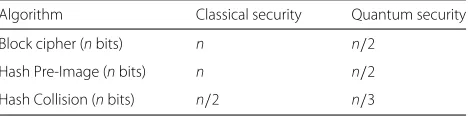
symmetric cryptography. Block ciphers ofnbits keys, for example, would offer only n/2 bits of security against a quantum adversary. Hash functions would be affected in ways that depend on the expected security property. In more details, hash functions ofnbits digests would offer onlyn/3 bits of security against collision attacks andn/2 bits of security against pre-image attacks. Table 1 sum-marizes this assessment. In this context, AES-128 and SHA-256 (collision-resistance) would not meet the min-imum acceptable security level of 128-bits (of quantum security). Note that both block ciphers and hash function constructions will still remain secure if longer keys and digest sizes are employed. However, this would lead to important performance challenges. AES-256, for example, is about 40% less efficient than AES-128 (due to the 14 rounds, instead of 10).
Even more critical than the scenario for symmetric
cryptography, quantum computers will offer an
exponen-tialspeedup to attack most of the widely-deployed public-key cryptosystems. This is due to Peter Shor’s algorithm [72] which can efficiently factor large integers and com-pute the discrete logarithm of an element in large groups in polynomial time. The impact of this work will be dev-astating to RSA and ECC-based schemes as increasing the key sizes would not suffice: they will need to be completely replaced.
In the field of quantum resistant public-key cryptosys-tems, i.e. alternative public key schemes that can with-stand quantum attacks, several challenges need to be addressed. The first one refers to establishing a consensus in both academia and industry on how to defeat quantum attacks. In particular, there are two main techniques con-sidered as capable to withstand quantum attacks, namely: post-quantum cryptography (PQC) and quantum cryp-tography (QC). The former is based on different compu-tational problems believed to be so hard that not even quantum computers would be able to tackle them. One important benefit of PQC schemes is that they can be implemented and deployed in the computers currently available [73–77]. The latter (QC) depends on the exis-tence and deployment of a quantum infrastructure, and is restricted to key-exchange purposes [78]. The limited capabilities and the very high costs for deploying quan-tum infrastructure should eventually lead to a consensus towards the post-quantum cryptography trend.
Table 1Symmetric cryptography security levels
Algorithm Classical security Quantum security
Block cipher (nbits) n n/2
Hash Pre-Image (nbits) n n/2
There are several PQC schemes available in the litera-ture. Hash-Based Signatures (HBS), for example, are the most accredited solutions for digital signatures. The most modern constructions [76,77] represent improvements of the Merkle signature scheme [74]. One important ben-efit of HBS is that their security relies solely on certain well-known properties of hash functions (thus they are secure against quantum attacks, assuming appropriate digest sizes are used). Regarding other security features, such as key exchange and asymmetric encryption, the academic and industry communities have not reached a consensus yet, although both code-based and lattice-based cryptography literatures have already presented promising schemes [79–85]. Isogeny-based cryptography [86] is a much more recent approach that enjoys cer-tain practical benefits (such as fairly small public key sizes [87,88]) although it has just started to benefit from a more comprehensive understanding of its cryptanal-ysis properties [89]. Regarding standardization efforts, NIST has recently started a Standardization Process on
Post-Quantum Cryptography schemes [90] which should
take at least a few more years to be concluded. The current absence of standards represents an important challenge. In particular, future interoperability problems might arise.
Finally, another challenge in the context of post-quantum public-key cryptosystems refers to potentially new implementation requirements or constraints. As mentioned before, hash-based signatures are very promis-ing post-quantum candidates (given efficiency and secu-rity related to hash functions) but also lead to a new set of implementation challenges, such as the task of keep-ing the scheme state secure. In more details, most HBS schemes have private-keys (theirstate) that evolve along the time. If rigid state management policies are not in place, a signer can re-utilize the same private-key twice, something that would void the security guarantees offered by the scheme. Recently, initial works to address these new implementation challenges have appeared in the lit-erature [91]. A recently introduced HBS construction [92] showed how to get rid of the state management issue at the price of much larger signatures. These examples indi-cate potentially new implementation challenges for PQC schemes that must be addressed by UbiComp systems architects.
4 Cryptographic engineering
UbiComp systems involve building blocks of very different natures: hardware components such as sensors and actu-ators, embedded software implementing communication protocols and interface with cloud providers, and ulti-mately operational procedures and other human factors. As a result, pervasive systems have a large attack surface that must be protected using a combination of techniques.
Cryptography is a fundamental part of any modern computing system, but unlikely to be the weak-est component in its attack surface. Networking protocols, input parsing routines and even interface code with cryptographic mechanisms are components much more likely to be vulnerable to exploitation. However, a successful attack on cryptographic security proper-ties is usually disastrous due to the risk concentrated in cryptographic primitives. For example, violations of confidentiality may cause massive data breaches involv-ing sensitive information. Adversarial interference on communication integrity may allow command injec-tion attacks that deviate from the specified behavior. Availability is crucial to keep the system accessible by legitimate users and to guarantee continuous service provisioning, thus cryptographic mechanisms must also be lightweight to minimize potential for abuse by attackers.
Physical access by adversaries to portions of the attack surface is a particularly challenging aspect of deploying cryptography in UbiComp systems. By assumption, adver-saries can recover long-term secrets and credentials that provide some control over a (hopefully small) portion of the system. Below we will explore some of the main chal-lenges in deploying cryptographic mechanisms for perva-sive systems, including how to manage keys and realize efficient and secure implementation of cryptography.
4.1 Key management
UbiComp systems are by definition heterogeneous platforms, connecting devices of massively different com-putation and storage power. Designing a cryptographic architecture for any heterogeneous system requires assigning clearly defined roles and corresponding secu-rity properties for the tasks under responsibility of each entity in the system. Resource-constrained devices should receive less computationally intensive tasks, and their lack of tamper-resistance protections indicate that long-term secrets should not reside in these devices. More critical tasks involving expensive public-key cryptography should be delegated to more powerful nodes. A careful trade-off between security properties, functionality and cryp-tographic primitives must then be addressed per device or class of devices [93], following a set of guidelines for pervasive systems:
– Functionality: key management protocols must manage lifetime of cryptographic keys and ensure accessibility to the currently authorized users, but handling key management and authorization separately may increase complexity and
[94,95], where keys have sets of capabilities and attributes that can be authorized and revoked on demand.
– Communication: components should minimize the amount of communication, at risk of being unable to operate if communication is disrupted.
Non-interactive approaches for key distribution [96] are recommended here, but advanced protocols based on bilinear pairings should be avoided due to recent advances on solving the discrete log problem (in the so called medium prime case [97]). These advances forcedly increase the parameter sizes, reduce performance/scalability and may be improved further, favoring more traditional forms of
asymmetric cryptography.
– Efficiency: protocols should be lightweight and easy to implement, mandating that traditional public key infrastructures (PKIs) and expensive certificate handling operations are restricted to the more powerful and connected nodes in the architecture. Alternative models supporting implicit certification include identity-based [98] (IBC) and certificate-less cryptography [99] (CLPKC), the former implying inherent key escrow. The difficulties with key revocation still impose obstacles for their wide adoption, despite progress [100]. A lightweight pairing and escrow-less authenticated key agreement based on an efficient key exchange protocol and implicit certificates combines the advantages of the two approaches, providing high performance while saving bandwidth [101].
– Interoperability: pervasive systems are composed of components originating from different
manufacturers. Supporting a cross-domain authentication and authorization framework is crucial for interoperability [102].
Cryptographic primitives involved in joint functionality must then be compatible with all endpoints and respect the constraints of the less powerful devices.
4.2 Lightweight cryptography
The emergence of huge collections of interconnected devices in UbiComp motivate the development of novel cryptographic primitives, under the monikerlightweight cryptography. The term lightweight does not imply
weakercryptography, but application-tailored cryptogra-phy that is especially designed to be efficient in terms of resource consumption such as processor cycles, energy and memory footprint [103]. Lightweight designs aim to target common security requirements for cryptography but may adopt less conservative choices or more recent building blocks.
As a first example, many new block ciphers were proposed as lightweight alternatives to the Advanced
Encryption Standard (AES) [104]. Important
construc-tions are LS-Designs [105], modern ARX and Feistel
networks [106], and substitution-permutation networks [107, 108]. A notable candidate is the PRESENT block cipher, with a 10-year maturity of resisting cryptanalytic attempts [109], and whose performance recently became competitive in software [110].
In the case of hash functions, a design may even trade-off advanced security properties (such as collision resis-tance) for simplicity in some scenarios. A clear case is the construction of short Message Authentication Codes (MAC) from non-collision resistant hash functions, such as in SipHash [111], or digital signatures from short-input hash functions [112]. In conventional applications,
BLAKE2 [113] is a stronger drop-in replacement to
recently cryptanalyzed standards [114] and faster in soft-ware than the recently published SHA-3 standard [115].
Another trend is to provide confidentiality and authenti-cation in a single step, through Authenticated Encryption with Associated Data (AEAD). This can be imple-mented with a block cipher operation mode (like GCM
[116]) or a dedicated design. The CAESAR
competi-tion1selected new AEAD algorithms for standardization across multiple use cases, such as lightweight and high-performance applications and a defense-in-depth setting. NIST has followed through and started its own standard-ization process for lightweight AEAD algorithms and hash functions2.
In terms of public-key cryptography, Elliptic Curve Cryptography (ECC) [63,117] continues to be the main contender in the space against factoring-based
cryptosys-tems [62], due to an underlying problem conjectured
to be fully exponential in classical computers. Modern instantiations of ECC enjoy high performance and imple-mentation simplicity and are very suited for embedded systems [118–120]. The dominance of number-theoretic primitives is however threatened by quantum computers as described in Section3.
The plethora of new primitives must be rigorously eval-uated from both the security and performance point of views, involving both theoretical work and engineer-ing aspects. Implementations are expected to consume
smaller amounts of energy [121], cycles and memory
[122] in ever decreasing devices and under more invasive attacks.
4.3 Side-channel resistance
and electromagnetic emanations to recover secret mate-rial. These attacks emerge from the interaction between the implementation and underlying computer architec-ture and represent an intrinsic security problem to per-vasive computing environments, since the attacker is assumed to have physical access to at least some of the legitimate devices.
Protecting against intrusive side-channel attacks is a challenging research problem, and countermeasures typ-ically promote some degree ofregularityin computation.
Isochronous or constant time implementations were among the first strategies to tackle this problem in the case of variances in execution time or latency in the memory hierarchy. The application of formal methods has enabled the first tools to verify isochronicity of implementations,
such as information flow analysis [124] and program
transformations [125].
While there is a recent trend towards construct-ing and standardizconstruct-ing cryptographic algorithms with some embedded resistance against the simpler
tim-ing and power analysis attacks [105], more
power-ful attacks such as differential power analysis [126] or fault attacks [127] are very hard to prevent or mit-igate. Fault injection became a much more power-ful attack methodology it was after demonstrated in software [128].
Masking techniques [129] are frequently investigated as a countermeasure to decorrelate leaked information from secret data, but frequently require robust entropy sources to achieve their goal. Randomness recycling tech-niques have been useful as a heuristic, but formal security analysis of such approaches is an open problem [130]. Modifications in the underlying architecture in terms of instruction set extensions, simplified execution environ-ments and transactional mechanisms for restarting faulty computation are another promising research direction but may involve radical and possibly cost-prohibitive changes to current hardware.
5 Resilience
UbiComp relies on essential services as connectivity, routing and end-to-end communication. Advances in those essential services make possible the envisioned Weiser’s pervasive applications, which can count on trans-parent communication while reaching the expectations and requirements of final users in their daily activi-ties. Among user’s expectations and requirements, the availability of services – not only communication ser-vices, but all services provided to users by UbiComp – is a paramount. Users more and more expect, and pay, for 24/7 available services. This is even more relevant when we think about critical UbiComp systems, such as those related to healthcare, urgency, and vehicular embedded systems.
Resilience is highlighted in this article, because it is one of the pillars of security. Resilience aims at identify-ing, preventidentify-ing, detecting and responding to process or technological failures to recover or mitigate damages and financial losses resulted from service unavailability [131]. In general, service unavailability has been associated with non-intentional failures, however, more and more the intentional exploitation of service availability breaches is becoming disruptive and out of control, as seen in the lat-est Distributed Denial of Service (DDoS) attack against the company DYN, a leading DNS provider, and the DDoS attack against the company OVH, the French website hosting giant [132, 133]. The latter reached an intense volume of malicious traffic of approximately 1 TB/s, gen-erated from a large amount of geographically distributed and infected devices, such as printers, IP cameras, res-idential gateways and baby monitors. Those devices are directly related to the modern concept of UbiComp sys-tems [134] and they intend to provide ubiquitous services to users.
However, what attracts the most the attention here is the negative side effect of the ubiquity exploitation against service availability. It is fact today that the Mark Weiser’s idea ofComputer for the 21st Centuryhas open doors to new kind of highly disruptive attacks. Those attacks are in general based on the idea of invisibility and unawareness for the devices in our homes, works, cities, and coun-tries. But, exactly because of this, people seems to not pay enough attention to basic practices, such as change default passwords in Internet connect devices as CCTV cameras, baby monitors, smart TVs and other. This simple fact has been pointed as the main cause of the two DDoS attacks mentioned before and a report by global professional ser-vices company Deloitte suggests that Distributed Denial of Service (DDoS) attacks, that compromise exactly service availability, increased in size and scale in 2017, thanks in part to the growing multiverse of connected things3. They also mentioned that DDoS attacks will be more frequent, with an estimated 10 million attacks in few months.
As there is no guarantee to completely avoid these attacks, resilient solutions become a way to mitigate damages and quickly resume the availability of services. Resilience is then necessary and complementary to the other solutions we observe in the previous sections of this article. Hence, this section focuses on highlighting the importance of resilience in the context of UbiComp systems. We overview the state-of-the-art regarding to resilience in the UbiComp systems and point out future directions for research and innovation [135–138]. We also understand that resilience in these systems still requires a lot of investigations, however we believe that it was our role to raise this point to discussion through this article.
information and communication technologies, such as wireless networking, have increased the use of distributed systems in our everyday lives. Network access is becoming ubiquitous through portable devices and wireless commu-nications, making people more and more dependent on them. This raising dependence claims for simultaneous high level of reliability and availability. The current net-works are composed of heterogeneous portable devices, communicating among themselves generally in a wire-less multi-hop manner [139]. These wireless networks can autonomously adapt to changes in their environment such as device position, traffic pattern and interference. Each device can dynamically reconfigure its topology, coverage and channel allocation in accordance with changes.
UbiComp poses nontrivial challenges to resilience design due to the characteristics of the current net-works, such as shared wireless medium, highly dynamic network topology, multi-hop communication and low physical protection of portable devices [140,141]. More-over, the absence of central entities in different scenarios increases the complexity of resilience management, par-ticularly, when it is associated with access control, node authentication and cryptographic key distribution.
Network characteristics, as well as constraints on other kind of solutions against attacks that disrupt ser-vice availability, reinforce the fact that no network is totally immune to attacks and intrusions. Therefore, new approaches are required to promote the availability of network services. Such requirements motivate the design of resilient network services. In this work, we focus on the delivery of data from one UbiComp device to another as a fundamental network functionality and we emphasize three essential services: physical and link-layer connectivity, routing and end-to-end logical communica-tion. However, resilience has also been observed under other perspectives. We follow the claim that resilience is achieved upon a cross-layer security solution that inte-grates preventive (i.e., cryptography and access control), reactive (i.e., intrusion detection systems) and tolerant (i.e., packet redundancy) defense lines in a self-adaptive and coordinated way [131,142].
However, what are still the open challenges to achieve resilience in the UbiComp context? First of all, we empha-size the heterogeneity of devices and technologies that compose UbiComp environments. The integration from large-scale systems, such as Cloud data centers, to tiny devices, such as wearable and implantable sensors, is a huge challenge itself due to the complexity resulted from it. Then, in addition, providing integration of preventive, reactive and tolerant solutions and their adaptation is even harder in face of the different requirements of these devices, their capabilities in terms of memory and pro-cessing, and application requirements. Further, dealing with heterogeneity in terms of communication technology
and protocols makes challenging the analysis of network behavior and topologies, what in conventional systems are employed to assist in the design of resilient solutions.
Another challenge is how to deal with scale. First, the UbiComp systems tend to be hyper-scale and geographi-cally distributed. How to cope, then, with the complexity resulted from that? How to define and construct models to understand these systems and offer resilient services? Finally, we also point out as challenges the uncertainty and speed. If on the one hand, it is so hard to model, analyze and define resilient services in this complex system, on the other hand uncertainly is a norm on them, being speed and low response time a strong requirement for the appli-cations in these systems. Hence, how to address all these elements together? How to manage them in order to offer resilient services considering diverse kind of requirements from the various applications?
All these questions lead to deep investigation and chal-lenges. However, they also show opportunities for applied research in designing and engineering resilient systems, mainly for the UbiComp context. Particularly, if we advo-cate for designing resilient systems that manage the three defense lines in an adaptive way. We believe that this man-agement can promote a great advance for applied research and for resilience.
6 Identity management
Authentication and Authorization Infrastructure (AAI) is the central element for providing security in dis-tributed applications. AAI is a way to fulfill the secu-rity requirements in UbiComp systems. It is possible to provide identity management with this infrastructure to prevent legitimate or illegitimate users/devices to access non-authorized resources. IdM can be defined as a set of processes, technologies and policies used for assur-ance of identity information (e.g., identifiers, credentials, attributes), assurance of the identity of an entity (e.g., users, devices, systems), and enabling businesses and security applications [143]. Thus, IdM allows these iden-tities to be used for authentication, authorization and
auditing mechanisms [144]. A proper identity
manage-ment approach is necessary for pervasive computing to be invisible to users [145]. Figure4provides an overview of the topics discussed in this section.
According to [143], electronic identity (eID) comprises a set of data about an entity that is sufficient to identify that entity in a particular digital context. An eID may be comprised of:
Fig. 4Pervasive IdM Challenges
– Credentials - an identifiable object that can be used to authenticate the claimant (e.g., digital certificates, keys, tokens and biometrics);
– Attributes - descriptive information bound to an entity that specifies its characteristics.
In UbiComp systems, identity has both a digital and a physical component. Some entities might have only an online or physical representation, whereas others might have a presence in both planes. IdM requires relation-ships not only between entities in the same planes but also across them [145].
6.1 Identity management system
An IdM system deals with the lifecycle of an iden-tity, which consists of registration, storage, retrieval, provisioning and revocation of identity attributes [146]. Note that the management of devices’ identify lifecy-cle is more complicated than people’s identity lifecylifecy-cle due to the complexity of operational phases of a device (i.e., from the manufacturing to the removed and re-commissioned) in the context of a given application or use case [102,147].
For example, consider a given device life-cycle. In the pre-deployment, some cryptographic material is loaded into the device during its manufacturing process. Next, the owner of the device purchases it and gets a PIN that grants the owner the initial access to the device. The device is later installed and commissioned within a network by an installer during the bootstrapping phase. The device identity and the secret keys used during nor-mal operation are provided to the device during this phase. After being bootstrapped, the device is in oper-ational mode. During this operoper-ational phase, the device will need to prove its identity (D2D communication) and to control the access to its resources/data. For devices with lifetimes spanning several years, maintenance cycles should be required. During each maintenance phase, the software on the device can be upgraded, or applications (running on the device) can be reconfigured. The device continues to loop through the operational phase until the device is decommissioned at the end of its lifecy-cle. Furthermore, the device can also be removed and re-commissioned to be used in a different system under a different owner thereby starting the lifecycle all over
again. During this phase, the cryptographic material held by the device is wiped, and the owner is unbound from the device [147].
An IdM system involves two main entities: iden-tity provider (IdP - responsible for authentication and user/device information management in a domain) and service provider (SP - also known as relying party, which provides services to user/device based on their attributes). The arrangement of these entities in an IdM system and the way in which they interact with each other character-ize the IdM models, which can be traditional (isolated or silo), centralized, federated or user-centric [146].
In traditional model, IdP and SP are grouped into a single entity whose role is to authenticate and control access to their users or devices without relying on any other entity. In this model, the providers do not have any mechanisms to share this identity information with other organizations/entities. This makes the identity provision-ing cumbersome for the end user or device, since the users and devices need to proliferate their sensitive data to different providers [146,148].
established among IdPs and SPs to enable the exchange of identity information and service sharing. Existing trust relationships guarantee that users/devices authenticated in home IdP may access protected resources provided by SPs from other federation security domains [148]. Sin-gle Sign-On (SSO) is obtained when the same authen-tication event can be used to access different federated services [146].
Considering the user authentication perspective, the negative points of the centralized and federated models focus primarily on the IdP, as it has full control over the user’s data [148]. Besides, the user depends on an online IdP to provide the required credentials. In the feder-ated model, users cannot guarantee that their information will not be disclosed to third parties without the users’ consent [146].
The user-centric model provides the user full control over transactions involving his or her identity data [148]. In the user-centric model, the user identity can be stored on a Personal Authentication Device, such as, a smart-phone or a smartcard. Users have the freedom to choose the IdPs which will be used and to control the personal information disclosed to SPs. In this model, the IdPs continue acting as a trusted third party between users and SPs. However, IdPs act according to the user’s pref-erences [152]. The major drawback of the user-centric model is that it is not able to handle delegations. Sev-eral solutions that adopted this model combine it with FIM or centralized model, however, novel solutions prefer federated model.
6.1.1 Authentication
User and device authentication within an integrated authentication infrastructure (IdP is responsible for user and device authentication) might use a centralized IdM model [149,153] or a traditional model [154]. Other works [155–157] proposed AAIs for IoT using the federated model, however, only for user authentication and not for device authentication. Kim et al. [158] proposes a central-ized solution that enables the use of different authenti-cation mechanisms for devices that are chosen based on device energy autonomy. However, user authentication is not provided.
Based on the traditional model, an AAI composed by a suite of protocols that incorporate authentication and access control during the entire IoT device lifecycle is pro-posed in [102]. Domenech et al. [151] proposes an AAI for the Web of Things, which is based on the federated IdM model (FIM) and enables SSO for users and devices. In this AAI, IdPs may be implemented as a service in a Cloud (IdPaaS - Identity Provider as a Service) or on premise. Some IoT platforms provide IdPaaS to user and device authentication such as Amazon Web Services (AWS) IoT, Microsoft Azure IoT, Google Cloud IoT platform.
Authentication mechanisms and protocols consume computational resources. Thus, to integrate an AAI into a resource constrained embedded device can be
a challenge. As mentioned in Section 4.2, a set of
lightweight cryptographic algorithms, which do not impose certificate-related overheads on devices, can be used to provide device authentication in UbiComp systems. There is a recent trend that investigates the benefits of using identity-based (IBC) cryptogra-phy to provide cross-domain authentication for con-strained devices [102, 151, 159]. However, some IoT platforms still provide certificate-based device authen-tication such as Azure IoT, WSO2 or per-device public/private key authentication (RSA and Elliptic Curve algorithms) using JSON Web Tokens such as Google Cloud IoT Platform and WSO2.
Identity theft is the fastest growing crime in recent years. Currently, password-based credentials are the most used by user authentication mechanisms, despite of their weaknesses [160]. There are multiple opportunities for impersonation and other attacks that fraudulently claim another subject’s identity [161]. Multi-factor authentica-tion (MFA) is a soluauthentica-tion created to improve the authen-tication process robustness and it generally combines two or more authentication factors (something you know,
something you have, andsomething you are) for success-ful authentication [161]. In this type of authentication, an attacker needs to compromise two or more factors which makes the task more complex. Several IdPs and SPs already offer MFA to authenticate its users, however, device authentication is still an open question.
6.1.2 Authorization
In UbiComp system, a security domain can have client devices and SPs devices (SP embedded). In this con-text, physical devices and online providers can offer services. Devices join and leave, SPs appear and disap-pear, and access control must adapt itself to maintain the user perception of being continuously and automat-ically authenticated [145]. The data access control pro-vided by AAI embedded in the device is also a significant requirement. Since these devices are cyber-physical sys-tems (CPS), a security threat against these can likely impact the physical world. Thus, if a device is improperly accessed, there is a chance that this violation will affect the physical world risking people’s well-being and even their lives [151].
of SSO authentication credentials for PACS across mul-tiple domains (in a federation), is also a challenge due to interoperability, assurance and privacy concerns.
In the context of IoT, authorization mechanisms are based on access control models used in classic Inter-net such as Discretionary model, for example Access Control List (ACL) [163]), Capability Based Access
Con-trol (CapBAC) [164, 165], Role Based Access Control
(RBAC) [156,166,167] and Attribute Based Access
Con-trol (ABAC) [102, 168, 169]. ABAC and RBAC are the
models better aligned to federated IdM and UbiComp sys-tems. As proposed in [151], an IdM system that supports different access control models, such as RBAC and ABAC, can more easily adapt to the needs of the administration processes in the context of UbiComp.
Regarding policy management models to access devices, there are two approaches: provisioning [151, 170] and
outsourcing [150, 151, 171, 172]. In provisioning, the device is responsible for the authorization decision mak-ing, which requires the policy to be in a local base. In this approach, Policy Enforcement Point (PEP), which controls the access to the device, and Policy Deci-sion Point (PDP) are both in the same device. In out-sourcing, the decision making takes place outside the device, in a centralized external service, that replies to all policy evaluation requests from all devices (PEPs) of a domain. In this case, the decision making can be offered as a service (PDPaaS) in the cloud or on premise [151].
For constrained devices, the provisioning approach is robust since it does not depend on an external service. However, in this approach, the decision making and the access policy management can be costly for the device. The outsourcing approach simplifies the policy manage-ment, but it has communication overhead and single point of failure (centralized PDP).
6.2 Federated identity management system
The IdM models guide the construction of policies and business processes for IdM systems but do not indicate which protocols or technologies should be adopted. SAML (Security Assertion Markup Language) [173], OAuth2 [174] and OpenId Connect specifications stand out in the federated IdM context [175, 176] and are adequate for UbiComp systems. SAML, developed by OASIS, is an XML-based framework for describing and exchanging security information between business partners. It defines syntax and rules for requesting, cre-ating, communicating and using SAML Assertions, which enables SSO across domain boundaries. Besides, SAML can describe authentication events that use different authentication mechanisms [177]. These characteristics are very important for the interoperability between secu-rity technologies of different administrative domains to
be accomplished. According to [151, 178, 179], the first step toward achieving interoperability is the adoption of SAML. However, XML-based SAML is not a lightweight standard and has a high computational cost for IoT resource-constrained devices [176].
Enhanced Client and Proxy (ECP), a SAML profile, defines the security information exchange that involves clients who do not use a web browser and consequently allows device SSO authentication. Nevertheless, ECP requires SOAP protocol, which is not suitable due to its high computational cost [180]. Presumably, due to its computational cost, this profile is still not widely used in IoT devices.
OpenID Connect (OIDC) is an open framework that adopts user-centric and federated IdM models. It is decen-tralized, which means no central authority approves or registers SPs. With OpenID, an user can choose the OpenID Provider (IdP) he or she wants to use. OpenID Connect is a simple identity layer on top of the OAuth 2.0 protocol. It allows Clients (SPs) to verify user or device identity based on the authentication performed by an Authorization Server (OpenID Provider), as well as to obtain basic profile information about the user or device in an interoperable and REST-like manner [181]. OIDC uses JSON-based security token (JWT) that enables iden-tity and security information to be shared across security domains, consequently it is a lightweight standard and suitable for IoT. Nevertheless, it is a developing stan-dard that requires more time and enterprise acceptance to become a established standard [176].
An IoT architecture based on OpenID, which treats authentication and access control in a federated
envi-ronment was proposed in [156]. Devices and users may
register at a trusted third party of the home domain, which helps the user’s authentication process. In [182], OpenId connect is used for authentication and authorization of users and devices and to establish trust relationships among entities in an ambient assisted living environment (medical devices acting as a SP), in a federated approach.
SAML and OIDC are used for user authentication in Cloud platforms (Google, AWS, Azure). FIWARE plat-form4(an open source IoT platform), via Keyrock Identity Management Generic Enabler, which brings support to SAML and OAuth2-based for authentication of users. However, platforms usually use certification-based or token-based certification for device authentication using a centralized or traditional model. In future works, it may be interesting to perform practical investigations on SAML (ECP profile with different lightweight authenti-cation mechanisms) and OIDC for various types of IoT devices and cross-domain scenarios and compare them with current authentication solutions.
OAuth protocol5 is an open authorization
resources to a third-party without sharing its creden-tials. With OAuth protocol it is possible to use a Json Web Token or a SAML assertion as a means for request-ing an OAuth 2.0 access token as well as for client authentication [176]. Fremantle et al. [150] discusses the use of OAuth for IoT applications that use MQTT protocol, which is a lightweight message queue pro-tocol (publish/subscribe model) for small sensors and mobile devices.
A known standard for authorization in distributed sys-tems is XACML (eXtensible Access Control Markup Language). XACML is a language based on XML for authorization policy description and request/response for access control decisions. Authorization decisions may be based on user/device attributes, on requested actions, and environment characteristics. Such features enable the building of flexible authorization mechanisms. Fur-thermore, XACML is generic, regardless of the access control model used (RBAC, ABAC) and enables the use of a local authorization decision making (provisioning model) or by an external service provider (outsourcing model). Another important aspect is that there are pro-files and extensions that provide interoperability between
XACML and SAML [183].
6.3 Pervasive IdM challenges
Current federation technologies rely on preconfigured static agreements, which are not well-suited for the open environments in UbiComp scenarios. These limi-tations negatively impact scalability and flexibility [145]. Trust establishment is the key for scalability. Although FIM protocols can cover security aspects, dynamic trust relationship establishment are open question [145]. Some requirements, such as usability, device authentication and the use of lightweight cryptography, were not properly con-sidered in Federated IdM solutions for UbiComp systems. Interoperability is another key requirement for success-ful IdM system. UbiComp systems integrates heteroge-neous devices that interact with humans, systems in the Internet, and with other devices, which leads to interop-erability concerns. These systems can be formed by het-erogeneous domains (organizations) that go beyond the barriers of a Federation with the same AAI. The interop-erability between federations that use different federated identity protocols (SAML, OpenId and OAuth) is still a problem and also a research opportunity.
Lastly, IdM systems for UbiComp systems must appro-priately protect user information and adopt proper per-sonal data protection policies. Section 7 discusses the challenges to provide privacy in UbiComp systems.
7 Privacy implications
UbiComp systems tend to collect a lot of data and gen-erate a lot of information. Correctly used, information
generates innumerable benefits to our society that has provided us with a better life over the years. However, the information can be used for illicit purposes, just as computer systems are used for attacks. Protecting pri-vate information is a great challenge that can often seem impractical, for instance, protecting customers’ electri-cal consumption data from their electricity distribution company [184–186].
Ensuring security is a necessary condition for ensur-ing privacy, for instance, if the communication between clients and a service provider is not secure, then pri-vacy is not guaranteed. However, it is not a sufficient condition, for instance, the communication is secure, but a service provider uses the data in a not allowed way. We can use cryptography to ensure secure as well as privacy. Nevertheless, even though one uses encrypted communication, the metadata from the network traffic might reveal private information. The first challenge is to find the extend of the data relevance and the impact of data leakage.
7.1 Application scenario challenges
Finding which data might be sensitive is a challeng-ing task. Some cultures classify some data as sen-sitive when others classify the same data as public. Another challenge is to handle regulations from different countries.
7.1.1 Identifying sensitive data
Classifying what may be sensitive data might be a chal-lenging task. The article 12 of the Universal Declaration of Human Rights proclaimed by the United Nations
Gen-eral Assembly in Paris on 10 December 1948 states: No
one shall be subjected to arbitrary interference with his pri-vacy, family, home, or correspondence, nor to attacks upon his honor and reputation. Everyone has the right to the protection of the law against such interference or attacks.
Lawmakers have improved privacy laws around the world. However, there is still plenty of room for improvements, specially, when we consider data from people, animals, and products. Providers can use such data to profile and manipulate people and market. Unfair competitors might use private industrial data to get advantages over other industries.
7.1.2 Regulation
advantages over ethical companies. Business models must use privacy-preserving protocols to ensure democracy and avoid a surveillance society (see [187]). Such proto-cols are the solution for the dilemma between privacy and information. However, they have their own technological challenges.
7.2 Technological challenges
We can deal with already collected data from legacy systems or private-by-design data that are collected by privacy-preserving protocols, for instance, databases used in old systems and messages from privacy-preserving pro-tocols, respectively. If a scenario can be classified as both, we can just tackle it as an already collected data in the short term.
7.3 Already collected data
One may use a dataset for information retrieval while keeping the anonymity of the true owners’ data. One may use data mining techniques over a private dataset. Several techniques are used in privacy
pre-serving data mining [188]. ARX Data Anonymization
Tool6 is a very interesting tool for anonymization of
already collected data. In the following, we present several techniques used to provide privacy in already collected data.
7.3.1 Anonymization
Currently, we have several techniques for anonymization and to evaluate the level of anonymization, for instance,
k-anonymity,l-diversity, andt-closeness [189]. They use a setE from data indistinguishable for an identifier in a table.
The methodk-anonymity suppresses table columns or
replace them for keeping eachEwith at leastkregisters. It seems safe, but only 4 points marking the position on the time are enough to identify uniquely 95% of the cellphone users [190].
The method l-diversity requires that each E have at
leastlvalues “well-represented” for each sensitive column. Well-represented can be defined in three ways:
1. at leastl distinct values for each sensitive column; 2. for eachE, the Shannon entropy is limited, such that
H(E)log2l, where
H(E)= −s∈SPr(E,s)log2(Pr(E,s)),S is the domain of the sensitive column, andPr(E,s)is the probability of the lines inE that have sensitive valuess;
3. the most common values cannot appear frequently, and the most uncommon values cannot appear infrequently.
Note that some tables do not have l distinct sensitive values. Furthermore, the table entropy should be at least
log2l. Moreover, the frequency of common and
uncom-mand values usually are not close to each other.
We say thatEist-closeness if the distance between the distribution of a sensitive columnE end the distribution of column in all the table is not more than a thresholdt. Thus, we say that a table hast-closeness if everyE in a table havet-closeness. In this case, the method generates a trade-off between data usefulness and privacy.
7.3.2 Differential privacy
The idea of differential privacy is similar to the idea of indistinguishability in cryptography. For defining it, let
be a positive real number and A be a probabilistic
algorithm with a dataset as input. We say that A is -differentially private if for every datasetD1andD2 that
differ in one element, and for every subsetSof the image of A, we have Pr [A(D1)∈S] ≤ e ×Pr [A(D2)∈ S] ,
where the probability is controlled for the algorithm randomness.
Differential privacy is not a metric in the mathemat-ical sense. However, if the algorithms keep the proba-bilities based on the input, we can construct a metric
dto compare the distance between two algorithms with
d(A1,A2) = |1 − 2|. In this way, we can
deter-mine if two algorithms as equivalents 1 = 2, and
we can determine the distance from an ideal algorithm computing
d(A1,Aideal)= |1−0|.
7.3.3 Entropy and the degree of anonymity
The degree of anonymity g can be measured with the
Shannon entropy H(X) = Ni=1
pi·log2
1
pi
, where
H(X)is the network entropy,N is the number of nodes, and pi is the probability for each node i. The maximal
entropy happens when the probability is uniform, i.e., all nodes are equiprobably 1/N, hence HM = log2(N).
Therefore, the anonymity degreegis defined byg = 1−
HM−H(X)
HM =
H(X) HM .
Similar to differential privacy, we can construct a metric to compare the distance between two networks comput-ing dg1,g2
= |g1 −g2|. Similarly, we can compare if
they are equivalent g1 = g2. Thus, we can determine
the distance from an ideal anonymity network computing
dg1,gideal
= |g1−1|.
The network can be replaced by a dataset, but in this model, each register should have a probability.
7.3.4 Complexity