
R E S E A R C H
Open Access
HEVC double compression detection under
different bitrates based on TU partition type
Lifang Yu
1, Yiyuan Yang
2, Zhaohong Li
3*, Zhenzhen Zhang
1and Gang Cao
4Abstract
During the process of authenticating the integrity of digital videos, double compression is an important evidence. High-efficiency video coding (HEVC) is the latest coding standard proposed in 2013 and has shown superior
performance over its predecessors. It brings in several novel syntactic units, such as coding tree unit (CTU), prediction unit (PU), and transform unit (TU). Few methods have been reported to detect HEVC double compression by utilizing such new characteristics. In this paper, a novel scheme based on TU is proposed to detect double compression of HEVC videos. The histogram of each TU partition type in the first I/P frame of all GOPs is calculated. The feature set is fed into SVM to classify single and double compressed videos. Experimental results have demonstrated the effectiveness of TU-based feature (accuracy in [0.84, 0.97]) that bears very low dimension (10-D). And it is also shown that TU-based feature set can be combined with other feature sets to boost their performance.
Keywords:HEVC, Double compression detection, TU partition type, Histogram, Bitrate
1 Introduction
Nowadays, video editing software can be easily accessed. At the same time, video editing algorithms have been proposed by researchers [1]. The editing of videos be-comes easier and easier. On the one hand, video editing helps people to achieve astounding visual effect in some situations, e.g., movies and video advertisements. On the other hand, editing videos with malicious purpose may lead to potentially serious moral, ethical, and legal con-sequences if tampered videos are considered as evi-dences. Hence, it is important to verify the integrity and authenticity of videos.
Double compression is a distinction of modified videos. Video tampering is commonly fulfilled in non-compressed domain. The original video will first be decompressed to frames, and the manipulation is performed directly on frames. Then, the tampered frames are recompressed [2].
High-efficiency video coding (HEVC) is the latest gener-ation of video coding standard prepared by the Joint col-laborative Team on Video Coding [3]. Although research works on double compression detection are prosperous
on video standards preceding HEVC [4–10], e.g., MPEG,
H.264, the research of double compression detection on HEVC needs more attention. Huang et al. [11] utilize co-occurrence matrixes of discrete cosine transform (DCT) coefficients to detect double compressed HEVC videos when the quantization parameters (QP) change in the process of the second compression. In 2016, our group proposed a feature set to detect double compression of
HEVC with the same QP after double compression [12].
The prediction unit (PU) partitioning type, which is a spe-cific syntactic unit owned by HEVC, was firstly utilized and showed a promising detection capability. Xu et al. [13] use the sequence of number of prediction unit of its prediction mode (SN-PUPM) to conduct double compres-sion detection of HEVC videos in the situation that the GOP size changes after double compression.
When considering transferring through the network, adopting bitrate as the ultimate compression parameter is more suitable because of the limit of band width. In this situation, videos are compressed at a certain bitrate. After they are tampered, they will be recompressed at another bitrate, which can be equal or not equal to the bitrate used in the first compression. In the process of video encoding, QP is assigned by the rate-distortion control process and it may change after double compres-sion. There has been some research works engaged in HEVC double compression detection with designated
© The Author(s). 2019Open AccessThis article is distributed under the terms of the Creative Commons Attribution 4.0 International License (http://creativecommons.org/licenses/by/4.0/), which permits unrestricted use, distribution, and reproduction in any medium, provided you give appropriate credit to the original author(s) and the source, provide a link to the Creative Commons license, and indicate if changes were made.
* Correspondence:[email protected]
3School of Electronic and Information Engineering, Beijing Jiaotong
University, Beijing 100044, China
bitrate. Li et al. [14] proposed a 164-D (dimension) fea-ture set based on co-occurrence matrix of PU types and DCT coefficients of I frame. Liang et al. [15] proposed a 25-D feature set based on the histogram of PU partition types of P frame.
In this work, we focus on the situation with designated bitrate and detecting HEVC double compression with different bitrates. We investigate transform unit (TU) partition type of single and double compressed videos and employ the histogram of the TU partition type in the first I and P frame of every group of pictures (GOP). As stated in Section5, our proposed TU-based feature is effective in detecting double HEVC compression. More-over, when combined with our TU-based feature set, the detection performance of some other feature sets will be boosted as shown in experiments.
The rest of this paper is organized as follows. In
Sec-tion 2, we introduce backgrounds simply. Then, in
Section 3, the feature set adopted in this paper is stated in details. Experimental results together with a
compari-son with a former work are shown in Section4to verify
the effectiveness of our feature set. Finally, discussion and conclusions are made in Section5.
2 Related work
2.1 Background of transforming unit (TU)
Compared to other members in the family of video cod-ing standards, HEVC has the highest feasibility. More than half of the average bitrate savings of HEVC relative to its predecessor H.264|MPEG-4 AVC can be attributed to its increased flexibility of block partitioning for pre-diction and transform coding [16].
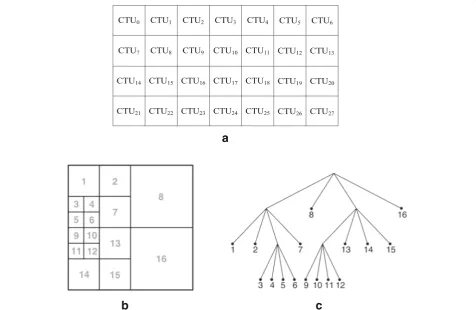
In recent years, the industry of standard- and high-definition (HD) video has been developed vigorously. One feature of large-sized images is that the area of smooth regions is larger. An encoding with larger blocks can greatly improve the encoding efficiency. Considering the characteristics of HD videos, the coding tree unit (CTU) is introduced in H.265/HEVC. For a luma CTU
with L×L luma samples, L can be chosen from the
values 16, 32, and 64. As shown in Fig.1a, an image can be divided into non-overlapping CTUs. Each CTU will be further divided into coding units (CU) using quadtree (as shown in Fig.1b, c. A CTU can be also directly used as a CU. Therefore, the size of the CU is a variable, and the largest one is 64 × 64 luma samples, while the smal-lest one is 8 × 8 luma samples. On the one hand, a CU
a
b
c
of a large size enables great increasing in the coding effi-ciency of a smooth region. On the other hand, small CUs are good at dealing with local image details, which makes the prediction of complex areas more accurate.
Transform unit (TU) is the basic unit of transform-ation and quantiztransform-ation opertransform-ation, and its size is also flex-ible. A CU is recursively divided into TUs based on a quadtree approach. The minimum size of a TU is 4 × 4, and the maximum size is 64 × 64. TUs with larger sizes concentrate energy better. And TUs with smaller sizes save more image details. This flexible partitioning struc-ture makes the residual energy be fully compressed in the transform domain, which further improves the cod-ing gain. In fact, a TU with the size of 64 × 64 implies that it must be further divided into four 32 × 32 TUs, be-cause the largest size of DCT (discrete cosine transform) transform operation is 32 × 32. In this paper, the sizes of TUs are regarded in five types, including 4 × 4, 8 × 8, 16 × 16, 32 × 32, and 64 × 64, regardless of implicit fur-ther division.
3 Methods—TU partition type features
In this section, we will introduce our proposed scheme in details. First, we introduce the feature set based on TU partition type. Then, we analyze the effectiveness of the proposed feature set.
3.1 Feature extraction method
In this subsection, we examine the unique coding struc-ture of HEVC. More specifically, the TU partition type of the first I/P frame in each GOP is investigated, and the histogram of TU partition type in the first I/P frame in all GOPs is used as the feature of video classification. We only take luminance component of TUs into ac-count during feature extraction process.
The process of feature extraction can be divided into three steps, and its flow chart is shown in Fig.2. Firstly, we extract the TU partition type of video frames using
video analysis software Gitl_HEVC_Analyzer [17].
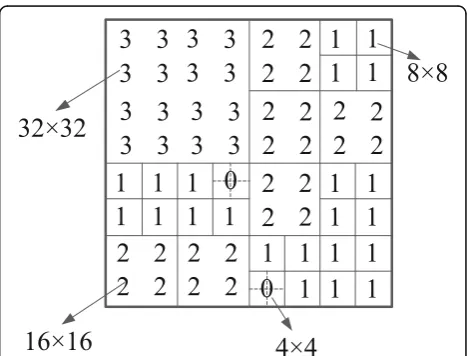
Sec-ondly, we mark the TU partition type of video frames. Based on blocks with sizes of 8 × 8, the TU partition
types are marked. Table 1 shows the label for the TU
partition types. Figure 3 shows an example of marking
TU partition types with their labels in a 64 × 64 CU. Thirdly, we count up the histogram of TU partition type. The number of each TU partition type in the first I/P frame of each GOP is counted, denoted byFi= {fi, 0,fi, 1,
fi, 2,fi, 3,fi, 4}(i= 1,⋯,M), where M is the number of
GOPs in the video sequence, and the value of the second index offis the same as the label shown in Table1. Each
Fi records the number of 8 × 8 blocks corresponding to
the five TU partition types in thei-th GOP. The average value ofFiis calculated as:
F¼ XM
i¼1 Fi
M ð1Þ
F is a 5-D vector, which can be denoted as F= {f0,f1,
f2,f3,f4}. Then, each element of is normalized as:
hk ¼X4fk
k¼0 fk
ð2Þ
where k= {0,⋯, 4}. The histogram of TU partition
type can be denoted asH= {h0,h1,h2,h3,h4}.
Fig. 2The procedure of feature extraction
Table 1Labels for the TU partition types
Label 0 1 2 3 4
Type 4 × 4 8 × 8 16 × 16 32 × 32 64 × 64
The histogram of TU partition type of the first I frame in all GOPs is called TU-I in the rest of this paper, and that of the first P frame is called TU-P. TU-I is a 5-D vector, so does TU-P. Then, in total, we have a 10-D vector corresponding to TU partition type, which will be
referred as TU-IP in the following text. The
TU-IPfeature describes the holistic distribution of the TU partition type in the first I/P frame of all GOPs, and it is the unique characteristic of HEVC.
3.2 Effectiveness of TU-based feature
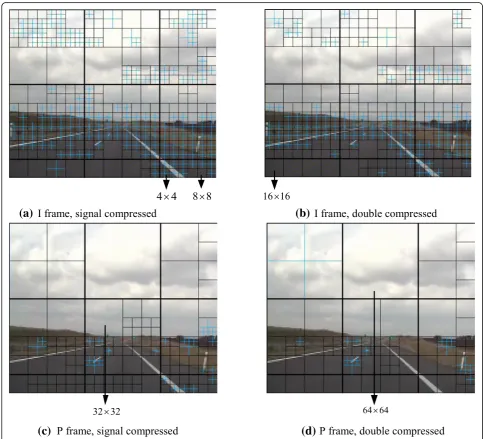
In this subsection, we will analyze the effectiveness of TU-based features. Figure4shows the TU partition type in the first I frame and the first P frame of a GOP in a single and
double compressed. The black solid box represents the CU partitioning type. If there are blue lines inside the black solid box, it means the CU is partitioned into several TUs recursively using quadtree. Or else, TU bears the same size as CU. From Fig.4, we can see that there is an obvious dif-ference in the TU partition type in the first I and P frames of a GOP between a single compressed video and its corre-sponding double one.
Figure5shows the average number of each TU partition type in the first I/P frame of all GOPs of a single com-pressed video and its corresponding double comcom-pressed one. The average number of each TU partition type is the parameterFin Eq. (1). From the figure, we can observe ob-vious difference between the TU partition type of the single
(a)
(c)
(d)
(b)
and double compressed videos. For example, there is a big difference between the blue and red bar when TU size is 4 × 4, and this is also true for the green and purple bar when TU size is 8 × 8.
4 Results and discussion
4.1 Experimental setup
In experiments, we use 17 uncompressed YUV sequences in QCIF format [18] as the initial video, whose resolution is 176 × 144. We also use 18 CIF format [19] videos with the resolution of 352 × 288. To increase the size of the video
database, each video is divided into non-overlapping frag-ments with lengths of 100 frames. And a total of 36 QCIF video fragments and 43 CIF video fragments are obtained.
To obtain single compressed video database, we com-press the video fragments to HEVC format at bitrate B2.
And to obtain double compressed video database, we com-press the video fragments to HEVC format at bitrate B1,
then after decompressing we recompress them at bitrate
B2. The bitrate group (B1−B2) is set to be the following
values: {(100−200), (100−300), (100−400), (200−300),
(200−400)} Kbps. In all these encoding and decoding
Fig. 5The average number of each TU partition type in the first I/P frame of all GOPs of single (200 k) and double (100 k–200 k) compressed videos.
‘200k_I’(‘200k_P’) means I (P) frame of a single compressed video with bitrate 200 k.‘100_200k_I’(‘100_200k_P’) means I (P) frame of a double compressed video with bitrate 100 k in the first compression process and 200 k in the second compression process. The video for testing is the first part of video named“akiyo”in QCIF database. Information on video database can be found in Section4
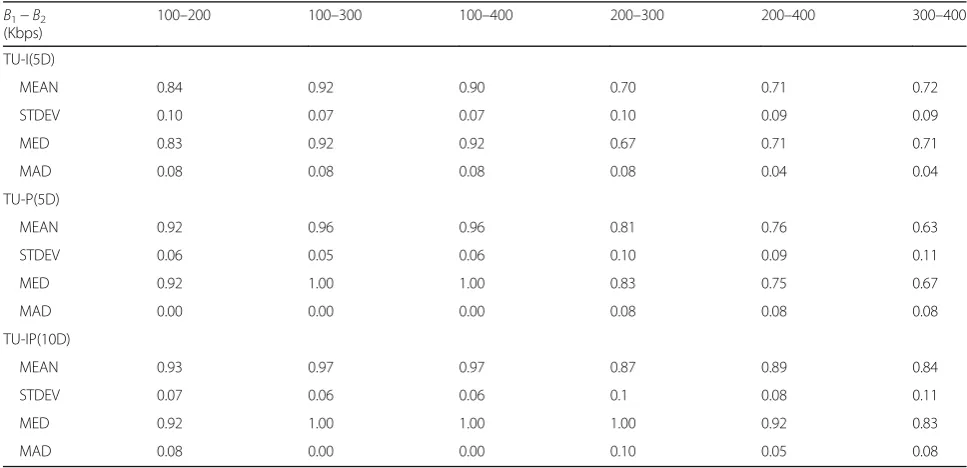
Table 2Detection accuracy of the double compressed video fragments from its corresponding single compressed ones using TU-I, TU-P, and TU features on QCIF video dataset
B1−B2
(Kbps)
100–200 100–300 100–400 200–300 200–400 300–400
TU-I(5D)
MEAN 0.84 0.92 0.90 0.70 0.71 0.72
STDEV 0.10 0.07 0.07 0.10 0.09 0.09
MED 0.83 0.92 0.92 0.67 0.71 0.71
MAD 0.08 0.08 0.08 0.08 0.04 0.04
TU-P(5D)
MEAN 0.92 0.96 0.96 0.81 0.76 0.63
STDEV 0.06 0.05 0.06 0.10 0.09 0.11
MED 0.92 1.00 1.00 0.83 0.75 0.67
MAD 0.00 0.00 0.00 0.08 0.08 0.08
TU-IP(10D)
MEAN 0.93 0.97 0.97 0.87 0.89 0.84
STDEV 0.07 0.06 0.06 0.1 0.08 0.11
MED 0.92 1.00 1.00 1.00 0.92 0.83
process, we utilize the codec HM10.0 [20]. In the process of encoding, frame rate, intra period, and GOP size are the three main parameters, and they are set to be 30, 4, and 4, respectively. Thus, the total number of first P frame in a video fragment is 25, and that of the first I frame is also 25.
The detection results are expressed in terms of the detec-tion probabilityPaccuracy. When the cardinalities of the
posi-tive set and the negaposi-tive set are the same, which is the scenario in our experiments,Paccuracyis defined as follows:
Paccuracy ¼PTPþPTN
2 ð3Þ
where PTP and PTN are the rate of true positive and
true negative, respectively.
All classifiers presented in this paper were constructed by using libSVM [21] with the polynomial kernel k(x,y) = (γxTy+coef0)d, γ> 0. coef0 anddare set to be the de-fault value 0 and 3, respectively. The classifier of DCT136 [10] is the only exception, where the classifier is libSVM with the rbf kernel as in the original paper.
Before training the libSVM on the training set, the value of the penalization parameterCand the kernel parameter need to be set. These hyper-parameters balance the com-plexity and accuracy of the classifier. The hyper-parameterCpenalizes the error on the training set. Higher values ofCproduce classifiers more accurate on the train-ing set but also more complex with a possibly worse
generalization. On the other hand, a smaller value of C
produces simpler classifiers with worse accuracy on the Fig. 6The mean value (MEAN) of detection accuracy of TU-I, TU-P, and TU
training set but hopefully with better generalization. The role of the kernel parameter is similar toC: Higher values of γ make the classifier more pliable but likely prone to over-fitting the data, while lower values ofγhave the op-posite effect.
The values of C and γ should be chosen to give the
classifier the ability to generalize. The standard ap-proach is to estimate the error on unknown samples using cross-validation on the training set on a fixed grid of values and then select the value corresponding to the lowest error. In this paper, we used five-foldcross-validation with the multiplicative grid
C∈2iji∈ −f 2;−1:5;−1;⋯;3;3:5;4g
γ∈2iji∈ −f 4;−3:5;−3;⋯;3;3:5;4g:
Candγpair that can get the highest accuracy with the smallestCis chosen and denoted as (C0,γ0).
We randomly split video set into training and testing sets. Then, (C0,γ0) is used to train the model on the
training set, and the predicted label of testing set is ob-tained based on the trained model. This process is
executed by 100 times, and statistics of the detection ac-curacy will be shown in the tables or/and figures. We use four kinds of statistics, that is, mean value (MEAN), standard deviation (STDEV), median value (MED), and median absolute deviation (MAD). For QCIF dataset, 30 single compressed video fragments and their corre-sponding double compressed video fragments are used for training, and the rest 6 single compressed video frag-ments and their corresponding double compressed video fragments are used for testing. For CIF dataset, the size of training and testing sets are 36 and 7, respectively.
4.2 Evaluating the effectiveness of TU features
TU-IP features are formed from TU partition type of the first I/P frame in all GOPs. It is the specific feature of HEVC. In this subsection, we will show the effectiveness of the TU-IP features in detecting double compression of HEVC.
Table 2 shows the detection accuracy of the double
compressed video fragments from its corresponding sin-gle compressed ones. It can be seen that TU-I or TU-P Table 3The parameters used for training libSVM for feature set TU-I, TU-P, and TU-IP on QCIF video dataset
B1−B2
(Kbps)
100–200 100–300 100–400 200–300 200–400 300–400
TU-I(5D)
c 2.8284 5.6569 1.0000 1.0000 16.0000 5.6569
g 2.8284 11.3137 16.0000 4.0000 0.0884 1.4142
TU-P(5D)
c 4.0000 11.3137 2.8284 1.4142 1.0000 16.0000
g 8.0000 0.3536 0.5000 8.0000 5.6569 16.0000
TU-IP(10D)
c 5.6569 8.0000 2.0000 2.0000 2.8284 0.7071
g 1.0000 0.7071 1.0000 16.0000 4.0000 11.3137
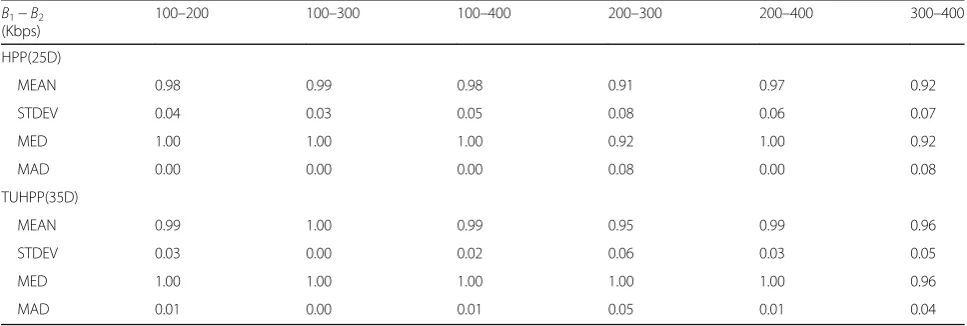
Table 4Detection accuracy of the double compressed video fragments from its corresponding single compressed ones using HPP feature and TUHPP feature on QCIF video dataset
B1−B2
(Kbps)
100–200 100–300 100–400 200–300 200–400 300–400
HPP(25D)
MEAN 0.98 0.99 0.98 0.91 0.97 0.92
STDEV 0.04 0.03 0.05 0.08 0.06 0.07
MED 1.00 1.00 1.00 0.92 1.00 0.92
MAD 0.00 0.00 0.00 0.08 0.00 0.08
TUHPP(35D)
MEAN 0.99 1.00 0.99 0.95 0.99 0.96
STDEV 0.03 0.00 0.02 0.06 0.03 0.05
MED 1.00 1.00 1.00 1.00 1.00 0.96
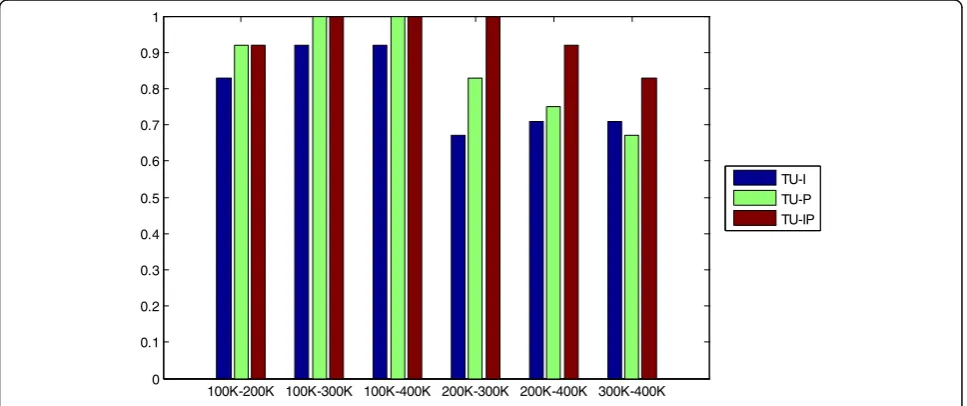
individually shows effectiveness in detecting HEVC double compression. For TU-I, the MEAN ranges from 0.70 to 0.92, and for TU-P, it ranges from 0.63 to 0.96. The MEAN of TU lies in [0.74, 0.97]. MED of TU-I and TU-P lies in [0.67,0.92] and [0.67,1], respectively, and that of TU lies in [0.75,1]. From Figs. 6 and 7, we can observe easily that TU outperforms TU-I and TU-P in both the mean value and the median value of the detec-tion accuracy of HEVC double compression. Merging TU-I and TU-P together shows conspicuous superiority over any of them. When evaluating the detection cap-ability of TU-I and TU-P, we should note that the di-mension of TU-I or TU-P is only 5-D and that of TU is only 10-D. The dimension of features based on TU is
low compared to other features for HEVC double com-pression detection, e.g., DCT136 [10] and HPP [13] fea-ture sets.
From the accuracy of TU-P in Table 2, we can also
found that, when B2is fixed, lower B1will result in
sig-nificantly better detection performance, and when B1 if
fixed, higherB2will lead to a boost in detection accuracy
by and large. This phenomenon is also true when comes to TU-I and TU. It can be interpreted from the follow-ing aspects. Firstly, when B2 is fixed, the single
com-pressed video dataset is fixed and the double
compressed video dataset is changing. Lower B1 may
lead to larger quantization step in the process of rate-distortion control. Larger quantization step means more Fig. 8The mean value (MEAN) of detection accuracy of HPP [14] and TUHPP
image details are lost in the first compression, and it will be easier to be detected after double
compres-sion. Secondly, when B1 is fixed, the quantity of lost
image details in the first compression is fixed, but both the single and the double compressed video
dataset are changing with respect to B2. Higher B2
may lead to smaller quantization step in the recom-pressing process, and the hints for lost image details in the first compression may be retained better. So,
higher B2 may lead to a boost in detection accuracy.
Nevertheless, both the single and the double
com-pression video databases are varying, and the
performance gain by higher B2 when B1 is fixed is
not as large as the case of lower B1when B2is fixed.
To make it easy for interested readers to reproduce the experimental results, the parameters used for train-ing libSVM for feature set TU-I, TU-P, and TU-IP are shown in Table3.
4.3 Combination with other feature sets
TU feature is extracted from TU partition type, which is the syntactic structure of HEVC. In this subsection, we will show that TU feature set can be combined with Table 5Detection accuracy of the double compressed video fragments from its corresponding single compressed ones using TU-IP, HPP feature, and TUHPP feature on CIF video dataset
B1−B2
(Kbps)
100–200 100–300 100–400 200–300 200–400 300–400
TU-IP(10D)
MEAN 0.90 0.95 0.97 0.87 0.90 0.81
STDEV 0.08 0.07 0.05 0.08 0.08 0.09
MED 0.93 1.00 1.00 0.86 0.93 0.79
MAD 0.07 0.00 0.00 0.07 0.07 0.07
HPP(25D)
MEAN 0.96 0.99 0.99 0.85 0.98 0.91
STDEV 0.05 0.03 0.02 0.09 0.03 0.07
MED 1.00 1.00 1.00 0.86 1.00 0.93
MAD 0.00 0.00 0.00 0.07 0.00 0.07
TUHPP(35D)
MEAN 0.98 1.00 1.00 0.96 0.99 0.95
STDEV 0.04 0.00 0.00 0.05 0.02 0.05
MED 1.00 1.00 1.00 1.00 1.00 0.93
MAD 0.00 0.00 0.00 0.00 0.00 0.04
Table 6Detection accuracy of the double compressed video fragments from its corresponding single compressed ones using DCT136 [11] feature and TUDCT136 feature on QCIF video dataset
B1−B2
(Kbps)
100–200 100–300 100–400 200–300 200–400 300–400
DCT136(136D)
MEAN 0.83 0.94 0.95 0.89 0.89 0.74
STDEV 0.14 0.06 0.05 0.07 0.07 0.08
MED 0.88 0.97 0.96 0.89 0.89 0.75
MAD 0.04 0.03 0.04 0.06 0.06 0.07
TUDCT136(146D)
MEAN 1.00 1.00 1.00 1.00 0.99 0.96
STDEV 0.00 0.01 0.00 0.03 0.03 0.06
MED 1.00 1.00 1.00 1.00 1.00 1.00
other feature set to boost their performance in detecting double HEVC compression.
Table4 shows the detection accuracy of HPP [15] and HPP combined with TU (TUHPP) on QCIF video data-set. Firstly, the mean value of detection accuracy (MEAN) of HPP ranges from 0.91 to 0.99, and that of
TUHPP ranges from 0.95 to 1. Figures8and9show the
MEAN and MED of HPP and TUHPP on QCIF dataset. It is obvious that the combination of TU feature and HPP outperforms HPP under every double compression
bitrate groups. Table 5 shows the detection accuracy of
TU-IP, HPP, and HPP combined with TU (TUHPP) on CIF video dataset. And we can also observe that TUHPP outperforms HPP. TU feature is extracted from the TU partition type, while HPP feature is extracted from the PU partition type. These two kinds of feature can be a good supplement to each other.
Table 6shows the detection accuracy of DCT136 [11]
and DCT136 combined with TU (TUDCT136). Firstly, the mean value of detection accuracy (MEAN) of DCT136 ranges from 0.74 to 0.95, and that of TUDCT136 ranges from 0.92 to 1. Secondly, the MED of DCT136 lies in [0.75,0.97], and that of TUDCT136 lies in [0.92,1]. Meanwhile, we can observe from Figs.10
and11that the combination of TU feature and DCT136
outperforms DCT136 under every double compression bitrate groups. TU feature is extracted from TU parti-tion type, which is the syntactic structure of HEVC. DCT136 is extracted from the DCT coefficients of a video, which is the content data of a video. The combin-ation of these two kinds of feature can boost the per-formance of each other.
To make it easy for interested readers to reproduce the experimental results, the parameters used for Fig. 10The mean value (MEAN) of detection accuracy of DCT136 [10] and TUDCT136
training libSVM for feature set HPP [15], TUHPP,
DCT136 [11], and TUDCT136 on QCIF video dataset
are shown in Table 7, and the parameters for TU-IP,
HPP, and TUHPP on CIF dataset are shown in Table8.
5 Conclusions
In this paper, we propose a new method to detect HEVC double compression under different bitrates. The distin-guishing feature set is composed of the histogram of TU partition type. It is firstly reported in this paper to em-ploy TU partition type-based feature to detect HEVC double compression, and the experimental results sug-gests its efficiency.
The detection methods proposed in ref. [11] employed the characteristic that DCT coefficients would be chan-ged during recompression. It is a traditional kind of method utilized for double compression in video coding standard preceding HEVC. Nevertheless, HEVC brings in unique syntax units, such as CTU, PU, and TU. To the best of our knowledge, only PU number was
investigated in ref. [12–15] for detecting HEVC double compression. The effectiveness of PU number in detect-ing HEVC double compression motivates us to explore another unique feature, i.e., TU.
When using histogram of TU partition type as features for classification, the accuracy is above 0.84, even reach-ing 0.97 when distreach-inguishreach-ing sreach-ingly compressed videos with bitrate 400 Kbps from double compressed videos
with bitrate (100−400) Kbps. The reason is that TU
partition type is controlled by the rate-distortion optimization process, and it is sensitive to bitrate. Differ-ent bitrate may result in differDiffer-ent TU partition type.
Our TU features are based on the syntactic structure of HEVC. When combined with DCT coefficients based features (e.g., ref. [11]), it can boost the original perform-ance. That mainly lies in the fact that they captured characteristics of videos from different aspects. When combined with features from other kinds of syntactic structures of HEVC (e.g., HPP [14]), it can also improve the original performance.
Table 7The parameters used for training libSVM for feature set HPP [15], TUHPP, DCT136 [11], and TUDCT136 on QCIF video dataset
B1−B2
(Kbps)
100–200 100–300 100–400 200–300 200–400 300–400
HPP(25D)
c 1.4142 2.0000 0.7071 2.0000 2.0000 2.0000
g 0.5000 0.3536 1.4142 0.7071 0.7071 0.5000
TUHPP(35D)
c 0.5000 0.5000 0.7071 16 4.0000 5.6569
g 0.3536 0.5000 0.7071 0.1768 0.5000 0.1768
DCT136(136D)
c 0.5000 32.0000 32.0000 32.0000 32.00 32.0000
g 8.0000 0.0313 0.0313 0.0313 0.0625 0.0625
TUDCT136(146D)
c 0.25 0.25 0.25 1.4142 0.25 16
g 0.13 0.06 0.09 0.25 0.71 0.25
Table 8The parameters used for training libSVM for feature set HPP [15], TUHPP, DCT136 [11], and TUDCT136 on CIF video dataset
B1−B2
(Kbps)
100–200 100–300 100–400 200–300 200–400 300–400
TU-IP(10D)
c 0.5 2.8284 1 11.3137 8 8
g 16 16 16 2.8284 2.8284 2.8284
HPP(25D)
c 2.8284 0.25 2 0.70711 1.4142 4
g 2 0.5 1.4142 2.8284 1.4142 1
TUHPP(35D)
c 1 0.25 1 2.8284 0.70711 5.6569
Other than borrowing ideas from double compression in other video standards and develop new methods that are universal to all/several kinds of video standards, re-searchers can also put some efforts on digging methods from the unique characteristic of HEVC. Apart from
the PU number used in ref. [12–15] and TU partition
types employed in this paper, there are many other in-teresting and promising characteristics of HEVC, such as the inter and intra prediction mode of PU and the merge type of PU in P frames. Our future work will be focused on utilizing these unique characteristics of HEVC to detect double compression. Meanwhile, the application of emerging new techniques in related area may boost the development of HEVC double compres-sion detection [22,23].
Abbreviations
CTU:Coding tree unit; DCT: Discrete cosine transform; HD: High definition; HEVC: High-efficiency video coding; PU: Prediction unit; QP: Quantization parameters; SN-PUPM: Prediction unit of its prediction mode; TU: Transform unit
Acknowledgements
The authors would like to thank the editor and anonymous reviewers for their helpful comments and valuable suggestions.
Authors’contributions
All authors take part in the discussion of the work described in this paper. ZL, ZZ, and LY conceived and designed the experiments. ZZ performed the experiments. ZL, ZZ, and LY analyzed the data. LY, ZZ, and GC wrote the paper. All authors read and approved the final version of the manuscript.
Funding
The work is founded by the National Natural Science Foundation of China (No. 61702034, No. 61401408) and Beijing municipal education commission project (No.KM201510015010).
Availability of data and materials We can provide the data.
Competing interests
The authors declare that they have no competing interests.
Author details
1
Department of Information Engineering, Beijing Institute of Graphic Communication, Beijing 102600, China.2School of Computer Science and
Engineering, Beihang University, Beijing 100083, China.3School of Electronic
and Information Engineering, Beijing Jiaotong University, Beijing 100044, China.4School of Computer Science, Communication University of China, Beijing 100024, China.
Received: 1 November 2018 Accepted: 16 May 2019
References
1. X. Guo, X. Cao, X. Chen, Y. Ma, inProc. of IEEE Conference on Computer Vision and Pattern Recognition. Video editing with temporal, spatial and appearance consistency (2013), pp. 2283–2290
2. P. Bestagini, K.M. Fontani, S. Milani, M. Barni, A. Piva, M. Tagliasacchi, K.S. Tubaro, inProc. of Asian-Pacific Signal and Information Processing Association. An Overview on Video Forensics (2012), pp. 1229–1233
3. G.J. Sullivan, J. Ohm, W.J. Han, T. Wiegand, Overview of the high efficiency video coding (HEVC) standard. IEEE Trans. Circuits Syst. Video Technol.
22(12), 1649–1668 (2012)
4. W. Chen, Y.Q. Shi, inDigital Watermarking. Detection of double MPEG compression based on first digit statistics (Springer, Berlin, 2008), pp. 16–30 5. W. Luo, M. Wu, J. Huang, inProc. of SPIE. MPEG recompression detection
based on block artifacts, vol 6819 (2008), pp. 68190–68112
6. X. Jiang, W. Wang, T. Sun, Y.Q. Shi, S. Wang, Detection of double compression in MPEG-4 videos based on Markov statistics. IEEE Signal Processing Lett.20(5), 447–450 (2013)
7. W. Wang, X. Jiang, S. Wang, T. Sun, inProc. of Visual Communications and Image Processing. Estimation of the primary quantization parameter in MPEG videos (2013)
8. D. Liao, R. Yang, H. Liu,“Double H.264/AVC compression detection using quantized nonzero AC coefficients”, in Proc. of SPIE - The International Society for Optical Engineering, vol. 7880, 2, pp. 78800-78810, 2011 9. J. Hou, Z. Zhang, Y. Zhang, J. Ye, Y.Q. Shi, Detecting multiple H.264/AVC
compressions with the same quantization parameters. IET Inf. Secur.11(3) (2016).https://doi.org/10.1049/iet-ifs.2015.0361
10. X. Jiang, P. He, T. Sun, F. Xie, S. Wang, Detection of double compression with the same coding parameters based on quality degradation mechanism analysis. IEEE Trans. Inf. Forensics Secur.13(1), 170–185 (2018)
11. M. Huang, R. Wang, J. Xu, D. Xu, Q. Li, inProc. of International Workshop on Digital Watermarking. Detection of double compression for HEVC videos based on the co-occurrence matrix of DCT coefficients (2015), pp. 61–71 12. R. Jia, Z. Li, Z. Zhang, D. Li,“Double HEVC compression detection with the same
QPs based on the PU number,”in Proc. Of 3rd Annual International Conference on Information Technology and Applications, Vol. 02010, 7, pp. 1–4, 2016 13. Q. Xu, T. Sun, X. Jiang, Y. Dong, inProc. of International Workshop on Digital
Watermarking. HEVC double compression detection based on SN-PUPM feature (2017), pp. 3–17
14. Z.-H. Li, R.-S. Jia, Z.-Z. Zhang, X.-Y. Liang, J.-W. Wang, inProc. ITM Web Conf. Double HEVC compression detection with different bitrates based on co-occurrence matrix of PU types and DCT coefcients, vol 12 (2017), p. 01020 15. X. Liang, Z. Li, Y. Yang, Z. Zhang, Y. Zhang, Detection of double compression
for HEVC videos with fake bitrate. IEEE Access6, 53243–53253 (2018) 16. V. Sze, M. Budagavi, G.J. Sullivan,High efficiency video coding (HEVC).
Integrated Circuit and Systems, Algorithms and Architectures, (Springer, 2014), pp. 1–375
17. https://github.com/lheric/GitlHEVCAnalyzer, Accessed 2 Aug 2017 18. http://www.media.xiph.org/video/derf/, Accessed 2 Aug 2015 19. http://www.trace.eas.asu.edu/yuv/index.html, Accessed 2 Aug 2015 20. http://download.csdn.net/download/amymayadi/7903385, Accessed 2 Aug 2015 21. C.C. Chang, C.J. Lin, inACM Transactions on Intelligent Systems and
Technology. LIBSVM : a library for support vector machines, vol 2 (2011), pp. 1–27 Software available athttp://www.csie.ntu.edu.tw/~cjlin/libsvm
(Accessed 14 Dec 2017)
22. C. Yan, L. Li, C. Zhang, B. Liu, Y. Zhang, Q. Dai, Cross-modality bridging and knowledge transferring for image understanding. IEEE Trans. Multimedia. pp. 1–1 (2019)
23. C. Yan, H. Xie, J. Chen, Z. Zha, X. Hao, Y. Zhang, Q. Dai, A fast Uyghur text detector for complex background images. IEEE Trans. Multimedia.20(12), 3389–3398 (2018).
6 Publisher’s Note
![Fig. 8 The mean value (MEAN) of detection accuracy of HPP [14] and TUHPP](https://thumb-us.123doks.com/thumbv2/123dok_us/873918.1584901/8.595.57.547.515.717/fig-mean-value-mean-detection-accuracy-hpp-tuhpp.webp)
![Table 6 Detection accuracy of the double compressed video fragments from its corresponding single compressed ones usingDCT136 [11] feature and TUDCT136 feature on QCIF video dataset](https://thumb-us.123doks.com/thumbv2/123dok_us/873918.1584901/9.595.56.539.108.344/detection-accuracy-compressed-fragments-corresponding-compressed-usingdct-feature.webp)
![Fig. 10 The mean value (MEAN) of detection accuracy of DCT136 [10] and TUDCT136](https://thumb-us.123doks.com/thumbv2/123dok_us/873918.1584901/10.595.57.543.88.270/fig-mean-value-mean-detection-accuracy-dct-tudct.webp)
![Table 8 The parameters used for training libSVM for feature set HPP [15], TUHPP, DCT136 [11], and TUDCT136 on CIF video dataset](https://thumb-us.123doks.com/thumbv2/123dok_us/873918.1584901/11.595.56.541.110.304/table-parameters-training-libsvm-feature-tuhpp-tudct-dataset.webp)
