Validation of the Pediatric Cardiac Quality
of Life Inventory
WHAT’S KNOWN ON THIS SUBJECT: Little is known regarding the impact of important clinical and patient factors (disease severity, medical care utilization, patient-parent consensus, and patient self-perception, competency, and behavior) on HRQoL in the pediatric cardiac population.
WHAT THIS STUDY ADDS: This large, multicenter study showed that lower HRQoL was associated with greater disease severity and medical care utilization, poorer patient self-perception and competency, and increased behavioral and emotional problems in the pediatric cardiac population. The PCQLI is valid and reliable.
abstract
OBJECTIVE:The purpose of this multicenter study was to confirm the validity and reliability of the Pediatric Cardiac Quality of Life Inventory (PCQLI).
METHODS:Seven centers recruited pediatric patients (8 –18 years of age) with heart disease (HD) and their parents to complete the PCQLI and generic health-related quality of life (Pediatric Quality of Life Inven-tory [PedsQL]) and non– quality of life (Self-Perception Profile for Chil-dren [SPPC]/Self-Perception Profile for Adolescents [SPPA] and Youth Self-Report [YSR]/Child Behavior Checklist [CBCL]) tools. PCQLI con-struct validity was assessed through correlations of PCQLI scores be-tween patients and parents and with severity of congenital HD, medical care utilization, and PedsQL, SPPC/SPPA, and YSR/CBCL scores. PCQLI test-retest reliability was evaluated.
RESULTS:The study enrolled 1605 patient-parent pairs. Construct va-lidity was substantiated by the association of lower PCQLI scores with Fontan palliation and increased numbers of cardiac operations, hos-pital admissions, and physician visits (P⬍.001); moderate to good correlations between patient and parent PCQLI scores (r⫽0.41– 0.61; P⬍.001); and fair to good correlations between PCQLI total scores and PedsQL total (r⫽0.70 – 0.76), SPPC/SPPA global self-worth (r⫽0.43– 0.46), YSR/CBCL total competency (r⫽0.28 – 0.37), and syndrome and Diagnostic and Statistical Manual of Mental Disorders,Fourth Edition-oriented scale (r ⫽ ⫺0.58 to ⫺0.30; P⬍ .001) scores. Test-retest reliability correlations were excellent (r⫽0.78 – 0.90;P⬍.001).
CONCLUSIONS:PCQLI scores are valid and reliable for children and adolescents with congenital and acquired HD and may be useful for future research and clinical management.Pediatrics 2010;126:498– 508
AUTHORS:Bradley S. Marino, MD, MPP, MSCE,a,bRyan S.
Tomlinson, BSE,aGil Wernovsky, MD,c,dDennis Drotar,
PhD,eJane W. Newburger, MD, MPH,f,gLynn Mahony, MD,h
Kathleen Mussatto, RN, PhD,iElizabeth Tong, RN, MS,j
Mitchell Cohen, MD,kCharlotte Andersen, RN, MS,aDavid
Shera, ScD,lPhilip R. Khoury, MS,aJo Wray, PhD,mJ.
William Gaynor, MD,nMark A. Helfaer, MD,dAnne E. Kazak,
PhD,oand Judy A. Shea, PhD,pfor the Pediatric Cardiac
Quality of Life Inventory Testing Study Consortium
Divisions ofaCardiology,bCritical Care Medicine, and eBehavioral and Clinical Psychology, Department of Pediatrics,
Cincinnati Children’s Hospital Medical Center, Cincinnati, Ohio; Divisions ofcCardiology,lEpidemiology and Biostatistics, and oPsychology, Department of Pediatrics,dDivision of Critical Care
Medicine, Department of Anesthesiology and Critical Care, and
nDivision of Cardiothoracic Surgery, Department of Surgery,
Children’s Hospital of Philadelphia, Philadelphia, Pennsylvania;
fDepartment of Cardiology, Children’s Hospital Boston, Boston,
Massachusetts;gDepartment of Pediatrics, School of Medicine,
Harvard University, Boston, Massachusetts;hDivision of
Cardiology, Department of Pediatrics, University of Texas Southwestern Medical Center at Dallas, Dallas, Texas;iDivision
of Cardiology, Department of Pediatrics, Children’s Hospital of Wisconsin, Milwaukee, Wisconsin;jDivision of Cardiology,
Department of Pediatrics, University of California, San Francisco, Children’s Hospital, San Francisco, California;
kDivision of Cardiology, Department of Pediatrics, Phoenix
Children’s Hospital, Phoenix, Arizona;mDepartment of Paediatric
Cardiology, Royal Brompton and Harefield National Health Service Trust, London, United Kingdom; andpDivision of General
Internal Medicine, Department of Medicine, School of Medicine, University of Pennsylvania, Philadelphia, Pennsylvania
KEY WORDS
congenital heart disease, acquired heart disease, health-related quality of life, reliability, validity
ABBREVIATIONS
CBCL—Child Behavior Checklist HD—heart disease
HRQoL—health-related quality of life
PCQLI—Pediatric Cardiac Quality of Life Inventory PedsQL—Pediatric Quality of Life Inventory QoL—quality of life
SPPA—Self-Perception Profile for Adolescents SPPC—Self-Perception Profile for Children YSR—Youth Self-Report
DSM-IV—Diagnostic and Statistical Manual of Mental Disorders, Fourth Edition
In recent decades, new surgical tech-niques and advances in cardiopulmo-nary bypass, intensive care, heart transplantation, and interventional catheterization have significantly re-duced mortality rates for children with heart disease (HD).1This growing pop-ulation of survivors has important neu-rodevelopmental, psychosocial, and physical morbidities resulting from their disease and/or its management that may affect quality of life (QoL).2,3 Health-related QoL (HRQoL) is defined as the influence of a specific illness, medical therapy, or health services policy on the ability of the patient to both function in and derive personal satisfaction from various physical, psychological, and social life contexts.4 Evaluation of HRQoL is important be-cause it allows for better communica-tion among patients, parents, and health care providers; prioritization of problems in part on the basis of pa-tient and/or parent preferences; mon-itoring of changes over time or in re-sponse to specific therapies; and screening for other significant medi-cal and psychosocial problems.5 De-spite the known advantages, validated assessment of HRQoL in the pediatric cardiac population is lacking.6A more-complete understanding of the impact of HD on HRQoL in the pediatric popu-lation may improve patient-centered medical treatment and outcomes.7
Several characteristics inherent to the pediatric cardiac population have lim-ited HRQoL assessment, including the broad age range, changing develop-mental capabilities, and the variety of defects, therapies (medical, surgical, and interventional), and outcomes. The existing, disease-specific, HRQoL in-struments for the pediatric cardiac population each have salient limita-tions, namely, narrow age ranges,8,9 limited data to support broad applica-bility to other geographic regions or demographic groups within the United
States,8–10 and/or an inability to dis-criminate among various types of HD.8–10The Pediatric Cardiac Quality of Life Inventory (PCQLI) was developed to address these limitations.11It is a self-administered, disease-specific, HRQoL tool for children and adolescents with HD that features a wide age range, parent-proxy reporting, and the ability to differentiate among congenital HD subpopulations.11
Limited validity and reliability analyses exist for disease-specific, pediatric, cardiac HRQoL measures, including the PCQLI.8–12 However, valid, reliable instruments are required for quantita-tive HRQoL assessment, which may be used to improve patient outcomes sys-tematically. The PCQLI subscales have been shown to have excellent internal consistency and to correlate well with each other and with the PCQLI total.11 The purpose of this large, multicenter study was to confirm the validity and reliability of the PCQLI by evaluating the impact of important clinical and pa-tient factors (disease severity, medical care utilization, patient-parent consen-sus, and patient self-perception, com-petency, and behavior) on HRQoL in the pediatric cardiac population. We hy-pothesized that PCQLI scores would be reliable (similar between baseline testing and retesting) and valid (in-versely correlated with disease sever-ity and medical utilization, similar between patient and parent respon-dents, and negatively associated with poorer self-perception, decreased competency, and increased behavioral and emotional problems).
METHODS
Study Design
This study was a prospective, cross-sectional survey of pediatric patients with congenital or acquired HD and their parents or guardians. It was per-formed at 7 large, pediatric cardiovas-cular care centers in the United States
between November 2004 and Decem-ber 2008. The institutional review boards of all participating institutions approved the study.
Subject Selection
Patients were eligible for participation if they had congenital or acquired HD, were 8 to 18 years of age, were fluent in English, and were attending an out-patient cardiology visit. Patients were excluded if they had a significant co-morbid medical condition or major de-velopmental delay or came to the clinic because of an acute change in their clinical status. Parents (an inclusive term for parents or guardians of eligi-ble patients) were excluded if they were not fluent in English or had a ma-jor developmental delay. All eligible, consenting/assenting patients and parents were enrolled in the study.
Inventory Administration
Patient-parent pairs completed a bat-tery of questionnaires that included a disease-specific, pediatric, cardiac HRQoL instrument (PCQLI),11a generic HRQoL instrument (Pediatric Quality of Life Inventory [PedsQL] Generic Core Scales 4.0),13 and non–QoL instru-ments (Self-Perception Profile for Chil-dren [SPPC]/Self-Perception Profile for Adolescents [SPPA], Child Behavior Checklist [CBCL], and Youth Self-Report [YSR]).14–17 All generic HRQoL and non–QoL inventories used in the study are internally consistent and valid.13–17
par-ents were excluded from test-retest reliability analysis if any significant life event or change in patient clinical sta-tus occurred between study visits. Patient-parent pairs who were unavail-able for testing on 2 occasions were recruited for construct validity testing and completed the baseline invento-ries on the day of the appointment, be-fore seeing their cardiology provider. Inventory completion was supervised, to minimize data contamination result-ing from patient-parent discussion.
Inventory Selection
PCQLI
The PCQLI measures disease-specific, pediatric HRQoL and generates 3 scores, namely, total, disease impact subscale, and psychosocial impact subscale.11Each subscale score has a maximum of 50 points, and their sum yields the total score. Higher scores represent better perceived HRQoL. The PCQLI has 4 forms, that is, child (ages 8 –12), parent of child (parent-proxy), adolescent (ages 13–18), and parent of adolescent (parent-proxy) forms.
PedsQL
The PedsQL is a generic HRQoL instru-ment that assesses HRQoL in healthy, acutely ill, and chronically ill pediatric populations.13 It generates 3 scores, namely, total, physical health mary, and psychosocial health sum-mary. Higher scores represent better perceived HRQoL. The PedsQL has 4 forms, that is, child (ages 8 –12) and teen (ages 13–18) forms and 2 associ-ated parent-proxy forms.
SPPC/SPPA
The SPPC (child form, for ages 8 –12) and SPPA (adolescent form, for ages 13–18) are non–QoL measures that as-sess self-perception in children and adolescents, respectively. The princi-pal construct is global self-worth.14,15 Higher scores are associated with bet-ter self-perception.
YSR/CBCL
The YSR (for patients 11–18 years of age) and CBCL (parent-proxy for pa-tients 6 –18 years of age) are non–QoL instruments that assess competen-cies (activities, social, school, and total), emotional state (syndrome scales), and behavioral problems (Di-agnostic and Statistical Manual of Mental Disorders, Fourth Edition [DSM-IV] scales) of children and ado-lescents.16,17 Total competency, the syndrome scales constituting the in-ternalizing problems summary scale (social withdrawal, somatic com-plaints, and anxiety/depression), and select DSM-IV scales (affective, anxiety, somatic, and attention-deficit/hyper-activity disorders) were analyzed for this study.16,17
Demographic and Clinical Data Collection
Patient and parent demographic infor-mation and patient clinical informa-tion (diagnostic, surgical, and medical history) were collected through parent report and chart review. Patient clini-cal information is presented as pri-mary diagnosis, original diagnostic category (primary diagnoses grouped into general categories), and current cardiac status (a synthesis of the pa-tient’s original diagnostic category and interventions performed).
Statistical Analyses
Approach
Descriptive statistics were determined for the entire population. Continuous variables were expressed as means (with SDs or SEs) or medians (with ranges), depending on their distribu-tion. Categorical variables were tabu-lated and expressed as proportions. All statistical comparisons used an a priori significance level ofP⬍.05. All study inventory scoring and missing value adjustments were performed ac-cording to published guidelines.13–17
Even if missing information precluded inclusion in a specific analysis, patient and/or parent data were still included in all analyses for which there were complete data. Baseline inventories from the reliability testing were in-cluded in the validity testing analyses.
Construct Validity Assessment
To substantiate the validity of PCQLI scores, construct validity was as-sessed by using (1) comparison of PCQLI scores between specific congen-ital HD subgroups (known-groups method), (2) variation of PCQLI scores with medical care utilization (analysis of variance), (3) comparison of patient and parent PCQLI scores (convergent validity), and (4) comparison of PCQLI scores and generic HRQoL and non– QoL scores (convergent validity). For validity analyses, correlations were in-terpreted as follows: ⱕ0.20, poor agreement; 0.21 to 0.40, fair ment; 0.41 to 0.60, moderate agree-ment; 0.61 to 0.80, good agreeagree-ment;
ⱖ0.81, excellent agreement.18
Association of PCQLI Scores With Severity of Congenital HD
To determine whether PCQLI scores de-creased with increasing disease se-verity, patients with congenital HD were grouped into 3 representative subgroups, that is, (1) mild HD (no previous surgical or catheter-based intervention), (2) repaired biven-tricular HD, and (3) palliated single-ventricle HD. The Kruskal-Wallis 1-way analysis of variance test was used to compare PCQLI total and sub-scale scores among the 3 subgroups. In addition, a sequential Bonferroni
correction (Holm’s method) was
used for 2-way comparisons.19
Variation of PCQLI Scores With Medical Care Utilization
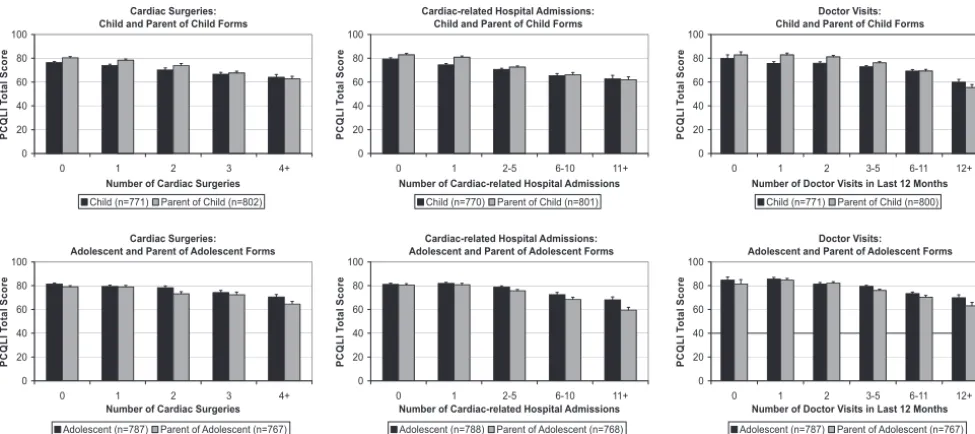
cardiac operations, 0, 1, 2, 3, or ⱖ4; HD-related hospital admissions, 0, 1, 2 to 5, 6 to 10, orⱖ11; physician visits within the previous 12 months, 0, 1, 2, 3 to 5, 6 to 11, orⱖ12. The Kruskal-Wallis 1-way analysis of variance test was used to evaluate the variance of PCQLI total scores with increasing medical care utilization in each respondent group.
Comparison of Patient and Parent PCQLI Scores
To assess the agreement between pa-tient and parent scores, disattenu-ated20 interrater Spearman correla-tions were calculated for PCQLI total and subscale scores. Comparisons were made between patients and par-ents within each age category (child and adolescent).
Association of PCQLI Scores With Generic HRQoL and Non–QoL Scores
The relationships between the
disease-specific HRQoL (PCQLI) and ge-neric HRQoL (PedsQL) and non–QoL (SPPC/SPPA and YSR/CBCL) measures were evaluated by using the Spearman test for correlation. The PCQLI total and subscale scores were compared with the PedsQL total and summary scores, respectively. In addition, PCQLI total scores were correlated with SPPC/ SPPA global self-worth scores and with YSR/CBCL total competency, internaliz-ing problems, and select DSM-IV scale scores.
Test-Retest Reliability Assessment
To assess the reliability of PCQLI scores, test-retest Spearman in-trarater correlation coefficients were calculated. Spearman coefficients in-stead of Pearson coefficients were used to assess test-retest reliability because the PCQLI scores are not nor-mally distributed, which violates the Pearson R assumption. Consistent with other biometric research, all comparisons used a predetermined
significance threshold of 0.70.21Values ofⱖ0.70 were considered excellent.
RESULTS
Subject Demographic Characteristics
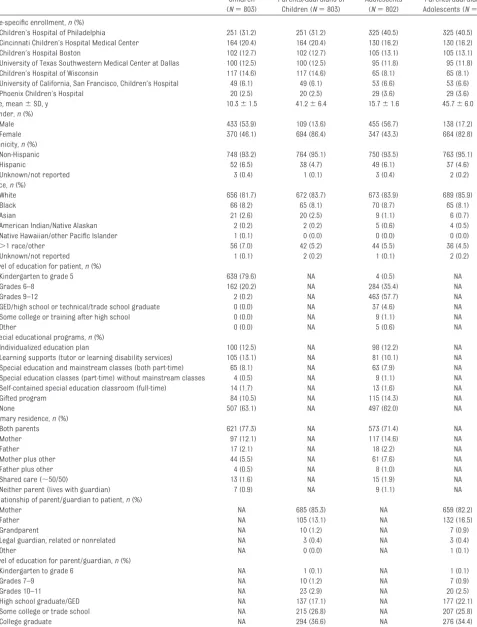
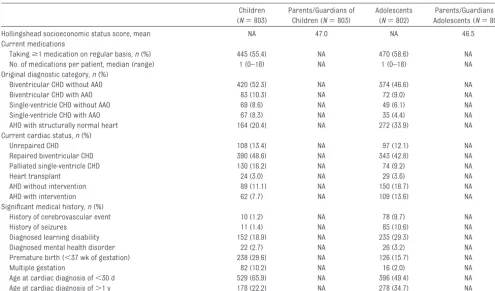
A total of 1605 eligible patient-parent pairs enrolled in the PCQLI Testing Study (consent rate: 85%). Site-specific enrollment, patient and parent demo-graphic, and patient clinical informa-tion is presented in Tables 1 and 2. The majority (53%–57%) of patients were male. Parents were primarily female (82%– 87%). Patients and parents were predominantly white (81%– 86%); black participants represented the most common minority (8%–9%). In both age groups,⬃25% of patients re-ceived special educational or learning support at school or home, and 10% to 14% were in gifted programs. Approx-imately 75% of parents had completed some postsecondary education, with
⬎50% having earned a bachelor’s de-gree or higher. The average Hollings-head socioeconomic status score of parents (mean score: 46.5– 47.0) was indicative of upper-middle class.22 Pa-tients commonly resided in a home with both parents (71%–78%). Primary diagnoses for the patient study popu-lation are shown in Table 2. Common biventricular HD primary diagnoses included septal defects, tetralogy of Fallot, aortic valve stenosis, and trans-position of the great arteries. The most-frequent single-ventricle lesion was hypoplastic left heart syndrome. Common nonstructural heart defects were complete atrioventricular block and various forms of supraventricular tachycardia.
The original diagnostic category and current cardiac status exhibited simi-lar trends between age groups. The most-prevalent original diagnostic cat-egory was biventricular congenital HD without aortic arch obstruction (eg, septal defects, transposition of the
great arteries, or tetralogy of Fallot [46%–52%]), followed by acquired HD with a structurally normal heart (eg, electrophysiologic diagnoses or car-diomyopathy [20%–34%]). Consistent with the original diagnostic category, repaired biventricular congenital HD was the most-common current car-diac status (43%– 49%). A substantial minority (16%) of children had palli-ated single-ventricle congenital HD cul-minating in a Fontan operation; how-ever, this current cardiac status was
less common among adolescents
(9%). Heart transplant recipients con-stituted only 3% to 4% of the study population.
Validity Analyses
Association of PCQLI Scores With Severity of Congenital HD
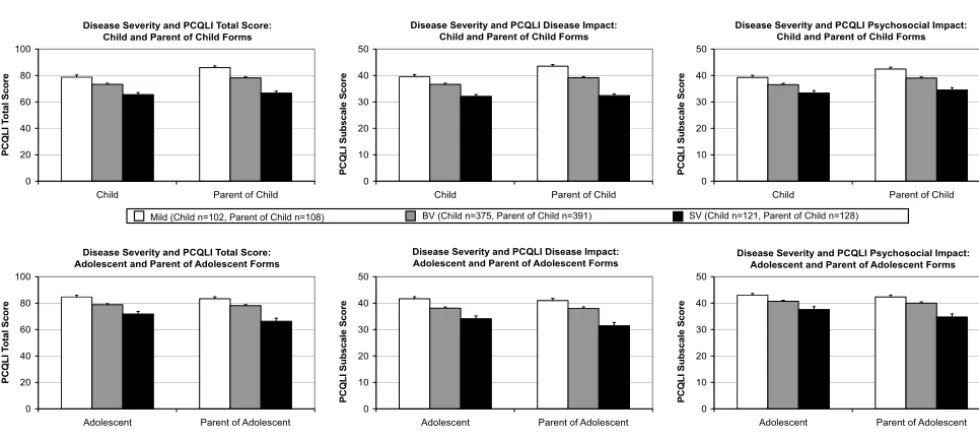
PCQLI scores differed significantly among disease severity subgroups (P ⬍ .001) (Fig 1). Furthermore, pa-tients in the repaired biventricular HD subgroup had significantly lower PCQLI total and subscale scores than did tients in the mild HD subgroup, and pa-tients in the palliated single-ventricle subgroup had significantly lower PCQLI total and subscales scores than did pa-tients in the repaired biventricular HD and mild HD subgroups (P ⱕ .036). These results were consistent across all age categories and respondent types and confirmed quantitatively the widespread, qualitative, clinical obser-vations regarding the association of lower HRQoL with increased disease severity.
Variation of PCQLI Scores With Medical Care Utilization
TABLE 1 Subject Demographic, Diagnostic, and Medical Information
Children (N⫽803)
Parents/Guardians of Children (N⫽803)
Adolescents (N⫽802)
Parents/Guardians of Adolescents (N⫽802)
Site-specific enrollment,n(%)
Children’s Hospital of Philadelphia 251 (31.2) 251 (31.2) 325 (40.5) 325 (40.5)
Cincinnati Children’s Hospital Medical Center 164 (20.4) 164 (20.4) 130 (16.2) 130 (16.2)
Children’s Hospital Boston 102 (12.7) 102 (12.7) 105 (13.1) 105 (13.1)
University of Texas Southwestern Medical Center at Dallas 100 (12.5) 100 (12.5) 95 (11.8) 95 (11.8)
Children’s Hospital of Wisconsin 117 (14.6) 117 (14.6) 65 (8.1) 65 (8.1)
University of California, San Francisco, Children’s Hospital 49 (6.1) 49 (6.1) 53 (6.6) 53 (6.6)
Phoenix Children’s Hospital 20 (2.5) 20 (2.5) 29 (3.6) 29 (3.6)
Age, mean⫾SD, y 10.3⫾1.5 41.2⫾6.4 15.7⫾1.6 45.7⫾6.0
Gender,n(%)
Male 433 (53.9) 109 (13.6) 455 (56.7) 138 (17.2)
Female 370 (46.1) 694 (86.4) 347 (43.3) 664 (82.8)
Ethnicity,n(%)
Non-Hispanic 748 (93.2) 764 (95.1) 750 (93.5) 763 (95.1)
Hispanic 52 (6.5) 38 (4.7) 49 (6.1) 37 (4.6)
Unknown/not reported 3 (0.4) 1 (0.1) 3 (0.4) 2 (0.2)
Race,n(%)
White 656 (81.7) 672 (83.7) 673 (83.9) 689 (85.9)
Black 66 (8.2) 65 (8.1) 70 (8.7) 65 (8.1)
Asian 21 (2.6) 20 (2.5) 9 (1.1) 6 (0.7)
American Indian/Native Alaskan 2 (0.2) 2 (0.2) 5 (0.6) 4 (0.5)
Native Hawaiian/other Pacific Islander 1 (0.1) 0 (0.0) 0 (0.0) 0 (0.0)
⬎1 race/other 56 (7.0) 42 (5.2) 44 (5.5) 36 (4.5)
Unknown/not reported 1 (0.1) 2 (0.2) 1 (0.1) 2 (0.2)
Level of education for patient,n(%)
Kindergarten to grade 5 639 (79.6) NA 4 (0.5) NA
Grades 6–8 162 (20.2) NA 284 (35.4) NA
Grades 9–12 2 (0.2) NA 463 (57.7) NA
GED/high school or technical/trade school graduate 0 (0.0) NA 37 (4.6) NA
Some college or training after high school 0 (0.0) NA 9 (1.1) NA
Other 0 (0.0) NA 5 (0.6) NA
Special educational programs,n(%)
Individualized education plan 100 (12.5) NA 98 (12.2) NA
Learning supports (tutor or learning disability services) 105 (13.1) NA 81 (10.1) NA
Special education and mainstream classes (both part-time) 65 (8.1) NA 63 (7.9) NA
Special education classes (part-time) without mainstream classes 4 (0.5) NA 9 (1.1) NA
Self-contained special education classroom (full-time) 14 (1.7) NA 13 (1.6) NA
Gifted program 84 (10.5) NA 115 (14.3) NA
None 507 (63.1) NA 497 (62.0) NA
Primary residence,n(%)
Both parents 621 (77.3) NA 573 (71.4) NA
Mother 97 (12.1) NA 117 (14.6) NA
Father 17 (2.1) NA 18 (2.2) NA
Mother plus other 44 (5.5) NA 61 (7.6) NA
Father plus other 4 (0.5) NA 8 (1.0) NA
Shared care (⬃50/50) 13 (1.6) NA 15 (1.9) NA
Neither parent (lives with guardian) 7 (0.9) NA 9 (1.1) NA
Relationship of parent/guardian to patient,n(%)
Mother NA 685 (85.3) NA 659 (82.2)
Father NA 105 (13.1) NA 132 (16.5)
Grandparent NA 10 (1.2) NA 7 (0.9)
Legal guardian, related or nonrelated NA 3 (0.4) NA 3 (0.4)
Other NA 0 (0.0) NA 1 (0.1)
Level of education for parent/guardian,n(%)
Kindergarten to grade 6 NA 1 (0.1) NA 1 (0.1)
Grades 7–9 NA 10 (1.2) NA 7 (0.9)
Grades 10–11 NA 23 (2.9) NA 20 (2.5)
High school graduate/GED NA 137 (17.1) NA 177 (22.1)
Some college or trade school NA 215 (26.8) NA 207 (25.8)
College graduate NA 294 (36.6) NA 276 (34.4)
Comparison of Patient and Parent PCQLI Scores
Comparison of child and parent-of-child PCQLI scores revealed moderate correlations, as follows: disease im-pact subscale scores, 0.55; psychoso-cial impact subscale scores, 0.41; total scores, 0.50 (N⫽759;P⬍.001). Com-parison of adolescent and parent-of-adolescent PCQLI scores revealed moderate to good correlations, as fol-lows: disease impact subscale scores, 0.61; psychosocial impact subscale scores, 0.45; total scores, 0.56 (N ⫽ 748;P⬍.001).
Association of PCQLI Scores With Generic HRQoL and Non–QoL Scores
The associations between PCQLI
scores and PedsQL, SPPC/SPPA, and YSR/CBCL scores were statistically sig-nificant (P ⬍ .0001) (Table 3). Good correlations existed between PCQLI and PedsQL scores; correlation coeffi-cients ranged from 0.61 (child PCQLI
disease impact subscale scores ver-sus PedsQL physical health summary scores) to 0.76 (adolescent PCQLI total scores versus PedsQL total scores). PCQLI total scores were moderately correlated with SPPC/SPPA global self-worth scores for both age groups. Fair correlations between PCQLI total scores and YSR/CBCL total compe-tency scores were noted, and fair to moderate inverse correlations existed between PCQLI total scores and both YSR/CBCL internalizing problems sum-mary scale scores and DSM-IV scale scores for all groups.
Reliability Analyses
The median interim time between baseline testing and retesting was 18 days (range: 10 – 42 days). Test-retest reliability correlations were excellent (correlations: ⱖ0.70), and all Spear-man intrarater correlation coeffi-cients were statistically significant (P⬍.001) (Table 4).
DISCUSSION
This large, multicenter study showed that lower HRQoL was associated with greater disease severity and medical care utilization, poorer patient self-perception and competency, and in-creased behavioral and emotional problems in the pediatric cardiac pop-ulation. These data substantiate the validity and reliability of PCQLI scores in a geographically diverse patient population and support the use of the PCQLI for HRQoL assessment among children and adolescents (8 –18 years of age) with congenital or acquired HD in clinical and research settings.11
PCQLI assessment may identify oppor-tunities to improve the HRQoL of pedi-atric patients with HD. PCQLI scores were inversely related to increasing medical care utilization (cardiac oper-ations, HD-related hospitalizations, and physician visits in the previous 12 months). This relationship parallels
TABLE 1 Continued
Children (N⫽803)
Parents/Guardians of Children (N⫽803)
Adolescents (N⫽802)
Parents/Guardians of Adolescents (N⫽802)
Hollingshead socioeconomic status score, mean NA 47.0 NA 46.5
Current medications
Takingⱖ1 medication on regular basis,n(%) 445 (55.4) NA 470 (58.6) NA
No. of medications per patient, median (range) 1 (0–18) NA 1 (0–18) NA
Original diagnostic category,n(%)
Biventricular CHD without AAO 420 (52.3) NA 374 (46.6) NA
Biventricular CHD with AAO 83 (10.3) NA 72 (9.0) NA
Single-ventricle CHD without AAO 69 (8.6) NA 49 (6.1) NA
Single-ventricle CHD with AAO 67 (8.3) NA 35 (4.4) NA
AHD with structurally normal heart 164 (20.4) NA 272 (33.9) NA
Current cardiac status,n(%)
Unrepaired CHD 108 (13.4) NA 97 (12.1) NA
Repaired biventricular CHD 390 (48.6) NA 343 (42.8) NA
Palliated single-ventricle CHD 130 (16.2) NA 74 (9.2) NA
Heart transplant 24 (3.0) NA 29 (3.6) NA
AHD without intervention 89 (11.1) NA 150 (18.7) NA
AHD with intervention 62 (7.7) NA 109 (13.6) NA
Significant medical history,n(%)
History of cerebrovascular event 10 (1.2) NA 78 (9.7) NA
History of seizures 11 (1.4) NA 85 (10.6) NA
Diagnosed learning disability 152 (18.9) NA 235 (29.3) NA
Diagnosed mental health disorder 22 (2.7) NA 26 (3.2) NA
Premature birth (⬍37 wk of gestation) 238 (29.6) NA 126 (15.7) NA
Multiple gestation 82 (10.2) NA 16 (2.0) NA
Age at cardiac diagnosis of⬍30 d 529 (65.9) NA 396 (49.4) NA
Age at cardiac diagnosis of⬎1 y 178 (22.2) NA 278 (34.7) NA
findings by Josie et al22for the pediat-ric asthma population. Because the medical care utilization required to maximize overall outcomes varies ac-cording to patient, disease type, and treatment group, the PCQLI may iden-tify opportunities to alter the timing, manner, and intensity of care to best balance required care and HRQoL. In addition, the PCQLI may identify patient predictors of lower HRQoL that may be more amenable to modification than clinical factors. In particular, psycho-social factors may allow for interven-tion, because lower PCQLI scores were associated with poorer self-perception, lower competency, and in-creased behavioral and emotional problems. Identification of modifiable psychosocial, neurodevelopmental, and physical morbidity factors with the PCQLI may permit interventions that improve HRQoL in the pediatric HD population.
PCQLI scores may be used to improve pa-tient care and HRQoL. In addition to iden-tifying patients who have poorer HRQoL scores, the PCQLI may detect areas for improvement in communication be-tween patients, parents, and care pro-viders that may affect overall manage-ment.23Moons et al6determined that, of 70 QoL studies concerning the pediatric cardiac population published between 1980 and 2003, only 1 measured patient-perceived HRQoL. This lack of patient self-assessment is problematic, because the perceptions of patients and parents re-garding patient HRQoL are similar but not the same. PCQLI assessment of the perceptions of both patients and parents might be valuable to practitioners be-cause it would identify instances of dis-parate perspectives.23 Understanding the perspectives of the patient, parent, and practitioner is crucial to the devel-opment of a patient care plan and may improve treatment adherence.24–26
In conjunction with its clinical uses,
the PCQLI may improve
patient-TABLE 2 Primary Diagnoses for Patients
n(%)
Children (N⫽803)
Adolescents (N⫽802)
Total (N⫽1605)
Septal defects 127 (15.8) 71 (8.9) 198 (12.3)
Atrial septal defect (patent foramen ovale, secundum, primum, or sinus venosus)
46 29 75
Ventricular septal defect (single or multiple) 66 39 105
Atrioventricular septal defect (complete or transitional) 12 3 15
Aortopulmonary window 3 0 3
Pulmonary venous anomalies 6 (0.8) 9 (1.1) 15 (0.9)
Partial anomalous pulmonary venous connection 3 3 6
Total anomalous pulmonary venous connection 3 6 9
Right heart lesions 138 (17.2) 115 (14.3) 253 (15.8)
Tetralogy of Fallot 52 46 98
Tetralogy of Fallot with pulmonary atresia 16 9 25
Tetralogy of Fallot with absent pulmonary valve 6 3 9
Pulmonary atresia with intact ventricular septum 15 14 29
Ebstein anomaly 15 9 24
Tricuspid stenosis 1 0 1
Pulmonary stenosis, valvar 29 28 57
Pulmonary artery stenosis, branch 1 4 5
Double-chambered right ventricle 3 2 5
Left heart lesions 81 (10.1) 105 (13.1) 186 (11.6)
Aortic stenosis 47 42 89
Aortic insufficiency 4 3 7
Aortic insufficiency and aortic stenosis 4 8 12
Mitral stenosis 3 5 8
Mitral regurgitation 6 12 18
Mitral valve prolapse (without moderate or greater mitral regurgitation)
2 8 10
Bicuspid aortic valve (nonobstructive) 13 27 40
Other outflow-tract abnormalities in left ventricle 2 0 2
Single ventricle 119 (14.8) 81 (10.1) 200 (12.5)
Hypoplastic left heart syndrome 39 23 62
Single-ventricle, double-inlet left ventricle 20 11 31
Single-ventricle, double-inlet right ventricle 0 3 3
Single-ventricle, mitral atresia (not hypoplastic left heart syndrome or double-outlet right ventricle/mitral atresia)
10 10 20
Single-ventricle, tricuspid atresia 22 18 40
Single-ventricle, unbalanced atrioventricular canal 12 9 21
Single-ventricle, right ventricle-aorta with pulmonary atresia 13 6 19
Single-ventricle, superoinferior ventricle (with or without straddling tricuspid valve)
3 1 4
Conotruncal anomalies 75 (9.3) 64 (8.0) 139 (8.7)
Transposition of great arteries 54 46 100
Double-outlet right ventricle 11 6 17
Truncus arteriosus 10 12 22
Thoracic arteries and veins 94 (11.7) 90 (11.2) 184 (11.5)
Coronary artery anomaly 8 6 14
Coarctation of aorta 65 62 127
Interrupted aortic arch 5 6 11
Patent ductus arteriosus 7 2 9
Vascular rings and slings (with or without tracheal stenosis) 1 1 2
Aortic root/ascending aorta dilation 8 13 21
Electrophysiologic conditions 121 (15.1) 193 (24.1) 314 (19.6)
Sinus node dysfunction 2 0 2
First-degree atrioventricular block 0 2 2
Second-degree atrioventricular block 2 3 5
Complete atrioventricular block 26 29 55
Supraventricular tachycardia 41 67 108
centered research. The variation be-tween PCQLI and PedsQL scores sug-gests that different information is obtained by using the disease-specific PCQLI measure. From a research per-spective, this implies that use of both generic and disease-specific HRQoL as-sessment tools would be advisable. A generic measure would allow for com-parison of HRQoL between a disease-specific group and healthy children
and/or children with other chronic dis-eases. In addition, a disease-specific measure such as the PCQLI may detect small but important changes in HRQoL over time or differences among clini-cally relevant subgroups and/or treat-ment regimens.
The ability of a disease-specific HRQoL instrument to distinguish among clini-cally meaningful subgroups within
a particular disease population is critically important. Disease-specific HRQoL measures used in adult cardi-ac27,28 and chronic pediatric noncar-diac22,29,30 disease populations can discriminate between discrete disease-specific subgroups across a wide age range, irrespective of respondent type (patient or parent). The pediatric car-diac disease-specific HRQoL tools cur-rently available (ConQoL Index and PedsQL 3.0 cardiac module) can distin-guish among disease severity sub-groups but only within select subsets of a study population (eg, age or re-spondent type).9,10In contrast, PCQLI to-tal and subscale scores can differenti-ate between congenital HD severity subgroups irrespective of age cate-gory, score examined, or respondent type. From a research perspective, this is an important development that should facilitate cross-sectional and prospective studies of HRQoL in clini-cally important subgroups in the pedi-atric HD population.
This study has several inherent limita-tions. The study population was pre-dominantly white, with few Hispanic,
TABLE 2 Continued
n(%)
Children (N⫽803)
Adolescents (N⫽802)
Total (N⫽1605)
Ventricular tachycardia 7 16 23
Long QT syndrome 37 54 91
Premature ventricular contractions 4 5 9
Vasodepressor syncope 2 15 17
Cardiomyopathy 29 (3.6) 57 (7.1) 86 (5.4)
Cardiomyopathy, dilated 17 30 47
Cardiomyopathy, hypertrophic 7 24 31
Cardiomyopathy, restrictive 5 3 8
Other 13 (1.6) 17 (2.1) 30 (1.9)
Pericarditis 1 1 2
Endocarditis 2 3 5
Kawasaki disease 5 6 11
Aneurysm, ventricular 1 1 2
Cardiac tumor 1 3 4
Pulmonary hypertension, primary 2 3 5
Myocardial infraction 1 0 1
Disease Severity and PCQLI Total Score: Child and Parent of Child Forms
0 20 40 60 80 100
Child Parent of Child
P C Q L I T o ta l S c o re
Disease Severity and PCQLI Disease Impact: Child and Parent of Child Forms
0 10 20 30 40 50
Child Parent of Child
P C Q L I Subscale S c ore
Disease Severity and PCQLI Psychosocial Impact: Child and Parent of Child Forms
0 10 20 30 40 50
Child Parent of Child
P C Q L I Su b scale S c o re
Disease Severity and PCQLI Total Score: Adolescent and Parent of Adolescent Forms
0 20 40 60 80 100
Adolescent Parent of Adolescent
PC Q L I T o tal Sco re
Disease Severity and PCQLI Disease Impact: Adolescent and Parent of Adolescent Forms
0 10 20 30 40 50
Adolescent Parent of Adolescent
PC QL I S u b s c a le Sc o re
Disease Severity and PCQLI Psychosocial Impact: Adolescent and Parent of Adolescent Forms
0 10 20 30 40 50
Adolescent Parent of Adolescent
PC QL I S u b s c a le Sc o re
BV (Child n=375, Parent of Child n=391)
Mild (Child n=102, Parent of Child n=108) SV (Child n=121, Parent of Child n=128)
BV (Adolescent n=336, Parent of Adolescent n=331)
Mild (Adolescent n=94, Parent of Adolescent n=88) SV (Adolescent n=72, Parent of Adolescent n=72)
FIGURE 1
Asian, or Native American participants, and was restricted to English-speaking patients and parents. The majority of patients lived in 2-parent households. In addition, parent respondents were predominantly mothers. Furthermore, the parent respondent population had above-average socioeconomic status and educational backgrounds. Be-cause any of these factors may poten-tially restrict the external validity of the PCQLI, additional research is
re-quired to substantiate the PCQLI for general application.
CONCLUSIONS
PCQLI scores were inversely corre-lated with increased disease severity and medical care utilization, poorer self-perception and competency, and increased behavioral and emotional problems. PCQLI scores were valid and reliable for children and adolescents (8 –18 years of age) with HD. The ability
Cardiac Surgeries: Child and Parent of Child Forms
0 20 40 60 80 100
0 1 2 3 4+
Number of Cardiac Surgeries
PC Q L I T o ta l S c or e
Child (n=771) Parent of Child (n=802)
Cardiac-related Hospital Admissions: Child and Parent of Child Forms
0 20 40 60 80 100
0 1 2-5 6-10 11+
Number of Cardiac-related Hospital Admissions
PC Q L I T o ta l S c or e
Child (n=770) Parent of Child (n=801)
Doctor Visits: Child and Parent of Child Forms
0 20 40 60 80 100
0 1 2 3-5 6-11 12+
Number of Doctor Visits in Last 12 Months
PC Q L I T o ta l S c or e
Child (n=771) Parent of Child (n=800)
Cardiac Surgeries: Adolescent and Parent of Adolescent Forms
0 20 40 60 80 100
0 1 2 3 4+
Number of Cardiac Surgeries
PC Q L I T ot a l Sc or e
Adolescent (n=787) Parent of Adolescent (n=767)
Cardiac-related Hospital Admissions: Adolescent and Parent of Adolescent Forms
0 20 40 60 80 100
0 1 2-5 6-10 11+
Number of Cardiac-related Hospital Admissions
PC Q L I T ot a l Sc or e
Adolescent (n=788) Parent of Adolescent (n=768)
Doctor Visits:
Adolescent and Parent of Adolescent Forms
0 20 40 60 80 100
0 1 2 3-5 6-11 12+
Number of Doctor Visits in Last 12 Months
PC Q L I T ot a l Sc or e
Adolescent (n=787) Parent of Adolescent (n=767)
FIGURE 2
Variation of PCQLI total scores with medical care utilization factors. Values are expressed as means, with error bars representing SEMs. All comparisons were significant (P⬍.001).
TABLE 3 Association of PCQLI Scores With Generic HRQoL and Non–QoL Scores
Instrument Score PCQLI Score Spearman Correlation Coefficients
Child Parent of Child Adolescent Parent of
Adolescent
PedsQL N⫽760 N⫽765 N⫽778 N⫽765
Total Total 0.70 0.70 0.76 0.72
Physical health summary Disease impact subscale 0.61 0.67 0.67 0.68
Psychosocial health summary Psychosocial impact subscale 0.64 0.62 0.69 0.64
SPPC/SPPA N⫽758 N⫽743
Global self-worth Total 0.46 0.43
YSR/CBCL N⫽277a N⫽754 N⫽759 N⫽733
Total competency Total 0.33 0.33 0.28 0.37
Internalizing problems Total ⫺0.51 ⫺0.52 ⫺0.58 ⫺0.54
DSM-IV
Affective disorder Total ⫺0.54 ⫺0.47 ⫺0.56 ⫺0.52
Anxiety disorder Total ⫺0.41 ⫺0.45 ⫺0.41 ⫺0.41
Somatic disorder Total ⫺0.33 ⫺0.34 ⫺0.39 ⫺0.38
Attention-deficit/hyperactivity disorder Total ⫺0.34 ⫺0.30 ⫺0.30 ⫺0.37
All Spearman correlation coefficients were statistically significant (P⬍.001).
aThe child sample for the YSR was limited to children 11 to 12 years of age, because the YSR is designed for patients 11 to 18 years of age.
TABLE 4 PCQLI Test-Retest Reliability
PCQLI Form N Spearman Correlation Coefficients PCQLI Disease Impact Subscale Score PCQLI Psychosocial Impact Subscale Score PCQLI Total Score
Child 291 0.82 0.78 0.82 Parent of child 290 0.87 0.82 0.86 Adolescent 194 0.87 0.84 0.88 Parent of
adolescent
190 0.90 0.83 0.89
of the PCQLI to distinguish among population subgroups irrespective of score examined, age category, or re-spondent type represents an advance over currently available pediatric, car-diac disease-specific, HRQoL instru-ments. The external validity and re-sponsiveness of PCQLI scores are being evaluated currently in multi-center studies. The PCQLI should be useful in clinical screening, surveil-lance, and evaluation for clinical man-agement and future research studies for children and adolescents with con-genital or acquired HD.
ACKNOWLEDGMENTS
Research and project support was provided by the National Institute of Child Health and Human Development
(grant 5-K23-HD048637), the American Heart Association, Pennsylvania/Dela-ware Affiliate (now Great Rivers Affiliate) (Beginning Grant-in-Aid 0465467U), the Cincinnati Children’s Hospital Research Foundation, and the Children’s Hospital of Philadelphia In-stitutional Development Fund.
The following persons participated in patient enrollment, data collec-tion, study coordinacollec-tion, or manu-script preparation: Cincinnati Chil-dren’s Hospital Medical Center: Richard Ittenbach, PhD, Shawna Hot-tinger, MS, Katelyn Mellion, BS, Ka-leigh Coughlin, BA, Brett Morgan, BS, Loran Carroll, BS, Melanie Riedel, BS, Michael Whalen, Aimee Baker, MA, Baiyang Wang, MS; Children’s Hospi-tal of Philadelphia: Linda Hurd, MSN,
CRNP, Janice Prodell, RN, Lynda Ahearn, RN, Lydia Kruge, BA, Anita Pu-dusseri, BS, Darryl Powell, Andrew Schissler, BSE, Josie Welkom, BA, Stanley O. Dunn, BA; Children’s Hospi-tal Boston: Annette Baker, MSN, CRNP, Jill Cotter, BA, Danielle Martin, BA, Erica Denhoff, BA, Ellen McGrath, BSN; University of California, San Francisco, Children’s Hospital: David Teitel, MD, Laura Robertson, MD; Phoenix Children’s Hospital: Melissa Hill, PA-C; Children’s Hospital of
Wisconsin: Stuart Berger, MD,
Nancy Ghanayem, MD, Lisa Young-Borkowski, MSN, Mary Krolikowski, MSN, Angie Klemm, Mara Koffarnus; University of Texas Southwestern Medical Center at Dallas: Gloria Wil-liams, BA.
REFERENCES
1. Lloyd-Jones D, Adams R, Carnethon M, et al. Heart disease and stroke statistics: 2009 update: a report from the American Heart Association Statistics Committee and Stroke Statistics Subcommittee. Circula-tion. 2009;119(3):480 – 486
2. Bellinger DC, Wypij D, duPlessis AJ, et al. Neurodevelopmental status at eight years in children with dextro-transposition of the great arteries: the Boston Circulatory Ar-rest Trial.J Thorac CardiovascSurg. 2003; 126(5):1385–1396
3. Mahle WT, Clancy RR, Moss EM, Gerdes M, Jobes DR, Wernovsky G. Neurodevelopmen-tal outcome and lifestyle assessment in school-aged and adolescent children with hypoplastic left heart syndrome.Pediatrics. 2000;105(5):1082–1089
4. Drotar D.Measuring Health-Related Quality of Life in Children and Adolescents. Mah-wah, NJ: Erlbaum; 1998
5. Higginson IJ, Carr AJ. Measuring quality of life: using quality of life measures in the clinical setting. BMJ. 2001;322(7297): 1297–1300
6. Moons P, Van Deyk K, Budts W, De Geest S. Caliber of quality-of-life assessments in congenital heart disease: a plea for more conceptual and methodological rigor.Arch
Pediatr Adolesc Med. 2004;158(11):
1062–1069
7. Janse AJ, Uiterwaal CS, Gemke RJ, Kimpen JL, Sinnema G. A difference in perception of quality of life in chronically ill children was
found between parents and pediatricians.J Clin Epidemiol. 2005;58(5):495–502
8. Kendall L, Lewin RJ, Parsons JM, Veldtman GR, Quirk J, Hardman GE. Factors associ-ated with self-perceived state of health in adolescents with congenital cardiac dis-ease attending paediatric cardiologic clin-ics.Cardiol Young. 2001;11(4):431– 438
9. Macran S, Birks Y, Parsons J, et al. The de-velopment of a new measure of quality of life for children with congenital cardiac dis-ease.Cardiol Young. 2006;16(2):165–172
10. Uzark K, Jones K, Burwinkle TM, Varni JW. The Pediatric Quality of Life Inventory in chil-dren with heart disease.Prog Pediatr Car-diol. 2003;18(2):141–148
11. Marino BS, Shera D, Wernovsky G, et al. The development of the Pediatric Cardiac Qual-ity of Life Inventory: a qualQual-ity of life measure for children and adolescents with heart dis-ease.Qual Life Res. 2008;17(4):613– 626
12. Uzark K, Jones K, Slusher J, Limbers CA, Bur-winkle TM, Varni JW. Quality of life in chil-dren with heart disease as perceived by children and parents. Pediatrics. 2008; 121(5). Available at: www.pediatrics.org/ cgi/content/full/121/5/e1060
13. Varni JW, Seid M, Rode CA. The PedsQL: mea-surement model for the Pediatric Quality of
Life Inventory. Med Care. 1999;37(2):
126 –139
14. Harter S.Manual for the Self-Perception Profile for Children. Denver, CO: University of Denver; 1985
15. Harter S.Manual for the Self-Perception Profile for Adolescents. Denver, CO: Univer-sity of Denver; 1985
16. Achenbach T.Child Behavior Checklist for Ages 6 –18. Burlington, VT: University of Vermont; 2001
17. Achenbach T.Youth Self-Report for Ages 1 1–18. Burlington, VT: University of Vermont; 2001
18. Landis JR, Koch GG. The measurement of ob-server agreement for categorical data. Bio-metrics. 1977;33(1):159 –174
19. Holm S. A simple sequentially rejective mul-tiple test procedure. Scand J Stat. 1979; 6(2):65–70
20. Zimmerman DW, Williams RH. Properties of the Spearman correction for attenuation for normal and realistic non-normal distri-butions.Appl Psychol Measure. 1997;21(3): 271–278
21. Nunnally JC.Psychometic Theory. 2nd ed. New York, NY: McGraw-Hill; 1978
22. Josie KL, Greenley RN, Drotar D. Health-related quality-of-life measures for children with asthma: reliability and validity of the Children’s Health Survey for Asthma and the Pediatric Quality of Life Inventory 3.0 Asthma Module.Ann Allergy Asthma Immu-nol. 2007;98(3):218 –224
2009;123(4). Available at: www.pediatrics. org/cgi/content/full/123/4/e708
24. McAllister S, Buckner EB, White-Williams C. Medication adherence after heart transplantation: adolescents and their
issues. Prog Transplant. 2006;16(4):
317–323
25. Byrne A, MacDonald J, Buckley S. Reading, language and memory skills: a comparative longitudinal study of children with Down syndrome and their mainstream peers.Br J Educ Psychol. 2002;72(4):513–529
26. Lawrence K, Stilley CS, Olshansky E, Bender A, Webber SA. Further exploration: maturity and adherence in adolescent and young adult heart transplant recipients. Prog Transplant. 2008;18(1):50 –54
27. Middel B, Bouma J, de Jongste M, et al. Psy-chometric properties of the Minnesota Liv-ing with Heart Failure Questionnaire (MLHF-Q).Clin Rehabil. 2001;15(5):489 –500
28. Green CP, Porter CB, Bresnahan DR, Spertus JA. Development and evaluation of the Kansas City Cardiomyopathy Questionnaire: a new health
status measure for heart failure.J Am Coll Car-diol. 2000;35(5):1245–1255
29. Quittner AL, Buu A, Messer MA, Modi AC, Watrous M. Development and validation of the Cystic Fi-brosis Questionnaire in the United States: a health-related quality-of-life measure for cystic fibrosis.Chest. 2005;128(4):2347–2354
30. Wallenstein GV, Carranza-Rosenzweig J, Ko-sinski M, Blaisdell-Gross B, Gajria K, Jhing-ran P. A psychometric comparison of three patient-based measures of asthma control. Curr Med Res Opin. 2007;23(2):369 –377
(Continued from first page)
www.pediatrics.org/cgi/doi/10.1542/peds.2009-2973
doi:10.1542/peds.2009-2973
Accepted for publication May 25, 2010
Address correspondence to Bradley S. Marino, MD, MPP, MSCE, Cincinnati Children’s Hospital Medical Center, Department of Pediatrics, 3333 Burnet Ave, MLC 5050, Cincinnati, OH 45229. E-mail: [email protected]
PEDIATRICS (ISSN Numbers: Print, 0031-4005; Online, 1098-4275).
Copyright © 2010 by the American Academy of Pediatrics
FINANCIAL DISCLOSURE:The authors have indicated they have no financial relationships relevant to this article to disclose.
DOI: 10.1542/peds.2009-2973 originally published online August 30, 2010;
2010;126;498
Pediatrics
of Life Inventory Testing Study Consortium
Mark A. Helfaer, Anne E. Kazak, Judy A. Shea and for the Pediatric Cardiac Quality
Charlotte Andersen, David Shera, Philip R. Khoury, Jo Wray, J. William Gaynor,
Newburger, Lynn Mahony, Kathleen Mussatto, Elizabeth Tong, Mitchell Cohen,
Services
Updated Information &
http://pediatrics.aappublications.org/content/126/3/498
including high resolution figures, can be found at:
References
http://pediatrics.aappublications.org/content/126/3/498#BIBL
This article cites 22 articles, 3 of which you can access for free at:
Subspecialty Collections
http://www.aappublications.org/cgi/collection/cardiology_sub Cardiology
following collection(s):
This article, along with others on similar topics, appears in the
Permissions & Licensing
http://www.aappublications.org/site/misc/Permissions.xhtml
in its entirety can be found online at:
Information about reproducing this article in parts (figures, tables) or
Reprints
http://www.aappublications.org/site/misc/reprints.xhtml
DOI: 10.1542/peds.2009-2973 originally published online August 30, 2010;
2010;126;498
Pediatrics
of Life Inventory Testing Study Consortium
Mark A. Helfaer, Anne E. Kazak, Judy A. Shea and for the Pediatric Cardiac Quality
Charlotte Andersen, David Shera, Philip R. Khoury, Jo Wray, J. William Gaynor,
Newburger, Lynn Mahony, Kathleen Mussatto, Elizabeth Tong, Mitchell Cohen,
Bradley S. Marino, Ryan S. Tomlinson, Gil Wernovsky, Dennis Drotar, Jane W.
Validation of the Pediatric Cardiac Quality of Life Inventory
http://pediatrics.aappublications.org/content/126/3/498
located on the World Wide Web at:
The online version of this article, along with updated information and services, is
by the American Academy of Pediatrics. All rights reserved. Print ISSN: 1073-0397.