Optimal Design of FIR Filter Using
Weighted Least Square Error Method
MEENU GARG
Electronics and communication, P.T.U, P.C.E.T, Mohali Mohali, State- Punjab, India
[email protected] DR.VIJAY KUMAR
Electronics and communication, P.T.U, P.C.E.T, Mohali Mohali, State- Punjab, India
[email protected] Abstract :
In this paper, a method for design of FIR Filters is proposed. The design method is based on Weighted Least Square (WLS) optimization. In this algorithm, Newton and Quasi-Newton method is used. The main reason to formulate and solve the design problem in a WLS optimization formulation is that the complementarily conditions associated with the WLS optimization lead to a very small number of non-zero Lagrange multipliers that need to be updated in a given iteration. This in turn improves design efficiency as well as the algorithm’s numerical stability which is of critical importance for the design filter. Simulation results with comparisons are presented to illustrate the effectiveness of the proposed method. In this thesis from pole zero plots, the stability in WLS optimization technique is much higher than in the traditional method of optimization (Parks-McClellan algorithm).From the simulation results, WLS technique is better than Parks McClellan Algorithm. WLS method reduces the ripple in the interpolated frequency response.
Keywords : Filter; Optimization technique; BER. 1. Introduction FIR of digital signal processing
The origin of digital signal processing (DSP) techniques can be traced back to the seventeenth century when finite difference modern computational power has given us the ability to process tremendous amounts of data in real‐time. DSP is found in a wide variety of applications, such as: filtering, speech recognition, image enhancement etc. such as linear‐phase filters [1]. Signals from the real world are naturally analog in form, so it must first be converted into discrete sampled for a digital computer to understand and manipulate. The signals are discretely sampled and quantized, and the data is represented in binary format so that the noise margin is overcome. This makes DSP algorithms insensitive to thermal noise. Further, DSP algorithms are predictable and repeatable to the exact bits given the same inputs. This has the advantage of easy simulation and short design time [6]. Additionally, if a prototype is shown to function correctly, then subsequent devices will also. Over the past several decades the field of Digital Signal Processing (DSP) has grown to important both theoretically and technologically.
2. Design of digital filter
Design is possible depending on the type of FIR filter required and the formulation of the objective function. The one design aspect of digital filters that can be handled quite efficiently with optimization is the approximation problem whereby the parameters of the filter have to be chosen to achieve a specified type of frequency response [9]. In one design, weighted least square objective function is formulated.
FIR filter is completely specified by its transfer function which assumes the form
0
( )
N n n n
H z
h z
Where the coefficients hn for n = 0, 1, . . . , n represent the impulse response of the filter.
characterizes the filter [5]. Under these circumstances, a weighted least-squares objective function that can be used to design FIR filters can be constructed as
2 2
0
( )
x
W
( )
H
( )
H
d( )
d
where x = [h0 h1……….hN]T is an N + 1-dimensional variable vector representing the transfer function
coefficients, ωis a normalized frequency variable which is assumed to be in the range 0 to πrad/s, and W(ω) is a predefined weighting function. The design is accomplished by finding the vector x∗that minimizes
(x), and this can be efficiently done by means of unconstrained optimization. Weighting is used to emphasize or deemphasize the objective function with respect to one or more ranges of ω. Without weighting, an optimization algorithm would tend to minimize the objective function uniformly with respect to ω.An important step in an organization – based design is to express the objective function in terms of variable vector x explicitly. This facilitates the evaluation of the gradient and Hessian of the objective function. To this end, if consider
The weighted integral square error (or “L2 error") is defined as
2 2
0
( )
d( )
( )
W
H
H
d
Where
( )
d
H
: The actual amplitude response( )
H
: The ideal amplitude response W (ω): nonnegative weighting functionThe weighting function can be used to assign more importance to specific parts of the frequency response. 3. Optimization technique
The optimization is a process of obtaining the ‘best’, if it is possible to measure and change what is ‘good’ or ‘bad’. In practice, one wishes the ‘most’ or ‘maximum’ (e.g., salary) or the ‘least’ or ‘minimum’ (e.g., expenses).Therefore, the word ‘optimum’ is taken to mean ‘maximum’ or ‘minimum’ depending on the circumstances; ‘optimum’ is a technical term which implies quantitative measurement and is a stronger word than ‘best’ which is more appropriate for everyday use. Likewise, the word ‘optimize’, which means to achieve an optimum, is a stronger word than ‘improve’. Optimization theory is the branch of mathematics encompassing the quantitative study of optima and methods for finding them. Optimization practice, on the other hand, is the collection of techniques, methods, procedures and algorithms that can be used to find the optima [2]. Optimization problems occur in most disciplines like engineering, physics, mathematics, economics, administration, commerce, social sciences, and even politics. Optimization problems abound in the various fields of engineering like electrical, mechanical, civil, chemical, and building engineering. Typical areas of application are modeling, characterization, and design of devices, circuits and systems; design of tools, instruments, and equipment; design of structures and buildings; process control; approximation theory, curve fitting, solution of systems of equations; forecasting, production scheduling, quality control; maintenance and repair; inventory control, accounting, budgeting, etc [7]. Some recent innovations rely almost entirely on optimization theory, for example, neural networks and adaptive systems. In this paper weighted least square error technique is being used for optimization.
3.1 Weighted Least Square (WLS) Optimization
Weighted least square optimization is the nonlinear optimization technique in which Newton method and Quasi Network methods are apply in sequence for the solution of problem.
3.1.a. Newton method
The steepest-descent method is a first-order method since it is based on the linear approximation of the Taylor series. A second-order method known as the Newton (also known as the Newton-Rap son) method can be developed by using the quadratic approximation of the Taylor series. If δis a change in x, f(x + δ) is given by
2
1 1 1
1
(
)
( )
2
n n n
i i j
j i i j i j
f
f
f x
f x
x
x x
3.1.b.Quasi newton method
The basic principle in quasi-Newton methods is that the direction of search is based on an n × n direction matrix S which serves the same purpose as the inverse Hessian in the Newton method [4]. This matrix is generated from available data and is contrived to be an approximation of H−1. Furthermore, as the number of iterations is increased, S becomes progressively a more accurate representation of H−1and for convex quadratic objective functions it becomes identical to H−1 in n + 1 iterations. Quasi-Newton methods, like most other methods, are developed for the convex quadratic problem and are then extended to the general problem. The rank among the most efficient methods available and is used extensively in numerous applications. The Quasi-Newton method is effective in the case of the unconstraint optimization. Its applications in the various fields like mathematics, digital signal processing etc [3].
The Basic Quasi-Newton Approach is given by xk+1 = xk −αkSkgk
Where
for the steepest- descent method
1for the Newton method
n k
k
I
S
H
4. Simulation Results
MATLAB programming is used to evaluate WLS optimization technique and compare it to other optimization technique. This paper compares WLS Optimization Technique with Parks-McClellan algorithm.
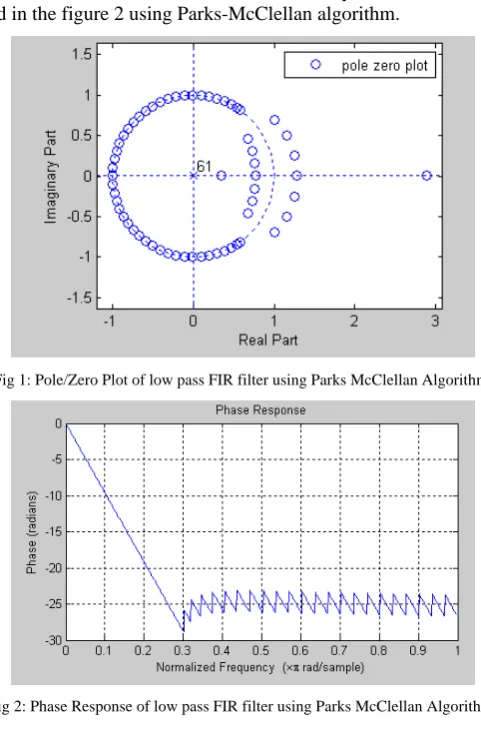
The simulations for the design of low pass FIR digital filter with the window technique are performed using MATLAB. While figure 1 explains the Pole/Zero Plot of low pass FIR digital filter. Pole/Zero Plot of filter explain the stability of the filter. If Poles lie inside the circle, stability of the filter is high. Phase response of low pass FIR filter is discussed in the figure 2 using Parks-McClellan algorithm.
Fig 1: Pole/Zero Plot of low pass FIR filter using Parks McClellan Algorithm.
Fig 2: Phase Response of low pass FIR filter using Parks McClellan Algorithm.
Design of Digital Filter Using Weighted Least Square (WLS) Technique
WLS optimization. It is interesting to note that the equiripple amplitude response is achieved in both pass band and stop band.
Fig 3: Pole/Zero Plot of low pass FIR filter using weighted least square Optimization
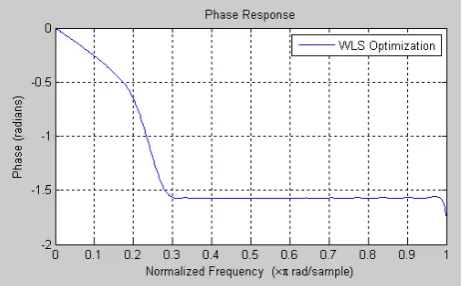
Fig 4: Phase Response of low pass FIR filter using weighted least square Optimization
The results shows the stability in WLS optimization technique is much higher than in the traditional method of optimization (Parks-McClellan algorithm).Simulation results Illustrate that the WLS optimization technique reduces more the group delay as compare to the traditional method of optimization (Parks-McClellan algorithm).
5. Conclusion and Future scope
The Parks-McClellan algorithm and its variant have been most efficient tools for the mini-max design of FIR digital filters. However, these algorithms apply only to the class of linear-phase FIR filters the group delay introduce by these filters is constant and independent of frequency in the entire baseband but it can be quite large but there is a requirement of relatively non-linear FIR filter.. In practice, a variable group delay in stop band is of little concern and by allowing the phase response to be nonlinear in stop bands, FIR filter can be designed with constant group delay with respect to the pass bands which is significantly reduced relative to that achieved with filters that have a constant group delay the entire baseband.
For FIR filter, the weighted L2 error function with an even integer p can be shown to be globally convex. This
Future Scope:
1. Research can be extended in design of FIR filter using various optimization techniques ACO, PSO etc. 2. In further work FIR filters can be design using evolutionary algorithms etc.
References
[1] A. Antoniou, “Digital Signal Processing: Signals, Systems and Filters,” McGraw-Hill, New York, 2005.
[2] A. Antoniou, “Improved mini-max optimization algorithms and their application in the design of recursive digital filters,” Proc. Inst. Elect. Eng., part G, vol. 138, pp. 724–730, Dec. 1991 , pp. 724–730.
[3] C. G. Broyden, “Quasi-Newton methods and their application to function minimization,”Maths. Compute. vol. 21, 1965, pp. 368–381. [4] D. F. Shanno, “Conditioning of quasi-Newton methods for function minimization,”Maths. Comput. vol. 24,1970, pp. 647–656. [5] D.J.Shpak and A. Antoniou, "A generalized Remez method for the design of FIR digital filters," IEEE Trans. Circuits and Systems,
Feb. 1990, pp. 161-174.
[6] E. C. Ifeachor and B. W. Jervis, “Digital Signal Processing,” A Practical Approach, Prentice Hall, 2002.
[7] GanchoI.Venkov,Stela and A.Stefanov,”Recursive digital filter optimization based on simultaneous approximation in frequency and time domain”, Engineering Optimization, 1029-0273, Volume 31, Issue 6,1999, pp. 663 – 677.
[8] I. W. Selesnick and S. Burrus, “Maximally flat low-pass FIR filters with reduced delay,'' IEEE Trans. Circuits Syst. II, vol. 45, no. 1,, 1998,pp. 53—68.