EUKARYOTICCELL, Nov. 2006, p. 1925–1933 Vol. 5, No. 11 1535-9778/06/$08.00⫹0 doi:10.1128/EC.00105-06
Copyright © 2006, American Society for Microbiology. All Rights Reserved.
Effect of Sequence-Directed Nucleosome Disruption on Cell-Type-Specific
Repression by
␣
2/Mcm1 in the Yeast Genome
䌤
Nobuyuki Morohashi,
1Yuichi Yamamoto,
1Shunsuke Kuwana,
1Wataru Morita,
1Heisaburo Shindo,
2Aaron P. Mitchell,
3and Mitsuhiro Shimizu
1*
Department of Chemistry, Meisei University, Hino, Tokyo 191-8506, Japan1; School of Pharmacy, Tokyo University of Pharmacy and
Life Science, Hachioji, Tokyo 192-0392, Japan2; and Department of Microbiology, Columbia University, New York, New York 100323
Received 12 April 2006/Accepted 31 August 2006
InSaccharomyces cerevisiae, a-cell-specific genes are repressed inMAT␣cells by␣2/Mcm1, acting in concert with the Ssn6-Tup1 corepressors and the Isw2 chromatin remodeling complex, and nucleosome positioning has been proposed as one mechanism of repression. However, prior studies showed that nucleosome positioning is not essential for repression by␣2/Mcm1 in artificial reporter plasmids, and the importance of the nucleosome positioning remains questionable. We have tested the function of positioned nucleosomes through alteration of genomic chromatin at the a-cell-specific geneBAR1. We report here that a positioned nucleosome in theBAR1
promoter is disrupted in cis by the insertion of diverse DNA sequences such as poly(dA) · poly(dT) and poly(dC-dG) · poly(dC-dG), leading to inappropriate partial derepression ofBAR1. Also, we show thatisw2
mutation causes loss of nucleosome positioning in BAR1 in MAT␣ cells as well as partial disruption of repression. Thus, nucleosome positioning is required for full repression, but loss of nucleosome positioning is not sufficient to relieve repression completely. Even though disruption of nucleosome positioning by thecis- and
trans-acting modulators of chromatin has a modest effect on the level of transcription, it causes significant degradation of the␣-mating pheromone inMAT␣cells, thereby affecting its cell type identity. Our results illustrate a useful paradigm for analysis of chromatin structural effects at genomic loci.
In Saccharomyces cerevisiae, a-cell-specific genes are
re-pressed inMAT␣cells by the␣2/Mcm1 repressor, in concert with the corepressors Tup1-Ssn6, and several models for re-pression mechanisms have been proposed (46). Tup1-Ssn6 may interact with the general transcriptional machinery to inhibit transcription directly, or it may interfere with transcrip-tional activator function (12, 18, 20, 21, 29, 34). Nucleosomes are precisely positioned in the promoters of a-cell-specific genes in the repressed state inMAT␣cells but are not posi-tioned in the activated state inMATacells (9, 14, 37, 42), and the presence and absence of nucleosome positioning is not a consequence of transcription (9). Tup1 interacts with histones and histone deacetylases (5, 10, 11, 51, 52), and atup1 muta-tion causes both disrupmuta-tion of nucleosome posimuta-tioning and repression (9, 57). Also, the Isw2-Itc1 chromatin remodeling complex (17) is involved in regulation of Tup1-Ssn6-repressed genes (56), includinga-cell-specific genes (16, 38). Thus, it has been proposed that positioned nucleosomes may modulate the accessibility of promoters to transcription factors to repress the genes (44).
However, some studies suggest that nucleosome positioning is not essential for repression by␣2/Mcm1. When thea -cell-specificSTE6TATA box is placed at different locations in a positioned nucleosome and in the internucleosomal linker in
STE6-lacZreporter plasmids, no expression is detectable, even
with the TATA box located in a linker region (31). Nucleo-somes are not positioned in a testCYC1promoter containing
the␣2 operator and Gal4 binding site and Gal4 can occupy its site, even though the test promoter is repressed by␣2/Mcm1 (35).␣2/Mcm1-dependent repression occurs in a naked DNA template in vitro (18). Also, the role of nucleosome positioning in repression of a-cell-specific genes has been examined by introducing mutations in histones and in other factors, such as Tup1, Ssn6, and histone deacetylases (37, 51). However, inter-pretation of these mutations is complicated by the fact that they have highly pleiotropic effects. Thus, although positioned nucleosomes have been observed in a number of promoters in yeast and mammalian cells, the importance of the positioning has remained questionable.
DNA can adopt several types of conformations as dictated by its sequence (45), and genomic analyses show that alterna-tive DNA structure-forming sequences are represented in eu-karyotic genomes (7, 39). Among such sequences, poly(dA) · poly(dT) and poly(dG) · poly(dC) as well as Z-DNA-forming sequences do not form nucleosomes reconstituted from puri-fied histone octamer (2, 6, 15, 43), whereas CTG repeats pref-erentially bind to histone octamers in vitro (50). We have shown that the unusualB⬘ conformation, adopted by longer poly(dA) · poly(dT) sequences, disrupts an array of positioned nucleosomes in yeast cells (41). Poly(dA) · poly(dT) sequences in the yeast HIS3 promoter (19) and the Candida glabrata AMT1gene (58) stimulate transcription by improving accessi-bility to the promoter in vivo. The nucleosome-free sequences were evolutionarily conserved and are enriched in poly(dA) · poly(dT) sequences as revealed by genome-scale analysis of yeast chromosome III (55). Poly(dA) · poly(dT) as well as (CCGNN)n, both of which do not favor nucleosome formation,
can act as efficient boundaries of silent chromatin (4, 54). Z-DNA is required for the activation of the human CSF1
* Corresponding author. Mailing address: Department of Chemis-try, Meisei University, 2-1-1 Hodokubo, Hino, Tokyo 191-8506, Japan. Phone: 81-42-591-7483. Fax: 81-42-591-8181. E-mail: shimizum@chem .meisei-u.ac.jp.
䌤Published ahead of print on 15 September 2006.
1925
on September 8, 2020 by guest
http://ec.asm.org/
promoter by the SWI/SNF-like BAF complex, and it is thought that Z-DNA formation promoted by the BAF complex stabi-lizes the open chromatin structure at the promoter (23, 24). Thus, DNA structural properties may be used to modulate the positioning of nucleosomes in vivo to alter gene expression.
In this report, we have developed a systematic strategy to test critically the role of nucleosome positioning in repression ofa-cell-specific geneBAR1 using nucleosome-disrupting se-quences. We show here that longer poly(dA) · poly(dT) and poly(dC-dG) · poly(dC-dG) inserts block formation of a posi-tioned nucleosome in the promoter to cause partial derepres-sion ofBAR1, while shorter inserts, CTG and GAGCTC re-peats, are incorporated into a positioned nucleosome to maintain the repressedBAR1state. These results indicate that nucleosome positioning contributes to full repression by␣2/ Mcm1, but it is solely responsible for repression.
MATERIALS AND METHODS
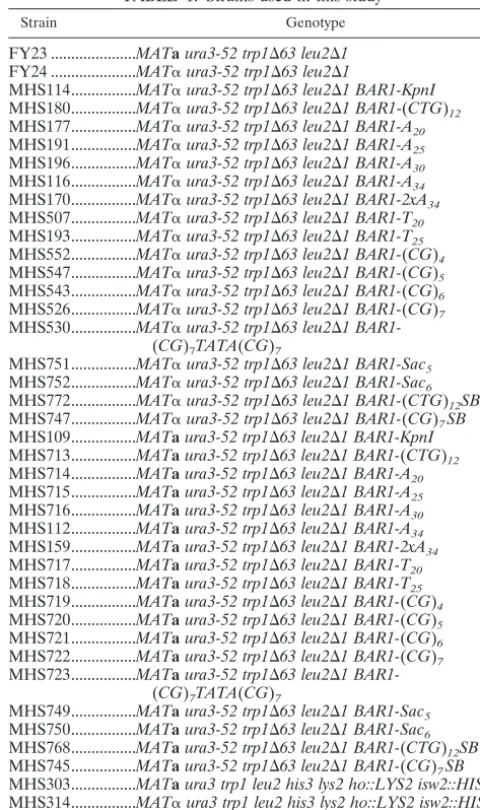
Yeast strains and plasmids.Yeast strains used were FY23 (MATaura3-52 trp1⌬63 leu2⌬1) and FY24 (isogenic to FY23 except forMAT␣), which were obtained from the Yeast Genetics course at Cold Spring Harbor Laboratory. To construct strains with a modifiedBAR1promoter, we cloned the⫺500 to⫹51 region ofBAR1into pRS306⌬KI, a pRS306 derivative in which the KpnI site in pRS306 was filled in, forming pYY1-2. Then, mutations in the sequence AATGT at a region⫺158 to⫺154 to GTACC were introduced to create a KpnI site in theBAR1promoter by PCR, forming pAS1-8. A pair of oligonucleotides syn-thesized chemically was annealed and cloned into the KpnI site of pAS1-8. The portions of theBAR1promoter sequence were replaced with (CTG)12or (CG)7
by two-step PCR, and the modified promoter fragments were recombined with pAS1-8 in vivo in yeast. All the modified promoters were verified by DNA sequencing. Plasmids containing the modifiedBAR1promoters were digested with XbaI and were integrated into the genomicBAR1locus in FY23 and FY24, and the plasmid portions were looped out by two-step gene replacement.isw2⌬ strains, MHS303 and MHS314, were constructed from wxy292 and wxy293, respectively, by one-step gene replacement using pFA6aMXHIS3 (53). Strains constructed in this study are listed in Table 1.
Halo assay.To assay for the generation of␣-factor halo (27),MATasst1cells were grown for 24 h. Aliquots were then diluted to an optical density at 600 nm (OD600) of 0.5, and 100l of the diluted culture (⬃10
6
cells) was spread on a YEPD (1% yeast extract, 2% peptone, 2% glucose) plate and allowed to dry. Spots of strains of interest were grown on YEPD plates overnight, the plates were replica plated to thesst1spread plates, and the replica plates were incu-bated for 2 days.
Northern blot analysis.Cells were grown to an OD600of 0.5 to 1.0, harvested,
and snap-frozen in a dry ice-ethanol bath. RNA was prepared by a hot phenol method (47). Northern blot analysis was performed as described previously (3). ABAR1fragment (⫹1 to⫹500) was prepared by PCR using 5⬘-ATG TCT GCA ATT AAT CAT CTT TGT TTG AAA-3⬘and 5⬘-ACG GGT GTC GTA GCA TAC TTG GCA ACT CCG-3⬘as 5⬘-forward and 3⬘-reverse primers, respectively. A Northern probe forBAR1was prepared by a random priming reaction with the BAR1fragment or anENO1fragment as described elsewhere (3).
Analysis of chromatin structure.Yeast cells were cultured in YEPD medium until the OD600reached⬃1.0. Nuclei were isolated, and micrococcal nuclease
(MNase) digestion proceeded as described previously (41, 42). Cleavage sites for MNase were analyzed by primer extension mapping using a primer with the BAR1⫺391 to⫺357 sequence as described elsewhere (42).
RESULTS
Experimental design.Previous studies indicate that the yeast
␣2/Mcm1 repressor positions nucleosomes adjacent to the␣2 operator in a-cell-specific genes, such as BAR1, STE2, and
STE6, in the genome (9, 14, 37, 42), as well as in yeast minichromosomes containing an␣2 operator (36, 42). Here, we have implemented a strategy to test the functional signifi-cance of the positioned nucleosomes by introducing short,
di-verse nucleosome-disrupting sequences into the BAR1
genomic locus. TheBAR1 promoter was modified by the in-sertion of poly(dA) · poly(dT), poly(dC-dG) · poly(dC-dG), CTG, or GAGCTC repeat sequences (Fig. 1; Table 1) as follows. We cloned the ⫺500 to ⫹51 region of BAR1 in an integrative plasmid and introduced modification into the genomicBAR1
locus by two-step gene replacement. In strains constructed in this study, a KpnI site was created at⫺158 in theBAR1 pro-moter and An(n⫽20, 25, 30, 34), A34GGTACCA34(denoted
as 2xA34), (CG)n(n⫽4 to 7), (CG)7TATA(CG)7[denoted as
(CG)14], (TGC)11T [denoted as (CTG)12, since this insert
be-comes (CTG)12, including the neighboring KpnI sequence],
AC(GAGCTC)5GA (denoted as Sac5), or AC(GAGCTC)6GT
(denoted as Sac6) were inserted into the KpnI site in theBAR1
promoter. Also, portions of the promoter sequence upstream of the KpnI site were replaced with (CTG)12or (CG)7
[de-noted as (CTG)12SB and (CG)7SB, respectively] to maintain
the native distance in theBAR1promoter. We predicted that longer poly(dA) · poly(dT) and poly(dC-dG) · poly(dC-dG) sequences would act as nucleosome-disrupting sequences (2, 6,
TABLE 1. Strains used in this study
Strain Genotype
FY23 ...MATaura3-52 trp1⌬63 leu2⌬1 FY24 ...MAT␣ura3-52 trp1⌬63 leu2⌬1
MHS114...MAT␣ura3-52 trp1⌬63 leu2⌬1 BAR1-KpnI MHS180...MAT␣ura3-52 trp1⌬63 leu2⌬1 BAR1-(CTG)12
MHS177...MAT␣ura3-52 trp1⌬63 leu2⌬1 BAR1-A20
MHS191...MAT␣ura3-52 trp1⌬63 leu2⌬1 BAR1-A25
MHS196...MAT␣ura3-52 trp1⌬63 leu2⌬1 BAR1-A30
MHS116...MAT␣ura3-52 trp1⌬63 leu2⌬1 BAR1-A34
MHS170...MAT␣ura3-52 trp1⌬63 leu2⌬1 BAR1-2xA34
MHS507...MAT␣ura3-52 trp1⌬63 leu2⌬1 BAR1-T20
MHS193...MAT␣ura3-52 trp1⌬63 leu2⌬1 BAR1-T25
MHS552...MAT␣ura3-52 trp1⌬63 leu2⌬1 BAR1-(CG)4
MHS547...MAT␣ura3-52 trp1⌬63 leu2⌬1 BAR1-(CG)5
MHS543...MAT␣ura3-52 trp1⌬63 leu2⌬1 BAR1-(CG)6
MHS526...MAT␣ura3-52 trp1⌬63 leu2⌬1 BAR1-(CG)7
MHS530...MAT␣ura3-52 trp1⌬63 leu2⌬1 BAR1-(CG)7TATA(CG)7
MHS751...MAT␣ura3-52 trp1⌬63 leu2⌬1 BAR1-Sac5
MHS752...MAT␣ura3-52 trp1⌬63 leu2⌬1 BAR1-Sac6
MHS772...MAT␣ura3-52 trp1⌬63 leu2⌬1 BAR1-(CTG)12SB
MHS747...MAT␣ura3-52 trp1⌬63 leu2⌬1 BAR1-(CG)7SB
MHS109...MATaura3-52 trp1⌬63 leu2⌬1 BAR1-KpnI MHS713...MATaura3-52 trp1⌬63 leu2⌬1 BAR1-(CTG)12
MHS714...MATaura3-52 trp1⌬63 leu2⌬1 BAR1-A20
MHS715...MATaura3-52 trp1⌬63 leu2⌬1 BAR1-A25
MHS716...MATaura3-52 trp1⌬63 leu2⌬1 BAR1-A30
MHS112...MATaura3-52 trp1⌬63 leu2⌬1 BAR1-A34
MHS159...MATaura3-52 trp1⌬63 leu2⌬1 BAR1-2xA34
MHS717...MATaura3-52 trp1⌬63 leu2⌬1 BAR1-T20
MHS718...MATaura3-52 trp1⌬63 leu2⌬1 BAR1-T25
MHS719...MATaura3-52 trp1⌬63 leu2⌬1 BAR1-(CG)4
MHS720...MATaura3-52 trp1⌬63 leu2⌬1 BAR1-(CG)5
MHS721...MATaura3-52 trp1⌬63 leu2⌬1 BAR1-(CG)6
MHS722...MATaura3-52 trp1⌬63 leu2⌬1 BAR1-(CG)7
MHS723...MATaura3-52 trp1⌬63 leu2⌬1 BAR1-(CG)7TATA(CG)7
MHS749...MATaura3-52 trp1⌬63 leu2⌬1 BAR1-Sac5
MHS750...MATaura3-52 trp1⌬63 leu2⌬1 BAR1-Sac6
MHS768...MATaura3-52 trp1⌬63 leu2⌬1 BAR1-(CTG)12SB
MHS745...MATaura3-52 trp1⌬63 leu2⌬1 BAR1-(CG)7SB
MHS303...MATaura3 trp1 leu2 his3 lys2 ho::LYS2 isw2::HIS3 MHS314...MAT␣ura3 trp1 leu2 his3 lys2 ho::LYS2 isw2::HIS3
on September 8, 2020 by guest
http://ec.asm.org/
15, 41, 43, 48), whereas (CTG)12and mixed sequences Sac5
and Sac6would serve as control inserts, since CTG and GA
GCTC repeats were shown previously to be incorporated into nucleosomes (41, 50).
Effect of introduced sequences on BAR1 expression. We examined the effect of nucleosome-disrupting sequences, such as poly(dA) · poly(dT) and poly(dC-dG) · poly(dC-dG), on repression ofBAR1inMAT␣cells through a halo assay (27), which reflects degradation of the ␣ mating pheromone (␣ -factor) by theBAR1product, a protease. In this assay, strains to be tested for␣-factor production were replica plated onto a lawn of the tester strain (MATasst1), which is supersensitive to
␣-factor (8); a zone of growth inhibition (halo) in thesst1cells surrounding a tested colony indicates that the colony secretes
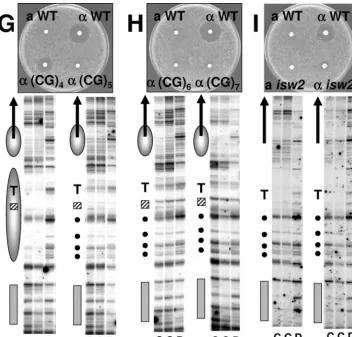
␣-factor. If BAR1were derepressed in MAT␣ cells, ␣-factor would degraded and the size of the halo would be diminished. A halo was observed around control wild-typeMAT␣cells (␣ WT) but not wild-typeMATacells (aWT), as expected (Fig. 2A, upper portion). Halo size was unaffected by introduction of the KpnI site into theBAR1promoter (data not shown) or the insertion of control sequences (CTG)12, Sac5, or Sac6(Fig.
2B and 3). Insertion of A20also had no effect on halo
forma-tion, but increased length of An(nⱖ25) decreased the halo
size (Fig. 2C to E), indicating that these longer Antract
inser-tions caused derepression. In addition to length, the orienta-tion of poly(dA) · poly(dT) also affected derepression. Inter-estingly, Tntracts (i.e., the T tract on the top strand ofBAR1)
were more effective than Antracts of identical length in
caus-ingBAR1 derepression (Fig. 2C and F, compare ␣ T20and
␣T25with␣A20and␣A25). Thus, in both orientations, poly
(dA) · poly(dT) increased expression of BAR1. (CG)n also
derepressed BAR1, as shown in Fig. 2G and H. The mating factor halo was undetectable after insertion of (CG)6or (CG)7,
and halo size was noticeably diminished by insertion of (CG)4
or (CG)5. Thus, (CG)nacts as a more powerful disruptor than
An; the insertion of only⬃10 to 14 bp leads to derepression of
BAR1.
We evaluated the effect of spacing between the␣2 operator and the TATA box that is altered by the insertions. First, three control inserts, (CTG)12(34 bp), Sac5(34 bp), and Sac6(40
bp), did not affect repression, as revealed by the halo assay (Fig. 3). This result indicates that spacing alone does not re-lieve repression. Second, we replaced a portion of the pro-moter sequence with (CTG)12 or (CG)7 to maintain native
distance between the␣2 operator and the coding region (Fig. 1, bottom). Halo size was unaffected by the (CTG)12
substitu-tion, whereas it was severely diminished by the (CG)7
substi-tution (Fig. 3), which agreed with the results for the insertion of (CTG)12 and (CG)7. Thus, the substitutions of these
se-quences caused the same effect as the insertions (Fig. 2B and H), indicating that changes in promoter distance of the ␣2 operator from the TATA box are not required to cause changes in repression. Furthermore, it should be noted that the derepression level ofBAR1increased as the length of (CG)n
(insertions of 8, 10, 12, 14, and 32 bp) increased, as shown by Northern analysis (see Fig. 4, below). Thus, changes in the helical orientation of the␣2 operator and TATA box do not affect repression. Therefore, derepression must result from the nature of the inserted sequences, rather than their effects on overall promoter length.
We examinedBAR1expression by Northern blot analysis to confirm our interpretation of the halo assays (Fig. 4). There was strong expression ofBAR1mRNA in the controlMATa
WT strain, whereas no signal was detected in MAT␣ WT,
MAT␣ Kpn,MAT␣ (CTG)12,MAT␣A20, MAT␣ A25, MAT␣
T20, andMAT␣(CG)4strains.BAR1mRNA was detectable to
some extent (1 to 15% of full expression in MATa WT) in
MAT␣A30,MAT␣A34,MAT␣2xA34,MAT␣T25, andMAT␣
(CG)n(nⱖ5) strains. Even though mRNA levels are low in
these strains,BAR1expression is sufficient to cause substantial
␣-factor degradation. Thus, the halo assay seems more sensi-tive than Northern analysis for monitoring changes inBAR1
expression. Importantly, in keeping with the halo assays in Fig. 2, the derepressed mRNA levels showed length dependence for poly(dA) · poly(dT) and poly(dC-dG) · poly(dC-dG), and (CG)naffectedBAR1expression more than Anor Tn. We also
examined expression from the modifiedBAR1promoters in a set ofMATastrains in order to determine whether the inserted sequences cause adventitious promoter activation (Fig. 4). The level ofBAR1 mRNA in this series of MATa strains varied from 1.0- to 1.6-fold above the level in theMATaWT strain. Given thatBAR1 mRNA is undetectable in the MAT␣ WT
FIG. 1. Experimental design for this study. Nucleosomes (gray el-lipses) are positioned at theBAR1promoter inMAT␣cells from the␣2 operator (␣2 op) to the coding region, and the TATA box (T) is incorporated into the positioned nucleosome (42). The genomicBAR1 promoter was modified to examine the effect of nucleosome destabi-lization. The nucleosome-disrupting sequences [poly(dA) · poly(dT) or poly(dC-dG) · poly(dC-dG)], a nucleosome-incorporating sequence, (TGC)11T [denoted as (CTG)12; see text], or mixed sequences CA (GAGCTC)5GA and CA(GAGCTC)6GT (denoted as Sac5and Sac6, respectively) were inserted into the KpnI site (⫺158) in the BAR1 promoter in the genome. Portions of theBAR1promoter sequence upstream of the KpnI site were replaced with (CTG)12 or (CG)7 [denoted as (CTG)12SB and (CG)7SB, respectively, as indicated by a box with SB] to maintain the native distance in theBAR1promoter.
VOL. 5, 2006 SEQUENCE-DIRECTED CHROMATIN DISRUPTION AND REPRESSION 1927
on September 8, 2020 by guest
http://ec.asm.org/
1928
on September 8, 2020 by guest
strain, we infer that the derepression caused by active inser-tions is much greater than 1.6-fold. These results indicate that the insertion of nucleosome-disrupting sequences partially de-repressesBAR1in its native genomic context inMAT␣cells.
Chromatin alteration in theBAR1promoter by introduced sequences. We analyzed the chromatin structure of the genomicBAR1promoter region by limited digestion of nuclei with MNase and subsequent high-resolution primer extension mapping (Fig. 2, lower portions). TheBAR1promoter region was cut with MNase in WT MATa cells, in which BAR1 is expressed, whereas a region of about 140 bp adjacent to the␣2 operator was protected from MNase digestion in WTMAT␣
cells, as indicated by a comparison of digested purified DNA (lanes marked “D”) and digested chromatin (lanes marked “C”) (Fig. 2A). These results indicate that nucleosomes are positioned adjacent to the␣2 operator inMAT␣cells but are not positioned inMATacells, in good agreement with previous
studies (9, 14, 37, 42, 44). The effects of promoter insertions on chromatin structure were monitored by the patterns of MNase cleavage between the␣2 operator and TATA box (Fig. 2), the region in which the sequences were inserted. Insertion of con-trol (CTG)12or shorter inserts, A20and (CG)4, did not
signif-icantly affect formation of positioned nucleosomes (Fig. 2B, C, and G). However, insertion of longer An· Tn(n ⱖ 25)
se-quences inMAT␣cells led to increasing the MNase cleavage sites characteristic of MATa cell chromatin (Fig. 2C to F). Similarly, the MNase cleavage sites became stronger as the length of (CG)n(nⱖ5) tracts increased (Fig. 2G and H).
The nucleosome positioning adjacent to the␣2 operator was destabilized to roughly the same extent by these longer An, Tn, and (CG)nsequences, although (CG)ninserts caused
greater derepression ofBAR1than Anor Tn. At present, it
is uncertain why the magnitude of derepression caused by poly(dA) · poly(dT) and poly(dC-dG) · poly(dC-dG) is
dif-FIG. 2. Chromatin alteration by alternative DNA structure-forming sequences disrupts repression of thea-specific geneBAR1in the yeast genome. Expression ofBAR1, as analyzed by halo assay, is shown in photographs of plates. Increased expression ofBAR1inMAT␣cells reduces the halo size, as explained in the text.aWT and␣WT are wild-type strains. The designations (CTG)12, An, Tn, and (CG)nrefer to the top-strand
sequences inserted into theBAR1promoter.MATaisw2andMAT␣isw2are isogenicisw2⌬mutant strains with a wild-typeBAR1promoter sequence. Autoradiograms of primer extension mapping of MNase cleavage sites in the genomicBAR1gene are shown under the halo assay plates. MNase cleavage sites downstream of the␣2 operator were mapped. In each set of data, lanes labeled C indicate MNase digestion of isolated nuclei (chromatin) at two nuclease levels, and lanes labeled D indicate MNase digestion of the naked DNA as a control. Locations of the␣2 operator (␣2 op; gray shaded box), TATA box (marked with T), inserts (hatched box), the coding region ofBAR1(arrows), and positioned nucleosomes (gray ellipses) are shown on the left side of each gel. An ellipse with a dotted line indicates a nucleosome whose positioning is uncertain in the MAT␣2xA34strain (E). Black circles on the left side of the gels indicate characteristic cleavage sites between the␣2 operator and TATA box in wild-typeMATacells.
VOL. 5, 2006 SEQUENCE-DIRECTED CHROMATIN DISRUPTION AND REPRESSION 1929
on September 8, 2020 by guest
http://ec.asm.org/
ferent. It is possible that the types of alternative structures (B⬘conformation or Z-DNA) or intrinsic structural proper-ties (local distortion and stiffness) may cause this effect. Our studies indicate that loss of nucleosome positioning is usu-ally accompanied by partial relief of cell-type-specific re-pression of BAR1, as shown by halo assay and Northern analysis, although there is no simple relationship between the magnitudes of the two effects.
Chromatin alteration and derepression ofBAR1in anisw2
mutant.The Isw2 chromatin remodeling complex is required for nucleosome positioning by Crt1 and Tup1 at the DNA damage-inducible geneRNR3 (12, 16, 57) and for normal chromatin structure of the a-cell-specific gene STE6 in
MAT␣ cells (12, 16, 57). In addition, repression of a -cell-specific genes requires Itc1 (38), a subunit of the Isw2 com-plex (17). These prior studies suggest that anisw2⌬ muta-tion might have an effect similar to nucleosome-disrupting sequences atBAR1.
Figure 2I shows the halo assay and mapping of MNase cleavage sites atBAR1inisw2⌬isogenic strains. The halo assay indicates thatBAR1is derepressed in aMAT␣isw2⌬strain, in keeping with the report by Ruiz et al. (38) that anitc1mutation
causes derepression ofa-cell-specific genesASG7,BAR1, and
STE2. Decrease in the halo size in theMAT␣isw2strain (Fig. 2I) was similar to that inMAT␣ A30, MAT␣ T25, andMAT␣
(CG)5strains (Fig. 2D, F, and G). In addition,BAR1mRNA in
the MAT␣ isw2⌬ strain was detectable to the same extent (2.3% of full expression inMATaWT) as in these strains (Fig. 4). As seen in Fig. 2I, the MNase cleavage pattern is nearly identical in MATa and MAT␣ isw2⌬ strains. These results reveal that the Isw2 chromatin remodeling complex is required for nucleosome positioning at the genomic BAR1 locus in
MAT␣cells and that anisw2mutation does not have a signif-icant effect on the BAR1 transcription level. This result is consistent with a report by Zhang and Reese (57) that nucleo-some positioning in the DNA damage-inducible geneRNR3is disrupted byisw2mutation, but the level ofRNR3mRNA was only slightly increased.
DISCUSSION
We have shown here that both the integrity of the positioned nucleosomes and MAT␣ cell-type-dependent repression of
BAR1respond to the samecis-andtrans-acting modulators of
FIG. 3. Lack of effect of the distance of the␣2 operator from the TATA box and of the helical orientation of the␣2 operator with respect to the TATA box, as revealed by the halo assay. The designations Sac5and Sac6refer to CA(GAGCTC)5GA and CA(GAGCTC)6GT insertion, respectively, into the KpnI site (⫺158) in theBAR1promoter. The designations (CTG)12SB and (CG)7SB refer to the replacement of existing promoter sequence upstream of the KpnI site with (CTG)12and (CG)7, respectively, to maintain the native distance between the␣2 operator and the TATA box.aand␣indicate the mating types of the strains.
on September 8, 2020 by guest
http://ec.asm.org/
chromatin structure. The sequences we have used are diverse, yet both poly(dA) · poly(dT) and poly(dC-dG) · poly(dC-dG) share the ability to disrupt a positioned nucleosome and to cause inappropriate activation ofBAR1. Even though chroma-tin alteration shows a modest effect on the level of BAR1
mRNA, it has a significant biological consequence, that is, it causes substantial degradation of the␣-mating pheromone in
MAT␣ cells, thereby affecting its cell type identity. Thus, the most economical model to explain our data is that nucleosome positioning directly contributes to complete repression of the genomicBAR1locus by␣2/Mcm1.
However, loss of nucleosome positioning is not sufficient to relieve repression of BAR1 completely. One reason for this could be explained by the absence of activator function of Mcm1 in MAT␣ cells; Mcm1 acts as an activator fora -cell-specific genes inMATacells, whereas it acts as a repressor with
␣2 inMAT␣cells. Since Tup1 has high affinity for underacety-lated histones and histone deacetylases (5, 10, 11, 52), com-plete relief of chromatin-mediated repression may require not only loss of nucleosome positioning but also other activities, such as action of a histone acetyltransferase.
The residual repression that persists despite the disruption
of nucleosome positioning is also likely to be achieved by chromatin-independent mechanisms of Tup1-Ssn6 action (29, 56). Two additional mechanisms have been proposed for re-pression by ␣2/Mcm1: activator interference (20), in which Ssn6-Tup1 exerts repression while the activator still occupies its target DNA site (35), and general transcription machinery interference, in which Ssn6-Tup1 inhibits the transcription machinery directly and independently of chromatin or acti-vators (18, 29). Our findings here do not rule out any re-pression mechanism. Rather, our results provide support for the contribution of nucleosome positioning to a-specific gene repression.
We note that insertions of longer An, Tn, or (CG)n
se-quences primarily disrupt one nucleosome in the promoter, while nucleosome positioning is preserved in the coding re-gion. Interestingly, the coding region is separated from the␣2 operator by the disrupted nucleosome. This may be explained by the fact that the Isw2 complex is associated with the entire region of theRNR3gene (57) and that the Isw2 complex slides nucleosomes to remodel chromatin structure (12, 13). Thus, it is likely that the insertions disrupt only one nucleosome prox-imal to the site, and the preserved nucleosome positioning in
FIG. 4. Northern blot analysis ofBAR1. Strains analyzed are indicated above each lane. The designations of strains are described in the legend of Fig. 2, except for (CG)14, which refers to (CG)7TATA(CG)7inserted into theBAR1promoter. Northern blots were probed with theBAR1probe and then stripped and reprobed with theENO1probe as a loading control, which is not regulated by mating type. TheBAR1mRNA levels, which are shown under theBAR1blot, were determined as theBAR1/ENO1ratio by using a phosphorimager and were normalized to the intensity of theMATaWT strain, set as 100. These normalized ratios are shown at the bottom of theBAR1blot.
VOL. 5, 2006 SEQUENCE-DIRECTED CHROMATIN DISRUPTION AND REPRESSION 1931
on September 8, 2020 by guest
http://ec.asm.org/
theBAR1coding region may be mediated by the Isw2 complex. This explanation is consistent with our results showing that the chromatin structure ofBAR1is nearly identical betweenMATa
WT,MATaisw2, andMAT␣isw2(no positioned nucleosomes). It may seem possible that proteins that bind to poly(dA) · poly(dT) or poly(dC-dG) · poly(dC-dG) compete with binding of histone octamer; hence, the effects of these sequences might not be a consequence of intrinsic DNA structural properties. Alternatively, the absence of nucleosome positioning might be a consequence of affecting the ability of the␣2/Mcm1 complex to recruit Ssn6/Tup1. However, the idea that DNA structural properties alter nucleosome positioning is founded on several lines of evidence. We and others previously demonstrated that longer Antracts exist as an unusualB⬘conformation to create
a nucleosome-free region in yeast cells (41, 48). Consistent with these reports, we found here that disruption of nucleo-some positioning and derepression ofBAR1showed a length dependent of the Antract, indicating that theB⬘conformation
excludes histone octamers from the promoter. Interestingly, Tn
disruptsBAR1repression more effectively than An, as
moni-tored in the halo assay. This difference in orientation can be explained by the fact that the unusual conformation of poly(dA) · poly(dT) is asymmetric; that is, the minor groove narrows asymmetrically from the 3⬘end towards the 5⬘end of a Tnstretch (1, 25, 28). Also,BAR1expression was not affected
by thedat1⌬mutation (data not shown), which lacks the only known poly(dA) · poly(dT) binding protein inS. cerevisiae(33). As for poly(dC-dG) · poly(dC-dG), its effects may be explained by the fact that (CG)nin the Z-form is not incorporated into
nucleosomes in vitro (2, 6, 15). The length of (CG)nis critical
for Z-DNA formation and stability in vivo (32), and the B-Z transition occurs from (CG)4to (CG)5at natural superhelical
densities (22). Also, CG repeats longer than (CG)6can form
Z-DNA stably in vivo in yeast cells (30). These studies argue that it is the Z-DNA conformation of (CG)n (n ⱖ 5) that
disrupts nucleosome positioning at the genomic BAR1 pro-moter, though the existence of Z-DNA formation in theBAR1
promoter was uncertain in the present study. We cannot rule out a contribution of sequence-dependent general properties of the inserted DNA that may alter nucleosome organization (26, 40, 49). Whatever the structure of (CG)n in the BAR1
locus is, the key feature is that poly(dC-dG) · poly(dC-dG) as well as poly(dA) · poly(dT) sequences disrupt nucleosome po-sitioning in a genomic context to alter gene expression. The intrinsic properties of these sequences make them useful tools for inquiring into local chromatin function in diverse cells and organisms as well as for artificial alteration of gene expression in vivo.
ACKNOWLEDGMENTS
We thank Toshiki Kobayashi, Atsushi Sato, Yukino Mukai, and Mayu Yamaguchi for technical assistance in constructions of plasmids and strains in their undergraduate studies, Daichi Kurihara for con-struction ofisw2⌬strains, and Karen Barwell and Clarissa Nobile for their help in Northern blot analysis. We thank Robert D. Wells of Texas A&M University for stimulating discussion and useful com-ments.
This work was supported, in part, by a JSPS research grant to M.S. and by NIH grants RO1 GM39531 and AI070272 to A.P.M.
REFERENCES
1.Alexeev, D. G., A. A. Lipanov, and I. Skuratovskii.1987. Poly(dA) · poly(dT) is a B-type double helix with a distinctively narrow minor groove. Nature 325:821–823.
2.Ausio, J., G. Zhou, and K. van Holde.1987. A reexamination of the reported B-Z DNA transition in nucleosomes reconstituted with poly(dG-m5dC) ·
poly(dG-m5dC). Biochemistry26:5595–5599.
3.Barwell, K. J., J. H. Boysen, W. Xu, and A. P. Mitchell.2005. Relationship ofDFG16to the Rim101p pH response pathway inSaccharomyces cerevisiae andCandida albicans. Eukaryot. Cell4:890–899.
4.Bi, X., Q. Yu, J. J. Sandmeier, and Y. Zou.2004. Formation of boundaries of transcriptionally silent chromatin by nucleosome-excluding structures. Mol. Cell. Biol.24:2118–2131.
5.Bone, J. R., and S. Y. Roth.2001. Recruitment of the yeast Tup1p-Ssn6p repressor is associated with localized decreases in histone acetylation. J. Biol. Chem.276:1808–1813.
6.Casasnovas, J. M., and F. Azorin.1987. Supercoiled induced transition to the Z-DNA conformation affects the ability of a d(CG/GC)12sequence to be
organized into nucleosome-cores. Nucleic Acids Res.15:8899–8918. 7.Champ, P. C., S. Maurice, J. M. Vargason, T. Camp, and P. S. Ho.2004.
Distributions of Z-DNA and nuclear factor I in human chromosome 22: a model for coupled transcriptional regulation. Nucleic Acids Res.32:6501– 6510.
8.Chan, R. K., and C. A. Otte.1982. Isolation and genetic analysis of Saccha-romyces cerevisiaemutants supersensitive to G1arrest by a factor and␣factor
pheromones. Mol. Cell. Biol.2:11–20.
9.Cooper, J. P., S. Y. Roth, and R. T. Simpson.1994. The global transcriptional regulators, SSN6 and TUP1, play distinct roles in the establishment of a repressive chromatin structure. Genes Dev.8:1400–1410.
10.Davie, J. K., D. G. Edmondson, C. B. Coco, and S. Y. Dent.2003. Tup1-Ssn6 interacts with multiple class I histone deacetylasesin vivo. J. Biol. Chem. 278:50158–50162.
11.Edmondson, D. G., M. M. Smith, and S. Y. Roth.1996. Repression domain of the yeast global repressor Tup1 interacts directly with histones H3 and H4. Genes Dev.10:1247–1259.
12.Fazzio, T. G., M. E. Gelbart, and T. Tsukiyama.2005. Two distinct mecha-nisms of chromatin interaction by the Isw2 chromatin remodeling complex in vivo. Mol. Cell. Biol.25:9165–9174.
13.Fazzio, T. G., and T. Tsukiyama.2003. Chromatin remodelingin vivo: evi-dence for a nucleosome sliding mechanism. Mol. Cell12:1333–1340. 14.Ganter, B., S. Tan, and T. J. Richmond.1993. Genomic footprinting of the
promoter regions of STE2andSTE3genes in the yeast Saccharomyces cerevisiae. J. Mol. Biol.234:975–987.
15.Garner, M. M., and G. Felsenfeld.1987. Effect of Z-DNA on nucleosome placement. J. Mol. Biol.196:581–590.
16.Gelbart, M. E., N. Bachman, J. Delrow, J. D. Boeke, and T. Tsukiyama.2005. Genome-wide identification of Isw2 chromatin-remodeling targets by local-ization of a catalytically inactive mutant. Genes Dev.19:942–954. 17.Gelbart, M. E., T. Rechsteiner, T. J. Richmond, and T. Tsukiyama.2001.
Interactions of Isw2 chromatin remodeling complex with nucleosomal arrays: analyses using recombinant yeast histones and immobilized templates. Mol. Cell. Biol.21:2098–2106.
18.Herschbach, B. M., M. B. Arnaud, and A. D. Johnson.1994. Transcriptional repression directed by the yeast␣2 proteinin vitro. Nature370:309–311. 19.Iyer, V., and K. Struhl.1995. Poly(dA:dT), a ubiquitous promoter element
that stimulates transcription via its intrinsic DNA structure. EMBO J.14: 2570–2579.
20.Keleher, C. A., C. Goutte, and A. D. Johnson.1988. The yeast cell-type-specific repressor␣2 acts cooperatively with a non-cell-type-specific protein. Cell53:927–936.
21.Keleher, C. A., M. J. Redd, J. Schultz, M. Carlson, and A. D. Johnson.1992. Ssn6-Tup1 is a general repressor of transcription in yeast. Cell68:709–719. 22.Kim, J., C. Yang, and S. DasSarma.1996. Analysis of left-handed Z-DNA formation in short d(CG)nsequences inEscherichia coliandHalobacterium
halobium plasmids. Stabilization by increasing repeat length and DNA supercoiling but not salinity. J. Biol. Chem.271:9340–9346.
23.Liu, H., N. Mulholland, H. Fu, and K. Zhao.2006. Cooperative activity of BRG1 and Z-DNA formation in chromatin remodeling. Mol. Cell. Biol. 26:2550–2559.
24.Liu, R., H. Liu, X. Chen, M. Kirby, P. O. Brown, and K. Zhao.2001. Regulation of CSF1 promoter by the SWI/SNF-like BAF complex. Cell 106:309–318.
25.Lyamichev, V.1991. Unusual conformation of (dA)n· (dT)n-tracts as
re-vealed by cyclobutane thymine-thymine dimer formation. Nucleic Acids Res. 19:4491–4496.
26.Mai, X., S. Chou, and K. Struhl.2000. Preferential accessibility of the yeast his3promoter is determined by a general property of the DNA sequence, not by specific elements. Mol. Cell. Biol.20:6668–6676.
27.Manney, T. R.1983. Expression of theBAR1gene inSaccharomyces cerevi-siae: induction by the␣mating pheromone of an activity associated with a secreted protein. J. Bacteriol.155:291–301.
on September 8, 2020 by guest
http://ec.asm.org/
28.McConnell, K. J., and D. L. Beveridge.2001. Molecular dynamics simula-tions of B⬘-DNA: sequence effects on A-tract-induced bending and flexibil-ity. J. Mol. Biol.314:23–40.
29.Mennella, T. A., L. G. Klinkenberg, and R. S. Zitomer.2003. Recruitment of Tup1-Ssn6 by yeast hypoxic genes and chromatin-independent exclusion of TATA binding protein. Eukaryot. Cell2:1288–1303.
30.Oh, D. B., Y. G. Kim, and A. Rich.2002. Z-DNA-binding proteins can act as potent effectors of gene expression in vivo. Proc. Natl. Acad. Sci. USA 99:16666–16671.
31.Patterton, H. G., and R. T. Simpson.1994. Nucleosomal location of the STE6TATA box and Mat␣2p-mediated repression. Mol. Cell. Biol.14:4002– 4010.
32.Rahmouni, A. R., and R. D. Wells.1989. Stabilization of Z DNAin vivoby localized supercoiling. Science246:358–363.
33.Reardon, B. J., D. Gordon, M. J. Ballard, and E. Winter.1995. DNA binding properties of the Saccharomyces cerevisiae DAT1gene product. Nucleic Acids Res.23:4900–4906.
34.Redd, M. J., M. B. Arnaud, and A. D. Johnson.1997. A complex composed of tup1 and ssn6 represses transcriptionin vitro. J. Biol. Chem.272:11193– 11197.
35.Redd, M. J., M. R. Stark, and A. D. Johnson.1996. Accessibility of␣ 2-repressed promoters to the activator Gal4. Mol. Cell. Biol.16:2865–2869. 36.Roth, S. Y., A. Dean, and R. T. Simpson.1990. Yeast␣2 repressor positions
nucleosomes in TRP1/ARS1 chromatin. Mol. Cell. Biol.10:2247–2260. 37.Roth, S. Y., M. Shimizu, L. Johnson, M. Grunstein, and R. T. Simpson.1992.
Stable nucleosome positioning and complete repression by the yeast␣2 repressor are disrupted by amino-terminal mutations in histone H4. Genes Dev.6:411–425.
38.Ruiz, C., V. Escribano, E. Morgado, M. Molina, and M. J. Mazon.2003. Cell-type-dependent repression of yeast a-specific genes requires Itc1p, a subunit of the Isw2p-Itc1p chromatin remodelling complex. Microbiology 149:341–351.
39.Schroth, G. P., and P. S. Ho.1995. Occurrence of potential cruciform and H-DNA forming sequences in genomic DNA. Nucleic Acids Res.23:1977– 1983.
40.Sekinger, E. A., Z. Moqtaderi, and K. Struhl.2005. Intrinsic histone-DNA interactions and low nucleosome density are important for preferential ac-cessibility of promoter regions in yeast. Mol. Cell18:735–748.
41.Shimizu, M., T. Mori, T. Sakurai, and H. Shindo.2000. Destabilization of nucleosomes by an unusual DNA conformation adopted by poly(dA) · poly(dT) tractsin vivo. EMBO J.19:3358–3365.
42.Shimizu, M., S. Y. Roth, C. Szent-Gyorgyi, and R. T. Simpson.1991. Nu-cleosomes are positioned with base pair precision adjacent to the␣2 oper-ator inSaccharomyces cerevisiae. EMBO J.10:3033–3041.
43.Simpson, R. T., and P. Kunzler.1979. Chromatin and core particles formed
from the inner histones and synthetic polydeoxyribonucleotides of defined sequence. Nucleic Acids Res.6:1387–1415.
44.Simpson, R. T., S. Y. Roth, R. H. Morse, H. G. Patterton, J. P. Cooper, M. Murphy, M. P. Kladde, and M. Shimizu.1993. Nucleosome positioning and transcription. Cold Spring Harbor Symp. Quant. Biol.58:237–245. 45.Sinden, R. R. 1994. DNA structure and function. Academic Press, San
Diego, Calif.
46.Smith, R. L., and A. D. Johnson.2000. Turning genes off by Ssn6-Tup1: a conserved system of transcriptional repression in eukaryotes. Trends Bio-chem. Sci.25:325–330.
47.Spellman, P. T., G. Sherlock, M. Q. Zhang, V. R. Iyer, K. Anders, M. B. Eisen, P. O. Brown, D. Botstein, and B. Futcher. 1998. Comprehensive identification of cell cycle-regulated genes of the yeast Saccharomyces cer-evisiae by microarray hybridization. Mol. Biol. Cell9:3273–3297. 48.Suter, B., G. Schnappauf, and F. Thoma.2000. Poly(dA · dT) sequences exist
as rigid DNA structures in nucleosome-free yeast promotersin vivo. Nucleic Acids Res.28:4083–4089.
49.Thastrom, A., L. M. Bingham, and J. Widom.2004. Nucleosomal locations of dominant DNA sequence motifs for histone-DNA interactions and nu-cleosome positioning. J. Mol. Biol.338:695–709.
50.Wang, Y. H., S. Amirhaeri, S. Kang, R. D. Wells, and J. D. Griffith.1994. Preferential nucleosome assembly at DNA triplet repeats from the myotonic dystrophy gene. Science265:669–671.
51.Watson, A. D., D. G. Edmondson, J. R. Bone, Y. Mukai, Y. Yu, W. Du, D. J. Stillman, and S. Y. Roth.2000. Ssn6-Tup1 interacts with class I histone deacetylases required for repression. Genes Dev.14:2737–2744.
52.Wu, J., N. Suka, M. Carlson, and M. Grunstein.2001. TUP1 utilizes histone H3/H2B-specific HDA1 deacetylase to repress gene activity in yeast. Mol. Cell7:117–126.
53.Xu, W., and A. P. Mitchell.2001. Yeast PalA/AIP1/Alix homolog Rim20p associates with a PEST-like region and is required for its proteolytic cleav-age. J. Bacteriol.183:6917–6923.
54.Yu, Q., J. Sandmeier, H. Xu, Y. Zou, and X. Bi.2006. Mechanism of the long range anti-silencing function of targeted histone acetyltransferases in yeast. J. Biol. Chem.281:3980–3988.
55.Yuan, G. C., Y. J. Liu, M. F. Dion, M. D. Slack, L. F. Wu, S. J. Altschuler, and O. J. Rando.2005. Genome-scale identification of nucleosome positions inS. cerevisiae. Science309:626–630.
56.Zhang, Z., and J. C. Reese.2004. Redundant mechanisms are used by Ssn6-Tup1 in repressing chromosomal gene transcription inSaccharomyces cerevisiae. J. Biol. Chem.279:39240–392450.
57.Zhang, Z., and J. C. Reese.2004. Ssn6-Tup1 requires the ISW2 complex to position nucleosomes inSaccharomyces cerevisiae. EMBO J.23:2246–2257. 58.Zhu, Z., and D. J. Thiele.1996. A specialized nucleosome modulates tran-scription factor access to aC. glabrata metal responsive promoter. Cell 87:459–470.
VOL. 5, 2006 SEQUENCE-DIRECTED CHROMATIN DISRUPTION AND REPRESSION 1933