Original Research Article
Undernutrition and its association with socio-demographic factors
among pregnant women attending tertiary health care hospital in
northern Maharashtra: a cross sectional study
Mamta S. Rathod, Anant N. Borde*, Sarika P. Patil, Mukesh S. Bawa,
Shriram Gosavi, Vikrant Pagar, Amol Kinge, Sushant Chavan
INTRODUCTION
Maternal under-nutrition is a worldwide public health problem affecting a high proportion of women in developing countries.1 Despite substantial improvement in health and well-being since the country’s independence in 1947, under nutrition remains a salient
emergency in India. The prevalence of under nutrition is high in India particularly among children below 5 years, adolescent girls and women. In our country although mothers are the main care provider for their children and for their family but they ignore their own health and which results in under nutrition among the care providers, the women, both in rural and urban areas and makes
ABSTRACT
Background: Maternal nutrition is one of the most important health and welfare problems among women in
developing countries. Only limited research has been conducted on the prevalence and determinants of maternal nutritional status in Maharashtra. Particularly, data on the nutritional status of pregnant women are lacking. The aim of this was to assess prevalence and determinants of undernutrition among pregnant women attending antenatal care center.
Methods: An institution based cross-sectional study was conducted during September to December, 2018. Randomly
selected 303 pregnant women were included in the study. Nutritional status was estimated using mid-upper-arm circumference. Data on potential determinants of undernutrition were gathered using a structured questionnaire. Statistical analysis was done using logistic regression. p<0.05 at 95% confidence interval was considered as statistically significant.
Results: Overall prevalence of under-nutrition among study participants was 21.8%. Using a logistic regression model, factors significantly associated with the under nutrition were rural residence (AOR=0.675; 95%CI 0.307-1.485), having less than three years duration of marriage (AOR=6.650;95%CI 2.268-19.501), living with joint family (AOR=4.128;95%CI 1.606-10.611), no utilization of family planning methods (AOR=0.319; 95%CI 0.131-0.775), less no. of ANC visit (AOR=3.253; 95%CI 1.342-7.888) and having less frequency of meal (AOR=0.319 (0.149-0.683). Remaining all factors like religion, education, occupation, family size, gravida, parity, consumption of iron and calcium tablet, getting USG done, anti-tetanus vaccination, support from family and husband were not found as significant risk factors for undernutrition.
Conclusions: Integrated approach is must to combat malnutrition among pregnant women.
Keywords: Undernutrition, Pregnant women, Maternal malnutrition
Department ofCommunity Medicine, Shree Bhausaheb Hire Government Medical College, Dhule, Maharashtra, India
Received: 31 July 2019
Accepted: 07 September 2019
*Correspondence: Dr. Anant N. Borde,
E-mail: [email protected]
Copyright: © the author(s), publisher and licensee Medip Academy. This is an open-access article distributed under
the terms of the Creative Commons Attribution Non-Commercial License, which permits unrestricted non-commercial use, distribution, and reproduction in any medium, provided the original work is properly cited.
themselves vulnerable to under nutrition. In countries like India, both social as well as biological factors are responsible for women to be a vulnerable group to under nutrition throughout the life cycle.2
Pregnancy occupies a critical and unique place in the course of life which has both health and social importance for individuals, family and the whole of society. The expectant mothers appear to be more vulnerable to malnutrition owing to considerable stress during pregnancy because of physical, metabolic and hormonal changes which make additional nutritional demands on their bodies.3
An undernourished mother is more likely to produce a child with low-birth weight and thus an under nourished child. This completes the cycle of undernourishment. Poor maternal nutrition is directly associated with mother’s lack of resistance to infection and to maternal ill health during pregnancy and childbirth, particularly among the poor. Therefore providing obstetric care alone is not enough unless poor women’s nutritional status is also addressed. In depth, understanding of women’s nutritional status is crucial to reducing maternal morality and food insecurity.2
Only limited recent empirical research works have been noticed on the determinants of under-nutrition among pregnant women in India.2,3 Therefore, it is important to know the nutritional status of this group so that corrective measures can be implemented in time.
This study will help us to identify the reasons of under nutrition in India especially among pregnant women. Keeping all this points in mind, an attempt has been made to access the status of under nutrition and their causal factors among pregnant women.
Objectives
The objectives of the present study were to assess the status of under-nutrition among pregnant women attending tertiary health care hospital and to study determinants of under-nutrition among pregnant women attending tertiary health care hospital.
METHODS
Study design and site
A cross-sectional study was undertaken in the ANC OPD of Govt. medical college and hospital, during the period from 1st September till end of December, 2018. ANC OPD is functional daily. The average attendance of the center is 40-60 pregnant women per day. The timings of the center are 9:00am to 1:00pm. Verbal informed consent was obtained after explaining the objectives of study to participants. This study did not include subjects to be part of the study without their consent. The method used for this study is the convenience sampling
technique. This method entails recruiting all the mothers who desired to be part of this study within the study period. We included all pregnant women visited to ANC OPD during study period who were in second and third trimester of pregnancy and given willingness to participate in study. Institutional Ethical Committee was obtained before the start of the study.
Sample size estimation
Sample size for this study was calculated using formula i.e. N=4pq/L2 with the assumptions: a 95% confidence level, 5% allowable error, prevalence of malnutrition among pregnant women of 22% and 10% non-response rate, a total of 290 were calculated, but total 303 pregnant women were included in study.4
Data collection and analysis
After taking oral informed consent and explaining the nature of this study, each study subject was moved to a separate room in ANC OPD. Data were collected by trained staff by using preformed and pretested semi structured questionnaire. All pregnant women were clinically examined, interviewed and then responses were recorded in a pretested semi structured questionnaire. The potential risk factors were identified from various previous studies and reviews.1,3,5-7
Measurements of height, weight, and mid-upper arm circumference (MUAC), were collected in accordance with standard recommendation. Maternal mid-upper arm circumference is a potential indicator of maternal nutritional status.8 Malnutrition status of study participants were identified using adult MUAC tape and categorized into normal (>21 cm) and malnourished (≤ 21 cm).7,9 Women’s pre-pregnancy weight was recorded from ANC card.
Descriptive statistics was done for calculating prevalence of underweight, normal weight among pregnant women. Chi-square test was utilized in this study for selecting significant independent factors for logistics regression models. Finally, binary multiple logistic regression was used to examine the relative importance of socio-demographic factors on nutritional status of pregnant women. In this model, category of nutritional status (MUAC) was considered as a dependent variable coded as 0=normal weight (under-nutrition absent) and 1=underweight (under-nutrition present). Multivariable logistic regression analysis was used to assess the association between the dependent and independent variables and to control confounders. The level of significance was set at p<0.05 for all analyses.
RESULTS
majority 175 (71.6%) were residing at rural area. Most of study participants were literate i.e., 202 (66.7%) and 240 (79.2%) were housewife by occupation.
Majority of study participant i.e., 202 (66.7%) were primigravida. Family planning service utilization was very minimal that was 23.8% and 224 (73.9%) were
having less than 3 years gap period between last and current pregnancy. Folic acid and iron supplementation to prevent and treat anemia among the study subjects were 85.8% and calcium supplementation was 71.0%. Majority of pregnant women i.e., 76.6% have done USG examination and 61.1% have received 2 doses of anti-tetanus vaccine (Table 1).
Table 1: Demographic details of study participants.
Variable Frequency %
Age (in years)
<20 39 12.9
20-29 252 83.2
≥30 12 4.0
Religion Muslim 86 28.4
Hindu 217 71.6
Residence Rural 175 57.8
Urban 128 42.2
Education Illiterate 101 33.3
Literate 202 66.7
Occupation Working 63 20.8
Housewife 240 79.2
Duration of marriage (in years) <3 ≥3 80 26.4
223 73.6
Family size 7-9, >9 84 27.7
<4, 4-6 219 72.3
Gravida group Primi 202 66.7
Multigravida 101 33.3
Parity group ≥3 12 4.0
<3 291 96.0
Gap period between last pregnancy and current pregnancy (in years)
<3 224 73.9
≥3 79 26.1
Use of family planning methods No 231 76.2
Yes 72 23.8
No. of ANC VISIT < 4 ≥4 209 69.0
94 31.0
Consumption of IFA tablet No 43 14.2
Yes 260 85.8
Consumption of calcium tablet No 88 29.0
Yes 215 71.0
USG No 71 23.4
Yes 232 76.6
Inj. TT 1 dose 118 38.9
2 dose 185 61.1
Type of diet Veg 127 41.9
Mixed 176 58.1
No. of meal per day <3 times ≥3 times 171 56.4
132 43.6
Support other family members No 72 23.8
Yes 231 76.2
Support from husband No 39 12.9
Yes 264 87.1
MUAC Malnutrition present (≤21 cm) 66 21.8
Table 2: Anthropometric characteristics of study participants. Anthropometric characteristics of study participants Mean±SD
Height 156.57±4.460
Weight 57.104±4.45
MUAC 21.88±2.260
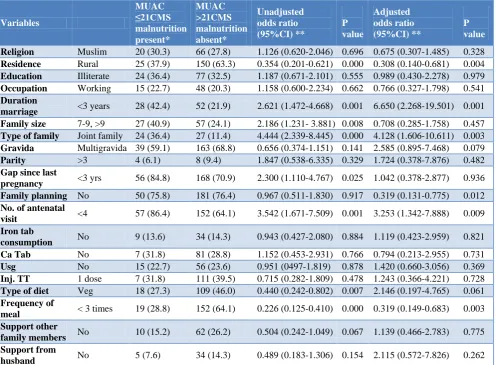
Table 3: Association of under-nutrition with Socio-demographic, and other relevant variables.
Variables
MUAC ≤21CMS malnutrition present*
MUAC >21CMS malnutrition absent*
Unadjusted odds ratio (95%CI) **
P value
Adjusted odds ratio (95%CI) **
P value
Religion Muslim 20 (30.3) 66 (27.8) 1.126 (0.620-2.046) 0.696 0.675 (0.307-1.485) 0.328
Residence Rural 25 (37.9) 150 (63.3) 0.354 (0.201-0.621) 0.000 0.308 (0.140-0.681) 0.004
Education Illiterate 24 (36.4) 77 (32.5) 1.187 (0.671-2.101) 0.555 0.989 (0.430-2.278) 0.979
Occupation Working 15 (22.7) 48 (20.3) 1.158 (0.600-2.234) 0.662 0.766 (0.327-1.798) 0.541
Duration
marriage <3 years 28 (42.4) 52 (21.9) 2.621 (1.472-4.668) 0.001 6.650 (2.268-19.501) 0.001
Family size 7-9, >9 27 (40.9) 57 (24.1) 2.186 (1.231- 3.881) 0.008 0.708 (0.285-1.758) 0.457
Type of family Joint family 24 (36.4) 27 (11.4) 4.444 (2.339-8.445) 0.000 4.128 (1.606-10.611) 0.003
Gravida Multigravida 39 (59.1) 163 (68.8) 0.656 (0.374-1.151) 0.141 2.585 (0.895-7.468) 0.079
Parity >3 4 (6.1) 8 (9.4) 1.847 (0.538-6.335) 0.329 1.724 (0.378-7.876) 0.482
Gap since last
pregnancy <3 yrs 56 (84.8) 168 (70.9) 2.300 (1.110-4.767) 0.025 1.042 (0.378-2.877) 0.936
Family planning No 50 (75.8) 181 (76.4) 0.967 (0.511-1.830) 0.917 0.319 (0.131-0.775) 0.012
No. of antenatal
visit <4 57 (86.4) 152 (64.1) 3.542 (1.671-7.509) 0.001 3.253 (1.342-7.888) 0.009
Iron tab
consumption No 9 (13.6) 34 (14.3) 0.943 (0.427-2.080) 0.884 1.119 (0.423-2.959) 0.821
Ca Tab No 7 (31.8) 81 (28.8) 1.152 (0.453-2.931) 0.766 0.794 (0.213-2.955) 0.731
Usg No 15 (22.7) 56 (23.6) 0.951 (0497-1.819) 0.878 1.420 (0.660-3.056) 0.369
Inj. TT 1 dose 7 (31.8) 111 (39.5) 0.715 (0.282-1.809) 0.478 1.243 (0.366-4.221) 0.728
Type of diet Veg 18 (27.3) 109 (46.0) 0.440 (0.242-0.802) 0.007 2.146 (0.197-4.765) 0.061
Frequency of
meal < 3 times 19 (28.8) 152 (64.1) 0.226 (0.125-0.410) 0.000 0.319 (0.149-0.683) 0.003
Support other
family members No 10 (15.2) 62 (26.2) 0.504 (0.242-1.049) 0.067 1.139 (0.466-2.783) 0.775
Support from
husband No 5 (7.6) 34 (14.3) 0.489 (0.183-1.306) 0.154 2.115 (0.572-7.826) 0.262
*Figure in parenthesis indicates column wise percentage; **Figure in parenthesis indicates 95% CI.
Variable to describe under nutrition status of study pregnant women was their height, weight, MUAC measurement. The mean values (and standard deviations) of anthropometric measure are shown in Table 2. Overall prevalence of under-nutrition among study participants was 21.8%.
The analysis of dependent and independent variables in present data were analyzed to determine their association. On bivariate analysis result showed that under-nutrition among pregnant women had a significant association with rural residence (OR=0.354; 95% CI 0.201-0.621), having less than three years duration of marriage (OR=2.621; 95%CI 1.472-4.668), Large family size (OR=2.186, 95% CI 1.231-3.881), living with joint family (OR=4.444; 95% CI 2.339-8.445), Having less
than three yrs. gap between last and current pregnancy (OR=2.300; 95% CI 1.110-4.767), less no. of ANC visit (OR=3.542 95% CI 1.671-7.509), vegetarian by diet (OR=0.440; 95% CI0.242-0.802) and having less frequency of meal (OR=0.226; 95% CI 0.125-0.410).
Remaining all factors like religion, education, occupation, family size, gravida, parity, consumption of iron and calcium tablet, getting USG done, anti-tetanus vaccination, support from family and husband were not found as significant risk factors for under-nutrition (Table 3).
DISCUSSION
This study assessed the status of under nutrition and its determinants among pregnant women attending ANC clinic at tertiary health care Centre. Our study Findings showed that, 22.8% of pregnant women were undernourished. This result is comparable with study results of nutrition reports, UNICEF, New Delhi, India; 2017 which shown that 22% pregnant women were undernourished.4 Various other studies also reported under nutrition among pregnant women using criteria MUAC <21cm and reported with figures 16.2%, 14%, 22.3%, 24% and 37%.1,9-12 The probable reason for this variation could be the interventions on nutrition, maternal health and other women empowering programs by the government and other non-governmental organizations in the country. Moreover, the variation may be due to geographical variation, smaller land holding, the recurrent food insecurity and the seasonal difference in data collection.1
Our study result showed that women living in rural areas are at higher risk of being undernourished than their urban counterparts. Similar results also reported from earlier study.1,13,14 The disparity may be due to less developed infrastructures, low nutritional awareness, low access to health care, safe water, and sanitation facilities, traditional ways of farming as only means of surviving and cultural and religious influences in rural areas. In addition, lower nutritional status among rural pregnant women could be explained partly by the fact that in rural areas women are more vulnerable to early marriage and childbearing than women in urban areas.1 The urban environment may be more affluent and so supportive of health. Furthermore, developed road and rail links facilitate the regular and abundant supply of foodstuffs to urban populations. Another presumption in the literature is that urban populations are advantaged in terms of water supply, housing and sanitation, and in social programming that directly affects health.14
The study further revealed that there was a significant relationship between the family type and the under-nutrition status (p<0.05), study participant living with joint family are more undernourished than those living in nuclear family. We also noted that Pregnant Women living in Households that had more individuals were more likely to be undernourished. Similarly study done by Acharya, et al showed significant relationship between the family type and the nutritional status.15 Households that had fewer individuals were more likely to have good nutritional status. 23.6% of study population living in joint family was underweight.
Our study findings indicate a negative relationship between the birth space since last pregnancy and under-nutrition, with decreasing duration of birth space since last pregnancy, the level of under-nutrition tends to increase. Also pregnant women who have been Family planning users before current pregnancy had showed less under-nutrition in compare to counterpart. This study finding is supported by Kumera et al and Mariyam et al.1,7 The finding is consistent with the knowledge that repeated reproductive cycles deplete maternal nutrition store.1 The high fertility of Indian women is one of the most detrimental socio-cultural influences on nutritional status because the metabolic stresses of pregnancy and lactation may not be adequately compensated by dietary intake before, during or even after these physiological processes.16
Study further revealed that pregnant women who had less no. of ANC visit had under nutrition when compared to those who had more ANC visit. Similar study results reported by previous studies.1,7,11 This implies that households that had access to health services were more likely to have a better nutritional status. Access in the context of this study means proximity to affordable and quality health services.
This study also showed that study women who had vegetarian diet and less no. of meal per day, significantly had under nutrition compared to their counterparts. Similarly study done by Acharya, et al showed that consumption of sufficient and various types of foods, significantly had better nutritional status compared to their counterparts.15 This low dietary practice of pregnant women may be due to their low income, relatively high family size, and lack of nutritional information and low educational status of the study participants. Adequate nutritional intake is one of the most important factors affecting on one’s health and well-being, especially during pregnancy.17 However during pregnancy women is access to foods even more restricted in the traditional Indian household through taboos and ritual observances, which are widely documented in both rural and tribal population.16
CONCLUSION
This study revealed that 21.8% pregnant women were undernourished among study participants. The factors like place of residence (rural areas), living with joint family, having large family size, not utilization of family planning methods, less no. of ANC visit and taking less no. of meal per days were found to be significantly associated with malnutrition (MUAC <21 cm). Remaining factors studied were not found as significant risk factor for malnutrition.
Recommendations
problem must be combated through an implementation of strategies like rural livelihood promotion, socio-economic empowerment of women and expansion of women’s education, particularly in rural areas. Intensive Information, education and communication (IEC) activity related to nutritional education should be integrated into maternity services. Sustained nutrition education should be provided using every opportunity for mothers, fathers, older women and children so that they would be advocates of good nutrition for pregnant women. It is recommended that family planning services should also be extended. The government should integrate and strengthen maternal nutrition in key health programs through community-based approaches.
Limitations
This study had limitations of cross sectional study. Definitive temporal relationships between the factors examined and outcomes cannot establish as this was a cross-sectional study. Another limitation is that the study was institution based; consequently, the findings in the study cannot be generalized beyond the study population. There was subjective bias introduced during the interview period.
ACKNOWLEDGEMENTS
We would like to acknowledge all the study participant who volunteered to provide data for this study. We also thank the efforts of staff involved for data collection.
Funding: No funding sources Conflict of interest: None declared
Ethical approval: The study was approved by the Institutional Ethics Committee
REFERENCES
1. Kumera G, Gedle D, Alebel A, Feyera F, Eshetie S. Undernutrition and its association with socio-demographic, anemia and intestinal parasitic infection among pregnant women attending antenatal care at the University of Gondar Hospital, Northwest Ethiopia. Matern Health Neonatol Perinatol. 2018;4:18.
2. Hazarika J, Saikia I, Hazarika PJ. Risk Factors of Undernutrition Among Women in the Reproductive Age Group of India: An Evidence from NFHS-3. American-Eurasian J Sci Res. 2012;7(1):5-11. 3. Jood S, Bishnoi S, Khetarpaul N. Nutritional status
of rural pregnant women of haryana state, Northern India. Nutr Health. 2002;16(2):121-31.
4. United Nations Children’s Fund (UNICEF). Nourishing Wombs: Delivering an Integrated Package of Maternal Nutrition Interventions in Andhra Pradesh and Telangana (India). Nutrition Reports, Issue 10, UNICEF, New Delhi, India; 2017.
5. Islam A, Islam N, Bharati P, Aik S, Hossain G. Socio-economic and demographic factors influencing nutritional status among early childbearing young mothers in Bangladesh. BMC Women’s Health. 2016;16:58.
6. Madhavi LH, Singh HKG. Nutritional Status of Rural Pregnant Women. People’s J Sci Res. 2011;4(2):20-3.
7. Mariyam AF, Dibaba B. Epidemiology of Malnutrition among Pregnant Women and Associated Factors in Central Refit Valley of Ethiopia. J Nutr Disord Ther. 2018;8(1):1-8. 8. Ricalde AE, Velásquez-Meléndez G, Tanaka
ACDA, De Siqueira AAF. Mid-upper arm circumference in pregnant women and its relation to birth weight. Rev Saude Publica. 1998;32(2):112-7. 9. Kumar P, Sareen N, Agrawal S, Kathuria N,Yadav S, Sethi V. Screening maternal acute malnutrition using adult mid upper arm circumference in resource-poor settings. Indian J Community Med. 2018;43:132-4.
10. Kedir H, Berhane Y, Worku A. Magnitude and determinants of malnutrition among pregnant women in eastern Ethiopia: Evidence from rural, community-based setting. Matern Child Nutr. 2016;12(1):51-63.
11. Gebre B, Biadgilign S, Taddese Z, Legesse T, Letebo M. Determinants of malnutrition among pregnant and lactating women under humanitarian setting in Ethiopia. BMC Nutr. 2018;4(1):11. 12. Jayatissa R, Bekele A, Piyasena CL, Mahamithawa
S. Assessment of nutritional status of children under five years of age, pregnant women, and lactating women living in relief camps after the tsunami in Sri Lanka. Food Nutr Bull. 2006;27(2):144-52. 13. Mudhaliar MR, Ghouse ISM, Neppali J, Asavadi D,
Uppara V, Chinnakotla V. Nutritional Status of Pregnant Women and Newborns in a Secondary Referral Health Care Setting of India. Indian J Pharm Pract. 2017;10(1):14-9.
14. Uthman O, Aremu O. Malnutrition among women in sub-Saharan Africa : rural-urban disparity. Rural Remote Health. 2008;8(2):931.
15. Acharya SR, Bhatta J, Timilsina DP. Factors associated with nutritional status of women of reproductive age group in rural, Nepal. Asian Pacific J Health Sci. 2017;4(4):19-24.
16. Rao KM, Balakrishna N, Arlappa N, Laxmaiah A, Brahmam GNV. Diet and Nutritional Status of Women in India. J Human Ecol. 2010;29(3):165-70. 17. Alemayehu SM. Dietary practice and associated factors among pregnant women in Gondar Town North West, Ethiopia, 2014. Int J Nutr Food Sci. 2015;4(6):707-12.
Cite this article as: Rathod MS, Borde AN, Patil SP,