Original Research Article
Sleep disturbance and its effect on academic performance among
students of a medical college of Tripura
Anjan Datta, Kaushik Nag*, Nabarun Karmakar, Tamal Chakraborty,
Kaushik Tripura, Partha Bhattacharjee
INTRODUCTION
Sleep is defined as unconsciousness from which the person can be aroused by sensory or other stimuli. It is to be distinguished from coma, which is unconsciousness from which the person cannot be aroused.1 A condition of body and mind which typically recurs for several hours every night, in which the nervous system is inactive, the eyes closed, the postural muscles relaxed and consciousness practically suspended. It serves several
different functions such as growth and repair, learning and memory consolidation and all these occur throughout the brain and the body.2
Sleep deprivation is the condition of not having enough sleep; can be either chronic or acute. An average adult needs 7-9 hours of sleep each night, teenagers 9.5 hours and infants 16 hours per day.3 College students are well known for keeping erratic sleep schedules. Sleep deprivation may have grave health consequences;
ABSTRACT
Background: Sleep deprivation may have grave health consequences; resulting in increasing disease morbidity and mortality. Sleep disturbance have also been affected academic performance of medical students. The objective of the study was to find out the prevalence of sleep disturbance and association between sleep disturbance and academic performance of medical students, if any.
Methods: An institution based cross-sectional study was conducted in the month of March 2018 among 203 medical students of Tripura Medical College and Dr. B.R.A.M. Teaching Hospital. Probability Proportionate to Sample Size (PPS) was used to determine the number of students required from each semester. Students selected by simple random sampling from each semester were interviewed by a pre-designed, pre-tested interview schedule designed based on Pittsburgh Sleep Quality Index. Data was represented in percentages in tables, charts and Chi square test was applied. P<0.05 was considered statistically significant.
Results: Mean age of the medical student was 21.36±1.96 years. Present study showed, 57% students were complaining of disturbed sleep. Students who felt sleepy during daytime (72.4%) were struggling more during exam compared to students not feeling sleepy (51.7%), which was statistically significant. Study revealed, students who got average mark in last semester exam were most affected with disturbed sleep (66.3%) followed by students who got good marks (53.5%) and poor marks (50%).
Conclusions: Prevalence of sleep disturbance was very high among medical students. Male students were much more affected compared to female students. Sleep disturbance has also affected academic performance of students.
Keywords: Sleep deprivation, Cross-sectional, Probability, Medical students, Academic performance, Hospitals Department ofCommunity Medicine, Tripura Medical College and Dr. BRAM Teaching Hospital, Agartala, Tripura, India
Received: 21 October 2018
Accepted: 03 December 2018
*Correspondence:
Dr. Kaushik Nag,
E-mail: [email protected]
Copyright: © the author(s), publisher and licensee Medip Academy. This is an open-access article distributed under the terms of the Creative Commons Attribution Non-Commercial License, which permits unrestricted non-commercial use, distribution, and reproduction in any medium, provided the original work is properly cited.
resulting in increasing disease morbidity and mortality. It was postulated that sleep deprivation may be associated with defect in the immune function, may be implicated in the pathogenesis of psychological problems, metabolic problems (diabetes mellitus, metabolic syndrome and obesity), accelerated atherosclerosis and increased risk of cardiac disease and stroke.4,5
Medical students are vulnerable to poor sleep, which may be attributed to their extended study years, high academic load (long duration and high concentration), clinical duties, emotionally challenging work, and the highly demanding lifestyle.6 Research on sleep disturbances in undergraduate medical student is of particular interest because of the known relationship between sleep and mental health and the concern that the academic demands of medical training can cause significant stress. It was found from various studies done in different countries that academic performance of medical students and health status were affected by sleep deprivation.7,8 No such data regarding the same is available in Tripura. Therefore the present study was aimed to find out the magnitude of sleep disturbance and its effect on academic performance of medical students in a Medical College & Hospital of Tripura.
Objectives
To find out the prevalence of sleep disturbance among Medical students.
To find out association between sleep disturbance & academic performance of medical students, if any.
METHODS
A hospital based cross-sectional study was conducted among medical students of Tripura Medical College & Dr. B.R.A.M. Teaching Hospital. The study was done for a period of one month (March 2018).
Inclusion and exclusion criteria
Medical students who were willing to participate in this study during survey period were included in this study and medical students who were sick were excluded from this study.
Sample size
Taking 70.4% as prevalence of sleep deprivation among medical students, sample size was calculated as 170 by using following formula:4
n=
Where ‘p’ is the prevalence of sleep disturbance from previous studies, q=100–p and l=allowable error. [p=70.4%, q=29.6%, l (allowable error=7)].
Finally, 203 medical students {(170+18% of 170)=201} were included in this study taking 18% as non-response rate.
Probability proportionate to sample size (PPS) was used to determine the number of students required from each semester. From each semester, students were selected using Simple random sampling. A pre-designed, pre tested semi structured interview schedule was designed based on Pittsburgh sleep quality index (PQSI) to collect the required information from the participants. The interview schedule consisted of questions related to socio-demographic information, sleep disturbance and academic performance respectively.7 Data was entered in Microsoft excel and analyzed with the help of Statistical Package for the Social Sciences (SPSS Inc. SPSS for Windows, Version 16.0. Chicago). Data was represented using appropriate tables and charts in the form of frequencies and percentages. Chi square test was applied to find out statistical association as required. P<0.05 was considered statistically significant. A duly explained and informed consent was taken in written from the medical students of TMC as well, before participation in the study. Ethical clearance was obtained from institutional Ethics Committee of Tripura Medical College and Dr BRAM Teaching Hospital before conducting the study.
RESULTS
Present study showed, mean age of the participants was 21.36±1.96 years. Maximum students (64.0%) were from 20 to 23 years of age group, male (57.6%), Hindus (86.2%) and from General caste (64%). Majority of students resides in the hostel (64.0%) while the rest stay in house (Table 1). Majority of the students (70.9%) sleep for 4-6 hours during college night and 62.1% students sleep for 7-9 hrs during non-college night (Table 2).
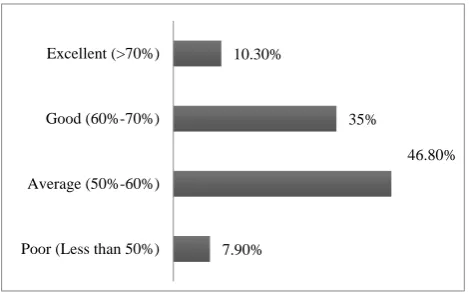
Figure 1: Bar graph showing distribution of study participants according to aggregate in last appeared
exams (n=203).
Most of the students (46.80%) scored average followed by good score (35%) in their last appeared exam (Figure 1).
7.90%
46.80% 35%
10.30%
Table 1: Showing distribution of students as per various Socio-demographic variables (n=203).
Socio-demographic
variables Frequency %
Age (in years)
17 to 20 32 15.8 20 to 23 130 64.0 23 to 26 31 15.3 More than 26 10 4.9
Gender
Male 117 57.6
Female 86 42.4
Semester
2nd 50 24.6
4th 51 25.2
6th 52 25.6
8th 50 24.6
Religion
Hindu 175 86.2
Muslim 12 5.9
Christian 8 3.9
Sikh 3 1.5
Buddhism 3 1.5
Others 2 1.0
Caste
General 130 64.0
SC 28 13.8
ST 18 8.9
OBC 27 13.3
Residence
House 73 36.0
Hostel 130 64.0
Table 2: Showing distribution of study participants according to sleep during college night and
non-college nights (n=203).
Sleep hours Frequency %
College nights (in hrs)
1-3 12 5.9
4-6 144 70.9
7-9 42 20.7
>9 5 2.5
Non-college nights (in hrs)
1-3 4 2.0
4-6 28 13.8
7-9 126 62.1
>9 45 22.2
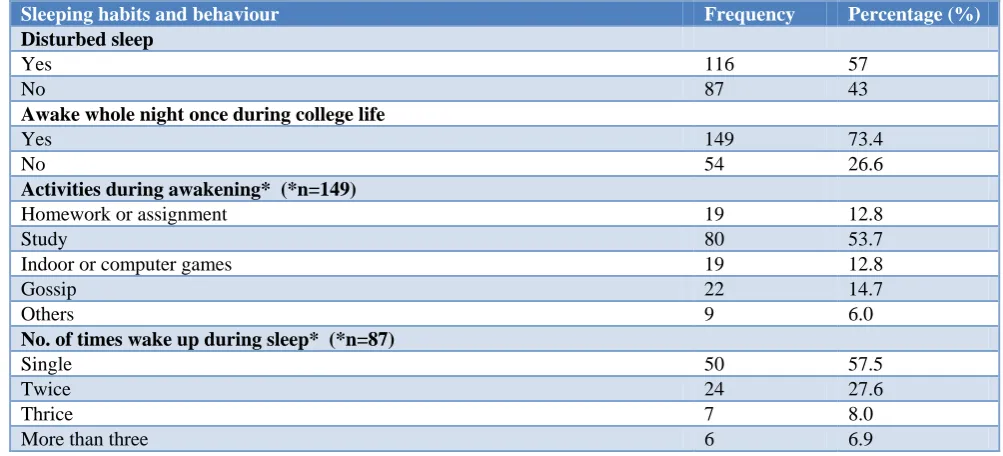
Regarding sleeping habits and behaviour, 57% students were complaining of disturbed sleep and 73.4% gave history of being wakeful whole night during college life. Most of them used to study (53.7%) during awakening followed by gossip (14.7%). Majority of the students (57.5%) gave history of single time awakening followed by twice (27.6%) during night. The present study showed, 87.2% of the students feel sleepy during day time, 78.8% of the students sleep during day time and among them most of them (62.5%) sleep for 1-2 hrs followed by <1 hour (25%). Most of the students used mobile phone (37.9%) before going to sleep used followed by reading books (24.1%) and listening to music (20.2%). Out of all the students, 69% students gave history of being awake whole night before exam and 64% students struggled during exam due to lack of sleep. Among strategies to stay awake next day after having disturbed sleep, majority used caffeinated drinks (49.8%), listening to music (20.2%) and 22.2% of the students never needed any strategies to stay awake the next day after not sleeping previous night (Table 3).
Table 3: Showing distribution of study participants according to sleeping habits and behavior (n=203).
Sleeping habits and behaviour Frequency Percentage (%)
Disturbed sleep
Yes 116 57
No 87 43
Awake whole night once during college life
Yes 149 73.4
No 54 26.6
Activities during awakening* (*n=149)
Homework or assignment 19 12.8
Study 80 53.7
Indoor or computer games 19 12.8
Gossip 22 14.7
Others 9 6.0
No. of times wake up during sleep* (*n=87)
Single 50 57.5
Twice 24 27.6
Thrice 7 8.0
Sleeping habits and behaviour Frequency Percentage (%) Sleep during daytime
Yes 160 78.8
No 43 21.2
Hours of daytime sleep (*n=160)
<1 40 25
1-2 100 62.5
>2 20 12.5
Feeling sleepy during college hours
Yes 177 87.2
No 26 12.8
Students using different materials before going to sleep
Using mobile phone 77 37.9
Listening to music 41 20.2
Reading books 49 24.1
Playing video games 6 3.0
Watching television 9 4.4
Using laptop 5 2.5
None of the above 16 7.9
Awake all night before exams
Yes 140 69
No 63 31
Strategies used to stay awake next day after having disturbed sleep
Caffeinated drinks 101 49.8
Never needed 45 22.2
Listening to music 41 20.2
Drugs 4 2.0
Others 12 5.9
Difficulty in exam due to lack of sleep
Yes 129 64
No 74 36
Table 4: Association between respondents feeling sleepy during college hours and struggling during exam (n=203).
Respondents feeling sleepy during college hours
Struggling during exam Chi square value
(p value)
Yes (%) No (%) Total (%)
Yes 84 (72.4) 32 (27.6) 116 (100.0)
9.187 (p=0.002)
No 45 (51.7) 42 (48.3) 87 (100)
Total 129 (63.5) 74 (36.5) 203 (100)
Table 5: Association of sleep disturbance with academic performance of medical students (n=203).
Respondent's Performance in last semester exam
Respondent suffering from disturbed sleep Chi square value
(p value)
Yes (%) No (%) Total (%)
Poor 8 (50) 8 (50) 16 (100)
8.879 (p=0.032)
Average 63 (66.3) 32 (33.7) 95 (100)
Good 38 (53.5) 33 (46.5) 71 (100)
Excellent 7 (33.3) 14 (66.7) 203 (100)
Total 116 (57.1) 87 (42.9) 203 (100)
The present study showed, majority of the students (61.6%) who felt sleepy during college hours had problem of disturbed sleep. This association of disturbed sleep with day time sleepiness was statistically significant (p=0.001). Students who felt sleepy during daytime (72.4%) were struggling more during exam compared to
students not feeling sleepy (51.7%), which was statistically significant (p=0.002) (Table 4).
(53.5%) and poor marks (50%). This difference of disturbed sleep with academic performance was statistically significant (p=0.032) (Table 5).
DISCUSSION
Socio-demographic characteristics
In this study, mean age of the students was 21.36±1.96 which is similar to a study done by Moayedi at Iran where mean age of the participants was 22.42±1.74. Majority (57.6%) of the students were males which is different from a study done by Hamed at United Arab Emirates where 74% of the participants were females.8,9
In the present study majority of the participants (64%) reside in the Hostel while the rest others (36%) stay at house. In a similar study conducted by Ibrahim at King Abdulaziz University, Iran found 90.1% stay at their houses while 9.9% reside at the hostel.4,6 Hamed at United Arab Emirates found, majority of the students (81%) were day-scholars and 19% stays in hostel.9
Association of sleep disturbance with academic performance of medical students
Majority of the participants sleep 4-6 hrs (70.9%) at night during college days and 7-9 hours (62.1%) during non-college nights. This may be due to the lack of time spent for sleeping in weekdays as the students might be busy with assignments and preparation for examination. The increase in sleeping time during weekends may be due to compensate their lack of sleep during college days. Hamed at United Arab Emirates among the undergraduate medical students, found 37% of them had sleep duration of <6 hours and only 16% students had sleep >8 hours during the week days and there was increment of respondents who slept >8 hrs from 4% on weekdays to 52% on weekends.9
The present study shows, 57% students were complaining of disturbed sleep and 73.4% gave history of being wakeful whole night at least once during college life. In a similar study conducted by Moayedi found, 38.2% had moderate clinical insomnia and 7.1% had severe insomnia among medical students of Iran.8 In contrast to our findings, Lai in Malaysia found, majority of the students were good sleepers (67.1%).10
Majority of the students (53.7%) were studying followed by gossiping (14.7%), playing in door or computer games (12.8%) or doing homework or assignments (12.8%) when they were awake whole night. Jennifer in their study among medical students in Tamil Nadu, India found, 79.2% students had poor quality of sleep who used mobile for more than 2 hours/day as compared to 65.7% who had poor sleep when they use 1 or 2 hours/day.11 Present study shows, majority of the students (57.5%) gave history of single time awakening followed by twice
(27.6%) during night. Spietinyte found, 40.4% students woke up in the middle of the night or early morning.12
The present study showed, 87.2% of the students feel sleepy during day time, 78.8% of the students sleep during day time and among them most of them (62.5%) sleep for 1-2 hrs followed by <1 hour (25%). Similarly, Hamed in their study among medical students found, 35% reported infrequent nap and 40% reported frequent day napping during weekdays.9
Different strategies were used to stay awake the next day after not sleeping previous night, caffeinated drinks (49.8%) was mostly used by the students followed by listening to music (20.2%) where as 22.2% students never needed any strategies to stay awake. Giri at Loni, Maharashtra, India revealed that excessive coffee intake, alcohol abuse, smoking, use of mobile phone, laptop was affecting sleep in medical students.13
Maximum proportion of students belonging to age more than 26 years (80%) suffered from disturbed sleep followed by those in the age group of 20 to 23 years (57.7%). A similar study was conducted among medical students by Ibrahim where students aged ≤21 years reported higher prevalence (74.9%) of disturbed sleep.4 Mokarrar an Eastern university in Iran, found significant positive correlation between sleep disorder and age of medical students.14 It was seen that, hostellers (60%) were more affected by disturbed sleep compared to non-hostellers (52.1%) which is similar to the findings of Ibrahim, where they found hostellers (80.7%) were suffering more from disturbed sleep compared to non-hostellers (69.4%).4
The present study showed, majority of the students (61.6%) who felt sleepy during college hours had problem of disturbed sleep. Students who felt sleepy during daytime (72.4%) were struggling more during exam compared to students not feeling sleepy (51.7%). Lai in Malaysia found, 16.1% of students had no problems at all in having enough energy in getting things done, 53.2% students had only a very slight problem, 25.7% had somewhat of a problem and only 5.0% had a very big problem.10
information. It might be an explanation for the diversity of the results of various studies.
CONCLUSION
Present study shows, prevalence of sleep disturbance was very high among medical students. Male students were much more affected compared to female students. Sleep disturbance has also affected academic performance of students. It is very much essential to find out measures to prevent sleep disturbance among medical students in future research. This will improve academic performance among medical students.
Funding: No funding sources Conflict of interest: None declared
Ethical approval: The study was approved by the Institutional Ethics Committee
REFERENCES
1. Guyton A, Hall J. Central Nervous System. Text book of physiology. Elsevier Publications. 2015;11(1):739-41.
2. Sarita M, Sukhwant B. Study of sleep pattern and sleep problems of under graduate students from different professional courses. Indian Journal of Basic and Applied Medical Research. 2016;5(2):16-28.
3. Ferrara M, Gennaro LD. How much sleep do we need? Sleep Med Rev. 2001;5:155-79.
4. Ibrahim NK, Badawi FA, Mansouri YM, Ainousa AM, Jambi SK, Fatani AN et al. Sleep Quality among Medical Students at King Abdulaziz University: A Cross-sectional Study. J Community Med Health Edu. 2017;7(5):1-6.
5. Czeisler CA, Scammell TE, Saper CB. Disorders of sleep and wakefullness Harrisons’s principle of internal medicine. Mc Graw Hill Education. 2015;19(2):185.
6. Azad MC, Fraser K, Rumana N, Abdullah AF, Shahana N, et al. Sleep disturbances among medical students:A global perspective. J Clin Sleep Med. 2015;11:69-74.
7. Pagal JF, Kwaitkowski CF. Sleep complaints affecting school performance at different educational levels. Front Neurol. 2010;16:125. 8. ElArab HE, Rabiea MAM, Ali DH. Sleep behavior
and sleep problems among a medical student sample
in relation to academic performance:a cross-sectional questionnaire-based study. Middle East Current Psychiatry. 2014;21:72–80.
9. Spira AP, Beaudreau SA, Stone KL, Kezirian EJ, Lui LY, et al. Reliability and validity of the pittsburgh sleep quality index and the epworth sleepiness scale in older men. J Gerontol A Biol Sci Med Sci. 2012;67:433-9.
10. Moayedi F, Shahabjahanlu A, Rasa F, Sadeghi P. Prevalence of Sleep Disorders among Medical Students. Res J Pharm Biol Chem Sci. 2015;6(2):894-8.
11. Hamed H, Miskey A, Alkurd R, Ghazal Z, Sami R, Abduljaleel N, et al. The Effect of Sleeping Pattern on the Academic Performance of Undergraduate Medical Students at Ajman University of Science and Technology. J Pharm Pharm Sci. 2015;4(4):18-21.
12. Lai PP, Say YH. Associated Factors of Sleep Quality and Behavior among Students of two Tertiary Institutions in Northern Malaysia. Med J Malaysia. 2013;68(3):196-203.
13. Gladius HJ, Sowmiya K, Vidya CD, ALP Archana, FR William. A study of mobile phone usage on sleep disturbance, stress and academic performance among medical students in Tamil Nadu. Int J Community Med Public Health. 2018;1:365-8. 14. Spietinyte A, Smigelskas K, Adomaitieni V,
Steibliene V. Studying habits, subjectively rated sleep quality and academic achievements among medical students. Biological Psychiatry Psychopharmacol. 2012-2013;18(2):69-75.
15. Giri PA, Baviskar MP, Phalke DB. Study of Sleep Habits and Sleep Problems among Medical Students of Pravara Institute of Medical Sciences Loni, Western Maharashtra, India. Ann Med Health Sci Res. 2013;3(1):51–4.
16. Mokarrar MH, Afsharmanesh A, Afshari M, Mohammadi F. Prevalence of sleep disorder among medical students in an Eastern university in Iran. Iranian J Health Sci. 2017;5(1):49-54.