Original Research Article
A study to assess the prevalence of iodine deficiency disorders in Betul
district, Madhya Pradesh, India
Sudarshan Kushwah, Akhil R. Nair*, Jeevan Singh Meena,
Shipra Verma, Harshima Sawlani, Ankit Chandak
INTRODUCTION
Iodine deficiency is the world’s most prevalent, yet easily preventable, cause of brain damage. Iodine deficiency disorders (IDD), which can start before birth, jeopardize children’s mental health and often their very survival. Serious iodine deficiency during pregnancy can result in stillbirth, spontaneous abortion, and congenital abnormalities such as cretinism, a grave, irreversible form of mental retardation that affects people living in iodine-deficient areas of Africa and Asia. However, of far greater significance are IDD’s less visible, yet pervasive, mental impairment that reduce intellectual capacity at home, in school and at work. The number of countries where iodine deficiency is a public health problem has
halved over the past the number of countries where iodine deficiency is a public health problem has halved over the past decade according to a new global report on iodine status. 54 countries are still iodine-deficient.1 IDD are linked to iodine deficient soil. Due to glaciations, flooding, rivers changing course and deforestation the iodine present in top soil is constantly leached. This in turn leads to deficiency of iodine in crops grown on iodine deficient soil with consequently low iodine in the diet for livestock and humans. In the past, iodine deficiency was thought to cause only goitre and cretinism. However, over the last quarter of the century, it has become increasingly clear that iodine deficiency leads to a much wider spectrum of disorders commencing with the intrauterine life and extending
ABSTRACT
Background: Iodine deficiency disorders (IDD) constitute the single largest cause of preventable neurological
damage worldwide. Majority of consequences of IDD are invisible and irreversible but at the same time these are preventable. The study was conducted to assess the prevalence of goiter in school children aged 6-12 years, to estimate the urinary iodine excretion and to assess the level of iodine concentration in salt samples obtained from households of selected school children.
Methods: Population proportionate to size sampling. Sample size was 90 primary school-going children of age 6-12
years in each selected village, total 2700 from 30 villages/wards in Betul district, Madhya Pradesh, India.
Results: The prevalence of goiter among the 6-12 years children was found to be 32.06%. Females had higher prevalence compared to males. Of the 540 salt samples, 370 (68.4%) had iodine concentration ≥15 ppm at household level.
Conclusions: IDD is a mild public health problem in Betul district.
Keywords: Goiter, Iodine deficiency disorders, Iodized salt, Prevalence, School children
Department of Community Medicine, Gandhi Medical College, Bhopal, Madhya Pradesh, India
Received: 21 June 2019
Revised: 02 August 2019
Accepted: 07 August 2019
*Correspondence: Dr. Akhil R. Nair,
E-mail: [email protected]
Copyright: © the author(s), publisher and licensee Medip Academy. This is an open-access article distributed under
the terms of the Creative Commons Attribution Non-Commercial License, which permits unrestricted non-commercial use, distribution, and reproduction in any medium, provided the original work is properly cited.
through childhood into adult life with serious health and social problems. The spectrum of diseases includes goitre, cretinism, hypothyroidism, brain damage, abortion, still birth, mental retardation, psychomotor defects and hearing and speech impairment. Majority of consequences of IDD are invisible and irreversible but at the same time preventable. IDD constitute the single largest cause of preventable brain damage worldwide leading to learning disabilities and psychomotor impairment.3 Children living in iodine-deficient areas on an average have lower intelligence quotient (IQ), by as much as 13.5 IQ points as compared to children living in iodine-sufficient areas.2
Most people need an additional source of iodine as it is found in relatively small amounts in the diet. Iodization is the process of fortifying salt for human consumption with iodine and is an effective strategy to increase iodine intake at the population level. The public health goals of reducing salt and increasing iodine intake through salt iodization are compatible as the concentration of iodine in salt can be adjusted as needed. Monitoring the levels of iodine in salt and the iodine status of the population are critical for ensuring that the population's needs are met and not exceeded.3 As per the surveys conducted by the Directorate General of Health Services, Indian Council of Medical Research, Health Institutions and the State Health Directorates, it has been found that out of 414 districts surveyed in all the 29 States and 7 UTs, 337 districts are endemic i.e., where the prevalence of IDDs is more than 5%.
Realizing the magnitude of the problem, the Government of India launched a 100 per cent centrally assisted National Goitre Control Programme (NGCP) in 1962. In August, 1992 the NGCP was renamed as National Iodine Deficiency Disorders Control Programme with a view of wide spectrum of Iodine Deficiency Disorders like mental and physical retardation, deaf mutism, cretinism, still births, abortions etc.. The programme is being implemented in all the States/UTs for entire population.4 The Salt Iodization Programme in India dates back to late 50’s when the classical study of Professor V. Ramalingaswamy and his associates in Kangra Valley of Himachal Pradesh established iodine deficiency as the causative factor for endemic goiter and consuming salt iodized with potassium iodate as the most economic and easiest means of its prevention and control in a population.5 The NFHS-4 finding of households using iodized salt in Madhya Pradesh: urban areas- 97.9 % and rural- 91.2%.6 This study aims to find out the prevalence of iodine deficiency disorders in the district of Betul, Madhya Pradesh, India.
Objectives
The study was done with the objectives to study the prevalence of IDD amongst 6-12 years children by clinical examination in the district, to determine the concentration of iodine in salt sample at consumer level
in study population of the district and to determine the urinary iodine excretion amongst 6-12 years age group children in study population of the district.
METHODS
Study design: Cross sectional study.
Study area: 30 villages/ wards selected from district by Population Proportionate to size (PPS) sampling.
Study duration: July 2018 to September 2018. Survey method
IDD Survey in the district was done using PPS sampling in the age group of 6-12 years children after obtaining the current lists of villages/wards along with their respective population were collected from the District CMHO office. Villages/wards of the above mentioned district were listed and numbered along with their cumulative population and then the required sampling table of the district was prepared separately.
By using currency note technique, first village (R1) with r1 cumulative population in every district was selected. After that subsequent 29 cluster villages were selected by adding sampling interval tor1 + (r2) + r3+…..+ r30.
Activities conducted in each cluster villages
Investigators visited the selected villages of the respective district initially and then proceeded towards the primary schools of that particular area.
As the school enrolment rate of the selected villages was more than 90%, the required samples i.e., clusters were limited to the primary schools of the respective villages/wards. Children belonging to the age group 6-12 years, studying in class I-V were then approached for the clinical examination to assess the presence of IDD. Samples of 90 children (45 boys and 45 girls) were examined from each school. This selection of students followed the following criteria. Out of those students present during the day of visit from each class, 9 boys and 9 girls were selected from each class randomly from the attendance register, thus contributing to a total of 18 students per class and 90 in total for a school. Thus a total of 2700 students were clinically examined from each district.
If the required number of students was not fulfilled by a particular primary school due to some reason or the other, the nearby government/private primary school in the same village was then identified and the required number of total 90 students was obtained.
Grade 0
No palpable or visible goiter/no goiter.
Grade 1
A mass in the neck that is consistent with an enlarged thyroid, which is palpable but not visible when the neck is in normal position. It moves upward in the neck as the subject swallows or seen as visible swelling on extended neck. Nodular alteration(s) can occur even when the thyroid is not enlarged/goiter palpable but not visible.
Grade 2
A swelling in the neck that is visible in normal position and is consistent with an enlarged thyroid when neck is palpated/goiter visible and palpable.
Salt sample collection and analysis for iodine content
Out of 90 children, who were selected initially for clinical examination, the team then randomly selected 9 boys and 9 girls, preferably from different sections and asked them to bring the salt sample from their respective households for the analysis of iodine content in them. Thus a total of 18 salt samples were collected from each school and was then subjected to testing on spot for iodine content by MBI kits supplied by the DHS. A total of 540 salt samples were tested in each district. Later on, the salt used in the cooking of mid-day meal of that particular school was also subjected to analysis.
Urine sample of children for UIE
Among these 9 boys and 9 girls who were selected from each school for the earlier step of salt collection, a total of 9 students were then recruited for collection of urine sample for UIE. A small amount, up to 5ml of urine sample was then collected for urinary estimation of iodine in thymol preserved containers having screw tops. Containers were then sealed, labelled and transported to state IDD lab Bhopal. A total of 270 urine samples were collected and send for estimation from each district. Urinary iodine content was then estimated using standard estimation procedure in the state IDD lab.
Demonstration and education regarding iodine content of cooking salt was done among school children, teachers and committee members of Mid-day Meal Programme.
RESULTS
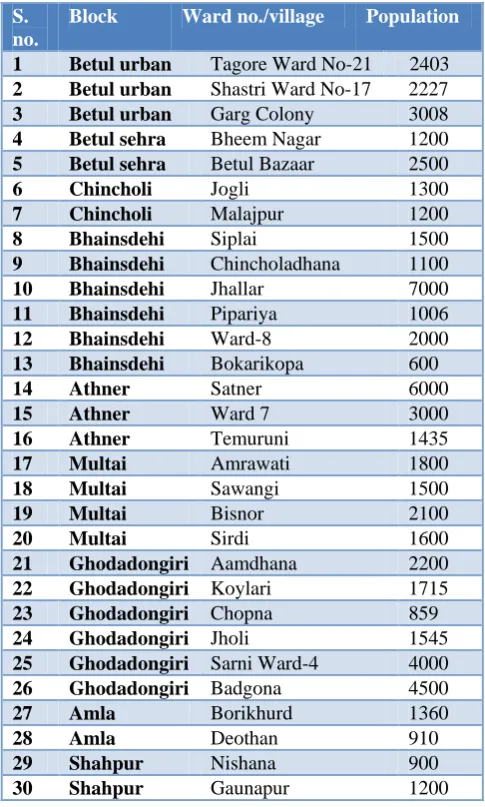
Selection of villages/wards by PPS method after line listing of 1395 villages/wards in the district. The total population of the district according to 2011 census was
15,75,247. Sampling interval was calculated to be 52040. Listing of 30 selected villages/wards was done.
In the selected villages, as the enrollment rate of boys and girls in schools was >90% each, allocation of sample was 100% from school, i.e., children aged between 6-12 years.
Table 1: List of selected 30 villages along with population.
S. no.
Block Ward no./village Population
1 Betul urban Tagore Ward No-21 2403
2 Betul urban Shastri Ward No-17 2227
3 Betul urban Garg Colony 3008
4 Betul sehra Bheem Nagar 1200
5 Betul sehra Betul Bazaar 2500
6 Chincholi Jogli 1300
7 Chincholi Malajpur 1200
8 Bhainsdehi Siplai 1500
9 Bhainsdehi Chincholadhana 1100
10 Bhainsdehi Jhallar 7000
11 Bhainsdehi Pipariya 1006
12 Bhainsdehi Ward-8 2000
13 Bhainsdehi Bokarikopa 600
14 Athner Satner 6000
15 Athner Ward 7 3000
16 Athner Temuruni 1435
17 Multai Amrawati 1800
18 Multai Sawangi 1500
19 Multai Bisnor 2100
20 Multai Sirdi 1600
21 Ghodadongiri Aamdhana 2200
22 Ghodadongiri Koylari 1715
23 Ghodadongiri Chopna 859
24 Ghodadongiri Jholi 1545
25 Ghodadongiri Sarni Ward-4 4000
26 Ghodadongiri Badgona 4500
27 Amla Borikhurd 1360
28 Amla Deothan 910
29 Shahpur Nishana 900
30 Shahpur Gaunapur 1200
Out of 2700 children belonging to 6-12 years age group, clinically examined by inspection and palpation for goiter, 78 (2.88%) were found to have visible goiter, enlarge or nodular. Prevalence of rate of goiter, observed in 8 blocks of Betul district is 2.88%.
In clinical examination, it was found that prevalence is more in 9 to 10 years age group (4.62%) and less in 12 years age group (2.40%).
Among the children examined, prevalence of goiter was found more in boys (3.03%) as compared to girls (2.74%).
urinary iodine excretion study, finding shows that maximum school children i.e.,124 (45.9%) had insufficient iodine intake. 101 (37.4%) were having adequate iodine intake. 30 (11.1%) school children had
Iodine intake more than daily requirement. 15 (5.5%) school children were having excessive iodine intake as reflected by excessive urinary iodine excretion.
Table 2: Prevalence rate of goiter among boys and girls according to age group and gender.
Age group
(years) Gender
Total
examinations
Grades of goiter Total cases
goiter %
Grade 0 Grade I Grade II (Ist+2nd)
6 to 7
Male 270 266 4 0 4 1.48
Female 270 265 5 0 5 1.85
Total 540 531 9 0 9 1.66
8 to 9
Male 270 262 8 0 8 2.96
Female 270 264 6 0 6 2.22
Total 540 526 14 0 14 2.59
9 to 10
Male 270 258 12 0 12 4.44
Female 270 257 13 0 13 4.81
Total 540 515 25 0 25 4.62
10 to 11
Male 270 261 9 0 9 3.33
Female 270 262 8 0 8 2.96
Total 540 523 17 0 17 3.14
12
Male 270 262 8 0 8 2.96
Female 270 265 5 0 5 1.85
Total 540 527 13 0 13 2.40
Table 3: Overall prevalence of goiter according to gender.
Sex Number Grade 0 Grade I Grade II (Ist+2nd) grade %
Male 1350 1309 41 0 41 3.03
Female 1350 1313 37 0 37 2.74
Table 4: Urinary iodine estimation (UIE analysis) of Betul district.
Mean value of urinary iodine excretion (µg/L) Iodine intake Urine samples (n) %
<20 Insufficient 23 8.5
20-49 Insufficient 68 25.1
50-99 Insufficient 33 12.2
100-199 Adequate 101 37.4
200-299 Above requirement 30 11.1
>300 Excessive 15 5.5
Total sample 270 100
Figure 1: Prevalence of goiter in Betul district
according to age group and gender. Figure 2: Distribution of samples according to level of urinary iodine. 1.48 2.96
4.44
3.33 2.96 1.85
2.22
4.81
2.96
1.85
6 to 7 years 8 to 9 years 9 to 10 years
10 to 11 years
12 years Girls
Boys
Perc
entag
e
8.50%
25.10%
12.20% 37.40%
11.10%
5.50%
Table 5: Distribution of iodine content of salt samples of Betul district.
Iodine content (in ppm) Frequency %
0 0 0
5 15 2.7
15 160 29.6
30 365 67.5
Total 540 100
525 (97.2%) salt samples had normal iodine content. 15 (2.7%) salt samples had inadequate iodine content. None of the salt samples was found negative for iodine.
DISCUSSION
A total of 2700 school children in the age group 6-12 years were examined for the presence of goiter. The goiter prevalence rate of 2.88% in the 6-12 year school children indicates that IDD is a severe public health problem in the district of Betul, Madhya Pradesh India. Similar findings were obtained in a study conducted by study done by Chudasama et al in Saurastra region showed the prevalence rate of 8.8% and a study by Sarkar et al, in the Mandya district of Karnataka, showed that the prevalence rate was 6.6% in school children and females had a higher prevalence compared to males in all the age groups. Makwan et al, study shows the overall prevalence of goiter among the study population was 4.83%.7-9 Findings contrary to our study were observed in a study conducted by Chandwani et al, where the prevalence was found to be 23.2%.10
About 97.2% of the salt sample had iodine concentration ≥15 and none had zero iodine content. 2.8% of the salt samples were having iodine inadequate iodine content, which may be because the fact that salt was iodized inadequately at the manufacturer level or due to loss of iodine during the distribution process. Chandwani et al study shows that about 93% of the households were consuming salt with iodine at adequate levels, and Kamath et al study in rural Belgaum, revealed that only 50% of the household had adequate iodine content (>15 ppm).10,11
CONCLUSION
The study findings with clinical examination among 6-12 years children in the district Dindori reveal the prevalence of IDD to be 2.88%, which indicates severe public health problem. Study of mean urinary iodine excretion shows 45.9% were having inadequate iodine excretion in urine, which indicates severe health concern, but not supported.
Recommendations
Use of rock salt should totally be prohibited and banned with special reference to Dindori district as it was found to be used in mid-day meals in schools.
Awareness of storage of salt in homes using air tight containers should be created in community.
Community especially pregnant mothers and children should be made aware about the benefits of iodized salt consumption as it goes long way in preventing hypothyroidism.
Community should be educated about the loss of iodine while cooking hence encouraged covering the utensils effectively while cooking.
Although this was not the objective of the study but the study teams observed that the salt was stored in the sunlight in shops hence the shopkeepers need to be educated regarding the correct storage practices of salt.
Further research should be conducted to explore the excessive intake of iodine found in every district.
Funding: No funding sources Conflict of interest: None declared
Ethical approval: The study was approved by the Institutional Ethics Committee
REFERENCES
1. World Health Organization. Micronutrient deficiencies. Available at: https://www.who.int/ nutrition/topics/idd/en/. Accessed on 17 June 2019. 2. Pandav CS, Yadav K, Srivastava R, Pandav R,
Karmarkar MG. Iodine deficiency disorders (IDD) control in India. Indian J Med Res. 2013;138(3):418.
3. World Health Organization. Iodization of salt for the prevention and control of iodine deficiency disorders. Available at: https://www.who.int/elena/ titles/salt_iodization/en/. Accessed on 17 June 2019. 4. National Iodine Deficiency Disorders Control Programme (NIDDCP). Available at: http://dghs .gov.in/content/1348_3_nationaliodinedeficiency.as px. Accessed on 17 June 2019.
5. National Iodine Deficiency Disorders Control Program (NIDDCP). Available at: http://www.salt comindia.gov.in/nidccp_iodised_program.html. Accessed on 17 June 2019.
6. National Family Health Survey-4, 2015-16. State fact sheet: Madhya Pradesh. Available at: http:// rchiips.org/nfhs/pdf/NFHS4/MP_FactSheet.pdf. Accessed on 17 June 2019.
7. Chudasama RK, Verma PB, Mahajan RG. Iodine nutritional status and goiter prevalence in 6-12 years primary school children of Saurashtra region, India. World J Pediatr. 2010;6:233-7
8. Sarkar P, Harish BR, Raghunath H, Mahendra BJ, Vinay M, Nimisha V. Prevalence of Iodine Deficiency Disorders among School Children Aged 6-12 Years in Mandya District, Karnataka. Int J Scientific Study. 2014;2(8):155-8.
salt iodization in Jamnagar district, India. Thyroid Res Pract. 2012;9:40-4.
10. Chandwani HR, Shroff BD. Prevalence of Goiter and Urinary Iodine Status in 6- 12 Year Old Rural Primary School Children of Bharuch District, Gujarat, India. Int J Prev Med. 2012;3(1):54-9. 11. Kamath R, Bhat V, Rao R, Das A, Ganesh KS,
Kamath A. Prevalence of Goiter in rural area of
Belgaum district, Karnataka. Indian J Community Med. 2009;34:48-51.
Cite this article as: Kushwah S, Nair AR, Meena JS, Verma S, Sawlani H, Chandak A. A study to assess