Original Research Article
A cross sectional study to assess prevalence and pattern of ocular
morbidity among pre-school children attending anganwadi centres of
Hubballi taluk in South India
Maneesha Godbole, N. P. Kavya, Manjunath S. Nekar*, D. D. Bant
INTRODUCTION
Vision is the most important special sense in human being and is essential for normal physical, mental, psychological development and education. According to WHO estimates, about 80% of global blindness is avoidable. About 30% of blind population of India loses their eyesight before the age of 20 years and many of them are under 5 when they become blind.1,2
Ocular morbidity is defined as any ocular pathology requiring clinical intervention or follow up. In India uncorrected refractive error, vitamin A deficiency, strabismus, amblyopia and conjunctivitis are the most common eye diseases contributing to it. Vitamin A deficiency was considered as the important cause for severe visual impairment in 1990s has come down and this change could be due to reduction in infections and improvement in nutrition because of effective prevention and primary health care measures and elevation of socio economic status. 3
ABSTRACT
Background: About 30% of blind population of India loses their eyesight before the age of 20 years and many of them are under 5 when they become blind. Childhood blindness will have serious impact on development, education and quality of life. Therefore it is essential that ocular morbidity is detected and treated at an early stage.
Methods: A cross-sectional study was conducted among 120 children aged 3-5 years attending 6 anganwadi centres
of Hubballi taluk which were selected by stratified random sampling. Data was collected using pretested semi-structured questionnaire. Ocular examination was conducted to identify ocular morbidity. Test for visual acuity, colour blindness and refractive status was done using lea chart, ischihara charts and plusoptix mobile vision screener respectively. Nutrition status was assessed by clinical examination and anthropometry. Statistical analysis was done using SPSS package.
Results: Out of 120 children 51.7% were male. Majority, 63.3% were residing in urban area and 40% belonged to
class IV of modified B G Prasad classification of socio-economic status scale. The prevalence of ocular morbidity was found to be 20%. 15.8% of children had refractive error, 2.5% had vitamin A deficiency and 1.7% had squint. No statistically significant association was found between ocular morbidity and any risk factors.
Conclusions: Refractive error was found to be the most common ocular morbidity among pre-school children. This if
detected early can be corrected. Therefore it is important to screen for refractive error at the preschool age itself and to create awareness among parents and anganwadi teachers regarding common ocular symptoms.
Keywords: Preschool children, Ocular morbidity, Anganwadi
Department of Community Medicine, Karnataka Institute of Medical Sciences, Hubballi, Karnataka, India
Received: 01 January 2019
Accepted: 15 January 2019
*Correspondence: Dr. Manjunath S. Nekar, E-mail: [email protected]
Copyright: © the author(s), publisher and licensee Medip Academy. This is an open-access article distributed under
the terms of the Creative Commons Attribution Non-Commercial License, which permits unrestricted non-commercial use, distribution, and reproduction in any medium, provided the original work is properly cited.
Children under the age of 5 years represent 8.9% of the whole population in India.4 Children do not complain of defective vision. They adjust to poor light by sitting near black board, holding the books closer to their eyes, squeezing the eyes and even avoiding work requiring visual concentration but it will have serious impact on their development, education and quality of life and this can extend beyond the children themselves into their family and society.5,6 This emphasis the need of vision screening in the preschool years to identify children with possible visual problems early, ensuring appropriate timely assessment and early intervention as required and thus preventing legal blindness and vision loss at later stage of life.
School eye screening program which was implemented as the integral part of the National Program for Control of Blindness (NPCB) and many studies done in India have focused on ocular health among school aged children.7-11 The very few studies done in preschool age group have mainly focused on vitamin A deficiency but amblyopia and amblyogenic risk factors such as strabismus and significant refractive error are also the most prevalent vision disorders in them which needs attention.12-15
Considering all above factors this study was conducted with the objective to estimate the prevalence of ocular morbidity among pre-school children and also to identify the pattern of ocular morbidity and factors associated with it.
METHODS
This is a cross sectional study conducted during the period of April to May 2017 aiming to estimate the prevalence of ocular morbidity among pre-school children aged between 3 to 5 years attending anganwadi centres in Hubballi taluk, to assess the pattern of ocular morbidity and to identify the factors associated with it.
6 anganwadi centres - 2 from rural areas Noolvi and Anchatageri, 1 from urban area Hanumanthnagar and 3 from urban slum areas Ramalingeshwar Nagar, Madhav Nagar and Maruti Heggeri were selected from Hubballi taluk by stratified random sampling.
All the children aged 3-5 years present in 6 anganwadi centres during the visit were included. Sick children and children of mothers who did not give consent to participate in the study were excluded.
A sample size of 120 was calculated by taking the prevalence of ocular morbidity as 50%, absolute precision as 10% and non-response rate as 20% using the formula 4PQ/d2.
Data collection
Permission was obtained from CDPO Dharwad to conduct study in anganwadi centres. After obtaining
informed oral consent from the mothers of children data was collected using predesigned, pretested and semi-structured questionnaire by interviewing mothers and anganwadi teachers in their own vernacular language. Questionnaire consists of socio-demographic data, obstetric and birth history of the child and data regarding vaccination and health status of the child. Environmental factors, family and behavioral factors associated with ocular morbidity were also taken into consideration.
Ocular examination was conducted to identify ocular morbidity. Test for visual acuity (unaided) and colour blindness was done using lea and ischihara charts respectively. Refractive status of the eye was assessed using plusoptix mobile vision screener (autorefractor). Nutrition status was assessed by clinical examination and anthropometry. Height of the child and mid upper arm circumference was measured with a measuring tape measured to the nearest centimeter (cm) and weight was measured by using salter weighing scale to the nearest kilogram (kg).
Definition of refractive error
Refractive error was taken as the spherical equivalent (SE) in diopters (D) and calculated as the power of the sphere plus half the cylindrical power. Eyes with a SE from -0.75 to +1.75 D were classified as emmetropic. Myopia was defined as SE refractive error of at least -0.75 D and hyperopia as +1.75 D or more. Astigmatism was defined as the cylinder power of 1.00 D or more. Vitamin A deficiency was diagnosed by the presence of Bitot’s spots or conjunctival xerosis or night blindness.16
The data was entered in microsoft excel worksheet and analysed using SPSS version 21. Statistical test like chi-square test was used and p<0.05 was considered as statistically significant.
RESULTS
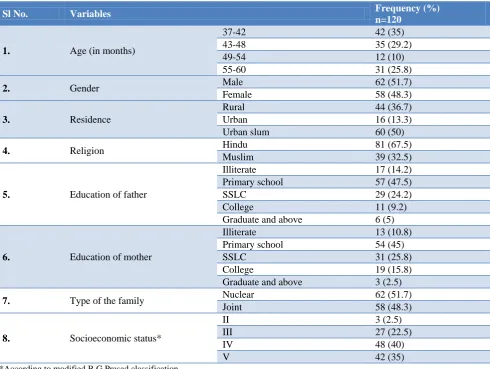
The mean age of study participants is 4 years. Out of 120 children 51.7% were boys, 63.3% were from urban area. Majority, 81% belonged to Hindu religion and 40% belonged to class IV socioeconomic status and 51.7% of children were from nuclear family as shown in table 1. 97.5% of children had completed vitamin A supplementation as per the schedule. 45% of children had birth weight <2.5 kg. 5.8% of children have family history of eye disorders like refractive error, glaucoma and blindness.
Table 2 depicts the nutritional status of children. According to weight for age 45.8% were underweight and 17.5% of children were malnourished according to mid upper arm circumference (<13.5 cm).
most common ocular morbidity was refractive error which was seen in 15.8% of children followed by 2.5% had vitamin A deficiency and 1.7% had squint. Study
also found that the knowledge of anganwadi teachers regarding ocular health was nil and growth charts were not maintained properly in any of the anganwadi centres.
Table 1: Socio-demographic characteristics of study participants.
Sl No. Variables Frequency (%)
n=120
1. Age (in months)
37-42 42 (35)
43-48 35 (29.2)
49-54 12 (10)
55-60 31 (25.8)
2. Gender Male 62 (51.7)
Female 58 (48.3)
3. Residence
Rural 44 (36.7)
Urban 16 (13.3)
Urban slum 60 (50)
4. Religion Hindu 81 (67.5)
Muslim 39 (32.5)
5. Education of father
Illiterate 17 (14.2)
Primary school 57 (47.5)
SSLC 29 (24.2)
College 11 (9.2)
Graduate and above 6 (5)
6. Education of mother
Illiterate 13 (10.8)
Primary school 54 (45)
SSLC 31 (25.8)
College 19 (15.8)
Graduate and above 3 (2.5)
7. Type of the family Nuclear 62 (51.7)
Joint 58 (48.3)
8. Socioeconomic status*
II 3 (2.5)
III 27 (22.5)
IV 48 (40)
V 42 (35)
*According to modified B G Prasad classification.
Table 2: Nutritional status of children based on weight for age and mid upper arm circumference.
Sl No Anthropometric variable Frequency
(n=120) %
1. Weight for age* Normal 65 54.2
Underweight(<-2SD) 55 45.8
2. Mid upper arm circumference
Normal(>13.5cm) 99 82.5
Mild to moderate
malnutrition(12.5cm-13.5cm) 19 15.8
Severe malnutrition (<12.5) 2 1.7
*Based on WHO weight for age Z scores.
Table 3: Pattern of ocular morbidity.
Pattern of ocular morbidity Frequency (n=120) %
Refractive error 19 15.8
Myopia 16 13.3
Hypermetropia 3 2.5
Vitamin A deficiency 3 2.5
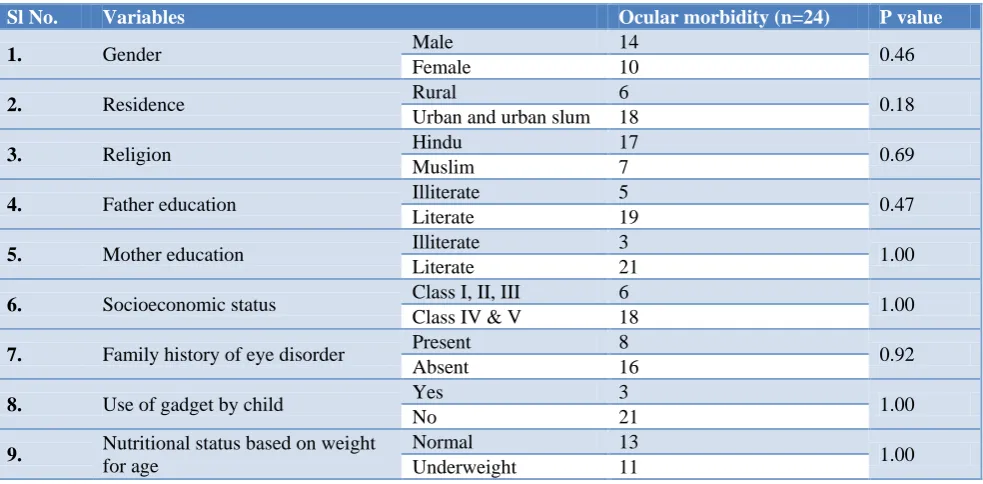
Table 4: Risk factors associated with ocular morbidity.
Sl No. Variables Ocular morbidity (n=24) P value
1. Gender Male 14 0.46
Female 10
2. Residence Rural 6 0.18
Urban and urban slum 18
3. Religion Hindu 17 0.69
Muslim 7
4. Father education Illiterate 5 0.47
Literate 19
5. Mother education Illiterate 3 1.00
Literate 21
6. Socioeconomic status Class I, II, III 6 1.00
Class IV & V 18
7. Family history of eye disorder Present 8 0.92
Absent 16
8. Use of gadget by child Yes 3 1.00
No 21
9. Nutritional status based on weight for age
Normal 13
1.00
Underweight 11
The study could not find any statistically significant association of ocular morbidity with any of the risk factors as p>0.05 (Table 4).
DISCUSSION
The present study was conducted to assess the prevalence and pattern of ocular morbidity among preschool children aged between 3 to 5 years attending anganwadi centres in Hubballi taluk and to identify the risk factors associated with it.
The present study found that the prevalence of ocular morbidity was 20% with refractive error as the most common cause of ocular morbidity. Data showing the overall prevalence of ocular morbidity among preschool children is not readily available in India for comparison of results, however studies done in Bangladesh among preschool children showed prevalence of 16.89% with refractive error as most common cause which is seen in 7.66% of children.17 Similar studies done on school children by Gupta et al, Sharma et al and Kemmanu et al to assess ocular morbidity showed the prevalence of 31.6%, 4.92% and 2.66% respectively with most common ocular morbidity as refractive error.3,18,19
In the present study the prevalence of refractive error was 15.8%. However in a study conducted in Saudi Arabia by Al-Rowaily among preschool children, prevalence of refractive error was 8% and it was 4.5% in Badawi et al study which is relatively lower compared to present study.15,20 This difference could be due to difference sociodemographic characteristics, difference in criteria used to define refractive error and difference in method used to assess refractive status.
In the present study vitamin A deficiency was seen in 2.5% of children, however it is higher (6.36%) in a study conducted in Southern Assam by Das et al in 2015 and lower (1.32%) in Dole et al study in Pune. The relatively lower prevalence of vitamin A deficiency could be due reduction in infection and improvement in health care delivery and vitamin A supplementation.12,14
In Prajapathi et al study done among school children, various factors like illiterate or lower parents’ education, lower socioeconomic class and malnutrition were significantly associated with ocular morbidity but the present study could not find any significant association with these factors.21
Limitations
The study could not assess the posterior segment eye disorders. The study could not identify any environmental, familial or other factors as risk factors of ocular morbidity.
CONCLUSION
Refractive error was found to be the most common ocular morbidity among pre-school children. This if detected early can be corrected. Therefore it is important to screen for refractive error at the preschool age itself and to create awareness among parents and anganwadi teachers regarding common ocular symptoms.
ACKNOWLEDGEMENTS
students Anil Kumar Biradar, Anjali A, Anjali R Biradar, Anoop Kulkarni, Anuradha Khavekar, Anusha K Prasad and Anushri V Illur for their help during data collection.
Funding: No funding sources Conflict of interest: None declared
Ethical approval: The study was approved by the Institutional Ethics Committee
REFERENCES
1. Madhavi MR, Kesuraju V, Nagrale P, Poka A. Ocular morbidity among school aged children in Indian scenario. Int J Res Med Sci. 2015;3:1431-4. 2. Danish Assistance to the National Program for
control of Blindness. New Delhi: India. Vision screening in school children. Training module 1, 1996.
3. Kemmanu V, Hegde K, Giliyar SK, Shetty BK, Kumaramanickavel G, McCarty CA. Prevalence of Childhood Blindness and Ocular Morbidity in a Rural Pediatric Population in Southern India: The Pavagada Pediatric Eye Disease Study-1. Ophthalmic Epidemiol. 2016;23(3):185-92.
4. Govt. of India. Sample Registration System Statistical Report 2014, Office of the Registrar General and Census Commissioner India, Ministry of Home Affairs, New Delhi, 2015.
5. Bedi R, Bedi DK, Nizamuddin, Dudule C, Gupta R, Sharma S. Prevalence of ocular morbidity among school children in Ajmer city. IOSR J Dental Med Sci. 2015;14(10):20-5.
6. Naik R, Gandhi J, Shah N. Prevalence of Ocular Morbidity among School Going Children (6-15years). Scholars J Applied Med Sci. 2013;1(6):848–51.
7. Jose R, Sachdeva S. School Eye Screening and the National Program for Control of Blindness. Indian Pediatrics. 2009;46:205-8.
8. Jayant DD, Malathi K. Prevalence of ocular morbidities among school children in rural area of North Maharashtra in India. National J Community Med. 2011;2(2):249-54.
9. Chauhan H, Dohare S, Khandekar J, Pradhan SK, Jain R, Mahajan H. Prevalence of Ocular Morbidity in 5 to 14 Years Children in an Urban Resettlement Colony of New Delhi, India. Indian J Public Health Res Develop. 2013;4(4):25-8.
10. Vinay BS, Shruthi BN. Prevalence of refractive error and other ocular morbidities among school going children aged 9-16yrs in rural area of Mandya, Karnataka, India. Int J Contemp Pediatr. 2016;3:509-13.
11. Dey AK, Nath AB. Prevalence of ocular morbidities among school children in a rural block of Cachar, Assam. J Evol Med Dental Sci. 2017;6(55):4124-7. 12. Dole K, Gilbert C, Deshpande M, Khandekar R.
Prevalence and Determinants of Xerophthalmia in Preschool Children in Urban Slums, Pune, India—A Preliminary Assessment. Ophthalmic Epidemiol. 2009;16(1):8-14.
13. Arlappa N, Balakrishna N, Laxmaiah A, Raghu P, Rao VV, Nair KM, et al. Prevalence of vitamin A deficiency and its determinants among the rural pre-school children of Madhya Pradesh, India. Ann Hum Biol. 2011;38(2):131-6.
14. Das R, Thakur NK, Mondal A. A Prevalence Study of Vitamin A Deficiency Ocular Morbidity among Preschool children in Southern Assam. 2016;3(3):852–854
15. Al-Rowaily M. Prevalence of refractive errors among pre-school children at King Abdulaziz Medical City, Riyadh, Saudi Arabia. Saudi J Ophthalmol. 2010;24(2):45-48.
16. Wang X, Liu D, Feng R, Zhao H, Wang Q. Refractive error among urban preschool children in Xuzhou, China. Int J Clin Exp Pathol. 2014;7(12):8922-8.
17. Uddin M, Omar R, Feizal V, Alam K. Ocular morbidity among preschool children in urban area of Chittagong in Bangladesh. Int Eye Sci. 2017;17(1):16-20.
18. Gupta M, Gupta BP, Chauhan A, Bhardwaj A. Ocular morbidity prevalence among school children in Shimla, Himachal, North India. Indian J Ophthalmol. 2009;57(2):133-8.
19. Sharma A, Maitreya A, Semwal J, Bahadur H. Ocular morbidity among school children in Uttarakhand: Himalayan State of India. Ann Trop Med Public Health. 2017;10(1):149-53.
20. Badawi AH, AlBloushi AF, Rashwan MM, Alsebaee AO, Ghunaim AA, Yousef AO. Prevalence of Uncorrected Refractive Errors Among Pre-school Children in Madinah City, Saudi Arabia: A pre-school based cross-sectional study. Int J Sci Res. 2017;6(1):691-4.
21. Prajapati P, Oza J, Prajapati J, Kedia G, Chudasama RK. Prevalence of Ocular Morbidity Among School Adolescents of Gandhinagar District, Gujarat. Online J Health Allied Sci. 2010;9(4):1-4.
Cite this article as: Godbole M, Kavya NP, Nekar