Asian J. Med. Biol. Res. 2015, 1 (2), 182-186; doi: 10.3329/ajmbr.v1i2.25610
Asian Journal of
Medical and Biological Research
ISSN 2411-4472 (Print) 2412-5571 (Online)www.ebupress.com/journal/ajmbr
Article
Effect of different fertilization practices on the growth and yield of cabbage
Mohammad Forhad Hossain1*, Taneya Farhana2, Md. Zahir Raihan1, Md. Saeed Hasan1,Md. Mukul Mia3 and M. Mazibur Rahman1
1
Department of Soil Science, Bangladesh Agricultural University, Mymensingh-2202, Bangladesh
2
Department of Entomology, Bangladesh Agricultural University, Mymensingh-2202, Bangladesh
3
Department of Genetics and Plant Breeding, Bangladesh Agricultural University, Mymensingh-2202, Bangladesh
*
Corresponding author: Mohammad Forhad Hossain, Department of Soil Science, Bangladesh Agricultural University, Mymensingh-2202, Bangladesh. E-mail: [email protected]
Received: 16 July 2015/Accepted: 10 August 2015/ Published: 30 September 2015
Abstract: The field experiment was conducted at the farmer’s field of Sutiakhali, a village near the BAU,
Mymensingh to investigate effect of integrated nutrient management on yield of cabbage and soil fertility
during the period from 5th November 2013 to February2014. The experiment was laid out in Randomized Complete Block Design (RCBD) with three replications and five treatments levels viz. T1: Recommended Dose (RD, N150P53K50S30Zn1.5Bo.7Mo0.5) T2: Soil Test Base (STB, N178P65K51S27Zn1.5B0.7Mo0.5) T3: Integrated Plant Nutrition System (IPNS, N158P59K42S24Zn1.5B0.7Mo0.5) + Cow dung (CD) @ 5.0 tha-1, T4: Farmer’s Practice (FP, N65P42K71S6) T5: Control (no fertilizer). The Integrated Plant Nutrition System showed significant positive effect on the yield and yield components of cabbage cv. Atlas-70. The results of the present study showed that cow-dung with inorganic fertilizers have significant variation on all the parameters except number of loose leaves. The highest values for plant height (25.88cm), number of folded leaves per head (42.50), length of the biggest leaf (34.77cm), length of the lateral root (31.92 cm), length of stem (6.83cm) were recorded in T3 treatments, on the other hand the highest values in case of number of loose leaves at the treatment of T5 (control). The yield of cabbage crop has increased significantly with application of inorganic fertilizer in combination of cow dung over the control. The highest values for fresh weight of cabbage was 89.16 t ha-1, dry matter content of head (5.93%), dry matter content of loose leaves (9.72%), were recorded at T3 treatments by the application of inorganic fertilizer (N158P59K42S24Zn1.5B0.7Mo0.5) in combination with cow dung @ 5.0 tha-1. The above results indicated that the integrated nutrient management had a remarkable effect in promoting soil fertility and increasing yield and yield components of cabbage.
Keywords: effect; fertilization practices; growth; yield; cabbage
1. Introduction
Cabbage (Brassica oleracea var. capitataL.) is a popular green leafy vegetable of the family Brassicaceae. It is a herbaceous, biennial, dicotyledonous flowering plant distinguished by a short stem upon which is crown with a mass of leaves, usually green but in some varieties red or purplish, which while immature form a characteristic compact, globular cluster (cabbage head). The only part of the plant that is normally eaten is the leafy head; more precisely, the spherical cluster of immature leaves, excluding the partially unfolded outer leaves. Cabbage is used in a variety of dishes for its naturally spicy flavor. In addition to, cabbage supplies B vitamins, potassium and calcium to the diet. 250 mL of raw cabbage contains 21 kilocalories and cooked 58 kilocalories (Haque 2006).
of 1, 13,000 tones. At present it is being cultivated in an area of 11.74 thousand hectares with a production of 115 thousand metric tons (BBS, 2001). But the yield of cabbage is very low in Bangladesh (9.79 t ha-1, BBS 2001) compared to that of other developed countries (30-70 t ha-1) of the world (FAO, 1999).
Cabbage is generally grown in Rabi season. Growth and yield of cabbage is remarkably influenced by organic and inorganic nutrients. It is an established fact that use of inorganic fertilizer for the crops is not so good for health because of residual effect but in the case of organic fertilizer such problem does not arise. On the other hand, it increases the productivity of soil as well as crop quality and yield (Tindall 2000). Nutrients may be applied both from organic and inorganic sources. Increased use of chemical fertilizer in crop field creates problems to the environment by polluting water, air and soil. The continuous use of chemical fertilizers also badly affects the soil texture and structure, decreases organic matter content of soil, and hampers soil microbial activity. The use of organic manures improve texture, structure, color, aeration, water holding capacity and microbial activity of the soil. Soils of Bangladesh contain less than 2% organic matter in most of the regions (BARC, 2005). In Bangladesh, the use of chemical fertilizers as a supplemental source of nutrients has been increasing steadily, however they are not usually applied in balanced proportions (Ferdous et. al., 2011). Hence, a pragmatic step needs to be taken for balanced application of fertilizer with the limiting nutrient elements wherever necessary. The conjunctive use of organic and inorganic sources will improve soil health and helps in maximizing production as it involves utilization of local sources and hence, turned to be rational, realistic and economically viable way of supply of nutrients to crop. As nutrients are the major contributing factors their appropriate management practices is essential to achieve the optimum yield of cabbage. A large number of research works have been conducted in the past on the effect of different fertilizer management practices on growth and yield of cabbage.
2. Materials and Methods
The research work was conducted at the farmer’s field of Sutiakhali, a village near the BAU, Mymensingh (AEZ 9). The experimental site is situated at 24°N latitude and 910E longitude having an altitude of 8.3m. The climate of the experimental site is subtropical in nature, which is characterized by three distinct seasons, the monsoon extending from May to October, the winter or dry season from November to February and pre-monsoon period hot season from March to April. The soil texture of the experimental site was silty loam, land was medium high and belongs to the Agro-Ecological Zone-9 (AEZ-9). The test crop was Cabbage (Atlas 70).Date of transplanting was 5th November, 2013 and date of harvesting was 20 January, 2014. The experiment was laid out in Randomized Complete Block Design (RCBD) with three replications. Five treatments including a control were assigned randomly to the unit plot of 4.5 m x 3.15 m in size. The total experimental area was 25.5 m x 11.45m and was divided into three blocks. Each block consisted of 5 unit plots. Thus the total number of unit plots was 15, plant spacing in unit plot was 60 cm x 45 cm and thus each unit plot accommodated 42 Nos.
Treatments of the experiment:
T1 Recommended Dose (RD, N150 P53 K50 S30 Zn1.5 Bo.7 Mo0.5)
T2 Soil Test Base (STB, N178 P65 K51 S27 Zn1.5 B0.7 Mo0.5)
T3 Integrated Plant Nutrition System (IPNS, N158 P59 K42 S24 Zn1.5 B0.7 Mo0.5 ) + Cow dung(CD)@5.0tha
T4 Farmer’s Practice (FP, N65P42K71S6)
T5 Control (no fertilizer)
Physical and chemical characteristics of the experimental field soil:
Characteristics Value
1. Particle size distribution
a. % Sand (2-0.05 mm) 27.06
b. % Silt (0.05 -0.002mm) 63.4
c. % Clay (<0.002mm) 9.54
2. Textural class silt
3. pH 6.53
4. Organic matter (%) 1.35
5. Total nitrogen (%) 0 .097
6. Available phosphorus (µg g-1) 6.00
7. Available potassium (meq 100 g-1) 0.097
8. Available sulphur (µg g-1) 9.3
9. Available zinc (µg g-1) 0.41
3. Results
The research work was done to investigate different fertilization practice on the growth and yield of cabbage. The analyses of variance (ANOVA) of the data on different yield contributing characters and yield have been shown in table 1. The results of the study have been presented in this section.
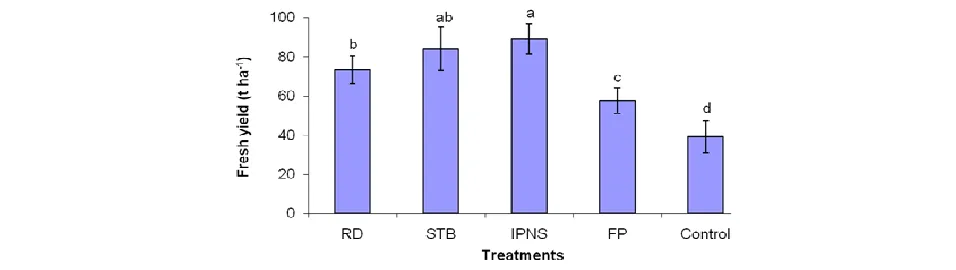
Plant height is one of the important growth contributing characters for cabbage plant. The plant height of cabbage at harvest was significantly influenced by different sources of nutrients (Table 1). The highest plant height (25.88 cm) was found in the treatment T3 (IPNS, N158P59K42S24Zn1.5B0.7Mo0.5 + cow dung @ 5.0 tha-1). The second highest plant height (25 cm) was found in the treatment T1 (RD, N150P53K50S30Zn1.5Bo.7Mo0.5). The lowest plant height (23.16 cm) was found in the treatment T5 (control). The number of loose leaves per plant at 75 days after transplanting varied from 36.40 to 42.50. The highest number of loose leaves (42.50) was produced in T5 (control) followed by T1 (N150P53K50S30Zn1.5Bo.7Mo0.5) and T2 (STB) which were statistically similar with treatment T4 (FP, N65P42K71S6). The lowest number of loose leaves (36.40) per plant was found in treatment T3 (IPNS, N158P59K42S24Zn1.5B0.7Mo0.5 + cow dung @ 5.0 t ha-1) which was statistically identical with treatment T2, (STB). Number of folded leaves of cabbage varied significantly with the different sources of nutrients (Table 1). The highest number of folded leaves (30.97) was recorded in the treatment T3 (IPNS, N158P59K42S24Zn1.5B0.7Mo0.5 + cow dung @ 5.0 tha-1) followed by the treatment, T2, T1, T4. The lowest number of folded leaves (23.70) was recorded from the treatment T5 (control). As outer leaves of cabbage mainly take part in photosynthesis, their number as well as fresh weight of head per plant is the most important physio-morphological character, which has a great contribution on cabbage yield. Fresh weight of cabbage per plant as influenced by different sources of nutrients was found significant. The highest fresh weight 89.16 tha-1 was recorded from the treatment T3 (IPNS, N158 P59 K42 S24 Zn1.5 B0.7 Mo0.5) + Cow dung @ 5.0 tha-1) which was statistically identical with T2 treatment. The lowest fresh weight 39.24 tha-1 was recorded in control T5 (Fig. 4.1). The fresh weight of cabbage due to different treatments ranked in the order of T3 > T2> T1> T4 > T5.
Table 1. Effect of different treatments on cabbage (cv. Atlas-70).
Treatments PH LL FL BL DM DMH LLR LS FW
T1 25.00ab 39.13b 29.43 a 32.33ab 9.26b 5.47c 28.41b 6.303b 73.44b
T2 24.75b 37.87bc 29.57a 31.67ab 9.22b 5.79b 27.29b 6.213b 84.13ab
T3 25.88a 36.40c 30.97a 34.77a 9.72a 5.93a 31.92a 6.827a 89.16a
T4 24.10bc 37.37bc 29.17a 31.40ab 8.85c 5.52c 27.10bc 6.140b 57.72c
T5 23.16c 42.50a 23.70b 29.13b 8.65d 5.23d 24.60c 5.703c 39.24d
SE () 0.29 0.70 1.13 1.01 0.05 0.03 0.77 0.075 4.2
Level of sig. ** ** * * ** ** ** ** **
CV (%) 2.06 3.13 6.83 5.47 0.93 0.99 4.80 2.09 12.4
Here, PH= Plant Height (cm), LL= Number of loose leaves, FL= Number of Folded Leaves, BL= Length of Biggest Leaf (cm), DM= Dry Matter Content (%), DMH= Dry Matter Content of Head (%), LLR= Length of Lateral Root (cm), LS= Length of Stem (cm), FW= Fresh Weight (t ha-1)
** =Significant at 1% level of probability, * =Significant at 5% level of probability
4. Discussion
Cabbage (Brassica oleracea L.) is a leafy green or purple biennial plant, grown as an annual vegetable crop for its dense-leaved heads. Plants perform best when grown in well-drained soil in a location that receives full sun. Different varieties prefer different soil types, ranging from lighter sand to heavier clay, but all prefer fertile ground with a pH between 6.0 and 6.8. Growth of cabbage and leafy green roots is influenced (and in many cases is limited) by the soil profile. Hard pans, clay pans and generally compacted soil restrict root growth. This, in turn, reduces nutrient and water uptake, limits plant growth and reduces yields. Although cabbage and leafy greens are shallow rooted, under favorable conditions and in properly prepared soil, roots will grow to a depth of 18 to 24 inches. The highest values for plant height (25.88 cm), Number of folded leaves per head (42.50), Fresh weight of cabbage leaves at harvest (930.50 g), were recorded in integrated plant nutrition System. This might be due to the fact that organic manures (cowdung) and inorganic fertilizers supplied adequate available plant nutrients for proper vegetative growth of cabbage plants, which ultimately influenced the plant height. Azad (2000) observed similar results. The highest values for yield of cabbage at the treatment of T3, Number of folded leaves per head (42.50), Fresh weight of cabbage (89.16 t ha-1) at harvest. This might be due to the fact that organic manures (cow-dung) and inorganic fertilizers supplied adequate available plant nutrients for proper vegetative growth of cabbage plants, which ultimately influenced the yield of cabbage. Hasan and Solaiman (2012) carried out a field experiment to evaluate the performance of fertilizers (organic) on the growth of cabbage. Vimala et al. (2006) carried out an experiment in Serdang, Malaysia to study the growth,yield and nutrient content of cabbage, and found a quadratic yield response to organic fertilizer rates and observed similar findings with this research. As nutrients are the major contributing factors, the appropriate management practices are essential to achieve the optimum yield of cabbage Sekender (2007). However, the conjunctive use of organic and inorganic sources will improve soil health and helps in maximizing production.
5. Conclusions
Cabbage is a tasty cool weather crop, easy to grow and delicious to eat. The yield of the Cabbage (Atlas-70) increased significantly due to integrated use of chemical fertilizer and organic manure in the farmers’ field under AEZ 9. Use of cow dung may reduce the use of chemical fertilizer from the conventional recommendation. Integrated Plant Nutrition System (IPNS, N158P59K42S24Zn1.5B0.7Mo0.5) along with cow dung (CD) @5.0 tha-1 appeared as the best suited combination providing higher yield and economic return.
Acknowledgements
The principal author, Mohammad Forhad Hossain along with others is thankful to the Department of Soil Science, Bangladesh Agricultural University; Soil Science Division of Bangladesh Institute of Nuclear Agriculture (BINA) for their technical assistance.
Conflict of interest None to declare.
References
Azad AK, 2000. Effects of plant spacing, sources of nutrients and mulching on growth and yield of cabbage. M.S. Thesis, Dept. of Horticulture, Bangladesh Agricultural University, Mymensingh.
Bangladesh Bureau of Statistics, 2001. Monthly Statistical Bulletin. Statistics Division, Ministry of Planning, Government of the People's Republic of Bangladesh, Dhaka, Bangladesh.
BARC, 2005. Fertilizer Recommendation Guide. Bangladesh Agricultural Research council Farmgate, Tejgoan, Dhaka, Bangladesh, p. 196.
Bhardwaj ML, R Harender and BL Koul, 2000. Yield response and economics of Bangladesh Agricultural Research Council 1997: Fertilizer Recommendation Guide, Farmgate, Tejgoan, Dhaka, Bangladesh, p. 196. Bhuiyan NI, 1994. Crop production and need of sustainability in agriculture. A paper presented in a three day
workshop on "Integrated Nutrient Management for Sustainable Agriculture" held at SRSI. 26-28.
Bhuiyan NI, AL Shaha and GM Panaullah, 1991. Effect of NPK fertilizer on the grain yield of transplanted rice and soil fertility long time study. Bangladesh J. Soil Sci., 22:41-50.
Haque KMF, 2006. Yield and nutritional quality of cabbage as affected by nitrogen and phosphorus fertilization. Bangladesh J. Sci.Indust. Res., 41: 41-46.
Hasan M and Solaiman, 2012. Efficacy of organic and organic fertilizer on the growth of Brassica oleracea L. (Cabbage). Intl. J. Agril.Crop Sci., 4:128-138
Ferdous MZ, MM Anowar, MA Rahman, F Yasmin and J Nain, 2011. Fertilizer management for maize-mungbean-T. aman based cropping pattern. J. Agrofor. Environ., 5 : 129-132.
Sekender DR, 2007. Effect Of Organic And Inorganic Fertilizers Ov Growth And Yield Of Chinese Cabbage (Brassica campestris var. pekinensis) SAU MS Thesis, Dhaka.
Tindall M, 2000. Mineral and organic fertilizing in cabbage.Residual effect forcommercial cultivation on yield and quality performance with organic farming. Hort. Bras., 6:15-20.