R E S E A R C H
Open Access
Hippocampal function is not required for the
precision of remote place memory
Takashi Kitamura
1,2,3,6, Reiko Okubo-Suzuki
1,2,3, Noriko Takashima
2,3, Akiko Murayama
2,3, Toshiaki Hino
3,
Hirofumi Nishizono
4, Satoshi Kida
2,5and Kaoru Inokuchi
1,2,3*Abstract
Background:During permanent memory formation, recall of acquired place memories initially depends on the hippocampus and eventually become hippocampus-independent with time. It has been suggested that the quality of original place memories also transforms from a precise form to a less precise form with similar time course. The question arises of whether the quality of original place memories is determined by brain regions on which the memory depends.
Results:To directly test this idea, we introduced a new procedure: a non-associative place recognition memory test in mice. Combined with genetic and pharmacological approaches, our analyses revealed that place memory is precisely maintained for 28 days, although the recall of place memory shifts from hippocampus-dependent to hippocampus-independent with time. Moreover, the inactivation of the hippocampal function does not inhibit the precision of remote place memory.
Conclusion:These results indicate that the quality of place memories is not determined by brain regions on which the memory depends.
Introduction
The hippocampus is a key brain structure for learning and memory [1-3]. Recall of some associative and spatial memories initially depends on the hippocampus, but that hippocampal dependency progressively decays over time, a process that is associated with a gradual increase of neocortex-dependency [4-9]. It has been suggested that the quality of original memories also transforms from a precise (i.e., detailed) form to a less precise (i.e., more schematic or generic) form with similar time course [10-12]. The question arises of whether changes in the quality of the original memories depend on the shift in brain regions on which the recall of these mem-ories relies, i.e., whether the hippocampus is always required for the precision of memories. This is an important question for understanding physiological sig-nificances of the hippocampal-cortical complementary memory systems.
There are several studies that address this issue in rodents. Using a contextual fear conditioning paradigm, which is an associative learning between a place and aversive experience, some studies demonstrated that the hippocampus is always necessary for the precision of place memories [13,14], supporting the memory trans-formation view [11] in which the quality of place mem-ory correlates with the brain region on which that memory depends. By contrast, another study demon-strated that the hippocampus is not required for mem-ory precision after the passage of time [15], supporting the memory reorganization view [9] in which the quality of place memory does not correlate with the brain region. Importantly, this discrepancy can be attributed to differences in experimental protocols used for asso-ciation with fear [15]. Because assoasso-ciation with fear modifies (i.e., strengthen or generalize) the precision [16,17], we cannot rule out the possibility that fear asso-ciation may mask the actual precision of place memory. Moreover, contextual fear conditioning indirectly evalu-ates the place memory by measuring fear responses. Analyses based on association procedures may not be suitable for evaluating the precision. A direct way to
* Correspondence: [email protected]
1Department of Biochemistry, Faculty of Medicine, Graduate School of
Medicine & Pharmaceutical Sciences, University of Toyama, Toyama 930-0194, Japan
Full list of author information is available at the end of the article
address this issue is to measure the place memoryper se
without association protocols. In this study, we intro-duced a new procedure: a one-trial and non-associative place recognition test in mice. The clear advantage is the absence of any explicit reinforcement. In this proce-dure, we simply placed mice in a previously experienced vs. novel place. In the previously experienced place, mice exhibited habituation (reduced motility). In the novel context, mice did not show this reduction in moti-lity. Thus, we evaluated the adaptation level as an index of the successful retrieval of place memory. Mice quickly acquired place memory during a free exploration and clearly discriminate experienced place from novel place. Especially mice maintained these memories for one month, which is different from the case in rats [18]. This procedure allows us to directly evaluate the preci-sion of remote place memory. Using this procedure combined with genetic and pharmacological approaches, we examined the relationship between the precision of place memory and the brain region on which that mem-ory depends.
Materials & methods Animals
All animal procedures were conducted in compliance with the guidelines of the National Institutes of Health and were approved by the Animal Care and Use Com-mittee of the University of Toyama and the Mitsubishi Kagaku Institute of Life Sciences. For WT experiments, male C57BL/6JSLC mice at 8 weeks of age were pur-chased from Sankyo Laboratory (Japan). For experiments using inducible cAMP response element binding protein
(CREB) repressor transgenic mice [19,20] anda
-Cal-cium-calmodulin kinase II heterozygous null mutant mice [21-23], the progeny for each line was produced usingin vitrofertilization and embryo transfer techni-ques to produce a number of animals sufficient for behavioral testing. Age- and gender-matched littermates were used for the tests. All behavioral experiments were conducted and analyzed by scientists blind to the
geno-types of the animals. Food and water were providedad
libitum.
Cannulation and drug infusion
We used a surgical procedure described previously [24,25]. Briefly, mice were implanted bilaterally with stainless steel guide cannulae (Eicom) using the follow-ing stereotactic coordinates: AP = -2.0 mm, ML = ± 1.5 mm, V = -2.1 mm from the bregma. Mice were allowed to recover for at least 14 days in individual home cages. To transiently inactivate hippocampus, a fluorescently-labeledg-aminobutyric acid subtype A receptor agonist (FCM, fluorophore-conjugated muscimol; Molecular Probe) was used. Mice were briefly anesthetized with
isoflurane to facilitate the insertion of the injection can-nula. FCM (0.8 mM, 0.5 ul) or PBS alone was infused into the dorsal hippocampus at a rate of 0.20μl/min 60 min before the retrieval test. The fluorescent signals of FCM were distributed in the dorsal hippocampus bilat-erally. To inhibit protein synthesis in the hippocampus, anisomycin (ANI, 100μg/μl, 0.75μl; Sigma) was infused into the dorsal hippocampus bilaterally at a rate of 0.25
μl/min 10 minutes after the learning. For the i.p. injec-tion of ANI, ANI (150 mg/kg, i.p.) was dissolved in PBS (pH adjusted to 7.0-7.4) and administered to mice 10 minutes after the learning. At this dose, ANI inhibits 90% of protein synthesis in the brain during the first 2 hours [26]. For the i.p. injection of (R)-CPP (10 mg/kg, i.p.; Tocris), an antagonist of N-methyl-D-aspartate receptors, (R)-CPP was dissolved in PBS and adminis-tered to mice 4.5 hours before the learning. To examine the effects of disrupting CREB function on place mem-ory formation, we used the transgenic mice that express an inducible CREB repressor in the forebrain, where a dominant-negative CREB protein is fused with the ligand binding domain of a mutant estrogen receptor [19]. Tamoxifen (4-hydroxytamoxifen; 16 mg/kg, i.p. TAM; Sigma), which was dissolved in 10 ml of peanut oil (Sigma), or peanut oil only (OIL) was administered to WT or transgenic mice 6 hours before the learning session.
Place memory test
system (Muromachi Kikai; Japan) to measure the moti-lity of the animals. The motimoti-lity was calculated as the cumulative area of movement (pixel size) per 0.1 sec in the learning and testing sessions.
Contextual fear conditioning
Contextual fear conditioning was carried out as described previously [24,27,28]. Briefly, during the train-ing session, mice were placed in the conditiontrain-ing cham-ber (S) in Room A. After 3 minutes, animals were subjected to three unsignaled footshocks (2 sec duration, 0.5 mA, a min apart). After the last shock, mice remained in the chamber for 1 minute and were then returned to their home cages. During the testing session, mice were placed back into the conditioning chamber (S) or the novel chamber (C) for 3 minutes in Room A at 1 day or 28 days after training. At the end of each session, mice were returned to their home cages and the chambers were cleaned with water and 80% ethanol. All experiments were conducted using a video tracking sys-tem (Muromachi Kikai; Japan) to measure the freezing behavior of the animals. Freezing was defined as a com-plete absence of movement, except for respiration. Scor-ing of the duration of the freezScor-ing responses was started after 1 sec of sustained freezing behavior.
Statistical analyses
All data are presented as mean ± SEM. The number of animals used is indicated by“n”. Comparisons between two-group data were analyzed by unpaired Student’s t-tests or paired t-t-tests. Multiple group comparisons were assessed using a one-way, two-way, or repeated
measures analysis of variance (ANOVA), followed by the post-hoc Scheffe’s test when significant main effects or interactions were detected. The null hypothesis was rejected at theP< 0.05 level.
Results
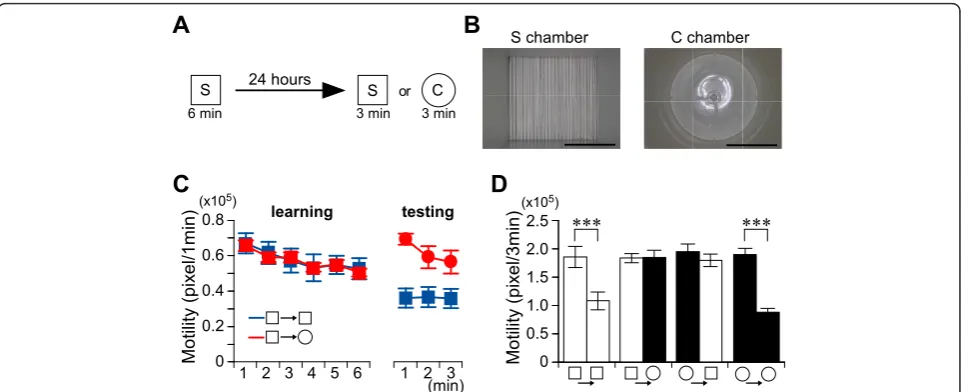
Mice were exposed to a novel square-type (S) chamber to learn this place (Figure 1A, B). One day later, mice were again exposed to the same chamber or a novel cir-cle-type (C) chamber to test memory retrieval (Figure 1A, C). We monitored the motility of mice in the cham-bers and evaluated the adaptation level for the experi-enced or novel chamber as an index of the successful retrieval of place memory (Figure 1C, D). Mice showed a reduction in their motility when exposed to the same S chamber (paired t-test;t6 = 9.96,P < 0.001) (Figure
1D). By contrast, a six-minute exposure to the S cham-ber did not induce adaptation in the novel C chamcham-ber (paired t-test; t6 = -0.07, P > 0.9) (Figure 1C, D). We
obtained a similar result when we changed the sequence (C-C paired t-test: t5 = 8.39,P < 0.001; C-S paired
t-test:t6 = 1.16,P > 0.2) (Figure 1D). These results
indi-cate that mice quickly learn the place and completely discriminate the experienced place from the novel place one day after learning. Thus, the adaptation can be used to index place memory.
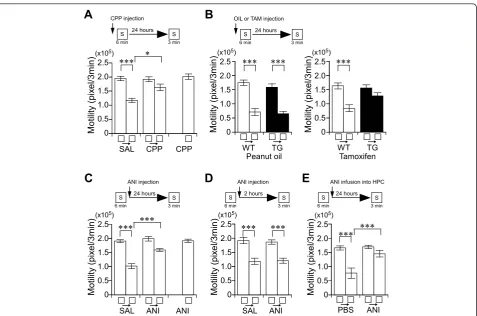
To validate the potency of this procedure as place memory test, we have characterized the molecular mechanisms of place memory formation (Figure 2). We found that the injection of NMDA receptor antagonist disrupted the adaptation 1 day after learning (Figure 2A), and that the tamoxifen-injected CREB transgenic
B BB
B B BBB B B B B
1 2 3 4 5 6 0.8
(x105)
0.6
0.4
0.2
0
learning
Mo
tility
(p
ix
e
l/1
m
in
)
B B B
J J J
C
Mo
tility
(p
ix
e
l/3
m
in
)(x102.55)
2.0 1.5 1.0
0 0.5
1 2 3 (min)
D
*** testing
***
S 24 hours S
6 min 3 min
A
B
or C
3 min
S chamber C chamber
Figure 1Mice discriminate places in non-associative place recognition test.A, Experimental design.B, Photographs of a square-type
chamber and a circular-type chamber. Scale bars, 10 cm.C, Recent place memory test. Kinetics of motility in the learning and testing sessions.
Blue line, S-S; red line, S-C; n = 6-7/group.D, Motility in the first 3 minutes during the learning or testing session in chamber S (white bars) or
mice showed less adaptation for chamber S compared with the other groups (Figure 2B), and that an injection of anisomycin into the dorsal hippocampus disrupted the adaptation 1 day after learning (Figure 2E) but not short-term memory (Figure 2C, D). Thus, similar to other forms of hippocampus-dependent memory [3,29], the place memory formation requires the NMDA recep-tor function, the CREB-mediated transcription (Figure 2B), and the protein synthesis in the hippocampus.
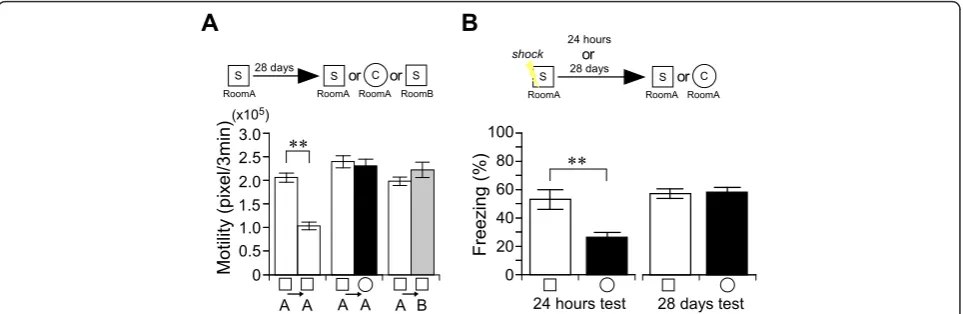
Next, we examined the maintenance of place memory 28 days after learning (Figure 3A). In the retrieval test, mice showed adaptation for the experienced S chamber (paired t-test: t5 = 6.48,P< 0.002), but not for the novel
C chamber (paired t-test:t5= 0.35,P> 0.7) (Figure 3A),
indicating that mice can discriminate the experienced place from the novel place 28 days after learning. We
further examined the precision of their remote place memory in a variable-rooms/constant-chamber condi-tion, in which mice were placed for 6 minutes in the S chamber in room A and 28 days later these mice were placed in the same S chamber in a different room B (Figure 3A). In novel room B, mice did not show adap-tation, even for the previously experienced S chamber (A-B, paired t-test: t10 = -1.69, P > 0.1) (Figure 3A),
indicating that mice can detect changes outside of the chamber. This seems to be a similar feature of hippo-campal representations, global remapping, in which both the firing location and firing rates of hippocampal pyra-midal cells change in variable-room/constant-chamber conditions [30,31]. These results indicate that the preci-sion of place memory does not decline with time in mice, even with one-trial learning. In marked contrast,
Mo tility (p ix e l/3 m in
)(x102.55)
2.0 1.5 1.0 0 0.5 *** * CPP SAL CPP
A
Mo tility (p ix e l/3 m in ) 2.5(x105)
2.0 1.5 1.0 0 0.5 Peanut oil WT TG *** *** Mo tility (p ix e l/3 m in ) 2.5
(x105)
2.0 1.5 1.0 0 0.5 Tamoxifen WT TG
B
*** *** *** Mo tility (p ix e l/3 m in ) 2.5(x105)
2.0 1.5 1.0 0 0.5 ANI SAL ANI
C
ANI PBS Mo tility (p ix e l/3 m in ) 2.5(x105)
2.0 1.5 1.0 0 0.5 *** ***
E
*** Mo tility (p ix e l/3 m in ) 2.5(x105)
2.0 1.5 1.0 0 0.5 ANI SAL ***
D
S 24 hours S 6 min 3 min CPP injection
S 24 hours S 6 min 3 min OIL or TAM injection
S 24 hours S
6 min 3 min ANI injection
S 2 hours S
6 min 3 min ANI injection
S 24 hours S
6 min 3 min ANI infusion into HPC
Figure 2Place memory formation requires NMDA receptor function, CREB-mediated transcription, and protein synthesis in the hippocampus.A-E, Experimental design used with data presented below.A, Effect of an antagonist of the NMDA receptor on place memory formation. Motility in the first 3 minutes during the learning or testing session in chamber S. SAL (saline), CPP, or CPP treatment-only
(homecage) groups. There was a significant interaction between adaptation and drug treatment (repeated ANOVA: F(1, 47)= 13.42,P< 0.01). n =
10-12/group.B, Effect of inducible repression of CREB function on place memory formation. Motility in the first 3 minutes during the learning or
testing session in chamber S. There was a significant interaction between adaptation and genotype (repeated ANOVA: F(1, 31)= 7.32,P< 0.02). n
= 6-9/group.C, Effect of i.p. injection of ANI on long-term place memory. Motility in the first 3 minutes during the learning or testing session in
chamber S. SAL, ANI, or ANI treatment-only (homecage) groups. Injection of ANI disrupted long-term place memory. There was a significant
interaction between adaptation and drug (repeated ANOVA: F(1, 47)= 15.89,P< 0.001). n = 10-12/group.D, Effect of i.p. injection of ANI on
short-term place memory. Injection of ANI did not affect short-term place memory. n = 10/group.E, Effect of infusion of ANI into dorsal
hippocampus on consolidation of place memory. There was a significant interaction between adaptation and drug (repeated ANOVA: F(1, 21)=
mice seemed not to discriminate between the S chamber and the C chamber in a remote memory test for contex-tual fear conditioning (Figure 3B). Mice showed high freezing behavior in both chambers in the 28-day mem-ory retrieval test (S vs C,t37= -0.20, P> 0.8), although
mice showed less freezing in the novel C chamber than in the conditioning S chamber in a one-day memory retrieval test (S vs C,t17= 3.18,P< 0.01) (Figure 1E), as
previously reported [13,15,24,32-34]. These results indi-cate that the fear association can mask the precision of place memory, whose mechanisms may be related to feed-forward inhibition growth in the hippocampus [34].
Alpha-calcium-calmodulin kinase II (a-CaMKII)
het-erozygous null mutant (HKO) mice [21] have severe deficits in cortical long-term potentiation (LTP), whereas hippocampal CA1 LTP is normal [35]. The HKO mice showed high motility compared with age-matched litter mate wild-type mice (motility/3 min in
Chamber S; WT (n = 10), 192876 ±11743 pixel; HKO
(n = 10), 274844±15573 pixel;t18= -4.2,P< 0.001), as
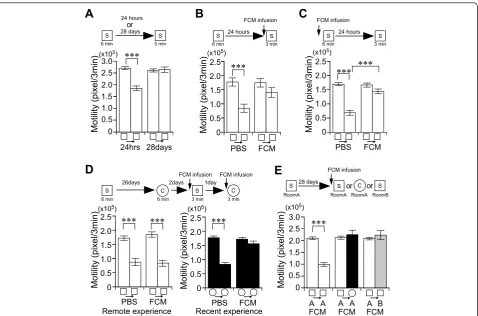
previously reported [22]. Interestingly, HKO mice showed a complete deficit in place memory 28 days later (paired t-test: t12 = -0.36,P > 0.7), whereas
one-day memory was normal (paired t-test; t13 = 9.09,P <
0.001) (Figure 4A). This suggests that cortical plasticity contributes to remote place memory formation. Here, we hypothesized that place memory temporally depends on the hippocampus. To test this, we assessed the con-tribution of the hippocampus to the retrieval of recent and remote place memories through the transient and pharmacological inactivation of the dorsal hippocampus (Figure 4B-D) [24]. The intrahippocampal infusion of
fluorescently-labeled muscimol (FCM) [36] significantly inhibited the retrieval of 1-day memory (Figure 4B). The infusion of FCM also disrupted memory formation (Fig-ure 4C). Treatment with FCM infusion alone did not affect natural motility (Figure 4B, C). Thus, hippocampal function is essential for the formation and retrieval of recent place memory. Next we examined the remote memory test. In the retrieval test for 28-day memory, both FCM- and phosphate buffered saline (PBS)-infused mice clearly showed adaptation to remotely experienced S chamber (PBS paired t-test:t9 = 6.30,P< 0.001; FCM
paired t-test: t10 = 16.9, P < 0.001) (Figure 4D, left panel). There was no interaction between adaptation and drug treatment (repeated ANOVA: F(1, 41)= 0.35, P
> 0.5). Subsequently, the same animals were subjected to recent memory retrieval test in which hippocampus was inactivated 60 min before the test by additional FCM infusion. The infusion of FCM significantly inhib-ited adaptation for the recently experienced C chamber (Figure 4D,right panel). There was a significant interac-tion between adaptainterac-tion and drug treatment (repeated ANOVA: F(1, 41)= 27.1, P < 0.001), indicating that the
FCM infusion effectively inactivated the hippocampal function in these animals. Therefore, the retrieval of remote place memory is completely hippocampal neuro-nal activity-independent.
Finally, we examined whether hippocampal function is required for the precision of remote place memory retrieval. In the retrieval test for 28-day memory, FCM-infused mice were placed in the experienced S chamber or novel C chamber (Figure 4E). FCM-infused mice showed adaptation for the experienced S chamber
Freez
ing
(%)
100 80
60 40 20
0
B
A
A A
Mo
tility
(p
ix
e
l/3
m
in
)(x105)
B A A A
3.0 2.5 2.0
1.0
0 0.5 1.5
**
**
24 hours test
C or
RoomA
S 28 days S
RoomA RoomA
C
or or S
RoomB RoomA
S 28 days S
RoomA RoomA
24 hours or
shock
28 days test
Figure 3The precision of non-associative place memory does not decline with time.A, B, Experimental design used with data presented
below.A, Remote place memory in non-associative place memory test. Motility in the first 3 minutes during the learning or testing session in
chamber S/Room A (white bar), or chamber C/Room A (black bar), or chamber S/Room B (gray bar). There was a significant interaction between
adaptation and chamber (chamber S/Room A vs chamber C/Room A; repeated ANOVA: F(1, 23)= 13.54,P< 0.01) (chamber S/Room A vs
chamber S/Room B; repeated ANOVA: F(1, 33)= 31.86,P< 0.001). n = 6-11/group.B, Recent (1 day: n = 9-10/group) or remote (28 days: n =
19-20/group) contextual fear conditioning memory tests. Training was carried out in the S chamber. Freezing behavior averaged over the 3-minute test sessions in chamber S/Room A (conditioned, white bars) or chamber C/Room A (novel, black bars). There was a significant interaction
(paired t-test: t9 = 12.06, P < 0.001), whereas
FCM-infused mice did not show adaptation for the novel C chamber (paired t-test:t9 = -0.68,P > 0.5) (Figure 4E).
We further examined the variable-rooms/constant-chamber condition 28 days after learning (Figure 4E). Similar to naive mice (Figure 3A), FCM-infused mice did not show adaptation for the experienced S chamber in the novel room B (paired t-test:t11 = -0.84,P> 0.4)
(Figure 4E). These results indicate that the pharmacolo-gical inactivation of hippocampal function does not inhi-bit the precision of remote place memory.
Discussion
In this study, we carried out the contextual fear condi-tioning test and the non-associative place recognition
test under the same experimental condition (same cham-bers and same exposure time to chamber) (Figure 3). These results clearly indicate that the association with fear masks the actual precision of place memory. More-over, in contextual fear conditioning mice showed the freezing responses even for unconditioned place in recent memory test (Figure 3B) [13,15,24,32-34], whereas in our non-associative place recognition test mice did not show any adaptation behavior even for similar place in remote memory test (Figure 3A). Therefore, the conclusions of previous studies using contextual fear conditioning [13-15] need to be validated by non-associative protocol. Thus, we examined the contribution of hippocampal function on the precision of remote place memory by non-associative place recognition test.
FCM PBS Mo tility (p ix e l/3 m in
)(x102.55)
2.0 1.5 1.0 0 0.5 *** ***
C
Remote experience Mo tility (p ix e l/3 m in)(x102.55)
2.0 1.5 1.0 0 0.5 PBS FCM Recent experience Mo tility (p ix e l/3 m in ) 2.5
(x105)
2.0 1.5 1.0 0 0.5 PBS FCM *** *** *** C S S
26days 2days 1day
C FCM infusion FCM infusion
6 min 6 min 3 min 3 min
A
Mo tility (p ix e l/3 m in ) 3.0(x105)
2.5 2.0 1.0 0 0.5 1.5 24hrs 28days ***
S 28 days S
6 min 3 min 24 hours or
D
Mo tility (p ix e l/3 m in)(x102.55)
2.0 1.5 1.0 0 0.5 PBS FCM ***
B
S 24 hours S 6 min 3 min FCM infusion
S 24 hours S
6 min 3 min FCM infusion
E
A A Mo tility (p ix e l/3 m in)(x105)
B A A A 3.0 2.5 2.0 1.0 0 0.5 1.5 ***
FCM FCM FCM
C
or or S
RoomB RoomA
S 28 days S
FCM infusion
RoomA RoomA
Figure 4The retrieval and precision of remote, but not recent, place memory does not require hippocampal function.A-E, Experimental
design used with data presented below.A, Recent and remote place memory in CaMK II heterozygous null mutant (HKO) mice. Motility in the
first 3 minutes during the learning and testing session. There was a significant interaction between adaptation and day (repeated ANOVA: F(1, 53)
= 36.55,P< 0.001). n = 13-14/group.B, C, Effect of the fluorescently-labeled muscimol (FCM) injection into the hippocampus on the formation
(C) and the retrieval (B) of recent place memory. Motility in the first 3 minutes during the learning or testing session. There was a significant
interaction between adaptation and drug (Figure 4B, repeated ANOVA: F(1, 29)= 23.61,P< 0.001) (Figure 4C, repeated ANOVA: F(1, 33)= 21.29,P
< 0.001).D, Effect of FCM infusion into the hippocampus on the retrieval of remote and recent place memory. Chamber S was used for the
remote memory retrieval test. Chamber C was used for the recent memory retrieval test. n = 10-11/group. E, Effect of the FCM infusion into the hippocampus on the retrieval of remote place memory in different chambers and rooms. Motility in the first 3 minutes during the learning or testing session. There was a significant interaction between adaptation and chamber (chamber S/Room A vs chamber C/Room A; repeated
ANOVA: F(1, 39)= 35.71,P< 0.001) (chamber S/Room A vs chamber S/Room B; repeated ANOVA: F(1, 43)= 34.99,P< 0.001). n = 10-12/group. ***P
Using this procedure, we found that the place memory is precisely maintained for 28 days, which may require
a-CaMKII-dependent plasticity in the cortex, and that
the retrieval of remote place memory (not recent mem-ory) does not require hippocampal function. These results indicate that the quality of a place memory does not correlate with the brain region on which that mem-ory depends. Moreover, we found that the inactivation of hippocampal function does not inhibit the precision of remote place memory. These results indicate that the hippocampal function is not required for the precision of remote place memory. This is consistent with a human case study in which a patient with bilateral extensive hippocampal damage showed intact memories for places learned long ago, but not intact recent place memory [37]. Eight patients with bilateral hippocampal damage were able to recall their remote autobiographi-cal memories [38]. Thus, the quality of original place memories is not determined by brain regions on which the memory depends.
Acknowledgements
We thank S. Kamijo, M. Matsuo and H. Hidaka for the care of the animals. We also thank B. Wiltgen and N. Ohkawa for reading the manuscript and for discussions, and all members of the Inokuchi laboratory for daily discussions. This work was supported by the Core Research for Evolutional Science and Technology (CREST) program of the Japan Science and Technology Agency (JST) to K.I., a Grant-in-Aid for Scientific Research (S) to K.I., the Mitsubishi Foundation to K.I., the Uehara Memorial Foundation to K.I., a Grant-in-Aid for Young Scientists (B) to T.K., and the Sasagawa Scientific Research Grant to T. K.
Author details
1Department of Biochemistry, Faculty of Medicine, Graduate School of
Medicine & Pharmaceutical Sciences, University of Toyama, Toyama
930-0194, Japan.2Japan Science and Technology Agency, CREST, Kawaguchi
332-0012, Japan.3Mitsubishi Kagaku Institute of Life Sciences, MITILS, Machida,
Tokyo 194-8511, Japan.4Division of Animal Experimental Laboratory, Life
Science Research Center, University of Toyama, Toyama 930-0194, Japan.
5
Department of Bioscience, Faculty of Applied Bioscience, Tokyo University
of Agriculture, Tokyo 156-8502, Japan.6Present address: RIKEN-MIT Center for
Neural Circuit Genetics and the Picower Institute for Learning and Memory, Massachusetts Institute of Technology, Cambridge, 02139, USA.
Authors’contributions
T.K. and K.I. designed research; T.K., R.O.-S., N.T., A.M., T.H., H.N., S.K. performed research; T.K., R.O.S., and K.I. analyzed data; T.K., and K.I. wrote the paper; and K.I. supervised the entire project. All authors read and approved the final manuscript.
Competing interests
The authors declare that they have no competing interests.
Received: 11 January 2012 Accepted: 2 February 2012 Published: 2 February 2012
References
1. Scoville WB, Milner B:Loss of recent memory after bilateral hippocampal
lesions.J Neurol Neurosurg Psychiatry1957,20:11-21.
2. Squire LR, Stark CE, Clark RE:The medial temporal lobe.Annu Rev Neurosci
2004,27:279-306.
3. InThe Hippocampus Book.Edited by: Andersen P, Morris R, Amaral D, Bliss
T, O’Keefe J. (New York: Oxford University Press); 2007:.
4. Kim JJ, Fanselow MS:Modality-specific retrograde amnesia of fear.Science
1992,256:675-677.
5. McClelland JL, McNaughton BL, O’Reilly RC:Why there are complementary
learning systems in the hippocampus and neocortex: insights from the successes and failures of connectionist models of learning and memory. Psychol Rev1995,102:419-457.
6. Dudai Y:The neurobiology of consolidations, or, how stable is the
engram?Annu Rev Psychol2004,55:51-86.
7. Wiltgen BJ, Brown RA, Talton LE, Silva AJ:New circuits for old memories:
the role of the neocortex in consolidation.Neuron2004,44:101-108.
8. Frankland PW, Bontempi B:The organization of recent and remote
memories.Nat Rev Neurosci2005,6:119-130.
9. Squire LR, Bayley PJ:The neuroscience of remote memory.Curr Opin
Neurobiol2007,17:185-196.
10. Nadel L, Moscovitch M:Memory consolidation, retrograde amnesia and
the hippocampal complex.Curr Opin Neurobiol1997,7:217-227.
11. Moscovitch M, Nadel L, Winocur G, Gilboa A, Rosenbaum RS:The cognitive
neuroscience of remote episodic, semantic and spatial memory.Curr Opin Neurobiol2006,16:179-190.
12. McKenzie S, Eichenbaum H:Consolidation and reconsolidation: two lives
of memories?Neuron2011,71:224-233.
13. Winocur G, Moscovitch M, Sekeres M:Memory consolidation or
transformation: context manipulation and hippocampal representations of memory.Nat Neurosci2007,10:555-557.
14. Wiltgen BJ, Zhou M, Cai Y, Balaji J, Karlsson MG, Parivash SN, Li W, Silva AJ:
The hippocampus plays a selective role in the retrieval of detailed contextual memories.Curr Biol2010,20:1336-1344.
15. Wang SH, Teixeira CM, Wheeler AL, Frankland PW:The precision of remote
context memories does not require the hippocampus.Nat Neurosci2009,
12:253-255.
16. Houston FP, Stevenson GD, McNaughton BL, Barnes CA:Effects of age on
the generalization and incubation of memory in the F344 rat.Learn Mem
1999,6:111-119.
17. Balogh SA, Radcliffe RA, Logue SF, Wehner JM:Contextual and cued fear
conditioning in C57BL/6J and DBA/2J mice: context discrimination and the effects of retention interval.Behav Neurosci2002,116:947-957.
18. Izquierdo I, da Cunha C, Rosat R, Jerusalinsky D, Ferreira MB, Medina JH:
Neurotransmitter receptors involved in post-training memory processing by the amygdala, medial septum, and hippocampus of the rat.Behav Neural Biol1992,58:16-26.
19. Kida S, Josselyn SA, Pena de Ortiz S, Kogan JH, Chevere I, Masushige S,
Silva AJ:CREB required for the stability of new and reactivated fear
memories.Nat Neurosci2002,5:348-355.
20. Kim R, Moki R, Kida S:Molecular mechanisms for the destabilization and
restabilization of reactivated spatial memory in the Morris water maze. Mol Brain2011,4:9.
21. Silva AJ, Wang Y, Paylor R, Wehner JM, Stevens CF, Tonegawa S:Alpha
calcium/calmodulin kinase II mutant mice: deficient long-term potentiation and impaired spatial learning.Cold Spring Harb Symp Quant
Biol1992,57:527-539.
22. Yamasaki N, Maekawa M, Kobayashi K, Kajii Y, Maeda J, Soma M, Takao K,
Tanda K, Ohira K, Toyama K,et al:Alpha-CaMKII deficiency causes
immature dentate gyrus, a novel candidate endophenotype of psychiatric disorders.Mol Brain2008,1:6.
23. Hasegawa S, Furuichi T, Yoshida T, Endoh K, Kato K, Sado M, Maeda R,
Kitamoto A, Miyao T, Suzuki R,et al:Transgenic up-regulation of
alpha-CaMKII in forebrain leads to increased anxiety-like behaviors and aggression.Mol Brain2009,2:6.
24. Kitamura T, Saitoh Y, Takashima N, Murayama A, Niibori Y, Ageta H,
Sekiguchi M, Sugiyama H, Inokuchi K:Adult neurogenesis modulates the
hippocampus-dependent period of associative fear memory.Cell2009,
139:814-827.
25. Kitamura T, Saitoh Y, Murayama A, Sugiyama H, Inokuchi K:LTP induction
within a narrow critical period of immature stages enhances the survival of newly generated neurons in the adult rat dentate gyrus.Mol Brain
2010,3:13.
26. Flood JF, Rosenzweig MR, Bennett EL, Orme AE:The influence of duration
of protein synthesis inhibition on memory.Physiol Behav1973,
10:555-562.
27. Hayashi F, Takashima N, Murayama A, Inokuchi K:Decreased postnatal
behavioral pathologies in adult mice.Mol Brain2008,1:22.
28. Inoue N, Nakao H, Migishima R, Hino T, Matsui M, Hayashi F, Nakao K,
Manabe T, Aiba A, Inokuchi K:Requirement of the immediate early gene
vesl-1S/homer-1a for fear memory formation.Mol Brain2009,2:7.
29. Lee YS, Bailey CH, Kandel ER, Kaang BK:Transcriptional regulation of
long-term memory in the marine snail Aplysia.Mol Brain2008,1:3.
30. Leutgeb S, Leutgeb JK, Barnes CA, Moser EI, McNaughton BL, Moser MB:
Independent codes for spatial and episodic memory in hippocampal neuronal ensembles.Science2005,309:619-623.
31. Fyhn M, Hafting T, Treves A, Moser MB, Moser EI:Hippocampal remapping
and grid realignment in entorhinal cortex.Nature2007,446:190-194.
32. Wiltgen BJ, Silva AJ:Memory for context becomes less specific with time.
Learn Mem2007,14:313-317.
33. Biedenkapp JC, Rudy JW:Context preexposure prevents forgetting of a
contextual fear memory: implication for regional changes in brain activation patterns associated with recent and remote memory tests. Learn Mem2007,14:200-203.
34. Ruediger S, Vittori C, Bednarek E, Genoud C, Strata P, Sacchetti B, Caroni P:
Learning-related feedforward inhibitory connectivity growth required for memory precision.Nature2011,473:514-518.
35. Frankland PW, O’Brien C, Ohno M, Kirkwood A, Silva AJ:
Alpha-CaMKII-dependent plasticity in the cortex is required for permanent memory. Nature2001,411:309-313.
36. Allen TA, Narayanan NS, Kholodar-Smith DB, Zhao Y, Laubach M, Brown TH:
Imaging the spread of reversible brain inactivations using fluorescent muscimol.J Neurosci Methods2008,171:30-38.
37. Teng E, Squire LR:Memory for places learned long ago is intact after
hippocampal damage.Nature1999,400:675-677.
38. Bayley PJ, Hopkins RO, Squire LR:Successful recollection of remote
autobiographical memories by amnesic patients with medial temporal lobe lesions.Neuron2003,38:135-144.
doi:10.1186/1756-6606-5-5
Cite this article as:Kitamuraet al.:Hippocampal function is not required for the precision of remote place memory.Molecular Brain20125:5.
Submit your next manuscript to BioMed Central and take full advantage of:
• Convenient online submission
• Thorough peer review
• No space constraints or color figure charges
• Immediate publication on acceptance
• Inclusion in PubMed, CAS, Scopus and Google Scholar
• Research which is freely available for redistribution