1. Introduction
Energy consumption has increased sharply in different sectors, such as human activities, electricity generations, commercial applications, transportation, and industry applications. Therefore, the researchers all over the world started to develop alternative sources of energy represented by Renewable Energy (RE). RE sources included solar energy, wind energy, biogas, geothermal energy, tidal energy, and hydropower are potential candidates to meet global energy requirements in a sustainable way. The solar collector is used to convert solar energy into thermal energy. The parabolic trough solar collector is one of the main types of solar collector, which is used to generate thermal energy at a moderate range of temperature. Recently, Concentrated Solar Power (CSP) is prospective new technology of solar energy. This technology is able to produce Heat Transfer Fluid (HTF) with moderate ranges of temperature between 170oC to 250oC. This range of temperature has many applications in the life. The development of thermal energy storage system depends on the phase change concepts which are necessary because there is no suitable system for moderate range of temperature. One of the prospective techniques of storing thermal energy at constant temperature is the application of the Phase Change
Corresponding author
E-mail: [email protected] DOI: 10.22105/jarie.2017.54731
Studying the Stability of Melting and Solidification Behavior of
Phase Change Material
Abdullah. N. Olimat
1, Ahmed Al-Salaymeh
2, Ayman
Al-Maaitah
31Department of Fire Safety Engineering, Prince Hussein Bin Abdullah II Academy of Civil Protection,
Jordan.
2Department of Mechanical Engineering, University of Jordan, Jordan. 3Department of Mechanical Engineering, Mu'tah University, Jordan.
A B S T R A C T P A P E R I N F O
Experimental analysis of thermal properties of phase change material was conducted using DCS and TG apparatus. Moderate rang of temperature of phase change material was selected and experimentally investigated. Measurement of melting and solidification temperature at several heating rate are carried out. Furthermore, the stability and thermal decomposition of the selected phase change material are also investigated. Experiment demonstrates clearly the phase change material effect in melting and solidification. The lab test with DSC and TG proves that the catalogue data of the Plus ICE H190 PCM is reasonable to be used for thermal storage devices with great deal of consistency. In general, results showed that the utilization of phase change material in thermal storage is feasible to store and extract heat at constant temperature in the range between 170oC to 200oC which has many applications in
engineering and industry.
Chronicle:
Received: 16 June 2017 Accepted:18 October 2017
Keywords :
Renewable energy Phase change material. Heating rate.
Journal of Applied Research on Industrial
Engineering
Materials (PCMs). PCMs posse the ability to change their state in a certain temperature ranges. These materials absorb energy during the heating process as phase change at which takes place and releases energy to the environment in the phase change range during a reverse cooling process. The phase change materials are structural compounds, which melt and solidify at very close range of temperature, which is the same in the ideal case [5]. In melting process, the PCM transformed from solid phase to liquid phase at melting temperature. When PCM absorbs heat, the reaction is called endothermic reaction. On the other hand, when the PCMs transform from liquid phase to solid phase the process is called solidification process. In solidification process, the heat is released and this reaction is called exothermic reaction. Whatever the process the amount of energy heat depends on the melting (lignifying) temperature, the temperature range at which it melts, and latent heat capacity per unit area [2]. The wide ranges of melting and solidifying temperatures of the phase change materials making them attractive in many applications. Thermal applications of PCMs include waste heat recovery, spacecraft temperature systems, heat pump, industrial cold store, thermal conditioning of building, and thermal energy storage. The particular interest application in this research is used as thermal energy storage for the CSP technology. The selected PCMs must be applicable with the application of temperature range of the CSP. Moreover, there is no ideal material can be used as a phase [1] determined some thermal, physical, chemical, and economical characteristics to be a criterion for PCMs selection. A wide range of PCMs with different melting points thermal and physical properties are reported by [4, 7, 8]. The PCMs classifications include inorganic substances, inorganic eutectic, and non-eutectic mixtures of inorganic substances, organic substances, inorganic salts, salt composites, and organic eutectic.
The present work is devoting on the moderate temperature of PCM, which have melting point ranges between 170oC to 250oC. This range of temperature is suitable in industrial steam generation in many industries including food industry, textile industry, solar cooling, etc. It is not possible to use all the materials as PCMs for moderate temperature range applications because the selection of suitable PCM depends on many factors, such as stability, heat of fusion, melting temperature, and availability in mass production. However, an important factor is the availability on the market.
2. Description of tested PCM
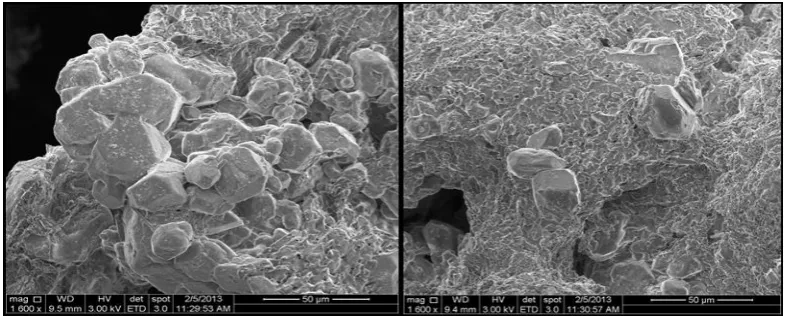
After lot of researches of PCMs, which are available in mass production, stable, high heat of fusion, satisfy desired melting point, and compatible with storage container, PCM range (H) of Type H190 is selected. This Product is manufactured by Phase Change Material Products Limited [6]. Fig 1 shows block of PCM (Plus ICE H190). Each block of Plus ICE H190 has weight one kg. The reported data of H190 which is listed in catalogue is summarized in Table.1 Scanning Electron Microscopy (SEM) is used to display the high crystanility of the selected PCM as shown in Fig 2.
Table 1. Thermo-physical catalogue properties of Plus ICE H190 [6].
Phase Change
Temperature(oC)
Density
(kg/m3)
Latent Heat Capacity(k
J/kg)
Volumetric Heat Capacity
(MJ/m3)
Specific Heat (kJ/kg.K)
Thermal Conductivity
(W/m.K)
Maximum
Temperature(oC)
191 2300 170 391 1.510 0.512 500
3. Experimental Results and Discussion
include melting point, freezing point, and heat of fusion, heat of crystallization, cyclic stability, and thermal stability. These properties are important for thermal energy storage system.
Fig 1. Block of Plus ICE H190PCM packed.
Fig 2. Scanning electron micrograph of Plus ICE H190 PCM.
(left picture in solid phase and right picture in melt phase)
4. Measurement of Thermal Properties
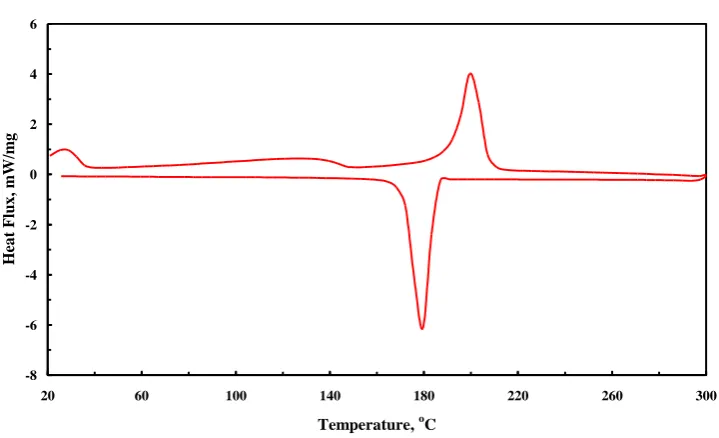
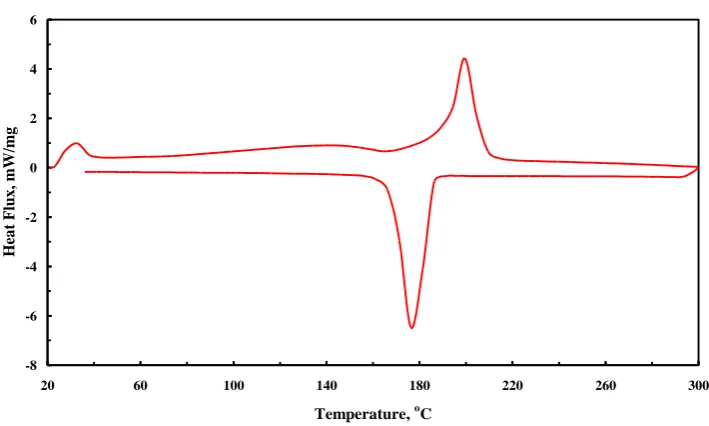
To measure the properties mentioned, Differential Scanning Calorimeter (DSC) instrument, model DSC 200F3, which is manufactured by NETZSCH, Germany. The accuracy in temperature reading is 0.1K and less than one percent for enthalpy [9]. This instrument is used to measure the melting temperature, freezing temperature, heat of fusion, and heat of solidification of PCM. Procedure lab of testing is carried out at different values of heating rates 5, 10, 15, and 20K/min. Figures (3–5) illustrate the analysis of 5, 10, and 15K/min heating rate respectively.
Fig 3. DSC curve of Plus ICE H190 PCM at rate 5K/min.
Fig 4. DSC curve of Plus ICE H190 PCM at rate 10K/min.
Table 2. Summarized DSC results of PCM test.
Rate(K/min
Melting Process Solidification Process
Peak Point(oC) Heat of
Fusion(J/g) Peak Point(
oC) Heat of
Solidification(J/g)
5 197.20 176.40 184.00 191.00
10 198.00 191.14 179.20 200.64
15 200.30 193.20 176.70 196.10
Avg. 198.50 186.91 179.97 195.91
Catalogue Data 191 170 191 170
Error % 0.04 0.09 0.05 0.13
-4 -3 -2 -1 0 1 2 3
20 60 100 140 180 220 260 300
Temperature,oC
Hea
t
Fl
u
x
,
mW/
mg
-8 -6 -4 -2 0 2 4 6
20 60 100 140 180 220 260 300
Temperature, oC
Hea
t
Fl
u
x
,
mW/
Fig 5. DSC curve of Plus ICE H190 PCM at rate 15K/min.
5. Stability Testing
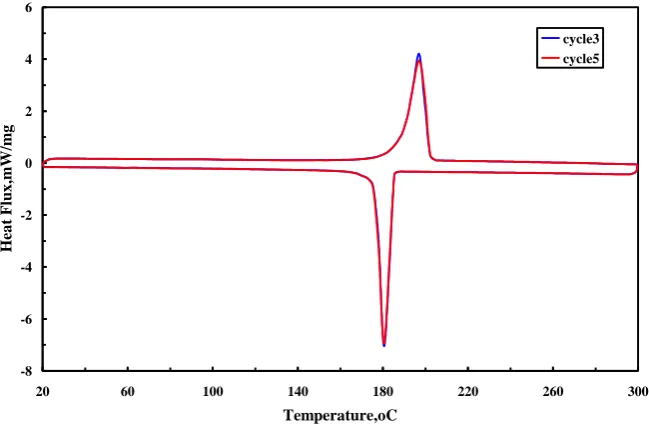
DSC apparatus is used also to test the PCM for five cycles simultaneously in order to be sure that PCM is stable under successive heating-freezing cycles. Fig 6 shows the results for cycle three and cycle five. The heating rate is taken to be 10K/min and it is the same for cooling rate. This figure shows the effects of number of cycles on the heat of fusion and heat of crystallization at the same rate for heating and cooling process. One can conclude that the PCM tested was not affected by repeated melting/freezing cycling. This proved the suitability of the selected PCM for thermal storage used.
6. Thermal Stability Decomposition
Thermal Gravity (TG) apparatus, model TG 409PCTM system, which is manufactured by NETZSCH, Germany. The resolution in mass reading is 0.1μg [9]. Thermal Gravity (TG) apparatus was used to see the degradation of the mass of Plus ICE H190 PCM with increasing Temperature. TG percentage as illustrated in Fig 7 indicates that the PCM remains stable below 600oC. This means the PCM can store thermal energy without any mass loss when the temperature below 600oC. Beyond the 600oC, The PCM mass begins to degrade. Differential Thermal Analysis (DTA) curve indicates that the sample goes under exothermic reactions, and it is clear that the phase transition occurs around 200oC and it represents calibration curve.
-8 -6 -4 -2 0 2 4 6
20 60 100 140 180 220 260 300
Temperature, oC
Hea
t
Fl
u
x
,
mW/
Fig 6. DSC curve of Plus ICE H190 PCM at rate 10K/min for cycle’s number three and five.
Fig 7. TG and DTA curves of Plus ICE H190 PCM.
7. Conclusions
The phase change material, Plus ICE H190, has significant attention in thermal energy storage system particularly materials with high heat of fusion which is capable of storing and releasing large amount of energy at certain temperature. A verification of catalogue properties of the selected PCM material is conducted in lab using DCS and TG apparatus. The measurements include melting point, freezing point, heat of fusion, heat of crystallization, cyclic stability, and thermal stability. Moreover, the results showed that the error percentage between catalogue data and measured data is slightly in the conservative side. In addition, the stability test illustrates that PCM tested was not affected by repeated melting/freezing cycling which is proved the suitability of the selected PCM for thermal storage used. Thermal Gravity showed that the degradation of the mass of Plus ICE H190 PCM with increasing Temperature remains stable below 600oC. This means the PCM can store thermal energy without any mass loss when the temperature below 600oC. The lab test with DSC and TG proves that the catalogue data of the Plus ICE H190 PCM is reasonable to be used for thermal storage devices with great deal of consistency.
-8 -6 -4 -2 0 2 4 6
20 60 100 140 180 220 260 300
Temperature,oC
Hea
t
Fl
u
x
,mW/
mg
References
[1] Abhat, A. (1983). Low temperature latent heat thermal energy storage: heat storage materials. Solar energy, 30(4), 313-332.
[2] Dincer, I., & Rosen, M. (2002). Thermal energy storage: systems and applications. John Wiley & Sons.
[3] Kumaresan, G., Velraj, R., & Iniyan, S. (2011). Thermal analysis of d-mannitol for use as phase change material for latent heat storage. Journal of applied sciences, 11(16), 3044-8.
[4] Kenisarin, M. M. (2010). High-temperature phase change materials for thermal energy storage. Renewable and sustainable energy reviews, 14(3), 955-970.
[5] Mehling, H., Hiebler, S., & Günther, E. (2010). New method to evaluate the heat storage density in latent heat storage for arbitrary temperature ranges. Applied thermal engineering, 30(17), 2652-2657. [6] PCM products limited. (2013). Retrieved from:
[7] http://aut.ac.nz.libguides.com/APA6th/websites
[8] Sharma, S. D., & Sagara, K. (2005). Latent heat storage materials and systems: a review. International Journal of green energy, 2(1), 1-56.
[9] Zalba, B., Marı́n, J. M., Cabeza, L. F., & Mehling, H. (2003). Review on thermal energy storage with phase change: materials, heat transfer analysis and applications. Applied thermal engineering, 23(3), 251-283.