the Work-Family Conflict Questionnaire
Aazami Sanaz, Akmal Syaqirah, Shamsuddin Khadijah
Department of Community Health, Faculty of Medicine, Universiti Kebangsaan Malaysia, 56000 Cheras, Kuala Lumpur, Malaysia
Submitted:12 May 2013
Accepted:18 Oct 2013
Abstract
Background: Work-family conflict has received increasing attention in recent decades in the area of workplace stressors, which can affect employees’ health. However, the dimensionality of the work–family conflict construct among the Malay-speaking population has not been clarified. In order to do so, it is crucial to use an instrument that is appropriate and valid for the Malay-speaking population. As such, the goal of this study was to validate and test the dimensionality of the Malay version of the Work-Family Conflict Questionnaire.
Methods: The present study conducted exploratory factor analysis, confirmatory factor analysis, discriminant validity, convergent validity, and internal consistency, using Cronbach’s alpha, of the work–family conflict construct among 332 working women in Malaysia.
Results: The results supported the existence of four dimensions in the Work-Family Conflict Questionnaire that distinguish between time based and strain-based work-family conflict and family-work conflict. The discriminant validity, convergent validity, and internal consistency of this construct are adequately supported.
Conclusion: The findings of this study supported the existence of discriminant and
convergent validity, as well as adequate reliability, for the construct. Thus, the Work–Family Conflict Questionnaire is a valid and reliable instrument among Malay-speaking working women.
Keywords: factor analysis, validity and reliability, working women, professional-family relation
Introduction
While engaging in work, family, and parenting roles may all have a constructive impact on the individual’s life (1), the lack of ability to balance the responsibilities associated with these roles can lead to conflict between the work and family domains. Work-family conflict is a form of inter-role conflict that occurs due to the demands of incompatible multiple roles (2). Experiencing work-family conflict, especially among employed women, has become a great source of stress (3) that can affect their health and well-being (4). Work-family conflict is considered as a bi-directional nature in which work obligations interfere with family demands (WIF) and conversely, family responsibilities interfere with work demands (FIW). However, each direction consists of tripartite dimensions: time-based, behaviour-based, and strain-based conflict (2). Time-based conflict develops when the time devoted to participate in one role makes it difficult to fulfil obligations in the other role. Behaviour-based conflict arises when required behaviour in one domain is incompatible, ineffective, and inappropriate with another domain. Finally, strain-based conflict refers to
strain from one role interfering with the effective fulfilment of another role. However, there is little empirical evidence to support the existence of the behaviour-based conflict, resulting in difficulties in operationalisation (5,6). Therefore, Kelloway et al. (6) developed a 22-item questionnaire that can measure time-based and strain-based conflict and has the ability to distinguish between WIF and FIW directions. However, this questionnaire is available in English, and further validated translation is required among non-English-speaking populations.
the Malay-speaking population (7); however, the scale is only able to distinguish between WIF and FIW, and not between time-based and strain-based conflict. Therefore, the aim of this study was to test the four dimensionality of Kelloway et al.’s (6) Work–Family Conflict Questionnaire among the Malay-speaking population.
Materials and Methods
Participants
This study was conducted among 332 Malaysian women employed for at least six months in the public services departments in Selangor and Kuala Lumpur. The participants were recruited by using a simple random sampling of women listed as staff in randomly selected departments. This study was initially approved by the Ethics Committee of Universiti Kebangsaan Malaysia Medical Centre (UKMMC), and then by the Head/Deputy director/Director of each particular department. Prior to data collection, the subjects were informed about the purpose, benefits, and importance of the surveys, as well as voluntary participation rights. Signed written consent forms were collected from the respondents who agreed to take part in the study. The data were collected using an anonymous, self-administrated questionnaire that consisted of two sections, including demographic characteristics and the 22-item Work–Family Conflict Questionnaire developed by Kelloway et al. (6).
Instrument
The Work-Family Conflict Questionnaire
This instrument was developed by Kelloway et al. (6) to measure the interface between work and family. This 22-items questionnaire has Likert-type answers that range from 1 (strongly disagree) to 5 (strongly agree). The questionnaire covers four dimensions: time-based WIF, strain-based WIF, time-strain-based FIW, and strain-strain-based FIW. Time-based WIF and FIW contain five questions per each dimension, for a total score range of 5–25. A higher score indicates a high level of time-conflict between work and family. Strain-based WIF and FIW contain six questions per each dimension, for a total score range of 6–30. A higher score indicates a high level of strain or conflict between work and family. A sample item for WIF is “I have to change plans with family members because of the demands of my job”. A sample item for FIW is “I would put in a longer
workday if I had fewer family demands”.
Translation and pre-test
To produce the Malay version of the questionnaire, forward–backward translation was performed by two different groups of bilingual experts. A pre-test was conducted among ten respondents, and a pilot of the questionnaire was conducted among 50 working women. The ten respondents for the pre-test and 50 respondents for the pilot study were chosen by simple random sampling from working women at Hospital Universiti Kebangsaan Malaysia (HUKM). In the first stage, six of 12 departments recruited by simple random sampling. The request letter for permission to conduct research was sent to the head of recruited departments. Upon receipt of permission to conduct research in the respective departments, lists of female workers were provided, and the respondents were recruited by simple random sampling. The respondents who agreed to participate in the study signed a written consent from and received the questionnaire with an envelope. The purpose of the envelope was to ensure confidentiality of the responses by returning the completed anonymous questionnaire in the sealed envelope. The pre-test was administered to ten respondents, separate from the research subjects. The purpose of the pre-test (face validity) was to ensure that the items were easy to understand and that the wording was correct. At the next step, content validity was tested to ascertain whether the content of the questionnaire was appropriate and relevant to the purpose of the study. The produced Malay version of the instrument was then piloted among 50 working women. The 50 subjects from the pre-test study were not included in the final sample of this study. A final version of the Malay language questionnaire was created after applying the modifications from the pre-test to the work– family conflict questionnaire.
Plan of analysis
(14), Comparative Fit Index (CFI) with acceptance level of > 0.90 (15), and finally Normal Fit Index (NFI) with acceptance level of > 0.90 (16). Finally the discriminant and convergent validity of the construct was assessed.
Results
The whole sample consisted of 332 women aged between 20 to 58 years old with mean of 32.64 (SD = 8.68) with 67.8% of them married. Our sample comprised of 28% secondary school, 33.8% had completed high school, 35.1% undergraduate attainment, 2.7% have post-graduate degree and 0.4% have lower than secondary school education. The majority of respondents (94.7%) were Malay.
Table 1 shows the Cronbach's alpha value, mean, and standard deviation for Malay work-family conflict scale in comparison with the original English scale which developed by Kelloway et al. (6). It could be seen that there is not much difference in terms of Cronbach's alpha value between Malay and English version of WFC scale. However, the Malay sample reported higher mean of experiencing conflict in all four dimensions compared to the English-speaking sample. The Cronbach's alpha internal consistency ranged from 0.76 to 0.89 which shows adequate evidence for reliability of the Malay version of work-family conflict questionnaire.
Exploratory factor analysis (EFA)
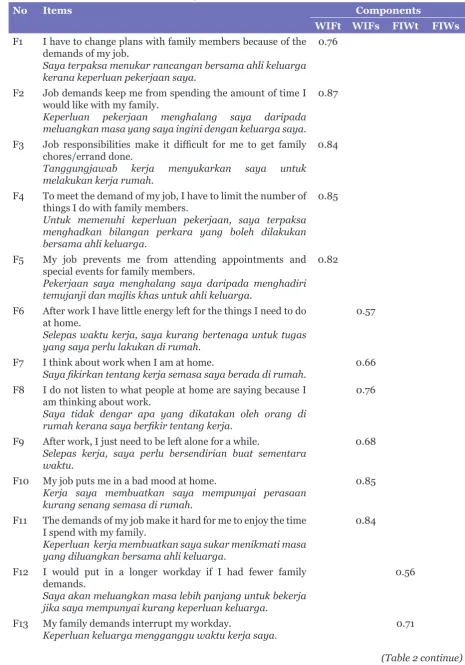
Principal component analysis with Promax rotation performed yielded a total of four components with eigenvalues greater than one (Table 2). These four extracted components explained 62.17% of total variance with 38.1% explained by the first factor. The value of Kaiser-Meyer-Olkin Measure of Sampling Adequacy (KMO) test was 0.91 which shows adequacy of our sample size. All items loaded in a single
dimension with the value of factor loading higher than 0.56. The four dimensions are in agreement with the original scale developed by Kelloway et al. (6), which is able to distinguish between time and strain-based conflict of both WIF and FIW.
Confirmatory factor analysis (CFA)
The dimensionality of the construct was examined via CFA in AMOS 21. Bayesian Estimation was used to impute the numerical value underlying the ordered-categorical data. This approach was performed via allowing AMOS 21 to read the non-numeric data (12). The four factor model extracted from EFA was tested and each item was allowed to load on its corresponding factor.
The result of CFA (Figure 1) to test the work-family conflict construct with four dimensions displays the following indices chi-square of 290.86 (df = 203, P < 0.001), RMSEA = 0.036, CFI = 0.98, NFI = 0.95, GFI = 0.93. All the fit indices imply that the model is consistent with the data.
Discriminant validity
The inter-correlation of factor-based work-family construct ranged from 0.35 to 0.78 (Figure 1). High inter correlation among the four dimensions of work-family conflict construct calls for examining the discriminant validity (17). This is to ensure that each latent variable in the model (WIFt, WIFs, FIWt and FIWs) is different and can be discriminated from other three construct. In order to prove the discriminant validity, the Average Variance Extracted (AVE) for each latent variable should be larger than the shared variance estimate (square of the correlation) (18). The formula given by Fornell and Larcker (18) used to calculate AVE which can be seen in table 3. The finding of current study showed that AVE of all latent variables is larger than shared variance between any two variables. Therefore, there is
Table 1: Cronbach’s alpha value of the Malay version of Work-Family Conflict scale in comparison with the original English Language
The current study Kelloway (6)
Mean (SD) Cronbach’s alpha Mean (SD) Cronbach’s alpha
WIFt 12.92 (3.81) 0.89 9.05 (2.70) 0.83
WIFs 15.64 (4.18) 0.81 11.50 (2.54) 0.76
FIWt 11.40 (3.03) 0.76 7.87 (2.54) 0.76
FIWs 12.94 (3.79) 0.88 9.68 (2.74) 0.84
Table 2: Factor structure of Work-Family Conflict Scale
No Items Components
WIFt WIFs FIWt FIWs F1 I have to change plans with family members because of the
demands of my job.
Saya terpaksa menukar rancangan bersama ahli keluarga kerana keperluan pekerjaan saya.
0.76
F2 Job demands keep me from spending the amount of time I would like with my family.
Keperluan pekerjaan menghalang saya daripada meluangkan masa yang saya ingini dengan keluarga saya.
0.87
F3 Job responsibilities make it difficult for me to get family chores/errand done.
Tanggungjawab kerja menyukarkan saya untuk melakukan kerja rumah.
0.84
F4 To meet the demand of my job, I have to limit the number of things I do with family members.
Untuk memenuhi keperluan pekerjaan, saya terpaksa menghadkan bilangan perkara yang boleh dilakukan bersama ahli keluarga.
0.85
F5 My job prevents me from attending appointments and special events for family members.
Pekerjaan saya menghalang saya daripada menghadiri temujanji dan majlis khas untuk ahli keluarga.
0.82
F6 After work I have little energy left for the things I need to do at home.
Selepas waktu kerja, saya kurang bertenaga untuk tugas yang saya perlu lakukan di rumah.
0.57
F7 I think about work when I am at home.
Saya fikirkan tentang kerja semasa saya berada di rumah. 0.66
F8 I do not listen to what people at home are saying because I am thinking about work.
Saya tidak dengar apa yang dikatakan oleh orang di rumah kerana saya berfikir tentang kerja.
0.76
F9 After work, I just need to be left alone for a while.
Selepas kerja, saya perlu bersendirian buat sementara waktu.
0.68
F10 My job puts me in a bad mood at home.
Kerja saya membuatkan saya mempunyai perasaan kurang senang semasa di rumah.
0.85
F11 The demands of my job make it hard for me to enjoy the time I spend with my family.
Keperluan kerja membuatkan saya sukar menikmati masa yang diluangkan bersama ahli keluarga.
0.84
F12 I would put in a longer workday if I had fewer family demands.
Saya akan meluangkan masa lebih panjang untuk bekerja jika saya mempunyai kurang keperluan keluarga.
0.56
F13 My family demands interrupt my workday.
Keperluan keluarga mengganggu waktu kerja saya. 0.71
(Table 2 continued)
F14 Family demands make it difficult for me to take additional job responsibilities.
Keperluan keluarga menyukarkan saya untuk memikul lebih tanggungjawab kerja.
0.61
F15 I spend time at work making arrangement for family members.
Saya mengambil masa kerja untuk menguruskan ahli keluarga.
0.70
F16 Family demands make it difficult for me to have the work schedule I want.
Keperluan keluarga menyukarkan saya untuk mempunyai jadual kerja yang saya kehendaki.
0.71
F17 When I am at work, I am distracted by family demands.
Semasa saya bekerja, saya diganggu oleh keperluan keluarga.
0.69
F18 Things going on in my family life make it hard for me to concentrate at work.
Perkara yang berlaku dalam kehidupan keluarga saya membuatkan saya sukar untuk menumpukan perhatian di tempat kerja.
0.77
F19 Events at home make me tense and irritable on the job.
Kejadian di rumah membuat saya tertekan dan cepat marah di tempat kerja.
0.80
F20 Because of the demands I face at home, I am tired at work.
Kerana keperluan yang saya hadapi di rumah, saya berasa letih di tempat kerja.
0.81
F21 I spend time at work thinking about the things that I have to get done at home.
Saya meluangkan masa di tempat kerja memikirkan tentang tugas yang saya perlu lakukan di rumah.
0.83
F22 My family life put me into a bad mood at work.
Kehidupan keluarga saya membuatkan saya berperasaan kurang senang di tempat kerja.
0.82
Principal Component Analysis, Rotation: Promax with Kaiser Normalisation.
Table 3: Shared variances (squared of correlation) and the Discriminant Validity
Factors AVE WIFt WIFs FIWt FIWs
WIFt 0.72 1 0.42 0.22 0.12
WIFs 0.59 0.42 1 0.29 0.28
FIWt 0.65 0.22 0.29 1 0.61
FIWs 0.66 0.12 0.28 0.61 1
**Correlation is significant at the 0.01 level (2-tailed).
AVE (Average Variance Extracted) =
λ = standardised factor loading, n = number of items.
Figure 1: Confirmatory factor analysis for the work-family conflict construct. adequate evidence to support four dimensionality of Kelloway et al. (6) work family conflict questionnaire among a sample of Malay-Speaking working women.
Convergent validity
The convergent validity of the construct was confirmed by obtaining the average variance extracted (AVE) greater than 0.50 in every single construct (18). Fornell and Larcker (18) recommended that convergent validity of a construct is questionable if the AVE is less than 0.50. The AVE less than 0.50 indicate that variance explained by the construct is smaller than variance explained by measurement error.
Finally the result of confirmatory
factor analysis in our study shows that four-dimensionality Work-Family Conflict construct meet the criteria to establish convergent and discriminant validity.
Discussion
The main aim of this study was to investigate the factorial structure of Kelloway’s et al. (6) work-family conflict scale among Malay speaking working women to find out its dimensions. Our result showed that work-family conflict scale is able to distinguish between time based and strain based dimension of both WIF and FIW. To the best of our knowledge, this is the first study which confirmed four dimensionality of the work-family conflict scale developed by Kelloway et al. (6), among Malay-speaking population.
The four extracted components from EFA in this study are similar to the study by Kelloway et al. (6). The four factors are time-based WIF (item 1, 2, 3, 4, 5), strain-based WIF (item 6, 7, 8, 9, 10, 11), time-based FIW (item 12, 13, 14, 15, 16) and finally strain-based FIW (item 17, 18, 19, 20, 21, 22). Confirmatory factor analysis confirmed the underlying factor structure of the Malay version of Kelloway et al. (6) work family conflict questionnaire is equivalent to the original English questionnaire. Therefore the scale is able to distinguish between WIF and FIW as well as time and strain-based conflict. Previous studies in Malaysia were not able to distinguish between time-based and strain-based conflict (7). Hence, our findings can help to improve the knowledge of source, nature and direction of conflict between work and family among Malaysian working women.
than 0.50. The assessment of factor-based Cronbach's alpha shows acceptable internal consistency for the Work-Family Conflict Questionnaire among the sample of Malaysian working women. These findings provide evidence to good construct validity of the Work-Family Conflict questionnaire which can be used in future to identify the issue of conflict between work and life among Malay working women.
Level of experiencing work-family conflict among Malay-speaking sample is higher in all four dimensions compare to the English-speaking sample in the Kelloway’s study. However, it should be noted that the present sample only comprises of women employees but, in the Kelloway’s et al. (6) study 69% of the respondents were women.
There are some limitations in the current study which should be taken into account. This study sought to validate the Malay version of the Kelloway’s et al. (6) Work-Family Conflict Questionnaire only among women. However, Level and experience of work-family conflict differ across gender (20,21). Hence, future researchers may also be interested to validate the instrument among Malaysian men. Another limitation in this study is the use of Bayesian Estimation to impute the numeric value underlying the ordered-categorical responses. The Bayesian analysis was conducted according to the model extracted from exploratory factor analysis. Despite the advantages of this approach which gives more accurate imputation of item 1 thought item 22, future research may benefit from EFA prior to using the Bayesian estimation.
Conclusion
Overall, this study provides a new insight into dimensionality of the Malay version of the Kelloway’s et al. (6) work-family conflict questionnaire. The results derived from the current study provide evidence to cross-cultural validity of the multidimensionality of the examined instruments. It is notable that the findings from the current study offer evidence to the construct validity and reliability of the Kelloway’s et al. (6) Work-Family Conflict Questionnaire among Malay-speaking working women.
Acknowledgement
The authors are grateful to all anonymous respondents for their effort in cooperating in this study.
Conflict of Interest
None.
Funds
This study was funded by Universiti Kebangsaan Malaysia (project code: UKM-GUP-2011-305) and by the Research Committee, Universiti Kebangsaan Malaysia Medical Centre (project code: FF-247-2012).
Authors’ Contributions
Conception and design, analysis and interpretation of the data, drafting of the article and administrative, technical or logistic support: SA, SYA, KS
Critical revision of the article for the important intellectual content, final approval of the article, provision of study materials or patient and obtaining of funding: KS
Statistical expertise and collection and assembly of data: SA, SYA
Correspondence
Dr Khadijah Shamsuddin
MBBCh (Cairo), MPH MS (Havard), PhD (Havard) Department of Community Health
Faculty of Medicine
Universiti Kebangsaan Malaysia 56000 Cheras, Kuala Lumpur Malaysia
Tel: +603 9145 5894 Fax: +603 9145 6670
Email: [email protected]
References
1. Rothbard NP. Enriching or depleting? The dynamics of engagement in work and family roles. Admin Sci Quart. 2001;46(4):655–684. doi: 10.2307/3094827. 2. Greenhaus JH, Beutell NJ. Sources of conflict between work and family roles. Acad Manage Rev.
1985;10(1):76–88. doi: 10.5465/AMR.1985.4277352. 3. Byron KA. Meta-analytic review of work–family conflict and its antecedents. J Vocat Behav. 2005;67(2):169– 198. doi: 10.1016/j.jvb.2004.08.009.
5. Geurts SA, Demerouti E. Work/non-work interface: A review of theories and findings. In: Schabracq MJ, Winnubst JM, Cooper CL, editors. The handbook of work and health psychology. 2nd ed. Chichester (UK): John Wiley & Sons, Ltd; 2004. p. 279–312. 6. Kelloway EK, Gottlieb HB, Barham L. The source,
nature, and direction of work and family conflict: A longitudinal investigation. J Occup Health Psych.
1999;4(4):337. doi: 10.1037/1076-8998.4.4.337. 7. Noor NM. Work-and family-related variables,
work–family conflict and women's well-being: Some observations. Community Work Fam. 2003;6(3): 297–319. doi: 10.1080/1366880032000143474. 8. Ngah N, Ahmad A, Baba M. The mediating effect of
work-family conflict on the relationship between locus of control and job satisfaction. J Soc Sci. 2009;
5(4):348–354. doi: 10.3844/jssp.2009.348.354. 9. Panatik SAB, Rajab A, Shah IM, Rahman HA,
Yusoff RM, Badri SKBZ. Work-Family Conflict, Stress and Psychological Strain in Higher Education.
International Conference on Education and Management Innovation. 2012;30:67–71.
10. Ahmad ZABAR, Che Mohd Zulkifli BCO, Jamal Nordin BY. Family Issues and Work-Family Conflict among Medical Officers in Malaysian Public Hospitals. Int J Business Soc Sci. 2010;1(1):26–36.
11. Noor NM. Malaysian women's state of well-being: empirical validation of a conceptual model. J Soc Psychol. 2006;146(1):95–115. doi: 10.3200/SOCP.1 46.1.95-115.
12. Arbuckle JL. IBM SPSS® Amos 21 User's Guide. Crawfordville (USA): Amos Development Corporation; 2012. p. 489–520.
13. MacCallum RC, Browne MW, Sugawara HM. Power analysis and determination of sample size for covariance structure modeling. Psychol Methods.
1996;1(2):130–149. doi: 10.1037/1082-989X.1.2.130.
14. Skovgaard LT. Basic Principles of Structural Equation Modeling. An Introduction to LISREL and EQS. In: Mueller RO, editor. Statistic in Medicine.
Netherlands (NL): Springer for Science; 1996. p. 84–89.
15. Bentler P. Comparative fit indices in structural models. Psychol Bull. 1990;107(2):238–246. doi: 10. 1037/0033-2909.107.2.238.
16. Bollen KA. A new incremental fit index for general structural equation models. Sociol Method Res.
1989;17(3):303–316. doi: 10.11 77/00491241890170 03004.
17. Farrell AM. Insufficient discriminant validity: A comment on Bove, Pervan, Beatty, and Shiu (2009).
J Bus Res. 2010;63(3):324–327. doi: 10.1016/j. jbusres.2009.05.003.
18. Fornell C, Larcker DF. Evaluating structural equation models with unobservable variables and measurement error. J Marketing Res. 1981;18(1): 39–50. doi: 10.2307/3151312.
19. Farrell A, Rudd J. Factor analysis and discriminant validity: A brief review of some practical issues. In. Dewi T, editor. ANZMAC 2009 conference proceedings. Melbourne (AU). Australian & New Zealand Marketing Academy (ANZMAC); 2010. 20. Cinamon RG, Rich Y. Gender differences in the
importance of work and family roles: Implications for work–family conflict. Sex Roles. 2002;47(11–12): 531–541. doi: 10.1023/A:1022021804846.