Maintenance of Certi
fi
cation Part 4 Credit and
Recruitment for Practice-Based Research
WHAT’S KNOWN ON THIS SUBJECT: Pediatric primary care has undergone a cultural shift. Changes in electronic health records, certification requirements, and practice structure have left many physicians feeling too busy to participate in research. Practice-based research networks must adapt tofit the current climate.
WHAT THIS STUDY ADDS: Adding quality improvement activities that meet Maintenance of Certification Part 4 criteria to research study design adds value to a practice-based research protocol. This incentive meets the needs of busy physicians, and may help researchers meet study recruitment goals.
abstract
BACKGROUND:Competing priorities in pediatric practice have created challenges for practice-based research. To increase recruitment success, researchers must design studies that provide added value to participants. This study evaluates recruitment of pediatricians into a study, before and after the development and addition of a quality improvement (QI) curriculum approved for American Board of Pediatrics Maintenance of Certification (MOC) Part 4 Credit as an enrollment incentive.
METHODS: Researchers implemented multiple outreach methods to enroll pediatric practices over 28 months. Field note review revealed that many physicians declined enrollment, stating that they prioritized MOC Part 4 projects over research studies. A QI curriculum meeting standards for MOC Part 4 Credit was developed and added to the study protocol as an enrollment incentive. Enrollment rates and character-istics of practitioners enrolled pre- and post-MOC were compared.
RESULTS: Pre-MOC enrollment contributed 48% of practices in 22 months; post-MOC enrollment contributed 49% of practices in 6 months. An average of 3.5 practices enrolled per month pre-MOC, compared with 13.1 per month post-MOC (P , .001). Clinicians in pre- and post-MOC groups were similar in age, gender, race, and time spent on patient care; practices enrolled post-MOC were more likely to be located in federally designated Medically Underserved Areas than those enrolled pre-MOC (28.6% vs 12%,P= .03).
CONCLUSIONS:Addition of MOC Part 4 Credit increased recruitment success and increased enrollment of pediatricians working in under-served areas. Including QI initiatives meeting MOC Part 4 criteria in practice-based research protocols may enhance participation and aid in recruiting diverse practice and patient populations. Pediatrics
2014;134:747–753 AUTHORS:Julie A. Gorzkowski, MSW,aJonathan D. Klein,
MD, MPH,aDonna L. Harris, MA,bKristen R. Kaseeska, BA,a
Regina M. Whitmore Shaefer, MPH,aAlison B. Bocian, MS,b
James B. Davis, MD,bEdward M. Gotlieb, MD,band Richard
C. Wasserman, MD, MPHb,c
aJulius B. Richmond Center of Excellence, andbPediatric
Research in Office Settings, Department of Research, American Academy of Pediatrics, Elk Grove Village, IL; andcDepartment of
Pediatrics, University of Vermont College of Medicine, Burlington, Vermont
KEY WORDS
quality improvement, research methods
ABBREVIATIONS
AAP—American Academy of Pediatrics ABP—American Board of Pediatrics
AHIPP—Adolescent Health in Pediatric Practice EHR—electronic health records
MOC—Maintenance of Certification MUA—medically underserved area PBRN—practice-based research network PDSA—Plan, Do, Study, Act
PROS—Pediatric Research in Office Settings QI—quality improvement
Ms Gorzkowski drafted the initial manuscript and incorporated all edits from the authorship team, drafted thefinal manuscript, carried out study recruitment, supervised data analysis, and supervised data collection at the American Academy of Pediatrics (AAP) and all project sites; Dr Klein conceptualized and designed the study, critically reviewed and revised the manuscript, and oversaw data analysis, recruitment, and data collection; Ms Harris carried out initial analyses, reviewed and revised the manuscript, coordinated study recruitment, and carried out data collection at AAP and all project sites; Ms Kaseeska reviewed and revised the manuscript, carried out study recruitment, and coordinated data collection at AAP and all project sites; Ms Shaefer critically reviewed and revised the manuscript, and oversaw study recruitment and data collection at AAP; Ms Bocian reviewed and revised the manuscript, and oversaw data analysis, recruitment, and data collection; Drs Davis and Gotlieb critically reviewed and revised the manuscript, conceptualized and participated in study recruitment strategies, and oversaw study implementation; Dr Wasserman critically reviewed and revised the manuscript, and conceptualized and oversaw study recruitment strategies, data collection, and data analysis; and all authors approved thefinal manuscript as submitted.
This trial has been registered at www.clinicaltrials.gov (identifier NCT01312480).
(Continued on last page)
pediatrics, allowing researchers to ex-pand the evidence base and translate findings into practice. Practice-based re-search networks (PBRNs) are uniquely positioned to perform clinically relevant research, as their structure provides both a population to study and a network of clinicians with a vested interest in de-veloping clinical evidence for practice. Recent shifts in pediatric primary care have created new challenges for PBRNs as they recruit clinicians for research stud-ies from increasingly busy practice set-tings.1To successfully recruit physicians,
PBRN investigators must adapt to this current climate by designing research studies that provide meaningful incen-tives to participants.
The American Academy of Pediatrics (AAP) Pediatric Research in Office Set-tings (PROS) network is the largest pe-diatric PBRN in the United States,2and
has successfully conducted a wide range of primary care research studies on a variety of health topics.3–11However, the
traditional recruitment methods used by PROS proved insufficient to recruit enough pediatricians to participate in the Adolescent Health in Pediatric Prac-tice (AHIPP) PROS study, a randomized controlled trial of adolescent tobacco cessation counseling. The AHIPP protocol was approved by the institutional review board at AAP and 30 institutional review boards at participating practice sites across the country. In this article, we de-scribe 1 solution to study recruitment challenges: the development and addition of a quality improvement (QI) curriculum meeting standards for American Board of Pediatrics (ABP) Maintenance of Certifi -cation (MOC) Part 4 Credit. This QI cur-riculum was integrated into the existing research protocol after 22 months of physician recruitment, and MOC Part 4 Credit was advertised as an enrollment incentive. Recruitment then continued for 6 months. In the following analyses, we
PBRN studies, and compare enrollment and practitioner characteristics before and after MOC Part 4 Credit was available.
METHODS
We evaluated the success of recruitment efforts for the AHIPP study before and after the addition of a QI curriculum meeting standards for MOC Part 4 Credit, and compared the demographic factors of practices/practitioners enrolled pre-and post-MOC. AHIPP was a rpre-andomized controlled trial of the effectiveness of a tobacco screening and brief counseling intervention for adolescents, delivered in the pediatric primary care setting. Control arm participants screened and counseled adolescents about social media use. To ensure sufficient power for planned sta-tistical analyses, AHIPP set a goal of en-rolling 160 community-based pediatric practices in the study. Eligible practices had to have a patient flow of at least 1 adolescent (age 14+) per week and a clinician-estimated smoking rate of at least 10% among adolescent patients. Eligible clinicians were pediatricians, nurse practitioners, and physician as-sistants; however, with the exception of a handful of nonphysician staff in PROS practices, only pediatricians were re-cruited directly. Each participating AHIPP practice was asked to screen all adoles-cent patients arriving for well-child visits or nonurgent sick visits for study eligibility and to enroll 100 adolescents into the study. Practitioners were trained to use guidelines-based screening with all ado-lescents, regardless of study enrollment, for the AHIPP tobacco intervention or the control arm social media intervention, and to deliver these counseling interven-tions as appropriate.
Recruitment Procedures and Challenges
Pre-MOC recruitment began in 2011. We used multiple outreach strategies to meet
recruited via a combination of direct-recruitment fax, E-mail, and phone con-tacts. These recruitment strategies were standard protocol for PROS and had been successful in previous studies.4–11To
ex-pand the pool of AHIPP-eligible practices, we recruited new practices to the PROS network. New practices were recruited via direct outreach, physician networking, and in-person recruitment at continuing medical education events and national meetings. To enhance the likelihood of enrolling a sufficient number of smokers to power the study analyses, we focused our outreach efforts for new PROS prac-tices in geographic areas known to have high population smoking rates.
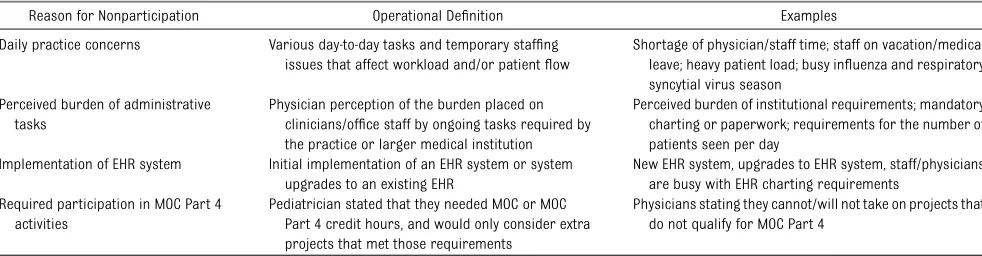
After 1 year of recruitment by using these methods, enrollment goals were not being met. Many pediatricians expressed initial interest in the study but did not complete enrollment. A review of project stafffield notes from recruitment contacts revealed that the most common reason that in-terested physicians ultimately declined to participate was that they were“too busy.” We examined cited reasons for this re-sponse (nonparticipation) and identified 4 factors most frequently mentioned as responsible for the physicians not en-rolling in AHIPP (Table 1): daily practice concerns, perceived burden of adminis-trative tasks, planned or recent imple-mentation of electronic health records (EHR) systems, and planned or current participation in activities necessary to meet ABP MOC Part 4 Performance in Practice requirements. We considered options for adapting the study protocol to meet the needs of potential enrollees and concluded that only 1 of these barriers could be addressed while maintaining study integrity: physician prioritization of MOC Part 4 projects.
Development of a QI Curriculum
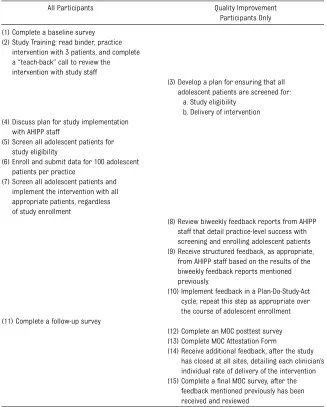
recruitment success, AHIPP investigators designed a QI curriculum to work in tandem with the existing study protocol (for a listing of study protocol tasks and QI curriculum tasks, please see Table 2). The curriculum focused on an area of pedi-atric care that has been cited in the literature as needing improvement: sys-tematic screening for delivery of preven-tive services. It is known that successful implementation of preventive services in practice requires systematic screening,12
yet many clinicians do not use such sys-tematic approaches, which potentially prevents patients from receiving recom-mended services.13–15The QI curriculum
added to AHIPP was designed to encour-age a disciplined approach to systematic screening through the experience of implementing the AHIPP research pro-tocol. This ability to screen systematically could then be applied to other areas of clinical practice.
Proper implementation of the study protocol required the use of 2 systematic screening processes, one that identified eligible patients for study enrollment and another that assessed whether patients should receive the preventive services intervention. The QI curriculum supplemented this protocol by adding 3 new elements: (1) 5 QI measures, designed by AHIPP investigators and approved by the AAP Quality Cabinet, which oversees AAP QI initiatives and the AAP MOC portfolio; (2) a series of Plan-Do-Study-Act (PDSA) cycles that col-lected and analyzed data on performance
in each measure over time; and (3) a QI posttest. Over the course of the PDSA cycles, physicians developed, imple-mented, and improved the screening systems required for the research pro-tocol, with the goal of fully integrating them into routine patient flow. Partici-pant data were compared with project benchmarks, progress was tracked in run charts, and participants received struc-tured feedback and coaching as appro-priate. Successful completion of the QI curriculum allowed participating pedia-tricians to simultaneously reach 3 goals: (1) completing the AHIPP research study, (2) improving their ability to systemati-cally screen in practice, and (3) meeting AAPand ABP requirements for meaningful participation in this MOC Part 4 project.
Addition of MOC Part 4 Credit as an Enrollment Incentive
The QI curriculum described previously was reviewed by the AAP Quality Cabinet as part of the AAP portfolio of MOC Part 4 projects, and was approved for 25 points of credit by ABP in April 2013. Study cruitment materials were updated to re-flect this added benefit, and we continued to use the standard recruitment strate-gies described previously. Recruitment continued for 6 months after the addition of MOC Part 4 Credit as an enrollment incentive. It should be noted that pedia-tricians who enrolled pre-MOC were of-fered the opportunity to earn MOC Part 4 Credit if they chose to participate in the additional QI measures and PDSA cycles. All pediatricians who elected to earn MOC
Part 4 Credit received training in both the QI curriculum and in the AAP and ABP meaningful participation requirements required to claim credit for completing the QI curriculum.
Data Analysis
We used nonparametric Mann-Whitney tests to evaluate the relative success of practice recruitment efforts before and after the addition of MOC Part 4 Credit as an enrollment incentive. To assess the utility of this incentive for future research efforts, we wanted to determine whether the MOC Part 4 Credit incentive affected the type of practitioners/practices that joined the study. To do this, we used nonparametric Mann-Whitney tests, x2, andttests to examine the demographic factors of the practices and practitioners enrolled pre- and post-MOC.
RESULTS
Differences in Enrollment Rates
During thefirst 22 months of study re-cruitment (Pre-MOC Group), we ap-proached a total of 9534 pediatric clinicians. These efforts yielded 152 clinicians in 76 practices joining the study (47.5% of our enrollment target). After this period, MOC Part 4 Credit was added as an enrollment incentive and recruitment continued for 6 months. During those 6 months (MOC Group), we approached 8311 pediatric clinicians and enrolled 200 clinicians in 79 practices in the study (49.4% of enrollment goal). An average of 6.9 clinicians in 3.5 practices were TABLE 1 Pediatrician Reasons for Being“Too Busy”to Participate, Despite Initial Interest in Adolescent Health in Pediatric Practice Study
Reason for Nonparticipation Operational Definition Examples
Daily practice concerns Various day-to-day tasks and temporary staffing issues that affect workload and/or patientflow
Shortage of physician/staff time; staff on vacation/medical leave; heavy patient load; busy influenza and respiratory syncytial virus season
Perceived burden of administrative tasks
Physician perception of the burden placed on clinicians/office staff by ongoing tasks required by the practice or larger medical institution
Perceived burden of institutional requirements; mandatory charting or paperwork; requirements for the number of patients seen per day
Implementation of EHR system Initial implementation of an EHR system or system upgrades to an existing EHR
New EHR system, upgrades to EHR system, staff/physicians are busy with EHR charting requirements
Required participation in MOC Part 4 activities
Pediatrician stated that they needed MOC or MOC Part 4 credit hours, and would only consider extra projects that met those requirements
Physicians stating they cannot/will not take on projects that do not qualify for MOC Part 4
enrolled each month during PMOC re-cruitment, compared with 33.3 clinicians in 13.1 practices per month for the MOC group (P,.001 for both clinicians and practices). It should be noted that of the 352 enrolled clinicians described pre-viously; 295 (84%) were pediatricians and 57 (16%) were nurse practitioners or physician assistants. Because ABP MOC Part 4 Credit is only a recruitment in-centive for board-certified pediatricians, it is unlikely that this benefit directly af-fected nonphysician participants’decision to enroll. However, we included nonphy-sician clinicians in enrollment compar-isons because they joined the study with their physician colleagues.
To assess the impact of seasonality on recruitment, the 6-month period of MOC recruitment (May–October 2013) was compared with the same 6-month period in 2012, when MOC was not offered. The mean number of practices recruited per month during this period in 2013 was 13.2, significantly higher (P= .002) than the 3.3 practices per month recruited during this period in 2012.
Differences in Pediatrician-level Factors
Table 3 compares demographic and practice factors between the 122 pedi-atricians recruited pre-MOC and the 173 pediatricians recruited post-MOC.
ses because MOC Part 4 Credit pertains only to board-certified pediatricians. Thus, the addition of this incentive was unlikely to affect the demographics of nonphysician participants.) No signifi -cant differences were found in pedia-trician age, gender, ethnicity, or in the hours and percentage of time spent in direct patient care.
As noted previously, pediatricians re-cruited in the Pre-MOC Group were also offered an opportunity to complete the QI curriculum and earn MOC Part 4 Credit after they had already begun study participation: 55.7% chose to seek this credit. In comparison, 83.2% of pediatricians who were recruited and enrolled in the MOC Group sought to earn the available MOC Part 4 credit.
Differences in Practice-level Factors
We compared the 76 practice sites en-rolled during pre-MOC recruitment to the 79 practice sites enrolled post-MOC (of these, 75 and 77, respectively, provided demographic information). These groups did not differ significantly by geographic setting or patient panel description (Ta-ble 4). However, pediatricians recruited with MOC Part 4 Credit were more likely to be practicing at sites that were lo-cated in federally designated Medically Underserved Areas (MUA;P= .03).
DISCUSSION
Pediatric primary care has undergone a significant cultural change. Shifting market forces have increased the number of practices owned by integrated health systems.16Implementation of the Health
Information Technology for Economic and Clinical Health Act and meaningful use requirements have accelerated adoption of EHR systems,17temporarily disrupting
office workflow and practice efficiency.18
In addition, changes in mandatory pro-fessional development requirements have Participants Only
(1) Complete a baseline survey (2) Study Training: read binder, practice
intervention with 3 patients, and complete a“teach-back”call to review the intervention with study staff
(3) Develop a plan for ensuring that all adolescent patients are screened for:
a. Study eligibility b. Delivery of intervention (4) Discuss plan for study implementation
with AHIPP staff
(5) Screen all adolescent patients for study eligibility
(6) Enroll and submit data for 100 adolescent patients per practice
(7) Screen all adolescent patients and implement the intervention with all appropriate patients, regardless of study enrollment
(8) Review biweekly feedback reports from AHIPP staff that detail practice-level success with screening and enrolling adolescent patients (9) Receive structured feedback, as appropriate,
from AHIPP staff based on the results of the biweekly feedback reports mentioned previously.
(10) Implement feedback in a Plan-Do-Study-Act cycle; repeat this step as appropriate over the course of adolescent enrollment (11) Complete a follow-up survey
(12) Complete an MOC posttest survey (13) Complete MOC Attestation Form
(14) Receive additional feedback, after the study has closed at all sites, detailing each clinician’s individual rate of delivery of the intervention (15) Complete afinal MOC survey, after the
significantly altered the work required to maintain professional certification.19
These changes have left physicians with a variety of daily practice concerns that may prevent them from joining PBRNs or participating in research.16,19–21These
concerns were echoed by physicians recruited for the AHIPP study before MOC Part 4 Credit was added as an enroll-ment incentive.
PBRNs have been called to adapt to the current culture by offering research opportunities that provide real value to clinicians.19–22Research networks that
design feasible, clinically relevant stud-ies may be more likely to succeed in recruiting physicians.20,23Appealing
stud-ies should combine minimal burden with real-time improvements to patient care.21,22One way to accomplish this is
to merge traditional research methods with QI initiatives.19,21,22
The addition of QI activities meeting standards for MOC Part 4 Credit in-creases the value of a research project in 2 ways: (1) it trains practitioners in a clinically valuable skill (QI), and (2) it providespediatricianswith anopportunity
to earn credit hours toward board cer-tification. QI initiatives have been linked to clinical practice benefits, including improved health outcomes,24–26increased
efficiency of clinical processes,24 and
cost-savings inherent in preventing clin-ical errors.24,27,28In addition, the
oppor-tunity to enact QI processes in practice has been cited as a key incentive for physician participation in practice-based research.21Thus, pediatricians may
pri-oritize participation in research studies with an MOC-approved QI curriculum over traditional research studies. After the addition of MOC Part 4, enrollment increased from an average of 3.5 to 13.1 practices per month, suggesting that MOC was a significant motivator for physicians.
Although the addition of an MOC-approved QI curriculum was a successful enrollment incentive for AHIPP, it may be challenging to adapt this approach to other projects. ABP does not award MOC Part 4 Credit to standard research projects; a separate QI curriculum was developed and approved TABLE 3 Reported Demographic and Practice Factors Among Pediatricians Recruited to
Participate in the AHIPP Study Before and After Availability of MOC Part 4 Credit
Demographic/Practice Factor (Mean % Unless Otherwise Specified)
Pre-MOC Pediatricians,
n= 122
MOC Pediatricians,
n= 173
Time spent in general pediatrics 90.1 90.9 Mean hours spent per week in direct patient care 37.7 37.3
Female 61.5 67.6
Mean age, y 50.0 47.2
Non-Hispanic, white 59.8 63.0
Non-Hispanic, Asian 15.6 14.5
Non-Hispanic, African American 7.4 5.2
Hispanic, any race 7.4 7.0
Seeking MOC credit 55.7a
83.2a
aP,.001.
TABLE 4 Practice Characteristics for Pediatricians Recruited Before and After MOC Part 4 Credit was Available
Practice Characteristic Practice Characteristics Recruited Pre-MOC,n= 75 Practices, %
Practice Characteristics Recruited With MOC,n= 77 Practices, %
P
Practice arrangement type .61
Pediatric group practice 38.7 51.9
Self-employed, solo physician 25.3 18.2
Multispecialty group 13.3 5.2
Medical school/parent university 6.7 3.9
Nongovernment hospital or clinic 5.3 7.8
Practice ownership .20
Physician or physician group 60.0 59.7
Hospital 12.0 5.2
Academic health center 2.7 11.7
Community health center 2.7 6.5
Federally designated MUA 12.0 28.6 .03
Mean % of patient population with traditional private insurance
23.1 18.9 .59
Practice community-type .83
Urban (inner and noninner city) 30.7 32.5
Suburban 41.3 40.3
Rural 26.7 23.4
Mean % of practice patient population
Hispanic (any race) 18.4 25.0 .50
White 66.3 59.7 .14
African American 21.3 22.9 .65
Asian 5.0 4.6 .71
Native American 2.1 9.4 .32
Native Hawaiian 0.7 11.2 .34
protocol required systematic screening for preventive services: this is an area of clinical care that the literature has iden-tified as needing QI.12–15Other research
protocols may not lend themselves as easily to QI activities; investigators should determine whether their individual proj-ects are appropriate to this approach by reviewing standards for MOC Part 4 Credit on the ABP Web site (www.abp.org) or consulting with colleagues who are experts in QI. Additionally, future projects may be better served by including a QI component from inception instead of adding this curriculum after several months of study implementation.
Demographic comparisons of pediatri-cians enrolled in the pre- and post-MOC groups may reveal an additional benefit of using an MOC-approved QI curriculum as an enrollment incentive: this incentive may increase participation from physi-cians practicing in federally designated MUAs. Although individual motivations for participating were not assessed, it is possible that these physicians were par-ticularly affected by time and resource constraints, making AHIPP impractical to take on without MOC. A similar trend was identified in a study of family physicians. Those practicing in underserved areas were more likely to have lapsed board certification than their colleagues in other communities; authors credited this
quires future study, it has potential benefits for research. MUA sites are more likely to serve low socioeconomic status, rural, and minority populations, all of which are often underrepresented in re-search participation.30,31If the addition of
a QI curriculum meeting MOC Part 4 standards allows pediatricians practic-ing in MUAs to participate in research, it could increase the overall representa-tiveness of research results.30,31Inclusion
of traditionally underrepresented groups is particularly important in tobacco control research, as individuals with low socioeconomic status are dispropor-tionately more likely to smoke.32
Limitations
There were several limitations to this study. First, the list of barriers to study participation named by physicians was not comprehensive. More than 17 000 physicians were recruited, so it was not feasible to collect follow-up data on all reasons for nonparticipation. Sec-ond, there was no planned, systematic collection of refusal reasons from all recruited pediatricians. These data were collected only from participants who expressed initial interest in the study; it is possible that physicians who never responded to AHIPP recruitment outreach had other reasons for non-participation. In addition, because we did
other incentives that could have been added to the AHIPP study, we cannot know whether another incentive could have produced greater results. Finally, the comparison of recruitment efforts with and without MOC was not planned as an empirical test. The MOC-approved QI curriculum was added as an additional incentive that helped us meet our study goals, and the effect of this incentive was assessed retrospectively. Thus, the study design may have created biases for which we did not adequately control.
CONCLUSIONS
Merging QI activities meeting standards for MOC Part 4 Credit with practice-based research studies serves 3 important functions: (1) provides an incentive for pediatricians to participate in research, (2) provides training in a clinically relevant skill, and (3) may increase participation of pediatricians serving traditionally un-derserved populations. In a culture in which primary care clinicians are often being asked to do more with less, research studies that include a QI component meeting standards for MOC Part 4 Credit have added value for pediatricians. This added value can help PBRNs achieve their recruitment goals and continue the im-portant work of advancing the science of primary care and evidence-based inter-ventions.
REFERENCES
1. Kairys S, Wasserman R, Pace W. Practice-based quality improvement/research net-works: full speed forward. Acad Pediatr. 2013;13(6 suppl):S12–S13
2. Pediatric Research in Office Settings Net-work. PROS Network Web site: About PROS. 2013. Available at: www2.aap.org/pros/ abtpros.htm. Accessed December 16, 2013 3. Wasserman RC, Slora EJ, Bocian AB, et al. Pediatric research in office settings (PROS): a national practice-based research network
to improve children’s health care.Pediatrics. 1998;102(6):1350–1357
4. Wasserman RC, Croft CA, Brotherton SE; Amer-ican Academy of Pediatrics. Preschool vision screening in pediatric practice: a study from the Pediatric Research in Office Settings (PROS) Network.Pediatrics. 1992;89(5 pt 1):834–838 5. Taylor JA, Darden PM, Brooks DA, et al.
Impact of the change to inactivated polio-virus vaccine on the immunization status of young children in the United States: a study
from Pediatric Research in Office Settings and the National Medical Association. Pe-diatrics. 2001;107(6). Available at: www. pediatrics.org/cgi/content/full/107/6/E90 6. Taylor JA, Darden PM, Slora E, Hasemeier CM,
7. Forrest CB, Glade GB, Starfield B, Baker AE, Kang M, Reid RJ. Gatekeeping and referral of children and adolescents to specialty care.Pediatrics. 1999;104(1 pt 1):28–34 8. Pantell RH, Newman TB, Bernzweig J, et al.
Management and outcomes of care of fever in early infancy. JAMA. 2004;291(10):1203– 1212
9. Gardner W, Kelleher K, Wasserman R, et al. Primary care treatment of pediatric psy-chosocial problems: a study from Pediatric Research in Office Settings and Ambulatory Sentinel Practice Network.Pediatrics. 2000; 106(4). Available at: www.pediatrics.org/ cgi/content/full/106/4/e44
10. Herman-Giddens ME, Slora EJ, Wasserman RC, et al. Secondary sexual characteristics and menses in young girls seen in office practice: a study from the Pediatric Re-search in Office Settings network. Pediat-rics. 1997;99(4):505–512
11. Resnicow K, McMaster F, Woolford S, et al. Study design and baseline description of the BMI2 trial: reducing paediatric obesity in primary care practices. Pediatr Obes. 2012;7(1):3–15
12. Hagan J, Shaw J, Duncan P, eds. Bright Futures: Guidelines for Health Supervision of Infants, Children and Adolescents. 3rd ed. Elk Grove Village, IL: American Academy of Pediatrics; 2008
13. Bordley WC, Margolis PA, Stuart J, Lannon C, Keyes L. Improving preventive service delivery through office systems.Pediatrics. 2001;108(3). Available at: www.pediatrics. org/cgi/content/full/108/3/E41
14. Committee on Adolescence American Acad-emy of Pediatrics. Achieving quality health services for adolescents. Pediatrics. 2008; 121(6):1263–1270
15. Igra V, Millstein SG. Current status and approaches to improving preventive services for adolescents.JAMA. 1993;269(11):1408–1412 16. Hilgers D.Introduction: Complex Environment– Difficult Choices. ACOs and Other Options: A
“How-To” Manual for Physicians Navigating a Post-Health Reform World. 4th ed. Chicago, IL: American Medical Association; 2013:1–9 17. King J, Patel W, Furukawa M.Physician
Adop-tion of Electronic Health Record Technology to Meet Meaningful Use Objectives: 2009-2012. ONC Data Brief, vol. 7. Washington, DC: Office of the National Coordinator for Health Informa-tion Technology; 2012
18. Menachemi N, Collum TH. Benefits and drawbacks of electronic health record sys-tems.Risk Manag Healthc Policy. 2011;4:47–55 19. Agency for Healthcare Research and Qual-ity.PBRN Workforce Strategies for Quality Improvement. AHRQ PBRN Resource Center Webinar; Rockville, MD: Agency for Health-care Research and Quality. 2013
20. Calmbach WL, Ryan JG, Baldwin LM, Knox L. Practice-based research networks (PBRNs): meeting the challenges of the future.J Am Board Fam Med. 2012;25(5):572–576 21. Gibson K, Szilagyi P, Swanger CM, et al.
Physician perspectives on incentives to participate in practice-based research: a greater Rochester practice-based re-search network (GR-PBRN) study. J Am Board Fam Med. 2010;23(4):452–454 22. Mold JW, Peterson KA. Primary care
practice-based research networks: working at the inter-face between research and quality improvement.
Ann Fam Med. 2005;3(suppl 1):S12–S20 23. Fagnan LJ, Handley MA, Rollins N, Mold J.
Voices from left of the dial: reflections of practice-based researchers. J Am Board Fam Med. 2010;23(4):442–451
24. US Department of Health and Human Services. Health Resources and Services Administration. Quality improvement. 2011. Available at: www.hrsa.gov/quality/toolbox/ methodology/qualityimprovement/index. html. Accessed July 3, 2014
25. Shaughnessy PW, Hittle DF, Crisler KS, et al. Improving patient outcomes of home health care:findings from two demonstration tri-als of outcome-based quality improvement.
J Am Geriatr Soc. 2002;50(8):1354–1364 26. Wells KB, Sherbourne C, Schoenbaum M,
et al. Impact of disseminating quality im-provement programs for depression in managed primary care: a randomized controlled trial.JAMA. 2000;283(2):212–220 27. Birkmeyer JD, Gust C, Dimick JB, Birkmeyer NJ, Skinner JS. Hospital quality and the cost of inpatient surgery in the United States.Ann Surg. 2012;255(1):1–5 28. Dimick JB, Weeks WB, Karia RJ, Das S,
Campbell DA Jr. Who pays for poor surgical quality? Building a business case for quality improvement.J Am Coll Surg. 2006; 202(6):933–937
29. Xierali IM, Rinaldo JC, Green LA, et al. Family physician participation in maintenance of certification.Ann Fam Med. 2011;9(3):203–210 30. Mosenifar Z. Population issues in clinical trials.Proc Am Thorac Soc. 2007;4(2):185– 187, discussion 187–188
31. National Institutes of Health.NIH Guidelines on the Inclusion of Women and Minorities as Subjects in Clinical Research. vol. 23. NIH Guide; Bethesda, MD: National Institutes of Health. 1994
32. Centers for Disease Control and Prevention (CDC). Cigarette smoking among adults— United States, 2007. MMWR Morb Mortal Wkly Rep. 2008;57(45):1221–1226
(Continued fromfirst page)
www.pediatrics.org/cgi/doi/10.1542/peds.2014-0316
doi:10.1542/peds.2014-0316
Accepted for publication Jul 21, 2014
Address correspondence to Julie A. Gorzkowski, MSW, American Academy of Pediatrics, 141 Northwest Point Blvd, Elk Grove Village, IL 60007. E-mail: [email protected]
PEDIATRICS (ISSN Numbers: Print, 0031-4005; Online, 1098-4275).
Copyright © 2014 by the American Academy of Pediatrics
FINANCIAL DISCLOSURE:The authors have indicated they have nofinancial relationships relevant to this article to disclose.
FUNDING:Supported by National Institutes of Health National Cancer Institute grant 5R01CA140576, a grant from the Flight Attendant Medical Research Institute to the American Academy of Pediatrics Julius B. Richmond Center of Excellence, and by the Pediatric Research in Office Settings Network, which receives core funding from the Health Resources and Services Administration Maternal and Child Health Bureau and by the American Academy of Pediatrics. The funders had no role in the design or conduct of the study; collection, management, analysis, and interpretation of the data; or in preparation, review, and approval of the manuscript. Funded by the National Institutes of Health (NIH).
POTENTIAL CONFLICT OF INTEREST:The authors have indicated they have no potential conflicts of interest to disclose.
DOI: 10.1542/peds.2014-0316 originally published online September 1, 2014;
2014;134;747
Pediatrics
and Richard C. Wasserman
Regina M. Whitmore Shaefer, Alison B. Bocian, James B. Davis, Edward M. Gotlieb
Julie A. Gorzkowski, Jonathan D. Klein, Donna L. Harris, Kristen R. Kaseeska,
Services
Updated Information &
http://pediatrics.aappublications.org/content/134/4/747 including high resolution figures, can be found at:
References
http://pediatrics.aappublications.org/content/134/4/747#BIBL This article cites 25 articles, 13 of which you can access for free at:
Subspecialty Collections
sub
http://www.aappublications.org/cgi/collection/quality_improvement_
Quality Improvement
e_management_sub
http://www.aappublications.org/cgi/collection/administration:practic
Administration/Practice Management
tatistics_sub
http://www.aappublications.org/cgi/collection/research_methods_-_s
Research Methods & Statistics
dev_sub
http://www.aappublications.org/cgi/collection/teaching_curriculum_
Teaching/Curriculum Development
following collection(s):
This article, along with others on similar topics, appears in the
Permissions & Licensing
http://www.aappublications.org/site/misc/Permissions.xhtml in its entirety can be found online at:
Information about reproducing this article in parts (figures, tables) or
Reprints
DOI: 10.1542/peds.2014-0316 originally published online September 1, 2014;
2014;134;747
Pediatrics
and Richard C. Wasserman
Regina M. Whitmore Shaefer, Alison B. Bocian, James B. Davis, Edward M. Gotlieb
Julie A. Gorzkowski, Jonathan D. Klein, Donna L. Harris, Kristen R. Kaseeska,
Research
Maintenance of Certification Part 4 Credit and Recruitment for Practice-Based
http://pediatrics.aappublications.org/content/134/4/747
located on the World Wide Web at:
The online version of this article, along with updated information and services, is
by the American Academy of Pediatrics. All rights reserved. Print ISSN: 1073-0397.