Timing of Complementary Feeding
Introduction and Adiposity
Throughout Childhood
Véronique Gingras, RD, PhD,bIzzuddin M. Aris, PhD,b,c,dSheryl L. Rifas-Shiman, MPH,bKaren M. Switkowski, PhD, MPH,b Emily Oken, MD, MPH,a,bMarie-France Hivert, MD, MMScb,e
abstract
This study examines associations of timing of CF introduction with adiposity throughout childhood and adolescence in the US Project Viva prospective cohort study.
OBJECTIVES:To examine associations of the timing of complementary feeding (CF) introduction with adiposity throughout childhood.
METHODS:We studied 1013 children from Project Viva. Our exposure was CF introduction, categorized as,4 months (19%), 4 to,6 months (68%; reference group), and$6 months of age (14%). Our outcomes included adiposity measures in midchildhood (mean: 7.9 years; SD 0.8;n= 896) and early adolescence (mean: 13.2 years; SD 0.9;n= 850). We used linear regression models adjusted for potential confounders and ran separate models for infants who were breastfed at least partly for$4 months (categorized as breastfed; 69%) and infants who were never breastfed or stopped breastfeeding at,4 months (categorized as formula fed; 31%).
RESULTS:CF initiated at,4 months was associated with higher adiposity in midchildhood in breastfed children; associations persisted into adolescence for waist circumference, truncal fat mass, and the sum of subscapular and triceps skinfolds (eg, waist circumference: confounder-adjustedb2.97 [95% confidence interval (CI) 0.47 to 5.47] cm). The effect estimates were larger in formula-fed children, with more associations persisting into adolescence (eg, waist circumference: adjustedb 3.42 [95% CI 0.12 to 6.71] cm). CF initiated at$6 months was associated with a higher subscapular/triceps skinfold ratio in midchildhood and adolescence (adjustedb0.13 [95% CI 0.02 to 0.25]) in formula-fed children.
CONCLUSIONS:We found associations of early CF introduction with higher adiposity
measurements in breastfed and formula-fed children and associations of late introduction of CF with higher adiposity in formula-fed children.
WHAT’S KNOWN ON THIS SUBJECT:The timing of complementary feeding (CF) introduction could possibly contribute to childhood obesity, although the evidence is inconsistent. Previousfindings suggest that early introduction of complementary foods might be associated with an increased risk of obesity in early childhood.
WHAT THIS STUDY ADDS:CF introduction at,4 months was associated with higher adiposity measurements in midchildhood and adolescence. CF introduction at$6 months was associated with higher adiposity through adolescence in children who were never breastfed or stopped breastfeeding at,4 months only.
To cite:Gingras V, Aris IM, Rifas-Shiman SL, et al. Timing of Complementary Feeding Introduction and Adiposity Throughout Childhood.Pediatrics. 2019;144(6):e20191320
aDepartment of Nutrition, Harvard T.H. Chan School of Public Health andbDivision of Chronic Disease Research
Across the Lifecourse, Department of Population Medicine, Harvard Medical School, Harvard University and Harvard Pilgrim Health Care Institute, Boston, Massachusetts;cDepartment of Obstetrics and Gynecology, Yong
Loo Lin School of Medicine, National University of Singapore, Singapore, Singapore;dSingapore Institute for Clinical Sciences, Agency for Science, Technology, and Research, Singapore, Singapore; andeDiabetes Unit,
Massachusetts General Hospital, Boston, Massachusetts
Childhood obesity is a major concern worldwide.1,2Epidemiological studies have suggested that several early life exposures, including feeding practices, are associated with increased risk of obesity during childhood and later in life.3–8The World Health Organization9 and the American Academy of Pediatrics10recommend exclusive breastfeeding for thefirst 6 months of life followed by complementary feeding (CF) introduction, defined as the introduction of solid or liquid food items other than breast milk or infant formula,9,11coupled with continued breastfeeding.
Timing of CF introduction could contribute to childhood obesity, although previous studies showed inconsistent associations.12–15 Systematic reviews suggested no clear association between CF introduction with children’s obesity risk, with the exception of solid food introduction before 4 months,14,16 which has been associated with greater obesity risk. Limitations of studies thus far include small sample sizes, a lack of inclusion of important confounders (eg, breastfeeding or formula feeding and maternal and paternal BMI), and the lack of longitudinal assessment of outcomes, especially up to adolescence.12–14,16 In Project Viva, a US longitudinal study, we previously reported that solid food introduction before 4 months of age was associated with higher odds of obesity at age 3 years among formula-fed children only.17In this follow-up study, we aimed to examine associations of the timing of CF introduction with adiposity in midchildhood and early adolescence. We hypothesized that associations with adiposity observed in early childhood would persist into midchildhood and early adolescence.
METHODS Participants
We studied participants from the Project Viva cohort.18We recruited
women between 1999 and 2003 from clinics of what is now Atrius Harvard Vanguard Medical Associates in eastern Massachusetts. Details of the cohort with full inclusion and exclusion criteria can be found in the published protocol,18and study questionnaires and instruments are available at www.hms.harvard.edu/ viva/. The study was approved by the institutional review board of Harvard Pilgrim Health Care. All women provided written informed consent at enrollment and each postnatal follow-up visit, and children provided assent at the midchildhood and early adolescent visits. All procedures were in accordance with the ethical standards for human experimentation established by the Declaration of Helsinki.
There were a total of 2128 live singleton births. We conducted in-person visits with infants after delivery and from infancy to early adolescence. Of the 1256 participants who had measured outcomes at midchildhood or early adolescence, we excluded those with missing exposure (n= 227) and children born at,34 weeks’gestation (n= 16; Supplemental Fig 1). Compared with participants included in this analysis (n= 1013), those excluded (n= 1115) had mothers who were younger, had higher BMI at inclusion, had a lower education level and household income, and were more likely to be nonwhite and to never have breastfed or stopped breastfeeding by 4 months of age (Supplemental Table 5).
Exposure
We collected data on the timing of CF introduction using questionnaires administered at 6 and 12 months after delivery. Mothers reported the timing of thefirst introduction of 13 different foods or food groups, including the following: infant cereal; other starches (eg, teething biscuits, bread, and rice); fruits; vegetables; meat, chicken, and/or turkey (including baby food); peanut butter;
eggs;fish; sweets (eg, candy, soft drinks, and cookies); cow’s milk (not formula); other cow’s milk dairy products (eg, yogurt and cheese); soy milk (not formula); and fruit juice. The 5 response categories on the 6-month questionnaire were as follows: “have not fed this to my child,” “,2 months old,” “2 or 3 months old,” “4 or 5 months old,”and“6 months or older.”Response categories on the 1-year questionnaire were“have not fed this to my child,” “,6 months old,” “6 to 8 months old,” “9 to 11 months old,”and“12 months or older.”We defined the timing of CF introduction according to the earliest introduction of at least 1 food item or group. CF was introduced at,2 months of age in few participants (2%), so we combined this category with 2 or 3 months old. We thus categorized the timing of CF introduction as,4 months, 4 to,6 months, or$6 months. The timing of introduction of specific food items was defined with the same categories.
Mothers reported whether their child was breastfed and the age at which the child was no longer breastfed at the 6-month visit and on the 12-month questionnaire. We categorized children who were at least partly breastfed (breast milk or mixed breast milk and formula feeding) for
$4 months as breastfed and children who were never breastfed or stopped breastfeeding at,4 months as formula fed.
Outcomes
Outcomes included children’s adiposity measurements in midchildhood (mean: 7.9; SD 0.8 years old;n= 896) and early adolescence (mean: 13.2; SD 0.9 years;n= 850). Trained, certified research assistants measured weight (total body composition analyzer TBF-300A; Tanita, Arlington Heights, IL) and height (calibrated
as well as age- and sex-specific BMIz
scores using US national reference data.19We also performed single measurements with standardized techniques for waist circumference20 using a Gulick II measuring tape (Performance Health, Warrenville, IL) as well as subscapular and triceps skinfold thicknesses using Holtain calipers (Holtain, Crosswell, United Kingdom). We calculated the sum of skinfolds (subscapular plus triceps) as a measure of overall adiposity and the ratio of skinfolds (subscapular/ triceps) to estimate central
adiposity.21We performed dual-energy radiograph absorptiometry (DXA) scans (Hologic Discovery A; Hologic, Bedford, MA) from which we derived whole-body fat percentage and truncal fat mass using the Hologic software version 4.0.22
Covariates
Women reported their age, race and/ or ethnicity, education level (college degree or higher or less than a college degree), marital status (married/ cohabitating or other), and household income (.$70 000 or#$70 000 [US dollars]). At enrollment, women reported their height and
prepregnancy weight, from which we calculated prepregnancy BMI. Mothers also reported paternal weight and height, from which we derived paternal BMI. We collected the delivery date, infant sex, birth weight, and 4-month clinician-measured weight from medical records. We derived gestational age from the last menstrual period or from the second trimester ultrasound if estimates differed by.10 days. We determined sex-specific birth weight for gestational agezscores on the basis of US natality data.23We calculated the change in weight-for-agezscore from 0 to 4 months (based on age- and sex-specific US national reference data19) by subtracting the weight-for-agezscore at birth from the weight-for-agez score at 4 months.
Statistical Analysis We present participants’
characteristics overall and stratified by infant feeding status at 4 months of age and by timing of CF
introduction. Differences between groups were examined by using linear or logistic regression analyses.
We assessed associations of the timing of CF introduction with the child’s BMIzscore and adiposity measurements in midchildhood and early adolescence using multivariable linear regression. Models were adjusted for child’s sex and age at outcome assessment (model 1) except for BMIzscore, which already accounts for the child’s age and sex. Model 2 was additionally adjusted for sociodemographic characteristics, including maternal education level, marital status, and household income; maternal prepregnancy, and paternal BMI; child’s race and/or ethnicity; infant gestational age at delivery; and change in weight-for-agezscore from 0 to 4 months. The change in weight-for-agezscore from 0 to 4 months was included as an indicator of early infant growth, which could have affected parental perceptions of the need for their child to be fed complementary foods. We decided a priori to conduct analyses separately for children who were breastfed and those who were formula fed to account for the potential interaction between the duration of breastfeeding and the timing of CF introduction24and because we found distinct effects among breastfed and formula-fed children in our cohort in early childhood.17
We used multiple imputation to impute missing data on covariates. All study variables were included in the imputation model, and results are based on pooled results of 50 imputed data sets. We conducted all analyses using SAS Studio version 3.7 (SAS Institute, Inc, Cary, NC).
RESULTS
Among the 1013 children included, 69% were breastfed (at least partly) at 4 months, and 31% were never breastfed or no longer breastfed at 4 months (formula fed). Compared with formula-fed infants, breastfed infants were more likely to be white (72% vs 63%), and they had a smaller change in weight-for-agez score from 0 to 4 months (0.296 1.02 vs 0.4760.97 SD units). In addition, breastfed infants had older mothers (33.164.5 vs 31.565.4 years) with a lower prepregnancy BMI (23.864.2 vs 25.966.3); their parents were more likely to have an annual household income.$70 000 (70% vs 57%), be married or cohabitating (97% vs 90%), and be college educated (82% vs 57%); and their fathers had a lower BMI (26.16 3.7 vs 27.164.3).
Overall, CF was introduced at
,4 months for 19% of children, 4 to
,6 months for 68% of children, and
$6 months for 14% of children. Compared with breastfed children, formula-fed children were more likely to have been introduced to CF at
,4 months (35% vs 12%) and were less likely to have been introduced to CF at$6 months (8% vs 16%). We also found differences in maternal age, marital status, education level, prepregnancy BMI, household income, and the child’s race and/or ethnicity in relation to the timing of CF introduction (Table 1).
In breastfed children, CF introduction at,4 months, compared with introduction at 4 to,6 months, was associated with higher waist
circumference and higher DXA truncal fat mass in midchildhood and early adolescence and with the sum of skinfolds in early adolescence in fully adjusted models (Table 2). CF introduction at,4 months in breastfed children was also
as well as with a higher skinfold ratio in early adolescence (model 1; age and sex adjusted); however, the effect estimates were moderately
attenuated after adjustment for confounders (model 2), with confidence intervals (CIs) crossing the null. No associations were found for CF introduction at$6 months and adiposity in breastfed children (Table 2).
In formula-fed children, CF introduction at,4 months was associated with a higher BMIzscore, waist circumference, DXA truncal fat mass, sum of skinfolds, and skinfold ratio in midchildhood (model 2; adjusted for confounders). Effect estimates for these associations were similar or larger in early adolescence (model 2; adjusted for confounders). Also, CF introduction at$6 months was associated with a higher skinfold ratio in midchildhood and early adolescence in fully adjusted models. In this group, CF introduction at
$6 months also seemed to be associated with other adiposity measures with estimated effect sizes similar to or greater than what we observed for CF introduction at
,4 months in formula-fed children, although with wider CIs that did not exclude the null (Table 2).
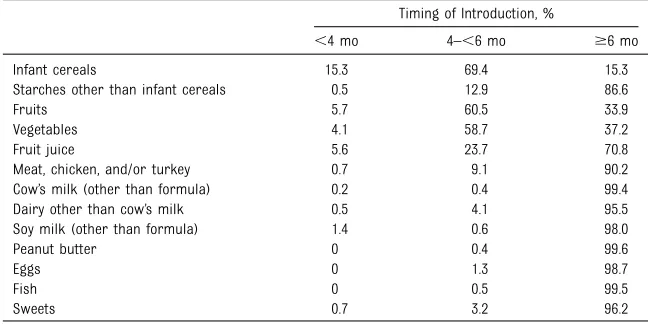
In exploratory analyses, we also examined associations of the timing of introduction of specific food items and offspring’s BMIzscore and waist circumference. The specific food items introduced more commonly before 4 months were infant cereals (15% of children), fruits (6%), vegetables (4%), and fruit juice (6%; Table 3). Although most children were introduced to CF at,6 months (86%), meat, soy and cow’s milk, dairy, peanut butter, eggs,fish, and sweets were introduced in,10% of children at,6 months. Among children introduced to CF at,4 months, 82% were fed infant cereals, 30% were fed fruits, 22% were fed
vegetables, and 30% were given fruit juice. In breastfed children, early introduction of infant cereals and fruit juice was associated with a higher BMIzscore and waist circumference in midchildhood, and the association for infant cereals and waist circumference persisted in early adolescence. In formula-fed children, early introduction of infant cereals was associated with a higher BMIzscore in midchildhood and early adolescence and with higher waist circumference in midchildhood (Table 4).
DISCUSSION
In this prospective longitudinal cohort, we found associations of the timing of CF introduction with child adiposity throughout childhood and early adolescence. Sociodemographic characteristics as well as
breastfeeding status were associated with the timing of CF introduction. In breastfed children, early CF
TABLE 1Parents’and Children’s Characteristics Overall and According to Breastfeeding Status at 4 Months of Age and Timing of CF Introduction Among 1013 Mother-Child Pairs in the Project Viva Cohort
Overall (N= 1013)
Breastfed (at Least Partly) at 4 mo (n= 704; 69%)
Formula Fed (Never Breastfed or Stopped Breastfeeding) at 4 mo
(n= 309; 31%) Timing of CF Introduction Timing of CF Introduction
,4 mo
(n= 81; 12%)
4–,6 mo (n= 509; 72%)
$6 mo (n= 114; 16%)
,4 mo
(n= 108; 35%)
4–,6 mo (n= 176; 57%)
$6 mo (n= 25; 8%)
Parental characteristics
Maternal age at enrollment, y, mean (SD) 32.6 (4.8) 31.8 (5.4) 33.0 (4.2) 34.5 (4.4) 29.9 (5.6) 32.2 (5.0) 32.9 (5.7)
Maternal marital status, married or cohabitating, % 95 91 97 99 82 95 92
Maternal education, college graduate, % 74 65 83 88 48 63 60
Household income.$70 000 (US) per y, % 66 56 72 72 52 62 47
Maternal prepregnancy BMI, kg/m2, mean (SD) 24.4 (5.0) 24.6 (4.6) 23.6 (4.1) 23.8 (4.3) 26.2 (6.4) 25.3 (5.9) 27.8 (7.6) Paternal BMI, kg/m2, mean (SD) 26.4 (3.9) 26.2 (3.3) 26.2 (3.9) 25.5 (3.2) 27.4 (5.0) 27.0 (3.9) 27.5 (4.7) Child characteristics
Female sex, % 51 43 51 53 46 55 56
Race and/or ethnicity, %
White 69 53 73 80 55 70 48
Black or African American 12 22 10 4 21 10 36
Hispanic 4 10 3 2 7 2 4
Asian 3 0 3 4 2 6 4
Other 12 15 11 11 15 11 8
Gestational age at birth, wk, mean (SD) 39.7 (1.4) 39.6 (1.5) 39.7 (1.4) 39.8 (1.3) 39.8 (1.4) 39.6 (1.4) 39.2 (1.7) Birth wt, kg, mean (SD) 3.53 (0.52) 3.48 (0.56) 3.54 (0.51) 3.60 (0.49) 3.51 (0.55) 3.50 (0.50) 3.35 (0.61) Birth wt for gestational age,zscore, mean (SD) 0.23 (0.97) 0.11 (1.01) 0.25 (0.95) 0.35 (0.96) 0.17 (0.99) 0.21 (0.99) 20.02 (0.97) Change in wt-for-agezscore from 0 to 4 mo, SD units,
mean (SD)
introduction was associated with higher adiposity measurements throughout childhood and early adolescence. In formula-fed children,
early CF introduction was associated with higher adiposity measurements throughout childhood and early adolescence, and CF introduction at
$6 months was associated with a higher skinfold ratio in
midchildhood and early adolescence. Associations were stronger and more TABLE 2Adjusted Linear Regression Coefficients for Associations of Timing of CF Introduction and Offspring’s Adiposity at Midchildhood and Early Adolescence in Breastfed (at Least Partly for$4 Months) or Formula-Fed (Never Breastfed or Stopped Breastfeeding by 4 Months) Children
Outcomes n Model 1b(95% CI) Model 2b(95% CI)
Timing of CF Introduction Timing of CF Introduction
,4 mo 4–,6 mo $6 mo ,4 mo 4–,6 mo $6 mo
Breastfed children Midchildhood
BMI,zscore 620 0.34 (0.11 to 0.58) 0.0 (reference) 20.10 (20.30 to 0.11) 0.20 (20.02 to 0.43) 0.0 (reference) 20.05 (20.24 to 0.14) Waist circumference, cm 620 2.71 (1.10 to 4.31) 0.0 (reference) 20.04 (21.44 to 1.36) 1.78 (0.19 to 3.36) 0.0 (reference) 0.17 (21.18 to 1.52) DXA whole-body fat
percentage, %
483 1.76 (0.29 to 3.22) 0.0 (reference) 20.21 (21.57 to 1.16) 1.08 (20.41 to 2.57) 0.0 (reference) 0.00 (21.34 to 1.35)
DXA truncal fat mass, kg 483 0.53 (0.21 to 0.85) 0.0 (reference) 20.06 (20.36 to 0.24) 0.33 (0.01 to 0.65) 0.0 (reference) 20.01 (20.30 to 0.29) Sum of skinfolds
(subscapular plus triceps), mm
618 2.86 (0.97 to 4.75) 0.0 (reference) 20.38 (22.03 to 1.27) 1.58 (20.29 to 3.45) 0.0 (reference) 0.01 (21.58 to 1.60)
Skinfold ratio (subscapular/ triceps)
618 0.04 (20.01 to 0.08) 0.0 (reference) 20.01 (20.05 to 0.03) 0.01 (20.03 to 0.06) 0.0 (reference) 0.00 (20.04 to 0.03)
Early adolescence
BMI,zscore 601 0.34 (0.08 to 0.60) 0.0 (reference) 20.06 (20.28 to 0.17) 0.22 (20.02 to 0.47) 0.0 (reference) 0.02 (20.19 to 0.22) Waist circumference, cm 604 3.48 (0.90 to 6.07) 0.0 (reference) 0.63 (21.57 to 2.83) 2.97 (0.47 to 5.47) 0.0 (reference) 1.09 (20.99 to 3.16) DXA whole-body fat
percentage, %
415 2.41 (0.43 to 4.38) 0.0 (reference) 0.70 (21.15 to 2.55) 1.73 (20.23 to 3.68) 0.0 (reference) 0.53 (21.24 to 2.31)
DXA truncal fat mass, kg 415 1.72 (0.83 to 2.61) 0.0 (reference) 0.39 (20.44 to 1.23) 1.20 (0.33 to 2.06) 0.0 (reference) 0.40 (20.39 to 1.19) Sum of skinfolds
(subscapular plus triceps), mm
603 4.36 (1.34 to 7.38) 0.0 (reference) 20.26 (22.84 to 2.32) 3.26 (0.33 to 6.19) 0.0 (reference) 0.26 (22.19 to 2.70)
Skinfold ratio (subscapular/ triceps)
603 0.07 (0.02 to 0.13) 0.0 (reference) 0.03 (20.02 to 0.07) 0.04 (20.02 to 0.09) 0.0 (reference) 0.04 (20.01 to 0.09)
Formula-fed children Midchildhood
BMI,zscore 271 0.43 (0.17 to 0.68) 0.0 (reference) 0.48 (0.04 to 0.93) 0.32 (0.09 to 0.55) 0.0 (reference) 0.37 (20.03 to 0.77) Waist circumference, cm 272 3.17 (0.99 to 5.36) 0.0 (reference) 4.26 (0.51 to 8.02) 2.58 (0.59 to 4.57) 0.0 (reference) 2.65 (20.75 to 6.05) DXA whole-body fat
percentage, %
219 1.18 (20.56 to 2.91) 0.0 (reference) 0.19 (22.99 to 3.36) 1.15 (20.44 to 2.73) 0.0 (reference) 20.87 (23.76 to 2.03)
DXA truncal fat mass, kg 219 0.64 (0.14 to 1.14) 0.0 (reference) 0.52 (20.40 to 1.43) 0.52 (0.07 to 0.97) 0.0 (reference) 0.07 (20.75 to 0.89) Sum of skinfolds
(subscapular plus triceps), mm
271 4.85 (2.14 to 7.55) 0.0 (reference) 2.99 (21.55 to 7.54) 4.23 (1.70 to 6.77) 0.0 (reference) 1.25 (22.98 to 5.48)
Skinfold ratio (subscapular/ triceps)
271 0.08 (0.03 to 0.13) 0.0 (reference) 0.14 (0.05 to 0.22) 0.06 (0.01 to 0.11) 0.0 (reference) 0.10 (0.02 to 0.18)
Early adolescence
BMI,zscore 245 0.47 (0.18 to 0.75) 0.0 (reference) 0.38 (20.14 to 0.90) 0.34 (0.07 to 0.61) 0.0 (reference) 0.33 (20.15 to 0.81) Waist circumference, cm 246 4.63 (1.00 to 8.27) 0.0 (reference) 5.75 (20.65 to 12.14) 3.42 (0.12 to 6.71) 0.0 (reference) 4.27 (21.46 to 10.00) DXA whole-body fat
percentage, %
184 2.34 (20.15 to 4.83) 0.0 (reference) 3.36 (21.13 to 7.86) 2.55 (0.20 to 4.91) 0.0 (reference) 2.25 (21.87 to 6.37)
DXA truncal fat mass, kg 184 1.44 (20.08 to 2.96) 0.0 (reference) 1.55 (21.19 to 4.29) 1.12 (20.25 to 2.50) 0.0 (reference) 0.59 (21.82 to 3.00) Sum of skinfolds
(subscapular plus triceps), mm
243 6.22 (2.08 to 10.36) 0.0 (reference) 7.85 (0.21 to 15.49) 5.04 (1.13 to 8.95) 0.0 (reference) 6.27 (20.79 to 13.33)
Skinfold ratio (subscapular/ triceps)
243 0.13 (0.06 to 0.19) 0.0 (reference) 0.17 (0.05 to 0.29) 0.10 (0.04 to 0.17) 0.0 (reference) 0.13 (0.02 to 0.25)
often persisted into early adolescence among formula-fed children.
Adjusting for potential confounders reduced estimated effect sizes, yet most associations remained statistically significant.
In our previous analysis, early CF introduction was associated with a higher BMIzscore at 3 years in formula-fed children, whereas no associations were found in breastfed children.17In this study, this association with BMIzscore persisted in midchildhood and early adolescence in formula-fed children, whereas the association was weaker and no longer statistically significant in fully adjusted models in breastfed children. In addition, we found associations of early introduction of CF with other adiposity
measurements, both overall and central, throughout childhood up to early adolescence in breastfed children as well as formula-fed children and an association of late introduction of CF with 1 adiposity measurement in formula-fed children only. Interestingly, the magnitude of the effect for early introduction of CF remained rather large for overall adiposity up to early adolescence, and we found additional associations with indicators of central obesity with estimates for waist circumference being∼3 cm higher and estimates for DXA truncal fat mass∼1.0 kg higher
compared with CF introduction at 4 to,6 months. An important
difference between our previous and current analyses is the exposure, which was previously restricted to “solid food introduction,”17whereas here we considered the broader definition of CF, including liquid food items (eg, cow’s milk and fruit juice), which is consistent with current guidelines.11,25,26Other longer-term studies also showed associations of the timing of CF introduction with adiposity or obesity in children aged 6 years and older,5,6,27although some studies found no associations.28–31 The latter studies differed in the definition of CF (only included solid food)28,30,31and did not account for paternal BMI28,31or breastfeeding status.29Beyond being statistically significant, the magnitude of the effect sizes observed in childhood and early adolescence support the clinical relevance of thesefindings. For example, among formula-fed children, early CF introduction was associated with a 0.34-higher BMI zscore in early adolescence compared with introduction at 4 to,6 months, and studies suggest that a change in BMIz score of 0.25 to 0.50 is of clinical relevance.32Also among formula-fed children, early CF introduction was associated with a 3.42-cm–higher waist circumference in early adolescence compared with introduction at 4 to,6 months,
a difference that has also been linked to changes in cardiometabolic risk factors.33
Overall, ourfindings support current guidelines9,10not to introduce CF before 4 months because we found an association with higher adiposity throughout childhood in both breastfed and formula-fed children. Our results also showed that introduction of CF at or beyond 6 months in formula-fed children is associated with a higher skinfold ratio. Thisfinding was not initially expected and needs to be interpreted with caution considering the small number of formula-fed participants with CF introduction at$6 months. At the time of recruitment in our cohort, guidelines from the American Academy of Pediatrics Committee on Nutrition stated that solid foods can be introduced between 4 and 6 months of age,26and reasons for delaying CF introduction in our study sample are unknown. It is possible that delayed introduction was driven by feeding or child health issues, which could explain the association with higher BMIzscores.
Nonetheless, other studies also showed associations of delayed introduction of CF and increased adiposity,5,30and a recent study suggested that delayed introduction of CF could possibly be associated with delayed healthy gut microbiota development.34Ourfindings, along with those from previous studies, suggest no clear benefit in delaying CF introduction beyond 6 months, which is in line with
recommendations from the European guidelines,11,25but more studies are needed with contemporary cohorts recruited after the implementation of the newest guidelines to better understand the effects of CF introduction beyond 6 months.
Finally, we found an association between early introduction of infant cereals and higher BMIzscores and waist circumference in midchildhood in breastfed and formula-fed children TABLE 3Distribution of Participants (n= 1013) by Age at Introduction of Specific Food Items
Timing of Introduction, %
,4 mo 4–,6 mo $6 mo
Infant cereals 15.3 69.4 15.3
Starches other than infant cereals 0.5 12.9 86.6
Fruits 5.7 60.5 33.9
Vegetables 4.1 58.7 37.2
Fruit juice 5.6 23.7 70.8
Meat, chicken, and/or turkey 0.7 9.1 90.2
Cow’s milk (other than formula) 0.2 0.4 99.4
Dairy other than cow’s milk 0.5 4.1 95.5
Soy milk (other than formula) 1.4 0.6 98.0
Peanut butter 0 0.4 99.6
Eggs 0 1.3 98.7
Fish 0 0.5 99.5
and an association between early introduction of fruit juice and BMIz scores and waist circumference in midchildhood in breastfed children. However, early CF introduction primarily involved the introduction of infant cereals, and it might just be the introduction of CF in general and not specifically the infant cereal that is driving this association. As for fruit juice, it is possible that earlier introduction is an indicator of greater intake later, which could explain the association observed with adiposity in midchildhood, and future studies should investigate the association between the timing of introduction and intake in childhood. CF guidelines focus on ensuring adequate nutrient intake and preventing allergies, but little evidence-based research is available to guide the type of foods to introducefirst during CF with regard to children’s risk of obesity.12 Guidelines recommend delaying the consumption of fruit juice to avoid the displacement of nutrient-rich foods,9,35but its effects on body composition might also need to be considered. In addition, more research is needed to examine not only when CF is introduced and what food is introduced but how (eg, restrictive versus no-restrictive feeding, infant-led weaning versus purees, etc).36The child’s feeding environment and behaviors during CF13,36should be further explored and considered for more
comprehensive guidance on CF introduction.
Strengths of this study include the longitudinal assessment of well-characterized adiposity
measurements throughout childhood and early adolescence and the inclusion of important confounders such as parental BMI, early infant growth, and breastfeeding status. Yet, we acknowledge that there might be residual confounding. For example, early infant feeding practices are probably correlated with overall family dietary habits, and some of the
associations observed may actually be reflecting the child’s later diet. Also, although we had a large number of participants included in this analysis, numbers of participants within some subgroups for analyses were small. We adjusted for several
sociodemographic characteristics; however, we acknowledge that generalizability to low-income groups or groups with different racial and/or ethnic background is limited. In addition, for the timing of
introduction of specific food items, variability within the explored range of timing was low for many items, which prevented us from examining associations with these components. Also, we did not have information on
the specific quantity of food introduced and if consumption was sustained after introduction.
CONCLUSIONS
We found associations of early CF introduction with adiposity measurements in breastfed and formula-fed children from midchildhood through early adolescence, with stronger associations seen in formula-fed children. Associations were also observed for late CF introduction and higher adiposity in formula-fed children only, yet the low sample size in this subgroup led to lower confidence in actual effect. These
findings support the
recommendations not to introduce CF at,4 months in children and suggest that delaying CF introduction could possibly be detrimental for obesity prevention in formula-fed children.
ACKNOWLEDGMENTS
We are grateful to the participants and staff of Project Viva.
ABBREVIATIONS
CF: complementary feeding CI: Confidence intervals DXA: dual-energy radiograph
absorptiometry
Dr Hivert codesigned the analysis and critically reviewed the manuscript for important intellectual content; and all authors approved thefinal manuscript as submitted and agree to be accountable for all aspects of the work.
This trial has been registered at www.clinicaltrials.gov (identifier NCT02820402).
DOI:https://doi.org/10.1542/peds.2019-1320 Accepted for publication Sep 17, 2019
Address correspondence to Véronique Gingras, RD, PhD, Department of Population Medicine, Harvard Medical School and Harvard Pilgrim Health Care Institute,
Landmark Center, 401 Park Dr, Suite 401 East, Boston, MA 02215. E-mail: [email protected]
PEDIATRICS (ISSN Numbers: Print, 0031-4005; Online, 1098-4275).
Copyright © 2019 by the American Academy of Pediatrics
FINANCIAL DISCLOSURE:The authors have indicated they have nofinancial relationships relevant to this article to disclose.
FUNDING:Supported by the US National Institutes of Health (grants R01 HD 034568 and UG3 OD023286). Dr Gingras is supported by a postdoctoral fellowship award from the Canadian Institutes of Health Research. Funded by the National Institutes of Health (NIH).
POTENTIAL CONFLICT OF INTEREST:The authors have indicated they have no potential conflicts of interest to disclose.
REFERENCES
1. Fryar CD, Carroll MD, Ogden CL. Prevalence of overweight and obesity among children and adolescents aged 2-19 years: United States, 1963-1965 through 2013-2014. 2016. Available at: www.cdc.gov/nchs/data/hestat/ obesity_child_13_14/obesity_child_13_ 14.htm. Accessed May 2018
2. Ogden CL, Carroll MD, Fryar CD, Flegal KM. Prevalence of obesity among adults and youth: United States, 2011-2014. NCHS Data Brief. 2015;(219):1–8
3. Gingras V, Hivert MF, Oken E. Early-life exposures and risk of diabetes
mellitus and obesity.Curr Diab Rep.
2018;18(10):89
4. Woo Baidal JA, Locks LM, Cheng ER, et al. Risk factors for childhood obesity
in thefirst 1,000 days: a systematic
review.Am J Prev Med. 2016;50(6):
761–779
5. Papoutsou S, Savva SC, Hunsberger M, et al; IDEFICS Consortium. Timing of solid food introduction and association with later childhood overweight and
obesity: the IDEFICS study.Matern Child
Nutr. 2018;14(1):e12471
6. Seach KA, Dharmage SC, Lowe AJ, Dixon JB. Delayed introduction of solid feeding reduces child overweight and
obesity at 10 years.Int J Obes. 2010;
34(10):1475–1479
7. Schack-Nielsen L, Sørensen TI, Mortensen EL, Michaelsen KF. Late introduction of complementary feeding, rather than duration of breastfeeding, may protect against adult overweight. Am J Clin Nutr. 2010;91(3):619–627
8. Fall CH, Borja JB, Osmond C, et al; COHORTS Group. Infant-feeding patterns and cardiovascular risk factors in young
adulthood: data fromfive cohorts in
low-and middle-income countries.Int
J Epidemiol. 2011;40(1):47–62
9. World Health Organization; United
Nations Children’s Fund. Global Strategy
Organization; 2003. Available at: https:// www.who.int/nutrition/publications/ infantfeeding/9241562218/en/. Accessed March 1, 2019
10. Section on Breastfeeding.
Breastfeeding and the use of human
milk.Pediatrics. 2012;129(3). Available
at: www.pediatrics.org/cgi/content/full/ 129/3/e827
11. Fewtrell M, Bronsky J, Campoy C, et al. Complementary feeding: a position paper by the European Society for Paediatric Gastroenterology, Hepatology, and Nutrition (ESPGHAN)
committee on nutrition.J Pediatr
Gastroenterol Nutr. 2017;64(1):119–132
12. Pearce J, Langley-Evans SC. The types of food introduced during complementary feeding and risk of childhood obesity:
a systematic review.Int J Obes. 2013;
37(4):477–485
13. Daniels L, Mallan KM, Fildes A, Wilson J. The timing of solid introduction in an
‘obesogenic’environment: a narrative
review of the evidence and
methodological issues.Aust N Z J Public
Health. 2015;39(4):366–373
14. Pearce J, Taylor MA, Langley-Evans SC. Timing of the introduction of complementary feeding and risk of childhood obesity: a systematic review. Int J Obes. 2013;37(10):1295–1306
15. Araújo CS, de Farias Costa PR, de Oliveira Queiroz VA, et al. Age of introduction of complementary feeding and overweight in adolescence and
adulthood: a systematic review.Matern
Child Nutr. 2019;15(3):e12796
16. Moorcroft KE, Marshall JL, McCormick FM. Association between timing of introducing solid foods and obesity in infancy and childhood: a systematic
review.Matern Child Nutr. 2011;7(1):3–26
17. Huh SY, Rifas-Shiman SL, Taveras EM, Oken E, Gillman MW. Timing of solid food introduction and risk of obesity in
preschool-aged children.Pediatrics. 2011;
127(3). Available at: www.pediatrics.org/ cgi/content/full/127/3/e544
18. Oken E, Baccarelli AA, Gold DR, et al.
Cohort profile: project viva.Int
J Epidemiol. 2015;44(1):37–48
19. Kuczmarski RJ, Ogden CL, Guo SS, et al. 2000 CDC Growth Charts for the United
States: methods and development.Vital
Health Stat 11. 2002;(246):1–190
20. Centers for Disease Control and Prevention. NHANES anthropometry procedures manual. 2007. Available at: https://www.cdc.gov/nchs/data/ nhanes/nhanes_07_08/manual_an.pdf. Accessed November 1, 2019
21. Goran MI, Kaskoun M, Shuman WP. Intra-abdominal adipose tissue in
young children.Int J Obes Relat Metab
Disord. 1995;19(4):279–283
22. VanItallie TB, Yang MU, Heymsfield SB,
Funk RC, Boileau RA. Height-normalized
indices of the body’s fat-free mass and
fat mass: potentially useful indicators
of nutritional status.Am J Clin Nutr.
1990;52(6):953–959
23. Oken E, Kleinman KP, Rich-Edwards J, Gillman MW. A nearly continuous measure of birth weight for gestational age using a United States national
reference.BMC Pediatr. 2003;3:6
24. Baker JL, Michaelsen KF, Rasmussen KM, Sørensen TI. Maternal prepregnant body mass index, duration of
breastfeeding, and timing of complementary food introduction are
associated with infant weight gain.Am
J Clin Nutr. 2004;80(6):1579–1588
25. Alvisi P, Brusa S, Alboresi S, et al. Recommendations on complementary feeding for healthy, full-term infants. Ital J Pediatr. 2015;41:36
26. American Academy of Pediatrics; Committee on Nutrition.
Complementary Feeding. In: Kleinman
RE, ed.Pediatric Nutrition Handbook,
5th ed. Elk Grove Village, IL: American Academy of Pediatrics; 2004
27. Wilson AC, Forsyth JS, Greene SA, et al. Relation of infant diet to childhood health: seven year follow up of cohort
of children in Dundee infant feeding
study.BMJ. 1998;316(7124):21–25
28. Barrera CM, Perrine CG, Li R, Scanlon KS. Age at introduction to solid foods
and child obesity at 6 years.Child Obes.
2016;12(3):188–192
29. Moschonis G, de Lauzon-Guillain B, Jones L, et al. The effect of early feeding practices on growth indices and obesity at preschool children from four European countries and UK
schoolchildren and adolescents.Eur
J Pediatr. 2017;176(9):1181–1192
30. Tahir MJ, Michels KB, Willett WC, Forman MR. Age at introduction of solid food and obesity throughout the life
course.Obesity (Silver Spring). 2018;
26(10):1611–1618
31. Neutzling MB, Hallal PR, Araújo CL, et al. Infant feeding and obesity at 11 years:
prospective birth cohort study.Int
J Pediatr Obes. 2009;4(3):143–149
32. Ford AL, Hunt LP, Cooper A, Shield JP. What reduction in BMI SDS is required in obese adolescents to improve body composition and cardiometabolic health? Arch Dis Child. 2010;95(4):256–261
33. Balkau B, Picard P, Vol S, Fezeu L, Eschwège E; DESIR Study Group. Consequences of change in waist circumference on cardiometabolic risk factors over 9 years: data from an Epidemiological Study on the Insulin
Resistance Syndrome (DESIR).Diabetes
Care. 2007;30(7):1901–1903
34. Laursen MF, Bahl MI, Michaelsen KF, Licht TR. First foods and gut microbes. Front Microbiol. 2017;8:356
35. American Academy of Pediatrics;
Committee on Nutrition.Pediatric
Nutrition Handbook, 6th ed. Elk Grove Village, IL: American Academy of Pediatrics; 2009
36. Michaelsen KF, Grummer-Strawn L, Begin F. Emerging issues in
DOI: 10.1542/peds.2019-1320 originally published online November 22, 2019;
2019;144;
Pediatrics
Emily Oken and Marie-France Hivert
Véronique Gingras, Izzuddin M. Aris, Sheryl L. Rifas-Shiman, Karen M. Switkowski,
Childhood
Timing of Complementary Feeding Introduction and Adiposity Throughout
Services
Updated Information &
http://pediatrics.aappublications.org/content/144/6/e20191320 including high resolution figures, can be found at:
References
http://pediatrics.aappublications.org/content/144/6/e20191320#BIBL This article cites 27 articles, 6 of which you can access for free at:
Subspecialty Collections
http://www.aappublications.org/cgi/collection/obesity_new_sub Obesity
http://www.aappublications.org/cgi/collection/nutrition_sub Nutrition
following collection(s):
This article, along with others on similar topics, appears in the
Permissions & Licensing
http://www.aappublications.org/site/misc/Permissions.xhtml in its entirety can be found online at:
Information about reproducing this article in parts (figures, tables) or
Reprints
DOI: 10.1542/peds.2019-1320 originally published online November 22, 2019;
2019;144;
Pediatrics
Emily Oken and Marie-France Hivert
Véronique Gingras, Izzuddin M. Aris, Sheryl L. Rifas-Shiman, Karen M. Switkowski,
Childhood
Timing of Complementary Feeding Introduction and Adiposity Throughout
http://pediatrics.aappublications.org/content/144/6/e20191320
located on the World Wide Web at:
The online version of this article, along with updated information and services, is
http://pediatrics.aappublications.org/content/suppl/2019/11/19/peds.2019-1320.DCSupplemental Data Supplement at:
by the American Academy of Pediatrics. All rights reserved. Print ISSN: 1073-0397.