Research Article
A CLINICAL STUDY TO EVALUATE THE EFFICACY OF HINGUTRIGUNA TAILA
VIRECHANA KARMA IN GRIDHRASI w.s.r TO SCIATICA
Karthikeya Prasad1, Vineeth Joseph2
1Guide; 2PG-Scholar;
Department of PG Studies in Panchakarma Mangalore, Karnataka, India
Email:[email protected]
ABSTRACT
Gridhrasi is a vatavikara characterised by
janga and paadha and associated with sthamba
it presents with symptoms like tandra,
in Ayurvedic classics can be correlated to sciatica of modern medicine,
of the sciatic nerve, most often with pain radiating into the buttock and lower limb. It is a relatively common co dition with a lifetime incidence varying fr
adhobhagaharasodhana is achieved. Objectives of the Study
To evaluate the efficacy of Hingutrigunatailavirechanakarma
with a pre and post-test design in 30 patients who were diagnosed with
rigunataila was carried as per the procedure of
their shuddhilakshanas. The assessment criteria were noted before and after treatment and on follow up.
The assessment of the overall effect of the treatment revealed showed moderate response in symptoms after treatment.
Keywords:Gridhrasi, Sciatica, Trikatuchurna,Tilataila, Hingutrigunataila.
INTRODUCTION
Ayurveda is one of the most ancient medical sc ences in the world. It is the 'Science of life' which deals with all aspects of life. It aims at not only cu ing the disease, but also in maintaining the health of healthy individuals. Ayurveda classics always e phasized the need of advancement in the science to keep pace with the need of time.
MEDICAL JOURNAL
ISSN: 2320 5091
A CLINICAL STUDY TO EVALUATE THE EFFICACY OF HINGUTRIGUNA TAILA
VIRECHANA KARMA IN GRIDHRASI w.s.r TO SCIATICA
PG Studies in Panchakarma, Karnataka Ayurveda Medical College and Hospital, Ashoknagara,
characterised by shoola starting from sphik and radiates down to kati
sthamba, ruk, toda, and spandana. Gridhrasi when associated with , gaurava and arochaka. The signs and symptoms of
lassics can be correlated to sciatica of modern medicine, where symptoms precise along the course of the sciatic nerve, most often with pain radiating into the buttock and lower limb. It is a relatively common co dition with a lifetime incidence varying from 13% to 40%.Virechanakarma is one of the
Objectives of the Study: 1. To study effect of Virechanakarma
Hingutrigunatailavirechanakarma in Gridhrasi. It was a single blind clinical study test design in 30 patients who were diagnosed with Gridhrasi. Then virechana
was carried as per the procedure of virechana. Patients were subjected to samsarjanakarma
. The assessment criteria were noted before and after treatment and on follow up.
The assessment of the overall effect of the treatment revealed showed moderate response in symptoms after
Trikatuchurna,Tilataila, Hingutrigunataila.
Ayurveda is one of the most ancient medical sci-ences in the world. It is the 'Science of life' which deals with all aspects of life. It aims at not only cur-ing the disease, but also in maintaincur-ing the health of healthy individuals. Ayurveda classics always em-phasized the need of advancement in the science to
Twenty-first century is the era of lifestyle disorders. Humans by their innate nature get along with these changes and adopt very quickly. In the world of modernization, man is neglecting his health for achieving various goals and worldly pleasures. Overexertion, improper sitting and standing postures in work place, jerking movements in the travel etc. invariably causes jerks to the spinal column, leads to
Impact Factor: 4.018
A CLINICAL STUDY TO EVALUATE THE EFFICACY OF HINGUTRIGUNA TAILA
Hospital, Ashoknagara,
kati, prishta, uru, janu, when associated with kapha, The signs and symptoms of Gridhrasi mentioned where symptoms precise along the course of the sciatic nerve, most often with pain radiating into the buttock and lower limb. It is a relatively common
con-is one of the sodhanakarma where
Virechanakarma in detail. 2. ingle blind clinical study
virechana with hingut-samsarjanakarma based on . The assessment criteria were noted before and after treatment and on follow up. Results:
The assessment of the overall effect of the treatment revealed showed moderate response in symptoms after
IAMJ: Volume 6, Issue 9, September - 2018 2031
low back ache and its related problems like Sciatica. In this way, this disease is now becoming a signifi-cant threat to the working population.
According to classics, Gridhrasi is a vatavikara
characterised by shoola starting from sphik and radi-ates down to kati, prishta, uru, janu, janga and
paadha and associated with sthamba, ruk, toda, and
spandana. Gridhrasi when associated with kapha, it presents with symptoms like tandra, gourava and
arochaka.1
The signs and symptoms of Gridhrasi mentioned in Ayurvedic classics can be correlated to sciatica of modern medicine. Sciatica is caused by compression or irritation of the sciatic nerve, the longest nerve in the human body. Injury to the sciatic nerve and its branches results in sciatica, pain that may extend from the buttock down the posterior and lateral as-pect of the leg and the lateral asas-pect of the foot.2Hence, movement of the affected leg is
re-stricted and patient walks with difficulty. The treat-ments available in modern medicine like muscle re-laxants, NSAIDs, corticosteroids and physiotherapy gives temporary relief from pain and has adverse effects on long term usage. Surgery is the last option in patients with adverse symptoms where there is lot of complications incurred due to non-invasive pro-cedure, which may result in physical disability of any kind. There is a lot of scope in finding safer drugs and some cost effective non-invasive proce-dures for achieving better efficacy.
Panchakarma is the unique part of purification ther-apy of Ayurveda. Procedure in panchakarma elimi-nates vitiated doshas completely and thus prevents the recurring of the disease.4The procedure by which
the vitiated doshas are get eliminated from the body is called shodhana.5The Virechanakarma is one of
the five sodhanakarmas where adhobhagaharasod-hana is achieved.6
Virechanakarma is simple, easy to perform and readily accepted by the patients. In the clinical texts, large number of formulations is described for Vire-chanakarma, but only few are in practice. Acharya
Charaka mentioned mridhusnehana and virechana
for the vatavyadhis.7
In Bhaishajyaratnavali also, the administration of
virechana karma using erandataila mentioned for
vatavyadhis.8In Gridhrasi, Virechana is advised by Acharya Vangasena.9
Hingutrigunataila used in this study which acts as
vatakaphahara and has ushnavirya, deepana,
pachana, adhobhagahara properties. The eran-dataila in it expels the doshas accumulated in the
dhatus. Thus considering the above facts, the present study “The efficacy of hingutrigunatailavirechana-karma in gridhrasi” was undertaken.
OBJECTIVES
The objectives of the study are
To study effect of Virechana karma in detail.
To study the disease Gridhrasi in detail.
To evaluate the efficacy of Hingutriguna-tailaVirechana karma in Gridhrasi.
MATERIALS AND METHODS: SOURCE OF DATA
Literary source:
All the Ayurvedic, modern literatures and contempo-rary texts including the journals, websites about the disease, procedure and drugs are reviewed and documented for the intended study.
Sample source:
Patients attending the OPD and IPD of Department of Panchakarma, Karnataka Ayurveda Medical Col-lege Hospital and other camps complaints of
Gridhrasi will be included for the proposed study.
Pharmacological source:
The formulation selected for research work, Hingut-rigunataila was prepared in Bhaishajyakalpana de-partment, Karnataka Ayurveda Medical College.
Sample size
In this study total 30 patients between the age of 30 to 60 years having classical signs and symptoms of
IAMJ: Volume 6, Issue 9, September - 2018 2032 Inclusion criteria
Patient with features of Gridhrasi namely ruk,
toda, stambha, spandana over sphik, kati,
prishta, uru, janu, jangha extending upto pada.
Positive SLR test.
Positive Bragard’s test.
Positive Lasegue’s sign.
Patients with age of 30 to 60 years.
Patients fit for Virechanakarma.
Exclusion criteria
Patients with history of trauma and infections to spine.
Patients with metabolic disorders like diabetes mellitus, hyperlipidemia are excluded.
Patients not fit for Virechanakarma are ex-cluded.
Diagnostic criteria
Ruk on sphik, kati, prishta, uru, janu, jangha and
padaparyantavedana
Toda Stambha Spandana Gourava Aruchi Tandra
Patient presenting with signs and symptoms of Sciatica.
Radiological examination of the lumbosacral spine in anteroposterior and lateral position.
Investigations
Blood Routine Examination (CBC, S. Creatinine, S. Uric acid, RA factor, RBS)
Radiological examination of the lumbosacral spine in anteroposterior and lateral position.
Urine routine examination.
MRI if necessary.
Table 1: Method of drug administration for Virechana karma
Procedure Drug and dose Duration
Deepana and pachana Trikatuchurna 3g twice a day with warm water 3 days
Snehapana Murchitatilataila 3 – 7 days
Abhyanga and swedana Murchitatilataila 3 days
Virechanakarma Hingutrigunataila 20 – 30 ml 1 day
Samsarjanakarma Diet as per shuddhi 3 – 7 days
Follow up: Approximately 20 days after treatment.
CRITERIA FOR ASSESSMENT
The detail of score given to each sign and symptom and clinical test carried out is described below:
SUBJECTIVE CRITERIA (GRADING)
1. Ruk (Pain)
Table 2: Grading of Ruk parameter
Severity of ruk (pain) Grade
No pain 0
Occasional pain 1
Mild pain (No difficulty in walking) 2
Moderate pain (Slight difficulty in walking) 3
IAMJ: Volume 6, Issue 9, September - 2018 2033 2. Toda (Pricking sensation)
Table 3: Grading of Toda parameter
Severity of toda (pricking sensation) Grade
No pricking sensation 0
Occasionally pricking sensation 1
Mild pricking sensation 2
Moderate pricking sensation 3
Severe pricking sensation 4
3. Stambha (Stiffness)
Table 4: Grading of Stambha parameter
Severity of stambha (stiffness) Grade
No stiffness 0
Stiffness for few minutes after sitting for long duration but relieved by mild movements 1 Stiffness more than 1 hour or more than once in a day but routine works are not disturbed. 2 Stiffness lasting for more than 1 hour or many times a day mildly affecting the daily routine. 3 Episodes of stiffness lasting for 2-6 hours. \ Daily routines are hampered severely 4
4. Spandana (Fasciculation)
Table 5: Grading of Spandana parameter
Severity of spandana (fasciculation) Grade
No Spandana 0
Sometimes for 5 to 10 minutes 1
Daily for 10 to 30 minutes 2
Daily for 30 – 60 minutes 3
Daily >1 hour 4
5. Gaurava (Heaviness)
Table 6: Grading of Gaurava parameter
Severity of gaurava (heaviness) Grade
No feeling of heaviness 0
Occasional feeling of heaviness not affecting the normal movements 1
Frequent feeling of heaviness affecting the normal movements 2
Feeling of heaviness throughout the day severely affecting the normal movements 3
Feeling of heaviness throughout the day totally Hampering normal movements 4
6. Aruchi (Anorexia)
Table 7: Grading of Aruchi parameter
Severity of aruchi (anorexia) Grade
Normal taste in food, feeling to eat food in time 0
Feeling to take food but not having taste 1
Anannabhilasha – not feeling to take food even if hungry 2
Bhaktadvesha – aversion to food 3
IAMJ: Volume 6, Issue 9, September - 2018 2034
7. Tandra (Drowsiness)
Table 8: Grading of Tandra parameter
Severity of tandra (drowsiness) Grade
No tandra 0
Mild tandraoccasionaly but does not affect daily routine 1
Moderate tandra frequently many times in a day that hamper daily routine 2
Moderate tandra whole day and Need to take rest can’t work 3
Severe tandra whole day also at mental level, reduced alertness etc. 4
OBJECTIVE CRITERIA (GRADING) Straight leg raising test
Table 9: Grading of SLR test
SLR test Grade
More than 90o 0
71o – 90o 1
51o – 70o 2
31o -50o 3
Up to 30o 4
Bragard’s test
Table 10: Grading of Bragard’s test
Bragard’s test Grade
Absent 0
Mildly positive 1
Moderately positive 2
Highly positive 3
Deep tendon reflexes
Table 11: Grading of deep tendon reflexes
Deep tendon reflexes Grade
Normal 0
Diminished 1
Exaggerated 2
Absent 3
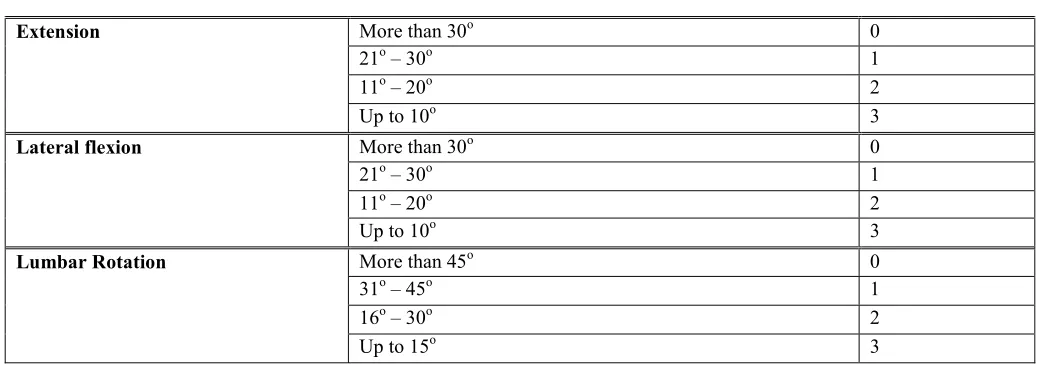
Range of movements at lumbosacral spine
Table 12: Grading of range of movements of lumbosacral spine
Range of movements at lumbosacral spine Score
Flexion More than 90o 0
71o – 90o 1
51o – 70o 2
31o – 50o 3
IAMJ: Volume 6, Issue 9, September - 2018 2035
Extension More than 30o 0
21o – 30o 1
11o – 20o 2
Up to 10o 3
Lateral flexion More than 30o 0
21o – 30o 1
11o – 20o 2
Up to 10o 3
Lumbar Rotation More than 45o 0
31o – 45o 1
16o – 30o 2
Up to 15o 3
CRITERIA FOR ASSESSING THE TOTAL EFFECT
Considering the overall improvement had shown by the patient in signs and symptoms, the total effect of the therapy has been assessed as below
Table 13: Criteria for assessing total effect
Criteria for assessing total effect
Complete relief Complete relief
Marked improvement Marked improvement
Moderate improvement Moderate improvement
Mild improvement Mild improvement
No improvement No improvement
DISCUSSION Deepanapachana
Deepanapachana is done for a period of three days using trikatuchurna. The ingredients of trikatu-churna have katurasa, ushnavirya, and laghu, ushna,
teekshna qualities which do amapachana and ag-nideepana by virtue of its properties. The pacifica-tion of kapha and vata will occur. The process of
deepana is stimulation of agni, whereas pachana is related with digestive and metabolic properties of
agni. Pachana drugs does pakwata of doshas while
deepana drugs cause separation of slishtadoshas. This helps to attain niramavastha, thereby facilitat-ing shodhana efficiently.
Snehapana
After the niramata by deepana and pachana, sneha-pana was started with 30ml of murchitatilataila and increased 30 ml each day till samyaksnigdhalaksha-nas are observed. In present clinical study maximum dose given in a patient was 450 ml and a minimum
of 180 ml. This is one of the very important stages in
shodhana procedure. Administration of sneha does the doshavilayana and moistens the srotas. Sneha-pana was indicated prior to virechana in the line of treatment and the purpose of giving snehapana is for
doshotkleshana before virechana. Snehana makes
klinnata of dooshitadosha which helps in shakha to
koshtabhigamana of doshas after swedana.
Abhyanga and swedana
Abhyanga was done in vishramakala before vire-chanakarma for three days. Abhyangamurchitati-lataila was used and for swedana, sarvangabash-pasweda was performed. Tilataila has ushnavirya,
vatakaphanashaka property and karmukata of
IAMJ: Volume 6, Issue 9, September - 2018 2036
which carries nutritional products. In mriduswedana
using sarvangabashpasweda, it does liquefaction of
klinnadoshas thereby helps to bring the vitiated
doshas from shakha to koshta. Hence it helps in the elimination of vitiated doshas through shodhana
procedure by bringing them to koshta.
Virechana
Virechanakarma is most commonly used shodhana
therapy in general practice. It means elimination of vitiated doshas through adhomarga. Along with
ushna, tikshna, vyavayi, vikashi properties, the vire-chana drugs have predominance of prithvi and ap-mahabhuta and adhobhagaharaprabhava.
The virechanadravya used in this study hingut-rigunatailahas hingu, saindava, erandataila and ra-sonarasa as ingredients. Hingu has deepana,
pachana, vatakaphaprashamana properties, thus it helps in the deepana and pachana of the patient along with controlling the vitiated vata and
kaphadosha. Saindava is tridoshahara and it has
agnideepaka and pachaka karmas. Erandataila
helps in the expulsion of vitiated vatadosha from the
pakwashaya. It has sothahara, vedanasthapana,
deepana karmas, thus helps in controlling the
shoola. Rasonarasa has vatakaphahara properties and vedanasthapana, deepana, pachana, anulo-mana, soolapraashamana, amapachana karmas. It helps in controlling the vitiated vata and
kaphadosha, ruk and also helps in anulomana.
Discussion on Overall Effect of the Treatment
In the overall assessment, among 30 patients, 26 pa-tients showed moderate response (86.7%) i.e. 50-75% reliefs in signs and symptoms and 4 patients (13.3%) showed mild response i.e. below 50% relief in signs and symptoms.
CONCLUSION
On the basis of observations and results made and through the discussion the following conclusions are made at the end of this study.
Gridhrasi occurs due to the vitiation of vata and it affects the normal movements of the lower ex-tremities. Impairment of sakthiutkshepana
karma is main symptom along with ruk, toda,
stambha, spandanaetc symptoms.
The signs and symptoms of Gridhrasi men-tioned in Ayurvedic classics can be correlated to sciatica of modern medicine.
The main cause of sciatica is the degenerative changes in the lumbar vertebrae, which can be correlated with dhatukshayajanyanidana of
Gridhrasi.
Results
In overall assessment of the study, 26 patients shown moderate response and 4 patients shown mild response to the treatment.
Statistically there was moderate improvement noted.
Limitations of the study The sample size was small.
Longer follow up was not done.
The study duration is short. It requires repeated
shodhana to achieve complete remission of dis-ease. It can be best indicated as a long proce-dure.
Scope for the further study
Same study can be repeated by taking larger samples.
Same study can be taken for comparing with other virechanayogas and with other shodhana
procedures.
Possibilities of complete remission of disease by repeated virechana can be studied. Repeated
shodhana helps in breaking samprapthis and give complete relief to patients.
Effect of virechana karma along with external applications can be studied.
Source of Support: Nil
Conflict Of Interest: None Declared