O R I G I N A L R E S E A R C H
Differences Between Central Airway Obstruction
and Chronic Obstructive Pulmonary Disease
Detected with the Forced Oscillation Technique
This article was published in the following Dove Press journal: International Journal of Chronic Obstructive Pulmonary Disease
Masanori Yasuo *
Yoshiaki Kitaguchi *
Yayoi Tokoro Makoto Kosaka Yosuke Wada Takumi Kinjo Atsuhito Ushiki Hiroshi Yamamoto Masayuki Hanaoka
The First Department of Internal Medicine, Shinshu University School of Medicine, Matsumoto, Japan
*These authors contributed equally to this work
Background: Obstructive ventilatory disturbances occur in both chronic obstructive
pul-monary disease (COPD), a typical disease representative of peripheral airway obstruction, and central airway obstruction (CAO). Pulmonary function tests (PFTs), which depend on patient effort, are traditionally used to evaluate lung function. The forced oscillation techni-que (FOT) is an effort-independent method for examining lung function during tidal breath-ing. The FOT is used universally to assess respiratory function in patients with COPD. Several studies have measured FOT to assess ventilatory disturbances in CAO. The results showed that FOT measurements in patients with CAO were similar to those reported in patients with COPD. However, no studies have compared FOT measurements directly between CAO and COPD. The aim of this study was to identify differences in ventilatory disturbances between peripheral and central airway obstructions in COPD and CAO, before patients received pharmacological therapy or bronchoscopic interventions, respectively.
Patients and Methods: We retrospectively included 16 patients with CAO (10 cases of
tracheal obstruction and 6 cases of bronchial obstruction) and 75 treatment-naïve patients with COPD (60 cases in Global Initiative for Chronic Obstructive Lung Disease [GOLD] stage II and 15 cases in GOLD stage III) that were admitted from December 2013 to May 2017. Prior to treatment, patients were examined with the FOT and PFTs.
Results:All parameters measured with the FOT in the inspiratory phase were significantly
worse in patients with CAO than in patients with COPD. The PFTs showed that the CAO group had a significantly lower peak expiratory flow rate. In the airway wall thickening phenotype of COPD, a difference between the inspiratory and expiratory phases of the resonance frequency (ΔFres) was the best indicator for distinguishing between peripheral and central airway obstructions.
Conclusion:This study compared differences between CAO and COPD (mainly GOLD stage II).
We found that the FOT measurement,ΔFres, was the optimal indicator of the difference between the airway wall thickening COPD phenotype and CAO. Thus, the difference might be due to mechan-ical changes that occur in COPD with airway wall thickening.
Keywords: forced oscillation technique, pulmonary function test, quality of life, central
airway obstruction, COPD
Introduction
Pulmonary function tests (PFTs) are essential for the diagnosis of chronic
obstruc-tive pulmonary disease (COPD).1 PFTs are also used to detect central airway
obstruction (CAO) and assess treatment effects. However, PFTs are not suitable for patients with severe tracheobronchial CAO, due to the dependence of these tests
Correspondence: Masanori Yasuo The First Department of Internal Medicine, Shinshu University School of Medicine, 3-1-1 Asahi, Matsumoto 390-8621, Japan
Tel +81 263 37 2631 Fax +81 263 36 3722
Email [email protected]
International Journal of Chronic Obstructive Pulmonary Disease
Dove
press
open access to scientific and medical research
Open Access Full Text Article
International Journal of Chronic Obstructive Pulmonary Disease downloaded from https://www.dovepress.com/ by 118.70.13.36 on 27-Aug-2020
on patient effort. The cause of tracheobronchial CAO might be benign or malignant. CAO symptoms resemble those of COPD, including cough, shortness of breath, and stridor. Both diseases also show obstructive ventilatory disturbances.
In 1956, DuBois et alfirst described the forced
oscilla-tion technique (FOT) for evaluating lung funcoscilla-tion;2since
then, the broadband frequency FOT has been used to evaluate pulmonary function. Recently, broadband fre-quency FOT was applied to measure lung function and evaluate pulmonary disease status, particularly in COPD and asthma, due to its independence from patient effort. Indeed, the FOT demanded minimal cooperation from
subjects.3The FOT is performed with a small loudspeaker
mounted in series with a pneumotachograph. The
loud-speaker generates random pressure pulses of 5–35 Hz,
which are applied to subjects during tidal breathing.
Real-time recordings of pressure-flow oscillations are
superim-posed on the subject’s tidal breathing to estimate the total
respiratory system impedance, including resistance and reactance. The different frequencies of impedance might provide a way to differentiate between central and
periph-eral airway obstructions.4
Several researchers previously applied the FOT to
assess CAO5–7 with the use of impulse oscillometry
(MasterScreen IOS; Jaeger, Hoechberg, Germany). This
procedure can be used to assess the degree4and type7 of
stenosis in tracheal or upper airway obstruction in the diagnosis stage. In addition, it can be used to estimate the therapeutic effects of treatment by assessing correla-tions between measurements and symptom improvements,
in the therapeutic or follow-up stage.5 We previously
reported the usefulness of FOT in evaluating therapeutic effects of interventional bronchoscopy on CAO. In that study, airway resistance was measured in patients with CAO; the FOT was applied with the MostGraph-01 (Chest Co., Ltd., Tokyo, Japan) before and after
interven-tional bronchoscopy.8 We found that the resistance
mea-sured at 20 Hz (R20) with the FOT was significantly
correlated with the amount of airway dilation achieved
with interventional bronchoscopy.8
To date, no study has directly compared FOT measure-ments between patients with CAO and those with peripheral airway obstruction, such as COPD. In the current study, we applied the FOT to evaluate airway resistance in patients with CAO prior to interventional bronchoscopy and treat-ment-naïve patients with COPD. This retrospective study
aimed to identify differences in obstructive ventilatory dis-turbances between these two diseases.
Patients and Methods
This study was approved by the Ethics Review Board of Shinshu University (Permission number: 3886, Date of approval: December 5, 2017) and written informed con-sent was obtained from all patients. The study protocols were performed in accordance with the principles outlined in the Declaration of Helsinki of the World Medical Association.
Patients with CAO
Our institute is the major medical facility in Nagano prefec-ture, Japan, for the treatment of patients with CAO with interventional bronchoscopy. Generally, the causes of tracheo-bronchial CAO include benign or malignant tumors and obstructions caused by secretions or bleeding, a foreign body, or airway collapse due to cartilaginous disorders, such as tracheobronchomalacia, etc. In this study, tracheobronchial
CAO was defined as an airway obstruction in the
tracheobron-chial segment due to various conditions (ie, benign, malignant,
iatrogenic, inflammatory, etc.). Tracheobronchial CAO was
diagnosed with chest computed tomography (CT) and bronchoscopy. From December 2013 to May 2017, 30 patients with CAO were treated with interventional bronchoscopy in our institute. Among these, 16 patients (10 males, 6 females) with CAO completed a series of systematic examinations within 5 days prior to interventional bronchoscopy, including the FOT, spirometry, PFTs, and chest CT. Of these 16 patients,
11 had CAO caused by a malignant obstruction, andfive had
CAO caused by benign conditions. All types of obstruction were included, namely: extra-luminal, mixed, and inluminal. Ten patients showed airway obstruction in the tra-cheal segment, and six patients showed obstruction in the main
bronchial segment (Supplemental Table 1). All patients
com-plained of respiratory symptoms, including cough, dyspnea,
and stridor. In this study, the central airway was defined as the
segment from the trachea to the left main bronchus and to the bronchus intermedius in the right main bronchus.
Patients with COPD
Clinical data were retrospectively reviewed regarding the age, gender, body weight, body height, smoking history, and PFTs for patients treated in Shinshu University
Hospital from December 2013 to May 2017. We identified
125 patients that were newly diagnosed with stable COPD. COPD was diagnosed with the following criteria: the
International Journal of Chronic Obstructive Pulmonary Disease downloaded from https://www.dovepress.com/ by 118.70.13.36 on 27-Aug-2020
forced expiratory volume in 1 second (FEV1) was <70%
of the forced vital capacity (FVC) (ie, the FEV1/FVC) and
the FEV1was <80% of the predicted value after inhaling
a short-acting β2-agonist (for moderate-to-very severe
COPD), in accordance with the Global Initiative for Chronic Obstructive Lung Disease (GOLD) guidelines. Among these 125 patients, 75 completed a series of exam-inations, including a chest CT, PFTs, and the FOT, before the COPD was managed. All patients had a smoking his-tory of more than 10 pack-years. No patients had a hishis-tory of asthma.
Forced Oscillation Technique
Measurements were performed with a commercially avail-able multi-frequency FOT device (MostGraph-01, Chest
Co., Ltd., Tokyo, Japan), according to standard
recommendations,9 as described previously.10 The FOT
measurements were performed before the PFTs. Briefly,
the patient sat in an upright position with a neutral head position. During the examination, the patient wore a nose clip and a support, which stabilized the cheek, tongue position, and chin, to minimize upper airway shunting.
We connected an anti-bacterial/viral filter (Spirofilter
999S®) just behind the mouthpiece, with afilter resistance
of 0.93 hPa/L/s at an airflow of 0–14 L/s, and dead space
of 63 mL (CHEST M.I. Inc., Tokyo, Japan). Before the FOT measurement, the frequency responses to the trans-ducer and pneumotachograph were automatically cali-brated. Additionally, a quick visual check was performed to detect any leaks around the mouthpiece during a stable period of tidal breathing (with a functional level of resi-dual capacity). The volume history of the subject was monitored for at least 30 s. The measurements were repeated at least 3 times. When artifacts (swallowing, irregular breathing, glottis closure, leaking around the mouthpiece, etc.) were found during the tests, the results
were discarded. Results were acceptable when the coeffi
-cient of variation was less than 10% in at least two data
sets. The essential information is shown in Supplemental
Table 2. We recordedfive measurements: the resistance at 5 Hz (R5), the resistance at 20 Hz (R20), the reactance at 5 Hz (X5), the resonant frequency (Fres), and the low-frequency reactance area (ALX). These oscillatory para-meters were measured during the whole breath cycle, during the inspiratory phase, and during the expiratory phase. We also calculated the difference between the
inspiratory and expiratory phases (Δ) for each oscillatory
parameter.
Pulmonary Function Tests
The PFTs were performed by two technicians, according to American Thoracic Society criteria. As described
previously,11a PFT system (Chestac-8800; Chest Co., Ltd.)
was applied for measuring spirometry, the capacity of the lung for diffusing carbon monoxide (DLco), the closing volume, and a global measurement of ventilation heteroge-neity (the slope of Phase III in the single breath nitrogen
washout test [ΔN2]). The percent of the predicted values for
the forced expiratory volume in 1 second (%FEV1) and vital
capacity (%VC) were derived, according to standard data
published by the Japanese Respiratory Society.12
The percent of predicted values for DLco (%DLco), the DLco/alveolar volume (VA), and the percent of the predicted value for the total lung volumes (ie, the residual volume [%RV] and total lung capacity [%TLC]) were determined
with the formulas described by Nishida et al13and Boren
et al.14These measurements were performed in duplicate or
triplicate to evaluate the repeatability.
Phenotypes of COPD
In this study, COPD was divided into two phenotypes, according to the presence or absence of airway wall thick-ening. Wall thickness was expressed in terms of a standardized measurement (AWT-Pi10), as previously
reported.15 Briefly, the chest CT images were analyzed
with image-analyzing software (ZioCube®; Ziosoft, Inc.,
Tokyo, Japan). The AWT-Pi10 is the standardized airway wall thickness at an internal perimeter of 10 mm. It is calculated with a linear regression analysis, in which the square root of the wall area of each measured segment is plotted against its internal perimeter. This standardized parameter obviates potential biasing issues due to the
dif-ferent distributions of airway sizes among subjects.15,16The
cross-sections (short to long axis >2:3) of all bronchial images up to the sixth generation bronchi (the segmental, subsegmental, and subsubsegmental) that could be detected
on an inspiratory CT were identified in whole lungfields for
each patient. Only the segments with an internal perimeter
of 6–20 mm were selected to estimate the AWT-Pi10.15,16
We defined a threshold for the AWT-Pi10 that served as the
cutoff for determining the thickened airway wall phenotype,
as described in our previous study.15The COPD phenotype
with airway wall thickening was defined as an AWT-Pi10
>4.30. The COPD phenotype without airway wall
thicken-ing was defined as an AWT-Pi10≤4.30.
International Journal of Chronic Obstructive Pulmonary Disease downloaded from https://www.dovepress.com/ by 118.70.13.36 on 27-Aug-2020
Statistical Analysis
Statistical analyses were performed with SPSS for Windows software (version 14.0, SPSS Inc., Chicago, IL, USA). Quantitative values are presented as the mean ± standard error of the mean (SEM). The distribution of the data for
variables in the two groups wasfirst assessed with Bartlett’s
test. Data with a normal distribution were compared with a one-way analysis of variance, followed by the multiple
comparisons correction, according to the Tukey–Kramer
method. Data that did not show a normal distribution were
compared with the Kruskal–Wallis test, followed by
a multiple comparisons correction, according to the
nonpara-metric Tukey–Kramer method. Correlations between
vari-ables were examined by calculating Pearson correlation
coefficients for parametric data or Spearman correlation
coefficients for nonparametric data. We performed
a receiver operating characteristic (ROC) curve analysis and calculated the area under the curve (AUC) to determine the importance of each parameter in distinguishing between
the two groups. P-values <0.05 were considered significant
in all statistical analyses.
Results
Clinical Characteristics, Symptoms, and
Health-Related Quality of Life
The characteristics of patients are shown in Table 1.
Briefly, patients with COPD were significantly older,
pre-dominantly male, and had a heavier smoking history than patients with CAO. The causes, locations, and therapeutic
choices for CAO are shown inSupplemental Table 1.
Pulmonary Function Tests
The PFT results for the CAO and COPD groups are shown inTable 2. Only the peak expiratoryflow rate (PEFR) was
significantly worse in the CAO group than in the COPD
group. The forced expiratory flow rate at 25% of vital
capacity (%V25) was significantly worse in the COPD
group than the CAO group. Because some patients with CAO could not complete some PFT measurements, due to disease severity, the measurements of RV, TLC, DLco, and
ΔN2in the PFTs could only be obtained for 12 patients
with CAO. The %RV, %DLco/VA, and %ΔN2were
sig-nificantly worse in patients with COPD (n=75) than in
patients with CAO (n=12;Supplemental Table 3).
Forced Oscillation Technique
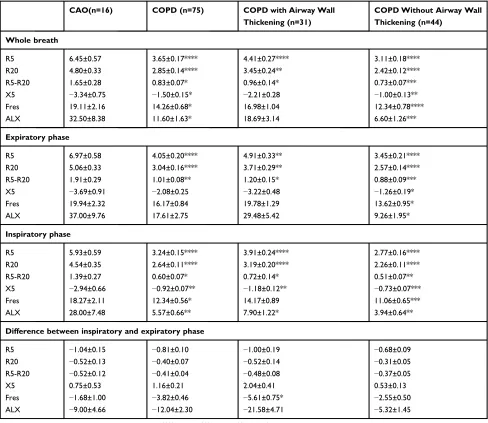
As shown in Table 3, the FOT measurements (R5, R20,
R5-R20, X5, Fres, and ALX), particularly in the
inspira-tory phase, were significantly higher in patients with CAO
(n=16) than in patients with COPD (n=75).
CAO and COPD Phenotypes Based on
PFTs and FOT
To focus on airway resistance, in the present study, we divided the COPD group into patients with and patients without airway wall thickening. These two phenotypes
were defined previously. We found no significant
differ-ences in the PFT results between the CAO group and the
COPD group with airway wall thickening (Table 2).
However, in the FOT results, the difference between the
inspiratory and expiratory phases of the Fres (ΔFres) was
significantly greater in the COPD with airway wall
thick-ening group than in the CAO group (Table 3). In addition,
the differences between the inspiratory and expiratory
phases of the X5 (ΔX5) and ALX (ΔALX) tended to be
greater in the COPD with airway wall thickening group
than in the CAO group (Table 3).
Table 1Information of the Patients
CAO(n=16) COPD (n=75) COPD with Airway Wall Thickening (n=31)
COPD Without Airway Wall Thickening (n=44)
Age 64.8±2.2 72.4±0.9*** 73.0±1.4** 72.0±1.1**
Gender (M/F) 11/5 73/2*** 31/0** 42/2*
Body mass index 22.3±1.1 22.5±0.4 23.5±0.7 21.9±0.4
Smoking history (Pack-Year) 33.0±8.1 60.6±4.4** 57.5±4.9** 65.2±4.0***
Location of stenosis (Trachea to carina/Main bronchus)
10/6 NA NA NA
GOLD stage (1/2/3/4) NA 0/60/15/0 0/25/6/0 0/35/9/0
Notes:Values are mean ± standard error of the mean. ***P<0.001; **P<0.005; *P<0.05 vs CAO.
Abbreviations:M, male; F, female; CAO, central airway stenosis; COPD, chronic obstructive pulmonary disease.
International Journal of Chronic Obstructive Pulmonary Disease downloaded from https://www.dovepress.com/ by 118.70.13.36 on 27-Aug-2020
Table 2Difference of the Pulmonary Function Tests
CAO(n=16) COPD (n=75) COPD with Airway
Wall Thickening (n=31)
COPD Without Airway Wall Thickening (n=44)
SVC, % predicted 80.29±6.43 92.72±1.52 89.37±2.22 95.08±2.02*
FVC, % predicted 80.44±6.76 90.00±1.65 85.65±2.19 93.04±2.27
FEV1, % predicted 57.88±5.86 63.31±1.50 60.00±2.42 65.65±1.86
FEV1/FVC, % 60.26±4.35 56.52±1.11 56.00±1.86 56.89±1.39
MMF, % predicted 32.34±5.46 22.27±0.92 20.24±1.54* 23.69±1.10
PEFR, % predicted 43.86±5.22 64.89±2.06 *** 62.56±3.00 ** 66.54±2.80 ***
V50, % predicted 36.46±5.40 27.81±1.37 25.43±1.93 29.49±1.87
V25, % predicted 35.64±6.22 21.97±0.95* 19.28±1.27* 23.87±1.29
Notes:Values are mean ± standard error of the mean. ***P<0.001; **P<0.005; *P<0.05 vs CAO.
Abbreviations:VC, vital capacity; FVC, forced vital capacity; FEV1, forced expiratory volume in 1 second; MMF, maximum mid-expiratoryflow rate; PEFR, peak expiratory
flow rate.
Table 3Difference of the Forced Oscillation Technique
CAO(n=16) COPD (n=75) COPD with Airway Wall Thickening (n=31)
COPD Without Airway Wall Thickening (n=44)
Whole breath
R5 6.45±0.57 3.65±0.17**** 4.41±0.27**** 3.11±0.18****
R20 4.80±0.33 2.85±0.14**** 3.45±0.24** 2.42±0.12****
R5-R20 1.65±0.28 0.83±0.07* 0.96±0.14* 0.73±0.07***
X5 −3.34±0.75 −1.50±0.15* −2.21±0.28 −1.00±0.13**
Fres 19.11±2.16 14.26±0.68* 16.98±1.04 12.34±0.78****
ALX 32.50±8.38 11.60±1.63* 18.69±3.14 6.60±1.26***
Expiratory phase
R5 6.97±0.58 4.05±0.20**** 4.91±0.33** 3.45±0.21****
R20 5.06±0.33 3.04±0.16**** 3.71±0.29** 2.57±0.14****
R5-R20 1.91±0.29 1.01±0.08** 1.20±0.15* 0.88±0.09***
X5 −3.69±0.91 −2.08±0.25 −3.22±0.48 −1.26±0.19*
Fres 19.94±2.32 16.17±0.84 19.78±1.29 13.62±0.95*
ALX 37.00±9.76 17.61±2.75 29.48±5.42 9.26±1.95*
Inspiratory phase
R5 5.93±0.59 3.24±0.15**** 3.91±0.24**** 2.77±0.16****
R20 4.54±0.35 2.64±0.11**** 3.19±0.20**** 2.26±0.11****
R5-R20 1.39±0.27 0.60±0.07* 0.72±0.14* 0.51±0.07**
X5 −2.94±0.66 −0.92±0.07** −1.18±0.12** −0.73±0.07***
Fres 18.27±2.11 12.34±0.56* 14.17±0.89 11.06±0.65***
ALX 28.00±7.48 5.57±0.66** 7.90±1.22* 3.94±0.64**
Difference between inspiratory and expiratory phase
R5 −1.04±0.15 −0.81±0.10 −1.00±0.19 −0.68±0.09
R20 −0.52±0.13 −0.40±0.07 −0.52±0.14 −0.31±0.05
R5-R20 −0.52±0.12 −0.41±0.04 −0.48±0.08 −0.37±0.05
X5 0.75±0.53 1.16±0.21 2.04±0.41 0.53±0.13
Fres −1.68±1.00 −3.82±0.46 −5.61±0.75* −2.55±0.50
ALX −9.00±4.66 −12.04±2.30 −21.58±4.71 −5.32±1.45
Notes:Values are mean ± standard error of the mean. ****P<0.001; ***P<0.005; **P<0.01; *P<0.05 vs CAO.
Abbreviations:R5 and R20, respiratory resistances at 5 Hz and 20 Hz frequencies, respectively; X5, respiratory reactance at 5 Hz frequency; Fres, resonant frequency; ALX, low-frequency reactance area.
International Journal of Chronic Obstructive Pulmonary Disease downloaded from https://www.dovepress.com/ by 118.70.13.36 on 27-Aug-2020
Relationship Between PFTs and FOT
The patients with CAO showed a significant reduction in
the PEFR (%) and an increase in most FOT measurements, particularly the R5, R20, and R5-R20, compared to the COPD group. The regression analyses revealed that, in the
CAO group, the PEFR (%) was significantly correlated
with most of the FOT parameters (Table 4).
The patients with COPD showed a significant reduction
in the %V25 compared to the CAO group in the PFTs. The regression analysis revealed that, in the COPD group, the %
V25 in the PFTs was significantly correlated with most of
the FOT parameters, despite the low correlation coefficient
values (<0.40, data not shown). Patients in the COPD with
airway wall thickening group (n=31) showed a significant
increase in the %RV and reductions in the percent of the
predicted value for maximal mid-expiratoryflow (%MMF)
and %V25 of the PFTs compared to patients in the CAO
group (Supplemental Table 3). Additionally, a large amount
of the difference in FOT results between the COPD and CAO groups could be attributed to the COPD with wall
thickening phenotype (ie, the ΔFres, the ΔX5, and the
ΔALX;Table 3). To determine the accuracy of FOT mea-surements in distinguishing the differences between CAO and COPD, we performed a binomial logistic regression analysis and calculated the area under the curve (AUC) for
the parameters: ΔFres, ΔX5, and ΔALX. The results
showed that the AUCs of ΔFres,ΔX5, and ΔALX were
0.78, 0.71, and 0.68, respectively. The analysis of relation-ships between the PFT parameters (%RV, %MMF, %V25)
and the FOT parameters (ΔX5,ΔFres, andΔALX) showed
that theΔX5 andΔALX were significantly correlated with
the %RV, and theΔALX was significantly correlated with
the %MMF, in the COPD with airway wall thickening
group (Supplemental Table 4).
Discussion
The present study described and compared the features of PFTs and the FOT for the two airway obstructive dis-eases, CAO and COPD. The comparison between these two diseases showed the differences between central and peripheral airway obstructions in terms of PFTs and FOT parameters. Several previous studies have suggested that the FOT results in patients with CAO were similar to
those reported in patients with COPD.6,7,17 Previous
studies2,8 also showed and discussed the notion that
CAO was associated with increases in the R5, a marked frequency dependence in the resistance, more negative reactance at 5 Hz, and increased Fres, compared to COPD. The features of FOT measurements in lung func-tion tests for COPD have been studied for decades. In 1975, Michaelson et al demonstrated that patients with COPD exhibited frequency-dependent resistance and
higher Fres values than healthy subjects.18 Later, Di
Mango et al revealed alterations in FOT measurements
for different degrees of airway obstruction in COPD.19
For example, the FOT could detect changes in respiratory mechanics with increasing degrees of airway obstruction
in COPD.19,20 Moreover, the FOT was applied to
evalu-ate the therapeutic effects of bronchodilator treatment21
and pulmonary rehabilitation22in patients with COPD. To
date, the FOT has been well documented regarding eva-luations of disease severity and therapeutic effects in patients with COPD. On the other hand, the present study aimed to identify features of FOT measurements in both COPD and CAO that could distinguish the sites of obstruction along the airway.
Table 4 Regression Analyses Between PEFR and FOT
Parameters
PEFR(%) in CAO
r
R5Ave. −0.64**
R5 In −0.58*
R5 Ex −0.69**
R20 Ave. −0.51*
R20 In −0.44
R20 Ex −0.56*
R5-R20 Ave −0.71**
R5-R20 In −0.65**
R5-R20 Ex −0.73**
X5 Ave. 0.74**
X5 In 0.72**
X5 Ex 0.71**
Fres Ave. −0.83***
Fres In −0.80***
Fres Ex −0.81***
ALX Ave. −0.73**
ALX In −0.70**
ALX Ex −0.71**
R5 In-Ex 0.30
R20 In-Ex 0.19
R5-R20 In-Ex 0.31
X5 In-Ex −0.32
Fres In-Ex 0.20
ALX In-Ex 0.35
Notes:***P<0.001; **P<0.01; *P<0.05.
Abbreviations:PEFR, peak expiratoryflow rate; R5 and R20, respiratory resis-tances at 5 Hz and 20 Hz frequencies, respectively; X5, respiratory reactance at 5 Hz frequency; Fres, resonant frequency; ALX, low-frequency reactance area.
International Journal of Chronic Obstructive Pulmonary Disease downloaded from https://www.dovepress.com/ by 118.70.13.36 on 27-Aug-2020
The currentfindings on applying FOT to evaluate CAO
status are less thorough than the collection of findings on
applying the FOT to evaluate COPD. In 2000, Beraldo et al evaluated a case of CAO due to spinal cord injury. They compared FOT measurements taken before and after
dilation treatment for postintubation tracheal stenosis.23
Then, in 2001, Horan and collogues reported the applica-tion of FOT for evaluating tracheostenosis in patients with
neurologic injuries.5Verbanck et al demonstrated that the
FOT showed high resistance values in 10 patients with
CAO.6They also investigated 10 healthy individuals and
10 patients with COPD; however, they did not directly compare FOT measurements between the CAO, COPD,
and healthy groups in that study.6Recently, our previous
study revealed that patients with CAO exhibited relatively high values of R5 and R20, Fres, and ALX, and a negative
reactance at 5 Hz.8In the present study, we first
demon-strated the similarities and differences between CAO and COPD, in terms of FOT and PFT parameters. These groups were analyzed with the FOT and PFTs in parallel at one respiratory institute.
Typically, the PFT features for CAO showed that the obstructive respiratory disturbances, particularly in the top
and bottom of the loop, were flattened. Thus, the fl
ow-volume loop configuration approached the shape of a
-rectangle.24 Consequently, the shape of the flow-volume
loop observed in CAO can be readily distinguished from that observed in COPD. On the other hand, previous studies showed that the FOT parameters were similar
between CAO and COPD.6,7,17
Clinically, the typical flow-volume loop cannot always
be observed in PFTs for patients with CAO, particularly when stenosis is in the main bronchus. Moreover, patients with serious airway symptoms in CAO were not able to complete the PFTs. However, in the present study, we
could precisely determine significant differences in several
PFT parameters between the CAO and COPD groups. The
%PEFR in the PFTs was significantly worse in the CAO
group than in the COPD group. Conversely, the percent of predicted values for the PFT parameters, V25, RV, DLco/
VA, andΔN2, were significantly worse in the COPD group
than in the CAO group. However, the FOT results for the COPD group were not worse than those for the CAO group.
Despite the fact that, generally, the R5-R20 measured with the FOT indicates a small airway caliper, it remains uncertain
whether the R5-R20 reflects a physiological condition.25In
addition, bronchodilation reduces hyperinflation, which could
potentially result in an increase in resistance with a decrease in reactance. Thus, the resistance and reactance measurements do not provide a straightforward interpretation, and they might
lead to a disparate spirometry response.25 Moreover, our
results unexpectedly showed that the R5-R20 was not higher in COPD than in CAO, rather it was correlated with the PEFR in the CAO group. Nevertheless, our results revealed that the difference between FOT expiratory and inspiratory parameters was an optimal indicator of peripheral airway physiology in the COPD phenotype with airway thickening. We divided the COPD group into two major phenotypes: the chronic bronchi-tic phenotype (with airway wall thickening) and the emphyse-matic phenotype (without airway wall thickening). Our results
showed that the magnitude of the FOT-determinedΔFres was
significantly higher in the COPD with airway wall thickening
group than in the CAO group. In addition, we observed a trend
of higherΔX5 andΔALX values in the COPD with airway
wall thickening group compared to the CAO group (Table 3).
The binomial logistic regression analysis showed that the
ΔFres had the best AUC value for distinguishing CAO from
COPD with the airway wall thickening phenotype (AUC = 0.78). Patients with the airway wall thickening COPD
pheno-type showed significantly worse PFT results for the MMF,
V25, and RV, compared to patients with CAO (Table 2 and
Supplemental Table 3). These features associated with the COPD with airway wall thickening phenotype were also observed in our previous study, which compared FOT results between patients with bronchitic and patients with emphysema
COPD phenotypes.15
The FOT parameters, R5, R20, and R5-R20, measured in all breath phases (average, inspiratory, and expiratory)
were significantly higher in patients with CAO than in
those with COPD. The regression analyses revealed that the R5 and R5-R20 measured in all breath phases were
significantly negatively correlated with the PEFR of the
PFTs in the CAO group (Table 4). The R20 measurements
(except during the inspiratory phase) were also signifi
-cantly negatively correlated with the PEFR of the PFTs (Table 4) in the CAO group. These results suggested that, in patients with CAO, an increase in the respiratory resis-tance measured with the FOT indicated a reduction in the PEFR measured with the PFTs.
In patients of COPD phenotype with airway wall
thicken-ing, the regression analysis showed significant relationships
between the FOT-determinedΔX5 and the PFT-determined
RV (R=0.53, P<0.01) and between the FOT-determined
ΔALX and the PFT-determined RV (R=−0.59, P<0.001;
Supplemental Table 4). We also detected a significant
International Journal of Chronic Obstructive Pulmonary Disease downloaded from https://www.dovepress.com/ by 118.70.13.36 on 27-Aug-2020
correlation between the FOT-determinedΔALX and the
PFT-determined MMF (R=0.38, P<0.05;Supplemental Table 4).
No significant relationship was detected between the
FOT-determinedΔFres,ΔX5, orΔALX and the PFT-determined
V25 (Supplemental Table 4). These results indicated that,
among patients with the COPD phenotype of airway wall
thickening, a higher FOT-determined ΔALX reflected
a higher PFT-determined RV and a lower PFT-determined
MMF. In addition, a higher FOT-determined ΔX5 reflected
a higher PFT-determined RV.
In patients with CAO, our previous study revealed that an alteration in the R20 was a useful parameter in
estimat-ing airway dilation in CAO after interventional
bronchoscopy.8Thus, the R20 appeared to be the optimal
parameter for evaluating mechanical changes in CAO. On the other hand, in patients with COPD, our group pre-viously found that the R20 was weakly correlated with
airway reversibility.15 From the viewpoint of a technical
standard,25despite the high R20 value in COPD, it was not
recommended for estimating the bronchodilation effect,
compared to an alteration in the FEV1 response.15,25
Moreover, we previously demonstrated that the R5, R20,
ΔX5, ΔALX, andΔFres were significantly higher in the
COPD phenotype with airway wall thickening than in other COPD phenotypes, including emphysema-dominant
COPD and COPD with normal chest CT findings.15 In
addition, the X5 was significantly lower in the COPD
phenotype with airway wall thickening than in the other
COPD phenotypes.15 The present results showed that the
ΔFres had the highest AUC among the FOT
measure-ments, consistent with results in a previous study.15,25
Thisfinding suggested that theΔFres was most likely the
optimal indicator of mechanical changes in the COPD phenotype with airway wall thickening, rather than the FOT parameters important in identifying mechanical changes in CAO.
This study had several limitations. First, the size of the CAO group was small. CAO is a relatively rare disease in the
clinical sitting, and it is difficult tofind data on CAO among
the available data on FOT measurements and PFTs. Moreover, before disease management (for example, airway dilation) with interventional bronchoscopy, only a proportion of patients in the CAO group could complete all the exam-inations included in both the FOT and PFT, due to the effort-dependency of these tests. Our current sample of 16 patients with CAO was the largest reported to date, and it represented patients admitted over a 4-year period. Past data on CAO
were insufficient to support a power analysis for calculating
an appropriate sample size for the present study. However, we performed strict and frequent calibrations of the equip-ment to ensure precise measureequip-ments and reliable data.
Future studies should include a larger sample size to confirm
the results and conclusions found in the present study. Second, some patients with CAO had relatively heavy smok-ing histories, which suggested that some patients with CAO might have co-existing COPD. This might have affected the interpretation of PFT results. Lastly, our study design included clinical data for patients with treatment-naïve COPD. The majority of patients with COPD were in GOLD stage II, consistent with the mostly moderate COPD treated in clinical settings. Thus, the present results might not be representative of other stages of COPD, for example, GOLD stage IV, which showed considerably worse FOT
findings.21
Despite these limitations, the FOT findings showed
similar, but different features for CAO and COPD, includ-ing the airway wall thickeninclud-ing COPD phenotype. Based
on our findings, we highly recommend performing the
FOT to evaluate lung function in patients with CAO prior to an interventional bronchoscopy, because the FOT examination is easier to complete than the PFTs for patients with CAO.
Conclusions
This study showed that significantly high or low FOT
para-meters could differentiate between the characteristics of venti-latory disturbances associated with CAO from those associated with moderate COPD in GOLD stage II. From the point of view of the airway obstruction site, we found
that the ΔFres was the best indicator for distinguishing
between the airway wall thickening phenotype of COPD and CAO.
Abbreviations
ALX, the low-frequency reactance area; AUC, area under the curve; CAO, central airway obstruction; COPD, chronic obstructive pulmonary disease; CT, computed
tomography; ΔN2, the single breath nitrogen washout
test; DLco, capacity of the lung for diffusing carbon
mon-oxide; FEV1, forced expiratory volume in 1 second; FOT,
forced oscillation technique; Fres, resonance frequency; FVC, forced vital capacity; GOLD, Global Initiative for Chronic Obstructive Lung Disease; PEFR, peak expiratory
flow rate; PFTs, pulmonary function tests; R5, resistance at
5 Hz; R20, resistance measured at 20 Hz; ROC, receiver
International Journal of Chronic Obstructive Pulmonary Disease downloaded from https://www.dovepress.com/ by 118.70.13.36 on 27-Aug-2020
operating characteristic; RV, residual volume; TLC, total lung capacity; X5, the reactance at 5 Hz.
Acknowledgments
The authors would like to thank Dr. Yunden Droma for her valuable advice and for kindly checking the English usage in our manuscript. The authors also thank Prof. Masayoshi Koinuma for his valuable advice in the statistical analysis.
Funding
This work was partly supported by JSPS KAKENHI Grant Number JP19K08647.
Disclosure
The authors have no conflicts of interest to disclose.
References
1. Global Initiative for Chronic Obstructive Lung Disease [homepage on the Internet]. Global strategy for the diagnosis, management, and prevention of chronic obstructive pulmonary disease. NHLBI/WHO workshop report. bethesda: national heart, lung and blood institute; 2001 [Updated 2018]. Available from: http://www.goldcopd.com. Accessed January 1, 2018.
2. Dubois AB, Brody AW, Lewis DH, Burgess BF Jr. Oscillation mechanics of lung and chest in man. J Appl Physiol. 1956;8 (6):587–594. doi:10.1152/jappl.1956.8.6.587
3. Shirai T, Kurosawa H. Clinical application of the forced oscillation technique. Intern Med. 2016;55(6):559–566. doi:10.2169/ internalmedicine.55.5876
4. Smith HJ, Reinhold P, Goldman MD. Forced oscillation technique and impulse oscillometry.Eur Respir Mon.2005;31:72–105.
5. Horan T, Mateus S, Beraldo P, et al. Forced oscillation technique to evaluate tracheostenosis in patients with neurologic injury. Chest. 2001;120(1):69–73. doi:10.1378/chest.120.1.69
6. Verbanck S, de Keukeleire T, Schuermans D, Meysman M, Vincken W, Thompson B. Detecting upper airway obstruction in patients with tracheal stenosis. J Appl Physiol. 2010;109(1):47–52. doi:10.1152/japplphysiol.01103.2009
7. Handa H, Huang J, Murgu SD, et al. Assessment of central airway obstruction using impulse oscillometry before and after interventional bronchoscopy. Respir Care. 2014;59(2):231–240. doi:10.4187/ respcare.02094
8. Yasuo M, Kitaguchi Y, Kinota F, et al. Usefulness of the forced oscillation technique in assessing the therapeutic result of tracheobron-chial central airway obstruction.Respir Investig.2018;56(3):222–229. doi:10.1016/j.resinv.2018.01.005
9. Oostveen E, MacLeod D, Lorino H, et al. ERS task force on respira-tory impedance measurements. The forced oscillation technique in clinical practice: methodology, recommendations and future developments. Eur Respir J. 2003;22(6):1026–1041. doi:10.1183/ 09031936.03.00089403
10. Shirai T, Mori K, Mikamo M, et al. Usefulness of colored 3D imaging of respiratory impedance in asthma. Allergy Asthma Immunol Res.2013;5(5):322–328. doi:10.4168/aair.2013.5.5.322 11. Kitaguchi Y, Yasuo M, Hanaoka M. Comparison of pulmonary
func-tion in patients with COPD, asthma-COPD overlap syndrome, and asthma with airflow limitation.Int J Chron Obstruct Pulmon Dis. 2016;11:991–997. doi:10.2147/COPD.S105988
12. Japanese Society of Chest Disease. Standards of pulmonary function tests for Japanese.Jpn J Respir Dis.1993;31:421–427.
13. Nishida O, Kambe M, Sewake N, Takano M, Kawane H. Pulmonary function in healthy subjects and its prediction: 5. Pulmonary diffusing capacity in adults.Jpn J Clin Pathol.1976;24:941–947.
14. Boren HG, Kory RC, Syner JC, Callahan R. The veterans administration-army cooperative study of pulmonary function. 2. The lung volume and its subdivisions in normal men.Am J Med. 1966;41(1):96–101. doi:10.1016/0002-9343(66)90008-8
15. Wada Y, Kitaguchi Y, Yasuo M, et al. Diversity of respiratory impe-dance based on quantitative computed tomography in patients with COPD. Int J Chron Obstruct Pulmon Dis. 2018;13:1841–1849. doi:10.2147/COPD.S163129
16. Nakano Y, Wong JC, de Jong PA, et al. The prediction of small airway dimensions using computed tomography.Am J Respir Crit Care Med.2005;171(2):142–146. doi:10.1164/rccm.200407-874OC 17. Handa H, Miyazawa T, Murgu SD, et al. Novel multimodality ima-ging and physiologic assessments clarify choke-point physiology and airway wall structure in expiratory central airway collapse.Respir Care.2012;57(4):634–641. doi:10.4187/respcare.01363
18. Michaelson ED, Grassman ED, Peters WR. Pulmonary mechanics by spectral analysis of forced random noise. J Clin Invest. 1975;56 (5):1210–1230. doi:10.1172/JCI108198
19. Di Mango AM, Lopes AJ, Jansen JM, Melo PL. Changes in respira-tory mechanics with increasing degrees of airway obstruction in COPD: detection by forced oscillation technique. Respir Med. 2006;100(3):399–410. doi:10.1016/j.rmed.2005.07.005
20. Ionescu C, Derom E, De Keyser R. Assessment of respiratory mechanical properties with constant-phase models in healthy and COPD lungs. Comput Methods Programs Biomed. 2010;97 (1):78–85. doi:10.1016/j.cmpb.2009.06.006
21. da Costa GM, Faria AC, Di Mango AM, Lopes AJ, Lopes de Melo P. Respiratory impedance and response to salbutamol in healthy indivi-duals and patients with COPD. Respiration. 2014;88(2):101–111. doi:10.1159/000362691
22. Zimmermann SC, Thamrin C, Chan AS, Bertolin A, Chapman DG, King GG. Relationships between forced oscillatory impedance and 6-minute walk distance after pulmonary rehabilitation in COPD. Int J Chron Obstruct Pulmon Dis.2020;15:157–166. doi:10.2147/ COPD.S225543
23. Beraldo PS, Mateus SR, Araújo LM, Horan TA. Forced oscillation technique to detect and monitor tracheal stenosis in a tetraplegic patient.Spinal Cord.2000;38(7):445–447. doi:10.1038/sj.sc.3101005 24. MSD. Kenilworth, NJ, USA: Manual professional version. Merck & Co., Inc.. Available from: https://www.msdmanuals.com/profes sional/pulmonary-disorders/tests-of-pulmonary-function-pft/airfl ow,-lung-volumes,-and-flow-volume-loop.
25. King GG, Bates J, Berger KI, et al. Technical standards for respira-tory oscillometry. Eur Respir J. 2020;55(2):1900753. doi:10.1183/ 13993003.00753-2019
International Journal of Chronic Obstructive Pulmonary Disease downloaded from https://www.dovepress.com/ by 118.70.13.36 on 27-Aug-2020
International Journal of Chronic Obstructive Pulmonary Disease
Dove
press
Publish your work in this journal
The International Journal of COPD is an international, peer-reviewed journal of therapeutics and pharmacology focusing on concise rapid reporting of clinical studies and reviews in COPD. Special focus is given to the pathophysiological processes underlying the disease, inter-vention programs, patient focused education, and self management
protocols. This journal is indexed on PubMed Central, MedLine and CAS. The manuscript management system is completely online and includes a very quick and fair peer-review system, which is all easy to use. Visit http://www.dovepress.com/testimonials.php to read real quotes from published authors.
Submit your manuscript here:https://www.dovepress.com/international-journal-of-chronic-obstructive-pulmonary-disease-journal
International Journal of Chronic Obstructive Pulmonary Disease downloaded from https://www.dovepress.com/ by 118.70.13.36 on 27-Aug-2020