GSJ: Volume 7, Issue 3, March 2019, Online: ISSN 2320-9186 www.globalscientificjournal.com
BIODEGRADATION
OF
HIGH
DENSITY
POLETHYLENE
BLENDS
IN
SOIL
ENVIRONMENT
By
I. P. Oragwu
Department of Pure and Industrial Chemistry Chukwuemeka Odumegwu Ojukwu University, Uli, Anambra State. E-mail: [email protected]
(+2348035721295)
__________________________________________________________________________ ABSTRACT
Biodegradation, which is a low cost, efficient technological, eco-friendly treatment capable of reducing or even eliminating plastic wastes is of great environmental interest. Non-biodegradable ‘High Density Polyethylene (HDPE)’ was formulated and investigated after blending known weight of polyethylene pellets with corresponding corn starch contents at 0, 2.50, 5.00, 7.50, 10.00, 12.50, and 15.00 wt. % by mass. The compatiblized blends were prepared by incorporating Maleic Anhydride-graft-Polyethylene (MA-g-PE) at 0.5 wt.% by mass of the corn-starch. The blends were injection moulded and extruded into sheets at the temperature of 250 0C. The extent of biodegradation were monitored for a period of 180 days under soil environment. The physical and mechanical properties of the blends were studied before soil burial. Percentage weight-loss, tensile strength, and elongation at break properties of the starch- blended polyethylene films were determined after the soil burial periods. The data obtained showed reduced properties for the blend films, as compared to the pure or zero-starch high density polyethylene sheets. These properties were observed to be improved by addition of the coupling agent.
Keywords: High Density Polyethylene, Tensile Properties, Maleic Anhydride-graft- Polyethylene, Corn-Starch, Biodegradation.
1 INTRODUCTION
The known biodegradable materials are of plant and animal origin. Starch is one of the polysaccharide that is biodegradable, cheap, regenerative, easily processable and non-toxic, that can be used in the development of bioplastics. Starch generally consist of a mixture of amylose (linear molecule) and amylopectin(branched molecule) that can introduce hydroxyl groups into the matrix of plastics to make them hydrophilic, degradable and eco- friendly (Shrogen et al, 2003).
High Density Polyethylene(HDPE) is one of the most widely used non-biodegradable hydrocarbon consisting of ethylene(C2H4) linear chains. The resistance of
HDPE to biodegradation is due to the presence of highly stable carbon, carbon-hydrogen covalent bonds, and high molecular weight (Tokiwa et al, 2009). The growth in population and numerous applications of high density polyethylene in everyday-used products had made them controversial materials, due to the environmental problems epitomised by their outrageous utilizations and indiscriminate disposal of their wastes.
However, development of biodegradable plastics had been thought of as the easiest way to ensure a cleaner, greener, healthier, and eco-friendly environment. As part of our effort to answer this global call, corn starch was incorporated into non-biodegradable high density polyethylene matrix to initiate it’s biodegradation within a reduced time interval.
2 Materials and Methods 2.1 Materials
Corn starch was extracted from zea mayz seeds, gotten from College of Agriculture Mgbakwu, Anambra State. High Density Polyethylene with specific density of 0.97 g /cm3 was gotten from CeePlast Industries Aba. The compatibilizer(Malei anhydride–graft– polyethylene) was purchased from FIN lab Chemical Stores, Owerri, Imo State. Soil samples used for the biodegradation tests were gotten from composite site at Anambra State University Uli.
2.2 Methods
2.2.1 Characterisation of Corn Starch
Extraction of the corn starch was achieved using steeping process specification according to patent US 801226282(2011). Characterization and other tests were carried out on the extracted corn starch sample to ascertain it’s suitability in blending with HDPE, such as percentage moisture content, particle size, ash content, and iodine test.
2.2.2 Preparation of HDPE/Corn Starch Blends
Weighed amount of HDPE and corn starch were mixed thoroughly and extruded as sheets using an injection moulding machine at the operation temperature of 2500 C. Pure HDPE to be used as control samples were also extruded under the same conditions.
2.2.3 Mechanical Properties of High Density Polyethylene /Corn Starch Blends ● Test for the breaking (Tensile Strength) the HDPE blends
● Test on the Elongation at Break(%) for both Compatibilized/Uncompatiliblized HDPE blends
The elongation at break (EB) for the pure, compatibilized and uncompatibilized corn-starch blended HDPE were recorded along the meter rule pointer on the tensile testing machine and the average values calculated.
● Weight-loss Determination
HDPE/Corn starch blend films were weighed and buried at a depth of 10 cm in plastic buckets containing humus soil. Pure HDPE samples were buried under the same condition and were left at the open for 180 days. The percentage weight–loss was determined according to ASTM D6003- 96 standard test.
3.0 RESULTS AND DISCUSSION 3.1 Tensile Strength
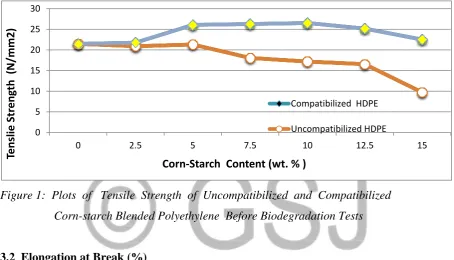
The tensile strength of the uncompatibilized and compatibilized HDPE/Corn-Starch blends before the biodegradation tests are graphically represented in figure 1. The systematic increase in corn starch contents from 2.50 wt.% to 15.00 wt.%, tremendously decreased the tensile strength from 20.90 N/mm2 to 9.73 N/mm2 for the corn starch blended polyethylene. The reduction in the tensile strength could be attributed to the poor interfacial adhesion between the bio-filler/polyolefin bonds. The results were in conformation to the findings of Thakore et al (1999). The pure HDPE exhibited highly stable tensile strength value of 21.48 N mm2 through- out the periods of soil burial as against the blended sheets. Pure high density polyethylene is known for it’s high strength to density ratio due to it’s lack of chain branching which is the reason for their high strength (Boryniec et al 2004).
Bhattachrya, 1997). The results obtained above support the assumption that the interaction between starch and MA-g-PE was a chemical one between the hydroxyl groups in corn starch and anhydride groups in MA-g-PE, because, a polar interaction between them would not improve their properties to any significant extent (Boryniec et al, 2004).
Figure 1: Plots of Tensile Strength of Uncompatibilized and Compatibilized
Corn-starch Blended Polyethylene Before Biodegradation Tests
3.2 Elongation at Break (%)
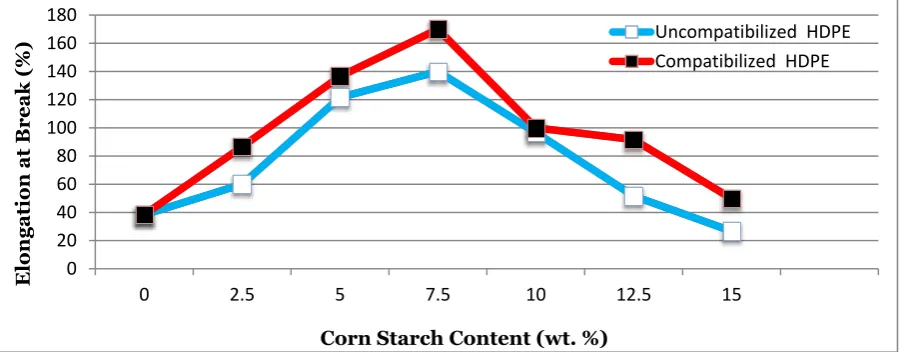
It was observed that increase in the corn starch content alternatively decreased the elongation at break of the blends. This could be due to the heterogeneous dispersion of starch granules within the polyethylene matrix. Starch molecules cannot stretch-out, therefore, cracks occurred reducing the elongation of the polyolefin/starch blends. This was in conformity to the findings of Martins, et al(2001); Obasi, (2013) and Kang, et al(1998), who reported that slight increase in starch content decreased the elongation at break of sweet potato starch blended polypropylene. The elongation at break was observed to increase with increase in starch content up to 7.50 wt % and thereafter, decreased with further increase in corn starch content. This can be attributed to the findings of Enamul (2013) who reported that, at higher starch content, filler interaction becomes more pronounced than filler-matrix interaction. This can reduce the effective cross-sectional area of the polyethylene due to the presence of the starch particles. Addition of MA-g-PE into the polyethylene /corn starch mixture increased the EB of blends as compared to uncompatibilized blend films. The results showed that the modification of the polyethylene/corn-starch blends with MA-g-PE
0 5 10 15 20 25 30
0 2.5 5 7.5 10 12.5 15
Tensli
e Str
eng
th
(
N/mm2)
Corn-Starch Content (wt. % )
Compatibilized HDPE
improved the elongation at break of the blends. It is assumed that the copolymer increased the interfacial attraction between the starch and polyethylene particles. The sharp reduction after the starch content of 7.50 wt % could be due to the heterogeneous molecular imbalance within the starch/filler intermolecular attractions. This according to Chandra (1998) tends to lower the elongation at break property of the blends.
Figure 2 : Plots of Elongation at Break(%) of Uncompatibilized and Compatibilized
High Density Polyethylene/ Corn-Starch Blends
3.3 Percentage Weight-loss
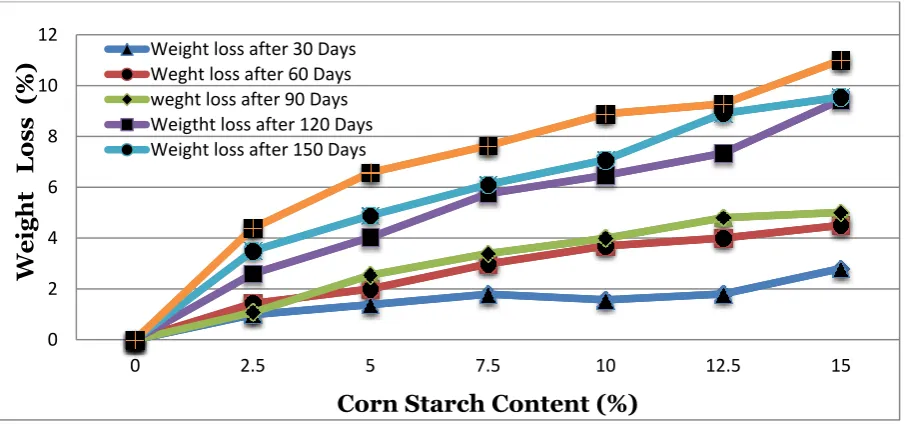
There was no apparent weight-loss for the Pure HDPE throughout the entire soil burial testing period, showing that pure polyethylene is inert to air, moisture and microbial attack and therefore are non-biodegradable. The plots show continuous increase in the weight–loss of HDPE/corn starch blended sheets with increased starch content. The reduction in the weight of the blended samples could be due to the removal of starch granules by soil microorganisms. It is expected that extension of the biodegradation period could result into complete bio-fragmentation, assimilation and mineralisation of the blended polyethylene. Albertsson (1998) had reported that the penetration of small amount of solar radiation reaching the film under soil surface might initiate oxidation process which can result into weight-loss. The plots also revealed the evidence of biodegradation by the gradual increase in the weight-loss of the blends.
0 20 40 60 80 100 120 140 160 180
0 2.5 5 7.5 10 12.5 15
El
ong
a
tio
n at Bre
a
k (%
)
Corn Starch Content (wt. %)
Figure 3: Plot of Weight loss of High Density Polyethylene /Corn- Starch Blends.
It is to be expected that the extension of the degradation period could result into complete degradation of the polyolefin fragments, since the weight loss increased with increase in the periods of soil burial days ( ie from 30 to 180 days). The compatibilized HDPE blends showed reduced weight losses when compared to the uncompatibilized blends throughout the soil burial periods. This could be attributed to the increased adhesion, and bonding effect of MA-g-PE to the polyolefin matrix/corn starch blends. The weight-loss for compatibilized HDPE blended with 2.5 wt. %, and 5.0 wt.% corn starch after 30 to 90 days of soil burial tests were low when compared to the uncompatibilized blends. This could be due to (i) the short time for biodegradation, and (ii), low content of corn starch to render biodegradation process. The plots revealed the biodegradation of the blends as evidenced in increased weight losses.
Figure 4: Plot of Weight loss of Compatibilized High Density Polyethylene
and Corn - Starch Blends. 0
5 10 15
0 2.5 5 7.5 10 12.5 15
Weig
ht Loss
(%)
Corn Starch Content (%)
Wt. Loss after 90 Days Wt. Loss (%) after 120 Days
0 2 4 6 8 10 12
0 2.5 5 7.5 10 12.5 15
We
ight
Loss (
%)
Corn Starch Content (%) Weight loss after 30 Days
(4) CONCLUSION
The tensile strength and elongation at break for the uncompatibilized HDPE /Corn-starch blends decreased with increase in starch contents. The pure HDPE exhibited higher tensile strength value, when compared to both uncompatibilized and compatilized blends. We can therefore conclude that, the decrease in the mechanical properties of the starch blended polyethylene is a good evidence of degradation.
Addition of coupling agent (MA-g-PE) was observed to improve the mechanical properties of the blended polyethylene. MA-g-PE modified HDPE/Corn-starch blends also exhibited reduced weight-loss properties than uncompatibilized HDPE and can be recommended for packaging or other engineering purposes. Significant biodegradation process was recorded within the short period of this study, therefore, complete biodegradation and mineralization is expected to occur on extension of the biodegradation period.
The use of con- starch in this research is due to its availability, non-toxicity, and ease of processability. There is an urgency to promote the use of starch blends in plastic applications, because starch represents a material with low energy demands from renewable sources. It can initiate biodegradation of HDPE by attracting starch-loving organisms to feed on the polymer chains. Biodegradation of plastics through incorporation of starch had been investigated and is seen as an option in the waste management. If polyethylene is made self-decomposing, it will reduce the resources invented on waste management, reduce the danger of death to animals who mistaken the wastes for prey, and reduce the problem of emission of dangerous gasses during recycling or incineration process.
5. REFERENCES
Albertson, A.C. Biodegradation of Synthetic Polymers. II. A limited Microbial Conversion
of 14 C in Polyethylene to 14 CO2 By Some Soil Fungi, Applied Polymer Science 2,
3419 (1998).
Boryniec, S., Slusarczyk, C., Zakowska, Z., and Stobinska, H. , Biodegradation of the films of polyethylene modified with Starch. Studies on Changes of their Supermolecular Structures. Academic Journal. 49(6), 424 (2004).
Materials, 7 (2013).
Kang, B.G., Yoon,S.H., Yie ,J.E., Yoo, B.S. and Suh, M. (1999). Studies on
the Physical Properties of Modified Starch Filled High Density Polyethylene .
Journal of Applied Polymer Science, 60, 177-184, (1999).
Sanadi, A.R., Caufield, D.F., Jacobson, R.E. and Rowell, R.M., Renewable Agricultural Fibres as Reinforcing Fillers in Plastics: Mechanical Properties of Kenaf Fibre- Polypropylene Composites. Industrial and Engineering Chemistry Research, 34(5), 1889-1896 (2001).
Shrogren, R.L., Doane, W.M., Garlotta, D., Lawtan, J.W. and Willet, J.L. Biodegradation of Starch / Polylactic Acid/Poly(hydroester- ether) Composite Bars, Polymer
Degradation and Stability, 79, 405-411, (2003).
Thakore, C.M., Lyer, S., Desai, A., Lele, A. and Devi, S., Morphology, Thermomechanical Properties, and Biodegradability of Low Density Polyethylene/Starch Blends, Journal of Applied Polymer Science, 74(12), 2791-2801, (1999).
Tokiwa, Y., Calabia Buenaventurada, P. Ugwu, Charles U., Aisa, Seilchi Biodegradation of Plastics , International Journal of Molecular Science , 9, 3722-3742, (2009).
Watanabe,T., Ohtake,Y., Asabe,H. Murakami,N., Furukawa, M. Biodegradability and
Degrading Microbes of Low Density Polyethylene. Journal of Applied Polymer Science 111, 555 - 559(2009).