The Impact Of Media Independence
On Firm Performance: A Panel Data
Analysis From Emerging Markets
Omar Farooq, ESSCA - Ecole de Management, FranceMounia Rbiha, Ph.D., Al Akhawayn University in Ifrane, Morocco Samir Aguenaou, Ph.D., Al Akhawayn University in Ifrane, Morocco
ABSTRACT
Can media have any influence on firm performance? Do firms in countries with more independent media perform better than firms with less independent media? This paper seeks to answer these questions by documenting the relationship between media independence and firm performance in emerging markets. Using a dataset from twenty seven emerging markets, we show significantly better performance of firms headquartered in countries with relatively more independent media than firms headquartered in countries with relatively less independent media during the period between 2007 and 2011. We argue that independent media reduces information asymmetries for stock market participants. Consequently, it is more difficult for managers to expropriate, thereby improving performance of firms. Our results indicate that media can play a substitute role for traditional governance mechanisms in emerging markets.
Keywords: Media Independence; Information Asymmetries; Firm Performance; Emerging Markets
1. INTRODUCTION
merging markets are characterized by high information asymmetries. Luez et al. (2003), for instance, document that managers do not disclose the true information about their firms in emerging markets. In another related study, Fan and Wong (2002) document similar findings by showing that the quality of information disclosure, measured by the relation between reported earnings and stock returns, is low in emerging markets.1 These findings have given rise to a vast amount of literature that is aimed at identifying the mechanisms via which information environment of firms can be improved. This strand of literature has identified several country-specific as well as firm-specific factors behind inefficient information environment in emerging markets.2 Luez et al. (2003), for example, relate information asymmetries with country-level factors and document that information environment of a firm improves with improvement in investor protection mechanisms. They argue that strong protection limits insiders’ ability to acquire private benefits, thereby reducing their incentives to hide firm performance. While, Bae and Jeong (2007) highlight the importance of firm-specific factors by reporting that quality of disclosure is weaker for firms that are affiliated with business groups. They also document that firms with foreign ownership have lower information asymmetries.
An important factor that has, however, eluded prior literature is how the extent of media independence – a country-specific factor – effect information environment of firms. Given that the media is a channel via which information gets transmitted to a large segment of society, it is intuitive to believe that media should play an
1 An important implication of low information disclosure is the presence of high information asymmetries and agency problems within firms in
emerging markets. Mitton (2002) argue that high information asymmetries adversely affect firm performance. He shows that firms with higher disclosure quality (ADRs and auditors from big-six accounting firms) outperform other firms.
2 Claessens and Fan (2003) conduct survey of literature and report that concentrated ownership structures, presence of family firms, cronyism,
inadequate governance mechanisms, and ineffective institutional framework are some of the more important factors that lead to poor information environment of firms in emerging markets.
important role in altering the information environment of firms in any economy.3 In a related study, Bushee et al. (2010) document that media has the ability to reduce information asymmetries. They argue that media has the ability to shape a firm’s information environment by packaging and disseminating information, as well as by creating new information through journalism activities. Dyck and Zingales (2002) also argue along similar lines when they report that media is a channel via which information is aggregated and credibly communicated to the public. This strand of literature argues that media’s ability to diffuse information to a wider audience creates an information environment where informed investors have very limited information leverage. Lower difference between information content possessed by informed investors and information content possessed by uninformed investors leads to more efficient prices. Rogers et al. (2013) show that media have a significant economic impact on securities markets in terms of the price formation process.
Basic assumption in the above strand of literature is that the media is able to credibly transmit information to the public. We argue that credibility of the media is synonymous to its independence. Media that is not independent can compromise on the quality of information being disclosed and disseminated to the public. Waisboard (1995), for instance, argue that less independent media is more inclined to distort and manipulate information, in order to prevent consumers from making informed decisions. In this paper, we argue that it is the quality of media, which is how independent and objective the media is, rather than the media coverage that should define the relationship between reduction in information asymmetries and media. If the media is not independent, we should not expect the media coverage to cause any improvement in information asymmetries.4 Our arguments are consistent with Duta and Roy (2013) who argue that media independence insures that information disseminated by the media is unbiased. They show that countries where media are not free tend to have a biased information environment even if the access of information is easy. Therefore, it is not the coverage but the independence of media that should be of prime determinant of superior information environment. Duta and Roy (2013) argue that the media that communicates freely is more likely to increase accountability and transparency, thereby improving the information environment.
Given that information asymmetries constitute important determinants of firm performance, this paper aims to extend the earlier literature by documenting the impact of media independence on firm performance in emerging markets. Our paper is similar in spirit to Farooq (2013). However, an important limitation of his analysis is the narrow definition of media independence. His definition of media independence depends on the extent of government ownership of the media.5 His variable of media independence overlooks the surrounding environment and country-specific conditions that can have a significant impact on the independence of media. Furthermore, he conducts a cross-sectional study covering one year period of 1999. Unlike Farooq (2013), we analyze a panel data covering the period between 2007 and 2011 with a more comprehensive definition of media independence. After controlling for potential endogeneity problem of media independence, our results confirm the findings of Farooq (2013) and show significantly better performance of firms headquartered in countries with relatively more independent media than firms headquartered in countries with relatively less independent media. Our results also show that all aspect of media independence – economic, legal, and political – is equally important for firm performance. We argue that the positive impact of media independence on firm performance is driven by the fact that independent media is able to reduce information asymmetries between firms and investors (Bushee et al., 2010). Lower information asymmetries should induce managers to work in the best interest of shareholders. Dyck and Zingales (2002) argue that media reduce information asymmetries by bringing into attention any wrong doings of
3 This should be, especially, true in emerging markets where tradition mechanisms of information transmission, such as financial analysts, are not
very strong. One of the reasons for this might be low demand of analyst services in emerging markets. Giannetti and Koskinen (2005) document that only 3.3% of Indian population invests in stock market, while this statistics is 1.2% for Turkey and 2.3% for Sri Lanka. Low participation of individuals in stock markets should lead to lower demand of analyst services. Claessens and Fan (2003) also report that there is inadequate amount of research on the role of financial analysts in emerging markets.
4 Islam (2002) notes that media has to independent, if it claims to have any beneficial impact on society. He also argues that the key element to
independence is objectivity. Once the independence of media is altered, it becomes hard to identify any benefit of the media.
5 Farooq (2013) argues that state-owned media is less independent and is more inclined to distort and manipulate information. However, we are
managers to the wider segment of society. As a result, media discipline the managers and positively impact firm performance.
Our results have implications are rich in policy implications. Our results imply that policy makers should also make efforts to strengthen unconventional institutions, such as media, if they want to improve information environments of their countries. Furthermore, our results also indicate that media independence is important publicly available information that investors should take into consideration while deciding how much capital to allocate to which country. Our arguments in this paper also provide direction for future research. If our arguments regarding information environment and media independence are true, media independence should also exert significant influence of the informativeness of reported earnings and traditional governance mechanisms, such as choice of auditors and dividend payout ratios.
The remainder of the paper is structured as follows: Section 2 briefly discusses motivation and background of this study. Section 3 summarizes the data. Section 4 presents assessment of our hypothesis and Section 5 discusses our results. The paper ends with Section 6 where we present conclusions.
2. MOTIVATION AND BACKGROUND
2.1 Media And Media Independence
Information is the key to efficient functioning of the stock markets (Stiglitz, 2000). Securities get priced correctly when all relevant information about firms enters the market. Therefore, any mechanism that can affect the disclosure and dissemination of information should be value relevant for stock market participants.6 This paper aims to bring into focus the role media plays in improving the information environment of firms. Djankov et al. (2003) classifies media as an information intermediary whose main goal is to provide the public with collected information. Within this goal, media performs tasks such as broadcasting, wrapping, and producing of information (Bushee et al., 2009). Dyck and Zingales (2002) argue that, in today’s market place, the importance of media has exceeded so much that investors’ decisions are more guided by media content than by other key financial criteria.
Prior literature argues that media is only able to perform its tasks efficiently if it is independent. Biased media can obscure the motives and interests behind corporate decisions. Dash (2012) note that biased media may not information that can damage firms with which they have direct business deals such as advertising. In a recent study, Dutta and Roy (2012) make the distinction between media independence and media exposure/coverage and note that media exposure makes sure that information is reachable and media independence insures this information is unbiased. To emphasize their point, they show that in countries where media is categorized as not free, wide access to media is not sufficient to reduce particular governance violations. We argue that the market understands that media exposure/coverage does not necessarily mean that information being disseminated in correct. Behrman and Roy (2011) points out that, for a media to be effective, it should be able to communicate unbiased information. Only unbiased reporting will ensure the beneficial impact of media. We argue that unbiased reporting promotes the involvement of shareholders, consumers and the public in corporate decisions. Consequently, those corporate decisions that negatively impact shareholders can be prevented. Brunetti and Weder (2003) note that dissemination of unbiased information can acts as a powerful tool of control against any wrongdoings. Islam (2002) identifies objectivity as the key element to media quality. He reports that media independence is all about reporting information in the most impartial manner. Therefore, we argue that the more independent is media, the more objectivity is achieved and the more quality is guaranteed eventually.
6 As an example, consider financial analysts. Financial analysts play an important role in this process by bringing out new information about
2.2 Media Independence And Information Asymmetries/Information Environment
Prior literature discusses media for its various roles, ranging from fight against corruption to economic development to religious tolerance (Besley et al., 2002; Djankov et al., 2002; Anam, 2002).7 As a result, media is supposed to have significant impact on any society. In this paper, we attempt to discuss the capacity of media as a channel via which information asymmetries regarding firms can be reduced. Prior literature argues that media helps in reducing information asymmetries by acting as a disciplining device. Dyck and Zingales (2002), for instance, suggest that media can play a significant role in inducing managers to act in the best interest of shareholders. They argue that media can create significant pressure on managers by bringing into public attention any wrongdoings done by managers. They consider public attention as the main reason behind disciplining the managers.8 In another related study, Dyck et al. (2008) conclude that exposing breaches of corporate governance in media significantly reduce the violation of governance mechanisms. They also argue that media attention induces managers to refrain from any wrongdoings. Kahan and Rock (2007) also reach the same conclusion as Dyck and Zingales (2002) and Dyck et al. (2008), when they document the positive link between media exposure/coverage and scrupulous behavior of management.
Prior literature highlights number of channels via which media exercises its governance/disciplining role. Some of them are listed below:
• We argue that independent exposure/coverage of events happening within firms by media can discipline managers via its impact on their reputation. Becker (1968) suggests that a manager will refrain from actions that destroy shareholder wealth if the perceived private benefits are smaller than reputational damage. Fama (1980) also considers concerns for reputation as one of the most important channel that can discipline managers. Fama and Jensen (1983) argue that, when it comes to act in accordance with corporate governance principles, management has more apprehension for their reputation than for legal penalties. Plentiful of examples in the prior literature show that the resulting embarrassment caused by media coverage considerably decreases expropriation activities (Monks and Minnow, 1995). SK Telecom, for instance, is an interesting case where media campaign not only helped in stopping expropriation but also forced firm to improve its governance practices. In another case, the Board of Directors of Sears Roebuck succumbed to the ad campaign launched against their inappropriate behavior (Dyck and Zingales, 2002).
• Another important reason behind the strong relationship between media independence and information
environment is the political concerns of lawmakers and regulators. Dyck and Zingales (2002) argue that media exposure can push political leaders to act as per good corporate governance practices and increase law enforcement in an attempt to protect their political careers. This is to say that the stakes are high when media coverage is involved.
However, as was argued earlier, all of these benefits of media exposure/coverage can only be realized if media coverage is independent and free of any bias. Dutta and Roy (2012) document that, for media to be that effective, it has be independent and unbiased. IN this paper, we posit that disciplining role played by media, eventually, translates into lower information asymmetries. In a recent study, Kalenborn and Lessmann (2012) consider an environment with symmetric information as synonymous to an environment of high degree of media independence. In another related study, Chen (2005) documents that the degree of asymmetric information can substitute the degree of media independence in a particular economy by showing that media independence is responsible for lower asymmetric information.9 Consistent with above findings, Vishawanath and Kaufmann (1999) also indentifies media as one of the key ways to lower information asymmetries. Oxelheim (2006) argues that lower information asymmetries enhance the ability of external investors to evaluate a particular firm’s activities in the most accurate way. This means that more independent media lead to higher transparency which leads to higher reduction of information asymmetry and contributes to have better informed investors.
7 Besley et al. (2002) argue that free media bridges the gap between the government and its citizens. Djankov et al. (2002) report that media has
the ability to reduce corruption. Anam (2002) considers media as a tool to fight religious extremism.
8 Dyck and Zingales (2002) cite number of examples to prove their arguments. One such example was the case of SK Telecom in which the
media exposure was the main reason that restrained people involved from unethical activities.
9 Chen (2005) also relates independent media with lower adverse selection problem. Conventional arguments would suggest that lower adverse
2.3 Media Independence, Information Environment And Firm Performance
Our arguments, thus far, have established the fact that media independence leads to lower information asymmetries via its impact on manager’s reputation. Being ashamed publicly acts as a deterrent and induces managers to refrain from any unscrupulous behavior. This paper argues that lower information asymmetries arising due to media independence should also have a positive impact on firm performance. Given that information asymmetries misalign the goals of managers and shareholders by creating conflicting objectives between the two, we should expect firms with lower information asymmetries to perform better than firms with higher information asymmetries. Johnson et al. (2000) show that country-specific measures of the information environment are positively related to firm performance in emerging markets. In particular, they find that firms located in environments with low information asymmetries are more likely to perform well in comparison to firms headquartered in environments with high information asymmetries. They conclude that a poor information environment can lead managers to misuse resources. Consistent with Johnson et al. (2000), Lemmon and Lins (2003) show that stock returns of firms in which managers have high level of control rights, but lower cash flow ownership, are significantly lower than other firms. Klapper and Love (2004) confirm the same results by documenting that higher market valuation and better operating performance is strongly related with governance and information environment in emerging markets. These studies argue that better information environment minimizes agency problems and improve firm performance by not allowing managers to expropriate.
Furthermore, conventional wisdom suggests that investors react to economically significant news related to firms. Prior literature also documents statistically significant correlations between publication of price-sensitive information and price movements. Beneish (1991) and Barber and Odean (2008) conclude that the US retail investors give high importance to information revealed in media. In another related study, Huth and Maris (1992) find that media tips about firms, especially smaller firm, have a significant impact on stock prices. The media not only keeps the existing investors up to date on information about firms, but also attracts potential investors into the market via various ways. Merton (1987) observes that the attention of investors is not distributed equally across the market. The media, therefore, plays an important role in channeling investors’ attention. Given that the media’s narrative about firms has a large audience, it may induce some of investors who are not the current shareholders to invest in firms. This increased interest from investors may also result in better performance. Therefore, consistent with above argument, we hypothesize that firms headquartered in countries with more independent media should outperform firms headquartered in less independent media.
3. DATA
This paper documents the relationship between media independence and firm performance in twenty-seven emerging stock markets. The sample consists of firms from Latin America (Argentina, Chile, Colombia, Mexico, Peru, and Venezuela), Asia (Bahrain, Jordan, Kuwait, Oman, Pakistan, Philippines, Qatar, Saudi Arabia, Thailand, United Arab Emirates, and Vietnam), Europe (Czech Republic, Hungary, Poland, Romania, Russia, and Turkey), and Africa (Egypt, Morocco, Nigeria, and Tunisia). The sample period for this research is from 2007 to 2011. We describe our dataset in the following subsections.
3.1 Firm Performance
This paper measures firm performance by the market-adjusted returns (RET). We measure RET by the difference between stock returns and market returns. Stock price data and the corresponding market index data is obtained for the first and the last day of the year to compute RET. The data for these items is obtained from the Datastream.
3.2 Media Independence
each country. The ranking aims to capture the extent to which the media is free in each country. The data provided by the Freedom House is also widely used in prior literature (Dutta and Roy, 2009; Petrova, 2008; Leeson, 2008).We would like to mention here that the ranking provided by the Freedom House does not provide evidence of media quality.
The index used to measure media freedom is based on twenty three methodology questions divided into the following three categories:
• Legal environment: This category assesses all laws and regulations of a particular country that could be
used to control media content and the capacity of media actors to work freely and independently.
• Political environment: This category examines the extent to which political powers can influence the content of news. It inspects the independence of media, censorship, harassment, threats and pressure on media actors.
• Economic environment: This category looks also at the independence of media in terms of ownership,
transparency, and operation activities such as production, distribution, and advertising.
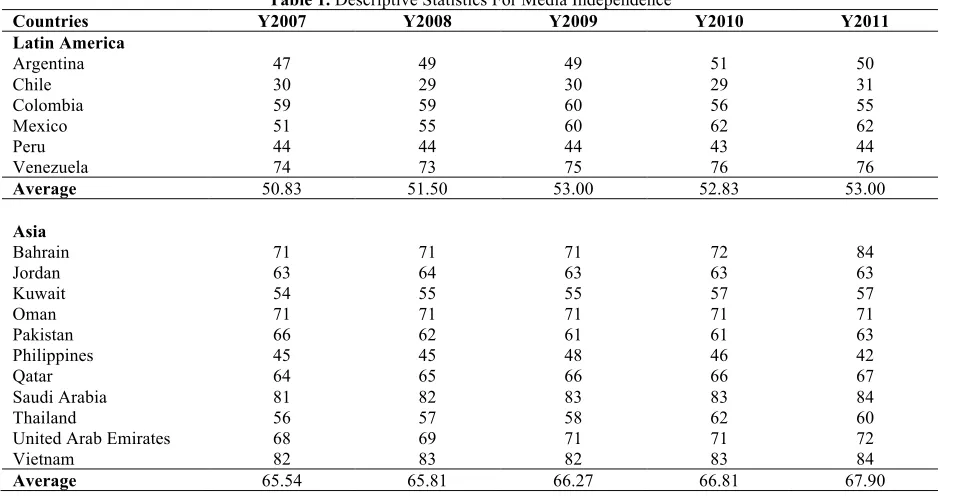
The Freedom House provides numerical ratings and rates the independence level of a country’s media as free, partly free, or not free. The ranking assigns numerical values between 0 and 100 points – 0 being the most free and 100 being the least free. The descriptive statistics for media freedom in the countries represented in our dataset are provided in Table 1. The results show that, on average, European emerging markets have more free media than the other emerging markets. Our results also show that media in Asian and African emerging markets is the least free.
Table 1. Descriptive Statistics For Media Independence
Countries Y2007 Y2008 Y2009 Y2010 Y2011
Latin America
Argentina 47 49 49 51 50
Chile 30 29 30 29 31
Colombia 59 59 60 56 55
Mexico 51 55 60 62 62
Peru 44 44 44 43 44
Venezuela 74 73 75 76 76
Average 50.83 51.50 53.00 52.83 53.00
Asia
Bahrain 71 71 71 72 84
Jordan 63 64 63 63 63
Kuwait 54 55 55 57 57
Oman 71 71 71 71 71
Pakistan 66 62 61 61 63
Philippines 45 45 48 46 42
Qatar 64 65 66 66 67
Saudi Arabia 81 82 83 83 84
Thailand 56 57 58 62 60
United Arab Emirates 68 69 71 71 72
Vietnam 82 83 82 83 84
(Table 1 continued)
Countries Y2007 Y2008 Y2009 Y2010 Y2011
Europe
Czech Republic 18 18 18 19 19
Hungary 21 21 23 30 36
Poland 24 24 24 25 25
Romania 44 44 43 42 41
Russia 78 80 81 81 80
Turkey 51 50 51 54 55
Average 39.33 39.50 40.00 41.83 42.67
Africa
Egypt 59 60 60 65 57
Morocco 64 64 66 68 68
Nigeria 53 54 54 52 50
Tunisia 81 82 85 85 51
Average 64.25 65 66.25 67.5 56.5
3.3 Control Variables
This paper uses number of firm-specific characteristics as control variables. These variables are:
• SIZE: It is defined as log of firm’s total assets. Conventional wisdom suggests that large firms have lower
agency problems due to increased interest from stock market participants (investors and analysts). Lower agency problems should lead to better performance of large firms (Fang et al., 2009). Furthermore, Bhattacharyya and Saxena (2009) argue that larger firms have more bargaining power over their suppliers and competitors, thereby improving their performance.
• LEVERAGE: It is defined as total debt to total assets ratio. High level of debt exposes firms to greater
financial risk. High risk should result in lower performance (Mitton, 2002).
• EPS: It is defined as earnings per share. EPS is an important variable that measures investor interest in a
firm (Chang et al., 2008). It also measures accounting performance of a firm. Higher investor interest and superior accounting performance is expected to translate into better stock price performance.
• GROWTH: It is defined as the growth in total assets over the last one year. Jegadeesh and Livnat (2006)
document that firms with higher growth have better stock price performance.
• RoA: It is defined as return on assets. It is an indicator of how efficient management is at using its assets to
generate earnings. We expect positive impact of RoA on stock prices.
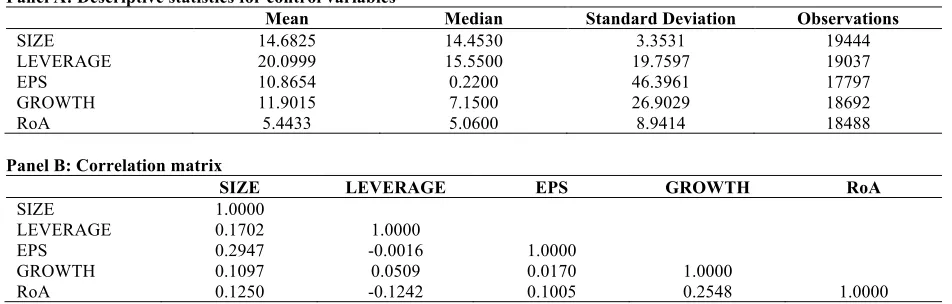
Table 2. Descriptive Statistics For Control Variables
Panel A: Descriptive statistics for control variables
Mean Median Standard Deviation Observations
SIZE 14.6825 14.4530 3.3531 19444
LEVERAGE 20.0999 15.5500 19.7597 19037
EPS 10.8654 0.2200 46.3961 17797
GROWTH 11.9015 7.1500 26.9029 18692
RoA 5.4433 5.0600 8.9414 18488
Panel B: Correlation matrix
SIZE LEVERAGE EPS GROWTH RoA
SIZE 1.0000
LEVERAGE 0.1702 1.0000
EPS 0.2947 -0.0016 1.0000
GROWTH 0.1097 0.0509 0.0170 1.0000
RoA 0.1250 -0.1242 0.1005 0.2548 1.0000
4. METHODOLOGY
The aim of this paper is to document the effect of media independence on firm performance in emerging markets. In order to test our hypothesis, we estimate panel regression with firm performance (RET) as a dependent variable and media independence (MEDIA) as an independent variable. As indicated above, we also add SIZE, LEVERAGE, EPS, GROWTH, and RoA as control variables in our regression equation. To control for unobserved heterogeneity, we also include dummy variables representing firm-specific fixed effects (FDUM). Our basic regression equation takes the following form. We would like to mention here that we believe that media independence is not an exogenous variable. Therefore, we allow for the endogenous relationship between media independence and firm performance. Media may be more independent in countries with better country-level governance environment. Therefore, it is likely that independent media is able to reduce information asymmetries in countries with better country-level governance environment. In order to address the endogeneity problem, we estimate the following panel regression by using the instrumental variables. The instruments used in our analysis are the following: (1) Voice and accountability index, (2) Rule of law index, and (3) Political stability index. All of these variables are obtained from the World Bank’s World Governance Indicator (WGI) database. In an unreported result, we confirm that our instruments are valid instruments. It is important to mention here that we use panel data regression with fixed effects for our analysis. Hausman test is used to decide between fixed effect and random effects.
(
)
(
)
(
)
(
)
(
)
(
)
(
FDUM)
εβ RoA β GROWTH β EPS β LEVERAGE β SIZE β MEDIA β α RET Fxd Fxd 6 5 4 3 2 1 + + + + + + + + =
∑
(1)Table 3. Effect Of Media Independence On Firm Performance
Coefficient t-statistic
MEDIA -0.0111*** -2.65
SIZE -0.1255*** -5.98
LEVERAGE -0.0033** -4.84
EPS -0.0004* -1.90
GROWTH 0.0023*** 10.22
RoA 0.0005*** 2.75
Fixed Effects Yes
No. of observations 16201
F-Value 23.7900
No. of groups 3880
R2 within 0.0146
Note: Coefficients with 1% significance are followed by ***, coefficient with 5% by **, and coefficients with 10% by *.
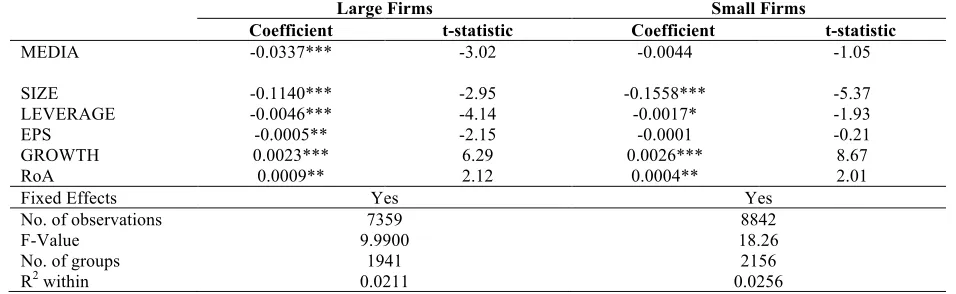
There can be concerns that the results obtained in Table 3 are confined to certain stocks. For instance, small firms have higher information asymmetries due to low interest from stock market participants (investors and analysts). Therefore, it may be possible that beneficial impact of independent media is more pronounced in these firms relative to large firms where information asymmetries are already low. In order to overcome these concerns, we divide our sample into two groups – firms with size above the median size of the sample and firms with size below the median of the sample. We re-estimate Equation (1) for both groups. Our results, reported in Table 3, show that our previous findings of better performance of firms in countries with more independent media holds only in a sample of large firms. We report a significant coefficient of MEDIA in a sample of large firms. For small firms, we show insignificant impact of media independence on firm performance in a sample of small firms. Our results are intuitive because large firms are regular features in financial press and journalists give a better coverage to the large firms (Dash, 2012).
Table 4. Effect Of Media Independence On Firm Performance In Different Samples Based On Size
Large Firms Small Firms
Coefficient t-statistic Coefficient t-statistic
MEDIA -0.0337*** -3.02 -0.0044 -1.05
SIZE -0.1140*** -2.95 -0.1558*** -5.37
LEVERAGE -0.0046*** -4.14 -0.0017* -1.93
EPS -0.0005** -2.15 -0.0001 -0.21
GROWTH 0.0023*** 6.29 0.0026*** 8.67
RoA 0.0009** 2.12 0.0004** 2.01
Fixed Effects Yes Yes
No. of observations 7359 8842
F-Value 9.9900 18.26
No. of groups 1941 2156
R2 within 0.0211 0.0256
Note: Coefficients with 1% significance are followed by ***, coefficient with 5% by **, and coefficients with 10% by *.
5. DISCUSSION OF RESULTS
5.1 Are All Components Of Media Independence – Economic, Political, Or Legal – Important For Firm Performance?
Table 5. Effect Of Different Aspects Of Media Independence On Firm Performance
Legal Environment Political Environment Economic Environment
Coefficient t-statistic Coefficient t-statistic Coefficient t-statistic
MEDIA -0.0299** -2.08 -0.0245*** -2.57 -0.0404*** -2.94
SIZE -0.1266*** -6.02 -0.1248*** -5.93 -0.1242*** -5.93 LEVERAGE -0.0033*** -4.84 -0.0033*** -4.85 -0.0033*** -4.84
EPS -0.0005** -2.09 -0.0004* -1.78 -0.0004* -1.76
GROWTH 0.0023*** 10.27 0.0023*** 10.08 0.0023*** 10.15
RoA 0.0005*** 2.69 0.0005*** 2.81 0.0005*** 2.71
Fixed Effects Yes Yes Yes
No. of
observations 16201 16201 16201
F-Value 23.55 23.66 24.00
No. of groups 3880 3880 3880
R2 within 0.0157 0.0109 0.0165
Note: Coefficients with 1% significance are followed by ***, coefficient with 5% by **, and coefficients with 10% by *.
5.2 Relationship Between Media Independence And Firm Performance Using Bootstrap Standard Errors
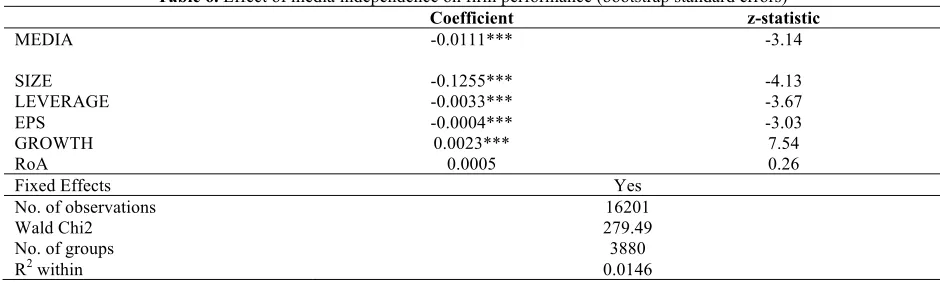
In this section, we estimate Equation (1) by using the method of bootstrapping as an alternative to obtain standard errors for estimated parameters. Bootstrapping is a nonparametric approach for evaluating the distribution of a statistic based on random resampling. It relies upon the assumption that the current sample is representative of the population, and therefore, the empirical distribution function is a nonparametric estimate of the population distribution (Guan, 2003). Our results are reported in Table 6. Our results confirm our earlier results of better stock price performance of firms headquartered in countries with more independent media.
Table 6. Effect of media independence on firm performance (bootstrap standard errors)
Coefficient z-statistic
MEDIA -0.0111*** -3.14
SIZE -0.1255*** -4.13
LEVERAGE -0.0033*** -3.67
EPS -0.0004*** -3.03
GROWTH 0.0023*** 7.54
RoA 0.0005 0.26
Fixed Effects Yes
No. of observations 16201
Wald Chi2 279.49
No. of groups 3880
R2 within 0.0146
Note: Coefficients with 1% significance are followed by ***, coefficient with 5% by **, and coefficients with 10% by *
6. CONCLUSION
AUTHOR INFORMATION
Omar Farooq, Ph.D., ESSCA - Ecole de Management, Angers, France. Email address: [email protected]
Mounia Rbiha, Ph.D., School of Business Administration, Al Akhawayn University in Ifrane, Ifrane, Morocco
Samir Aguenaou, Ph.D., School of Business Administration, Al Akhawayn University in Ifrane, Ifrane, Morocco
REFERENCES
Anam, M., (2002). The Media and Development in Bangladesh. In R. Islam, S. Djankov, and C. McLiesh (Eds.), The Right to Tell: The Role of Mass Media in Economic Development, Washington, DC: World Bank Institute, pp. 267–274.
Bae, K. H., and Jeong, S. W., (2007). The Value-relevance of Earnings and Book Value, Ownership Structure, and Business Group Affiliation: Evidence from Korean Business Groups. Journal of Business Finance and Accounting, 34(5-6), pp. 740-766.
Barber, B. M. and Odean, T., (2008). All that Glitters: The Effect of Attention and News on the Buying Behavior of Individual and Institutional Investors. Review of Financial Studies, 21(2), pp. 785-818.
Becker, G. S., (1968). Crime and Punishment: An Economic Approach. Journal of Political Economy, 76(2), pp. 169-217.
Behrman, M. and Roy, S., (2011). Media and Economic Development: Sub-Saharan Africa. Working Paper, Media Map Project.
Beneish, M. D., (1991). Stock Prices and the Dissemination of Analysts’ Recommendations. Journal of Business, 64(3), pp. 393-416.
Besley, T., Burgess, R., and Prat, A., (2002). Mass Media and Political Accountability. In R. Islam, S. Djankov, and C. McLiesh (Eds.), The Right to Tell: The Role of Mass Media in Economic Development, Washington, DC: World Bank Institute, pp. 45–60.
Bhattacharyya, S. and Saxena, A., (2009). Does the Firm Size Matter? An Empirical Enquiry into the Performance of Indian Manufacturing Firms. MPRA Paper No. 13029, Munich Personal RePEc Archive.
Brunetti, A. and Weder, B., (2003). A Free Press is Bad News for Corruption. Journal of Public Economics, 87(7-8), pp. 1801-1824.
Bushee, B., Core, J., Guay, W., and Hamm, S., (2010). The Role of Business Press as an Information Intermediary. Journal of Accounting Research, 48(1), pp. 1-19.
Chang, H-L., Chen, Y-S., Su, C-W., and Chang, Y-W., (2008). The Relationship between Stock Price and EPS: Evidence Based on Taiwan Panel Data. Economics Bulletin, 3(30), pp. 1-12.
Chen, Z., (2005). Press Freedom and Economic Development. Working Paper, Yale School of Management, USA. Claessens, S. and Fan, J. P. H., (2003). Corporate Governance in Asia: A Survey. International Review of Finance,
3(2), pp. 71-103.
Dash, A. K., (2012). Media Impact on Corporate Governance in India: A Research Agenda. Corporate Governance, 12(1), pp. 89-100.
Djankov, S., McLeish, C., Nenova, T., and Shleifer, A., (2002). Media Ownership and Prosperity. In R. Islam, S. Djankov, and C. McLiesh (Eds.), The Right to Tell: The Role of Mass Media in Economic Development, Washington, DC: World Bank Institute, pp. 141–166.
Djankov, S., McLiesh, C., Nenova, T., and Shleifer, A., (2003). Who Owns the Media? Journal of Law and Economics. 46(2), pp. 341-382.
Dutta, N. and Roy, S., (2009). The Impact of Foreign Direct Investment on Press Freedom. Kyklos, 62(2), pp. 239-257.
Dutta, N. and Roy, S., (2012). The Watchdog Reassessed: Press Freedom, Access to Information and Corruption. Working Paper, University of Wisconsin, USA.
Dyck, A. and Zingales, L., (2002). Corporate Governance Role of the Media. Working Paper 9309, National Bureau of Economic Research.
Fama, E. F., (1980). Agency Problems and the Theory of the Firm. Journal of Political Economy, 88(2), pp. 288-307.
Fama, E. F. and Jensen, M. C., (1983). Separation of Ownership and Control. Journal of Law and Economics, 26(2), pp. 301-325.
Fan, J. P. H. and Wong, T. J., (2002). Corporate Ownership Structure and the Informativeness of Accounting Earnings in East Asia. Journal of Accounting and Economics, 33(3), pp. 401-425.
Fang, V. W., Noe, T. H., and Tice, S., (2009). Stock Market Liquidity and Firm Value. Journal of Financial Economics, 94(1), pp. 150-169.
Farooq, O., (2013). Media Independence and Firm Performance: Evidence from Emerging Markets. Forthcoming, Journal of Applied Business Research, 29(4).
Giannetti, M. and Koskinen, Y., (2005). Investor Protection and the Demand for Equity. Finance Working No. 63/2004, European Corporate Governance Institute.
Guan, W., (2003). From the Help Desk: Bootstrapped Standard Errors. The Stata Journal, 3(1). Pp. 71-80.
Huth, W. L. and Maris, B. A., (1992). Large and Small firm Stock Price Response to “Heard on the Street” Recommendations. Journal of Accounting, Auditing, and Finance, 7(1), pp. 27-47.
Islam, R., (2002). The Right to Tell: The Role of Mass Media in Economic Development. Washington, DC: World Bank Publications.
Jegadeesh, N. and Livnat, J., (2006). Revenue Surprises and Stock Returns. Journal of Accounting and Economics, 41(1-2), pp. 147-171.
Johnson, S., Boone, P., Breach, A., and Friedman, E., (2000). Corporate Governance in the Asian Financial Crisis, 1997–98. Journal of Financial Economics, 58(1-2), pp. 141–186.
Kahan, M. and Rock, E. B., (2007). Hedge Funds in Corporate Governance and Corporate Control. ECGI - Law Working Paper No. 76/2006.
Kalenborn, C. and Lessmann, C., (2012). The Impact of Democracy and Press Freedom on Corruption: Conditionality Matters. CESifo Working Paper No 3917.
Klapper, L. F. and Love I., (2003). Corporate Governance, Investor Protection, and Performance in Emerging Markets. Journal of Corporate Finance, 10(5), pp. 703-728.
Leeson, P. T., (2008). Media Freedom, Political Knowledge, and Participation. Journal of Economic Perspective, 22(2), pp. 155-169.
Lemmon, M. L. and Lins, K. V., (2003). Ownership Structure, Corporate Governance, and Firm Value: Evidence from the East Asian Financial Crisis. Journal of Finance, 58(4), pp. 1445-1468.
Leuz, C., Nanda, D., and Wysocki, P. D., (2003). Earnings Management and Investor Protection: An International Comparison. Journal of Financial Economics, 69(3), pp. 505-527.
Merton, R., (1987). Presidential Address: A Simple Model of Capital Market Equilibrium with Incomplete Information. Journal of Finance, 42(3), pp. 483-510.
Mitton, T., (2002). A Cross-firm Analysis of the Impact of Corporate Governance on the East Asian Financial Crisis. Journal of Financial Economics, 64(2), pp. 215-244.
Monks, R. and Minnow, N., (1995). Corporate Governance. Cambridge, MA: Blackwell Publishers.
Oxelheim, L., (2006). Corporate and Institutional Transparency for Economic Growth in Europe. Emerald Group Publishing.
Petrova, M., (2008). Inequality and Media Capture. Journal of Public Economics, 92(1-2), pp. 183-212.
Rogers, J., Skinner, D., and Zechman, S., (2013). The Role of the Media in Disseminating Insider Trading News. Fama-Miller Center for Research in Finance, Chicago Booth Paper 13-34.
Stiglitz, J. E., (2000). The Contributions of the Economics of Information to Twentieth Century Economics. Quarterly Journal of Economics, 115(4), pp. 1441-1478.
Kaufmann, D., and Vishawanath, T., (1999). Towards Transparency in Finance and Governance. Working Paper, The World Bank, USA.