United Kingdom Vol. III, Issue 12, December 2015
Licensed under Creative Common Page 331
http://ijecm.co.uk/
ISSN 2348 0386
THE EFFECT OF CORPORATE IMAGE ON WOM: THE ROLE
OF CUSTOMER SATISFACTION AND TRUST
PROPOSING A CONCEPTUAL FRAMEWORK
Methaq Ahmed Abdulmajid Sallam
College of Administrative Sciences, Najran University, Saudi Arabia [email protected]; [email protected]
Abstract
The use of positive corporate image by companies continues to be a popular method to support
the customer satisfaction and to encourage his/her trusts on the company, and lead the
customer to own more positive word of mouth about the company and its brand. When the
customers have the positive corporate image they focus on aspects of a company, in addition,
they usually express it by using the positive words of mouth, and which in turn is considered the
goal of any company. The reason that lies behind using corporate image is its direct and indirect
strong impact that builds customer satisfaction and makes customers more trust to speak
positively about the company. This theoretical paper develops a conceptual framework that
explains how independent variable (corporate image) affects on dependent variable which is
called word of mouth when trust and customer satisfaction are mediating.
Keywords: Corporate Image, Trust, Customer Satisfaction and WOM
INTRODUCTION
Word-of-mouth communication simply involves people sharing their assessment of their experiences. Word-of-mouth communication, which relates both to positive and negative evaluations of service encounters, has been shown to influence other people’s purchase
Licensed under Creative Common Page 332
importance in the decision making of the consumers. Word of mouth is gaining importance among the societal changes observed in the environment and has become one of the most important and effective communication channel.
A positive corporate image is not only increasing competition but also encourage consumers to repurchase (Tu et al, 2013). Corporate image helps consumers obtain a better understanding of the products offered by specific corporations and further mitigate their uncertainty while making buying decisions (Lin and lu, 2010), and they mentioned that corporate image plays important role to enhance the trust of customer. Tu et al, (2013) illustrated that corporate image form positive customer satisfaction, in addition, Sichtmann, (2007) and NG, (2001) explored that trust and customer satisfaction encourage the customer WOM.
Problem Statement
Although many studies have been conducted on this issue, but there are still gaps that need to be filled in the literature. Studies conducted by previous researchers only focused on certain aspects of customer's WOM process, and the variables used in those studies were segmented in natural in previous studies. In other words, the model proposed in this study is an integrative one, and come from four separate models found in the area related literature, e.g. study of (Tu et al, 2013) explored the relationship between corporate image and customer satisfaction, study of (Lin and lu, 2010) explored the relationship between corporate image and trust, study of (Sichtmann, 2007) explored the effect of trust on WOM, while study of (NG, 2001) illustrated the effect of customer satisfaction on WOM. This means, that four main models of this study were segmented in four different studies, and each one was separated alone, and this study tries to integrate them in one conceptual framework, and this is the contribution of this study.
LITERATURE REVIEW
Licensed under Creative Common Page 333
called WOM when customer satisfaction and trust are mediating, and these issues are discussed in details to allay concepts of these concerns here.
Corporate Image
Dowling (1986) defined image as specific viewpoints towards a certain matter through description, memory, or other ways of association with such matter. It results from the interactions among people’s impression, existing beliefs, thoughts, and feelings on such a thing.
(Giovanis et al., 2014) mentioned that corporate image has been identified as an important factor in the overall judgment of a service provider. It is defined as the mental picture that springs up at the mention of a firm's name. It is a composite psychological impression that continuously changes with the firm's circumstances, media coverage, performance, etc. Similar to a firm's reputation or goodwill, it is the public perception of the firm, rather than a reflection of its actual state or position. MacInnis and Price (1987) pointed out that corporate image results from an evaluation process, which originates from thoughts, feelings, and previous consumption experience in relation to a business entity, turning consumers’ memories into spiritual
impression (Yuille and Catchpole, 1977). Gray (1986) suggested that corporate image is the combination of consumers’ perception and attitude towards a business entity.
Robertson and Gatignon (1986) further proposed that corporate image helps facilitate consumers’ knowledge on products or services offered by a certain company and reduces
uncertainty while making buying decisions. Consumers are directed to buy commodities from a company with good corporate image to reduce their risks. Nguyen and Leblanc (2001) found that corporate image is associated with a company’s constitution and nature of behavior. For
example, corporate name, corporate building, and product or service quality may reinforce customer's’ impression on a company.
Corporate image is defined as the “overall impression” left in the customers’ mind as a
result of accumulative feelings, ideas, attitudes and experiences with the organization, stored in memory, transformed into a positive/negative meaning, retrieved to reconstruct image and recalled when the name of the organization is heard or brought to ones’ mind (Dowling, 1986).
Thus, corporate image is a result of communication process in which the organizations create and spread a specific message that constitutes their strategic intent; mission, vision, goals and identity that reflects their core values that they cherish (Leuthesser and Kohli, 1997).
Licensed under Creative Common Page 334 Customer Satisfaction
The word "satisfaction" is significant by itself; as psychologists debate our overall "life" satisfaction so management seeks to provide job satisfaction and consumer satisfaction. Consumers demand satisfaction. Consumer behaviour researchers seek to understand and explain consumer satisfaction (Wan, 2007). According to (Oliver, 1997) satisfaction is defined from the mixture of both affection (emotion) and cognition approach as “the consumer’s
fulfillment response. (Almossawi, 2012) said that many previous studies has been extensively focused on customer's satisfaction e.g. (Oliver, 1980). (Kotler and Keller, 2008) define satisfaction as “a person‟s feeling of pleasure or disappointment resulting from comparing a product’s perceived performance (or outcome) in relation to his/her expectations”. This definition
is supported by many other studies, for example, (Oliver, 1980). Others define customer satisfaction as the feeling or attitude of customers toward a product/service after it has been used (Hansemark & Albinsson, 2004).
Parasuraman et al., (1988) Customer satisfaction has emerged as one of the most powerful tools for sustaining a competitive advantage for business success and survival nowadays. Joewono and Kubota (2007) indicated that customer satisfaction was from the product and service evaluations according to the customer experiences as well as the overall measurement on the consuming experience.
York et al., (2009) mentioned that customer satisfaction’s importance, specifically service encounters, is well documented in the marketing and management literature, it is recognized as an important goal largely because empirical studies establish a relationship between customer satisfaction, customer loyalty and long-term profitability. Specifically, during the past two decades, research centered around exploring customer satisfaction’s impact on
customer retention and loyalty, branding, profits, market share and growth (Ammar et al., 2008). Therefore, it is not surprising that organizations spend substantial resources measuring and managing customer satisfaction (Hasin, 2001; Lee; 2005).
Aburoub et al., (2011) mentioned that customers’ satisfaction in the first place in interested in defining of buying behavior. The research stressed the customers’ satisfaction role
in focusing on expectation, performance achieved, and satisfaction. Comparison between expectation and performance achieved leads either to customers’ satisfaction or dissatisfaction
of customer.
Trust
Licensed under Creative Common Page 335
Morgan and Hunt (1994) pointed out that trust means someone regards his/her transactional partners as reliable and honest and has confidence in them. (Morgan and Hunt, 1994) referred that trust is an essential issue in human relationships, they pointed out that trust means someone regards his/her transactional partners as reliable and honest and has confidence in them.
Smith and Barclay (1997) suggested that trust is a cognitive expectation or emotional viewpoint. It is also a behavior bearing risks or willingness to be engaged in the above said behavior. If the object trusted is an organization, trust is defined as the customers’ dependence
on service quality and reliability offered by that organization (Garbarino and Johnson, 1999). Trust is a very important factor in today’s business competitive environment. Trust in a business
relationship helps reduce business risks (Anderson, 1998). Smeltzer (1997) pointed out that mutual trust is influenced by psychological identification, image, and reputation perceived between suppliers and buyers.
Singh and Sirdeshmukh (2000) considered the definition of trust came before and after transactions. The trust presented before the transactions directly influenced satisfaction after transactions, while the trust shown after transactions directly influenced trust afterwards.
Word of Mouth (WOM)
Word-of-mouth means the measure of consumers’ major informal communication. In early
times, word-of-mouth meant at least two consumers, without commercial intention, communicating face-to-face regarding brands, products, or services. Communication is critical in customers’ consumption and the process is called word-of-mouth (Lin & Chen, 2005).
Word-of-mouth (WOM) communication usually invites thoughts on others. Some people engage in WOM communication to seek other people’s opinions on products or companies. Other people
first consider the characteristics of potential WOM message receivers and then deliver WOM messages to the relevant receiver (Allsop, Bassett & Hoskins, 2007)
Word of mouth is gaining importance among the societal changes observed in the environment and has become one of the most important and effective communication channel. (Harrison-Walker, 2001) defined WOM as “informal, person-to-person communication between
Licensed under Creative Common Page 336
consumers to share information and opinions that direct buyers toward and away from specific products, brands and services (Hawkins et al., 2004). There is recent focus on WOM in the literature on relationship marketing as a potential response that can emerge from efforts directed at forming relationships with consumers (e.g. Verhoef et al., 2002).
Lias et al., (2012) mentioned that word of mouth has been an age old concept where a person shares his view with another person. The views of the person can be related to a product or the service he have received. The studies in consumer behavior suggest that words of mouth have a strong influence on the psychology of the person. The influence of word of mouth can have both positive and negative aspects. Relating word of mouth to the consumer behavior, it can be interpreted that the positive word of mouth increases the likelihood of the consumers in opting for the product, whereas the negative word of mouth does the reverse. The overall effect of the word of mouth is dependent on two factors. The total number of people being exposed to positive word of mouth or negative word of mouth helps in judging the final influence.
The Relationship between Corporate Image and Customer Satisfaction
Cameran et al., (2010) mentioned that there is considerable evidence in the literature supporting the relationship between a company’s image and the level of satisfaction reported by its
customers, for this reason, it is often argued that customer satisfaction should be the ultimate goal of all firms. Many previous studies explored the relationship between corporate image and customer satisfaction, e.g. (Abd-El-Salam & Shawky, 2013) explored that corporate image had positive impact on customer satisfaction. (Cameran et al., 2008) found that corporate image had strong effect impact on customer satisfaction. Cameran et al., (2010) explored that corporate image had strong relationship and significant effect on customer satisfaction.
The Relationship between Corporate Image and Trust
When the consumer owns a good image about the company, the company's image - via the time - in turn affect his trust. Previous literature mainly focused on the influences of corporate image on consumers’ trust e.g. (Grewal et al., 1998; Solomon, 1999), while few studies have discussed the influence of corporate image on consumers’ trust. Few previous studies explored
Licensed under Creative Common Page 337 The Relationship between Customer Satisfaction and WOM
Positive customer's WOM often come from his/her satisfaction about the company. Previous literature mainly focused on the influences of customer's satisfaction on consumers’ WOM e.g.
(NC, 2001) found that customer satisfaction effects of customer's word of mouth. Aljumaa et al., (2014) explored that customer satisfaction has strong effect on customer's word of mouth. In addition, (Jayasankaraprasad et al., 2012) found that customer's satisfaction effects on his/her word of mouth. Ranaweera et al., (2003) found that there is strong relationship between these two variables, and explored that customer's satisfaction effects positively on customer's word of mouth.
The Relationship between Trust and WOM
It is known, that the consumer who has trust on a company, he speaks a positive manner about the company and its products. Few previous studies explored the strong relationship between customer's trust and word of mouth, e.g. (Sichtmann, 2007) illustrated that trust had strong impacts on customer's word of mouth. In addition, Ranaweera et al., (2003) found that customer's trust effects on word of mouth. (Salehnia et al., 2014) explored that customer's trust effect positively on customer's word of mouth.
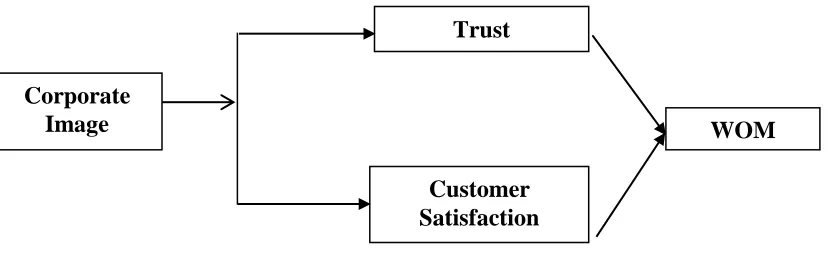
THE PROPOSED CONCEPTUAL FRAMEWORK
The conceptual framework below is proposed to ensure that corporate image is as independent variable impacts on dependent variable which is called customer's word of mouth when customer satisfaction and trust are mediating.
Figure 1: Proposed Conceptual Framework
CONCLUSIVE REMARKS
The purposes of this study were to determine a conceptual framework and to create customer's word of mouth by build corporate image and to illustrate the role of mediating variable which are
Trust
WOM
Customer
Satisfaction
Corporate
Licensed under Creative Common Page 338
namely consumer's satisfaction and trust. If the study were applied in practice in the future by one of the researchers, the results inform the company mangers how to use the independent variables e.g. corporate image and to see its effect on customer's word of mouth. In addition, the results of study will give the researchers idea about the mediating role of customer's satisfaction and trust between corporate image and customer's word of mouth and will try to explore if customer's satisfaction and trust are full or partial mediating.
REFERENCES
Abd-El-Salam, E & Shawky, A. (2013). The impact of corporate image and reputation on service quality, customer satisfaction and customer loyalty: testing the mediating role. Case analysis in an international service company. The Business & Management Review, Vol.3 Number-2, January 2013
Lin, L & Lu, C. (2010). The influence of corporate image, relationship marketing, and trust on purchase intention: the moderating effects of word-of-mouth. TOURISM REVIEW. VOL. 65 NO. 3 2010.
Tu, y & Li, M &Chih, H. (2013). An Empirical Study of Corporate Brand Image, Customer Perceived Value and Satisfaction on Loyalty in Shoe Industry. Journal of Economics and Behavioral Studies Vol. 5, No. 7, pp. 469-483, July 2013
Sichtmann, C. (2007). An analysis of antecedents and consequences of trust in a corporate brand. European Journal of Marketing, Vol. 41 No. 9/10, 2007. pp. 999-1015
Jayasankaraprasad, C & Vijaya Kumar, L. (2012). Antecedents and Consequences of Customer Satisfaction inFood & Grocery Retailing: An Empirical Analysis. Decision, Vol. 39, No. 3, December, 2012 NC, Y (2001). A Study of Customer Satisfaction, Return Intention, and Ward of Mouth Endorsement in University Dining Facilities. Submitted to the Faculty of the Graduate College of the Oklahoma State University in partial fulfillment of the requirements for the Degree of Master of Science, July, 2005
Ranaweera, C & Prabhu, J. (2003). On the relative importance of customer satisfaction and trust as determinants of customer retention and positive word of mouth. Journal of Targeting, Measurement and Analysis for Marketing 12.1 (Sep 2003): 82-90.
Walsh, G & Vincent-Wayne, M. (2010). The effect of consumer confusion proneness on word of mouth, trust, and customer satisfaction. European Journal of Marketing 44.6 (2010): 838-859.
Giovanis, A & Zondiros, D & Tomaras, P. (2014). The antecedents of customer loyalty for broadband services: Therole of service quality, emotional satisfaction and corporate image. Apostolos N. Giovanis et al. / Procedia - Social and Behavioral Sciences 148 ( 2014 ) 236 – 244
Cameran, M & Moizer, P & Pettinicchio, A. (2010). Customer satisfaction, corporate image, and service quality in professional services. The Service Industries Journal. Vol. 30, No. 3, March 2010, 421–435 Grewal, D Monroe, K.B. and Krishnan, R. (1998), ‘‘The effects of price-comparison advertising on buyers’ perceptions of acquisition value, transaction value, and behavioral intentions’’, Journal of Marketing, Vol. 62 No. 2, pp. 46-59.
Solomon, M. (1999), Consumer Behavior: Buying, Having, and Being, Prentice-Hall, Englewood Cliffs, NJ.
Morgan, R.M. and Hunt, S.D. (1994), ‘‘The commitment-trust theory of relationship marketing’’, Journal of Marketing, Vol. 58 No. 3, pp. 20-38.
Struebing, L. (1996). Word-of-mouth recommendations promote service quality. Quality Progress, 29 (10), 18.
Licensed under Creative Common Page 339 Yuille, J.C. and Catchpole, M.J. (1977), ‘‘The role of imagery in models of cognition’’, Journal of Mental Imagery, Vol. 1, pp. 171-80.
Gray, G. (1986), ‘‘Interaction of learner control and prior understanding in computer-assisted video instruction’’, Journal of Educational Psychology, Vol. 78 No. 3, pp. 325-7.
Robertson, T.S. and Gatignon, H. (1986), ‘‘Competitive effects on technology diffusion’’, Journal of Marketing, Vol. 50 No. 3, pp. 1-12.
Nguyen, N. and Leblanc, G. (2001), ‘‘Corporate image and corporate reputation in customers’ retentiondecisions in services’’, Journal of Retailing and Consumer Services, Vol. 8, pp. 227-36.
Dowling, G.R. (1986), ‘‘Managing your corporate image’’, Industrial Marketing Management, Vol. 15,pp. 109-15.
Leuthesser, L., Kohli, C.S. and Harich, K.R. (1995), ‘‘Brand equity: the halo effect measure’’, EuropeanJournal of Marketing, Vol. 29 No. 4, pp. 57-66.
Oliver, R. L. (1980). A Cognitive Model of the Antecedents and Consequences of Satisfaction Decisions. Journal of Marketing Research, 17 (September), 460-469.
Oliver, Richard L. (1999), "Whence Consumer Loyalty?" Journal of Marketing, 63 (Special Issue), 33-44.
Almossawi, M. (2012). Customer Satisfaction in the Mobile Telecom Industry in Bahrain: Antecedents and Consequences. International Journal of Marketing Studies, Vol 4, No 6 (2012).
Kotler, P., & Keller, K. L. (2008). Marketing Management. Pearson Prentice Hall.
Hansemark, Ove C. and Marie Albinsson (2004), “Customer Satisfaction and Retention: The Experiences of Individual Employees,” Managing Service Quality, 14 (1), 40-57.
Joewono, T. B., and Kubota, H. . (2005). The Characteristics of Paratransit and Non-Motorized Transport in Bandung, Indonesia. Journal of 6th EASTS (Eastern Asia Society for Transportation Studies) Conference. Bangkok, Thailand. September 21-24. (2005a).
Oliver, R. L. (1980), "A Cognitive Model of the Antecedents and Consequence of Satisfaction Decisions", Journal of Marketing Research, Vol. 17 (November), pp.460-469.
Oliver, R.L. (1997), "Satisfaction: A behavioural perspective on the consumer", New York, NY: McGraw-Hill.
Oliver, R.L., and Swan, J.E. (1989), "Equity and disconfirmation perceptions as influences on merchant and product satisfaction", Journal of Consumer Research, Vol. 15, pp.372-383.
York, A. & McCarthy, K. (2009). Patient, staff and physician satisfaction: a new model, instrument and their implications. International Journal of Health Care Quality Assurance Vol. 24 No. 2, 2011 pp. 178-191.
Ammar, S., Moore, D. and Wright, R. (2008), “Analysing customer satisfaction surveys using a fuzzy rule-based decision support system: enhancing customer relationship management”, Journal of Database Marketing and Customer Strategy Management, Vol. 15 No. 2, pp. 91-105.
Hasin, M. (2001), “Statistical measures of customer satisfaction for healthcare quality assurance: a case study”, International Journal of Health Care Quality Assurance. , Vol. 14 No. 1, pp. 6-13.
Aburoub , A ,Hersh, A & Aladwan, K 2011, „Relationship between Internal Marketing and Service Quality with Customers' Satisfaction‟, International Journal of Marketing Studies, vol.3.no.2, p.107.
Hennig-Thurau, T., Gwinner, K.P., Walsh, G. and Gremler, D.D. (2004), ‘‘Gremler electronic word-of-mouth via consumer-opinion platform: what motivates consumers to articulate themselves on the internet?’’, Journal of Interactive Marketing, Vol. 18, pp. 38-52.
Garbarino, E. and Johnson, M., (1999), “The different roles of satisfaction, trust and commitment for relational and transactional consumers”, Journal of Marketing, Vol. 63 No. 2, pp. 70-87.
Licensed under Creative Common Page 340 Smeltzer, L. R., (1997). ‘‘The meaning and origin of trust in buyer-supplier relationships’’, International Journal of Purchasing and Materials Management, Vol. 33 No. 1, pp. 40-8.
Singh, J. and Sirdeshmukh, D. (2000), “Agency and trust mechanism in consumer satisfaction and loyalty judgements”, Journal of the Academy of Marketing Science, Vol. 28 No. 1,pp. 150-67.
Lin, L.-Y. and Chen, Y.-F., (2005), ‘‘The effects of price promotion, perceived value and store image on consumers’ purchase intention: a case of 3C chain home appliances in Taipei area’’, Journal of Management and Information, Vol. 10, pp. 51-85.
Allsop, T. & Bassett, R. & Hoskins, J. (2007). Word-of-Mouth Research: Principles and Applications. Journal of Advertising Research 47.4 (Dec 2007): 398.
Harrison, W. L. J, (2001). The measurement of word-of-mouth communication and investigation of service quality and customer commitment as potential antecedents. Journal of Service Research, 4(1), 60–75 Hawkins, D.I., Best, R,& Coney, K.A. (2004).Consumer Behavior: Building Marketing Strategy(9th ed.).Boston, MA: McGraw-Hill.
Verhoef, P.C., Franses, P. & Hoekstra, J.C. (2002). The effect of relational constructs on customer referrals and number of services purchased from a multiservice provider: does age of relationship matter? Journal of Academy of Marketing Science, 30(3), 202–12.http://dx.doi.org/10.1177/0092070302303002 Liao, S. H., Chung, Y. C., Hung, Y. R., & Widowati, R. (2010). The impacts of brand trust, customer satisfaction, and brand loyalty on word-of-mouth. Paper presented at the Industrial Engineering and Engineering Management (IEEM), 2010 IEEE International Conference.
Walters, C.G. (1978), Consumer Behavior: An Integrated Framework, Richard D. Irwin, New York, NY.
Walters, C.G. and Paul, G.W. (1970). Consumer Behavior: An Intergated Frame Work, Richard D. Irwin, New York, NY.
Parasuraman, A., Zeithaml, V. A., & Berry, L. L. (1988). SEVQUAL: A multiple-item scale for measuring consumer perceptions of service quality. Journal of Retailing,64 (1), 12-40.
Sherman, E., Mathur, A. and Smith, R. B. 1997. Store Environment and Consumer Purchase Behavior: Mediating Role of Consumer Emotions. Psychology and Marketing, 14 (4):361-378.
Brown, T. J., Barry, T. E., Dacin, P. A., & Gunst, R. F. (2005). Spreading the word: investigating antecedents of consumer’s positive word-of-mouth intentions and behaviors in a retailing context. Journal of the Academy of Marketing Science, 33(2), 123–138. http://dx.doi.org/10.1177/0092070304268417 Allahham, A. & Aljumaa, A. (2014). Analyzing Antecedents of Customer Satisfaction and its Impact on Word Of Mouth Communication in Life Insurance Services. International Journal of Management Sciences and Business Research, 2014 ISSN (2226-8235) Vol-3, Issue 4
Ranaweera, C. & Prabhu, J. (2003). On the relative importance of customer satisfaction and trust as determinants of customer retention and positive word of mouth. Journal of Targeting, Measurement and Analysis for Marketing Vol. 12, 1, 82–90