Product family optimization: a multiplatform algorithm
based on iterative increase of the commonality
Derrick Fongang Fongang, Rodolphe Le Riche, Xavier Bay
To cite this version:
Derrick Fongang Fongang, Rodolphe Le Riche, Xavier Bay. Product family optimization: a multiplatform algorithm based on iterative increase of the commonality. Quatorzi`eme congr`es annuel de la Soci´et´e Fran¸caise de recherche Op´erationnelle et d’Aide `a la D´ecision (ROADEF 2013), Feb 2013, Troyes, France. pp.Session 36 : Programmation Math´ematique MultiObjectifs (PM2O), 2013. <emse-00796767>
HAL Id: emse-00796767
https://hal-emse.ccsd.cnrs.fr/emse-00796767
Submitted on 5 Mar 2013HAL is a multi-disciplinary open access archive for the deposit and dissemination of sci-entific research documents, whether they are pub-lished or not. The documents may come from teaching and research institutions in France or abroad, or from public or private research centers.
L’archive ouverte pluridisciplinaire HAL, est destin´ee au d´epˆot et `a la diffusion de documents scientifiques de niveau recherche, publi´es ou non, ´emanant des ´etablissements d’enseignement et de recherche fran¸cais ou ´etrangers, des laboratoires publics ou priv´es.
Product family optimization: a multiplatform algorithm based
on iterative increase of the commonality
Derrick Fongang Fongang1,2, Rodolphe Le Riche1,2, Xavier Bay1,2
1 Inst. H. Fayol , Ecole des Mines de Saint-Etienne
158, Cours Fauriel, 42 023 Saint-Etienne cedex, France
{fongang, leriche, bay}@emse.fr
2CNRS UMR 6158 LIMOS
Keywords: product family, product platform, multicrieria optimization, mixed-integer non linear programming.
1
Context
This work addresses the problem of optimizing the design of a family of products and simul-taneously maximizing the commonality between these products. By commonality, we mean the proportion of components that are shared between the products. The set of all compo-nents common to all products is called platform [2, 3]. We consider here the multiplatform problem that allows the commonality to start as soon as one component is common to two products. The multiplatform formulation encompasses every possible case of commonality and leads to a highly complex optimization problem: for NP products, of each N design vari-ables, there are (BNP)
N multiplatform configurations (B
NP is the N
th
P number of Bell). In this paper, we propose an algorithm to tackle this multiplatform product family optimization. Similarly to [1, 3] , we will estimate the Pareto front between an aggregation of the prod-ucts engineering performance and the family commonality. The proposed method is based on a quadratic approximation of the product performance functions and has a complexity of O(N×NP2×log(NP)), which is much better than the complexity of any enumeration strategy ((BNP)
N).
2
Mathematical formulation
Considering a family of NP products, we call xi ∈ RN and fi, i = 1, . . . , NP, the design attribute values and the performance functions of the productsPi respectively. LetV be a list of N matricesvj = (vji1,i2), (1≤j ≤N and 1≤i1, i2≤NP), that described the commonality within the products family.
vi1,i2 j = ( 1, if xi1 j =x i2 j 0, otherwise with 1≤i1, i2≤NP (1) For example, in the automotive industry, Pi could be a manufacturer’s car range, xi the car body parameters of Pi, and fi its crash-worthiness. Maximizing the family commonality is equivalent to minimize the number of degrees of freedom D, that is equal to the number of independant variables. The Equation 2 hereafter gives a mathematical formulation of this problem.
min X,V D(V) and min X,V NP X i=1 fi(xi) where X = (x1, x2, . . . , xNP) and V = (v1, v2, . . . , vN) s.t. vi1,i2 j .(x i1 j −x i2 j) = 0 (2)
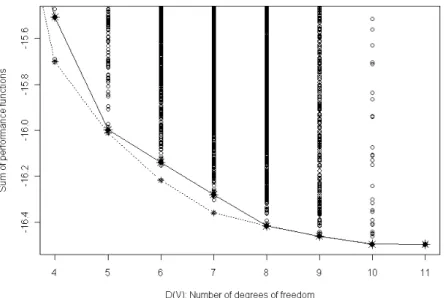
A two-stage enumeration algorithm consists in first sampling all the possible partitions (all the possible V values), second solving for each V the continous optimization problem in X and keeping the optimal solutions as points of the Pareto front. In Figure (1), each point represents one value of (V, X), with its corresponding number of degrees of freedomD on thex-axis, and its aggregated performance function on they-axis.
3
One step ReDuction Algorithm (ORDA) in one dimension
To reduce the number of degrees of freedom by one, we should first choose one design variable, xj, and then select two products Pi1 and Pi2 that will share the same value for that design variable, which means vi1,i2j = 1 and x i1 j −x
i2
j = 0. In this section, we suppose the parameter xj already chosen (so that we temporarily drop the subscript). The idea behind the ORDA algorithm is to order all the possible pairs of products, and to pick the pair (k, l) that increases the least the aggregated engineering performance function when merged. Letqi be a quadratic approximation of the function fi around its non-platform optima. The implementation of
Algorithm 1: ORDA algorithm
Require: Q, the list of all the functions qi, 1≤i≤N P
P Q, the list of #Q(#2Q−1) pairs of functions ordered by increasing ∆k•l(cf. Equations 6 & 3)
Begin
pick the first pair (qk, ql) fromP Q
create the functionqk•l(x) =qk(x) +ql(x) by merging the hyper-variablesxk, xl deleteqk andql fromQ
UpdateP Q:
delete fromP Q all the pairs that containqk orql
insert in the orderedP Q all new pairs obtained with qk•l and other functions from Q UpdateQ:
add the functionqk•l toQ.
return Q,P Q
End
ORDA is based on the quadratic nature of the functionsqi’s:
qi(xi) = 1 2hi(x
i
)2+aixi+bi (3) wherehi>0,ai andbi are scalars. Whenxk and xl are common, the new functionqk•l is :
qk•l(xk•l) = 1
2(hk+hl)(x
k•l)2+ (a
k+al)xk•l+ (bk+bl) (4)
Thus, in the ORDA algorithm, to find the pair of variables to set equal, we should solve:
min 1≤k<l≤Np min X qk•l+ X 1≤i6=k,l≤Np qi (5)
where X accounts for the merged k andl variables. Using the Equation 3 and 4, Equation 5 is equivalent to minimizing on k and l, ∆k•l. We denote:
∆∗= min 1≤k<l≤Np ∆k•l=−(ak+al)2 (hk+hl) + (a 2 k hk +a 2 l hl ) ! (6)
4
The general ORDA algorithm
Repeated applications of the one dimensional ORDA reduction algorithm can serve as a build-ing block to approximate the commonality-engineerbuild-ing performance Pareto front in the general case. The algorithm starts from the extremity where all the design attributes are different (no platform) and moves step by step by either creating a new two elements platform or by adding one element to an existing platform. These steps can be suboptimal as it is possible that the optimal reduction of one degree of freedom involves a complete reorganization of the platforms. Generalization of the ORDA algorithm to many dimensions is also straightforwardï¿12: again, the idea is to make a quadratic approximationqi of the performance function for each product Pi around its no platform optima. We denote byqi
j the restriction ofqi to its variablexij. The coefficients of the quadratic functions qi
j which depend on the xik, k6=j, need to be updated. The algorithm 2 summarizes the procedure to follow.
Algorithm 2: Multi-dimensional repeated ORDA algorithm (rORDA)
Require: Q, the list of all the functionsqji, 1≤i≤NP, 1≤j ≤N P Q, an ordered list of all the pairs ofqi
j functions 1≤i≤NP, 1≤j≤N
while the targeted commonality is not reached (D(V)> Dtarget) do forall dimensions t= 1, . . . , N do
apply ORDA to thetth dimension, get the performance degradation ∆∗ t
end for
choose the dimension j that optimizes the most, when reducing by one the number of degrees of freedom (j=argmint=1,...,N∆∗t) (cf. Equation 6)
Record optimized variables (V∗, X∗) updateQandP Q
end while
return the (sum ofqiperformance,D) Pareto front approximation from the list of recorded (V∗, X∗) variables
Multiplatform products family optimization is a complex problem: with NP products of N design variables each, there are (BNP)
N possible multiplatform configurations for which a continuous optimization needs to be done. BNP, the Bell number, is the number of partitions of
a set of sizeNP and it has a complexity of orderO (NPlog(NP))NP
. WithNP = 11 andN = 1, there are B11 = 678570 possible partitions (V values). It can be seen that the complexity
of the ORDA algorithm is induced by sorting the pairs of merged performances (∆k,l) and is O(NP2log(NP)). The overall algorithm complexity is O(N ×NP2log(NP)). The Figure (1) shows an example of Pareto front and its approximation built with NP = 11 products. The Table 1 describes the associated 11 quadratic functions. The dashed line represents the true Pareto front as obtained by enumerating all possible partitions (i.e., multiplatforms) while the solid line represents the ORDA approximation of the Pareto front. The three first variables that are merged by the ORDA algorithm are optimal, in the sense that the algorithm remains on the true Pareto front. The fourth merged variable, when going from D= 8 to 7 degrees of freedom, is suboptimal, yet the approximation errors to the true Pareto front seems bounded as a near optimal solution is found atD = 5.
FIG. 1: Example of commonality / performance compromise with 11 quadratic functions. Dashed lineï¿1
2: the true Pareto front. Solid lineï¿12: approximation of the Pareto front obtained by successive
ORDA calls. The functions are described in Table 1.
q1 q2 q3 q4 q5 q6 q7 q8 q9 q10 q11 h 55 45 75 25 15 85 5 65 12 33 70 a 4.1 8.3 -2.4 9.8 -3.5 -7.2 3.0 1.2 -25.1 15.6 27 b -3.0 2.0 4.0 3.0 15.0 24.0 -19.0 -15.0 0.15 26.0 -14.0
TAB. 1: Coefficients of the eleven quadratic functions test case.
5
Conclusion and perspectives
We have presented an algorithm named rORDA for optimizing product families in a multi-platform context. The multi-platform benefit was measured in terms of the number of independent variables and needs to be balanced against performance loss due to the platforms. The re-sulting formulation is a multicriteria mixed-integer nonlinear programming problem. rORDA is a heuristic strategy that approximates the Pareto front of this complex problem by se-quentially merging variables on the basis of a local quadratic approximation of the product performances. The numerical complexity is much lower than any enumeration of all platforms and our first tests show good approximations of the Pareto front. The solutions provided by rORDA could typically serve as starting points for other optimization algorithms that do not rely on a quadratic approximation.
References
[1] Souma Chowdhury, Achille Messac, and Ritesh A Khire. Comprehensive product platform planning (CP3) framework. Journal of Mechanical Design, 133(10):101004, 2011.
[2] Marc H. Meyer and Alvin P. Lehnerd. The Power of Product Platforms. Free Press, November 2011.
[3] T.W. Simpson, Z. Siddique, and J. Jiao. Product platform and product family design: methods and applications. Springer Verlag, 2006.
[4] M. Tawarmalani and Nikolaos V. Sahinidis. Convexification and Global Optimization in Continuous and Mixed-Integer Nonlinear Programming: Theory, Algorithms, Software, and Applications. Springer, October 2002.