2480
Comparative Study On Dissimilar Techniques
Used To Sense And Mitigate The Black Hole
Attack In Manet
T. Arul Mozhidevan, Dr. K. Mohan Kumar
ABSTRACT: The acronym of MANET is Mobile Ad-hoc Network. It is also called wireless ad hoc network or ad hoc wireless network. It is an infrastructure free IP based network. Nodes cooperation is the main requirements to establish communication amongst nodes. Each node presence in MANET is responsible for transmitting packets to other nodes. Sometimes the packet moves using various intermediate nodes, present in between source to the destination. In this circumstance, many malicious nodes may present in between source to destination. All the packets through the malicious nodes are simply consumed or lost. This paper focus on the pros and cons of different techniques used to detect and mitigate the black hole attack in MANET.
Key words: MANET, AODV, DSR, Black hole attack
————————————————————
I.
INTRODUCTION
A mobile ad hoc network (MANET) is a continuously self-configuring, infrastructure-less network of mobile devices connected wirelessly (Vishal Vig, & Rishi Sharma, 2017). In MANET messages propagates over other nodes. So, node co-operation is important to send message from source to destination. Basically source wants to send any data to the destination, first sent request message through its neighbor’s node in multicast manner (Charles, E., & Perkins). Once get reply message from the destination to source, the path should established. The transaction between source to destination depends on the neighbor nodes. It is done by routing protocols. These protocols are used to decide the shortest route between source and destination and also maintain routes for the correct destination(Jotheeshwaran, S., & Kumaravel, A, 2016). It is classified into Proactive, Reactive and Hybrid protocols (Neha Choudhary, & Sudhir Agrawal, 2014). Proactive protocol: It is otherwise called table driven protocol, monitor the topology in the network at all the times and continuously assess the routes within the network. At regular interval, share the route information for nodes throughout the network. This protocol is very much helpful for static routing. When a packet transmitted from source to destination, the route is already known and can be instantly used. Reactive protocol: It is otherwise called on-demand routing protocol. The route is established only at the time of transmission. When send packets to the destination then the route discovery process starts. Source send RREQ message to its neighbor and find the shortest path to its destination. Hybrid Protocol: It combines the advantages of proactive and reactive routing. Initially the routing is established by the proactive protocol and then serves the demand through reactive flooding.
In this work the on-demand routing protocols AODV (Ad hoc On-demand Distance Vector) and DSR (Dynamic Source Routing) are taken for analysis.
AODV Protocol
It is one of a reactive (on-demand) routing protocol in MANETs. In this protocol route establishment is not started until it is required (on-demand). The protocol operates in two methods: route discovery and route maintenance. Route discovery is used when the packet sender has no route available in its route table. It broadcasts a RouteRequest(RREQ) packet into the network. A node receives a fresh RREQ will check its route table to see whether it has a route to the requested destination. It replies if there is one otherwise, the RREQ is forwarded. Before forwarding, it keeps a reverse path to the source node in its route table. The route table updates the route information of the next hop, the distance and the current highest sequence number it has seen. The cached route is invalid in the network topology then the route maintenance starts to collect the neighbor nodes information. It is to notify the source node or to initiate a new route discovery (Junhai, et al., 2008).
DSR Protocol
It is the source-routed on-demand routing protocol. Here, a node maintains route caches that contain the source routes. The node updates entries in the route cache as and when it discovers about new routes (Mahamuni, K. & Chandrasekar, C., 2013). Sending or retrieving documents through MANET using this protocol in a secured manner is an extremely difficult task. Different kinds of attacks (simple or sophisticated attacks) may done while transferring the data through MANET (Satria Mandala et al., 2013).
Black hole attack
Among the many types of attacks Black hole attack is one of serious attacks in MANET. Assume when a source node wants to send data packets to a destination node and has no route available in its route table. In this case protocol will initiate the routing discovery process. Assume the node B to be a malicious node (Figure 1). Whenever node B receives RouteRequest (RREQ) packets, using AODV/DSR
_________________________
PG and Research Department of Computer Science, Rajah Serfoji
Government College, Thanjavur -613 005, India
protocol, it sends response to the source node at once. The destination node may also give a reply. If node B is nearer to the source node then the reply from node B could reach the source node first. Moreover, node B does not need to check its route table when sending a false message. So, its response reaches the source node quickly. Once the false message received by the source node then the routing discovery process is completed and ignores all other reply messages. The source node begins to send data packets. The forged routing has been created. All the packets received by node B are simply consumed or lost. Node B could be said to form a black hole in the network, and call it as the black hole attack (Satria Mandala et al., 2013).
(a) Network Flooding of RREQ
(b) Propagation of RREP Message
Figure 1: Black Hole Attack
Black hole attack may be single or cooperative. A single black hole means, any one malicious node in a group utilizes the routing protocol to claim itself of being the shortest path to the destination node, but drops the routing packets. In mobile ad hoc networks, a single black hole attack is easily happened (Karthick, M., & Sakthivel, D, 2018).
Figure 2: Single Black Hole (A & G – Source and Destination node, C-Black hole attacked node)
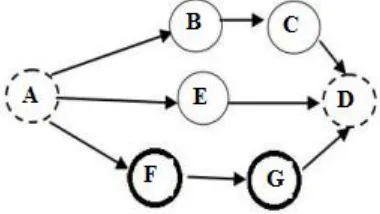
The cooperative black hole attack means in which black hole nodes act in a group together. For example, in Figure 3, nodes F and G are act as a multiple black hole nodes and coordination with each other, the first black hole node refers to the one of its teammate in the next hop .This type of attack harms the system very much and affect the throughput of the system. (Karthick, M., & Sakthivel, D, 2018)
Figure 3: Cooperative Black Hole
The black hole attack significantly degrades network performance, such as packet delivery rate and throughput. Many techniques are used to prevent this type of attacks. This paper basically analyzes the performance of these techniques with various metrics.
II. LITERATURE SURVEY
2482 algorithm the quality of services are improved. Prachee N.
Patil and Ashish T. Bhole, (2013) analyzed the performance of proposed DSR algorithm with respect to existing DSR and DSR affected by black hole attack. The performance is compared for Throughput, Delay, Jitter & End-to-End. It is observed that the performance of proposed algorithm is better than existing DSR. By using proposed cache based black hole attack prevention approach, that only able to achieve moderate performance and at the same time delay is also maintained in both cases. Also as the number of nodes and network size grows, the performance is same for both existing DSR and modified DSR systems. Durgesh Kshirsagar, Ashwini Patil, (2013) proposed a method to detect and prevent Black hole attack by real time monitoring suspected node by its neighbor node. AODV routing protocol is modified to simulate the detection and prevention method. Node which replies to RouteRequest (RREQ) by source is monitored in promiscuous mode. Neighbor node of RouteReply (RREP) sender node is actually detecting malicious node.
III. METHODOLOGY
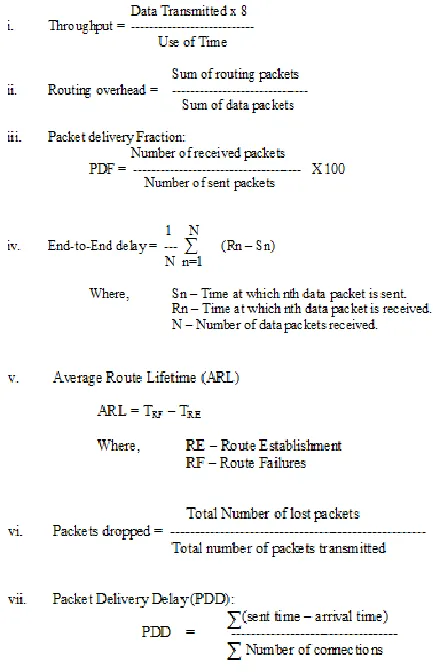
In this work the following metrics are used to evaluate the advantages and disadvantages of various black hole mitigation techniques.
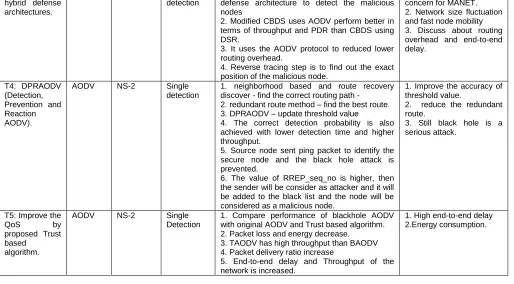
With the above metrics the following Table 1 generated for the various black hole mitigation techniques, after reviewing 5 papers (Mubarak Umar et al., (2018); Noguchi, and Yamamoto, (2017); Dumne, and Manjaramkar, (2016); Nakka Nandini, Reena Aggarwal, (2015); Apurva Jain and Anshul Shrotriya, (2014)).
Table 1: Comparison of various techniques used to detect black hole attacks Techniques Routing
Protocol
Simulator Schemes Advantages Disadvantages
T1: Modified Cooperative Bait Detection Scheme (existing CBDS with an RSA public key cryptosystem)
DSR NS-2 Cooperative detection
1. CBDS: detect and prevent malicious nodes 2. merges the proactive and reactive defense structure
3. It baits malicious nodes to sent a fake RREP reply and detects the malicious nodes.
4. Merges the advantage of proactive detection in the initial stage and the superiority of reactive response that reduce the waste of resource. 5. PDR by 22.22%, reduced
6. the routing overhead by 36.36%, decreased 7. reduced end to end delay by 10%
8. Increased the network throughput.
1. No particular line of defense.
2. Still security is a major concern for MANET. 3. PDR increased (Buffer the RREQ)
T2: Dynamic Threshold based black hole attack prevention method
AODV NS-2 Single Detection
1. Classified either normal node or blackhole node by using dynamic updated sequence number threshold
2. Detects a black hole node by using a dynamically updated sequence number threshold and dummy RREPs
3. Aims to improve the true detection rate 4. RREP sequence number is higher than a dynamically updated threshold value then black listed the node
5. Delete all the non–black hole nodes from the blacklists by the black hole node rejudgment mechanism with dummy RREPs
1. Performance worse with a smaller number of nodes. 2. Network size fluctuation and fast node mobility 3. Still security is a major concern for MANET
hybrid defense architectures.
detection defense architecture to detect the malicious nodes
2. Modified CBDS uses AODV perform better in terms of throughput and PDR than CBDS using DSR.
3. It uses the AODV protocol to reduced lower routing overhead.
4. Reverse tracing step is to find out the exact position of the malicious node.
concern for MANET. 2. Network size fluctuation and fast node mobility 3. Discuss about routing overhead and end-to-end delay.
T4: DPRAODV (Detection, Prevention and Reaction AODV).
AODV NS-2 Single detection
1. neighborhood based and route recovery discover - find the correct routing path - 2. redundant route method – find the best route. 3. DPRAODV – update threshold value
4. The correct detection probability is also achieved with lower detection time and higher throughput.
5. Source node sent ping packet to identify the secure node and the black hole attack is prevented.
6. The value of RREP_seq_no is higher, then the sender will be consider as attacker and it will be added to the black list and the node will be considered as a malicious node.
1. Improve the accuracy of threshold value.
2. reduce the redundant route.
3. Still black hole is a serious attack.
T5: Improve the
QoS by
proposed Trust based
algorithm.
AODV NS-2 Single Detection
1. Compare performance of blackhole AODV with original AODV and Trust based algorithm. 2. Packet loss and energy decrease.
3. TAODV has high throughput than BAODV 4. Packet delivery ratio increase
5. End-to-end delay and Throughput of the network is increased.
1. High end-to-end delay 2.Energy consumption.
IV. RESULT AND DISCUSSION
The following Table 2 is derived from Table 1. It calculates the ranks by counting the advantages and disadvantages of various techniques.
Table2: Rank of black hole mitigation techniques
In the Table 2 the T1 to T5 indicate the various black hole mitigation techniques which are given below.
T1: Modified CBDS (existing CBDS with an RSA public key cryptosystem)
T2: Dynamic Threshold based black hole attack prevention method
T3: CBDS uses hybrid defense architectures. T4: DPRAODV (Detection, Prevention and Reaction AODV)
T5: Improve the QoS by proposed Trust based algorithm
The technique T1 combines the existing Cooperative Bait Detection Scheme (CBDS) with an RSA public key cryptosystem. So, it increases the network throughput and reduces the end to end delay. The following Figure 4 is a graph generated using the values in Table 2. This graph shows that the techniques T1 gives better performance compare with other techniques. It proves that if two or more techniques are combined, the performance of that technique will be improved.
Figure 4 : Various techniques used to detect black hole
attack
V. CONCLUSION
MANET is defenseless to various attacks. Attackers can easily generate the attack to falsifying the RREQ and RREP messages and produce the false route entries in the routing table. In communication channel, the attack causes incorrect routes and blocks. This work is helpful for researchers to know the various techniques used to prevent the black hole attacks and the positive and negative sides of those techniques. Also it proves that if two or more effective techniques are combined to prevent black hole attack, definitely it will reduce the black hole attack at optimum level.
REFERENCE
[1] Vishal Vig, & Rishi Sharma. (2017). Review of Different Techniques Used for Detection and Appease Black Hole Attack in Aodv Routing Technique
s
Advantages Disadvantages Rank
T1 T2 T3 T4 T5
8 5 4 6 5
3 3 3 3 2
2484 Protocol. International journal of current
Engineering and Scientific Research. 4(10). 26-31. [2] Charles, E., & Perkins. Ad Hoc Networking. ISBN 978-81-317-2096-7, published by Dorling Kindersley(India) Pvt. Ltd., licenses of Pearson Education in South Asia.
[3] Jotheeshwaran, S., & Kumaravel, A. (2016). Back Pressure Algorithm with CBDS. International Journal of Electronics and Communication Engineering. 3(12). 8-11.
[4] Neha Choudhary, & Sudhir Agrawal. (2014). Analysis of Black-Hole Attack in MANET using AODV Routing Protocol. International Journal of Engineering Research & Technology 3(11). 1317-1321.
[5] Junhai, L., Mingyu, F., & Danxia, Y. (2008). Black hole attack prevention based on authentication mechanism. IEEE International Conference on Communication Systems, Singapore, 19-21. 173-177
[6] Mahamuni, K. & Chandrasekar, C. (2013). Mitigate Black Hole Attack In Dynamic Source Routing (DSR) Protocol By Trapping. International Journal of Computer Science Issues. 10(4). 49-54.
[7] Satria Mandala et al. (2013). A Review of Blackhole Attack in Mobile Adhoc Network. International Conference on Instrumentation, Communications, Information Technology, and Biomedical Engineering. Bandung. November 7-8. [8] Karthick, M., & Sakthivel, D. (2018). Single and
Cooperative Black Hole Attacks in MANET. International Journal of Engineering Development Research. 6(3). 713-715.
[9] Mubarak Umar, Abdulrashid Sabo, Auwal, & Tata. (2018). Modified Cooperative Bait Detection Scheme for Detecting and Preventing Cooperative Blackhole and Eavesdropping Attacks in MANET. International Conference on Networking and Network Applications.
[10] Noguchi, T., & Yamamoto, T. (2017). Black Hole Attack Prevention Method Using Dynamic Threshold in Mobile Ad Hoc Networks. Proceedings of the 2017 Federated Conference on Computer Science and Information Systems. [11] Dumne, PR., & Manjaramkar, A.
(2016). Cooperative bait detection scheme to prevent collaborative blackhole or grayhole attacks by malicious nodes in MANETs. 5th International Conference on Reliability, Infocom Technologies and Optimization.
[12] Nakka Nandini, & Reena Aggarwal. (2015). Prevention of black hole attack by different methods. International Journal of Advanced Research in Computer Engineering & Technology. 4(2). 297-300.
[13] Apurva Jain, & Anshul Shrotriya. (2014). Prevention of Black Hole Attack on MANET Using Trust Based Algorithm. International Journal of Scientific & Engineering Research. 5(5). 409-413. [14] Patil, PN., & Bhole, AT. (2013). Black hole attack
prevention in mobile Ad Hoc networks using route caching. Tenth International Conference on Wireless and Optical Communications Networks. [15] Durgesh Kshirsagar, & Ashwini Patil. Black hole