Vascular Health and Risk Management
Dovepress
R e V i e w open access to scientific and medical research
Open Access Full Text Article
implications of bleeding in acute coronary
syndrome and percutaneous coronary
intervention
Phuong-Anh Pham1
Phuong-Thu Pham2
Phuong-Chi Pham3
Jeffrey M Miller4
Phuong-Mai Pham5
Son V Pham6
1Department of Medicine, Division
of Cardiovascular Diseases, VA Medical Center and University of Tennessee Health Science Center, Memphis, TN, USA; 2Department
of Medicine, Nephrology Division, Kidney Transplant Program, David Geffen School of Medicine at UCLA;
3Department of Medicine, Nephrology
Division, 4Department of Medicine,
Hematology-Oncology Division, UCLA-Olive View Medical Center and David Geffen School of Medicine at UCLA; 5Department of Medicine,
Greater Los Angeles VA Medical Center and David Geffen School of Medicine at UCLA, Los Angeles, CA, USA; 6Department of Medicine,
Division of Cardiovascular Diseases, Bay Pines VA Medical Center, Bay Pines, FL, USA
Correspondence: Phuong-Thu Pham Department of Medicine, Nephrology Division, Kidney Transplant Program, David Geffen School of Medicine at UCLA, Los Angeles,
CA 90095, USA Tel +1 310 794 1757 email [email protected]
Abstract: The advent of potent antiplatelet and antithrombotic agents over the past decade has resulted in significant improvement in reducing ischemic events in acute coronary syndrome (ACS). However, the use of antiplatelet and antithrombotic combination therapy, often in the settings of percutaneous coronary intervention (PCI), has led to an increase in the risk of bleed-ing. In patients with non-ST elevation myocardial infarction treated with antithrombotic agents, bleeding has been reported to occur in 0.4%–10% of patients, whereas in patients undergoing PCI, periprocedural bleeding occurs in 2.2%–14% of cases. Until recently, bleeding was con-sidered an intrinsic risk of antithrombotic therapy, and efforts to reduce bleeding have received little attention. There have been increasing data demonstrating that bleeding is associated with adverse outcomes, including myocardial infarction, stroke, and death. Therefore, it is imperative to optimize patient outcomes by adopting pharmacological and nonpharmacological strategies to minimize bleeding while maximizing treatment efficacy. In this paper, we present a review of the bleeding classifications used in large-scale clinical trials in patients with ACS and those undergoing PCI treated with antiplatelets and antithrombotic agents, adverse outcomes, particu-larly mortality associated with bleeding complications, and suggested predictive risk factors. Potential mechanisms of the association between bleeding and mortality and strategies to reduce bleeding complications are also discussed.
Keywords: bleeding risk, antiplatelets, antithrombotics, acute coronary syndrome, percutaneous coronary intervention
Bleeding classifications: historical perspectives
The TIMI and GUSTO scales were the first bleeding classifications developed to measure short-term bleeding associated with thrombolytic therapy in patients with ST elevation myocardial infarction (STEMI). The TIMI classification was a
laboratory-based scale that categorized bleeding as major or minor.1 Major bleeding was defined
as any intracranial bleeding or a reduction in hemoglobin of 5 g/dL (or a .15%
decrease in hematocrit). Minor bleeding was defined by an observed blood loss and a drop in hemoglobin of 3–5 g/dL (or in hematocrit of 10%–15%), spontaneous gross
hematuria or hematemesis (.120 mL), even if the hemoglobin or hematocrit drop
was 3 g or 10%, respectively, or an unobserved loss of 4 g/dL in hemoglobin
or 12% in hematocrit.
The GUSTO classification was based on clinical events that classified bleeding as
severe/life-threatening, moderate, or mild.2 Severe bleeding was defined as intracranial
bleeding or bleeding which resulted in substantial hemodynamic compromise requir-ing intervention. Moderate bleedrequir-ing was defined by the need for blood transfusion
Vascular Health and Risk Management downloaded from https://www.dovepress.com/ by 118.70.13.36 on 27-Aug-2020
For personal use only.
Number of times this article has been viewed
This article was published in the following Dove Press journal: Vascular Health and Risk Management
Dovepress
Pham et al
but without hemodynamic insult, and minor bleeding was defined by bleeding which did not require transfusion or cause hemodynamic instability.
With the advent of more potent antithrombotic agents and American College of Cardiology/American Heart Asso-ciation guidelines for long-term oral antiplatelet therapy in patients with acute coronary syndrome (ACS) and those undergoing percutaneous coronary intervention (PCI), the TIMI and GUSTO scales may have limited applicability to current clinical trials. It should be noted that the TIMI definition was developed to quantify bleeding complications in patients receiving thrombolytic therapy for STEMI and may underestimate the impact of bleeding complications on mortality in patients undergoing planned or urgent PCI. Due to the limitations of these scales, over the last half decade clinical investigators have devised study-specific bleeding definitions to assess patients’ risks and outcomes, such as those defined by the ACUITY and REPLACE-2 trials
(dis-cussed below).3,4
Noncoronary artery bypass graft (CABG) ACUITY-scale major bleeding was defined as intracranial or intraocular bleeding, access site hemorrhage requiring intervention,
hematoma 5 cm in diameter, reduction in hemoglobin of
3 g/dL with an overt source of bleeding or 4 g/dL and no
source identified, reoperation for bleeding, or blood product transfusion. Analysis of the ACUITY trial demonstrated that major bleeding is a powerful predictor of 30-day mortality in patients with ACS managed invasively (odds ratio [OR]
7.55, P 0.0001). Independent predictors of major bleeding
were advanced age, female gender, diabetes, hypertension, renal insufficiency, anemia, no prior PCI, cardiac biomarker
elevation, ST segment elevation 1 mm, and treatment with
heparin plus glycoprotein IIb/IIIa inhibitor (GPI) versus bivalirudin monotherapy.
The REPLACE-2 trial classified bleeding as major and minor based on both adverse clinical events and labora-tory values. Major hemorrhage was defined as intracranial,
intraocular, or retroperitoneal, overt blood loss with a .3 g/dL
decrease in hemoglobin, any hemoglobin decrease .4 g/dL,
or transfusion of 2 units of blood products. Minor
hemor-rhage was defined as overt bleeding that did not meet the criteria for major bleeding. Major hemorrhage as defined by the REPLACE-2 study protocol was found to be an independent predictor of mortality in patients undergoing elective or urgent PCI. Independent baseline predictors of major hemorrhage included advanced age, female gender, impaired creatinine clearance, and anemia (defined using
World Health Organization criteria of hemoglobin 13 g/dL
in men and 12 g/dL in women) whereas independent
periprocedural predictive factors included treatment with heparin plus GPI, increased procedural duration, provisional use of GPI, increased time to sheath removal, length of intensive care unit stay, and use of an intra-aortic balloon
pump (all P 0.05).5
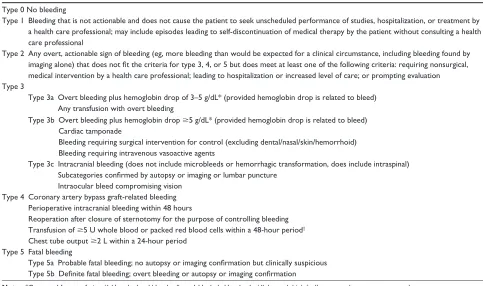
Until recently, there has been no consensus on the end-point definitions of bleeding in patients with ACS or those undergoing PCI. In February 2010, the Bleeding Academic Research Consortium consisting of leaders in the field of cardiovascular disease and experts from the academic research organizations, the Food and Drug Administration, the National Institutes of Health, and the pharmaceutical and cardiovascular device manufacturers set forth a standardized Bleeding Academic Research Consortium definition of bleed-ing. The proposed bleeding definition consisted of five types, from 0 to 5. Type 0 was defined as no evidence of bleeding. Type 1 was defined as bleeding which is not actionable and does not cause the patient to seek unscheduled performance of studies, hospitalization, or treatment by a health care pro-fessional. Type 2 was defined as any clinically overt sign of hemorrhage that is actionable but does not meet criteria for type 3, type 4 (CABG-related), or type 5 (fatal bleeding). The bleeding must require diagnostic studies, hospitalization, or treatment by a health care professional. Type 3 was defined as clinical, laboratory, and/or imaging evidence of bleeding with specific health care provider responses. Type 4 was defined as CABG-related bleeding and type 5 was defined as fatal bleeding. It is noteworthy that the proposed bleed-ing definitions were based on expert consensus rather than clinical data. Validation of the consensus definitions is still
needed from future cardiovascular clinical trials.6,7
Currently, the American College of Cardiology task force on clinical data standards recommends using the TIMI classification as the standard for classifying bleeding events. Nonetheless, in a pooled analysis of the PURSUIT
(n = 10,798) and PARAGON B (n = 5225) trials to determine
the association between the severity of TIMI and GUSTO bleeding and 30-day and six-month death or myocardial infarction, Rao et al demonstrated that while both GUSTO and TIMI bleeding scales identified patients at risk for adverse outcomes, when both bleeding definitions were included in the same model, the stepwise increase in the risk with worsening GUSTO bleeding persisted, whereas the association between any level of TIMI bleeding and
outcome was no longer significant.8 The results of the study
suggested that clinically evident bleeding added prognostic value to laboratory parameters.
Vascular Health and Risk Management downloaded from https://www.dovepress.com/ by 118.70.13.36 on 27-Aug-2020
Dovepress implications of bleeding in ACS and PCi
In summary, bleeding classification appears to have a better prognostic value when both clinical and laboratory data are incorporated. It has generally been accepted that any significant bleeding episode involves intracranial or intraocular bleeding, hemodynamic compromise requiring blood transfusions, observed blood loss with a hemoglobin drop of at least 3 g/dL, or access site complications requiring surgical intervention.
The Bleeding Academic Research Consortium definitions of bleeding are summarized in Table 1. The definitions of major bleeding in large-scale clinical trials (discussed in this article) are summarized in Table 2.
Adverse outcomes associated
with bleeding in ACS and PCI
Bleeding is an important safety concern for patients with ACS and those undergoing PCI who are managed with multiple antithrombotic agents. The effect of bleeding was thought to be acute, and when treated accordingly, had no long-term impact. However, over the last half decade, there has been increasing evidence demonstrating an association between bleeding and short-term and long-term adverse cardiovas-cular events, most importantly, mortality. An overview of the literature on the impact of bleeding on short-term and long-term outcomes, particularly mortality in patients with
ACS and those undergoing PCI, is presented followed by a brief discussion of the authors’perspectives.
Rao et al were among the first to report the associa-tion between bleeding and mortality. In a meta-analysis of four multicenter, randomized clinical trials to determine the association between bleeding severity as measured by the GUSTO scale and mortality rates in patients with NSTEMI-ACS, Rao et al demonstrated stepwise increases in 30-day and six-month mortality as bleeding severity
increased.9 Clinical data were obtained from the GUSTO
IIb (n = 8011), PURSUIT (n = 10,948), and PARAGON A
and B (n = 2282 and n = 5225, respectively) trials. Of more
than 26,000 patients studied, 27.6% had at least one bleed-ing event durbleed-ing the index hospitalization. The proportions of patients with mild, moderate, and severe bleeding were 16.6%, 9.8%, and 1.2%, respectively. Older age, female gender, the presence of cardiac risk factors, inhospital treat-ment with hirudin, eptifibatide, or lamifiban, and the need for invasive cardiac procedures were seen more frequently in patients who had a bleeding event compared with those
who did not (P 0.001). There were stepwise increases in
the adjusted hazards of 30-day and six-month mortality as bleeding severity increased (hazards ratio [HR] for 30-day mortality categorized by bleeding severity were 1.6 [1.3–1.9], 2.7 [2.3–3.4], and 10.6 [8.3–13.6] for mild, moderate, and
Table 1 Bleeding Academic Research Consortium bleeding definitions Type 0 No bleeding
Type 1 Bleeding that is not actionable and does not cause the patient to seek unscheduled performance of studies, hospitalization, or treatment by a health care professional; may include episodes leading to self-discontinuation of medical therapy by the patient without consulting a health care professional
Type 2 Any overt, actionable sign of bleeding (eg, more bleeding than would be expected for a clinical circumstance, including bleeding found by imaging alone) that does not fit the criteria for type 3, 4, or 5 but does meet at least one of the following criteria: requiring nonsurgical, medical intervention by a health care professional; leading to hospitalization or increased level of care; or prompting evaluation Type 3
Type 3a Overt bleeding plus hemoglobin drop of 3–5 g/dL* (provided hemoglobin drop is related to bleed) Any transfusion with overt bleeding
Type 3b Overt bleeding plus hemoglobin drop 5 g/dL* (provided hemoglobin drop is related to bleed) Cardiac tamponade
Bleeding requiring surgical intervention for control (excluding dental/nasal/skin/hemorrhoid) Bleeding requiring intravenous vasoactive agents
Type 3c intracranial bleeding (does not include microbleeds or hemorrhagic transformation, does include intraspinal) Subcategories confirmed by autopsy or imaging or lumbar puncture
intraocular bleed compromising vision Type 4 Coronary artery bypass graft-related bleeding
Perioperative intracranial bleeding within 48 hours
Reoperation after closure of sternotomy for the purpose of controlling bleeding Transfusion of 5 U whole blood or packed red blood cells within a 48-hour period†
Chest tube output 2 L within a 24-hour period Type 5 Fatal bleeding
Type 5a Probable fatal bleeding; no autopsy or imaging confirmation but clinically suspicious Type 5b Definite fatal bleeding; overt bleeding or autopsy or imaging confirmation
Notes: *Corrected for transfusion (1 U packed red blood cells or 1 U whole blood = 1 g/dL hemoglobin); †cell saver products are not counted.
Vascular Health and Risk Management downloaded from https://www.dovepress.com/ by 118.70.13.36 on 27-Aug-2020
Dovepress
Pham et al
Table
2
Study protocol-defined major bleeding
Studies
TIMI 1987
GUSTO 1993
GRACE 2003
ACUITY 2006 REPLACE-2 2007 HORIZONS-AMI 2008 CRUSADE 2009 OASIS-5 2009
Clinical
intracranial bleed intracranial bleed Hemodynamic compromise requiring intervention Death Hemorrhagic subdural hematoma Stroke intracranial, or intraocular bleed Access site bleeding requiring intervention Hematoma
.
5 cm
Reoperation for bleeding
intracranial, intraocular, or retroperitoneal bleed intracranial or intraocular bleed Access site bleeding with hematoma
.
5 cm
or requiring intervention Reoperation for bleeding intracranial, or retroperitoneal bleed Clinically overt fatal bleed Symptomatic intracranial, retroperitoneal or intraocular hemorrhage leading to significant visual loss
Transfusion requirement
2 U PRBCs
Any transfusion
2 U PRBCs
Blood product transfusion Any transfusion when Hct
28%
or when Hct
28% with witnessed bleed
2 units PRBCs or
equivalent of whole blood
Laboratory parameters
↓ Hb . 5 g/dL or ↓ Hct . 15%
Absolute ↓ Hct
10%
↓
Hb
4 g/dL without
overt bleeding source ↓ Hb
3 g/dL with
an overt source
Any ↓ Hb 4 g/dL Hb ↓ .
3 g/dL with
overt bleeding
↓
Hb
4 g/dL without
overt bleeding source ↓ Hb
3 g/ dL w ith a n ov er t source ↓ Hct 12% ↓ Hb 3.0 g/dL Abbreviations:
PRBCs, packed red blood cells; Hb, hemoglobin; Hct, hematocrit;
severe bleeding, respectively). The corresponding HR for six-month mortality were 1.4 (1.2–1.6), 2.1 (1.8–2.4), and 7.5 (6.1–9.3), respectively. The association between severity of bleeding and adverse outcomes remained after adjustment for potential confounding factors, including blood transfusions and after censoring for CABG and for procedure-related and nonprocedure-related bleeds. The results of the study sug-gested that the GUSTO bleeding classification can identify a subset of patients who are at risk for short-term and long-term adverse events.
Subsequent studies by Eikelboom et al similarly dem-onstrated a strong temporal and dose-related association between bleeding and death in ACS patients without
per-sistent ST segment elevation.10 Data were obtained from
the OASIS-1, OASIS-2, and CURE trials (OASIS-1 n about
11,500; OASIS-2 n = 10,141; and CURE n = 12,562). Major
bleeding was defined in each study as significantly disabling,
transfusion requirement of 2 units of packed cells, or
life-threatening. Major bleeding was independently associ-ated with an increased risk of death during the first 30 days
(HR 5.37, P 0.0001). In contrast, the HR was weaker
between 30 days and six months (HR 1.54, P = 0.047).
Independent baseline predictors of major bleeding included older age, diabetes, prior stroke, lower systolic and diastolic blood pressures, higher serum creatinine, and ST segment changes on electrocardiography. The associations between major bleeding were consistent across subgroups according to cointerventions during hospitalization (treatment with a GPI, unfractionated heparin, low-molecular-weight heparin, fibrinolysis, treatment with oral anticoagulants or the need for undergoing coronary angiography, CABG, or intra-aortic balloon pump). Further analysis demonstrated a dose rela-tionship between severity of bleeding and increasing risk of death (minor less than major less than life-threatening,
Ptrend= 0.009). A similar association was observed between
major bleeding and increased risk of ischemic events (myo-cardial infarction, stroke) at 30 days and between 30 days and six months.
The OASIS-5 trial previously demonstrated that fonda-parinux was similar to enoxaparin in reducing the risk of ischemic events in patients with non-ST elevation ACS at nine days while substantially reducing the risk of major
bleeding.11 More importantly, reduced major bleeding was
associated with improved long-term morbidity and mortality. In a study to determine the incidence and outcomes after bleeding in more than 20,000 patients enrolled in the OASIS-5 trial, Budaj et al demonstrated that fondaparinux reduced bleeding compared with enoxaparin, but more
Vascular Health and Risk Management downloaded from https://www.dovepress.com/ by 118.70.13.36 on 27-Aug-2020
Dovepress implications of bleeding in ACS and PCi
importantly, the reduced risk of bleeding was associated with
reduced mortality.12 Of the 57 excess deaths between the two
groups at 30 days, 66.7% of the deaths were patients in the enoxaparin group who experienced bleeding (fatal, major, and minor). Similarly, of the 64 excess deaths between the two groups at 180 days, 95.3% of the deaths occurred in patients from the enoxaparin group who experienced bleed-ing (fatal, major, and minor). Within each treatment group, patients who had more severe bleeding had a higher risk of death (major versus minor). Analysis of the relationship between major bleeding and outcomes at 30 days in the over-all patient population revealed a nearly four-fold increase in the composite endpoints of death, myocardial infarction, or stroke (21.8% versus 6.2%, HR 3.99, 95% confidence interval [CI] 3.30–4.82). A similar increase in each of the individual components of the composite outcome was also observed, ie, death (8.4% versus 2.7%, HR 3.46, 95% CI 2.60–4.60), myocardial infarction (8.3% versus 3.4%, HR 4.39, 95% CI 3.45–5.59), and stroke (3.0% versus 0.7%,
HR 4.66, 95% CI 2.83–7.65, P 0.0001). The magnitude
of association was attenuated at 180 days but remained sig-nificant (approximately three-fold increase for the composite
endpoints and for each individual component, P 0.0001).
Minor bleeding was also independently associated with an increased risk of death, myocardial infarction, and stroke as well as the composite endpoints of death/myocardial infarction/stroke, at 30 and 180 days. The results of the study showed an independent, temporal, and dose-related association between bleeding and the composite endpoints of death/myocardial infarction/stroke, as well as its individual components. Patients who bled were older, more likely to be female, more likely to have a history of diabetes, hyperten-sion, stroke, peripheral vascular disease, heart failure, higher serum creatinine, lower baseline hemoglobin, or ST segment changes on the electrocardiogram at presentation. In addi-tion, they were more likely to be treated with antithrombotic and antiplatelet medications, and to undergo procedures (coronary angiography, PCI, or CABG). The investigators concluded that bleeding in patients with ACS is a powerful determinant of fatal and nonfatal outcomes. Reducing the risk of bleeding using a safer anticoagulation strategy during the first nine days is associated with substantial reduction in morbidity and mortality.
Although analyses from large-scale, randomized, con-trolled trials suggest that bleeding independently predicts mortality in ACS and PCI, the relative predictive value of bleeding compared with other comorbid factors associated with mortality remains to be elucidated.
In an analysis of findings from the GRACE registry study, Spencer et al demonstrated that the risk of hospi-tal morhospi-tality associated with bleeding was much lower
than that reported in randomized controlled trials.13 The
authors speculated that although bleeding may be causally related to adverse outcome in the “real-world” setting, it is often merely a marker for patients at a higher risk for adverse outcomes. Of more than 40,000 patients with acute myocardial infarction (53% STEMI, 47% NSTEMI) included in the GRACE study, 2.8% experienced major bleeding during their index hospitalization. Nearly half of these events (49%) occurred on the day of admission or on the day after admission. Patients with bleeding were more likely to die during hospitalization (HR 1.9, 95% CI 1.6–2.2) but not after discharge (HR 0.8, 95% CI 0.6–1.0). Analysis between bleeding and outcomes among patients who bled, regardless of whether fibrinolytic therapy was given, similarly demonstrated an increased risk of inhos-pital death in patients who developed a major bleed. Of the 5931 patients who received fibrinolytic therapy, 3.1% had a major bleeding episode. Their adjusted risk of inhospital death compared with those without a bleeding episode was three times higher (HR 3.3, 95% CI 2.3–4.7). Among patients who bled but did not receive fibrinolytic therapy, the risk of inhospital death was attenuated but remained significant (HR 1.7, 95% CI 1.4–2.0). Despite the strong association between bleeding and inhospital mortality, it is noteworthy that, among patients who suffered major bleed-ing within the first hospital day, mortality rates were higher among those who discontinued aspirin, thienopyridines, or unfractionated heparin compared with those who bled but continued to be treated with these agents after the first day, ie, aspirin (OR 7.55, 95% CI 4.43–12.88), thienopyridines (OR 8.91, 95% CI 4.39–18.2), and heparin (OR 1.91, 95% CI 1.09–3.36). Hence it is speculated that discontinuation of antiplatelet and antithrombotic therapies might explain in part the increased mortality rates observed in patients who experienced bleeding complications.
In a study to determine the predictors of major bleed-ing and the impact of major bleedbleed-ing on 30-day outcomes including mortality in patients with ACS, Manoukian et al demonstrated that major bleeding is a powerful independent predictor of 30-day mortality in patients with ACS managed
invasively.3 Data were obtained from the randomized,
open-labeled, Phase III ACUITY trial.14 Study subjects consisted
of nearly 14,000 patients with ACS in whom urgent or early intervention was planned. Of the 13,819 patients studied, 4.7% experienced major bleeding. The use of bivalirudin
Vascular Health and Risk Management downloaded from https://www.dovepress.com/ by 118.70.13.36 on 27-Aug-2020
Dovepress
Pham et al
alone compared with unfractionated heparin plus GPI was associated with a noninferior rate of composite ischemic endpoint (death, myocardial infarction, unplanned revascu-larization for ischemia) but significantly reduced the rates of major bleeding and, hence, net clinical outcome. Patients with major bleeding had higher 30-day mortality rates, com-posite ischemia, and stent thrombosis compared with those
without major bleeding (P 0.0001 for each analysis). More
importantly, major bleeding was found to be an independent predictor of 30-day mortality (OR 7.55, 95% CI 4.68–12.18,
P 0.0001). Older age, lower body weight, female gender,
diabetes, hypertension, anemia, renal insufficiency, elevated
cardiac biomarkers, and ST segment deviation of 1 mm
were more frequently observed in patients who experienced major bleed. They were also more frequently given a GPI, and more likely to undergo PCI rather than CABG, or be assigned to medical therapy. Knowledge of these findings might be useful to reduce bleeding risk and improve out-comes in ACS.
It has been suggested that the relative value of bleeding in predicting mortality can be assessed by determining the overall contribution of bleeding to mortality. Early results of the ACUITY trial demonstrated that both major bleeding and myocardial infarction were independent predictors of 30-day mortality. Mehran et al subsequently evaluated the risk of each of these events on the magnitude and timing
of mortality at one-year follow-up.15 Of more than 13,000
patients with moderate and high-risk ACS enrolled in the ACUITY trial, 5.1% had a myocardial infarction and 4.7% had a major bleed within 30 days of randomization. Patients who had a major bleed had a 3.5-fold increased risk of one-year mortality compared with those who did not bleed, whereas patients who had a myocardial infarction had a 3.1-fold increased risk compared with those who did not have a myocardial infarction. Although the risk was slightly greater for patients who had a major bleed compared with those who had a myocardial infarction, it is noteworthy that the risk of death in patients who experienced a myocardial infarction was time-dependent, with the risk declining rap-idly after 30 days (HR 17.7, 95% CI 10.8–28.7, day 0–1;
HR 1.4, 95% CI 0.9–2.1, days 31+). In contrast, the risk of
death in patients who experienced a major bleed did not vary in the first 30 days, and although the risk slightly decreased after day 30, it remained fairly steady over time throughout one year. The results of the study demonstrated a strong association of both major bleeds and myocardial infarction with mortality in the first year after ACS. However, myo-cardial infarction was correlated with a dramatic increase in
short-term risk, whereas major bleed correlated with a more prolonged mortality risk.
The REPLACE-2 trial was the first large-scale ran-domized, double-blind, active controlled trial comparing inhospital major bleeding rates associated with bivalirudin and provisional GPI during PCI versus standard practice
of low-dose heparin plus planned GPI.4 Of 6010 patients
enrolled in the study, 3.2% experienced major hemorrhage as defined by the REPLACE-2 study protocol. Independent baseline predictors of major hemorrhage included advanced age, female gender, impaired creatinine clearance, and
ane-mia (defined as hemoglobin 13 g/dL in men and 12 g/dL
in women), whereas independent periprocedural predictive factors included treatment with heparin plus GPI, increased procedural duration, provisional use of GPI, increased time to sheath removal, length of intensive care unit stay, and use of an intra-aortic balloon pump. Patients with major bleeding compared with those without major bleeding had significantly higher rates of mortality at 30 days (5.1%
versus 0.2%, P 0.001), six months (6.7% versus 1.0%,
P 0.001), and one year (8.7% versus 1.9%, P 0.0001).
Multivariate analysis demonstrated that periprocedural major bleeding was an independent predictor of one-year mortality
(OR 2.66, 95% CI 1.44–4.92, P= 0.002).5
In a retrospective analysis to investigate the incidence, predictors, and impact of periprocedural bleeding and blood
transfusion in .10,000 patients undergoing PCI, Kinnaird
et al demonstrated that major bleeding was an independent
predictor of inhospital death after PCI (OR 3.5, P= 0.0001)
but not after one year, whereas transfusion was an indepen-dent predictor of inhospital and one-year mortality (OR 2.0,
P 0.002; OR 1.9, P 0.0001).16 Major and minor
bleed-ing were defined by the TIMI criteria, and no bleedbleed-ing was
defined as a hematocrit decrease of 10 points with no
clini-cal bleeding. Of the study sample, major bleeding occurred in 5.4%, minor bleeding in 12.7%, and no bleeding in 81.9%. Patients who experienced bleeding had higher inhospital mor-tality (7.5% major, 1.8% minor, and 0.6% no bleeding) and higher one-year mortality (17.2% versus 9.1% versus 5.5%) in a stepwise fashion with bleeding severity. On multivariate analysis, the increased mortality rates remained after one
year for each bleeding category (P 0.001). Patients who
bled and received transfusions compared with those who did not had significantly higher inhospital mortality, regardless of their bleeding category (10.6% versus 5.1% for major bleeding, 6.8% versus 0.9% for minor bleeding, 10.3%
ver-sus 0.4% for no bleeding; P 0.001 for all comparisons).
Furthermore, there was a significant association between the
Vascular Health and Risk Management downloaded from https://www.dovepress.com/ by 118.70.13.36 on 27-Aug-2020
Dovepress implications of bleeding in ACS and PCi
number of units transfused and one-year mortality (OR 1.47
per unit transfused, P 0.001). The use of an intra-aortic
balloon pump (OR 3.0, P 0.0001), procedural hypotension
(OR 2.9, P 0.001), and age . 80 years (OR 1.9 compared
with age 50 years, P= 0.001) were the strongest predictors
for major bleeding.
In a meta-analysis of four randomized clinical trials (ISAR-REACT, -SWEET, -SMART-2 , REACT-2) to inves-tigate the relationship between bleeding (defined according to the TIMI criteria) within 30 days post-PCI and one-year mortality and to assess the appropriateness of inclusion of periprocedural bleeding in a quadruple composite endpoint, Ndrepepa et al demonstrated that bleeding in the first 30 days after PCI was as strongly and independently associated with mortality as the 30-day occurrence of other commonly used components of the composite endpoints in PCI studies, such as myocardial infarction, urgent revascularization, or
death.17 Study subjects consisted of .5000 patients with
a wide range of coronary artery disease (from lower-risk patients undergoing elective PCI to higher-risk patients with an NSTEMI) who were randomly assigned to receive abcix-imab after pretreatment with 600 mg clopidogrel or placebo as a control. The 30-day occurrence of bleeding (HR 2.96,
P 0.001), myocardial infarction (HR 2.29, P 0.001), and
urgent revascularization (HR 2.49, P= 0.019) independently
predicted one-year mortality. It is noteworthy that not only major but minor bleeding was also associated with one-year mortality (OR 5.00 versus patients without bleeding,
P 0.001). The results of the study support the
appropri-ateness of including periprocedural bleeding in a quadruple composite of primary endpoints to assess outcomes in patients undergoing PCI. Overall, patients who died had
a worse cardiovascular risk profile, including older age (74.3 versus 66.3 years), lower body mass index, history of diabetes, elevated cardiac enzymes and serum creatinine, multivessel disease, and reduced left ventricular function
(ejection fraction 51.0% versus 59.0%, P 0.001 for each
variable).
Results from the HORIZONS-AMI consisting of 3602 STEMI patients undergoing primary PCI who were random-ized to receive bivalirudin monotherapy and provisional GPI or heparin plus GPI demonstrated that bivalirudin monotherapy resulted in significantly reduced 30-day rates of major bleeding and net adverse clinical events (9.2%
versus 12.1%; relative risk [RR] 0.76, P= 0.005), compared
with heparin plus GPI (abciximab or eptifibatide) owing to a lower rate of major bleeding (4.9% versus 8.3%, respectively,
P 0.001).18 Similarly, 30-day rates of death from cardiac
causes (RR 0.62, P= 0.03) and death from all causes (RR
0.66, P= 0.047) were lower in the patients who received
bivalirudin alone, compared with their counterparts treated with heparin plus GPI.
The safety and efficacy of bivalirudin monotherapy compared with heparin plus GPI were sustained at three-year follow-up. Three-three-year rates of all-cause mortality
(5.9% versus 7.7%, P = 0.03), cardiac mortality (2.9%
versus 5.1%, P= 0.001), reinfarction (6.2% versus 8.2%,
P = 0.0001), and major bleeding not related to CABG
(6.9% versus 10.5%, P= 0.0001) were lower in the
biva-lirudin group compared with the heparin plus GPI-treated
groups.19,20
Clinical trial acronyms and their full names are provided in Table 3. Studies demonstrating the adverse outcomes associated with bleeding are summarized in Table 4.
Table 3 Study acronyms and their respective clinical trial full names (in alphabetical order)
Acronyms Clinical trial full names
ACUiTY Acute Catheterization and Urgent intervention Triage Strategy
CRUSADe Can Rapid risk stratification of Unstable angina patients Suppress Adverse outcomes with early implementation of the ACC/AHA guidelines
GRACe Global Registry of Acute Coronary events
GUSTO Global Utilization of Streptokinase and Tissue Plasminogen Activator for Occluded Coronary Arteries HORiZONS-AMi Harmonizing Outcomes with Revascularization and Stents in Acute Myocardial infarction
HORiZONS-SwiTCH effect of Switching Antithrombin Agents for Primary Angioplasty in Acute Myocardial infarction OASiS-5 The Fifth Organization to Assess Strategies in Acute ischemic Syndrome
OASiS-6 The Sixth Organization to Assess Strategies in Acute ischemic Syndrome
RePLACe -1 Randomized evaluation in Percutaneous Coronary intervention Linking Angiomax to Reduced Clinical events-1 RePLACe-2 Randomized evaluation in Percutaneous Coronary intervention Linking Angiomax to Reduced Clinical events-2 TiMi Thrombolysis in Myocardial infarction
TRiTON-TiMi 38 Trial to Assess improvement in Therapeutic Outcomes by Optimizing Platelet inhibition with Prasugrel-Thrombolysis in Myocardial infarction
RiVAL Radial versus femoral access for coronary angiography and intervention in patients with acute coronary syndromes
Vascular Health and Risk Management downloaded from https://www.dovepress.com/ by 118.70.13.36 on 27-Aug-2020
Dovepress
Pham et al
Table
4
Adverse outcomes associated with bleeding
Trials/study design
Bleeding definition
Outcomes
Comments
References
Meta-analysis (GUSTO
iib, PURSU
iT,
PARAGON A and B) ACS patients with NST
eM
i
Major and minor bleeding defined by GUSTO criteria
30-day hazard of death by bleeding severity Mild: HR 1.6 (1.3–1.9) Moderate: HR 2.7 (2.3–3.4) Severe: HR 10.6 (8.3–13.6) Six-month mortality Mild: HR 1.4 (1.2–1.6) Moderate: HR 2.1 (1.8–2.4) Severe: HR 7.5 (6.1–9.3)
Stepwise
↑
in adjusted hazards
of 30-day and six-month mortality with severity of GUSTO bleeding
Rao et al
9
OAS
iS-1 and -2
and CUR
e
ACS patients without
Major bleeding defined as significantly disabling, transfusion
2 units PRBCs,
or life-threatening
30-day hazard of death HR 5.37;
P
0.0001)
Between 30 days–6 months HR 1.54,
P
=
0.047
There was a dose relationship between severity of bleeding and
↑
risk of death
(
Ptrend
=
0.009).
eikelboom
et
al
10
OAS
iS-5
Patients with non-ST elevation ACS
Major bleeding defined as clinically overt fatal bleeding, symptomatic intracranial hemorrhage or retroperitoneal hemorrhage or intraocular hemorrhage leading to visual loss, transfusion
2 units
PRBCs or equivalent of whole blood,
↓
Hb
3.0 g/dL
30-day composite endpoints of death, M
i, or
stroke:
↑
by about 4-fold in patients with major
bleeding sompared with those without bleeding. Similar
↑
in each of the individual components
180-day composite endpoints:
↑
by about
4-fold in patients with major bleeding compared with those without bleeding. Similar
↑
in each
of the individual components.
There was an independent, temporal, and dose-related association between bleeding and the composite end points of death/M
i/stroke as well as its
individual components
Budaj et al
12
GRAC
e Registry study
Patients with ST
eM
i
and NST
eM
i
Major bleeding defined by GRAC
e criteria
Patients with bleeding more likely to die during hospitalization (HR 1.9, 95% C
i 1.6–2.2) but
not after discharge Similar association between major bleeding and mortality was observed regardless of whether fibrinolytic therapy was given Mortality was higher among those who discontinued ASA, thienopyridines, or UFH compared with those who bled but continued to be treated with these agents after day 1
Spencer et al
13
Phase
iii
ACU
iTY
ACS patients requiring urgent or planned intervention Major bleeding defined by ACU
iTY criteria
30-day mortality, composite ischemia, and stent thrombosis: higher in patients with compared with those without major bleeding (P
0.0001 for each analysis)
Major bleeding was an independent predictor of 30-day mortality (OR 7.55,
P
0.0001)
Manoukian
et
al
3
ACU
iTY
Patients with moderate and high-risk ACS Major bleeding defined by ACU
iTY criteria
One-year mortality: 3.5-fold
↑
in patients with major bleed
compared with those without One-year mortality: 3.1-fold
↑
in patients who had an M
i compared
with those who did not have an M
i
M
i was correlated with a dramatic
↑
in
short-term risk (30 days), whereas major bleed correlated with a more prolonged mortality risk
Mehran et al
15
Vascular Health and Risk Management downloaded from https://www.dovepress.com/ by 118.70.13.36 on 27-Aug-2020
Dovepress implications of bleeding in ACS and PCi
R
ePLAC
e-2
Major bleeding defined as intracranial, intraocular, or retroperitoneal bleed, transfusion
2 units PRBCs,
Hb
↓
.
3 g/dL with overt
bleeding, or any
↓
PRBC
Hb
4 g/dL
↓
30-day major bleeding rates and net
clinical adverse events (owing to lower rates of major bleeding) ↑ 30-day mortality rates in patients with vs without bleeding: 5.1% vs 0.2% (
P
0.001)
Corresponding 6-month mortality: 6.7% vs 1.0% (
P
0.001)
Corresponding 1-year mortality: 8.7% vs 1.9% (
P
0.001)
Major hemorrhage was found to be an independent predictor of one-year mortality
Feit et al
5
Retrospective analysis .10,000 patients undergoing PC
i
Major and minor bleeding defined by TIMI criteria Major bleeding was an independent predictor of in-hospital death after PC
i (OR 3.5,
P
=
0.0001)
but not after one year Transfusion was an independent predictor of in-hospital and 1-year mortality (OR 2.0,
P
0.002
and OR 1.9,
P
0.0001, respectively)
Transfusion was found to be a risk factor for inhospital mortality regardless of bleeding categories A significant association between the number of units transfused and one-year mortality was observed (OR 1.47 per unit transfused,
P
0.001)
Kinnaird et al
16
Meta-analysis (
iSAR-R
eACT,
-S
wee
T, -SMART-2, R
eACT-2)
Patients with a wide range of CAD (lower-risk patients undergoing elective PC
i to
higher-risk NST
eM
i pts)
Major and minor bleeding defined by TIMI criteria
30-day occurrence of bleeding, M
i, and urgent
revascularization independently predicted mortality Bleeding: HR 2.96 (
P
0.001)
M
i: HR 2.29 (
P
0.001)
Urgent revascularization: HR 2.49 (
P
=
0.019)
Not only major but minor bleeding was also associated with one-year mortality (OR 5.00 compared with patients without bleeding,
P
0.001)
Ndrepepa et al
17
Abbreviations:
ACS,
acute
coronary
syndrome;
ASA,
aspirin;
CI,
confidence
interval;
Hb,
hemoglobin;
MI,
myocardial
infarction;
HR,
hazards
ratio;
OR,
odds
ratio;
PBRCs,
packed
red
blood
cells;
PCI,
percutaneous
coronary
intervention;
CAD, coronary artery disease; NST
eM
i, non-ST elevation myocardial infarction; ST
eM
i, ST elevation myocardial infarction; UFH, unfractionated heparin.
Vascular Health and Risk Management downloaded from https://www.dovepress.com/ by 118.70.13.36 on 27-Aug-2020
Dovepress
Pham et al
The association between bleeding and adverse outcomes, particularly mortality in patients with ACS and those under-going PCI, has increasingly been recognized. The difference in the incidence of major bleeding and its associated mortality rates is likely due in part to the lack of a standard definition of bleeding, differences in study design and demographic characteristics, and the potential interplay among various risk factors. Furthermore, patients with bleeding complica-tions commonly have significant comorbidities, which may independently correlate with the risk of nonfatal and fatal adverse outcomes. Despite adjustment for comorbidities, statistical modeling may not capture all baseline differences in demographic characteristics between patients with and those without bleeding. The contributory role of cessation of antiplatelet and antithrombotic therapies to the observed mortality rates in patients with bleeding complications should not be overlooked, and warrants further studies.
Predictive risk factors for bleeding
in ACS and PCI
Bleeding is the most common noncardiac complication of antithrombotic therapy in ACS and PCI. The following sec-tion discusses various risk stratificasec-tion models that have been developed to predict major bleeding in patients with ACS and those undergoing PCI. Study protocol-defined major bleeding is summarized in Table 2.
Moscucci et al were among the first to devise a prediction
rule for identifying patients at higher risk of major bleeding.21
In an analysis of the GRACE study, consisting of more than 24,000 patients with ACS, the investigators demonstrated that advanced age, female gender, history of bleeding, and renal insufficiency were independently associated with a higher
risk of bleeding (P 0.01). Pharmacological interventions
including diuretics, inotropic agents, thrombolytic agents, GPI receptor blockers, and vasodilators were found to be independently associated with an increased risk of bleeding. Similarly, the use of right heart catheterization and PCI were independently associated with an increased risk of bleeding. The predictive factors for major bleeding were similar among the subgroups of patients who presented with a STEMI (4.8%), NSTEMI (4.7%), or an unstable angina (2.3%) event. Further analysis demonstrated that patients with major bleed-ing had significantly higher inhospital mortality than those
without major bleeding (18.6% versus 5.1%, P 0.001).
After adjustment for comorbidities, clinical presentation and hospital therapies, major bleeding remained independently associated with increased risk of inhospital mortality (OR 1.64, 95% CI 1.18–2.28).
In an analysis of the CRUSADE Quality Improvement Initiative database, Subherwal et al identified eight inde-pendent baseline predictors of major inhospital bleeding
among community-treated NSTEMI patients.22 Of the
89,134 high-risk patients with NSTEMI enrolled in the study, 71,277 patients (80%) were randomly assigned to the derivation cohort, and 17,857 (20%) to the validation cohort. Major bleeding occurred in 9.4% in the derivation cohort and 9.6% in the validation cohort (not statistically significant for cross-cohort comparisons). Factors inde-pendently associated with major bleeding on multivariate analysis included female gender, history of diabetes, prior vascular disease (peripheral vascular disease or stroke), heart rate (higher risk per 10 beats per minute increase), systolic blood pressure (higher risk with pressures above or below 110–180 mmHg range), signs of congestive
heart failure, baseline hematocrit 36% (versus 36%),
and creatinine clearance (higher risk per 10 mL/minute decrease). The CRUSADE major bleeding model derived from the final regression model discriminated patients who did and did not have a major bleeding event in both the
deri-vation (c statistic = 0.72) and validation (c statistic = 0.71)
cohorts. Further analysis demonstrated that the CRUSADE bleeding model was similarly able to predict rates of moder-ate to severe bleeding according to the GUSTO definition
(c statistic = 0.71).
To quantify the risk for inhospital major bleeding, a CRUSADE bleeding score was derived by assigning weighted integers to each independent predictor on the basis of its coefficient in the regression model. The bleed-ing risk was estimated by the sum of the weighted integers (range 1–100 points). Similar to the multivariate model, the CRUSADE bleeding score had a good ability to discriminate between patients who did and did not have a major
bleed-ing event in the derivation (c statistic = 0.71) and validation
(c statistic = 0.70) cohorts. In the derivation cohort, the rate of
bleeding increased 10-fold (3% to .30%) between patients
in the lowest to patients in the highest bleeding scores. A similarly increased trend of major bleeding rates were seen across the quintile risk groups (3.1% for patients at very
low risk [score # 20]; 5.5% for patients at low risk [score
21–30]; 8.6% for patients at moderate risk [score 31–40]; 11.9% for patients at high risk [score 41–50]; and 19.5%
for patients at very high risk [score . 50]; Ptrend 0.001).
Similar results were seen across quintiles of risk groups in the
validation cohort (Ptrend 0.001). Similar to the CRUSADE
major bleeding model, the CRUSADE bleeding score had good ability to discriminate between patients who did and
Vascular Health and Risk Management downloaded from https://www.dovepress.com/ by 118.70.13.36 on 27-Aug-2020
Dovepress implications of bleeding in ACS and PCi
did not have a major bleeding event in the derivation and validation cohorts.
Although the CRUSADE bleeding score model did not include postadmission treatments, it demonstrated preserved discrimination across treatment subgroups in the derivation cohort. The incidence of major bleeding was higher among patients who received at least two antithrombotic
medica-tions (n = 50,969) versus patients who received less than two
antithrombotic medications (n = 5931; 8.2% versus 6.9%).
The increased bleeding risk persisted in the analysis within
each bleeding risk quintile (Ptrend 0.001). Furthermore,
among patients who received at least two antithrombotic medications and underwent invasive procedure
(catheter-ization performed, n = 43,492) versus patients who did not
undergo an invasive procedure, the rate of major inhospital bleeding remained higher within each bleeding risk quintile
(Ptrend 0.001).
Consistent with the findings of Moscucciet et al, Subher-wal et al demonstrated an association between bleeding and inhospital mortality. Patients who experienced a major bleed versus those who did not had a higher mortality rate within each bleeding risk quintile (2.2% versus 0.2% for those at very low risk; 4.4% versus 0.8% for those at low risk; 6.9% versus 1.6% for those at moderate risk; 9.2% versus 3.2% for those at high risk; 11.0% versus 6.0% for those at very
high risk, Ptrend 0.0001). A calculation of the CRUSADE
bleeding score and its associated risk of inhospital major bleeding is available at www.crusadebleedingscore.org.
Nikolsky et al used the database from two large
random-ized PCI trials to develop (the REPLACE-2 trial, n = 6002)4
and validate (the REPLACE-1 trial, n = 1056)23 a
prognos-tic risk score for major bleeding in patients undergoing elective or urgent PCI via the femoral approach. Similar to the CRUSADE bleeding score, Nikolsky et al found that female gender, baseline anemia, and lower creatinine
clearance (estimated glomerular filtration rate 60 mL/
minute/1.73 m2) were independent predictors of bleeding.24
Other clinical and procedural variables that were associated with increased risk of bleeding in their bleeding risk model
included age .55 years, administration of low molecular
weight heparin within 48 hours pre-PCI, use of GPI, and intra-aortic balloon pump use. Based on the seven variables identified, a risk score was derived by assigning weighted integers to each independent predictor, the sum of which comprised a total risk score (range 0.9%–22.2%). Stratifica-tion of the risk score into four groups revealed a stepwise increased risk of bleeding with increasing score, with the risk of major bleeding varying from 1.0% in patients
without risk factors to 5.4% in the high-risk patients (risk
score 10, n = 1563). The discriminatory power of the risk
model was confirmed in the validation data set (receiving
operating curve = 0.62). However, it should be noted that
the REPLACE-2 trial enrolled a highly selective population undergoing PCI using the femoral approach, and included treatment variables (ie, invasive procedures and antithrom-botics), which limits its utility for assessment of baseline bleeding risk in a community population.
Studies evaluating predictive risk factors for bleeding in ACS and PCI have yielded variable results. Nonetheless, risk factors can be categorized into nonmodifiable and modifiable risks, ie, the former category to identify high-risk individuals, and the latter to optimize treatment variables that are associ-ated with bleeding risks. Commonly reported nonmodifiable risk factors include advanced age, female gender, chronic kidney disease (renal insufficiency), baseline anemia, prior stroke, smaller body weight, history of hypertension or diabetes, and baseline ST segment deviation. Commonly reported modifiable (or potentially modifiable) risk factors include combination therapy with antithrombotic and anti-platelet agents, particularly GPI, large sheath size, invasive procedures (PCI, intra-aortic balloon pump), procedural duration, and femoral versus radial access. The CRUSADE bleeding score permits assessment of baseline bleeding risk, whereas the REPLACE bleeding score permits both base-line and treatment variable risk stratification. Although the CRUSADE bleeding score model did not include postadmis-sion treatments, it is conceivable that bleeding risk increases with increasing number of risk factors.
Suggested predictive risk factors for bleeding in patients with ACS and those undergoing PCI are summarized in Figure 1.
Non-modifiable Potentially modifiable Modifiable
•Female gender
•Chronic kidney disease
•Baseline anemia
•Prior stroke
•Lower body weight
•History of diabetes
•History of HTN
•Baseline ST-segment
changes
•Combination Rx with
antithrombotic & antiplatelets (particularly GPIs)
•Large sheath size
•Invasive procedures
•Procedure duration
•Femoral vs radial access
• Fondaparinux
(vs enoxaparin)*
• Bivalirudin
monotherapy (vs UFH + GPI)*
•Advanced age
Figure 1 Risk factors for bleeding.
Note: *Discussedunder strategies to reduce bleeding.
Abbreviations: HTN, hypertension; UFH, unfractionated heparin; GPis, glycoprotein inhibitors.
Vascular Health and Risk Management downloaded from https://www.dovepress.com/ by 118.70.13.36 on 27-Aug-2020
Dovepress
Pham et al
Mechanisms behind bleeding
and mortality
There has been ample literature suggesting an association between bleeding and mortality in ACS and PCI. Nonetheless, because mortality and bleeding have been demonstrated to have overlapping risk factors, including age, anemia, history of hypertension, renal insufficiency, prior stroke, and baseline ST segment changes, the contributory role of bleeding per se and mortality remains to be defined. The following sec-tion discusses the potential mechanisms of the associasec-tion between bleeding and mortality.
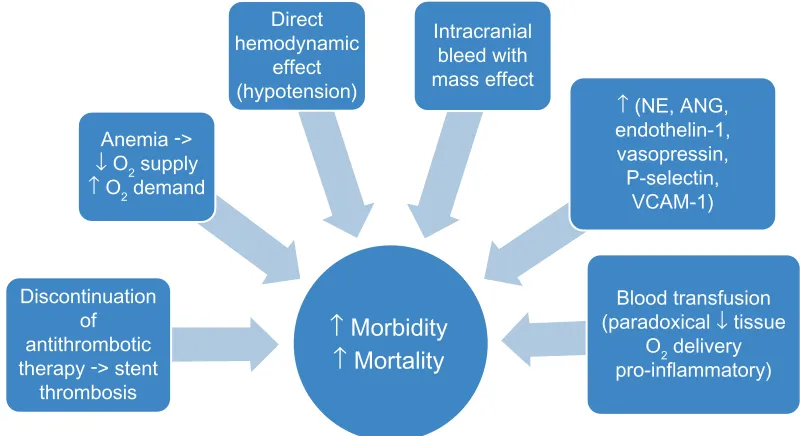
The direct hemodynamic effect of massive hemor-rhage on mortality risk and the causal relationship between intracranial bleed with mass effect and mortality appear intuitive. However, the causative role of less severe bleed-ing on mortality remains speculative. Nonetheless, in acute bleeding, while increased in neurohormonal levels such as norepinephrine, angiotensin, endothelin-1, and vasopressin act to maintain blood pressure and regional blood flow, they have also been demonstrated to be associated with adverse
cardiac events.9 In hemorrhagic shock, upregulation of
cel-lular adhesion molecules, such as P-selectin and vascular cell adhesion molecule-1, has been suggested to promote eccentric left ventricular remodeling, increase diastolic wall stress, increase oxygen consumption, and thus exacerbates
myocardial ischemia and increases mortality.9 Furthermore,
bleeding can result in reduced oxygen supply and increased oxygen demand, the former attributable to anemia and reduced tissue perfusion and the latter as a result of stress and tachycardia. It is conceivable that the disparity in oxy-gen supply and demand can lead to coronary ischemia and
increased mortality.25
In addition to the seemingly direct effect of bleeding on mortality, measures to ameliorate bleeding, such as discontinuation of antithrombotic therapy, paradoxically increases mortality risk. In the GRACE registry study, patients with acute myocardial infarction who experienced bleeding had a higher frequency of discontinuation of aspirin, thienopyridines, and heparin compared with those who did
not bleed.13 More importantly, Spencer et al demonstrated
higher inhospital mortality rates in patients who discontin-ued aspirin, thienopyridines, or unfractionated heparin after experiencing major bleeding compared with those who continued their anticoagulation therapy despite their
bleed-ing episodes.13 Patients with ACS and those undergoing PCI
are in a heightened state of thrombosis and platelet activa-tion. It is conceivable that withholding of antithrombotic therapy can result in activation of the coagulation system and
platelets, which compromises coronary blood flow leading to myocardial damage, reduced left ventricular function, and fatal cardiac arrhythmias. Furthermore, activation of the coagulation cascade can lead to stent thrombosis and nonfatal and fatal cardiac events. Retrospective analysis of the Phase III ACUITY trial demonstrated a greater than five-fold increase in stent thrombosis among patients who
experienced major bleeding.3
Acute bleeding may require blood transfusions to replen-ish plasma volume rapidly and to increase oxygen-carrying capacity for tissue oxygenation. However, there has been accumulating literature demonstrating an association between blood transfusions and increased mortality risk. Results from the GUSTO IIb, PURSUIT, and PARAGON B trials demonstrated that blood transfusions in the setting of ACS were associated with a nearly four-fold increase in the risk of
death at 30 days.26,27 Transfusion of stored packed red blood
cells can result in depletion of 2,3-diphosphoglycerate and nitric oxide from red blood cells resulting in increased affinity of hemoglobin for oxygen and impaired release of oxygen at the capillary level, ultimately leading to reduced tissue
oxygen delivery.28,29 Hence, a transfusion-associated increase
in hemoglobin concentration is not proportionally associated
with an increase in tissue oxygenation.30 Blood transfusions
have also been shown to be associated with an increase in the production of proinflammatory cytokines and other bioreactive substances that may promote coronary ischemia
and thrombosis.29,31 Other suggested adverse consequences
from blood transfusions include exposure to viral pathogens, immune suppression, fluid overload, electrolyte imbalance,
and increased blood viscosity.32 Lastly, acute bleeding may
necessitate invasive interventions and anesthesia which may independently contribute to the increased incidence of mortality observed in these patients. Suggested mechanisms of the association between bleeding and mortality are sum-marized in Figure 2.
Bleeding can be classified into two arbitrarily defined states, ie, acute, occurring in patients with ACS and those undergoing PCI, and chronic, occurring during maintenance therapy with anticoagulation. The following section discusses suggested strategies to reduce bleeding complications in the acute settings. Discussion of strategies to reduce bleeding complications in the chronic setting is beyond the scope of this article.
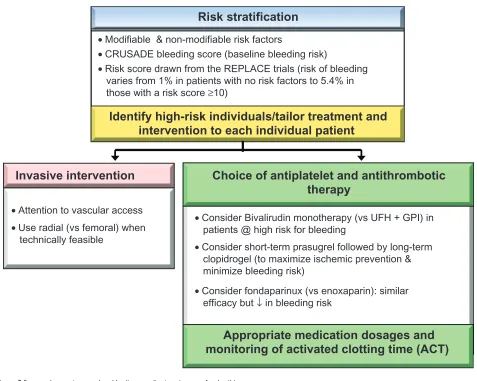
Risk stratification
While no single protocol with maximum treatment effi-cacy and minimum bleeding risk exists, a preprocedural
Vascular Health and Risk Management downloaded from https://www.dovepress.com/ by 118.70.13.36 on 27-Aug-2020
Dovepress implications of bleeding in ACS and PCi
risk assessment assists clinicians to tailor procedures and pharmacotherapy to each individual patient. A risk score derived from the REPLACE study demonstrated that the risk of protocol-defined major bleeding varies from 1.0% in patients without risk factors to greater than 5% in those with
a risk score .10, whereas the CRUSADE bleeding score
offers baseline risk stratification.22,23,33
Choice of antiplatelet
and antithrombotic therapy
Efforts to improve clinical outcomes in patients with ACS and those undergoing PCI entail a judicious balance between antithrombotic effect and risk of bleeding. Hence, unless contraindicated, administration of medications that have been shown to ameliorate bleeding risk should be considered.
The OASIS-5 trial demonstrated that fondaparinux was as effective as enoxaparin in reducing the risk of ischemic events, but with a nearly 50% reduction in the
incidence of major bleeding and a .60% reduction in
minor bleeding compared with enoxaparin.34 More
impor-tantly, a reduction in the incidence of bleeding has been suggested to account for the long-term reduction of death in patients treated with fondaparinux compared with their enoxaparin-treated counterparts. Results of both OASIS-5 and OASIS-6 (comparing unfractionated heparin for 4–48 hours versus fondaparinux 2.5 mg subcutaneously daily for up to eight days in a placebo-controlled double-blind trial in patients with STEMI undergoing PCI) suggest
that using unfractionated heparin with fondaparinux during PCI substantially reduces the risk of catheter thrombosis and related complications, without an increase in clinical
complications or major bleed.34,35 Nonetheless, it should be
noted that currently available data do not support a role for fondaparinux during PCI for stable or unstable coronary artery disease.
Although administration of unfractionated heparin is still regarded as the gold standard antithrombotic therapy in the early periprocedural period, bivalirudin overcomes several limitations of heparin and may be considered as an alternative strategy to unfractionated heparin plus GPI, particularly in patients at risk for bleeding complications. Results of the ACUITY and REPLACE-2 trials demon-strated that bivalirudin significantly reduced the risk of bleeding while maintaining efficacy in reducing ischemic
events in comparison with heparin plus GPI.3,4 Similarly,
the HORIZONS-AMI trial demonstrated reduced rates of net adverse clinical events and major bleeding with the use of bivalirudin monotherapy compared with heparin plus GPI in
patients with STEMI undergoing PCI.19,36 However, the use
of bivalirudin is relatively contraindicated in patients with chronic total occlusion because there is currently no agent to reverse the antithrombotic effect of bivalirudin. Bivalirudin should be used with caution in patients without unfractionated heparin or clopidogrel pretreatment due to increased risk of acute stent thrombosis.
In a recent analysis of the HORIZONS-SWITCH study, Dangas et al demonstrated that in patients with STEMI Direct
hemodynamic effect (hypotension)
Intracranial bleed with mass effect
↑ (NE, ANG, endothelin-1, vasopressin, P-selectin,
VCAM-1)
↑
Morbidity
Anemia ->↓ O2 supply ↑ O2 demand
↑
Mortality
Blood transfusion (paradoxical ↓ tissue
O2 delivery
pro-inflammatory) Discontinuation
of antithrombotic therapy -> stent
thrombosis
Figure 2 Suggested mechanisms of the association between bleeding and mortality (see text for details). Abbreviations: Ne, norepinephrine; ANG, angiotensin, VCAM-1, vascular cell adhesion molecule-1.
Vascular Health and Risk Management downloaded from https://www.dovepress.com/ by 118.70.13.36 on 27-Aug-2020
Dovepress
Pham et al
who received early treatment with unfractionated heparin, switching to bivalirudin before primary PCI resulted in reduced rates of major bleeding and improved early and late
cardiac survival.37 Study subjects consisted of 2357 patients
in the HORIZONS-AMI trial who received unfractionated heparin before study enrollment and were subsequently
randomly assigned to bivalirudin (switch group, n = 1178)
or unfractionated heparin plus GPI (control group, n = 1179).
At 30 days, major bleeding occurred in 7.6% and 12.3% in
the switch and control groups, respectively, P = 0.0001.
Furthermore, 30-day rates of cardiac mortality was lower in the switch compared with the control groups (1.6%
ver-sus 2.9%, respectively, P = 0.04). Similarly, at two-year
follow-up, switch patients experienced lower rates of major
bleeding (P = 0.0003), cardiac mortality (P = 0.04), and
reinfarction (P= 0.0002) while two-year rates of definite
or probable stent thrombosis were similar between the two treatment groups (switch versus control, 3.1% versus 4.3%,
respectively, P= 0.17). The results of the study suggested
that a strategy of switching STEMI patients who received early treatment with unfractionated heparin to bivalirudin may be safe and effective, resulting in reduced hemorrhagic complications and cardiac mortality and enhanced event-free survival compared with unfractionated heparin continua-tion and initiacontinua-tion of GPI. Nonetheless, the investigators acknowledged that the results of the HORIZON-SWITCH study should be considered exploratory and hypothesis-generating due to limited statistical power. Further studies are needed.
Results of the TRITON-TIMI 38 trial demonstrated that patients with ACS and known coronary anatomy who received aspirin and prasugrel had a lower risk of ischemic event but a greater risk of TIMI major and life-threatening bleeding (particularly in those undergoing CABG or those with a history of cerebrovascular disease) compared with
those receiving aspirin and clopidogrel.38,39 Further analysis
Risk stratification
• Modifiable & non-modifiable risk factors
• CRUSADE bleeding score (baseline bleeding risk)
• Risk score drawn from the REPLACE trials (risk of bleeding varies from 1% in patients with no risk factors to 5.4% in those with a risk score ≥10)
• Attention to vascular access
• Use radial (vs femoral) when technically feasible
• Consider Bivalirudin monotherapy (vs UFH + GPI) in patients @ high risk for bleeding
• Consider short-term prasugrel followed by long-term clopidrogel (to maximize ischemic prevention & minimize bleeding risk)
• Consider fondaparinux (vs enoxaparin): similar efficacy but ↓ in bleeding risk
Identify high-risk individuals/tailor treatment and
intervention to each individual patient
Invasive intervention
Choice of antiplatelet and antithrombotic
therapy
Appropriate medication dosages and
monitoring of activated clotting time (ACT)
Figure 3 Suggested strategies to reduce bleeding complications (see text for details).
Vascular Health and Risk Management downloaded from https://www.dovepress.com/ by 118.70.13.36 on 27-Aug-2020