Correcting prepositional phrase attachments using multimodal corpora
Sebastien Delecraz and Alexis Nasr and Frederic Bechet and Benoit Favre Aix-Marseille University, CNRS, LIF
Abstract
PP-attachments are an important source of errors in parsing natural language. We propose in this article to use data coming from a multimodal corpus, combining tex-tual, visual and conceptual information, as well as a correction strategy, to propose alternative attachments in the output of a parser.
1 Introduction
Prepositional phrase attachments ( PP-attachments) are known to be an important source of errors in parsing natural language. The main reason being that, in many cases, correct attachments cannot be predicted accurately based on pure syntactic considerations: their prediction ask for precise lexical co-occurrences or non linguistic knowledge. Such information is usually not found in treebanks that are limited in their size and therefore do not model many bi-lexical phenomena.
In this paper, we propose to combine textual, conceptual and visual information extracted from a multimodal corpus to train a PP-attachment cor-rection model. In order to do so, we have used a corpus made of pairs(S, P)whereSis a sentence andP a picture. Some words ofShave been man-ually linked to bounding boxes in P and tagged with coarse-grained conceptual types. The rela-tive positions of the boxes in the pictures as well as conceptual types and the lexical nature of words involved in a PP-attachment are used as features for a classifier that classifies a PP-attachment as either correct or wrong. Given the parse treeT of
S, and a target preposition, its different possible attachment sites are identified and the classifier is used to select the most promising one.
Our contributions in this study are the selec-tion and the manual annotaselec-tion of a corpus of am-biguous PP-attachments from the multimodal cor-pusFlickr30k Entities(Plummer et al.,2017); the study of the relative importance of different kinds of features for the PP-attachment resolution prob-lem, from very specific ones (lexical features) to very generic ones (spatial features); and the com-bination of them in a single model for improving the accuracy of a syntactic dependency parser.
The structure of the paper is the following: sec-tion2 presents some related work in the fields of PP-attachment and multimodal language process-ing. In section 3 the multimodal corpus is de-scribed as well as the manual annotation that has been performed on it. In section 4the error pre-diction classifier is described and its performance evaluated. In section5, the correction strategy is described. The experiments are described in sec-tion6and section7concludes the paper.
2 Related work
This work is related to two different areas: mul-timodal language processing through the joint analysis of image and text describing the same scene andsyntactic parsing through the problem of prepositional phrase attachment resolution ( PP-attachments).
The joint processing of image and natural lan-guage is not novel. It has been studied mostly in the context of natural language generation, for example for generating a textual description of a video or an image. Early work (Herzog and Wazinski, 1994) computes first spatial re-lations among objects detected in images with knowledge-based language generation model in order to generate short descriptions of videos in limited domains (traffic scenes, soccer matches). Recently open-domain language generation from
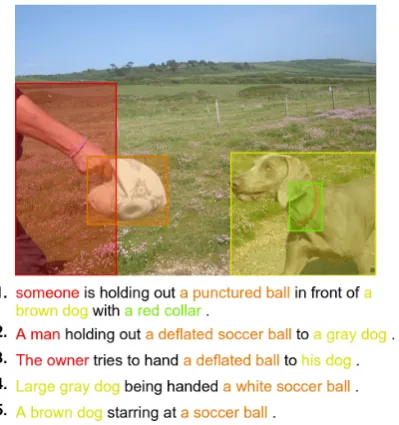
Figure 1: Example of theF30kEannotations.
images or videos received a lot of attention through the use of multimodal deep neural net-works (Vinyals et al.,2015). Theses models built a unified representation for both image and lan-guage features and generate in an end-to-end pro-cess a text directly from an image, without an ex-plicit representation (syntactic or semantic) of the text generated.
For syntactic parsing, the problem of PP-attachment has a long history in Natural Language Processing and a wealth of different methods and sources of information have been used to allevi-ate it. Giving a overview of this vast body of literature is well beyond the scope of this paper. Traditionally, two types of resources have been used to help resolving PP-attachment, semantic knowledge bases (Agirre et al.,2008;Dasigi et al., 2017), and corpora (Rakshit et al., 2016; Mir-roshandel and Nasr, 2016;Belinkov et al., 2014; de Kok et al.,2017).
We are not aware of much work using multi-modal information for PP-attachment. In the most relevant work that we have found (Christie et al., 2016), a parser is used to predict thekbest parses for a sentence and this set is re-ranked using visual information. The main difference with their work is, in our case, the combined use of lexical, seman-tic and visual cues as well as the method used (k
best parses v/s parse correction).
3 Data
The multimodal corpus used in this work is the Flickr30k Entities (F30kE) (Plummer et al., 2017), an extension of the original Flickr30k dataset (Young et al.,2014). This corpus is com-posed of almost 32K images and, for each im-age, five captions describing the image have been produced. Besides, every object in the image that corresponds to a mention in the captions has been manually identified with a bounding box. Bound-ing boxes and the mentions in the captions have been paired together via co-reference links. A total of 244K such links have been annotated. Furthermore, each mention in the captions has been categorized into eight coarse-grained con-ceptual types using manually constructed dictio-naries. The types are: people, body parts, animals, clothing, instruments, vehicles, scene, and other. One example of the corpus has been reproduced in Figure1.
Our goal in this study is to evaluate several set of features, at the lexical, conceptual and vision levels, for the PP-attachment task. The F30kE corpus contains already all these features, but no syntactic annotation was provided on the image captions. Focusing on the PP-attachment problem, we added such annotations with the following pro-cess: first the whole caption corpus ofF30kEwas processed by a Part-Of-Speech tagger (Nasr et al., 2011); a set of regular expressions on the POS la-bels were defined in order to select sentences that contain a preposition that might lead to an am-biguous PP-attachment; finally all these sentences were manually processed in order to attach the se-lected prepositions to their correct syntactic gov-ernor.
Captions containing ambiguous PP-attachment have been identified using two simple rules: a preposition is considered ambiguous if it is pre-ceded by at least two nouns or a verb and a noun, in other word, the captions must match one of the following regular expressions: X* N X* N X* p X* or X* V X* N X* p X*, where N and Vstand for the POS tags noun and verb, Xstand for any POS tag andpis the target preposition.
a development set, made of 2271 captions (2907 annotated prepositions) and a test set, made of 2288 captions (2907 prepositions).
4 Error Prediction
The train part of the PP-corpus has been used to train a classifier that predicts whether a PP-attachment proposed by a parser is correct or not. The parser used is a standard arc-eager transition based parser (Nivre, 2003), trained on sections
0−18of the Penn Treebank (Marcus et al.,1993). The parser was run on the train set of the corpus and, for each occurrence of a manually attached preposition, a negative or a positive example has been produced depending on whether the parser has predicted the correct attachment or not. This data set is composed of 17643 positive and 5611 negative examples. It has been used to train a clas-sifier that predicts whether the attachment made by the parser is correct or not.
The classifier used for this task is theIcsiboost classifier (Favre et al.,2007). This Adaboost clas-sifier is a combination of weak learners that learn a threshold for continuous features, and a binary indicator for discrete ones. Training minimizes the exponential loss function by greedily select-ing the best classifier and re-weightselect-ing the trainselect-ing set to focus on misclassified examples. This kind of classifier has two benefits: models are easier to interpret than in other families of models, and the greedy selection of classifier effectively selects relevant features and is less affected by noise.
Three sets of features have been used to train the classifier, from the most specific ones (lexi-cal features) to the most generic ones (spatial fea-tures). The setT is composed of textual features, extracted from the captions. The set C is com-posed of conceptual features, based on the concep-tual classes associated with boxes or words. SetV
is composed of visual features representing spatial information about the objects annotated in the im-age (enriched with bounding boxes).
Let GpD be a PP-attachment where G is the governor of the prepositionpandDits dependent. We define the functionsP OS(X)that denote the POS of wordX,LEM(X)its lemma,F CT(X)
its syntactic function,CON(X)the list of its con-ceptual types, BB(X) its bounding box (in the case where X is associated with several boxes,
SBB(X)lists this set). DIST(X, Y)represents the distance between wordsX andY in the
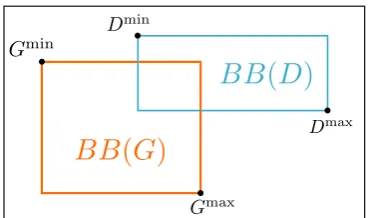
sen-Figure 2: Points of interest from (G) and (D) boxes.
tence. Here is a detailed description of the features of the three different categories using the notations defined above1:
Textual features:
T1 =P OS(G)
T3 =P OS(D)
T5 =F CT(p)
T2 =LEM(G)
T4 =LEM(D)
T6 =DIST(G, p)
T7 =LEM(G) +LEM(D)
T8 =P OS(G) +P OS(D)
Conceptual features:
C1=CON(G) C2 =CON(D)
C3 = CON(G) + CON(D) Eight types of
concept are defined: people, body parts, animals, clothing, instruments, vehicles, scene, and other. The value UNK is used if either G or D is not associated with a type.
Visual features: in Figure 2, we identify two corners for every bounding box B: Bmin and
Bmax, that are used compute the visual features:
V1 = GDmaxxxmin−−GGminxminx
V3 = D
min
y −Gminy
Gmax
y −Gminy
V5 =|SBB(D)|
V2 = DGmaxxmaxx −−GGminminxx
V4 = D
max
y −Gminy
Gmax
y −Gminy
V6 =|SBB(G)|
V7 =Area(BB(D))/ Area(BB(G))
FeaturesV1. . .V4describe the relative position
ofD box with respect toGbox, respectively on thexandyaxis. FeaturesV5 andV6 describe the
number of boxes associated withDandG. V7 is
the ratio of the areas ofDandGboxes. In case of multi-boxing, we compute the distance between
GminandDminand keep the two closest boxes as
BB(G)and BB(D). When eitherG orDdoes not have a box, theUNKvalue is used.
It is important to notice that the visual fea-tures in our study are limited to spatial informa-tion about bounding boxes. No image analysis of the content of the boxes is done since this level of
[image:3.595.324.509.60.169.2]Features Train Dev Test Baseline 0.76 0.76 0.75
T 0.94 0.90 0.88
C 0.83 0.84 0.83
V 0.78 0.79 0.77
[image:4.595.111.252.62.137.2]T + C 0.96 0.91 0.90 T + C + V 0.98 0.91 0.89
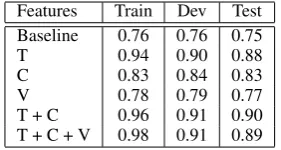
Table 1: Classifier accuracy by model.
information is covered by theconceptual features which attach to each box a concept tag related to its content.
Table 1 details the classification accuracy for each model trained using different feature com-binations, on train, development and test sets. The accuracy is computed on the attachments pre-dicted by the parser. A baseline has been added to Table1that selects the majority class which is thepositiveclass, therefore it reflects the accuracy of the parser for PP-attachment (75%accuracy on the test set).
As one can see, all four models beat the base-line. The best features are the lexical ones. This is expected as they are the most specific ones, re-quiring a training corpus matching closely the ap-plication domain. Conceptual features obtain very good results although they can be considered as generic since only 8 types of concepts are con-sidered. The visual features are just slighlty bet-ter than the baseline (+2%), however we have to keep in mind that the only information considered here are spatial features of bounding boxes. Since not all prepositions in the PP-corpus are related to spatial positions, and considering the generic-ity of the features used, obtaining an accuracy of
77%without any lexical or semantic features is an interesting result.
By combining feature sets we can improve ac-curacy. The best combination is the textual and the conceptual features together.
5 Correction Strategy
The classifier developed in the previous section only checked if a PP-attachment proposed by the parser is correct or not. In this section we inte-grate this classifier in a correction strategy in order to improve the accuracy of our parser. This cor-rection strategy is inspired from the ideas of An-guiano and Candito(2011);Attardi and Ciaramita (2007);Hall and Nov´ak(2005): given a sentence
S, a parseT forSand a target prepositionp, a set
Gpof candidate governors forpis identified. The
highest scoringc∈Gpis then assigned as the new
governor ofpinT.
The set Gp is initialized with g, the
ac-tual governor of p in the parse T. The following rules are then applied to T and new potential governors are added to Gp:
1 N ←V →p ⇒Gp=Gp∪ {N}
2 N ←P ←V →p ⇒Gp=Gp∪ {N}
3 N0 ←N →p ⇒Gp=Gp∪ {N0}
4 N0 ←P ←N →p ⇒G
p=Gp∪ {N0} 5 N0 →X→N →p ⇒Gp=Gp∪ {N0}
6 N →N →p ⇒Gp=Gp∪ {N}
7 V →N →p ⇒Gp=Gp∪ {V}
Rule1is interpreted as follows: if target preposi-tionphas a verbal governor which has a nounN
as a direct dependent, N is added as a candidate governor. These rules have been evaluated on our development corpus. When applying the rules to the output of the parser, the correct governor of the manually annotated prepositions is in the setGp in92.28%of the cases. This figure is our
upper bound for PP-attachments.
Given the sentence a man throws a child into the air at a beach, and target preposition at that the parser has attached to child, the two rules 4 and 7 apply, yieldingGp ={child, air, throws}
man throws child into air at
4 N P N∗ p
7 V∗ N p
The correction strategy is the following: given an attachment GpD produced by the parser, this attachment is given as input to the error detector. If the detector predicts theCORRECTclass, then the attachment is kept unchanged. Otherwise, the set Gp is computed and the element g of the set
that maximizes the score S(gpD, CORRECT) is selected (i.e.the score that the classifier associates with the classCORRECTto the given input).
6 Experiments
Prep Occ BL T C V TCV into 116 0.89 0.93 0.88 0.89 0.96 with 310 0.65 0.78 0.75 0.66 0.79 through 145 0.95 0.96 0.95 0.95 0.97 behind 35 0.74 0.86 0.83 0.77 0.89 under 58 0.84 0.84 0.86 0.84 0.86 down 41 0.63 0.73 0.63 0.44 0.68
in 369 0.76 0.84 0.81 0.76 0.85
in front of 51 0.90 0.88 0.90 0.90 0.90 outside 35 0.63 0.74 0.74 0.69 0.74
on 143 0.85 0.90 0.89 0.85 0.91
around 59 0.73 0.81 0.73 0.71 0.83 for 168 0.73 0.82 0.77 0.72 0.80
at 63 0.84 0.86 0.90 0.84 0.90
along 50 0.52 0.86 0.76 0.52 0.88 across 49 0.88 0.96 0.88 0.88 0.96 against 31 0.77 0.94 0.84 0.77 0.94 near 159 0.33 0.84 0.83 0.58 0.84 towards 30 0.90 0.93 0.87 0.90 0.90 next to 137 0.89 0.89 0.88 0.89 0.89
by 76 0.84 0.86 0.86 0.84 0.87
of 72 0.93 0.93 0.93 0.93 0.93
[image:5.595.71.292.62.346.2]over 111 0.66 0.85 0.73 0.66 0.86 during 41 0.71 0.76 0.73 0.71 0.76 from 140 0.76 0.86 0.78 0.76 0.84 TOTAL 2907 0.75 0.85 0.82 0.77 0.86
Table 2: PP-attachment accuracy on the test set per preposition (only those with at least 30 occur-rences).
Features Accuracy Baseline 0.75
T 0.85
C 0.82
V 0.77
T + C 0.86
T + V 0.86
C + V 0.82
T + C + V 0.86
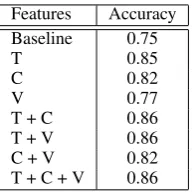
Table 3: PP-attachment accuracy on the test set.
of the error detector: using only one type of tures (Textual, Conceptual and Visual) and all fea-tures. The last line gives the attachment accuracy on all preposition.
As one can see on Table 2, the global accu-racy of the parser on all PP-attachment is equal to75%. This figure is lower than the86%correct PP-attachment reported byAnguiano and Candito (2011) on the Penn Treebank using the same kind of parser, which does not come as a surprise, given the different nature of these two corpora. Ta-ble3presents the accuracy of PP-attachment after correction with different feature set combinations. Adding conceptual features to textual features im-prove accuracy, however spatial features have no impact when used in conjunction with other
fea-ture sets.
Several conclusions can be drawn from these results: different prepositions have very different accuracy with the parser, ranging from 95% for prepositionthrough, to33%for prepositionnear. The correction strategy implemented has a posi-tive impact on accuracy: changing some attach-ments proposed by the parser using an error cor-rector based on limited but specific data is useful. Similarly as the results obtained on the classifica-tion accuracy, textual features are the most useful ones. Used alone, they increase accuracy by 10
points. Although improving accuracy by2%when used alone, visual features have no impact when combined with other feature sets. The positive impact of visual features is concentrated on three prepositions in table2: (near,behindandoutside). It is interesting to note that these prepositions are mostly locative. It does therefore make sense that visual features only focusing on spatial informa-tion have some impact on these preposiinforma-tions. On the other extreme, preposition likeduringthat are mostly temporal are logically not impacted by the correction.
7 Conclusion
We have proposed in this paper an error correction strategy for PP-attachment that extracts from a multimodal corpus features that help predict such attachments as either correct or not. This classifier is used to select among the different possible at-tachment points of a preposition the highest scor-ing one with respect to the classifier. Experiments showed that this method increases by11absolute points the correct PP-attachment rate. As expected the most relevant feature set is the lexical one, which is the most specific one. Conceptual fea-tures, although quite generic, obtain results close to lexical features. Visual features, limited in our case to spatial information, can improve greatly the accuracy of pp-attachment when used alone for some locative preposition, however they have no impact when mixed with more specific features.
[image:5.595.134.231.403.499.2]Acknowledgments
This work has been carried out thanks to the sup-port of French DGA in partnership with Aix-Marseille University as part of the “Club des parte-naires D´efense”.
References
Eneko Agirre, Timothy Baldwin, and David Martinez. 2008. Improving parsing and pp attachment perfor-mance with sense information. InACL. pages 317– 325.
Enrique Henestroza Anguiano and Marie Candito. 2011. Parse correction with specialized models for difficult attachment types. In Proceedings of the Conference on Empirical Methods in Natural
Lan-guage Processing. Association for Computational
Linguistics, pages 1222–1233.
Giuseppe Attardi and Massimiliano Ciaramita. 2007. Tree revision learning for dependency parsing. In
HLT-NAACL. pages 388–395.
Yonatan Belinkov, Tao Lei, Regina Barzilay, and Amir Globerson. 2014. Exploring compositional architec-tures and word vector representations for preposi-tional phrase attachment. Transactions of the
Asso-ciation for Computational Linguistics2:561–572.
Gordon Christie, Ankit Laddha, Aishwarya Agrawal, Stanislaw Antol, Yash Goyal, Kevin Kochersberger, and Dhruv Batra. 2016. Resolving language and vision ambiguities together: Joint segmentation & prepositional attachment resolution in captioned scenes.arXiv preprint arXiv:1604.02125.
Pradeep Dasigi, Waleed Ammar, Chris Dyer, and Ed-uard Hovy. 2017. Ontology-aware token embed-dings for prepositional phrase attachment. arXiv
preprint arXiv:1705.02925.
Dani¨el de Kok, Jianqiang Ma, Corina Dima, and Erhard Hinrichs. 2017. Pp attachment: Where do we stand?
EACL 2017page 311.
Benoit Favre, Dilek Hakkani-T¨ur, and Sebastien Cuen-det. 2007. Icsiboost. http://code.google.
come/p/icsiboost.
Keith Hall and V´aclav Nov´ak. 2005. Corrective model-ing for non-projective dependency parsmodel-ing. In Pro-ceedings of the Ninth International Workshop on
Parsing Technology. Association for Computational
Linguistics, pages 42–52.
Gerd Herzog and Peter Wazinski. 1994. Visual trans-lator: Linking perceptions and natural language de-scriptions. Artificial Intelligence Review8(2):175– 187.
Mitchell P Marcus, Mary Ann Marcinkiewicz, and Beatrice Santorini. 1993. Building a large annotated corpus of english: The penn treebank. Computa-tional linguistics19(2):313–330.
Seyed Abolghasem Mirroshandel and Alexis Nasr. 2016. Integrating selectional constraints and subcat-egorization frames in a dependency parser. Compu-tational Linguistics.
A. Nasr, F. B´echet, J.F. Rey, B. Favre, and J. Le Roux. 2011. Macaon: An nlp tool suite for processing word lattices. Proceedings of the ACL 2011 System
Demonstrationpages 86–91.
Joakim Nivre. 2003. An efficient algorithm for pro-jective dependency parsing. In Proceedings of the 8th International Workshop on Parsing Technologies (IWPT. Citeseer.
Bryan A. Plummer, Liwei Wang, Chris M. Cervantes, Juan C. Caicedo, Julia Hockenmaier, and Svetlana Lazebnik. 2017. Flickr30k entities: Collecting region-to-phrase correspondences for richer image-to-sentence models. International Journal of Com-puter Vision123(1):74–93.
Geetanjali Rakshit, Sagar Sontakke, Pushpak Bhat-tacharyya, and Gholamreza Haffari. 2016. Prepo-sitional attachment disambiguation using bilin-gual parsing and alignments. arXiv preprint
arXiv:1603.08594.
Oriol Vinyals, Alexander Toshev, Samy Bengio, and Dumitru Erhan. 2015. Show and tell: A neural im-age caption generator. InProceedings of the IEEE conference on computer vision and pattern recogni-tion. pages 3156–3164.