On the difficulty of a distributional semantics of spoken language
Grzegorz Chrupała Tilburg University [email protected]
Lieke Gelderloos Tilburg University [email protected]
´Akos K´ad´ar Tilburg University [email protected]
Afra Alishahi Tilburg University [email protected]
Abstract
In the domain of unsupervised learning most work on speech has focused on discovering low-level constructs such as phoneme inven-tories or word-like units. In contrast, for writ-ten language, where there is a large body of work on unsupervised induction of semantic representations of words, whole sentences and longer texts. In this study we examine the challenges of adapting these approaches from written to spoken language. We conjecture that unsupervised learning of the semantics of spoken language becomes feasible if we ab-stract from the surface variability. We simulate this setting with a dataset of utterances spo-ken by a realistic but uniform synthetic voice. We evaluate two simple unsupervised models which, to varying degrees of success, learn semantic representations of speech fragments. Finally we present inconclusive results on hu-man speech, and discuss the challenges inher-ent in learning distributional semantic repre-sentations on unrestricted natural spoken lan-guage.
1 Introduction
In the realm of NLP for written language, unsuper-vised approaches to inducing semantic representa-tions of words have a long pedigree and a history of substantial success (Landauer et al., 1998; Blei et al., 2003; Mikolov et al., 2013b). The core idea behind these models is to build word representa-tions that can predict their surrounding context. In search for similarly generic and versatile rep-resentations of whole sentences, various composi-tion operators have been applied on word repre-sentations (e.g. Socher et al., 2013; Kalchbrenner et al., 2014; Kim, 2014; Zhao et al., 2015). Alter-natively, sentence representations are induced via
the objective to predict the surrounding sentences (e.g. Le and Mikolov, 2014; Kiros et al., 2015; Arora et al., 2016; Jernite et al., 2017; Logeswaran and Lee, 2018). Such representations capture as-pects of the meaning of the encoded sentences, which can be used in a variety of tasks such as semantic entailment or text understanding.
In the case of spoken language, unsupervised methods usually focus on discovering relatively low-level constructs such as phoneme inventories or word-like units. This is mainly due to the fact that the key insight from distributional semantics that “you shall know the word by the company it keeps” (Firth, 1957) is hopelessly confounded in the case of spoken language. In text two words are considered semantically similar if they co-occur with similar neighbors. However, speech seg-ments which occur in the same utterance or situ-ation often have many other features in addition to similar meaning, such as being uttered by the same speaker or accompanied by similar ambient noise. In this study we show that if we can abstract away from speaker and background noise, we can effectively capture semantic characteristics of spo-ken utterances in an unsupervised way. We present SegMatch, a model trained to match segments of the same utterance. SegMatch utterance encod-ings are compared to those in Audio2Vec, which is trained to decode the context that surrounds an utterance. To investigate whether our represen-tations capture semantics, we evaluate on speech and vision datasets where photographic images are paired with spoken descriptions. Our experiments show that for a single synthetic voice, a simple model trained only on image captions can capture pairwise similarities that correlate with those in the visual space.
Furthermore we discuss the factors preventing effective learning in datasets with multiple human speakers: these include confounds between se-mantic and situational factors as well as artifacts in the datasets.
2 Related work
Studies of unsupervised learning from speech typ-ically aim to discover the phonemic or lexical building blocks of the language signal. Park and Glass (2008) show that words and phrase units in continuous speech can be discovered using algo-rithms based on dynamic time warping. van den Oord et al. (2017) introduce a Vector Quantised-Variational AutoEncoder model, in which a con-volutional encoder trained on raw audio data gives discrete encodings that are closely related to phonemes. Recently several unsupervised speech recognition methods were proposed that segment speech and cluster the resulting word-like seg-ments (Kamper et al., 2017a) or encode them into segment embeddings containing phonetic infor-mation (Wang et al., 2018). Scharenborg et al. (2018) show that word and phrase units arise as a by-product in end-to-end tasks such as speech-to-speech translation. In the current work, the aim is to directly extract semantic, rather than word form information from speech.
Semantic information encoded in speech is used in studies that ground speech to the visual context. Datasets of images paired with spoken captions can be used to train multimodal models that extract visually salient semantic information from speech, without access to textual information (Harwath and Glass, 2015; Harwath et al., 2016; Kamper et al., 2017b; Chrupała et al., 2017; Alishahi et al., 2017; Harwath and Glass, 2017). This form of se-mantic supervision, through contextual informa-tion from another modality, has its limits: it can only help to learn to understand speech describing the here and now.
On the other hand, the success of word embed-dings derived by distributional semantic princi-ples has shown how rich the semantic information within the structure of language itself is. Semantic representations of words obtained through Latent Semantic Analysis have proven to closely resem-ble human semantic knowledge (Blei et al., 2003; Landauer et al., 1998). Word2vec models produce semantically rich word embeddings by learning to predict the surrounding words in text (Mikolov
et al., 2013a,b) and this principle is extended to sentences in the Skip-thought model (Kiros et al., 2015) and several subsequent works (Arora et al., 2016; Jernite et al., 2017; Logeswaran and Lee, 2018).
In the realm of spoken language, in Chung and Glass (2017) the sequence-to-sequence Au-dio2vec model learns semantic embeddings for audio segments corresponding to words, by pre-dicting the audio segments around it. Chung and Glass (2018) further experiment with this model and rename it to Speech2vec. Chen et al. (2018) train semantic word embeddings from word-segmented speech as part of their method of training an ASR system from non-aligned speech and text. These works are closely related to our current study, but crucially, unlike them we donot assume that speech is already segmented into dis-crete words.
3 Models
3.1 Encoder
All the models in this section use the same encoder architecture. The encoder is loosely based on the architecture of Chrupała et al. (2017), i.e. it con-sists of a 1-dimensional convolutional layer which subsamples the input, followed by a stack of recur-rent layers, followed by a self-attention operator. Unlike Chrupała et al. (2017) we use GRU layers (Chung et al., 2014) instead of RHN layers (Zilly et al., 2017), and do not implement residual con-nections. These modifications are made in order to exploit the fast native CUDNN implementation of a GRU stack and thus speed up experimenta-tion in this exploratory stage of our research. The encoderEncis defined as follows:
Enc(x) = unit(Attn(GRU`(Convs,d,z(x))))
(1) whereConvis a convolutional layer with length
s,dchannels, and stridez,GRU` is a stack of` GRU layers,Attnis self-attention andunitis L2-normalization. The self-attention operator com-putes a weighted sum of the RNN activations at all timesteps:
Attn(x) =X t
↵txt (2)
through the timewise softmax function:
↵t= Pexp(Utanh(Wxt))
t0exp(Utanh(Wxt0)) (3)
3.2 Audio2vec
Firstly we define a model inspired by Chung and Glass (2017) which uses the multilayer GRU en-coder described above, and a single-layer GRU de-coder, conditioned on the output of the encoder.
The model of Chung and Glass (2017) works on word-segmented speech: the encoder encodes the middle word of a five word sequence, and the decoder decodes each of the surrounding words. Similarly, the Skip-thought model of (Kiros et al., 2015) works with a sequence of three sentences, encoding the middle one and decoding the previ-ous and next one. In our fully unsupervised setup we do not have access to word segmentation, and thus our Audio2vec models work with arbitrary speech segments. We split each utterance into three equal sized chunks: the model encodes the middle one, and decodes the first and third one.
The decoder predicts the MFCC features at time
t+ 1based on the state of the hidden layer at time
t. From reading Chung and Glass (2017) it is not
clear whether in addition to the hidden state their decoder also receives the MFCC frame attas
in-put. We thus implemented two versions, one with and one without this input.
Audio2vec-C The decoder receives the output of the encoder as the initial state of the hidden layer, and the frame attas input as it predicts the next
frame att+ 1.
ˆ
xfirstt+1=Fht (4)
ht= gru(ht 1,xfirstt ) (5)
h0= Enc xmiddle (6)
wherexfirstt are the MFCC features of the previous
chunk at timet,ˆxfirstt+1are the predicted features at the next time step,Fis a learned projection matrix, gru(·,·) is a single step of the GRU recurrence, andxmiddleis the sequence of the MFCC features
of the input. The decoder for the third chunkxthird
is defined in the same way.
Audio2vec-U The decoder receives the output of the encoder as the input at each time step, but does not have access to the frame att.
ˆ
xfirstt+1=Fht (7)
ht= gru(ht 1,Enc(xmiddle)) (8)
In this versionh0 is a learned parameter. There
are two separate decoders: i.e. the weights of the decoder for the first chunk and for the third chunk arenotshared.
For both versions ofAudio2vec the loss func-tion is the Mean Squared Error.
3.3 SegMatch
This model works with segments of utterances also: we split each utterance approximately in half, while erasing a short portion in the center in order to prevent the model from finding triv-ial solutions based on matching local patterns at the edges of the segments. The encoder is as de-scribed above. After encoding the segments, we project the initial and final segments via separate learned projection matrices:
b=BEnc(x0:m) (9)
e=EEnc(xm+k:n) (10)
wherex0:n is the sequence of MFCC frames for an utterance,kis the size of the erased segment, Enc(·)is the encoder andBandEare the projec-tion matrices for the beginning and end segment respectively. That is, there is a single shared en-coder for both types of speech segments (begin-ning and end), but the projections are separate. There is no decoding, but rather the model learns to match encoded segments from the same utter-ance and distinguish them from encoded segments from different utterances within the same mini-batch. The loss function is similar to the one for matching spoken utterances to images in Chrupała et al. (2017), with the difference that here we are matching utterance segments to each other:
L=X
b,e
X
b0
max[0, ↵+d(b,e) d(b0,e)]
+X
e0
max[0, ↵+d(b,e) d(b,e0)] !
Note that the specific way we segment speech is not a crucial component of either of the models: it is mostly driven by the fact that we run our experi-ments on speech and vision datasets, where speech consists of isolated utterances. For data consisting of longer narratives, or dialogs, we could use dif-ferent segmentation schemes.
4 Experimental setup
4.1 Datasets
In order to facilitate evaluation of the semantic as-pect of the learned representations, we work with speech and vision datasets, which couple pho-tographic images with their spoken descriptions. Thanks to the structure of these data we can use the evaluation metrics detailed in section 4.2.
Synthetically spoken COCO This dataset was created by Chrupała et al. (2017), based on the original COCO dataset (Lin et al., 2014), using the Google TTS API. The captions are spoken by a single synthetic voice, which is realistic but sim-pler than human speakers, lacking variability and ambient noise. There are 300,000 images, each with five captions. Five thousand images each are held out for validation and test.
Flickr8k Audio Caption Corpus This dataset (Harwath and Glass, 2015) contains the captions in the original Flickr8K corpus (Hodosh et al., 2013) read aloud by crowdworkers. There are 8,000 images, each image with five descriptions. One thousand images are held out for validation, and another one thousand for the test set.
Places Audio Caption Corpus This dataset was collected by (Harwath et al., 2016) using crowd-workers. Here each image is described by a single spontaneously spoken caption. There are 214,585 training images, and 1000 validation images (there are no separate test data).
4.2 Evaluation metrics
We evaluate the quality of the learned semantic speech representations according to the following criteria.
Paraphrase retrieval For the Synthetically Spo-ken COCO dataset as well as for the Flickr8k Au-dio Caption Corpus each image is described via five independent spoken captions. Thus captions describing the same image are effectively para-phrases of each other. This structure of the data allows us to use a paraphrasing retrieval task as
a measure of the semantic quality of the learned speech embeddings. We encode each of the spo-ken utterances in the validation data, and rank the others according to the cosine similarity. We then measure: (a) Median rank of the top-ranked paraphrase; and (b) recall@K: the proportion of paraphrases amongK top-ranked utterances, for
K2 {1,5,10}.
Representational similarity to image space Representational similarity analysis (RSA) is a way of evaluating how pairwise similarities between objects are correlated in two object representation spaces (Kriegeskorte et al., 2008). Here we compare cosine similarities among encoded utterances versus cosine simi-larities among vector representations of images. Specifically, we create two pairwise N ⇥ N
similarity matrices: (a) among encoded utterances from the validation data, and (b) among images corresponding to each utterance in (a). Note that since there are five descriptions per image, each image is replicated five times in matrix (b). We then take the upper triangulars of these matrices (excluding the diagonal) and compute Pearson’s correlation coefficient between them. The image features for this evaluation are obtained from the final fully connected layer of VGG-16 (Simonyan and Zisserman, 2014) pre-trained on Imagenet (Russakovsky et al., 2014) and consist of 4096 dimensions.
4.3 Settings
We preprocess the audio by extracting 12-dimensional mel-frequency cepstral coefficients (MFCC) plus log of the total energy. We use 25 milisecond windows, sampled every 10 milisec-onds. Audio2vec and SegMatch models are trained for a maximum of 15 epochs with Adam, with learning rate 0.0002, and gradient clipping at 2.0. SegMatch uses margin↵ = 0.2. The en-coder GRU has 5 layers of 512 units. The con-volutional layer has 64 channels, size of 6 and stride 3. The hidden layer of the attention MLP is 512. The GRU of the Audio2vec decoder has 512 hidden units; the size of the output of the pro-jectionsBandEin SegMatch is also 512 units.
mini-batch includes utterances spoken only by one speaker: this is in order to discourage the model from encoding speaker-specific features.
5 Results
5.1 Synthetic speech
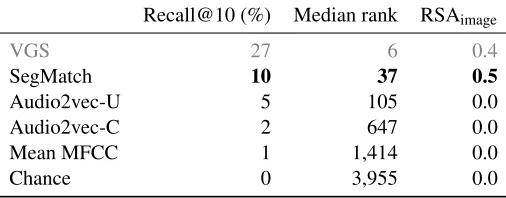
Table 1 shows the evaluation results on synthetic speech. Representations learned by Audio2vec and SegMatch are compared to the performance of random vectors, mean MFCC vectors, as well as visually supervised representations (VGS, model from Chrupała et al. (2017)). Audio2vec works better than chance and mean MFCC on paraphrase retrieval, but does not correlate with the visual space. SegMatch works much better than Au-dio2vec according to both criteria. It does not come close to VGS on paraphrase retrieval, but it does correlate with the visual modality even better.
5.2 Human speech
Places This dataset only features a single cap-tion per image and thus we only evaluate accord-ing to RSA: with both SegMatch and Audio2vec we found the correlations to be zero.
Flickr8K Initial experiments with Flickr8K were similarly unsuccessful. Analysis of the learned SegMatch representations revealed that in spite of partitioning the data by speaker for train-ing, speaker identity can be decoded from them.
Enforcing speaker invariance We thus imple-mented a version of SegMatch where an auxiliary speaker classifier is connected to the encoder via a gradient reversal operator (Ganin and Lempitsky, 2015). This architecture optimizes the main loss, while at the same time pushing the encoder to re-move information about speaker identity from the representation it outputs. In preliminary experi-ments we saw that this addition was able to prevent speaker identity from being encoded in the rep-resentations during the first few epochs of train-ing. Evaluating this speaker-invariant representa-tion gave contradictory results, shown in Table 2: very good scores on paraphrase retrieval, but zero correlation with visual space.
Further analysis showed that there seems to be an artifact in the Flickr8K data where spoken cap-tions belonging to consecutively numbered images share some characteristics, even though the im-ages do not. As a side effect, this causes cap-tions belonging to the same image to also share
some features, independent of their semantic con-tent, leading to high paraphrasing scores. The arti-fact may be due to changes in data collection pro-cedure which affected some aspect of the captions in ways which correlate with their sequential or-dering in the dataset.
If we treat the image ID number as a regression target, and the first two principal components of the SegMatch representation of one of its captions as the predictors, we can account for about 12% of the holdout variance in IDs using a non-linear model (using either K-Nearest Neighbors or Ran-dom Forest). This effect disappears if we arbitrar-ily relabel images.
6 Conclusion
For synthetic speech the SegMatch approach to inducing utterance embeddings shows very promising performance. Likewise, previous work has shown some success with word-segmented speech. There remain challenges in carrying over these results to natural, unsegmented speech. Word segmentation is a highly non-trivial research problem in itself and the variability of spoken lan-guage is a serious and intractable confounding fac-tor.
Even when controlling for speaker identity there are still superficial features of the speech signal which make it easy for the model to ignore the se-mantic content. Some of these may be due to arti-facts in datasets and thus care is needed when eval-uating unsupervised models of spoken language: for example use of multiple evaluation criteria may help spot spurious results. In spite of these challenges, in future we want to further explore the effectiveness of enforcing desired invariances via auxiliary classifiers with gradient reversal.
References
Afra Alishahi, Marie Barking, and Grzegorz Chrupała. 2017. Encoding of phonology in a recurrent neu-ral model of grounded speech. In Proceedings of the 21st Conference on Computational Natural Lan-guage Learning (CoNLL 2017), pages 368–378. As-sociation for Computational Linguistics.
Sanjeev Arora, Yingyu Liang, and Tengyu Ma. 2016. A simple but tough-to-beat baseline for sentence em-beddings. InICLR.
Recall@10 (%) Median rank RSAimage
VGS 27 6 0.4
SegMatch 10 37 0.5
Audio2vec-U 5 105 0.0
Audio2vec-C 2 647 0.0
Mean MFCC 1 1,414 0.0
Chance 0 3,955 0.0
Table 1: Results on Synthetically Spoken COCO. The row labeled VGS is the visually supervised model from Chrupała et al. (2017).
Recall@10 (%) Median rank RSAimage
VGS 15 17 0.2
SegMatch 12 17 0.0
[image:6.612.179.432.61.160.2]Mean MFCC 0 711 0.0
Table 2: Results on Flickr8K. The row labeled VGS is the visually supervised model from Chrupała et al. (2017).
Yi-Chen Chen, Chia-Hao Shen, Sung-Feng Huang, and Hung-yi Lee. 2018. Towards unsuper-vised automatic speech recognition trained by un-aligned speech and text only. arXiv preprint arXiv:1803.10952.
Grzegorz Chrupała, Lieke Gelderloos, and Afra Al-ishahi. 2017. Representations of language in a model of visually grounded speech signal. In Pro-ceedings of the 55th Annual Meeting of the Associa-tion for ComputaAssocia-tional Linguistics.
Junyoung Chung, Caglar Gulcehre, KyungHyun Cho, and Yoshua Bengio. 2014. Empirical evaluation of gated recurrent neural networks on sequence model-ing. InNIPS 2014 Deep Learning and Representa-tion Learning Workshop.
Yu-An Chung and James Glass. 2017. Learning word embeddings from speech. InNIPS ML4Audio Work-shop.
Yu-An Chung and James Glass. 2018. Speech2vec: A sequence-to-sequence framework for learning word embeddings from speech. arXiv preprint arXiv:1803.08976.
John Rupert Firth. 1957. A synopsis of linguistic the-ory 1930-1955, volume 1952-59. The Philological Society.
Yaroslav Ganin and Victor Lempitsky. 2015. Unsu-pervised domain adaptation by backpropagation. In Proceedings of the 32nd International Conference on Machine Learning, volume 37 of Proceedings of Machine Learning Research, pages 1180–1189, Lille, France. PMLR.
David Harwath and James Glass. 2015. Deep multi-modal semantic embeddings for speech and images. InIEEE Automatic Speech Recognition and Under-standing Workshop.
David Harwath and James R Glass. 2017. Learn-ing word-like units from joint audio-visual analysis. arXiv preprint arXiv:1701.07481.
David Harwath, Antonio Torralba, and James Glass. 2016. Unsupervised learning of spoken language with visual context. InAdvances in Neural Infor-mation Processing Systems, pages 1858–1866.
Micah Hodosh, Peter Young, and Julia Hockenmaier. 2013. Framing image description as a ranking task: Data, models and evaluation metrics.Journal of Ar-tificial Intelligence Research, 47:853–899.
Yacine Jernite, Samuel R Bowman, and David Son-tag. 2017. Discourse-based objectives for fast un-supervised sentence representation learning. arXiv preprint arXiv:1705.00557.
Nal Kalchbrenner, Edward Grefenstette, and Phil Blunsom. 2014. A convolutional neural net-work for modelling sentences. arXiv preprint arXiv:1404.2188.
Herman Kamper, Aren Jansen, and Sharon Goldwa-ter. 2017a. A segmental framework for fully-unsupervised large-vocabulary speech recognition. Computer Speech & Language, 46:154–174.
Herman Kamper, Shane Settle, Gregory Shakhnarovich, and Karen Livescu. 2017b. Visually grounded learning of keyword prediction from untranscribed speech. In Proc. Interspeech 2017, pages 3677–3681.
Yoon Kim. 2014. Convolutional neural net-works for sentence classification. arXiv preprint arXiv:1408.5882.
and Sanja Fidler. 2015. Skip-thought vectors. In Ad-vances in Neural Information Processing Systems, pages 3276–3284.
Nikolaus Kriegeskorte, Marieke Mur, and Peter A Ban-dettini. 2008. Representational similarity analysis-connecting the branches of systems neuroscience. Frontiers in systems neuroscience, 2:4.
Thomas K Landauer, Peter W Foltz, and Darrell La-ham. 1998. An introduction to latent semantic anal-ysis.Discourse processes, 25(2-3):259–284.
Quoc Le and Tomas Mikolov. 2014. Distributed rep-resentations of sentences and documents. In Inter-national Conference on Machine Learning, pages 1188–1196.
Tsung-Yi Lin, Michael Maire, Serge Belongie, James Hays, Pietro Perona, Deva Ramanan, Piotr Doll´ar, and C Lawrence Zitnick. 2014. Microsoft COCO: Common objects in context. InComputer Vision– ECCV 2014, pages 740–755. Springer.
Lajanugen Logeswaran and Honglak Lee. 2018. An efficient framework for learning sentence represen-tations.arXiv preprint arXiv:1803.02893.
Tomas Mikolov, Kai Chen, Greg Corrado, and Jef-frey Dean. 2013a. Efficient estimation of word representations in vector space. arXiv preprint arXiv:1301.3781.
Tomas Mikolov, Ilya Sutskever, Kai Chen, Greg S Cor-rado, and Jeff Dean. 2013b. Distributed representa-tions of words and phrases and their compositional-ity. InAdvances in Neural Information Processing Systems, pages 3111–3119.
A¨aron van den Oord, Oriol Vinyals, and Koray Kavukcuoglu. 2017. Neural discrete representation learning.CoRR, abs/1711.00937.
Alex S Park and James R Glass. 2008. Unsuper-vised pattern discovery in speech. IEEE Transac-tions on Audio, Speech, and Language Processing, 16(1):186–197.
Olga Russakovsky, Jia Deng, Hao Su, Jonathan Krause, Sanjeev Satheesh, Sean Ma, Zhiheng Huang, An-drej Karpathy, Aditya Khosla, Michael Bernstein, Alexander C. Berg, and Li Fei-Fei. 2014. ImageNet large scale visual recognition challenge.
Odette Scharenborg, Laurent Besacier, Alan Black, Mark Hasegawa-Johnson, Florian Metze, Graham Neubig, Sebastian St¨uker, Pierre Godard, Markus M¨uller, Lucas Ondel, et al. 2018. Linguistic unit discovery from multi-modal inputs in unwritten lan-guages: Summary of the Speaking Rosetta JSALT 2017 workshop.arXiv preprint arXiv:1802.05092.
Karen Simonyan and Andrew Zisserman. 2014. Very deep convolutional networks for large-scale image recognition.CoRR, abs/1409.1556.
Richard Socher, Alex Perelygin, Jean Wu, Jason Chuang, Christopher D Manning, Andrew Ng, and Christopher Potts. 2013. Recursive deep models for semantic compositionality over a sentiment tree-bank. In Proceedings of the 2013 conference on empirical methods in natural language processing, pages 1631–1642.
Yu-Hsuan Wang, Hung-yi Lee, and Lin-shan Lee. 2018. Segmental audio word2vec: Representing ut-terances as sequences of vectors with applications in spoken term detection. In2018 IEEE International Conference on Acoustics, Speech, and Signal Pro-cessing. Proceedings.
Han Zhao, Zhengdong Lu, and Pascal Poupart. 2015. Self-adaptive hierarchical sentence model. InIJCAI, pages 4069–4076.