INTRODUCTION
Patients with chronic lymphocytic leukemia (CLL) assigned to stereotyped subset #4 are characterized clinically by an early age at diagnosis and an indolent disease course and molecularly by B-cell receptor immunoglobulins (BcR IGs) that exhibit a series of distinctive immuno-genetic features (1,2). More specifically, they are IgG-switched (a rarity in CLL
since the great majority of CLL clones, >90% of all cases, express IgM/IgD) and are composed of heavy chains encoded by the IGHV4-34gene and light chains encoded by the IGKV2-30gene (3–5). The antigen-binding sites of subset #4 are equally interesting, being composed of a variable heavy complementarity deter-mining region 3 (VH CDR3) that is long and enriched in positively charged
residues (reminiscent of pathogenic anti-DNA antibodies) (3,4). Anti-anti-DNA is the most common specificity in autoreactiv-ity, with DNA binding often acquired through surface-active basic amino acids; predominantly arginine (R) but also, to a lesser extent, lysine (K) (6–8). This point is worthy of note since the VH CDR3 of subset #4 is defined by a (R/K)RYY motif which is deemed to not only be “CLL-bi-ased” but also exclusive to subset #4 as it has never been found outside this con-text (3,4). In addition, both the VH and variable kappa (VK) domains of subset #4 demonstrate a high impact of somatic hypermutation (SHM) and are remark-able for carrying shared (“stereotyped”) SHM, that is, identical changes at the same codon position of the variable do-main (3,9).
Subset #4 is also outstanding due to in-tense intraclonal diversification (ID)
Ancestor and Evolutionary Trajectory of Chronic Lymphocytic
Leukemia Stereotyped Subset #4
Lesley-Ann Sutton,
1*Giorgos Papadopoulos,
2*Anastasia Hadzidimitriou,
1,3Stavros Papadopoulos,
2Efterpi Kostareli,
4Richard Rosenquist,
1Dimitrios Tzovaras,
2and Kostas Stamatopoulos
1,3,51Department of Immunology, Genetics and Pathology, Science for Life Laboratory, Uppsala University, Uppsala, Sweden; 2
Information Technologies Institute, Center for Research and Technology Hellas, Thessaloniki, Greece; 3Institute of Applied Biosciences, Center for Research and Technology Hellas, Thessaloniki, Greece; 4Division of Epigenomics and Cancer Risk Factors,
German Cancer Research Center (DKFZ), Heidelberg, Germany; and 5Hematology Department and HCT Unit, G. Papanicolaou Hospital, Thessaloniki, Greece
Patients with chronic lymphocytic leukemia (CLL) assigned to stereotyped subset #4 express highly homologous B-cell receptor immunoglobulin (BcR IG) sequences with intense intraclonal diversification (ID) in the context of ongoing somatic hypermutation (SHM). Their remarkable biological and clinical similarities strongly support derivation from a common ancestor. We here revisited ID in subset #4 CLL to reconstruct their evolutionary history as a community of related clones. To this end, using specialized bioin-formatics tools we assessed both IGHV–IGHD–IGHJ rearrangements (n = 511) and IGKV–IGKJ rearrangements (n = 397) derived from eight subset #4 cases. Due to high sequence relatedness, a number of subclonal clusters from different cases lay very close to one another, forming a core from which clusters exhibiting greater variation stemmed. Minor subclones from individual cases were mu-tated to such an extent that they now resembled the sequences of another patient. Viewing the entire subset #4 data set as a single entity branching through diversification enabled inference of a common sequence representing the putative ancestral BcR IG expressed by their still elusive common progenitor. These results have implications for improved understanding of the ontogeny of CLL subset #4, as well as the design of studies concerning the antigenic specificity of the clonotypic BcR IGs.
Online address: http://www.molmed.org doi: 10.2119/molmed.2014.00140
*LAS and GP are both first authors.
Address correspondence toLesley-Ann Sutton, Department of Immunology, Genetics and Pathology, Science for Life Laboratory, Uppsala University, SE-751-85 Uppsala, Sweden. Phone: +46-18-4714852; E-mail: [email protected].
within their IG genes in the context of on-going SHM, alluding to an active, ongo-ing interaction with antigen(s) (10,11). In-deed, by conducting a large-scale longitudinal study of subset #4 we previ-ously established: (i) the existence in most cases of distinct “clusters” of subcloned sequences; (ii) a hierarchical pattern of subclonal evolution, thus revealing which SHMs were negatively or positively se-lected overtime; and, (iii) subclonal drift, that is, temporal changes in the relative size of different clusters of sequences (12).
Nevertheless, this study only investi-gated clonal evolution at an individual case level and hence could not shed light on the clonal ancestry of subset #4 as a whole, which is relevant since the re-markable biological and clinical similari-ties of subset #4 cases strongly support derivation from a common ancestor. In an attempt to trace the ontogeny of sub-set #4, we here sought to revisit ID in subset #4 and reconstruct their evolu-tionary history by determining the struc-ture of a community of related clones profiled at different time points for both IG heavy and light chains.
MATERIALS AND METHODS
Patient Group
Peripheral blood samples were col-lected at multiple time points from eight CLL patients meeting the International Workshop on Chronic Lymphocytic Leukaemia (iwCLL) criteria; these eight patients, on the basis of both their IG gene sequence features and our previ-ously established criteria, were assigned to subset #4 (1,3,4,13). Patients’ demo-graphics and clinical and molecular data are summarized in Supplemental Table 1. Cases were analyzed over a six-year pe-riod (range 7 to 72 months, median 20 months) and no patient received treat-ment during sampling (Suppletreat-mental Table 1). The diagnostic sample was available, and called time point 1, for 6 of the 8 patients analyzed. No diagnostic samples were available for the remaining two patients (P0103 and P2451) and therefore the initial sample (time point 1)
analyzed for these patients were 81 and 63 months post diagnosis, respectively. Written informed consent was obtained in accordance with the Declaration of Helsinki and the study was approved by the local ethics review committee.
PCR Amplification, Subcloning and Sequence Analysis of
IGHV–IGHD–IGHJ and IGKV–IGKJ Gene Rearrangements
PCR amplification using the fidelity Accuprime Pfx polymerase (In-vitrogen [Thermo Fisher Scientific, Waltham, MA, USA]), subcloning and se-quence analysis and interpretation were performed as described previously. The sequence data evaluated herein has been reported previously (1,3,9–12).
Visualization of Clonal Evolution in Subcloned IG Gene Sequences
Sequence data was processed using the Damerau-Levenshtein edit distance algo-rithm (14–16). The Damerau-Levenshtein distance, as defined in this paper, is a multivariate function of two parameters; in this study these two parameters are the amino acid (or nucleotide) sequences. The defined distance is used for the com-putation of the difference between two IG chains. It is a distance metric in the sense that, given the amino acid (or nu-cleotide) sequences s1, s2, s3, the follow-ing conditions apply:
• Nonnegativity: d(s1, s2) ≥ 0; • Nondegeneracy: d(s1, s2) = 0 if and
only if s1 = s2;
• Symmetry: d(s1, s2) = d(s2, s1);
• Triangle inequality: d(s1, s2) + d(s2, s3) ≥ d(s1, s3).
The analytical form of the Damerau-Levenshtein distance between two chains, aand b, having lengths Mand N, respectively, is defined by the following:
where levis a two-dimension matrix with Mrows and Ncolumns and the (i,j) entry
is leva,b(i,j), where i= 0, 1, 2, … , M-1 and j= 0, 1, 2, … , N-1. This matrix has one in the element when a match is found be-tween the i-th letter of the chain aand the j-th element of chain b; otherwise this ele-ment is equal to 0. Application of this al-gorithm to the entire IG variable domain was used to illustrate the diversity/ similarity between subcloned sequences obtained from different time points across all patients. Consequently, each clonal se-quence was compared with the entire data set, i.e., all clonal sequences obtained irrespective of time point or case, and this strategy provided a more robust evolu-tionary model for CLL subset #4 than in-ferring clonal relations at an individual case level. Modeling the genesis of subset #4 in this manner facilitated the deconvo-lution of sequence changes that occurred during the life of the clone. The distance matrix (17,18) resulting from the compari-son process was used to interconnect each clone to the remainder in a minimum spanning tree which was subsequently vi-sualized using purpose-built tools (19–21). Clones were positioned within this tree according to their individual distances, thus forming clusters which illustrated clonal relatedness beyond the individual patient level.
To explore the functional similarities of observed sequence changes, we followed the ImMunoGeneTics information system (IMGT) classification of the 20 common amino acids for the properties of hy-dropathy and chemical characteristics (http://www.imgt.org/IMGTeducation/ Aide-memoire/_UK/aminoacids/) and performed the following compar-isons: (i) amino acid sequence distance including only replacement mutations; (ii) amino acid sequence distance when considering amino acids with similar physicochemical properties as single equivalent entities; (iii) amino acid se-quence distance when considering amino acids within the same hydropathy group as single equivalent entities; and (iv) nu-cleotide sequence distance.
nu-cleotide or amino acid had the highest probability of appearing at a certain posi-tion, a hypothetical VH and VK CDR3 se-quence from which all subset #4 CDR3 sequences derive could be constructed. More specifically, a hierarchical tree struc-ture comprised of nodes and branches was assembled. Within this structure, the root node corresponded to the derived (proposed) ancestral sequence, and the branches were determined based on the calculated optimal string distance of each node. The string distance of a node indi-cated its position from the root node and also its proximity to the other nodes.
RESULTS
Composite Clusters of Subset #4 IG Sequences: Convergent Patterns of Subclonal Evolution
Clustering at the amino acid level.
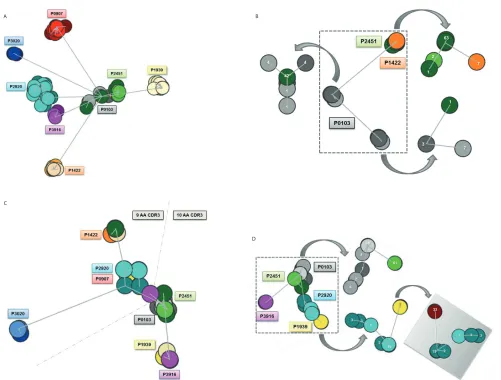
Analysis of the IGHV–IGHD–IGHJ amino acid sequences produced six dis-tinct clusters (Figure 1A). Four of these clusters were composed of subclonal se-quences obtained from different patients (P0907, P1422, P3020 and P1939), with each individualized cluster exhibiting a distinctive dispersion of clones, thus re-flecting the varying extent of ID among subset #4 cases (Supplemental Figure 1). The remaining two clusters largely con-sisted of sequences from two patients each (composite clusters). The first such cluster contained sequences from pa-tients P3916 and P2920 that grouped closely together. The second multimem-ber cluster primarily contained se-quences from two patients, P0103 and P2451; however, seven subcloned se-quences from patient P1422, stemming from two different time points also clus-tered within this group, while the major-ity of sequences from patient P1442 clus-tered separately and at some distance away (Figures 1A,B). Thus, subcloned se-quences from individual subset #4 cases clustered close together and behaved as if they were clonally related, that is, as if they stemmed from a community of clones with common ancestry. The ob-served branching may be indicative of
special selective pressures occurring in parallel in distinct subclones.
Similar analysis of the IGKV–IGKJ amino acid sequences produced five clusters (Figure 1C). Two clusters were located within a very close distance, forming a more central core from which a further two clusters emanated. More specifically, the first cluster was formed by two patients (P2920 and P0907), while the second closely neighboring cluster contained the subcloned sequences from P0103 and P2451. Subcloned sequences from P3916 bridged these two clusters (Figure 1D). Clonal sequences from P1422 formed one of the two more dis-tant clusters, while the other cluster was composed of clonal sequences from P1939. Patient P3020, previously found to carry limited ID despite bearing the highest SHM load (within both the IG heavy and light chain), was distanced from all other clusters. As with the clus-ter analysis of IG heavy chain sequences, we noted that individual IG kappa se-quences occasionally were separated from their respective clusters and, in-stead, attached to clusters generated by other patients and located some distance away. Hence, the pattern of clustering evidenced from the kappa light chain se-quences is analogous to that of their partner heavy chains, thereby reenforcing the idea that subset #4 essentially consti-tutes a community of related clones that follow closely similar ontogenetic and evolutionary pathways.
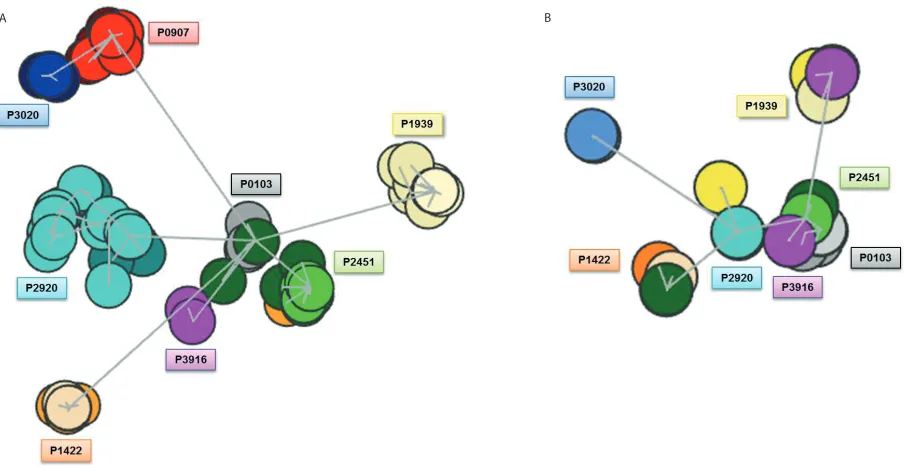
Clustering based on shared amino acid properties.Further comparisons were performed at the amino acid level by permitting a degree of ambiguity through the use of amino acid equiva-lences, that is, following the IMGT grouping of amino acids into classes based on distinct physicochemical or hy-dropathic properties. Excluding amino acids with the same physicochemical properties from the sequence distance-defining algorithm, that is, considering such amino acids as equal and, hence, not resulting in an overall change, re-sulted in a slight alteration to cluster for-mation. At the IG heavy chain level, five
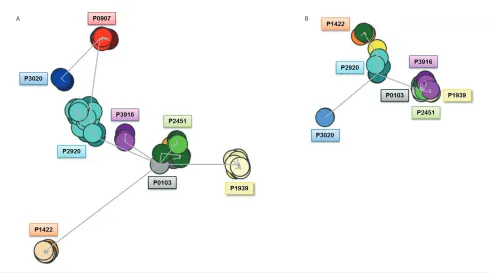
distinct clusters were now observed as opposed to the six clusters initially ob-served when physicochemical properties were included; this change primarily re-sulted from the clustering of P3020 with P0907 (previously occurring as two dis-tinct clusters) (Figure 2A). For subset #4 kappa light chains, the effect on cluster formation was very minor (Figure 2B).
When amino acids within the same hy-dropathy groups were considered as equal, it was noted that mutations intro-duced by SHM did not lead to striking changes in hydropathy for any patient. Nevertheless, one difference observed when clustering in this manner con-cerned the subcloned IG heavy chain se-quences of P3020 which, although re-maining as a distinct cluster, now emerged from the cluster produced by patient P0907; prior to taking physico-chemical properties or hydropathy into consideration, this cluster hailed from the central core cluster (Supplemental Fig-ures 2, 3). The observed clustering based on shared amino acid properties indicates strong functional constraints for preser-vation of critical physicochemical proper-ties; the limited range of permissible amino acids potentially reflects selection events governed by structural constraints for optimal antigen recognition.
B A
C
D
for three additional sequence changes as opposed to one at the amino acid level.
Taken collectively, this detailed com-putational reconstruction of CLL subset #4 clonal evolution based on merged IG sequence data for all eight cases (at ei-ther an amino acid or nucleotide level) reveals a convergent and unified tumori-genic evolutionary process. Thus, this framework is indicative of a “consensus path” of evolution for subset #4 cases with the branched evolutionary growth perhaps reflecting selective pressures honing their BcR affinities.
Tracing the Origins of CLL Subset #4: Molecular Phylogeny of CDR3 Sequences
Both the VH and VK CDR3s were vi-sualized hierarchically with the aim of constructing a CDR3 sequence at both the nucleotide and amino acid level, which then could be considered as the root from which all subset #4 CDR3 se-quences derive. Comparison of each
CDR3 sequence to the derived root se-quence, using the same algorithmic pro-cess applied throughout the entire vari-able domain, envari-abled us to identify the mutational path followed by each indi-vidual patient.
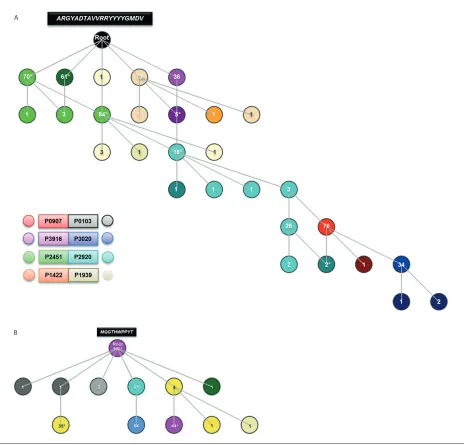
With regards to the VH CDR3, the de-rived root sequences for both nucleotide and amino acids, were GCG AGA GGC TAC GCG GAT ACA GCT GTG GTT AGG AGG TAC TAC TAT TAC GGT ATG GAC GTC and ARGYADTAVVRRYYYYGMDV, respectively. These sequences would have been created through the association of the IGHV4-34and IGHJ6genes with the IGHD5-18gene in reading frame 1. Within these sequence strings, GGC TAC GCG (translation: GYA) and AGG AGG (trans-lation: RR) cannot be assigned to the germline sequence of any IGHD and/or IGHJ gene, and thus would correspond to nontemplated regions (N1 and N2, re-spectively). Regarding the VK CDR3, the derived root nucleotide and amino acid sequences were ATG CAA GGC ACA
CAC TGG CCC CCG TAC ACT and MQGTHWPPYT, respectively, and would have been created by the association of the IGKV2-30and IGKJ2genes.
Comparison of the complete VH CDR3 amino acid sequence data set to the root revealed that no patient’s sequence ex-actly matched the root. That said, clonal sequences exhibiting the least differences were from patients P1422, P1939, P2451 and P3916 while P0907, P2920 and P3020 were those located furthest away (Fig-ure 4A). Within the VK CDR3 data set, 41% (162/397) of all kappa light chain se-quences were identical to the derived root. These sequences were from patients P0103 (n = 75), P2451 (n = 60) and P3916 (n = 27), while their few remaining quences together with the subclonal se-quences obtained from all other patients, contained only one or two differences, thus explaining the limited branching observed from the root (Figure 4B). Overall, by adopting this strategy we could for the first time propose the
A B
preimmune VH and VK CDR3 which forms the subset #4 BcR IG.
DISCUSSION
CLL subset #4 lies at the intersection between autoimmunity and malignancy. The expression of IGHV4-34endows B cells with the capacity to recognize the N-acetyllactosamine (NAL) antigenic epi-tope present in both self and exogenous antigens via a germline-encoded motif lo-cated within the heavy variable frame-work region 1 of the IGHV4-34gene (22,23). This motif remains intact in all CLL subset #4 IG heavy chain sequences despite a heavy SHM load and intense ID (3,4,10). Notably, recombinant mono-clonal antibodies from CLL subset #4 pa-tients have been found to bind viable B cells, recognizing the NAL epitope pres-ent on B-cell CD45 (24,25). Additional features encoded in the subset #4 IG BcR sequence that hint at autoreactivity
in-clude: (i) the predicted high electroposi-tivity of their long arginine-rich VH CDR3s, reminiscent of pathogenic anti-DNA antibodies; and (ii) the presence of recurrent SHMs typified by the frequent introduction of acidic residues, similar to edited anti-DNA antibodies (3,9).
The route to malignancy for CLL sub-set #4 clones may thus be a multifactor-ial phenomenon, beginning with autore-active precursors that undergo positive selection by DNA, nucleosomes and/or surface structures of apoptotic cells (26,27). Thereafter, modifications intro-duced by SHM may curtail this autore-activity, thus rendering these clones an-ergic (28–30), though still capable of reactivation either through their BcRs and/or other immune receptors, namely toll-like receptors (TLRs) (31–35). While this scenario bodes well for our under-standing of the evolutionary pathway followed by subset #4 clones, despite
much ingenuity and effort, our knowl-edge about the specific eliciting anti-gen(s) for subset #4 remains limited. Along these lines, it is relevant to men-tion that recombinant monoclonal anti-bodies derived from subset #4 patients lacked detectable reactivity with DNA, however, upon removal of SHMs (rever-sion to germline configuration), these antibodies regained the ability to strongly bind DNA (24). Nevertheless, owing to difficulties in defining the un-mutated progenitor rearrangement, mainly due to the extensive SHM pres-ent within subset #4 clones, the contribu-tion made by the somatically generated CDR3s to auto-antibody specificity (24,25,36–39) may have been underesti-mated, thus obscuring the actual anti-body-antigen interactions (40–42).
In an attempt to clarify and enhance our understanding of the ontogeny of CLL subset #4 B cells, we sought not
A B
only to reconstruct the evolutionary his-tory of subset #4 clones viewed as a single antibody lineage, that is, the se-quence of changes introduced into the lineage during the development of the clone, but also to identify the common ancestral sequence from which all
sub-set #4 cases are derived—a task hitherto unattainable due to the heavy SHM load within the antigen-binding sites. One means to obtain insight into the trajec-tory of subset #4 clones would be through characterization of their genetic sequence, with the greatest insight
ob-tained from longitudinal sampling. Con-sequently, for this purpose, we drew on a community of related clones profiled at different time points, for both heavy and light chains, derived from 8 subset #4 cases (12). The Damerau–Levenshtein distance algorithm, in the form of a
A
B
purpose-built computational tool, was applied and enabled us to infer both the unmutated ancestral rearrangement and the maturation intermediates, and hence gain further insight into the interplay between mutational constraints and se-lection on antigen-binding affinity.
Through this approach the focused evolution of subset #4, the evolution of single entities into a community of re-lated clones, was clearly evidenced with most patient clusters found lying very close to each other due to a high degree of sequence relatedness. The branching observed within such clusters could per-haps reflect specific selective pressures that occurred in parallel in distinct sub-clones, as a means to fine-tune their BcR affinities. Importantly, exploring the evo-lutionary trajectory of subset #4 enabled us to suggest for the first time the com-mon ancestral sequence from which all subset #4 cases likely descend. By deter-mining the most probable sequence of mutations, the mutationally preferred pathway, the unmutated common ances-tor (including the predicted VH CDR3) could be inferred, which could now serve as a template for antigen reactivity studies (which should better predict anti-gen specificities compared with previous studies). Defining the antigens bound by the CLL cells should aid in unraveling the path to malignancy in subset #4. We thus reason that knowledge of the subset #4 ancestral rearrangement could pro-vide a blueprint for the resolution of crystal structures, which would not only further define structural characteristics of the #4 antibody, but also provide de-tailed molecular insights into the nature of contact sites between the antibody and antigen.
CONCLUSION
The tale of CLL subset #4 is truly in-triguing; bestowed with autoreactive properties at birth, they fortuitously es-cape immunological tolerance and exist in an anergic state in the periphery, only to reemerge as immunocompetent cells (potentially due to dual engagement of the BcRs and TLRs). That said, the story
is far from complete and unresolved is-sues relate to where and under what in-fluence SHM (and also switching to the IgG isotype) occurs, and whether specific modalities of BcR/TLR collaboration and/or regulation may eventually im-pact on the biological behavior of the clones. Nevertheless, results from this study unveil new leads in the ontogeny of CLL subset #4 clones and bring fresh insights, which may directly impact the design of studies concerning the anti-genic specificity of the clonotypic BcR IGs. Although it is difficult to predict how revelations in biological under-standing may translate into improved immunological interventions, it seems reasonable to think that once a detailed understanding of the B-cell ontogeny of CLL subset #4 is achieved, doors for therapeutic strategies may open, for ex-ample, the design of peptides that would inhibit or alter the consequences of anti-gen-antibody interactions.
ACKNOWLEDGMENTS
This work was supported in part by the Swedish Cancer Society, the Swedish Research Council, and the Lion’s Cancer Research Foundation, Uppsala; the ENosAI project (code 09SYN-13-880) cofunded by the EU and the Hellenic General Secretariat for Research and Technology; the KRIPIS action, funded by the Hellenic General Secretariat for Research and Technology and the Euro-pean Regional Development Fund of the EU under the O.P. Competitiveness and Entrepreneurship, NSRF 2007-2013.
DISCLOSURE
The authors declare that they have no competing interests as defined by Molecu-lar Medicine, or other interests that might be perceived to influence the results and discussion reported in this paper.
REFERENCES
1. Stamatopoulos K, et al. (2007) Over 20% of pa-tients with chronic lymphocytic leukemia carry stereotyped receptors: Pathogenetic implications and clinical correlations. Blood. 109:259–70. 2. Baliakas P, et al. (2014) Clinical effect of
stereo-typed B-cell receptor immunoglobulins in
chronic lymphocytic leukaemia: a retrospective multicentre study. Lancet Haematol. 1:e74–84. 3. Murray F, et al. (2008) Stereotyped patterns of
so-matic hypermutation in subsets of patients with chronic lymphocytic leukemia: implications for the role of antigen selection in leukemogenesis.
Blood. 111:1524–33.
4. Agathangelidis A, et al. (2012) Stereotyped B-cell receptors in one-third of chronic lymphocytic leukemia: a molecular classification with implica-tions for targeted therapies. Blood. 119:4467–75. 5. Vardi A, et al. (2014) IgG-switched CLL has a
dis-tinct immunogenetic signature from the common MD variant: ontogenetic implications. Clin. Can-cer Res. 20:323–30.
6. Krishnan MR, Jou NT, Marion TN. (1996) Correla-tion between the amino acid posiCorrela-tion of arginine in VH-CDR3 and specificity for native DNA among autoimmune antibodies. J. Immunol. 157:2430–9. 7. Li Z, Schettino EW, Padlan EA, Ikematsu H,
Casali P. (2000) Structure-function analysis of a lupus anti-DNA autoantibody: central role of the heavy chain complementarity-determining re-gion 3 Arg in binding of double- and single-stranded DNA. Eur. J. Immunol. 30:2015–26. 8. Jang YJ, Stollar BD. (2003) Anti-DNA antibodies:
aspects of structure and pathogenicity. Cell. Mol.
Life Sci. 60:309–20.
9. Hadzidimitriou A, et al. (2009) Evidence for the significant role of immunoglobulin light chains in antigen recognition and selection in chronic lymphocytic leukemia. Blood. 113:403–11. 10. Sutton LA, et al. (2009) Extensive intraclonal
di-versification in a subgroup of chronic lympho-cytic leukemia patients with stereotyped IGHV4–34 receptors: implications for ongoing in-teractions with antigen. Blood. 114:4460–8. 11. Kostareli E, et al. (2010) Intraclonal diversification
of immunoglobulin light chains in a subset of chronic lymphocytic leukemia alludes to antigen-driven clonal evolution. Leukemia. 24:1317–24. 12. Sutton LA, et al. (2013) Temporal dynamics of
clonal evolution in chronic lymphocytic leukemia with stereotyped IGHV4–34/IGKV2–30 antigen receptors: longitudinal immunogenetic evidence.
Mol. Med. 19:230–6.
13. Hallek M, et al. (2008) Guidelines for the diagno-sis and treatment of chronic lymphocytic leukemia: a report from the International Work-shop on Chronic Lymphocytic Leukemia updat-ing the National Cancer Institute-Workupdat-ing Group 1996 guidelines. Blood. 111:5446–56.
14. Dang QT, Phan TH. (2010) Determining Restricted Damerau-Levenshtein Edit-Distance of Two Lan-guages by Extended Automata [Internet]. In: Com-puting and Communication Technologies, Research, In-novation, and Vision for the Future (RIVF), 2010 IEEE RIVF International Conference on; 2010 Nov 1–4; Hanoi. [cited 2015 Mar 31]. Available from: http:// ieeexplore.ieee.org/xpl/articleDetails.jsp?tp=&ar number=5632914&queryText%3DDetermining+ Restricted+Damerau-Levenshtein
on the Ordering of Common Elements. In: Model-ing Decisions for Artificial Intelligence: 5th Interna-tional Conference, MDAI 2008, Sabadell, Spain, Octo-ber 30-31, 2008, Proceedings. Torra V, Narukawa Y (eds.) Springer, Berlin, pp. 134–45.
16. Schulz MA, Schmalbach B, Brugger P, Witt K. (2012) Analysing humanly generated random number sequences: a pattern-based approach.
PloS One. 7:e41531.
17. Farris JS. (1972) Estimating phylogenetic trees from distance matrices. Am. Nat. 106:645–68. 18. Helmkamp LJ, Jewett EM, Rosenberg NA. (2012)
Improvements to a class of distance matrix meth-ods for inferring species trees from gene trees.
J. Comput. Biol. 19:632–49.
19. Meyer F, Najman L. (2013) Segmentation, mini-mum spanning tree and hierarchies. In: Mathe-matical morphology: From theory to applications. L N, H T (eds.) John Wiley & Sons, Hoboken, New Jersey, USA, pp. 229–61.
20. Marsh JW, et al. (2010) Multilocus number tandem-repeat analysis and multilocus sequence typing reveal genetic relationships among Clostridium difficile isolates genotyped by restriction endonuclease analysis. J. Clin. Mi-crobiol. 48:412–8.
21. Erciyes K. (2013) Minimum spanning trees. In:
Distributed graph algorithms for computer networks. Sammes AJ (ed.) Springer, pp. 69–82.
22. Silberstein LE, George A, Durdik JM, Kipps TJ. (1996) The V4–34 encoded anti-i autoantibodies recognize a large subset of human and mouse B-cells. Blood Cells Mol. Dis. 22:126–38. 23. Potter KN, Hobby P, Klijn S, Stevenson FK,
Sut-ton BJ. (2002) Evidence for involvement of a hy-drophobic patch in framework region 1 of human V4–34-encoded Igs in recognition of the red blood cell I antigen. J. Immunol. 169:3777–82. 24. Catera R, et al. (2008) Chronic lymphocytic leukemia
cells recognize conserved epitopes associated with apoptosis and oxidation. Mol. Med. 14:665–74. 25. Catera R, et al. (2006) Polyreactive monoclonal
antibodies synthesized by some B-CLL cells rec-ognize specific antigens on viable and apoptotic T cells. Blood. 108:2813.
26. Pugh-Bernard AE, et al. (2001) Regulation of in-herently autoreactive VH4–34 B cells in the main-tenance of human B cell tolerance. J. Clin. Invest. 108:1061–70.
27. Cappione AJ, Pugh-Bernard AE, Anolik JH, Sanz I. (2004) Lupus IgG VH4.34 antibodies bind to a 220-kDa glycoform of CD45/B220 on the surface of human B lymphocytes. J. Immunol. 172:4298–307. 28. Cocca BA, et al. (2001) Structural basis for auto
-antibody recognition of phosphatidylserine-beta 2 glycoprotein I and apoptotic cells. Proc. Natl.
Acad. Sci. U. S. A. 98:13826–31.
29. Li Y, Li H, Ni D, Weigert M. (2002) Anti-DNA B cells in MRL/lpr mice show altered differentia-tion and editing pattern. J. Exp. Med. 196:1543–52. 30. Behrendt M, et al. (2003) The role of somatic
mu-tation in determining the affinity of anti-DNA antibodies. Clin. Exp. Immunol. 131:182–9. 31. Kostareli E, et al. (2009) Molecular evidence for
EBV and CMV persistence in a subset of patients with chronic lymphocytic leukemia expressing stereotyped IGHV4–34 B-cell receptors. Leukemia. 23:919–24.
32. Ntoufa S, et al. (2012) Distinct innate immunity pathways to activation and tolerance in sub-groups of chronic lymphocytic leukemia with distinct immunoglobulin receptors. Mol. Med. 18:1281–91.
33. Duty JA, et al. (2009) Functional anergy in a sub-population of naive B cells from healthy humans that express autoreactive immunoglobulin recep-tors. J. Exp. Med. 206:139–51.
34. Andrews SF, Wilson PC. (2010) The anergic B cell. Blood. 115:4976–8.
35. Chatzouli M, et al. (2014) Heterogeneous func-tional effects of concomitant B cell receptor and TLR stimulation in chronic lymphocytic leukemia with mutated versus unmutated Ig genes. J. Immunol. 192:4518–24.
36. Herve M, et al. (2005) Unmutated and mutated chronic lymphocytic leukemias derive from self-re-active B cell precursors despite expressing differ-ent antibody reactivity. J. Clin. Invest. 115:1636–43. 37. Chu CC, et al. (2008) Chronic lymphocytic
leukemia antibodies with a common stereotypic rearrangement recognize nonmuscle myosin heavy chain IIA. Blood. 112:5122–9.
38. Chu CC, et al. (2010) Many chronic lymphocytic leukemia antibodies recognize apoptotic cells with exposed nonmuscle myosin heavy chain IIA: implications for patient outcome and cell of origin. Blood. 115:3907–15.
39. Zwick C, et al. (2013) Autoantigenic targets of -cell receptors derived from chronic lymphocytic leukemias bind to and induce proliferation of leukemic cells. Blood. 121:4708–17.
40. Wellmann U, et al. (2005) The evolution of human anti-double-stranded DNA autoantibod-ies. Proc. Natl. Acad. Sci. U. S. A. 102:9258–63. 41. Lambrianides A, et al. (2007) Arginine mutation
alters binding of a human monoclonal antibody to antigens linked to systemic lupus erythemato-sus and the antiphospholipid syndrome. Arthritis
Rheum. 56:2392–401.