The FBK Participation in the WMT 2016
Automatic Post-editing Shared Task
Rajen Chatterjee(1,2), Jos´e G. C. de Souza(2), Matteo Negri(2), Marco Turchi(2) (1)University of Trento, Italy
(2)Fondazione Bruno Kessler, Italy
{chatterjee, desouza, negri, turchi}@fbk.eu
Abstract
In this paper, we present a novel approach to combine the two variants of phrase-based APE (monolingual and context-aware) by a factored machine translation model that is able to leverage benefits from both. Our factored APE models in-clude part-of-speech-tag and class-based neural language models (LM) along with statistical word-based LM to improve the fluency of the post-edits. These models are built upon a data augmentation tech-nique which helps to mitigate the problem of over-correction in phrase-based APE systems. Our primary APE system fur-ther incorporates a quality estimation (QE) model, which aims to select the best trans-lation between the MT output and the automatic post-edit. According to the shared task results, our primary and con-trastive (which does not include the QE module) submissions have similar perfor-mance and achieved significant improve-ment of 3.31% TER and 4.25% BLEU (relative) over the baseline MT system on the English-German evaluation set.
1 Introduction
Translation from and to multiple languages is a growing need of this era. Especially in a multilin-gual continent like Europe this poses a challenge to the language service providers (LSPs) that need to quickly deliver high quality translations. To cope with the increasing demand, the LSPs have shifted human translation from a completely man-ual process to a semi-automated one, with the help of computer-assisted translation (CAT) tools. CAT tools are indeed becoming a standard and ubiqui-tous tool for LSPs, which have to daily face the
trade-off between quality and productivity, under the pressure of a growing demand. Machines, however, are not yet perfect: machine translation (MT), in particular, is often prone to systematic errors that human post-editing (PE) has to fix be-fore publication. This process of translation re-sults in the generation of parallel data consisting of MT output on one side and its corrected ver-sion on the other side. This data can be leveraged to develop Automatic Post-Editing (APE) systems capable not only to spot recurring MT errors, but also to correct them (in a broad sense, ranging from fixing typos to adapting terminology to a spe-cific domain or even modeling the personal style of an individual translator). These capabilities be-come crucial especially when the MT system used to produce the translation suggestions is a “black-box” whose inner workings are not accessible and can not be tuned or re-trained (a frequent condition for small LSPs).
A recent study on APE by Chatterjee et al. (2015b) over six language pairs have reported consistent improvement (7.3% to 14.7% TER re-duction) in the quality of machine translated text across all language pairs. They performed the experiments using the state-of-the-art statistical phrase-based machine translation technique with two variants, which are discussed briefly in Sec-tion 2. Based on the observed complementarity between the two variants and the room for mutual improvement, in Section 3 we present a factored APE model capable to leverage the two methods. In Section 4 we describe how to create different representations of the data in order to train each of the variants (monolingual, context-aware) and the factored models. Different configurations of our experiments and their corresponding results are discussed in Section 5. The results of our sub-missions in the shared task are reported in Section 6, followed by concluding remarks in Section 7.
2 Statistical APE Approaches
Most of the current statistical APE systems follow the phrase-based machine translation approach. They mainly differ in the way the data is repre-sented in the parallel corpus. Unlike MT systems where the parallel corpus is made up of source and target language texts, APE systems use either i) MT text or ii) MT text with source annotations on the source side, and post-edits on the target side of the parallel corpus. The former variant (to use only MT text on the source side) was proposed by Simard et al. (2007), also known as monolingual
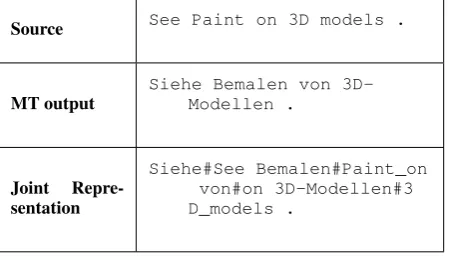
translation, and the latter variant was proposed by B´echara et al. (2011), which is known as context-aware translation. The monolingual translation approach is more robust, it better generalizes the post-editing rules, and is less prone to word align-ment errors which eventually impact on the qual-ity of the post-editing rules. However, since the post-editing rules are learned from (mt, pe) (mt: machine translated;pe: post-edited) pairs, it loses connection with the source sentence, which im-plies that information lost or distorted in the ma-chine translation process are impossible to recover by the APE system. This issue was addressed by thecontext-awarevariant that annotates each word in the machine translated text by the correspond-ing source word (obtained from word alignment information between the mt and source text) to form a joint representation (mt#source) that rep-resents the new source side of the parallel corpus (as shown in Table 1).
Source See Paint on 3D models .
MT output Siehe Bemalen von 3D-Modellen .
Joint Repre-sentation
[image:2.595.73.298.520.648.2]Siehe#See Bemalen#Paint_on von#on 3D-Modellen#3 D_models .
Table 1: An example of joint representation used incontext-awaretranslation.
APE systems trained with the context-aware
variant are more precise because they have the power to disambiguate when a mt word is a cor-rect translation and when it should be post-edited, by having knowledge of the source context.
How-ever, this variant faces two potential problems. First, preserving the source context results in mul-tiple representations of the samemtword (eachmt
word can be aligned to multiple source words), causing a high increase of the vocabulary size, and, consequently, higher data sparseness that will eventually reduce the reliability of the word alignments and, consequently, of the post-editing rules. Second, the joint representation (mt#source) may be affected by the word alignment errors which may mislead the learning of translation op-tions. Moreover, a technical problem with this representation occurs during tuning of the system. Since the input is a joint representation, the OOVs (mt#source) penalize the tuning metric even if the
mtinmt#sourceis a correct translation thereby af-fecting the tuning process. To address these issues and to leverage the complementarity of the two al-ternative APE approaches, we propose a more el-egant approach that combines them into a factored model as described in the following section.
3 Factored APE model
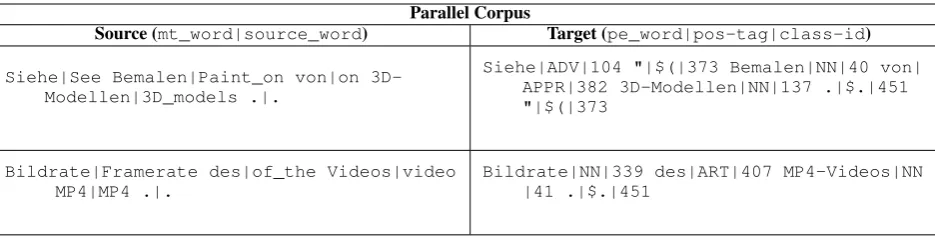
The factored machine translation model was pro-posed by Koehn and Hoang (2007). It enables a straightforward integration of additional annota-tion (called factors) at the word-level. These fac-tors can be linguistic markup or automatically gen-erated word classes. To build our factored APE systems, we pre-process the training data to obtain the factored representation. A fragment of our par-allel corpus with factored representation is shown in Table 2. The source side of the parallel corpus has 2 factors (mt wordandsource word, similar to the joint representation), and the target side con-tains 3 factors (pe word,pos-tag, andclass-id). In this representation we can define:
• A word alignment mapping between
mt word<->pe word. This helps to
mit-igate the problem of word alignment of
context-awareAPE approach;
• A translation mapping between mt word< ->pe word (monolingual translation), and
mt word|source word<->pe word ( context-awaretranslation). This allows us to leverage both the models during decoding;
• A generation mapping between pe word< ->pos-tag, andpe word<->class-id. This
trans-Parallel Corpus
Source (mt_word|source_word) Target (pe_word|pos-tag|class-id)
[image:3.595.76.544.62.181.2]Siehe|See Bemalen|Paint_on von|on 3D-Modellen|3D_models .|.
Siehe|ADV|104 "|$(|373 Bemalen|NN|40 von| APPR|382 3D-Modellen|NN|137 .|$.|451 "|$(|373
Bildrate|Framerate des|of_the Videos|video MP4|MP4 .|.
Bildrate|NN|339 des|ART|407 MP4-Videos|NN |41 .|$.|451
Table 2: Example of parallel corpus with factored representation.
lations by scoring them with both part-of-speech tag and class-based language models.
Source factors: The factor on the source side of the parallel corpus is obtained following the ap-proach to obtain the joint representation (as de-scribed in Section 2) for context-awareAPE, the only difference is that instead of joint representa-tion (mt#source) we now have factored representa-tion (mt|source) suitable to train factored models. Target factors: We introduce two target factors to measure fluency of the translations at syntac-tic and semansyntac-tic levels, i) POS-tag (∼50 tags)
ob-tained using the TreeTagger (Schmid, 1995), and ii) word-class id (∼500 classes) obtained using
mkcls1 tool, which clusters words based on
bi-gram contextual similarity. These factors are used to learn generation models (P(pos-tag|pe) and
P(class-id|pe)) to generate corresponding target
factors for the test sentence, which are scored by their respective LMs during decoding.
4 Data set and Experimental setup
As defined in the shared task, the training data (English-German) consist of 12K triplets of source (src), MT output (mt), and human post-edits (pe). We split the development data (consisting of 1K triplets) released in this shared task into 400 and 600 triplets (selected randomly) to tune and eval-uate our APE systems. We use the pe from the training data to build a 5-gram word-based sta-tistical language model using the KENLM toolkit (Heafield, 2011), and 8-gram POS-tag and class-based language model using both KENLM (sta-tistical) and the NPLM (neural) (Vaswani et al., 2013) toolkit. To build the joint representation (mt#src) and to obtain source factors (mt|src), we
use the word alignment model trained onsrc and
1https://github.com/clab/mkcls
mt pairs of the training data by using MGIZA++ (Gao and Vogel, 2008).
To develop the APE systems we use the phrase-based statistical machine translation toolkit MOSES (Koehn et al., 2007) with alignment heuristic set to “grow-diag-final-and”, and re-ordering heuristic to “msd-bidirectional-fe”. For building the word alignment models we use MGIZA++ (Gao and Vogel, 2008). For tuning the feature weights we use MERT (Och, 2003) opti-mizing TER (Snover et al., 2006).
We run case-sensitive evaluation with TER, which is based on edit distance, and BLEU (Pa-pineni et al., 2002), which is based on modified n-gram precision. In addition to the standard evaluation metrics, we also measure precision of our APE system using sentence level TER score as defined in Chatterjee et al. (2015a)
Precision = Number of Improved Sentences Number of Modified Sentences where the “Number of Improved Sentences” consists in all the APE outputs that have lower TER than the corresponding MT output and the “Number of Modified Sentences” consists in all the APE outputs that have TER scores different from the TER of the corresponding MT output.
5 Experiments and Results
word-POS-tag LM Class-based LM POS-tag & Class-based LM
Approach TER BLEU Precision TER BLEU Precision TER BLEU Precision
Statistical 24.20 64.29 63.88 24.28 65.08 67.27 24.22 65.12 70.25
[image:4.595.68.526.63.114.2]Neural 24.06 65.27 71.85 24.07 65.04 68.92 24.07 65.31 72.72
Table 3: Performance of the Factored APE-2 for various LMs (statistical word-based LM is present in all the experiments by default).
s/phrases which are already correct in the MT out-put.
Baselines TER BLEU Precision
MT system 24.80 63.07
-APE-1 24.73 64.55 55.55
[image:4.595.90.267.211.255.2]APE-2 24.68 64.01 54.01
Table 4: Performance of the APE baselines.
Addressing over-correction: In order to avoid the problem of over-correction (making unneces-sary corrections), the APE system should learn to preserve the chunks of the input which are already correct. To this aim, we augmented the paral-lel corpus with the post-editions (12K) available in the training data. So now our training corpus consist of 12Kmt-peormt#src-pepairs (to learn post-editing rules) and an additional 12Kpe-peor
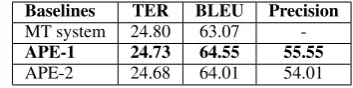
pe#src-pepairs (to preserve correct input chunks). Replicating the baseline APE systems with the augmented data showed significant improvements with all the evaluation metrics as reported in Table 5. For this reason, we use the augmented parallel data in all the further experiments. Among the two variants we noticed that the APE-2 gets maximum benefit with an absolute precision improvement of 16.40% (from 54.01% to 70.41%).
TER BLEU Precision
APE-1 24.46 64.74 63.27
APE-2 24.08 64.88 70.41
Table 5: Performance of the APE system with data augmentation technique.
Factored APE models: Both the APE variants have their own strengths and weaknesses as dis-cussed in Section 2. To leverage their comple-mentarity, we use factored translation approach as described in Section 3. Before combining the two variants, we decided to replicate the context-awarevariant in the factored architecture (since it achieved the best performance as reported in Ta-ble 5) with the integration of different target LMs. Along with the 5-gram statistical word-based LM,
we study the effect on the performance of the APE system of using an additional 8-gram statistical as well as a neural POS-tag and a class-based LMs. The results are reported in Table 3. It is evident that the neural LM performs better than the statis-tical ones, and the combination of both POS-tag and class-based neural LM has slightly better pre-cision than the individual neural LMs.
We hence decided to use the neural POS-tag and the class-based LMs along with statistical word-based LM for both the variants (monolingualand
context-aware) in the factored architecture. The translation models of both the variants are used to-gether during decoding with the help of the mul-tiple decoding feature available in the MOSES toolkit (Koehn et al., 2007). The results of this combined factored APE system for various tuning strategies (i) MERT to optimize TER, ii) MERT to optimize BLEU, and iii) MIRA to optimize BLEU are shown in Table 6. Although the TER is almost the same for different tuning strategies, but slight improvement is observed with MIRA in terms of BLEU score.
Optimization TER BLEU Precision
MERT-TER 24.03 65.03 69.71 MERT-BLEU 24.07 65.47 65.67
MIRA-BLEU
[image:4.595.314.516.494.550.2](Contrastive) 24.04 65.56 67.47
Table 6: Performance of the combined factored model for various tuning configurations.
Factored APE model with quality estimation:
the source sentence) and adequacy (e.g. ratio be-tween the number of nouns in the source and trans-lation sentences). These features, obtained with the QuEst feature extractor implementation (Spe-cia et al., 2013) are used to train a regression model that predicts the actual post-editing effort as measured by the TER between the MT-generated translation or the factored APE output and a hu-man post-edited version. The regression model was trained using the extremly randomized trees (Geurts et al., 2006) implementation of scikit-learn library (Pedregosa et al., 2011). This method reached competitive results in sentence-level QE share-tasks in previous years (C. de Souza et al., 2013; C. de Souza et al., 2014). To select the fi-nal translation we check if the predicted score of MT output is lower2 than the predicted score of
the APE output by at least k points (threshold). We performed experiments with different thresh-old values, as reported in Table 7. Using QE with threshold of 5 performs slightly better than the one without QE, so our primary submission is the fac-tored model with QE, whereas, the contrastive one is without QE.
Threshold TER BLEU Precision
1 24.18 65.09 72.13
2 24.15 65.34 70.88
3 24.09 65.51 68.15
4 24.02 65.59 68.94
5 (Primary) 23.99 65.65 67.83
6 24.01 65.64 67.98
Contrastive (w/o
QE) 24.04 65.56 67.47
Baseline (MT) 24.80 63.07
-Table 7: Performance of the APE system with quality estimation for various thresholds.
6 Results of our submissions
The shared task evaluation was on 2,000 unseen samples consisting of source and mt pairs from the same domain of the training data. Our pri-mary submission is a factored APE system which i) is trained with data augmentation technique, ii) leverages the two statistical phrase-based variants (monolingual, andcontext-aware), iii) uses a neu-ral POS-tag and class-based LMs along with the statistical word-based LM, and iv) uses a quality estimation model. Our contrastive submission is similar to primary but without quality estimation.
2Lower is better since we are predicting TER scores
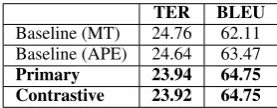
According to the shared task results (reported in Table 8) both of our submissions achieves simi-lar performance (with minimal difference in TER) with significant improvement of 3.31% TER and 4.25% BLEU (relative) over the baseline MT sys-tem. We also observe that the use of quality esti-mation in our primary submission did not yield the expected improvements.
TER BLEU
Baseline (MT) 24.76 62.11 Baseline (APE) 24.64 63.47
[image:5.595.346.485.181.235.2]Primary 23.94 64.75 Contrastive 23.92 64.75
Table 8: Results of the shared task for our submis-sions
7 Conclusion
In this system description paper, we discussed the potential strength and weakness of the two phrase-based APE variants (monolingual and context-aware) and showed that their complementarity can be leveraged by combining them in a factored APE model. Factored models made it possible to in-tegrate several target LMs and study their effect on the performance of the APE systems. From our experiments on LMs, we learn that i) using both the POS-tag, and the class-based LM in the APE system is better than using them in isolation, ii) building these LMs using neural approach is much better than statistical ones, and iii) the best LM combination achieves 0.4 BLEU improve-ment (from 64.88 to 65.31) over the APE system which do not use these LMs. We also showed that the problem of over-correction in phrase-based APE can be mitigated by our data augmentation technique which showed significant improvement of 0.6 TER, 0.8 BLEU, and 16.40% precision, for
context-awarevariant, over APE system which do not use data augmentation. Performance of our primary and contrastive submissions to the shared task were similar with a significant improvement of 3.31% TER and 4.25% BLEU (relative) over the baseline MT system. However, having a layer of quality estimation in our primary submission did not yield expected improvement.
8 Acknowledgements
[image:5.595.80.283.400.512.2]References
Hanna B´echara, Yanjun Ma, and Josef van Genabith. 2011. Statistical post-editing for a statistical mt
sys-tem. InProceedings of the XIII MT Summit, pages
308–315.
Jos´e G. C. de Souza, Christian Buck, Marco Turchi, and Matteo Negri. 2013. FBK-UEdin participation to the WMT13 Quality Estimation shared-task. In Proceedings of the Eighth Workshop on Statistical Machine Translation, pages 352–358.
Jos´e G. C. de Souza, Jes´us Gonz´alez-Rubio, Chris-tian Buck, Marco Turchi, and Matteo Negri. 2014. FBK-UPV-UEdin participation in the WMT14
Quality Estimation shared-task. InProceedings of
the Ninth Workshop on Statistical Machine Transla-tion, Baltimore, MD, USA, June.
Jos´e G. C. de Souza, Matteo Negri, Elisa Ricci, and Marco Turchi. 2015. Online Multitask Learning for Machine Translation Quality Estimation. In Pro-ceedings of the 53rd Annual Meeting of the Associ-ation for ComputAssoci-ational Linguistics and the 7th In-ternational Joint Conference on Natural Language Processing (Volume 1: Long Papers), pages 219– 228, Beijing, China, July.
Rajen Chatterjee, Marco Turchi, and Matteo Negri. 2015a. The fbk participation in the wmt15 auto-matic post-editing shared task. InProceedings of the Tenth Workshop on Statistical Machine Translation, pages 210–215.
Rajen Chatterjee, Marion Weller, Matteo Negri, and Marco Turchi. 2015b. Exploring the Planet of the APEs: a Comparative Study of State-of-the-art
Methods for MT Automatic Post-Editing. In
Pro-ceedings of the 53rd Annual Meeting of the Associa-tion for ComputaAssocia-tional Linguistics, Beijing, China.
Qin Gao and Stephan Vogel. 2008. Parallel
implemen-tations of word alignment tool. In Software
Engi-neering, Testing, and Quality Assurance for Natural Language Processing, pages 49–57.
Pierre Geurts, Damien Ernst, and Louis Wehenkel.
2006. Extremely randomized trees. Machine
Learn-ing, 63(1):3–42, April.
Kenneth Heafield. 2011. Kenlm: Faster and smaller language model queries. InProceedings of the Sixth Workshop on Statistical Machine Translation, pages 187–197.
Philipp Koehn and Hieu Hoang. 2007. Factored
trans-lation models. In Proceedings of EMNLP-CoNLL,
pages 868–876.
Philipp Koehn, Hieu Hoang, Alexandra Birch, Chris Callison-Burch, Marcello Federico, Nicola Bertoldi, Brooke Cowan, Wade Shen, Christine Moran, Richard Zens, et al. 2007. Moses: Open source toolkit for statistical machine translation. In Pro-ceedings of the 45th annual meeting of the ACL on
interactive poster and demonstration sessions, pages 177–180.
Yashar Mehdad, Matteo Negri, and Marcello Fed-erico. 2012. Match without a Referee: Evaluating MT Adequacy without Reference Translations. In Proceedings of the Machine Translation Workshop (WMT2012), pages 171–180, Montr´eal, Canada.
Franz Josef Och. 2003. Minimum error rate training in statistical machine translation. InProceedings of the 41st Annual Meeting on Association for Compu-tational Linguistics-Volume 1, pages 160–167.
Kishore Papineni, Salim Roukos, Todd Ward, and Wei-Jing Zhu. 2002. Bleu: a method for automatic
evaluation of machine translation. In Proceedings
of the 40th annual meeting on association for com-putational linguistics, pages 311–318.
Fabian Pedregosa, Ga¨el Varoquaux, Alexandre Gram-fort, Vincent Michel, Bertrand Thirion, Olivier Grisel, Mathieu Blondel, Peter Prettenhofer, Ron Weiss, Vincent Dubourg, Jake Vanderplas, Alexan-dre Passos, David Cournapeau, Mathieu Brucher, Mathieu Perrot, and ´Edouard Duchesnay. 2011.
Scikit-learn : Machine Learning in Python. Journal
of Machine Learning Research, 12:2825–2830.
Helmut Schmid. 1995. Improvements in part-of-speech tagging with an application to german. In Proceedings of the Association for Computational Linguistics SIGDAT-Workshop.
Michel Simard, Cyril Goutte, and Pierre Isabelle. 2007. Statistical Phrase-Based Post-Editing. In Proceedings of the Annual Conference of the North American Chapter of the Association for Compu-tational Linguistics (NAACL HLT), pages 508–515, Rochester, New York.
Matthew Snover, Bonnie Dorr, Richard Schwartz, Lin-nea Micciulla, and John Makhoul. 2006. A study of translation edit rate with targeted human annotation. In Proceedings of association for machine transla-tion in the Americas, pages 223–231.
Lucia Specia, Kashif Shah, Jos´e G. C. de Souza, and Trevor Cohn. 2013. QuEstA translation quality
es-timation framework. InProceedings of the 51st
An-nual Meeting of the Association for Computational Linguistics, pages 79–84.
Marco Turchi, Antonios Anastasopoulos, Jos´e G. C. de Souza, and Matteo Negri. 2014. Adaptive Qual-ity Estimation for Machine Translation. In Proceed-ings of the 52nd Annual Meeting of the Association for Computational Linguistics, ACL ’14.