Multinomial Adversarial Networks for Multi-Domain Text Classification
Xilun Chen
Department of Computer Science Cornell Unversity
Ithaca, NY, 14853, USA [email protected]
Claire Cardie
Department of Computer Science Cornell Unversity
Ithaca, NY, 14853, USA [email protected]
Abstract
Many text classification tasks are known to be highly domain-dependent. Unfortunately, the availability of training data can vary drasti-cally across domains. Worse still, for some domains there may not be any annotated data at all. In this work, we propose a multino-mial adversarial network1(MAN) to tackle this real-world problem of multi-domain text clas-sification (MDTC) in which labeled data may exist for multiple domains, but in insufficient amounts to train effective classifiers for one or more of the domains. We provide theo-retical justifications for the MAN framework, proving that different instances of MANs are essentially minimizers of various f-divergence metrics (Ali and Silvey,1966) among multi-ple probability distributions. MANs are thus a theoretically sound generalization of tradi-tional adversarial networks that discriminate overtwodistributions. More specifically, for the MDTC task,MANlearns features that are invariant across multiple domains by resort-ing to its ability to reduce the divergence among the feature distributions of each do-main. We present experimental results show-ing that MANs significantly outperform the prior art on the MDTC task. We also show that MANs achieve state-of-the-art performance for domains with no labeled data.
1 Introduction
Text classification is one of the most fundamen-tal tasks in Natural Language Processing, and has found its way into a wide spectrum of NLP ap-plications, ranging from email spam detection and social media analytics to sentiment analysis and data mining. Over the past couple of decades, supervised statistical learning methods have be-come the dominant approach for text classification
1The source code of MAN is available at https://
github.com/ccsasuke/man.
(e.g. McCallum et al. (1998); Kim (2014); Iyyer et al.(2015)). Unfortunately, many text classifica-tion tasks are highly domain-dependent in that a text classifier trained using labeled data from one domain is likely to perform poorly on another. In the task of sentiment classification, for example, the phrase “runs fast” is usually associated with positive sentiment in the sports domain; not so when a user is reviewing the battery of an elec-tronic device. In real applications, therefore, an adequate amount of training data from each do-main of interest is typically required, and this is expensive to obtain.
Two major lines of work attempt to tackle this challenge: domain adaptation (Blitzer et al.,2007) andmulti-domain text classification
(MDTC) (Li and Zong, 2008). In domain adap-tation, the assumption is that there is some main with abundant training data (the source do-main), and the goal is to utilize knowledge learned from the source domain to help perform classifica-tions on another lower-resourced target domain.2
The focus of this work, MDTC, instead simulates an arguably more realistic scenario, where labeled data may exist for multiple domains, but in insuffi-cient amounts to train an effective classifier for one or more of the domains. Worse still, some domains may haveno labeled data at all. The objective of MDTC is to leverageallthe available resources in order to improve the system performance over all domains simultaneously.
One state-of-the-art system for MDTC, the CMSC system of Wu and Huang (2015), com-bines a classifier that is shared across all do-mains (for learning domain-invariant knowledge) with a set of classifiers, one per domain, each of which captures domain-specific text classification knowledge. This paradigm is sometimes known
2See
§6for other variants of domain adaptation.
as the Shared-Private model (Bousmalis et al.,
2016). CMSC, however, lacks an explicit mech-anism to ensure that the shared classifier captures only domain-independent knowledge: the shared classifier may well also acquire some domain-specific features that are useful for a subset of the domains. We hypothesize that better performance can be obtained if this constraint were explicitly enforced.
In this paper, we thus propose Multinomial Ad-versarial Networks (henceforth,MANs) for the task of multi-domain text classification. In contrast to standard adversarial networks (Goodfellow et al.,
2014), which serve as a tool for minimizing the divergence between two distributions (Nowozin et al., 2016),MANs represent a family of theoret-ically sound adversarial networks that, in contrast, leverage a multinomial discriminator to directly minimize the divergence among multiple proba-bility distributions. And just as binomial adversar-ial networks have been applied to numerous tasks (e.g. image generation (Goodfellow et al.,2014), domain adaptation (Ganin et al., 2016), cross-lingual text classification (Chen et al.,2016)), we anticipate thatMANs will make a versatile machine learning framework with applications beyond the MDTC task studied in this work.
We introduce the MAN architecture in §2 and prove in§3that it directly minimizes the (gener-alized) f-divergence among multiple distributions so that they are indistinguishable upon successful training. Specifically for MDTC,MAN is used to overcome the aforementioned limitation in prior art where domain-specific features may sneak into the shared model. This is accomplished by rely-ing onMAN’s power of minimizing the divergence among the feature distributions of each domain. The high-level idea is thatMANwill make the ex-tracted feature distributions of each domain indis-tinguishable from one another, thus learning gen-eral features that are invariant across domains.
We then validate the effectiveness of MAN in experiments on two MDTC data sets. We find first that MANsignificantly outperforms the state-of-the-art CMSC method (Wu and Huang,2015) on the widely used multi-domain Amazon review dataset, and does so without relying on external re-sources such as sentiment lexica (§4.1). When ap-plied to the second dataset, FDU-MTL (§4.3), we obtain similar results: MANachieves substantially higher accuracy than the previous top-performing
method, ASP-MTL (Liu et al.,2017). ASP-MTL is the first empirical attempt to use a multinomial adversarial network for multi-task learning, but is more restricted and can be viewed as a special case ofMAN. In addition, we provide the first theoretical guarantees for multinomial adversarial networks (§3). Finally, while many MDTC methods such as CMSC require labeled data for each domain,MANs can be applied in cases where no labeled data ex-ists for a subset of domains. To evaluate MAN in this semi-supervised setting, we compareMANto a method that can accommodate unlabeled data for (only) one domain (Zhao et al.,2017), and show thatMANachieves performance comparable to the state of the art (§4.2).
2 Model
In this paper, we strive to tackle the text classifi-cation problem in the real-world setting in which texts come from a variety of domains, each with a varying amount of labeled data. Specifically, as-sume we have a total ofN domains,N1 labeled
domains(denoted as L) for which there is some
labeled data, andN2 unlabeled domains( U) for which no annotated training instances are avail-able. Denote = L[ U as the collection of all domains, withN =N1+N2. The goal of
this work, and of MDTC in general, is to improve the overall classification performance across allN
domains, measured in this paper as the average3
classification accuracy across theNdomains in .
2.1 Model Architecture
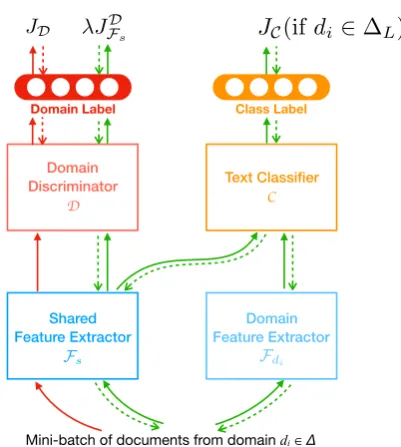
As shown in Figure 1, the Multinomial Adver-sarial Network (MAN) adopts the Shared-Private paradigm ofBousmalis et al.(2016) and consists of four components: ashared feature extractorFs,
a domain feature extractor Fdi for each labeled
domaindi 2 L, atext classifierC, and adomain
discriminatorD. The main idea of MANis to
ex-plicitly model the domain-invariant features that are beneficial to the main classification task across all domains (i.e. theshared features, extracted by Fs), as well as the domain-specific features that mainly contribute to the classification in its own domain (the domain features, extracted by Fd). Here, the adversarial domain discriminatorDhas a multinomial output that takes a shared feature
Forward and backward passes when updating the parameters of Fs, Fd and C
Forward and backward passes when updating the parameters of D
Shared Feature Extractor
Domain Feature Extractor
Mini-batch of documents from domain di∈Δ Text Classifier
C
Domain Discriminator
D
Class Label
Domain Label JFsD
JD JC(if di 2 L)
Fdi
[image:3.595.86.287.57.281.2]Fs
Figure 1:MANfor MDTC. The figure demonstrates the training on a mini-batch of data from one domain. One training iteration consists of one such mini-batch train-ing from each domain. The parameters ofFs,Fd,Care
updated together, and the training flows are illustrated by the green arrows. The parameters ofDare updated separately, shown in red arrows. Solid lines indicate forward passes while dotted lines are backward passes.
JFDs is the domain loss forFs, which is anticorrelated
withJD(e.g.JFDs= JD). (See§2,§3)
vector and predicts the likelihood of that sample coming from each domain. As seen in Figure1, during the training ofFs(green arrows denote the training flow),Fsaims to confuseDby minimiz-ingJFDs, which is anticorrelated toJD(detailed in §2.2), so that D cannot predict the domain of a sample given its shared features. The intuition is that if even a strong discriminatorDcannot tell the domain of a sample from the extracted features, those features Fs learned are essentially domain invariant. By enforcing domain-invariant features to be learned byFs, when trained jointly via back-propagation, the set of domain feature extractors Fdwill each learn domain-specific features bene-ficial within its own domain.
The architecture of each component is relatively flexible, and can be decided by the practitioners to suit their particular classification tasks. For in-stance, the feature extractors can adopt the form of Convolutional Neural Nets (CNN), Recurrent Neural Nets (RNN), or a Multi-Layer Perceptron (MLP), depending on the input data (see§4). The input ofMANwill also be dependent on the feature
Algorithm 1MANTraining
Require: labeled corpusX; unlabeled corpusU;
Hyperpa-mameter >0,k2N
1: repeat
2: .Diterations 3: forditer= 1tokdo 4: lD= 0
5: for alld2 do .For allNdomains
6: Sample a mini-batchx⇠Ud
7: fs=Fs(x) .Shared feature vector
8: lD+=JD(D(fs);d) .AccumulateDloss
9: UpdateDparameters usingrlD 10: .Main iteration
11: loss= 0
12: for alld2 Ldo .For all labeled domains
13: Sample a mini-batch(x,y)⇠Xd
14: fs=Fs(x)
15: fd=Fd(x) .Domain feature vector
16: loss+=JC(C(fs,fd);y) .ComputeCloss
17: for alld2 do .For allNdomains
18: Sample a mini-batchx⇠Ud
19: fs=Fs(x)
20: loss+= ·JD
Fs(D(fs);d) .Domain loss ofFs 21: UpdateFs,Fd,Cparameters usingrloss
22: untilconvergence
extractor choice. The output of a (shared/domain) feature extractor is a fixed-length vector, which is considered the (shared/domain) hidden features of some given input text. On the other hand, the out-puts of C and D are label probabilities for class and domain prediction, respectively. For example, bothCandDcan be MLPs with a softmax layer on top. In§3, we provide alternative architectures for D and their mathematical implications. We now present a detailed description of theMANtraining in§2.2as well as the theoretical grounds in§3.
2.2 Training
Denote the annotated corpus in a labeled domain
di 2 LasXi; and(x, y)⇠Xiis a sample drawn from the labeled data in domaindi, wherexis the input andyis the task label. On the other hand, for any domaindi0 2 , denote the unlabeled corpus
asUi0. Note for the choice of unlabeled data of a
unlabeled domains with no Fd, the domain fea-tures are set to the0vector forC’s input. On the contrary,Donly takes the shared features as input, for both labeled and unlabeled domains. TheMAN
training procedure is described in Algorithm1. In Algorithm 1, LC andLD are the loss func-tions of the text classifier C and the domain dis-criminatorD, respectively. As mentioned in §2.1, C has a sof tmax layer on top for
classifica-tion. We hence adopt the canonical negative log-likelihood (NLL) loss:
LC(ˆy, y) = logP(ˆy =y) (1)
where y is the true label and yˆ is the sof tmax
predictions. For D, we consider two variants of
MAN. The first one is to use the NLL loss same asCwhich suits the classification task; while an-other option is to use the Least-Square (L2) loss that was shown to be able to alleviate the gradient vanishing problem when using the NLL loss in the adversarial setting (Mao et al.,2017):
LN LLD ( ˆd, d) = logP( ˆd=d) (2)
LLD2( ˆd, d) = N
X
i=1
( ˆdi {d=i})2 (3)
wheredis the domain index of some sample and
ˆ
dis the prediction. Without loss of generality, we
normalizedˆso thatPN
i=1dˆi = 1and8i: ˆdi 0.
Therefore, the objectives ofCandDthat we are minimizing are:
JC = N
X
i=1
E
(x,y)⇠Xi
[LC(C(Fs(x),Fd(x));y)] (4)
JD = N
X
i=1
E x⇠Ui
[LD(D(Fs(x));d)] (5)
For the feature extractors, the training of do-main feature extractors is straightforward, as their sole objective is to help C perform better within their own domain. Hence,JFd = JC for any
do-main d. Finally, the shared feature extractor Fs has two objectives: to helpCachieve higher accu-racy, and to make the feature distribution invariant across all domains. It thus leads to the following bipartite loss:
JFs =JFCs+ ·J
D Fs
where is a hyperparameter balancing the two parts. JFDs is the domain loss ofFsanticorrelated
toJD:
(N LL)JFDs = JD (6)
(L2)JFDs = N
X
i=1
E x⇠Ui
2 4
N
X
j=1
(Dj(Fs(x)) 1
N)
2
3 5
(7)
IfD adopts the NLL loss (6), the domain loss is simply JD. For the L2 loss (7),JFDs intuitively
translates to pushing D to make random predic-tions. See§3for theoretical justifications.
3 Theories of Multinomial Adversarial Networks
Binomial adversarial nets are known to have theoretical connections to the minimization of various f-divergences4 between two
distribu-tions (Nowozin et al., 2016). However, for ad-versarial training among multiple distributions, no theoretical justifications have been provided to our best knowledge, despite that this idea has recently been explored empirically (Liu et al.,2017).
In this section, we present a theoretical analy-sis showing the validity ofMAN. In particular, we show that MAN’s objective is equivalent to mini-mizing the total f-divergence between each of the shared feature distributions of theNdomains, and
the centroid of the N distributions. The choice
of loss function will determine which specific f-divergence is minimized. Furthermore, with ade-quate model capacity, MAN achieves its optimum for either loss function if and only if allN shared
feature distributions are identical, hence learning an invariant feature space across all domains.
First, consider the distribution of the shared fea-turesffor instances in each domaindi 2 :
Pi(f),P(f =Fs(x)|x2di) (8)
Combining (5) with the two loss functions (2), (3), the objective ofDcan be written as:
JDN LL= N
X
i=1
E
f⇠Pi
[logDi(f)] (9)
JDL2= N
X
i=1
E
f⇠Pi
2 4
N
X
j=1
(Dj(f) {i=j})2
3 5
(10)
4An f-divergence (Ali and Silvey,1966) is a function that
where Di(f) is the i-th dimension of D’s (nor-malized) output vector, which conceptually corre-sponds to the probability ofDpredicting thatf is from domaindi
We first derive the optimalDfor any fixedFs.
Lemma 1. For any fixedFs, with either NLL or
L2 loss, the optimum domain discriminatorD⇤is:
Di⇤(f) =
Pi(f)
PN
j=1Pj(f)
(11)
The proof involves an application of the
La-grangian Multiplier to solve the minimum value
of JD, and the details can be found in the
Ap-pendix. We then have the following main theo-rems for the domain loss forFs:
Theorem 1. LetP =
PN i=1Pi
N . WhenDis trained
to its optimality, ifDadopts theNLL loss:
JFDs = min
✓D JD= JD⇤
= NlogN +N ·JSD(P1, P2, . . . , PN)
= NlogN + N
X
i=1
KL(PikP)
whereJSD(·)is the generalized Jensen-Shannon Divergence (Lin, 1991) among multiple distribu-tions, defined as the average Kullback-Leibler di-vergence of eachPito the centroidP (Aslam and
Pavlu,2007).
Theorem 2. IfDuses theL2 loss:
JFDs = N
X
i=1
E
f⇠Pi
2 4
N
X
j=1
(Dj⇤(f) 1
N)
2
3 5
= 1
N
N
X
i=1 2
Neyman(PikP)
where 2
Neyman(·k·) is the Neyman 2 diver-gence (Nielsen and Nock, 2014). The proof of both theorems can be found in the Appendix.
Consequently, by the non-negativity and joint convexity of the f-divergence (Csiszar and Korner,
1982), we have:
Corollary 1. The optimum of JFDs is NlogN
when using NLL loss, and 0for the L2 loss. The
optimum value above is achieved if and only if
P1=P2 =· · ·=PN =P for either loss.
Therefore, the loss ofFs can be interpreted as simultaneously minimizing the classification loss
Book DVD Elec. Kit. Avg. Domain-Specific Models Only
LS 77.80 77.88 81.63 84.33 80.41 SVM 78.56 78.66 83.03 84.74 81.25 LR 79.73 80.14 84.54 86.10 82.63 MLP 81.70 81.65 85.45 85.95 83.69
Shared Model Only
LS 78.40 79.76 84.67 85.73 82.14 SVM 79.16 80.97 85.15 86.06 82.83 LR 80.05 81.88 85.19 86.56 83.42 MLP 82.40 82.15 85.90 88.20 84.66
MAN-L2-MLP 82.05 83.45 86.45 88.85 85.20
MAN-NLL-MLP 81.85 83.10 85.75 89.10 84.95
Shared-Private Models
RMTL1 81.33 82.18 85.49 87.02 84.01
MTLGraph2 79.66 81.84 83.69 87.06 83.06
CMSC-LS3 82.10 82.40 86.12 87.56 84.55
CMSC-SVM3 82.26 83.48 86.76 88.20 85.18
CMSC-LR3 81.81 83.73 86.67 88.23 85.11
SP-MLP 82.00 84.05 86.85 87.30 85.05
MAN-L2-SP-MLP (82.46±0.25) (83.98±0.17) 87.22*(±0.04) (88.53±0.19) 85.55*(±0.07) MAN-NLL-SP-MLP 82.98*(±0.28) (84.03±0.16) (87.06±0.23) 88.57*(±0.15) 85.66*(±0.14)
1Evgeniou and Pontil(2004) 2Zhou et al.(2011)
[image:5.595.306.527.61.296.2]3Wu and Huang(2015)
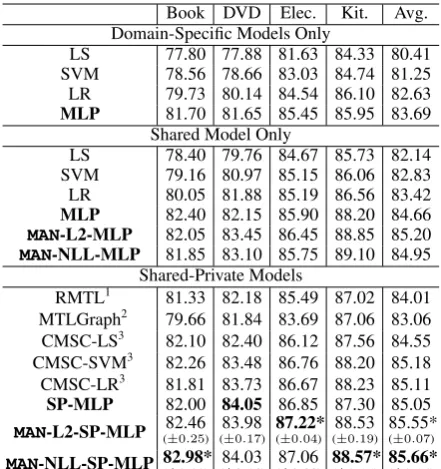
Table 1: MDTC results on the Amazon dataset. Mod-els in bold are ours while the performance of the rest is taken fromWu and Huang(2015). Numbers in paren-theses indicate standard errors, calculated based on 5 runs. Bold numbers indicate the highest performance in each domain, and ⇤ shows statistical significance (p <0.05) over CMSC under a one-sample T-Test.
JCas well as the divergence among feature
distri-butions of all domains. It can thus learn a shared feature mapping that is invariant across domains upon successful training while being beneficial to the main classification task.
4 Experiments
4.1 Multi-Domain Text Classification
fea-tures. Our MLP feature extractor would then have an input size of 5000 in order to process the re-views.
The Amazon dataset contains 2000 samples for each of the four domains: book, DVD, electron-ics, andkitchen, with binary labels (positive, neg-ative). FollowingWu and Huang(2015), we con-duct 5-way cross validation. Three out of the five folds are treated as the training set, one serves as the validation set, while the remaining is the test set. The 5-fold average test accuracy is reported.
Table1shows the main results. Three types of models are shown:Domain-Specific Models Only, where only in-domain models are trained5;Shared
Model Only, where a single model is trained with
all data; andShared-Private Models, a combina-tion of the previous two. Within each category, various architectures are examined, such as Least Square (LS), SVM, and Logistic Regression (LR). As explained before, we use MLP as our feature extractors for all our models (bold ones). Among our models, the ones with theMAN prefix use ad-versarial training, andMAN-L2 andMAN-NLL in-dicateMANwith the L2 loss and the NLL loss, re-spectively.
From Table1, we can see that by adopting mod-ern deep neural networks, our methods achieve su-perior performance within the first two model cat-egories even without adversarial training. This is corroborated by the fact that our SP-MLP model performs comparably to CMSC, while the latter relies on external resources such as sentiment lex-ica. Moreover, when our multinomial adversar-ial nets are introduced, further improvement is observed. With both loss functions, MAN out-performs all Shared-Private baseline systems on each domain, and achieves statistically signifi-cantly higher overall performance. For ourMAN -SP models, we provide the mean accuracy as well as the standard errors over five runs, to illustrate the performance variance and conduct significance tests. It can be seen that MAN’s performance is relatively stable, and consistently outperforms CMSC.
4.2 Experiments for Unlabeled Domains
As CMSC requires labeled data for each domain, their experiments were naturally designed this way. In reality, however, many domains may not
5For our models, it meansF
sis disabled. Similarly, for
Shared Model Only, noFdis used.
Target Domain Book DVD Elec. Kit. Avg. MLP 76.55 75.88 84.60 85.45 80.46 mSDA1 76.98 78.61 81.98 84.26 80.46
DANN2 77.89 78.86 84.91 86.39 82.01
MDAN (H-MAX)3 78.45 77.97 84.83 85.80 81.76
MDAN (S-MAX)3 78.63 80.65 85.34 86.26 82.72
MAN-L2-SP-MLP 78.45 81.57 83.37 85.57 82.24
MAN-NLL-SP-MLP 77.78 82.74 83.75 86.41 82.67
[image:6.595.311.519.61.177.2]1Chen et al.(2012) 2Ganin et al.(2016) 3Zhao et al.(2017)
Table 2: Results on unlabeled domains. Models in bold are our models while the rest is taken fromZhao et al.
(2017). Highest domain performance is shown in bold.
have any annotated corpora available. It is there-fore also important to look at the performance in these unlabeled domains for a MDTC system. Fortunately, as depicted before,MAN’s adversarial training only utilizes unlabeled data from each do-main to learn the dodo-main-invariant features, and can thus be used on unlabeled domains as well. During testing, only the shared feature vector is fed intoC, while the domain feature vector is set to0.
In order to validate MAN’s effectiveness, we compare to state-of-the-art multi-source domain
adaptation(MS-DA) methods (see§6). Compared
to standard domain adaptation methods with one source and one target domain, MS-DA allows the adaptation from multiple source domains to a sin-gle target domain. Analogically, MDTC can be viewed asmulti-source multi-targetdomain adap-tation, which is superior when multiple target do-mains exist. With multiple target dodo-mains, MS-DA will need to treat each one as an independent task, which is more expensive and cannot utilize the unlabeled data in other target domains.
re-books elec. dvd kitchen apparel camera health music toys video baby magaz. softw. sports IMDb MR Avg.
Domain-Specific Models Only
BiLSTM 81.0 78.5 80.5 81.2 86.0 86.0 78.7 77.2 84.7 83.7 83.5 91.5 85.7 84.0 85.0 74.7 82.6 CNN 85.3 87.8 76.3 84.5 86.3 89.0 87.5 81.5 87.0 82.3 82.5 86.8 87.5 85.3 83.3 75.5 84.3
Shared Model Only
FS-MTL 82.5 85.7 83.5 86.0 84.5 86.5 88.0 81.2 84.5 83.7 88.0 92.5 86.2 85.5 82.5 74.7 84.7
MAN-L2-CNN 88.3 88.3 87.8 88.5 85.3 90.5 90.8 85.3 89.5 89.0 89.5 91.3 88.3 89.5 88.5 73.8 87.7
MAN-NLL-CNN 88.0 87.8 87.3 88.5 86.3 90.8 89.8 84.8 89.3 89.3 87.8 91.8 90.0 90.3 87.3 73.5 87.6
Shared-Private Models
ASP-MTL 84.0 86.8 85.5 86.2 87.0 89.2 88.2 82.5 88.0 84.5 88.2 92.2 87.2 85.7 85.5 76.7 86.1
MAN-L2-SP-CNN 87.6* 87.4 88.1* 89.8*(0.2) (1.0) (0.4) (0.4) 87.6 91.4(0.7) (0.4)* 89.8*(0.3) 85.9(0.1)* 90.0* 89.5* 90.0 92.5 90.4* 89.0* 86.6 76.1 88.2*(0.1) (0.2) (0.6) (0.5) (0.4) (0.4) (0.5) (0.5) (0.1)
MAN-NLL-SP-CNN86.8*(0.4) (088.8 88.6.6) (0.4)*89.9(0.4)* 87.6(0.4) (090.7 89.4 85.5*.4) (0.3) (0.1) 90.4(0.2)*89.6(0.3) (0*90.2 92.9 90.9.6) (0.4) (0.7)* 89.0* 87.0*(0.2) (0.1) (076.7 88.4.8) (0.1)*
Table 3: Results on the FDU-MTL dataset. Bolded models are ours, while the rest is fromLiu et al.(2017). High-est performance is each domain is highlighted. For our fullMANmodels, standard errors are shown in parenthese and statistical significance (p <0.01) over ASP-MTL is indicated by *.
maining three are used as source domains.
In Table 2, the target domain is shown on top, and the test set accuracy is reported for various systems. It shows that MAN outperforms several baseline systems, such as a MLP trained on the source-domains, as well as single-source domain adaptation methods such as mSDA (Chen et al.,
2012) and DANN (Ganin et al.,2016), where the training data in the multiple source domains are combined and viewed as a single domain. Finally, when compared to MDAN,MANand MDAN each achieves higher accuracy on two out of the four target domains, and the average accuracy ofMAN
is similar to MDAN. Therefore, MAN achieves competitive performance for the domains without annotated corpus. Nevertheless, unlike MS-DA methods,MANcan handle multiple target domains at one time.
4.3 Experiments on the MTL Dataset
To make fair comparisons, the previous experi-ments follow the standard settings in the literature, where the widely adopted Amazon review dataset is used. However, this dataset has a few limita-tions. First, it has only four domains. In addition, the reviews are already tokenized and converted to a bag of features consisting of unigrams and bi-grams. Raw review texts are hence not available in this dataset, making it impossible to use certain modern neural architectures such as CNNs and RNNs. To provide more insights on how wellMAN
works with other feature extractor architectures, we provide a third set of experiments on the FDU-MTL dataset (Liu et al.,2017). This dataset is cre-ated as a multi-task learning dataset with 16tasks, where each task is essentially a different domain of reviews. It has 14 Amazon domains: books,
elec-tronics, DVD, kitchen, apparel, camera, health, music, toys, video, baby, magazine, software, and sports, in addition to two movie review domains from the IMDb and the MR datasets. Each domain has a development set of 200 samples, and a test set of 400 samples. The amount of training and un-labeled data vary across domains but are roughly 1400 and 2000, respectively.
We compare MAN with ASP-MTL (Liu et al.,
2017) on this FDU-MTL dataset. ASP-MTL also adopts adversarial training for learning a shared feature space, and can be viewed as a special case ofMANthat adopts the NLL loss (MAN-NLL) and chooses LSTM as their feature extractor. In contrast, we found a CNN-based feature extrac-tor (Kim, 2014) achieves much better accuracy while being⇠10times faster. Indeed, as shown in Table3, with or without adversarial training, our CNN models outperform LSTM ones by a large margin. When used in ourMANframework, we at-tain the state-of-the-art performance on every do-main with a 88.4% overall accuracy, surpassing ASP-MTL by a significant margin of 2.3%.
than the vanilla LSTM in ASP-MTL. However, it still does not outperform CNN and is much slower. As a result, we conclude that, for text classifica-tion tasks, CNN is both effective and efficient in extracting local and higher-level features for mak-ing a smak-ingle categorization.
Finally, we observe that MAN-NLL achieves slightly higher overall performance compared to
MAN-L2, providing evidence for the claim in a re-cent study (Lucic et al., 2017) that the original GAN loss (NLL) may not be inherently inferior to the L2 loss. Moreover, the two variants excel in different domains, suggesting the possibility of further performance gain when using ensemble.
5 Implementation Details
For all three of our experiments, we use = 0.05 andk = 5 (See Algorithm1). For both optimiz-ers, Adam (Kingma and Ba, 2015) is used with learning rate0.0001. The size of the shared
fea-ture vector is set to 128while that of the domain feature vector is64. Dropout of p = 0.4is used in all components. CandDeach has one hidden layer of the same size as their input (128 + 64for Cand128forD). ReLU is used as the activation function. Batch normalization (Ioffe and Szegedy,
2015) is used in bothCandDbut notF. We use a batch size of 8.
For our first two experiments on the Amazon review dataset, the MLP feature extractor is used. As described in§4.1, it has an input size of 5000. Two hidden layers are used, with size 1000 and 500, respectively.
For the CNN feature extractor used in the FDU-MTL experiment, a single convolution layer is used. The kernel sizes are 3, 4, and 5, and the num-ber of kernels are 200. The convolution layers take as input the 100d word embeddings of each word in the input sequence. We useword2vecword em-beddings (Mikolov et al.,2013) trained on a bunch of unlabeled raw Amazon reviews (Blitzer et al.,
2007). After convolution, the outputs go through a ReLU layer before fed into a max pooling layer. The pooled output is then fed into a single fully connected layer to be converted into a feature vec-tor of size either 128 or 64. More details of us-ing CNN for text classification can be found in the original paper (Kim,2014). MAN is implemented using PyTorch (Paszke et al.,2017).
6 Related Work
Multi-Domain Text Classification The MDTC
task was first examined by Li and Zong (2008), who proposed to fuse the training data from multi-ple domains either at the feature level or the classi-fier level. The prior art of MDTC (Wu and Huang,
2015) decomposes the text classifier into a gen-eral one and a set of domain-specific ones. How-ever, the general classifier is learned by param-eter sharing and domain-specific knowledge may sneak into it. They also require external resources to help improve accuracy and compute domain similarities.
Domain Adaptation Domain Adaptation
at-tempts to transfer the knowledge from a source domain to a target one, and the traditional form is thesingle-source, single-target(SS,ST) adapta-tion (Blitzer et al.,2006). Another variant is the
SS,MT adaptation (Yang and Eisenstein, 2015),
which tries to simultaneously transfer the knowl-edge to multiple target domains from a single source. However, it cannot fully take advantage the training data if it comes from multiple source domains. MS,ST adaptation (Mansour et al.,
2009; Zhao et al., 2017) can deal with multiple source domains but only transfers to a single target domain. Therefore, when multiple target domains exist, they need to treat them as independent prob-lems, which is more expensive and cannot utilize the additional unlabeled data in these domains. Fi-nally, MDTC can be viewed as MS,MT adapta-tion, which is arguably more general and realistic.
Adversarial Networks The idea of
adversar-ial networks was proposed by Goodfellow et al.
(2014) for image generation, and has been applied to various NLP tasks as well (Chen et al.,2016;Yu et al., 2017). Ganin et al.(2016) first used it for
the SS,ST domain adaptation followed by many
provide theoretical justifications the multinomial adversarial nets. Moreover,Liu et al.(2017) used a LSTM without attention as their feature extrac-tor, which we found to perform sub-optimal in the experiments. We instead chose Convolutional Neural Nets as our feature extractor that achieves higher accuracy while running an order of magni-tude faster (see§4.3).
7 Conclusion
In this work, we propose a family of Multinomial Adversarial Networks (MANs) that generalize the traditional binomial adversarial nets in the sense thatMAN can simultaneously minimize the differ-ence among multiple probability distributions in-stead of just two. We provide theoretical justifi-cations for two instances of MAN,MAN-NLL and
MAN-L2, showing they are minimizers of two dif-ferent f-divergence metrics among multiple distri-butions, respectively. This indicatesMAN can be used to make multiple distributions indistinguish-able from one another. It can hence be applied to a variety of tasks, similar to the versatile binomial adversarial nets, which have been used in many areas for makingtwodistributions alike.
In this paper, we design a MAN model for the MDTC task, following the shared-private paradigm that has a shared feature extractor to learn domain-invariant features and domain fea-ture extractors to learn domain-specific ones.MAN
is used to enforce the shared feature extractor to learn only domain-invariant knowledge, by resort-ing to MAN’s power of making indistinguishable the shared feature distributions of samples from each domain. We conduct extensive experiments, demonstrating our MAN model outperforms the prior art systems in MDTC, and achieves state-of-the-art performance on domains without labeled data when compared to multi-source domain adap-tation methods.
Acknowledgments
This work was supported in part by NSF grant SES-1741441 and DARPA DEFT Grant FA8750-13-2-0015. The views and conclusions contained herein are those of the authors and should not be interpreted as necessarily representing the official policies or endorsements, either expressed or im-plied, of NSF, DARPA or the U.S. Government. We also thank Yun Liu, Tianze Shi, Xun Huang, and the anonymous reviewers for their helpful
feedback and/or discussions.
References
S. M. Ali and S. D. Silvey. 1966. A general class of coefficients of divergence of one distribution from another. Journal of the Royal Statistical Society. Series B (Methodological)28(1):131–142. http: //www.jstor.org/stable/2984279. Javed A. Aslam and Virgil Pavlu. 2007. Query
hardness estimation using jensen-shannon di-vergence among multiple scoring functions. In Advances in Information Retrieval. Springer Berlin Heidelberg, Berlin, Heidelberg, pages 198–209. https://doi.org/10.1007/978-3-540-71496-5 20.
Dzmitry Bahdanau, Kyunghyun Cho, and Yoshua Ben-gio. 2015. Neural machine translation by jointly learning to align and translate. In3rd International Conference on Learning Representations (ICLR 2015).http://arxiv.org/abs/1409.0473. John Blitzer, Mark Dredze, and Fernando Pereira.
2007. Biographies, bollywood, boom-boxes and blenders: Domain adaptation for sentiment clas-sification. In Proceedings of the 45th Annual Meeting of the Association of Computational Lin-guistics. Association for Computational Linguistics, Prague, Czech Republic, pages 440–447. http: //www.aclweb.org/anthology/P07-1056. John Blitzer, Ryan McDonald, and Fernando Pereira. 2006. Domain adaptation with structural cor-respondence learning. In Proceedings of the 2006 Conference on Empirical Methods in Natu-ral Language Processing. Association for Compu-tational Linguistics, Sydney, Australia, pages 120–
128. http://www.aclweb.org/anthology/
W/W06/W06-1615.
Konstantinos Bousmalis, George Trigeorgis, Nathan Silberman, Dilip Krishnan, and Dumitru Erhan. 2016. Domain separation networks. In Ad-vances in Neural Information Processing Systems 29, Curran Associates, Inc., pages 343–351. http://papers.nips.cc/paper/6254-domain-separation-networks.pdf. Minmin Chen, Zhixiang Xu, Kilian Q. Weinberger,
and Fei Sha. 2012. Marginalized denoising autoencoders for domain adaptation. In Pro-ceedings of the 29th International Coference on International Conference on Machine Learning, Omnipress, USA, ICML’12, pages 1627–1634. http://dl.acm.org/citation.cfm?id= 3042573.3042781.
Imre Csiszar and Janos Korner. 1982. Infor-mation Theory: Coding Theorems for Discrete Memoryless Systems. Academic Press, Inc., Orlando, FL, USA. https://dl.acm.org/ citation.cfm?id=601016.
Theodoros Evgeniou and Massimiliano Pontil. 2004.
Regularized multi–task learning. In Proceedings of the Tenth ACM SIGKDD International Con-ference on Knowledge Discovery and Data Min-ing. ACM, New York, NY, USA, KDD ’04, pages 109–117. https://doi.org/10.1145/ 1014052.1014067.
Yaroslav Ganin, Evgeniya Ustinova, Hana Ajakan, Pascal Germain, Hugo Larochelle, Franc¸ois Lavi-olette, Mario Marchand, and Victor Lempit-sky. 2016. Domain-adversarial training of neu-ral networks. Journal of Machine Learn-ing Research 17:1–35. http://dl.acm.org/ citation.cfm?id=2946645.2946704.
Ian Goodfellow, Jean Pouget-Abadie, Mehdi Mirza, Bing Xu, David Warde-Farley, Sherjil Ozair, Aaron Courville, and Yoshua Bengio. 2014.
Generative adversarial nets. In Advances in Neural Information Processing Systems 27, Curran Associates, Inc., pages 2672–2680. http://papers.nips.cc/paper/5423-generative-adversarial-nets.pdf.
Sergey Ioffe and Christian Szegedy. 2015. Batch nor-malization: Accelerating deep network training by reducing internal covariate shift. In Proceedings of the 32nd International Conference on Machine Learning. pages 448–456. http://jmlr.org/ proceedings/papers/v37/ioffe15.pdf.
Mohit Iyyer, Varun Manjunatha, Jordan Boyd-Graber, and Hal Daum´e III. 2015. Deep unordered com-position rivals syntactic methods for text classifi-cation. In Proceedings of the 53rd Annual Meet-ing of the Association for Computational LMeet-inguistics and the 7th International Joint Conference on Natu-ral Language Processing (Volume 1: Long Papers). Association for Computational Linguistics, Beijing, China, pages 1681–1691. https://doi.org/ 10.3115/v1/P15-1162.
Yoon Kim. 2014. Convolutional neural networks for sentence classification. InProceedings of the 2014 Conference on Empirical Methods in Natural Lan-guage Processing (EMNLP). Association for Com-putational Linguistics, pages 1746–1751. https: //doi.org/10.3115/v1/D14-1181.
Diederik Kingma and Jimmy Ba. 2015. Adam: A method for stochastic optimization. InInternational Conference on Learning Representations 2015. https://arxiv.org/abs/1412.6980.
Shoushan Li and Chengqing Zong. 2008. Multi-domain sentiment classification. InProceedings of
ACL-08: HLT, Short Papers. Association for Com-putational Linguistics, Columbus, Ohio, pages 257–
260. http://www.aclweb.org/anthology/
P/P08/P08-2065.
Jianhua Lin. 1991. Divergence measures based on the shannon entropy. IEEE Transactions on Informa-tion Theory37(1):145–151. https://doi.org/ 10.1109/18.61115.
Pengfei Liu, Xipeng Qiu, and Xuanjing Huang. 2017.
Adversarial multi-task learning for text classifica-tion. In Proceedings of the 55th Annual Meet-ing of the Association for Computational LMeet-inguistics (Volume 1: Long Papers). Association for Compu-tational Linguistics, Vancouver, Canada, pages 1–
10.
https://doi.org/10.18653/v1/P17-1001.
Mario Lucic, Karol Kurach, Marcin Michalski, Syl-vain Gelly, and Olivier Bousquet. 2017. Are GANs Created Equal? A Large-Scale Study. Comput-ing Research RepositoryarXiv:1711.10337.http: //arxiv.org/abs/1711.10337.
Thang Luong, Hieu Pham, and Christopher D. Man-ning. 2015. Effective approaches to attention-based neural machine translation. InProceedings of the 2015 Conference on Empirical Methods in Natu-ral Language Processing. Association for Compu-tational Linguistics, pages 1412–1421. https: //doi.org/10.18653/v1/D15-1166. Yishay Mansour, Mehryar Mohri, and Afshin
Ros-tamizadeh. 2009. Domain adaptation with multiple sources. In Advances in Neural Information Processing Systems 21, Curran Associates, Inc., pages 1041–1048. http://papers.nips.cc/ paper/3550-domain-adaptation-with-multiple-sources.pdf.
Xudong Mao, Qing Li, Haoran Xie, Raymond Y.K. Lau, Zhen Wang, and Stephen Paul Smolley. 2017.
Least squares generative adversarial networks. In IEEE International Conference on Computer Vision (ICCV). pages 2813–2821. https://doi.org/ 10.1109/ICCV.2017.304.
Andrew McCallum, Kamal Nigam, et al. 1998.
A comparison of event models for naive bayes text classification. In AAAI-98 workshop on learning for text categorization. Madison, WI, USA, volume 752, pages 41–48. http: //www.aaai.org/Papers/Workshops/ 1998/WS-98-05/WS98-05-007.pdf. Tomas Mikolov, Kai Chen, Greg Corrado, and Jeffrey
Dean. 2013. Efficient estimation of word represen-tations in vector space. In International Confer-ence on Learning Representations 2013 Workshop. https://arxiv.org/abs/1301.3781. Frank Nielsen and Richard Nock. 2014. On the
Sebastian Nowozin, Botond Cseke, and Ryota Tomioka. 2016. f-GAN: Training generative neural samplers using variational divergence minimization. In Advances in Neural Information Processing Systems 29. Curran Associates, Inc., pages 271–
279. http://papers.nips.cc/paper/
6066-f-gan-training-generative- neural-samplers-using-variational-divergence-minimization.pdf.
Adam Paszke, Sam Gross, Soumith Chintala, Gre-gory Chanan, Edward Yang, Zachary DeVito, Zem-ing Lin, Alban Desmaison, Luca Antiga, and Adam Lerer. 2017. Automatic differentiation in py-torch. NIPS 2017 Autodiff Workshop https:// openreview.net/pdf?id=BJJsrmfCZ.
Fangzhao Wu and Yongfeng Huang. 2015. Collabora-tive multi-domain sentiment classification. In2015 IEEE International Conference on Data Mining. pages 459–468. https://doi.org/10.1109/ ICDM.2015.68.
Yi Yang and Jacob Eisenstein. 2015. Unsupervised multi-domain adaptation with feature embeddings. InProceedings of the 2015 Conference of the North American Chapter of the Association for Compu-tational Linguistics: Human Language Technolo-gies. Association for Computational Linguistics, pages 672–682. https://doi.org/10.3115/ v1/N15-1069.
Lantao Yu, Weinan Zhang, Jun Wang, and Yong Yu. 2017. Seqgan: Sequence genera-tive adversarial nets with policy gradient. In AAAI Conference on Artificial Intelligence. https://aaai.org/ocs/index.php/ AAAI/AAAI17/paper/view/14344.
Han Zhao, Shanghang Zhang, Guanhang Wu, Jo˜ao P. Costeira, Jos´e M. F. Moura, and Geoffrey J. Gor-don. 2017. Multiple source domain adaptation with adversarial training of neural networks. Comput-ing Research RepositoryarXiv:1705.09684.http: //arxiv.org/abs/1705.09684.
J. Zhou, J. Chen, and J. Ye. 2011. MAL-SAR: Multi-tAsk Learning via StructurAl Regularization. Arizona State University.
http://www.public.asu.edu/˜jye02/
Appendix A Proofs
A.1 Proofs forMAN-NLL
Assume we haveN domains, consider the distribution of the shared featuresFs for instances in each domaindi:
Pi(f),P(f =Fs(x)|x2di) The objective thatDattempts to minimize is:
JD = N
X
i=1
E
f⇠Pi
[logDi(f)] (12)
whereDi(f)is thei-th dimension ofD’s output vector, which conceptually corresponds to the softmax probability ofDpredicting thatf is from domaindi. We therefore have property that for anyf:
N
X
i=1
Di(f) = 1 (13)
Lemma 1. For any fixedFs, the optimum domain discriminatorD⇤is:
D⇤i(f) =
Pi(f)
PN
j=1Pj(f)
(14)
Proof. For a fixedFs, the optimum
D⇤ = arg min D
JD = arg min D
N
X
i=1
E
f⇠Pi
[logDi(f)]
= arg max D
N
X
i=1
Z
f
Pi(f) logDi(f)df
= arg max D
Z
f
N
X
i=1
Pi(f) logDi(f)df
We employ the Lagrangian Multiplier to derivearg maxDPNi=1Pi(f) logDi(f)under the constraint of (13). Let
L(D1, . . . ,DN, ) = N
X
i=1
PilogDi ( N
X
i=1
Di 1)
LetrL= 0:
(
rDi
PN
j=1PjlogDj = rDi(
PN
j=1Dj 1) (8i)
PN
i=1Di 1 = 0
Solving the two equations, we have:
D⇤i(f) =
Pi(f)
PN
j=1Pj(f)
On the other hand, the loss function of the shared feature extractorFs consists of two additive com-ponents, the loss from the text classifierC, and the loss from the domain discriminatorD:
JFs =JFCs+ J
D
Fs ,JC JD (15)
Theorem 1. WhenDis trained to its optimality:
JFDs = JD⇤ = NlogN +N ·JSD(P1, P2, . . . , PN) (16)
where JSD(·) is the generalized Jensen-Shannon Divergence (Lin, 1991) among multiple distribu-tions.
Proof. LetP =
PN i=1Pi
N .
There are two equivalent definitions of the generalized Jensen-Shannon divergence: the original def-inition based on Shannon entropy (Lin,1991), and a reshaped one expressed as the average Kullback-Leibler divergence of eachPito the centroidP (Aslam and Pavlu,2007). We adopt the latter one here:
JSD(P1, P2, . . . , PN), 1
N
N
X
i=1
KL(PikP) = 1
N
N
X
i=1
E
f⇠Pi
logPi(f)
P(f) (17)
Now substitutingD⇤ intoJFDs:
JFDs = JD⇤ = N
X
i=1
E
f⇠Pi
[logD⇤i(f)]
= N
X
i=1
E
f⇠Pi
"
logPNPi(f) j=1Pj(f)
#
= NlogN + N
X
i=1
E
f⇠Pi
"
logPNPi(f) j=1Pj(f)
+ logN
#
= NlogN + N
X
i=1
E
f⇠Pi
2
4log PNPi(f) j=1Pj(f)
N
3 5
= NlogN + N
X
i=1
E
f⇠Pi
logPi(f)
P
= NlogN + N
X
i=1
KL(PikP)
= NlogN +N ·JSD(P1, P2, . . . , PN)
Consequently, by the non-negativity ofJSD(Lin,1991), we have the following corollary:
Corollary 1. The optimum ofJFDsis NlogN, and is achieved if and only ifP1=P2 =· · ·=PN =P.
A.2 Proofs forMAN-L2
The proof is similar forMANwith the L2 loss. The loss function used byDis, for a sample from domain diwith shared feature vectorf:
LD(D(f), i) = N
X
j=1
(Dj(f) {i=j})2 (18)
So the objective thatDminimizes is:
JD = N
X
i=1
E
f⇠Pi
2 4
N
X
j=1
(Dj(f) {i=j})2
3
For simplicity, we further constrainD’s outputs to be on a simplex:
N
X
i=1
Di(f) = 1 (8f) (20)
Lemma 2. For any fixedFs, the optimum domain discriminatorD⇤is:
D⇤i(f) =
Pi(f)
PN
j=1Pj(f)
(21)
Proof. For a fixedFs, the optimum
D⇤= arg min D
JD = arg min D
N
X
i=1
E
f⇠Pi
[LD(D(f), i)]
= arg min D
N
X
i=1
Z
f
Pi(f)LD(D(f), i)df
= arg min D
Z
f
N
X
i=1
Pi(f) N
X
j=1
(Dj(f) {i=j})2df
Similar to MAN-NLL, we employ the Lagrangian Multiplier to derive arg maxDPNi=1Pi(f)PNj=1(Dj(f) {i=j})2under the constraint of (20). LetrL= 0:
(
2((PNj=1Pj)Di Pi) = (8i)
PN
i=1Di 1 = 0
Solving the two equations, we have = 0and:
D⇤i(f) =
Pi(f)
PN
j=1Pj(f)
For the domain loss ofFs:
Theorem 2. LetP =
PN i=1Pi
N . WhenDis trained to its optimality:
JFDs = N
X
i=1
E
f⇠Pi
2 4
N
X
j=1
(Dj(f) 1
N)
2
3 5
= 1
N
N
X
i=1 2
Neyman(PikP) (22)
where 2
Proof. SubstitutingD⇤ intoLDFs:
JFDs = N
X
i=1
E
f⇠Pi
2 4
N
X
j=1
(Dj⇤(f) 1
N)
2
3 5
= N
X
i=1
Z
f Pi
N
X
j=1
( Pj
N P
1
N)
2df
=
Z
f
N
X
i=1
N
X
j=1
Pi(
Pj
N P
1
N)
2df
= 1
N2
N
X
j=1
Z
f
N
X
i=1
Pi(
Pj
P 1)
2df
= 1
N2
N
X
j=1
Z
f
N P(Pj
P 1)
2df
= 1
N
N
X
j=1
Z
f
(Pj P)2
P df
= 1
N
N
X
i=1 2
Neyman(PikP)
Finally, by the joint convexity of f-divergence, we have the following corollary:
Corollary 2.
LDFs =
1
N
N
X
i=1 2
Neyman(PikP)
2
Neyman( 1
N
N
X
i=1
Pik 1
N
N
X
i=1
P)
= 2Neyman(PkP) = 0