Proceedings of the 2019 Conference on Empirical Methods in Natural Language Processing 3894
ProSeqo: Projection Sequence Networks for On-Device Text Classification
Zornitsa Kozareva Google
Mountain View, CA, USA
Sujith Ravi Google Research Mountain View, CA, USA
Abstract
We propose a novel on-device sequence model for text classification using recurrent projec-tions. Our model ProSeqo uses dynamic re-current projections without the need to store or look up any ptrained embeddings. This re-sults in fast and compact neural networks that can perform on-device inference for complex short and long text classification tasks.
We conducted exhaustive evaluation on multi-ple text classification tasks. Results show that ProSeqo outperformed state-of-the-art neural and on-device approaches for short text clas-sification tasks such as dialog act and intent prediction. To the best of our knowledge, ProSeqo is the first on-device long text clas-sification neural model. It achieved compara-ble results to previous neural approaches for news article, answers and product categoriza-tion, while preserving small memory footprint and maintaining high accuracy.
1 Introduction
In the last decade, research in deep neural net-works has lead to tremendous advances and state-of-the-art performance on wide range of Natu-ral Language Processing (NLP), speech and vi-sion applications. Coupled with the tremendous growth and adoption of smart devices such as mo-bile phones, watches, Internet of Things, conver-sational AI devices like Alexa and Google Home, these deep learning improvements have resulted in text and speech becoming the primary modes of communication (Cohen, 2008). To date, the majority of the models run on the server side by taking user input, sending the data to the server (or cloud) for processing and returning the results back to the user. This often results in latency de-lays, inconsistent user experiences and concerns over user privacy.
One way to surmount these challenges is to de-velop and deploy text and speech models that run
inference entirely on-device and return accurate predictions in real-time. To make this work, the on-device models have to be very small in size (few kilobytes or megabytes) to fit on-devices like mobile phone, watch and IoT; to have low latency and be as accurate as server side models. These on-device challenges opened up new active area of research, which recently has shown promising results for speech (Lin et al., 2018), wake word detection (He et al., 2017), dialog act (Ravi and Kozareva, 2018) and intent prediction short text classification (Ravi and Kozareva,2019).
Previous attempts for on-device text classifica-tion used hashed<input text,output class>pairs. Unfortunately, such models cannot handle exam-ples that are not part of the lookup table and cannot generalize to more complex tasks like the ones we solve in this paper – long text classi-fication, conversational intent prediction. (Bui et al., 2018) combined graphs with neural net-works to improve the robustness of the model, but this resulted in large model sizes that can-not fit on-device. The most successful work is the self-governing neural network (SGNN) from (Ravi and Kozareva, 2018) and (SGNN++) from (Ravi and Kozareva, 2019), which use locality-sensitive projections (Ravi,2017,2019) to encode short text into low-dimensional representations. SGNN reached state-of-the-art results on dialog acts outperforming recurrent networks. While suc-cessful, SGNN’s static projections make it hard to generalize to longer sequences.
• We propose novel on-device dynamic projec-tion sequence network ProSeqo for short and long text classification; To the best of our knowledge, this is the first on-device neural network for long text classification;
• Unlike SGNN which uses static projections and fully connected networks, ProSeqo is the first work to introduce embedding-free LSTMs that combine dynamic projections
with recurrent operations to learn powerful yet compact neural networks applicable for on-device scenarios;
• We conduct exhaustive evaluations and com-parisons against state-of-the-art on-device and deep learning models for short and long text classification;
• Our results show that ProSeqo outperformed state-of-the-art on-device SGNN network (Ravi and Kozareva,2018) with up to +8.9% accuracy on short text classification and +35.9% accuracy on long document classifi-cation. This shows that ProSeqo’s dynamic recurrent projections are more powerful than the static ones used in SGNN;
• Similarly, our results show that ProSeqo out-performed the non-on-device neural models like RNN (Khanpour et al.,2016), CNN (Lee and Dernoncourt, 2016) for dialog acts and intent prediction; as well as LSTMs (Zhang et al., 2015), character CNNs (Zhang et al., 2015; Bui et al., 2018) for long document classification of news, answers and product reviews. This is a significant advancement given ProSeqo’s small model size compared to these widely used approaches;
• Finally, we conduct a series of ablation stud-ies to demonstrate the effect of ProSeqo’s projection size on accuracy and the ability of ProSeqo to produce small model sizes while retaining high accuracy.
2 ProSeqo: Projection Sequence Networks for On-device Text Classification
We introduce a neural architecture, ProSeqo, a projection-based sequence network, that is de-signed to (a) be efficient and learn compact
embedding-free neural representations of text at
the semantic level, (b) capture contextual and mor-phological information at the character-level, and (c) model longer context across words and sen-tences that is suited for both short and long-text classification tasks.
The key differences to prior work (e.g., RNNs, CNNs) are that we use context information to dy-namicallycompute text representations and learn compact neural networks for text classification that are suited for on-device applications. Our work departs significantly from recent on-device work (Ravi and Kozareva, 2018) and (Ravi and Kozareva, 2019) which leverage projection oper-ations to learn efficient networks that can even be transferred to other tasks (Sankar et al., 2019b). However, they are limited to short-text classifica-tion tasks. In contrast, our model effectively uses contextual information and combines recurrent
andprojectionoperations to achieve efficiency and enable learning more powerful neural networks that generalize well and can solve more complex language classification tasks. As a result, our pro-jection sequence network is able to dynamically project and learn efficient neural classifier mod-els that are competitive with state-of-the-art RNNs and CNNs without the need to store or lookup any pre-trained embeddings.
2.1 Model Overview
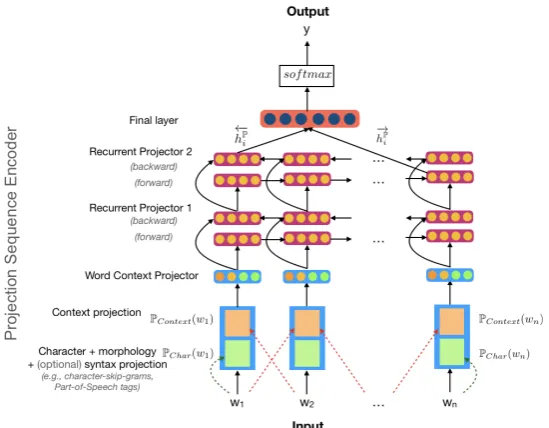
The overall architecture of ProSeqo is shown in Figure1. It consists of multiple parts: a word con-text projector, a recurrent projector, a projection sequence encoder, and a classification layer. Next, we describe in details each component.
2.2 Word Context Projector
Given an input textxi(sentence or document) with sequence of words wit, where wit refers to t-th word in the input, we first project the inputxito a vector representationP(xi). Majority of the neural models used in NLP rely on embedding matrices (word or character level) to achieve this. Instead, we dynamically compute word vector representa-tions using context and locality-sensitive projec-tions (Ravi,2017).
2.2.1 Character and Morphology Projection
Figure 1: Model architecture for ProSeqo: On-device Projection Sequence Neural Networks.
is particularly challenging for NLP tasks to han-dle large vocabularies and modelunknownwords missing from training data. Previous methods have proposed to overcome this by relying on character-level embeddings and other neural mod-els like character-CNNs. However, these methods are often complex and slow to compute for long text (e.g., convolution kernels on devices with-out significant computational capacity) and still require explicitly storing character or sub-word se-quences. For example, even simple character tri-grams over 26 characters in the English alphabet requires storing and looking upV = 263 = 18K entries in character embedding table and complex-ity ofO(V ·d), where dis the dimensionality of the embedding. For word embeddings, V can be as large as 100K to millions of entries.
We extract character-level sequence informa-tion (i.e., character sequences) and use locality-sensitive projections (Ravi, 2017, 2019) to dy-namically project them to a vector representation
PChar(wit)with justO(T ·d)complexity, where T << V.
PChar(wit) = P(witc1...C) (1) = P(−w→it) (2)
where,witc1...C is the sequence of characters c ∈ [1, C]in wordwitand−w→itis a sparse vector com-prised of character-level features (character skip-grams) extracted from the word wit. We can also extend this to include other morphological (e.g., stemming) or syntax features (e.g.,
Part-of-Speech) but this adds further complexity and requires lexicons or further pre-processing steps (e.g., stemmers, taggers) which may not be avail-able on device during inference. Hence, we only use simple raw features like character skip-grams in the projector.
P(−w→it) = LSHproj(−w→it,
−−→
PT ,d) (3)
= [ sgn(−w→it·
−−→
P1,1), ..., (4)
..., sgn(−w→it·
−−→ PT ,d) ]
We then apply LSH projections that dynam-ically compute locality-sensitive projections and transform the extracted sparse vector −w→it (char-acter sequence features) into a compact, low-dimensional binary representation P(−w→it). The projection functions−→P used to compute the binary
vector are dynamically generated from observed features in−w→itand a random seed.T, drepresents the number of projection functions and dimenson-ality of each binary vector produced by each pro-jection function. So, the output of the character-level projector is aT·dbinary vector.
2.2.2 Context Projection
In addition to characters, the surrounding con-text also contains important information useful to represent in the word vector. Unlike characters though, word context is typically not fixed in lan-guage and changes across sentences and docu-ments. To address this, we extend the projection mechanism to capture word meaning using con-textual information.
PContext(wit) = P(context(wit)) (5) = P(wit−∆...wit−1, (6)
wit+1...wit+∆)
= P(−−−wit,→∆) (7)
= LSHproj(−−−wit,→∆, −−→ PT ,d) (8)
where, ∆ represents the context size around the current wordwit,−−−wit,→∆is the context features
ex-tracted from neighboring context. We use simple raw features like word unigrams to model the con-text and apply dynamic projections on the sparse context feature vector to transform this to a binary context projection vector.
2.3 Recurrent Projector
We use LSTM to model the state of word pro-jection sequences within a sentence or document. This allows the model to capture words appear-ing in different parts of the input text, and use the projection space to learn an efficient neural rep-resentation for the task. At each time-stept, we compute the word projection by combining both character and context information, and transform-ing them via projections.
P(xt) = [PChar(xt),PContext(xt) ] (9)
The LSTM-projector PRNN then computes the new statehP
t using the projector output as follows
fP
t = σ(Wf·[ht−1,P(xt)] +bf) (10) iP
t = σ(Wi·[ht−1,P(xt)] +bi) (11)
f
CP
t = tanh(WC·[ht−1,P(xt)] +bC)(12) CP
t = ftP∗CtP−1+iPt ∗CftP (13) oP
t = σ(Wo·[ht−1,P(xt)] +bo) (14) hP
t = oPt ∗tanh(CtP) (15)
where, fP, iP, oP represent the projection for-get, input and output gates respectively, σ is a non-linearity (ReLu) andW, bare the weight and
bias parameters. hP
t is the new state computed from previous statehP
t−1. Note that we can replace
LSTM with GRU (Cho et al.,2014) or other vari-ants to control the gating mechanism and derive other recurrent projector model variants.
2.4 Projection Sequence Encoder
We use a bidirectional recurrent projector PRNN that encodes the input word sequence by summa-rizing information from both directions for word projections. The sequence encoder captures both character-level and contextual information across time steps through the projection spaceΩP.
The projection sequence encoder contains a for-ward encoder−−→PRNNthat processes the sentence (or document) fromwi1towiT and the backward en-coder←−−PRNNwhich reads the input text in reverse.
x
−→
hP i =
−−→
PRNN(xi) (16)
←−
hP i =
←−−
PRNN(xi) (17)
hi = [
−→
hP i,
←−
hP
i ] (18)
We concatenate the two states to model the state hi and transition of word projection sequences within a sentence or document.
Stacked Recurrent Projections: We also stack the recurrent projections to create deeper, multi-layered ProSeqo. Each layer is a bidirectional re-current projection encoder with information from the forward and backward states passed to the next layer. In our work, we train ProSeqo with 2 layers.
2.5 Text Classifier
The final state of the projection sequence encoder hiF is combined with an output layer to learn a classifier for a given task.
yi = softmax(WF ·hiF +bF) (19)
We train ProSeqo via backpropagation using stochastic gradient descent with negative log like-lihood of correct labels as the loss.
3 Text Classification Tasks
Text Classification Task #Classes Vocabulary Avg. Length Train Test
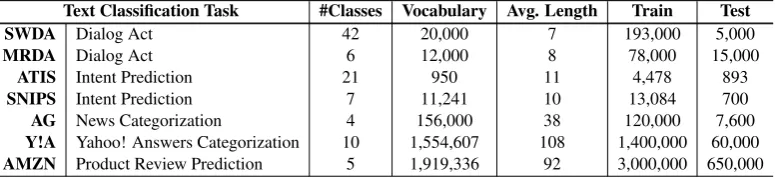
SWDA Dialog Act 42 20,000 7 193,000 5,000
MRDA Dialog Act 6 12,000 8 78,000 15,000
ATIS Intent Prediction 21 950 11 4,478 893
SNIPS Intent Prediction 7 11,241 10 13,084 700
AG News Categorization 4 156,000 38 120,000 7,600
Y!A Yahoo! Answers Categorization 10 1,554,607 108 1,400,000 60,000
[image:5.595.107.495.63.152.2]AMZN Product Review Prediction 5 1,919,336 92 3,000,000 650,000
Table 1: Text Classification Tasks and Dataset Characteristics
3.1 Dataset Description
• SWDA: Switchboard Dialog Act Corpus is a popular open domain dialog corpus between two speakers with 42 dialog acts (Godfrey et al.,1992; Jurafsky et al., 1997). The dataset is used in the on-device work of (Ravi and Kozareva,2018).
•MRDA:Meeting Recorder Dialog Act is a dia-log corpus of multiparty meetings annotated with 6 dialog acts (Adam et al.,2003;Shriberg et al., 2004). The dataset was also used by on-device work of (Ravi and Kozareva,2018). We used the same data split as (Lee and Dernoncourt, 2016; Ortega and Vu,2017;Ravi and Kozareva,2018).
•ATIS: The Airline Travel Information Systems dataset (T¨ur et al., 2010) is widely used in di-alog and speech research. The dataset contains audio recordings of people making flight reserva-tions (T¨ur et al.,2010;Goo et al.,2018).
•SNIPS:To test the generalizability of our model, we use another NLU dataset with custom intent-engines collected by Snips personal voice assis-tant. We used the data from (Goo et al., 2018). Compared to the single-domain ATIS dataset, Snips is more complicated mostly because of the rich and diverse intent repository combined with the larger vocabulary.
• AG: AG News corpus is a collection of news articles on the web, where each document has a title and a description field. We used the dataset from (Zhang et al.,2015).
• Y!A: Yahoo! Answers is a text classification task with 10 diverse classes: Society & Culture,
Science & Mathematics,Health,Education & Ref-erence,Computers & Internet,Sports,Business & Finance,Entertainment & Music,Family & Rela-tionships andPolitics & Government. Each doc-ument contains a question title, question context and best answers. We obtained the data from (Zhang et al.,2015). Note that (Yang et al.,2016) used a smaller test sample for evaluation. To present fair results, we will not compare to (Yang
et al.,2016).
• AMZN: Amazon review dataset is obtained from (Zhang et al., 2015). Resolving this task can be very helpful for product categorization (Kozareva,2015). The corpora has reviews with ratings ranging from 1 to 5. Following prior work, we use 3,000,000 reviews for training and 650,000 reviews for testing.
3.2 Dataset Characteristics
Table1shows the datasets characteristics such as the type of the task, number of classes, vocabu-lary size, average text length, train and test sizes. As shown in Table1, the datasets are very diverse, some have few thousand training examples, while others have millions. The test sizes also differ. Similarly, there are tasks with small and huge vo-cabularies. These diverse characteristics help vali-date and capture the ability of our on-device model ProSeqo to generalize to different tasks, data con-straints, settings and vocabulary. With respect to the text length, we have two major categories: short text tasks such as dialog act and intent pre-diction, and long text tasks such as news, product reviews and answer categorization.
3.3 Experimental Setup & Model Parameters
We setup our experiments as given a classification task and dataset, we apply ProSeqo to train an on-device model. For each task, we reportAccuracy
on the test set. Unlike typical NLP approaches in-cluding baseline neural methods, we do not ap-ply any vocabulary pruning or pre-processing at all to the input sentences and documents, except for splitting tokens by space.
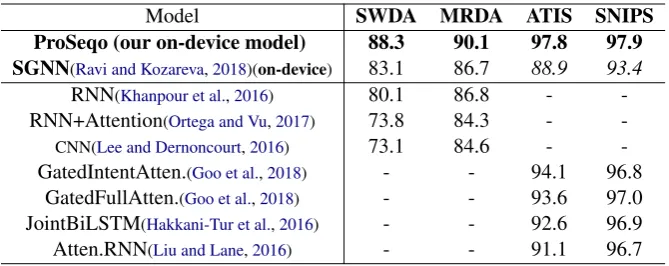
Model SWDA MRDA ATIS SNIPS ProSeqo (our on-device model) 88.3 90.1 97.8 97.9 SGNN(Ravi and Kozareva,2018)(on-device) 83.1 86.7 88.9 93.4
RNN(Khanpour et al.,2016) 80.1 86.8 - -RNN+Attention(Ortega and Vu,2017) 73.8 84.3 -
-CNN(Lee and Dernoncourt,2016) 73.1 84.6 - -GatedIntentAtten.(Goo et al.,2018) - - 94.1 96.8
[image:6.595.132.467.61.194.2]GatedFullAtten.(Goo et al.,2018) - - 93.6 97.0 JointBiLSTM(Hakkani-Tur et al.,2016) - - 92.6 96.9 Atten.RNN(Liu and Lane,2016) - - 91.1 96.7
Table 2: Short Text Classification On-device Results & Comparisons to Prior Work
optimizer (Kingma and Ba, 2014) over shuffled mini-batches of size 100. We did not do any addi-tional dataset-specific tuning or processing.
4 STC: Short Text Classification Results
This section focuses on the multiple short text classification experiments we have conducted. Ta-ble 2 shows the results on the dialog act and in-tent prediction tasks for SWDA, MRDA, ATIS and SNIPS datasets. Overall, ProSeqo reached the highest performance and significantly improved upon prior state-of-the-art on-device neural ap-proaches (Ravi and Kozareva, 2018). Similarly, ProSeqo outperformed non-on-device neural mod-els like RNN (Khanpour et al., 2016), CNN (Lee and Dernoncourt,2016) and joint neural ap-proaches (Goo et al., 2018; Hakkani-Tur et al., 2016).
4.1 STC: Comparison with On-Device Work
We compare our on-device model against state-of-the-art on-device short text classification approach SGNN (Ravi and Kozareva, 2018). SGNN was evaluated only on the SWDA and MRDA dialog act tasks (Ravi and Kozareva, 2018) and reached state-of-the-art performance against prior non-on-device neural approaches (Khanpour et al.,2016). We directly compare performance on the same SWDA and MRDA datasets. As shown in Table2 ProSeqo reaches +5.3% improvement for SWDA and +3.4% accuracy improvement for MRDA.
Since we want to compare on-device perfor-mance on a wider spectrum of tasks and datasets, we re-implemented SGNN with the same param-eters (Ravi and Kozareva, 2018). We run ex-periments on ATIS and SNIPS intent prediction tasks and reported results in Table 2 in italic to indicate that this is a re-implementation of (Ravi and Kozareva, 2018) and previously these
on-device results were not reported. As shown in Table 2, SGNN consistently performs well on dialog act and intent prediction tasks. Overall, ProSeqo reached +8.9% accuracy improvements on ATIS and +4.5% accuracy improvements on SNIPS compared to SGNN. This shows that ProS-eqo’s recurrent dynamic projections learn more powerful representations than the static SGNN ones, this also leads to significant performance im-provements on multiple tasks.
4.2 STC: Comparison with Non-On-Device
The main objective of on-device work is to de-velop small and efficient models that fit on devices with limited memory and capacity. In contrast, the non-on-device models do not have any constraints and can use all resources available on server side. Therefore, it is not fair to directly compare the on-device and non-on-on-device models. Taking these differences in consideration, we show in Table2 results from non-on-device models with the ob-jective to highlight the power of on-device models and their capability to produce small memory foot-print models, which are competitive in accuracy to those using pre-trained embeddings and uncon-strained resources.
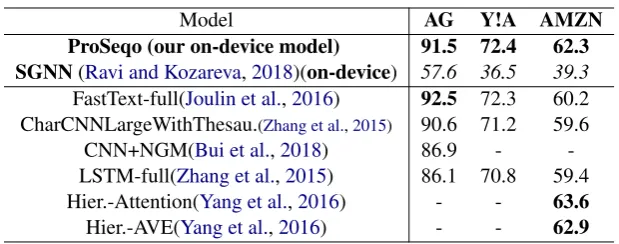
enti-Model AG Y!A AMZN ProSeqo (our on-device model) 91.5 72.4 62.3
SGNN(Ravi and Kozareva,2018)(on-device) 57.6 36.5 39.3
FastText-full(Joulin et al.,2016) 92.5 72.3 60.2 CharCNNLargeWithThesau.(Zhang et al.,2015) 90.6 71.2 59.6 CNN+NGM(Bui et al.,2018) 86.9 - -LSTM-full(Zhang et al.,2015) 86.1 70.8 59.4 Hier.-Attention(Yang et al.,2016) - - 63.6
[image:7.595.144.454.59.181.2]Hier.-AVE(Yang et al.,2016) - - 62.9
Table 3: Long Text Classification On-device Results & Comparisons to Prior Work
ties and their semantic categories in the text, and the intent prediction model uses the slot informa-tion. (Liu and Lane, 2016) showed that joint in-tent and slot model improves upon the individual ones. While the entities and their semantic types are useful, ProSeqo does not rely on such addi-tional information. ProSeqo simply uses the text and different context to learn compact semantic projection representations on-the-fly to make the intent prediction. ProSeqo improves with +3.7% the best approach for ATIS, which is a gated in-tent atin-tention (Goo et al.,2018), and with +1% the best approach for SNIPS, which is gated full at-tention (Goo et al., 2018). (Goo et al.,2018) de-veloped two complimentary approaches one with full attention and one with gated intent attention, yet they do not have consistent improvements on both datasets and tasks. In our case, our on-device ProSeqo model consistently improved upon both tasks, and reached state-of-the-art performance over prior non-on-device neural approaches. This is a significant improvement given the small size of ProSeqo and the fact that it does not store or lookup any pre-trained embedding matrices.
5 LDC: Long Document Classification Results
This section focuses on long document classi-fication results. Table 3 shows the results on three tasks and datasets (AG, Y!A, AMZN). Over-all, ProSeqo significantly improved upon the on-device neural model SGNN (Ravi and Kozareva, 2018) with +23% to +35.9% accuracy. ProS-eqo also reached comparable performance to prior non-on-device neural LSTMs and character CNNs approaches (Zhang et al.,2015;Bui et al.,2018).
5.1 LDC: Comparison with On-Device Work
To the best of our knowledge, ProSeqo is the first on-device neural approach for long
docu-ment classification. Since prior on-device work fo-cused mostly on short text, we re-implemented the on-device state-of-the-art neural approach SGNN (Ravi and Kozareva,2018) and run it on multiple long text tasks and datasets. Similarly to the short text section, we reported SGNN results in Table3 in italic to indicate that this is a re-implementation of (Ravi and Kozareva,2018) and previously re-sults on these datasets and tasks were not reported. As shown in Table 3, SGNN performed well on short texts, but it did not reach high perfor-mance on long documents. It it important to high-light that ProSeqo maintained consistent perfor-mance across all short and long document classi-fication tasks. For long texts, ProSeqo improved SGNN with +33.9% accuracy on AG news, with +35.9% accuracy on Y!A and with +23% accuracy on Amazon product review classification. These are significant improvements and further show the importance of ProSeqo’s recurrent dynamic pro-jections for short and long text classification.
5.2 LDC: Comparison with Non-On-Device
hierarchi-cal average models of (Yang et al., 2016) were evaluated only on the Amazon reviews and Y!A datasets. However, we noticed that the test set of the Y!A dataset in (Yang et al.,2016) was smaller compared to the data used in (Zhang et al.,2015; Joulin et al.,2016) and our experiments. To make consistent and fair comparisons, we did not in-clude (Yang et al., 2016). For Amazon reviews, ProSeqo reached comparable performance to hi-erarchical average and hihi-erarchical attention mod-els (Yang et al.,2016). Overall, ProSeqo reached similar performance to non-on-device neural ap-proaches, which use pre-trained embeddings while ProSeqo does not store or lookup any pre-trained embedding matrices.
6 ProSeqo Ablation Studies
This section shows two ablation studies focusing on the: (1) effect of the projection size on accuracy and (2) model size on accuracy.
6.1 Effect of Projection Size on Accuracy
During series of evaluations on multiple short and long text classification tasks, and comparing re-sults against prior state-of-the-art neural networks and on-device neural models, ProSeqo achieved robust performance irrespective of the task, vocab-ulary size, training and test datasets. This is signif-icant improvement given the small memory size of the model and the fact that we used the same model, configuration and model parameters across all seven NLP tasks unlike prior work which fine-tuned on specific data.
We also evaluated ProSeqo with different num-ber of parametersT,dused in the recurrent projec-tion. Table4 shows the performance of ProSeqo on the AG News classification task and indicates that even if we reduce the projection size by 3x, we still achieve 90% accuracy with a small drop in performance of 1.4% (91.5→90.09).
Projection Size (T·d) 300 600 800 Compression Ratio (S1S2) 15×104 7.5×10⁴ 5.6×10⁴
Accuracy 90.0 91.0 91.5
Table 4: Effect of ProSeqo’s Recurrent Projection Size on Accuracy for AG News Classification. Compres-sion Ratiois computed wrt ProSeqo model size (S1) vs. LSTM baseline (S2) with word embeddings (vo-cabulary size=150K, embedding size=300).
6.2 ProSeqo’s Model Size
In addition to the quality evaluations, comparisons and results, we also highlight how compact and fast our on-device model is, which is very im-portant for fitting the model on small memory-constrained devices such as mobile phones and watches. For this purpose, we measure the current size of our ProSeqo model. We do not have the exact parameter counts and model sizes from the previous neural approaches such as RNNs, BiL-STMs, and Hierarchical Attention models. But we make an observation that number of parame-ters in the recurrent layers of these baseline net-works are similar to the parameters encoded in the recurrent projector layers in the ProSeqo model. Hence we can approximately compute the differ-ence in model sizes between ProSeqo and other neural models by taking into consideration the size of embeddings fed into the recurrent layers along with the training data vocabulary size.
As highlighted in the main contributions of our approach ProSeqo is an embedding-free method, which means that it does not have to store or look up any embedding matrices. This makes the model small in comparison to existing neural approaches. For instance, to calculate the model size of ProS-eqo as explained in Section2we need to consider (T·d)wheredis the number of LSH bits specified for each projection vector, andT is the number of projection functions used resulting in (T ·d) = 60×14 parameters shared across all time-steps. Independent of the task, length of the text (shortvs
ProS-eqo’s size remains constant independent of the text lengths, vocabulary size and classification tasks. Even with neural models like charCNN that use character-level embeddings which is typically ap-plied in conjunction with word embeddings, ProS-eqo still yields an order or two magnitude smaller model sizes. The computation within ProSeqo is fast,O(T·d·n)multiply-addoperations for n-length words regardless of word/character vo-cabulary sizes.
7 Conclusion
We proposed a novel Projection Sequence Neural Network (ProSeqo) for on-device text classifica-tion. Evaluations on multiple text classification tasks show that ProSeqo significantly improved accuracy compared to state-of-the-art on-device neural network SGNN (Ravi and Kozareva,2018) on short text with +3.4% for MRDA, +4.5% on SNIPS, +5.3% on SWDA and +8.9% on ATIS; and long documents with +23% on Amazon prod-uct reviews, +33.9% on AG news, +35.9% on Y!A. Similarly, ProSeqo improved non-on-device neural RNN, CNN and joint approaches ( Khan-pour et al., 2016; Lee and Dernoncourt, 2016; Hakkani-Tur et al., 2016; Goo et al., 2018) on short text and reached comparable results on long documents (Joulin et al.,2016;Zhang et al.,2015; Bui et al.,2018). This is significant improvement given ProSeqo’s small network size, and the fact that we used the same architecture and parameters across all seven NLP tasks, while prior work tuned depending on the task and dataset.
References
Janin Adam, Don Baron, Jane Edwards, Dan Ellis, David Gelbart, Nelson Morgan, Barbara Peskin, Thilo Pfau, Elizabeth Shriberg, Andreas Stolcke, and Chuck Wooters. 2003. The icsi meeting cor-pus. InProceedings of the 5TH SIGdial Workshop on Discourse and Dialogue, pages 364–367.
Thang D. Bui, Sujith Ravi, and Vivek Ramavajjala. 2018. Neural graph learning: Training neural net-works using graphs. InProceedings of the Eleventh ACM International Conference on Web Search and Data Mining, WSDM ’18, pages 64–71.
Kyunghyun Cho, Bart van Merri¨enboer, C¸ alar G¨ulc¸ehre, Dzmitry Bahdanau, Fethi Bougares, Hol-ger Schwenk, and Yoshua Bengio. 2014. Learning phrase representations using rnn encoder–decoder for statistical machine translation. InProceedings of
the 2014 Conference on Empirical Methods in Nat-ural Language Processing (EMNLP), pages 1724– 1734, Doha, Qatar. Association for Computational Linguistics.
Jordan Cohen. 2008. Embedded speech recognition applications in mobile phones: Status, trends, and challenges. pages 5352 – 5355.
John J. Godfrey, Edward C. Holliman, and Jane Mc-Daniel. 1992. Switchboard: Telephone speech cor-pus for research and development. In Proceed-ings of the 1992 IEEE International Conference on Acoustics, Speech and Signal Processing - Volume 1, ICASSP’92, pages 517–520. IEEE Computer So-ciety.
Chih-Wen Goo, Guang Gao, Yun-Kai Hsu, Chih-Li Huo, Tsung-Chieh Chen, Keng-Wei Hsu, and Yun-Nung Chen. 2018. Slot-gated modeling for joint slot filling and intent prediction. InProceedings of the 2018 Conference of the North American Chap-ter of the Association for Computational Linguistics: Human Language Technologies, Volume 2 (Short Papers), pages 753–757. Association for Computa-tional Linguistics.
Dilek Hakkani-Tur, Gokhan Tur, Asli Celikyilmaz, Yun-Nung Vivian Chen, Jianfeng Gao, Li Deng, and Ye-Yi Wang. 2016. Multi-domain joint semantic frame parsing using bi-directional rnn-lstm. In Pro-ceedings of The 17th Annual Meeting of the Interna-tional Speech Communication Association (INTER-SPEECH 2016).
Yanzhang He, Rohit Prabhavalkar, Kanishka Rao, Wei Li, Anton Bakhtin, and Ian McGraw. 2017. Streaming small-footprint keyword spot-ting using sequence-to-sequence models. CoRR, abs/1710.09617.
Armand Joulin, Edouard Grave, Piotr Bojanowski, Matthijs Douze, Herv´e J´egou, and Tomas Mikolov. 2016. Fasttext.zip: Compressing text classification models. CoRR, abs/1612.03651.
Daniel Jurafsky, Rebecca Bates, Rachel Martin Noah Coccaro, Marie Meteer, Klaus Ries, Eliza-beth Shriberg, Audreas Stolcke, Paul Taylor, and Van Ess-Dykema. 1997. Automatic detection of discourse structure for speech recognition and un-derstanding. InProceedings of IEEE Workshop on Automatic Speech Recognition and Understanding, pages 88–95.
Hamed Khanpour, Nishitha Guntakandla, and Rod-ney Nielsen. 2016. Dialogue act classification in domain-independent conversations using a deep re-current neural network. InProceedings of COLING 2016, the 26th International Conference on Compu-tational Linguistics: Technical Papers, pages 2012– 2021.
Zornitsa Kozareva. 2015. Everyone likes shopping! multi-class product categorization for e-commerce. InProceedings of the 2015 Conference of the North American Chapter of the Association for Computa-tional Linguistics: Human Language Technologies, pages 1329–1333.
Ji Young Lee and Franck Dernoncourt. 2016. Sequen-tial short-text classification with recurrent and con-volutional neural networks. InProceedings of the 2016 Conference of the North American Chapter of the Association for Computational Linguistics: Hu-man Language Technologies, pages 515–520.
Zhong Qiu Lin, Audrey G. Chung, and Alexander Wong. 2018. Edgespeechnets: Highly efficient deep neural networks for speech recognition on the edge. CoRR, abs/1810.08559.
Bing Liu and Ian Lane. 2016. Attention-based recur-rent neural network models for joint intent detection and slot filling. Proceedings of The 17th Annual Meeting of the International Speech Communication Association (INTERSPEECH 2016).
Daniel Ortega and Ngoc Thang Vu. 2017. Neural-based context representation learning for dialog act classification. In Proceedings of the 18th Annual SIGdial Meeting on Discourse and Dialogue, pages 247–252.
Sujith Ravi. 2017. Projectionnet: Learning efficient on-device deep networks using neural projections. CoRR, abs/1708.00630.
Sujith Ravi. 2019. Efficient on-device models using neural projections. In Proceedings of the 36th In-ternational Conference on Machine Learning, vol-ume 97 of Proceedings of Machine Learning Re-search, pages 5370–5379.
Sujith Ravi and Zornitsa Kozareva. 2018. Self-governing neural networks for on-device short text classification. InProceedings of the 2018 Confer-ence on Empirical Methods in Natural Language Processing, Brussels, Belgium, October 31 - Novem-ber 4, 2018, pages 804–810.
Sujith Ravi and Zornitsa Kozareva. 2019. On-device structured and context partitioned projection net-works. In Proceedings of the 57th Annual Meet-ing of the Association for Computational LMeet-inguis- Linguis-tics, pages 3784–3793.
Chinnadhurai Sankar, Sujith Ravi, and Zornitsa Kozareva. 2019a. On the robustness of projection neural networks for efficient text representation: An empirical study. ArXiv, abs/1908.05763.
Chinnadhurai Sankar, Sujith Ravi, and Zornitsa Kozareva. 2019b. Transferable neural projection representations. In Proceedings of the 2019 Con-ference of the North American Chapter of the Asso-ciation for Computational Linguistics: Human Lan-guage Technologies, pages 3355–3360.
Elizabeth Shriberg, Raj Dhillon, Sonali Bhagat, Jeremy Ang, and Hannah Carvey. 2004. The icsi meeting recorder dialog act (mrda) corpus. InProceedings of the 5th SIGdial Workshop on Discourse and Di-alogue, pages 97–100, Cambridge, Massachusetts, USA. Association for Computational Linguistics.
G¨okhan T¨ur, Dilek Hakkani-T¨ur, and Larry P. Heck. 2010. What is left to be understood in atis? In Proceedings of 2010 IEEE Spoken Language Tech-nology Workshop (SLT), pages 19–24.
Zichao Yang, Diyi Yang, Chris Dyer, Xiaodong He, Alex Smola, and Eduard Hovy. 2016. Hierarchi-cal attention networks for document classification. InProceedings of the 2016 Conference of the North American Chapter of the Association for Compu-tational Linguistics: Human Language Technolo-gies, pages 1480–1489. Association for Computa-tional Linguistics.