This PDF document was made available from www.rand.org as a public service of the RAND Corporation.
6
Jump down to document
Purchase this document Browse Books & Publications Make a charitable contribution
Visit RAND at www.rand.org
Explore RAND Infrastructure, Safety, and Environment
View document details
This document and trademark(s) contained herein are protected by law as indicated in a notice appearing later in this work. This electronic representation of RAND intellectual property is provided for non-commercial use only. Permission is required from RAND to reproduce, or reuse in another form, any of our research documents.
Limited Electronic Distribution Rights
For More Information
Support RAND
The RAND Corporation is a nonprofit research organization providing objective analysis and
effective solutions that address the challenges facing the public and private sectors around the world. CHILD POLICY
CIVIL JUSTICE
EDUCATION
ENERGY AND ENVIRONMENT
HEALTH AND HEALTH CARE
INTERNATIONAL AFFAIRS
NATIONAL SECURITY
POPULATION AND AGING
PUBLIC SAFETY
SCIENCE AND TECHNOLOGY
SUBSTANCE ABUSE
TERRORISM AND HOMELAND SECURITY
TRANSPORTATION AND INFRASTRUCTURE
Aptitude for Destruction
Volume 1
Organizational Learning in Terrorist
Groups and Its Implications for
Combating Terrorism
Brian A. Jackson with: John C. Baker
Kim Cragin John Parachini Horacio R. Trujillo
Peter Chalk
The RAND Corporation is a nonprofit research organization providing objective analysis and effective solutions that address the challenges facing the public and private sectors around the world. RAND’s publications do not necessarily reflect the opinions of its research clients and sponsors.
R® is a registered trademark.
© Copyright 2005 RAND Corporation
All rights reserved. No part of this book may be reproduced in any form by any electronic or mechanical means (including photocopying, recording, or information storage and retrieval) without permission in writing from RAND.
Published 2005 by the RAND Corporation
1776 Main Street, P.O. Box 2138, Santa Monica, CA 90407-2138 1200 South Hayes Street, Arlington, VA 22202-5050 201 North Craig Street, Suite 202, Pittsburgh, PA 15213-1516
RAND URL: http://www.rand.org/
To order RAND documents or to obtain additional information, contact Distribution Services: Telephone: (310) 451-7002;
Fax: (310) 451-6915; Email: [email protected]
Library of Congress Cataloging-in-Publication Data
Aptitude for destruction : organizational learning in terrorist groups and its implications for combating terrorism / Brian A. Jackson ... [et al.].
p. cm. “MG-331.”
Includes bibliographical references. ISBN 0-8330-3764-1 (pbk. : alk. paper)
1. Terrorists. 2. Organizational learning. 3. Terrorism—Prevention—Government policy. I. Jackson, Brian A. (Brian Anthony) II.Title.
HV6431.A67 2005 303.6'25—dc22
2005003983
Photo courtesy of iStockphoto.com Inc. Copyright 2005 iStockphoto Inc. Online at http://www.iStockphoto.com
Cover design by Stephen Bloodsworth
iii
Preface
Continuing conflicts between violent groups and states generate an ever-present de-mand for higher quality and more timely information to support operations to com-bat terrorism. In particular, better ways are needed to understand how terrorist and insurgent groups adapt over time into more-effective organizations and increasingly dangerous threats. To adapt, terrorist organizations must learn. A group’s ability to learn determines its chance of success, since learning is the link between what the group wants to do and its ability to gather the needed information and resources to actually do it. Despite the importance of terrorist group learning, comparatively little focused research effort has been directed at understanding this process and identify-ing the factors that influence group learnidentify-ing ability. While relevant data and insights can be found in the literature on terrorism and terrorist organizations, this informa-tion has not been collected and systematically analyzed to assess its importance from the perspective of efforts to combat terrorism. This study addresses that need in an effort to both analyze current understanding and stimulate further study and research in this area.
The National Institute of Justice provided funding to the RAND Corporation to conduct an analysis of organizational learning in terrorist groups and assess its im-plications for efforts to combat terrorism. The work was performed between Novem-ber 2003 and NovemNovem-ber 2004, a period during which the threat of international ter-rorism was high and concern about the capabilities of terrorist organizations and how they might change over time was a central focus of policy debate and U.S. homeland security planning. The study is described in this report and in a companion volume,
Aptitude for Destruction, Volume 2: Case Studies of Organizational Learning in Five Terrorist Groups-332-NIJ, which examines the innovation and learning activities of five groups selected to represent the spectrum of organizations that have used terror-ist tactics.
iv Aptitude for Destruction
• Brian A. Jackson et al., Aptitude for Destruction, Volume 2: Case Studies of Orga-nizational Learning in Five Terrorist Groups, MG-332-NIJ, 2005.
• Brian A. Jackson et al., Protecting Emergency Responders: Lessons Learned from Terrorist Attacks, CF-176-OSTP, 2002.
• Kim Cragin and Sara A. Daly, The Dynamic Terrorist Threat: An Assessment of
Group Motivations and Capabilities in a Changing World, MR-1782-AF, 2004.
• Peter Chalk and William Rosenau, Confronting the “Enemy Within”: Security
In-telligence, the Police, and Counterterrorism in Four Democracies, MG-100-RC,
2004.
• Bruce Hoffman, Insurgency and Counterinsurgency in Iraq, OP-127-IPC/ CMEPP, 2004.
This research was conducted within RAND Infrastructure, Safety, and Envi-ronment (ISE), a division of the RAND Corporation. The mission of RAND ISE is to improve the development, operation, use, and protection of society’s essential built and natural assets; and to enhance the related social assets of safety and security of individuals in transit and in their workplaces and communities. The ISE research portfolio encompasses research and analysis on a broad range of policy areas includ-ing homeland security, criminal justice, public safety, occupational safety, the envi-ronment, energy, natural resources, climate, agriculture, economic development, transportation, information and telecommunications technologies, space exploration, and other aspects of science and technology policy. Inquiries regarding RAND Infra-structure, Safety, and Environment may be directed to
Debra Knopman, Vice President and Director RAND Infrastructure, Safety, and Environment 1200 South Hayes Street
Arlington, Virginia 22202 703-413-1100
v
Contents
Preface...iii
Figures...vii
Summary...ix
Acknowledgments...xvii
Abbreviations and Acronyms...xix
CHAPTER ONE Introduction...1
About This Study...4
About This Report...7
CHAPTER TWO What Is Organizational Learning? ...9
Organizational Learning as a Four-Part Process...10
The Need to Combine Explicit and Tacit Knowledge...14
Different Forms of Organizational Learning...15
CHAPTER THREE The Need to Learn in Order to Change Effectively...17
Development, Improvement, and Employment of New Weapons or Tactics...18
Improving Skills with Current Weapons or Tactics...20
Collecting and Utilizing Intelligence Information...21
Thwarting Efforts to Combat Terrorist Activities...23
Preserving Organizational Capabilities Despite the Loss of Group Members...24
CHAPTER FOUR How Understanding Terrorist Group Learning Can Aid in Combating Terrorism...27
Detecting Terrorist Groups’ Efforts to Change...28
Anticipating the Outcome of Terrorist Groups’ Efforts to Change...34
vi Aptitude for Destruction
CHAPTER FIVE
Limitations of an Organizational-Learning-Based Approach for Analysis
and Operational Planning in Combating Terrorism...61
The Need to Understand Terrorist Group Structure and Membership...61
Lack of Data on Terrorist Group Learning Processes...62
The Nature of Learning Models...63
Difficulties in Measuring the Results of Learning...63
Understanding the Contribution of Learning Ability to Specific Terrorist Operations ...66
CHAPTER SIX Conclusions...69
Assessing the Threat Posed by Individual Terrorist Groups and Understanding Their Behavior...69
Developing and Implementing Effective Counterstrategies...70
Allocating Resources and Developing Metrics to Assess the Effectiveness of Efforts to Combat Terrorism ...70
Concluding Remarks...72
APPENDIX Overview of the Case Study Groups...73
vii
Figures
S.1. Component Processes of Organizational Learning...xi
S.2. Phases of Law Enforcement and Intelligence Activity to Counter Terrorist Group Efforts to Change and Adapt...xii
S.3. Characteristics That Affect Terrorist Group Learning Abilities...xiii
2.1. Component Processes of Organizational Learning...10
4.1. Phases of Law Enforcement and Intelligence Activity to Counter Terrorist Group Efforts to Change and Adapt...28
4.2. Understanding Group Learning to Aid in Detection...29
4.3. Understanding Group Learning to Aid in Anticipation...36
4.4. Characteristics That Affect Terrorist Group Learning Abilities...37
4.5. Understanding Group Learning to Aid in Action...49
ix
Summary
If a terrorist group lacks the ability to learn, its effectiveness in achieving its goals will largely be determined by chance—the chance that its members already have the nec-essary skills to carry out operations and support activities; the chance that its current tactics are effective against desirable targets and against current antiterrorism mea-sures; and the chance that shifts made by the group will prove to be beneficial.1 Similarly, in a dynamic environment, a terrorist organization that cannot learn will not be able to effectively adapt to new developments in intelligence gathering and law enforcement.
But when a terrorist group can learn—and learn well—it can act systematically to fulfill its needs, strengthen its capabilities, and advance its strategic agenda. The ability to learn allows a terrorist group to purposefully adapt to ever-evolving circum-stances by
• Developing, improving, and employing new weapons or tactics that can enable it to change its capabilities over time
• Improving its members’ skills in applying current weapons or tactics
• Collecting and utilizing the intelligence information needed to mount opera-tions effectively
• Thwarting countermeasures and improve its chance of surviving attempts to de-stroy it
• Preserving the capabilities it has developed even if some of its members are lost ____________
1 While change in the way a group carries out its activities is frequently indicative of learning, the occurrence of
x Aptitude for Destruction
A terrorist group’s ability to learn is therefore a primary determinant of the level of threat it poses, since learning is the route through which organizations can seek solu-tions to the problems that bound their freedom of action and limit their ability to pursue their goals in changing operational and security circumstances.
The Need to Understand Organizational Learning
Discerning how terrorist groups learn in a dynamic environment is crucial for under-standing terrorism. With increased underunder-standing of group learning processes, intel-ligence analysts and security planners will be better able to
• Assess the level of threat posed by a terrorist organization, which can be radi-cally altered by effective learning.
• Design and implement strategies for combating terrorism, using knowledge of how terrorist groups use learning to blunt or overcome the countermeasures and security systems intended to defeat their efforts.
• Appropriately allocate resources for combating terrorism, since terrorist groups that can learn effectively can pose a more potent threat than do organizations that are unable to change and adapt.
An understanding of terrorist group learning can also assist in developing metrics for efforts to combat terrorism by providing an additional approach for assessing the effects of countermeasures on terrorist group capabilities.
About This Study
This study addresses two basic questions:
• What is known about how terrorist groups learn?
• Can such knowledge be used by law enforcement and intelligence personnel in their efforts to combat terrorism?
Summary xi
groups through literature research and interviews with intelligence and law enforce-ment professionals who have had direct experience with terrorist groups.2
[image:13.612.125.386.242.360.2]Using analytical frameworks drawn from the organizational-theory literature to assist in framing questions about what organizations must do to learn, we examined terrorist groups that have been successful learners in order to focus on those behav-iors of greatest concern. Discussions with intelligence and law enforcement profes-sionals enabled us to explore the applicability and utility of organizational-learning-focused approaches to analysis and operational planning for combating terrorism.
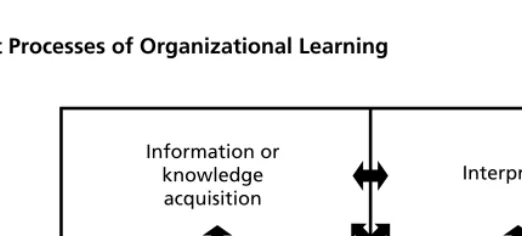
Figure S.1
Component Processes of Organizational Learning
RAND MG331-S.1
Information or knowledge acquisition
Interpretation
Storage Distribution
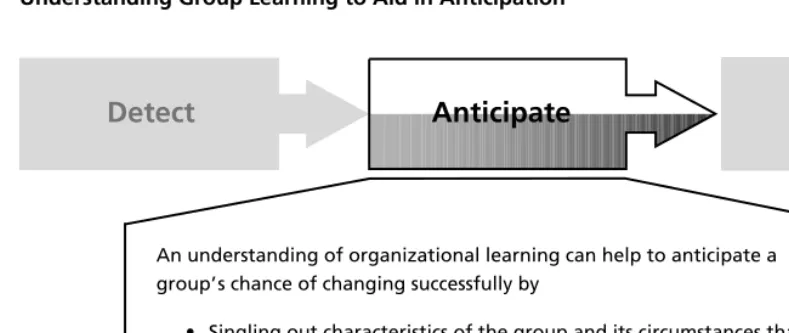
Terrorist groups present a moving target that can prove very difficult to hit. Effective efforts to combat terrorism require the ability to anticipate how and where groups are evolving over time. Beyond simply describing how such groups change— for example, tracking differences in weapons they use or how well they use them—we need to understand the mechanisms through which those changes occur. Drawing on the organizational-theory literature, we adopted a model of learning as a four-part process, comprising acquiring, interpreting, distributing, and storing information and knowledge (Figure S.1). By breaking down the composite and complex process of “learning” into discrete pieces, this model helps frame specific and actionable ques-tions about how individual terrorist groups learn. Sufficiently detailed information on the four subprocesses in the model could assist law enforcement and intelligence professionals in carrying out the three key functions shown in Figure S.2: detecting
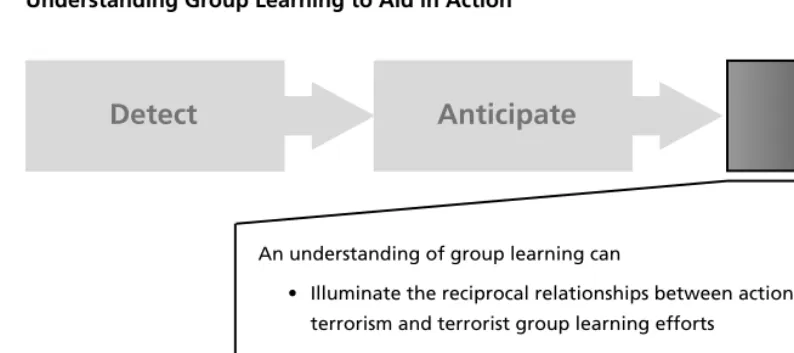
terrorist groups’ efforts to change and adapt, anticipating whether those efforts will be successful, and acting to limit terrorist groups’ ability to learn or undermine their learning efforts.
____________
2 This approach has been applied previously to the analysis of drug cartels and transnational criminal
xii Aptitude for Destruction
Figure S.2
Phases of Law Enforcement and Intelligence Activity to Counter Terrorist Group Efforts to Change and Adapt
Detect Anticipate Act
RAND MG331-S.2
Detecting Terrorist Groups’ Efforts to Change
Although the efforts of terrorist groups to adapt and learn are frequently easy to see in hindsight, they are much more difficult to detect before they are fully realized. De-tection is critical, however, if terrorist groups are to be denied the advantage of sur-prise in their tactics and operations. Intelligence and law enforcement analysts must have access to specific types of information, the ability to extract that information from the noisy background of collected intelligence, and the analytical tools to dis-cern what the information means in terms of terrorist group adaptive activities. Integrating an understanding of organizational learning into the intelligence collec-tion and analysis process could help ensure that key informacollec-tion about terrorist groups’ adaptive efforts is not overlooked. Providing a structure for framing clear, actionable questions about the specific processes of terrorist group learning could in-crease the possibility that the right information will be collected and will therefore be available to analysts studying particular groups. Similarly, a clear model of how ter-rorist organizations learn would provide an alternative analytical framework for ex-amining new intelligence. Such a framework would help to ensure that data signaling terrorist group learning activities are not missed in the daily stream of collected intel-ligence. Having a clear understanding of organizational learning processes would also provide a context for assessing more fully the potential “learning implications” of a terrorist group’s current activities. Having such an alternative lens through which to view new information could be critical—for example, individual operations that ap-pear detrimental to a terrorist group’s interests from a strategic or organizational per-spective may have very different implications when viewed from the perper-spective of the group’s learning goals.
Key Findings: Detecting Terrorist Groups’ Efforts to Change
• Use frameworks describing organizational learning by terrorist organizations to focus intelligence collection and ensure that necessary information is collected and terrorists’ efforts to change are not overlooked.
Summary xiii
Anticipating the Outcomes of Terrorist Groups’ Efforts to Change
It is always worrisome when a terrorist group decides to pursue damaging new weap-ons or to adopt a new tactic. But whether or not such a decision actually increases the threat posed by the group depends on whether the terrorists can bring their plans to fruition. Accurately assessing the implications of a shift in a terrorist group’s intent or activities—i.e., determining whether the threat it is trying to pose is credible— requires a judgment about the likelihood of the group succeeding in its plans. Be-cause successful learning dramatically increases a terrorist group’s ability to do what it wants to do, understanding how the group learns can help analysts anticipate whether the group will succeed in its efforts. To better understand how a terrorist group learns, the analyst can (1) examine the group and its circumstances to assess how their characteristics will affect its ability to learn and (2) examine what the group is trying to accomplish to assess whether the strategies it has adopted will bring to-gether the ingredients needed to succeed.
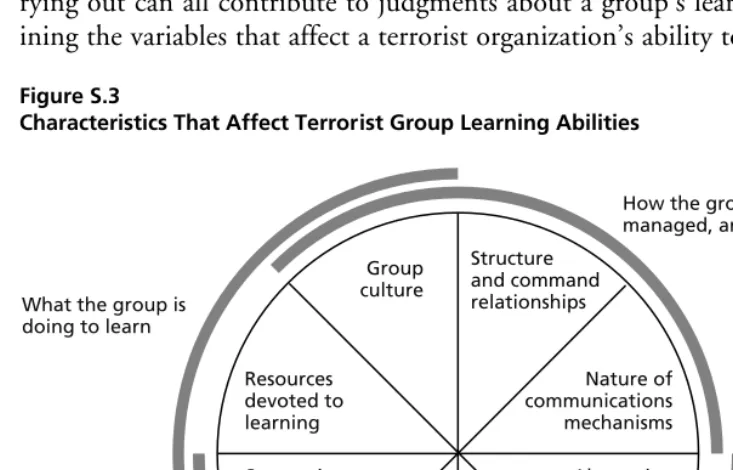
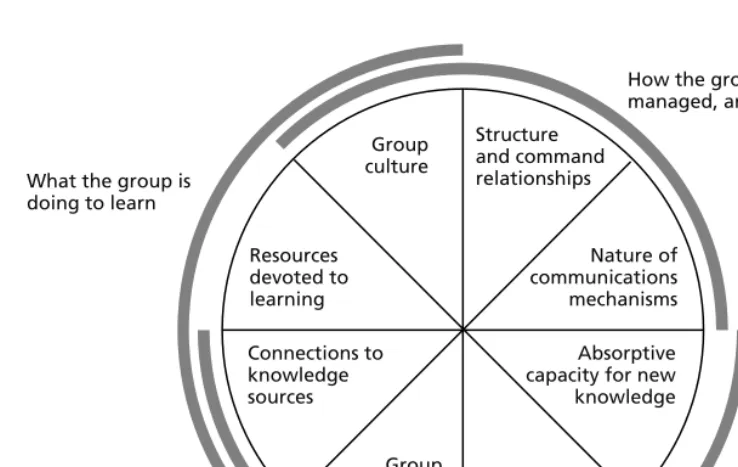
[image:15.612.56.423.386.621.2]Earlier research has identified a range of characteristics associated with a group’s ability to learn effectively. Details about the nature of an organization’s structure and interconnections, its membership, its environment, and the specific activities it is car-rying out can all contribute to judgments about a group’s learning potential. Exam-ining the variables that affect a terrorist organization’s ability to succeed (Figure S.3)
Figure S.3
Characteristics That Affect Terrorist Group Learning Abilities
RAND MG331-S.3
What the group is doing to learn
How the group is organized, managed, and connected
Who is in the group and what they know The environmental
conditions the group faces
xiv Aptitude for Destruction
can enable analysts to better assess the credibility of the threat posed by the organi-zation.
To learn successfully, an organization must combine different types of knowl-edge. Explicit knowledge—e.g., recipes for explosive materials, blueprints for attrac-tive targets, weapons or other technologies—can be transferred readily to a terrorist group, provided it can find an appropriate and willing source. Tacit knowl-edge—e.g., proficiency in mixing explosives safely or the military expertise and op-erational intuition needed to plan an operation well—is more difficult to transfer from one group to another. To the extent that the analyst can evaluate the combina-tions of explicit and tacit knowledge needed for an organization’s plans, he or she can assess the likelihood the organization’s strategy for gathering that knowledge and im-plementing its plans will be successful.
Key Findings: Anticipating the Outcomes of Terrorist Groups’ Efforts to Change
• Gather information about the characteristics of terrorist groups’ structures and interconnections, membership, environment, and activities that are specifically relevant to assessing the likely outcome of their attempts to adapt and evolve. • Examine the varied paths and combinations of knowledge relevant to terrorist
groups’ learning goals to enable better assessment of the potential success of their efforts to learn.
Acting More Effectively to Thwart Terrorist Efforts
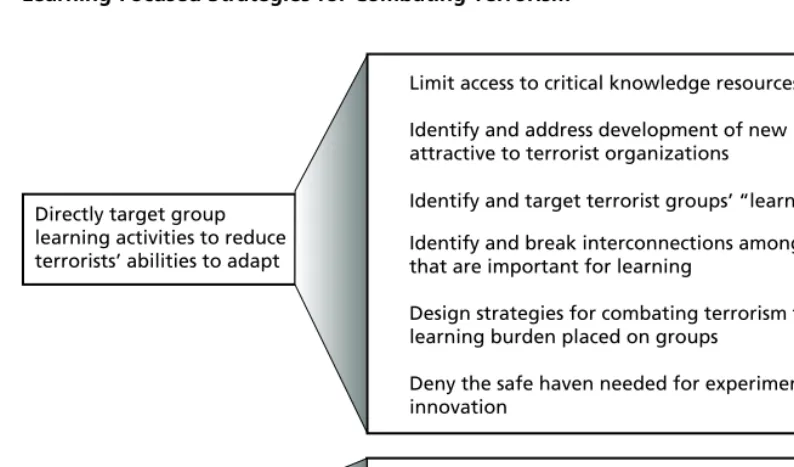
An understanding of how terrorist groups learn can contribute to shaping approaches for combating terrorism. Terrorist groups’ learning capabilities define the options they have available to defeat security measures and counter the actions of security forces. Such groups have devoted considerable effort to foiling the information-gathering efforts of intelligence and law enforcement organizations and have in-formed their attack plans by direct study and observation of security forces’ tactics and procedures. If the ways terrorist groups learn to get around countermeasures can be understood and anticipated, the design and application of those countermeasures can be improved. A detailed understanding of group learning processes could make it possible to design countermeasures to directly address or even take advantage of ter-rorist groups’ attempts to learn. Targeted attacks on a group’s “learning systems” could degrade the group’s ability to adapt over time.3 Potential strategies include the following:
____________
3 It should be noted, however, that terrorist groups could respond to such efforts by subsequently altering their
Summary xv
• Limiting the terrorist group’s access to critical knowledge resources • Identifying and preventing acquisition of novel technologies and weapons • Locating and targeting a terrorist group’s “learning leadership”—those
indi-viduals critical to the ability to carry out organizational learning processes • Identifying and breaking critical connections among terrorist group members • Designing strategies for combating terrorism to maximize the “learning burden”
placed on terrorist groups and limit their chances of adapting to get around it • Denying terrorist groups the safe haven needed for experimentation and
innova-tion
Beyond simply seeking to prevent a terrorist group from learning, strategies for com-bating terrorism could be designed to shape group learning in more subtle ways. With sufficient information on terrorist groups’ learning processes, intelligence and law enforcement organizations could potentially affect the nature and outcome of group learning activities. Strategies utilizing deception, misinformation, and other psychological techniques could be applied to steer terrorist group learning in specific directions or influence the apparent results of their efforts. Such indirect approaches would require significant knowledge about a terrorist group’s learning efforts and even then would never be guaranteed success, but they could serve as useful alterna-tive or complementary tactics.
Key Findings: Acting More Effectively to Thwart Terrorist Efforts
• Use an understanding of terrorist groups’ learning capabilities to improve planning for combating terrorism. Shape countermeasures to resist efforts to circumvent or defeat them.
• Apply models of terrorist groups’ learning behaviors to the design of novel countermeasures that specifically target their ability to adapt and change. • Seek out opportunities to use terrorist groups’ learning activities against them
by guiding their efforts or shaping the outcomes of those efforts to reduce the groups’ capabilities and potential threat levels.
Conclusions
xvi Aptitude for Destruction
group is structured, to describe its learning processes, and to determine how its learning efforts should be assessed, these approaches will provide little benefit to the analyst. In some cases, such information may be collected in the course of general intelligence gathering on a terrorist group; in other cases, specific efforts may be re-quired. Even for the groups examined in this study—terrorist organizations that have been the focus of significant analytical attention over many years—information on the learning process is not always easy to find. Studies of groups carried out for other reasons have sometimes provided insights about learning, but even then, blind spots remain, particularly regarding the internal components of the process, such as inter-pretation and decisionmaking activities, which are perhaps of greatest interest to the analyst studying learning behavior.
xvii
Acknowledgments
The members of the research team would like to extend their thanks to the many in-dividuals in governments, academic institutions, and other organizations around the world who gave generously of their time and expertise as the study progressed. Study workshop participants from a variety of law enforcement, homeland security, and intelligence agencies provided critical input that made the analysis possible. Because of the sensitivity of the topics involved, these outside contributors are not identified here, but the necessity of maintaining their anonymity in no way diminishes our gratitude for their participation.
We gratefully acknowledge the funding from the National Institute of Justice that supported this research. The direct assistance and support we received from Marvene O’Rourke and Sandra Woerle, who served as the NIJ grant monitors for this effort through the period of research and writing, were also invaluable in facili-tating our efforts.
We also gratefully acknowledge the contributions of our reviewers, Dennis Pluchinsky and Terrence Kelly. The report benefited greatly from their thoughtful and thorough reviews and the insights and suggestions they provided.
A number of our RAND colleagues gave generously of their time and insights. We would like to acknowledge Claude Berrebi, Sara Daly, Bruce Don, David Frelinger, Scott Gerwehr, Bruce Hoffman, Angel Rabasa, Bill Rosenau, and Mike Wermuth. Susan Bohandy of RAND’s Research Communications Group provided valuable assistance and input that greatly improved the report. Jeremy Roth and Merril Micelli provided administrative support for both the project workshop and the overall project. Janet DeLand also provided extremely valuable input during the final edit of the text that greatly improved the readability of the report.
xix
Abbreviations and Acronyms
Aum Aum Shinrikyo
ELF/ALF Earth Liberation Front/Animal Liberation Front ETA Basque Fatherland and Liberty
FARC Revolutionary Armed Forces of Colombia JI Jemaah Islamiyah
LTTE Liberation Tigers of Tamil Eelam PIRA Provisional Irish Republican Army PLO Palestinian Liberation Organization RPG rocket-propelled grenade
1
CHAPTER ONE
Introduction
Early in its campaign in Northern Ireland, the Provisional Irish Republican Army (PIRA) faced a problem. Improving security forces’ activities and the strengthening of military bases and police stations made it increasingly difficult for the Provision-als to stage attacks on these targets with their preferred weapons. To solve this prob-lem, PIRA made the decision to pursue a new weapon—the mortar.
Although PIRA could have sought out mortars from the international arms market, the group chose to build its own. Reportedly drawing on knowledge from military reference books, the Provisionals began to manufacture mortar units in lo-cal machine shops and safe houses. PIRA’s path to developing mortar technology was not a smooth one. Early versions of the weapons threw their shells far off course, sometimes exploding in residential areas and schools, killing and maiming civilians. Shells that reached their targets often didn’t explode or exploded ineffectively. Units with design defects exploded in the mortar tube, killing the PIRA members at-tempting to use them.
PIRA made many modifications to their mortars’ designs to correct their flaws and better adapt them to the group’s operational needs. The Provisionals’ engineers observed the performance of their creations, identified their shortcomings, experi-mented with alternative designs, and introduced the new models into the group’s arsenal. Cells within PIRA became expert in the use of the weapon and applied their expertise both to constructing new mortar designs and to applying the weapons in high-profile attack operations. The group was innovative in its tactics. It built mortars into vehicles for greater mobility and fitted them with timers so individual Provisionals could place the weapons and disappear long before an attack took place.
2 Aptitude for Destruction
Heathrow Airport, and an attack on the police station at Newry which claimed the lives of nine members of the Royal Ulster Constabulary.1
Terrorism2 and insurgent violence have become constant threats in today’s world. Nearly every day, nonstate groups in different countries carry out violent ac-tions, many of which can be characterized as terrorism. The threat of such violence drives ongoing global military action, and the need to protect the U.S. homeland against terrorist attack is a primary shaper of the country’s domestic political agenda.3
The experience of PIRA described above illustrates the importance of terrorist groups’ ability to change and adapt. Faced with a challenge to their operational capa-bility, PIRA shifted, adopting a new attack form that reconstituted the threat they could pose. The ability to modify tactics and behaviors is critical across all areas of terrorist group operations.4 Such adaptive behaviors can enable terrorist groups to
• Become more effective at applying their chosen tactics and weapons5 • Adopt new, often increasingly damaging tactics and weapons
• Alter their behavior in an effort to fend off attempts to infiltrate, undermine, and destroy them6
The ability of terrorist organizations to change their operations effectively over time is inherently linked to their ability to learn.7 While changes in society, coun-____________
1 Narrative adapted from Bell, 1998b; Geraghty, 2000; Glover, 1978; Harnden, 2000; O’Callaghan, 1999;
Urban, 1992.
2 In this report, we adopt the convention that terrorism is a tactic—the systematic and premeditated use, or
threatened use, of violence by nonstate groups to further political or social objectives to coerce an audience larger than those directly affected. With terrorism defined as a tactic, it follows that individual organizations are not inherently “terrorist.” We use the terms “terrorist group” and “terrorist organization” as shorthand for “group that has chosen to utilize terrorism.”
3 Though many of the violent substate groups discussed in this study use tactics that are not purely terroristic in
nature—for example, mixing traditional military operations against opposing security forces with terrorist bombings or assassinations—we use “terrorism,” “terrorist violence,” and “counterterrorism” as generic descrip-tors of groups’ violent activities and government efforts to counter them.
4 For a variety of discussions of change and adaptation in terrorism and terrorist group activities, see Cragin and
Daly, 2004; Crenshaw, 2001; Gerwehr and Glenn, 2003, pp. 49–53; Hoffman, 2001; Jackson, 2001; Kitfield, 2001; Stern, 2003; Thomas and Casebeer, 2004, pp. 35–38. We particularly acknowledge Lutes (2001), an un-published paper that did not come to our attention until late in the study. Lutes brings the literature on organiza-tional learning to bear on terrorism, specifically on al Qaeda.
5 Training of group members is a primary route through which organizations carry out this organizational
learn-ing function.
6 This adaptation can include the adoption of new learning behaviors.
7 While change in the way a group carries out its activities is frequently indicative of learning, the occurrence of
Introduction 3
termeasures, or shifts in the public’s reactions to types of attacks might provide the
motivation for change, a terrorist group cannot adapt automatically. New tactics and novel capabilities do not become available without effort. Terrorist groups do not improve their ability to execute operations or increase their level of expertise with weapons simply because they want to do so. Organizations must be able to learn in order to identify opportunities and to have the wherewithal to take advantage of them with significant chances of success. The ability to learn marks the difference between a lucky organization that may fortuitously discover the solutions to its problems and a consistently effective one that can systematically act to fulfill its needs and advance its goals in a dynamic environment.
Terrorist groups’ learning capabilities pose a significant challenge to the ability of law enforcement and intelligence organizations to protect the public. In addressing the threat posed by terrorism, such organizations face three central challenges:
• Assessing threats and understanding terrorist group behavior. Understanding a terrorist group’s intentions and capabilities, the types of operations it may at-tempt, and its chances of being successful when it stages an operation is critical for effective efforts to combat terrorism. Because terrorist organizations are moving targets, the analyst must understand them in a dynamic context—not just what the organization is today, but what it might be tomorrow. Law en-forcement and intelligence organizations must also rapidly identify the groups or individuals responsible for terrorist incidents so that action can be taken in response.
• Developing and implementing counterstrategies. Proactively defeating terror-ism requires the ability to discover terrorist group activities, gather needed evi-dence and intelligence information, and disrupt operations and destroy group infrastructures and capabilities. To develop effective strategies for combating terrorism, law enforcement and intelligence action must be shaped so that it is appropriate for the specific situations of particular groups and the environments in which they operate.
• Allocating resources and developing metrics to assess success in combating terrorism. Because the resources that can be devoted to combating terrorism are finite, decisions must be made about how and where those resources should be allocated. Knowledge of terrorist groups’ intent helps to make those decisions. There is less pressure to devote resources to thwarting the efforts of groups that are not interested in attacking a nation or its interests. However, the remaining __________________________________________________________________
4 Aptitude for Destruction
groups frequently pose more potential threats than it is possible to target with the resources available. Decisions must be made about deploying resources, and metrics must be developed to measure the results of those decisions to ensure that the most serious threats to national security and human life are being ad-dressed.8
An understanding of how terrorist organizations learn may allow analysts to get in-side a group’s efforts to change and adapt and could thereby help the law enforce-ment and intelligence communities address all three challenges. Insights about ter-rorist group learning processes provide an approach to building an understanding of the dynamics of terrorist organizations, not just by tracking data on how they change but by exploring the ways those changes are realized. Such an understanding could facilitate better threat assessment and could also play a part in assigning responsibility for past terrorist incidents. Organizations’ “learning histories” can help identify what group or groups could plausibly have carried out specific attacks.
In addition, an understanding of group learning processes might also help ana-lysts identify and exploit key weaknesses in a group’s organizational and operational makeup. Measures of terrorist group learning can help to separate groups whose ca-pabilities may be bounded by an inability to adapt from those that can more readily shift to pose greater levels of threat, providing a key input to threat assessment and resource allocation.
About This Study
This research effort addresses two basic questions:
• What is known about how terrorist groups learn?
• Can that knowledge be used by law enforcement and intelligence personnel in their efforts to combat terrorism?
To answer these questions, we designed a methodology to explore why and what terrorist groups learn, to gain insights into their learning processes, and to iden-tify ways in which the law enforcement and intelligence communities might apply those insights. The research process comprised four main tasks:
1. Review of the literature on organizational learning. The rich literature on learning in organizations is focused predominantly on learning in legitimate ____________
8 See Cragin and Daly, 2004, for a discussion of the relative threat posed by terrorist organizations as a function
Introduction 5
groups, particularly commercial organizations, but it provides a wealth of models and hypotheses on group learning practices that can be applied to terrorist groups. Later phases of our study were informed by ideas and concepts drawn from this literature.
2. Review of available literature on terrorism and insurgent violence. We reviewed the published literature and other data sources on groups that have used terrorism to assess what was already known about organizational learning activities in such groups and to assist in selecting individual groups for detailed study.
3. Terrorist group case studies. The research process consisted primarily of prepar-ing and reviewprepar-ing a set of case studies of organizations that have used terrorism as a component of their violent activities. We selected five organizations for these case studies:9
• Aum Shinrikyo • Hizballah
• Jemaah Islamiyah (JI)
• Provisional Irish Republican Army (PIRA) • The Radical Environmentalist Movement
These groups, having a variety of characteristics, were selected to cover the full spectrum of organizations that have used terrorism: Aum Shinrikyo is a religious cult that pursued chemical and biological weapons; Hizballah is a social and po-litical movement with insurgent and terrorist aims and activities; JI is a smaller, better defined terrorist group linked to and influenced by the global jihadist
movement; PIRA is a traditional ethnic terrorist group with a long operational history; and the radical environmentalist movement (focusing on terrorist activi-ties claimed by organizations identified as the Earth Liberation Front and the Animal Liberation Front, among others)10 is an example of a much less-defined ____________
9 Al Qaeda was deliberately not selected to be a case study group. The goal of the study was to examine
organiza-tional learning across different types of terrorist organizations to find commonalities and differences among their experiences. The rapid change occurring in al Qaeda during the study period and the volume of information available made it such a complex subject that we would not have been able to satisfactorily examine a sufficient number of other terrorist groups.
10 It should be noted that the radical environmental movement is significantly different from the other groups
6 Aptitude for Destruction
terrorist “front” of a broader ideological movement. These organizations are de-scribed in more detail in the Appendix to this report.
In addition, to focus the study on learning behavior, we chose terrorist groups that have a reputation for innovative activities.11 The wide variety of group types selected was intentional—addressing the study’s research questions required ex-amining the relevance and utility of organizational learning theories and frame-works across a range of terrorist groups.
To provide a common approach and structure for the individual case studies, the researcher examining each terrorist group began his or her work with a com-mon set of areas to explore, including the group’s motivations for learning, the areas it chose to learn, the outcomes, and—to the extent possible—how it carried out its learning efforts. The case study process included review of available pub-lished information on each group’s learning activities, supplemented by examina-tion of other informaexamina-tion sources and interviews with experts in the academic, in-telligence, and law enforcement communities who had direct experience with the groups being studied.
4. Project workshop. We invited practitioners from law enforcement and the intelli-gence community, along with academic experts, to participate in a workshop held concurrently in RAND’s Washington, DC, and Santa Monica, CA, offices on September 29, 2004. Approximately 25 individuals participated in the workshop, where discussions were held on a not-for-attribution basis. The workshop focused ____________
11 Throughout this report, terrorist groups that can learn effectively are contrasted with groups that are not
effec-tive learners and, as a result, pose less serious levels of threat. Because of the design of the study, specific groups that learn poorly were not examined in detail and are generally cited as a class rather than as individual groups. Terrorism-incident databases and compendia, such as the Memorial Institute for the Prevention of Terrorism’s
Terrorism Knowledge Base (http://www.tkb.org), provide a range of examples of groups that are poor learners— groups that staged only single types of attacks of limited effectiveness, communicated so poorly that their agenda and intent was difficult to discern, or were rapidly rolled up by security and law enforcement. It should be noted that even terrorist groups that one might consider poor learners overall obviously learned in some areas, but their inability to do so in the areas most critical to their effectiveness limited their impact. Such groups include the following:
• The Tupac Katari Guerrilla Army in Bolivia was active for two years. It had approximately 100 members but did not learn what was needed to maintain its activities after its leadership was captured (http://www.tkb.org/ Group.jsp?groupID=4289).
• Terra Lliure in Spain disbanded after approximately 20 years, during which it never developed effective strate-gies to build significant support among the Catalan population it sought to champion (http://www.tkb.org/ Group.jsp?groupID=4281).
• The Free Papua Movement, partially due to its goals and ideology, did not pursue technologies that would pose a significant threat (http://www.tkb.org/Group.jsp?groupID=4023).
• Black Star in Greece, which carried out attacks via two tactics—using gas canister bombs and setting cars on fire—demonstrated neither the interest nor the ability to carry out operational learning in its attack modes (http://www.tkb.org/Group.jsp?groupID=32).
Introduction 7
on practical insights into how to improve the design of policies for combating ter-rorism. Starting with the preliminary results of the case studies, the discussion ex-plored how analytical approaches based on organizational learning might be rele-vant and applicable to combating terrorism.
About This Report
This report synthesizes the results of the study, combining input from the organiza-tional learning literature, published literature on terrorist and insurgent groups, and insights drawn from the case studies and workshop discussions. Chapter Two describes organizational learning. Chapter Three examines terrorist groups’ need to learn in order to change effectively. Chapter Four assesses the utility of understand-ing terrorist group learnunderstand-ing in plannunderstand-ing and implementunderstand-ing efforts to combat terror-ism and, therefore, contains the core observations that may be most useful to law enforcement and intelligence agencies as they craft programs and operations for combating terrorism. The report does not present explicit recommendations; rather, it outlines a framework that should be useful both for current implementation and for identifying areas requiring further study. Chapter Five addresses the limits of analytical approaches based on organizational learning, and the study’s conclusions are summarized in Chapter Six.
9
CHAPTER TWO
What Is Organizational Learning?
Organizational learning is a process through which a group acquires new knowledge or technology that it then uses to make better strategic decisions, improve its ability to develop and apply specific tactics, and increase its chance of success in its opera-tions.1 In short, learning is change aimed at improving a group’s performance; we would not call change that is detrimental learning.2
While individual members of a group must build new skills and knowledge in order for organizational learning to take place, learning at the organizational level is more than simply the sum of what each individual member knows or can do. An or-ganization is a system that structures, stores, and influences what and how its mem-bers learn (Fiol and Lyles, 1985; Hedberg, 1981; Shrivastava, 1983). As such, it pos-sesses a “memory” greater than that of any individual member: “Members [of an organization] come and go, and leadership changes, but organizations’ memories pre-serve certain behaviors, mental maps, norms and values over time” (Easterby-Smith et al., 2000). This “organizational memory” enables an organization to utilize the capabilities of individual members to achieve group goals while reducing its depen-dence on any one person. When knowledge is organizational, a group has captured new or expanded capabilities in such a way that it does not depend on particular individuals to exploit them.
Although they are significantly different from the private-sector companies that are the focus of much of the literature on organizational learning, terrorist groups are
organizations. To be successful, they must change; and to change effectively, they must learn. Operating in extremely volatile environments, they must capture their learning at an organizational level in order to survive. By doing so, they gain critical advantages: They can gather the information they need more readily than any single individual could; they can interpret that information through the diverse lenses of ____________
1 The literature on organizational learning offers a range of definitions that differ with regard to, for example,
what a group must demonstrate to show learning, whether the process must be intentional, and whether the knowledge gained must be relevant to an organization’s actions and goals. Our definition is roughly equivalent to that of Miller (1996).
10 Aptitude for Destruction
many different members; they can transmit information from an original learner to other group members, thereby reducing the risk of losing important knowledge if any one member is lost.3 The following sections describe the process of organizational learning in terrorist groups, drawing on illustrations from the description of PIRA’s acquisition of mortar technologies presented in Chapter One.
Organizational Learning as a Four-Part Process
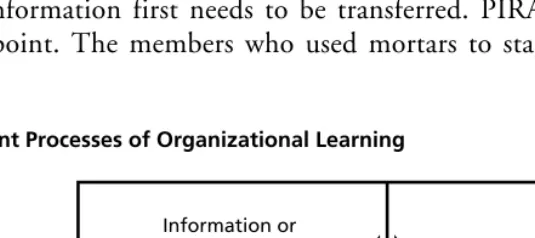
[image:32.612.116.384.414.533.2]Learning can be characterized as a process comprising four component subprocesses: acquiring, interpreting, distributing, and storing information and knowledge.4,5 Fig-ure 2.1 shows a model of this process. All four subprocesses must be carried out suc-cessfully for knowledge to become organizational—that is, clearly tied to group ob-jectives, accessible to many different group members, and resistant to the loss of individual members. The subprocesses are interrelated and can occur in different orders, depending on context. For example, when the individuals who acquire new information or knowledge are also qualified to interpret it, there is no need to dis-tribute it to anyone else in the group before it can be utilized. But when the members with the expertise to make use of new information are not the ones who collected it, the information first needs to be transferred. PIRA’s mortar development is a case in point. The members who used mortars to stage attacks could assess their
Figure 2.1
Component Processes of Organizational Learning
RAND MG331-2.1
Information or knowledge acquisition
Interpretation
Storage Distribution
____________
3 Argyris and Schön (1978) best summarize the advantages and limitations of organizational learning. 4 Lutes (2001) presents a similar four-stage model, also applied to terrorist organizations.
5 Romme and Dillen (1997) present a brief but detailed treatment of organizational learning as an information
What Is Organizational Learning? 11
operations, make judgments about their use of the devices, and apply tactical im-provements to the way they used them. They had no immediate need to distribute this information to other members of the group. But new technical information on the ways mortars were failing probably had to be transferred to the group’s engineers, who could understand its implications and apply it to improve the next generation of weapons.
Acquisition
In order to learn, groups must acquire the information or knowledge6 they need to assess the value of their current activities, understand their effects, and identify changes they need to make to their future behavior to improve performance. They can both reach to external sources for information and mine the knowledge of their own members.
Acquiring Information or Knowledge from External Sources
Organizations of all sizes obtain information and knowledge from external sources, but small organizations are much more likely to need to look outside frequently, be-cause they can seldom find all of the knowledge they need within the group. Some common external resources are described below.
Vicarious Experience. Observing the activities of other groups to glean insights is the least demanding way of gathering information, since it usually requires little effort on the part of the observing group. Vicarious experience usually provides only incomplete insights, however, because observers can watch only the effects of an op-eration and may not gain all the information or knowledge they would need to du-plicate it.
Cooperation with Other Organizations. Groups can access information or knowledge from other groups engaged in similar activities (Romme and Dillen, 1997). Different organizations can form a variety of joint efforts and interactions aimed at specific goals. When the aims and culture of other organizations are com-patible with those of the group seeking information or knowledge, such organizations can be a very valuable resource. They may be less useful when their goals or culture diverge, because these differences can impede the flow of information or knowledge between the groups (Jones, 1991).
____________
6 The difference between information and knowledge is mainly the degree of relevance and adaptation to the
12 Aptitude for Destruction
Outside Human Resources.If a group can locate the right individual experts, it can draw on their expertise either by recruiting them into the organization or by en-gaging them as consultants.
Outside Knowledge Sources or Technologies. Acquiring potentially useful technologies or other knowledge sources—ranging from weapons to blueprints of desirable targets—can rapidly increase a group’s capabilities. PIRA’s acquisition of plans to manufacture mortars is an example of a group using an external knowledge source. For certain types of knowledge, public and electronic sources, such as the In-ternet, can be highly useful. However, acquiring knowledge, whether it is a technol-ogy or some other source of relevant data, generally does not mean that one has all the related information required to use that knowledge effectively. Therefore, groups may need to draw on other sources to gain the additional required information.
Acquiring Information or Knowledge from Internal Sources
Groups commonly gather or develop new information or knowledge within their ranks. They draw on three main sources: congenital knowledge, direct experience, and internal knowledge development.
Congenital Knowledge. The information that an organization inherits from its founding leaders and members is very important early in its development. As the en-vironment changes and the group matures, other sources of knowledge become more important.
Direct Experience (“Learning by Doing”). A group’s ongoing activities provide valuable information and spur knowledge development. Groups frequently draw on this knowledge source unintentionally and unsystematically as they recognize mis-takes that offer lessons on how to improve over time (Cyert and March, 1963). De-liberate efforts to garner information in this way usually take the form of some sort of evaluation, such as an after-action review or lessons-learned process. PIRA’s im-provements in their use of mortars drew on information gained in their initial fail-ures; the group was learning by doing.
Internal Development of Knowledge. A group may be able to develop new knowledge internally. Internal research and development efforts can be aimed at such things as crafting new tactics and weapons to support group operations. The devel-opment of mortars by PIRA’s own engineering department is an example of such ac-tivity. Information and knowledge can also be developed through training, where a group can experiment with and test new concepts and technologies.
Interpretation
What Is Organizational Learning? 13
1991). The group must learn lessons and make judgments about three classes of ac-tivities:7
• Current activities. Are the group’s actions effective? Are they moving the group
toward its overall strategic goals? How can the group alter these actions to make them more successful?
• Possible future activities. Would a new tactic or technology help the group?8 Does the group know what it needs to know to use that tactic or technology? Is the group likely to be able to use it successfully?
• Older or invalidated knowledge and procedures. Is older knowledge still useful?
Are established routines still effective? Should they be discarded in order to adopt newer operating procedures (Hedberg, 1981; McGill and Slocum, Jr., 1993)?
For interpretation to be most effective, the group must have both the knowl-edge needed to make sense of new information and the time and opportunity to think through what it means. Being able to interpret information within a useful time interval is also critical, and culture is key: The group must be open-minded enough to recognize when its circumstances have changed or a particular approach is not working, rather than adhering inflexibly to previous assumptions.
Distribution
Distribution plays a critical role in advancing the learning process. Organizational learning requires that knowledge get to the right people in the group. The more broadly information is distributed within an organization, the more likely it is to be interpreted and to be interpreted in multiple ways, which increases the likelihood that the group will be able to utilize it effectively. Distribution also plays a central role in facilitating the storage of information and increasing its availability for later use. Effective distribution significantly lowers the risk that an organization’s learning will deteriorate (Huber, 1991). However, for terrorist organizations, this may come at the price of increased vulnerability to compromise and penetration because of the ____________
7 Much of the following discussion is framed in a language consistent with viewing terrorist groups and
deci-sionmakers as essentially rational actors—interpreting information based on some concept of the organization’s goals and making decisions on the basis of whether an activity does or does not contribute to them. Other ele-ments of the literature on terrorist group decisionmaking (reviewed recently in McCormick, 2003) provide differ-ent “frames” through which to view the interpretation activities of terrorist groups. The analyses reported here do not depend on the specific decisionmaking model appropriate for a given terrorist organization; a group can learn, no matter what interpretive model it applies, and can make rational decisions and choices within its interpretive frame, though the specifics of its model would be a primary shaper of the aims of its learning efforts.
8 Dolnik and Bhattacharjee (2002) describe such a notional interpretation process regarding Hamas’s choice to
14 Aptitude for Destruction
possibility of interception of communications traffic by law enforcement or intelli-gence organizations.
Storage
Groups must retain information and knowledge to ensure that they can access them in the future. Newer organizations usually keep knowledge almost exclusively in the individual memories of group members. In PIRA, individuals were a key repository of the group’s expertise in mortar use. However, individual memories are highly vul-nerable places in which to preserve knowledge (Carley, 1992; Kim, 1993), so estab-lished groups tend to favor other repositories:
• Language, rituals, and symbols.Storing knowledge in these mechanisms helps to standardize it. Language, rituals, and symbols are also very effective for trans-ferring lessons to new group members.
• Organizational structures. Because group structures define the activities of all members of the organization, they can provide a durable way to institutionalize some types of organizational lessons.
• Written and unwritten operating guidelines. Manuals, recipes, and other types of records codify a group’s processes and can be easily passed among group members.
• External repositories. Storing information outside a group, e.g., on the Internet or with members of allied organizations, can provide an alternate strategy to en-sure the preservation of key knowledge.
The Need to Combine Explicit and Tacit Knowledge
When PIRA set out to acquire mortars, it had to gain knowledge of various types be-fore its efforts could be successful. To fabricate the weapons, the group needed plans, which it reportedly obtained from military reference books. Such books are examples of explicit knowledge, knowledge that is preserved in a physical form—in documents describing activities, blueprints or instructions, and technological systems or devices. This type of knowledge can be transferred from one individual or group to another relatively easily; doing so may entail no more than handing someone a book or downloading a photograph.9 PIRA could also have chosen to acquire mortars on the international arms market, in which case the weapons themselves would have consti-tuted the majority of the explicit knowledge PIRA needed to attain the capability. ____________
9 Different groups attempting a task described in an explicit format will perform that task similarly, because the
What Is Organizational Learning? 15
To use mortars effectively, however, PIRA needed more than just the weapons themselves. It also needed to develop the expertise needed to manufacture the weap-ons so that they would function properly and the expertise to use them well. The knowledge required to gain expertise is largely tacit knowledge—more-abstract knowledge held by individuals. The most common example is the knowledge and skill, often intuitive, that an expert builds over the course of his or her career. Be-cause this type of knowledge is hard to articulate, much less codify,10 it is much more difficult to transfer than explicit knowledge. The individual seeking the knowledge often has to meet the expert face to face. The development of the right tacit knowl-edge within PIRA eventually meant that the group could use mortars with consistent effectiveness.
The PIRA story is not an exception; few activities require either explicit or tacit knowledge alone. Acquiring new information, knowledge, or technology from an explicit source is usually only a group’s first step. The group must then develop enough tacit knowledge within its ranks to be able to apply the information effec-tively (Jones, 1991).
Different Forms of Organizational Learning
Different groups need to learn in different ways at different times. This has every-thing to do with the environment in which a group operates. When conditions are relatively stable, a group may need only to make small changes to the activities it al-ready carries out or the strategies it designs in order to prosper. Once it had acquired mortar technologies, PIRA learned to correct the flaws in its initial designs and im-prove its ability to use the weapons. Because such “continuous improvement efforts” focus on activities a group already performs, they do not challenge existing bounda-ries, rules, and norms. The change that results can be either unintentional or inten-tional.
But if the environment shifts considerably, a group needs to make more dra-matic changes in order to survive (Wang and Ahmed, 2003). In this case, a group may have to pursue “discontinuous change”—learning aimed at entirely new activities or making large shifts in the way the group plans and acts. PIRA’s initial acquisition of mortar technologies could be viewed as such a discontinuous change. Depending on the scale of the change, this type of learning can go far beyond the tactical level and may require a group to reevaluate its fundamental strategies, norms, values, structures, processes, and goals. Because it aims at a radical departure from what the ____________
10 This is not to say that it cannot be articulated and codified, thereby being converted to explicit knowledge.
16 Aptitude for Destruction
group is already doing, discontinuous change is usually pursued intentionally and requires a more complex learning process than continuous improvement efforts do.
17
CHAPTER THREE
The Need to Learn in Order to Change Effectively
The effectiveness of a terrorist group that lacks the ability to learn will be determined largely by chance—the chance that its members already have all the necessary skills, the chance that its current tactics are effective against desirable targets and against current countermeasures, and the chance that any accidental or arbitrary shifts the group makes will prove to be beneficial. Since a terrorist group’s learning capability is a key determinant of the level of threat it poses, knowledge of that capability is criti-cal for law enforcement and intelligence planners in allocating resources for combat-ing the most dangerous terrorist groups.
A terrorist group that can learn successfully can shape its activities systematically to effectively pursue its organizational goals. Analogous to the three classes of group interpretation activities discussed in Chapter Two, terrorist group activities must be assessed in three time frames:
• Past behavior. A learning organization is equipped to assess its tactics and stra-tegic choices, make judgments about what has worked and what has not, and determine whether or not specific actions contributed to achieving its goals.
• Current activities. A terrorist group that learns effectively is better prepared to improve its skills and can make better choices in operational planning and exe-cution.
• Future actions. A learning organization is prepared to search for and pursue new opportunities and to assess how its strategy and tactics must change if it is to remain effective and survive the pressures of its environment.
A terrorist group’s ability to learn at the organizational level can make it both more effective and better able to survive in hostile environments. If a group is able to learn successfully, it can
18 Aptitude for Destruction
• Improve its members’ skills so that they can better apply its current weapons or tactics
• Collect and utilize the intelligence information needed to mount operations effectively
• Thwart countermeasures and improve its chance to survive efforts to destroy it • Preserve the capabilities it has developed even if individual group members are
lost
The operational histories of many terrorist groups, described in our case studies and in the broader terrorism literature, provide examples of the organizational learn-ing processes terrorist organizations have used in each of these five areas, the prices they can pay for not doing so, and the potential benefits of effective learning efforts.
Development, Improvement, and Employment of New Weapons or Tactics
A terrorist group has much to gain by building or acquiring new operational capabilities and tactics. The more tactics a group has in its rep-ertoire—from bombings to firearms attacks to kidnappings to unconventional weapons—the greater its flexibility and operational freedom.1 Having a diverse range of options prepares a terrorist group to deal with complex situations and helps it increase the impact of its operations (Bell, 1998a, p. 183) by
• Addressing shifts in its environment
• Matching tactics precisely to operational needs • Capitalizing on new opportunities
Addressing Environmental Shifts
Shifts in terrorist groups’ environments can gradually devalue their repertoire of attack options—potentially to the point where they become ineffectual. Changes ranging from improved security and hardening of targets to shifts in the public’s re-action to different types of attacks can significantly undermine a terrorist group’s ca-pabilities. Groups that are effective learners have the opportunity to address such ____________
1 For example, officials interviewed during the study estimated that over the course of its operational career,
PIRA developed the ability to use more than 30 different kinds of weapons, including mortars, rocket-propelled grenades (RPGs), explosive devices, and firearms (Jackson, 2005), which it integrated into an even broader range of tactical applications.
The Need to Learn in Order to Change Effectively 19
changes, modifying and diversifying the ways they stage operations and the technolo-gies they use to do so. The ability to unlearn—to rapidly discard previous modes of operation when they prove ineffective—is similarly essential. For example, when elements of the radical environmental movement realized that their operations in wilderness areas were becoming less effective for advancing their agenda, they shifted their focus from operations such as tree spiking to attacking suburban housing devel-opments (Schwarzen, 2004). This enabled the movement to stage operations that attracted more public attention and also increased its visibility. Aum Shinrikyo and Hizballah also developed new types of weapons and tactics in response to environ-mental change, sometimes by drawing on expert consultants and other sources of outside knowledge. Aum’s learning was driven by the perception that its environ-ment required it to acquire unconventional weapons to defend itself and to advance its apocalyptic agenda (Kaplan and Marshall, 1996). Because of perceived changes in its operational environment, Hizballah shifted its operations from predominantly ter-rorist attacks on international targets in Beirut toward more direct confrontation with Israeli forces in southern Lebanon (Ranstorp, 1997). Hizballah’s organizational learning capabilities enabled it to build the guerrilla-warfare capabilities needed for success in this second phase of its conflict.
Matching Tactics to Operational Needs
All of the case study groups acquired not only the ability to use new weapons, but also the ability to manufacture them. In some groups, manufacturing was quite lim-ited (or confined to single munitions types); for example, ELF/ALF “members” manufactured only incendiary devices, and JI produced only bombs. Other groups, such as PIRA and Hizballah, developed full-scale capabilities to manufacture arms. Learning to manufacture weapons provides a terrorist organization with a more stable and predictable source of arms, as well as the ability to customize weapons over time so that their capabilities better match their operational needs. To adapt to shifts in Israeli forces’ tactics, Hizballah produced homemade claymore-type antipersonnel mines that provided significant advantages in targeting security patrols (Cragin, 2005). By designing and building its own RPGs, PIRA could adapt the weapons to its needs as a clandestine organization. Because PIRA could obtain only a limited number of RPGs from international arms sources, group members fleeing the scene of an attack had to carry away the cumbersome launchers, which made them easier to identify and apprehend. By building their own RPGs, the group could make the launchers disposable, facilitating escape after an operation (Jackson, 2005).
Capitalizing on New Opportunities