The established negative role of saturated fatty acids (SFAs) for the development of cardiovas-cular diseases (Lock and Bauman, 2004; Parodi, 2004) has initiated the continuing effort in the research on animal fat composition. Milk fat has been a representative of that group as it contains all so-called hypercholesterolaemic fatty acids at a considerable level – lauric (C12:0), myristic (C14:0) and palmitic (C16:0) acid – Collomb et al. (2004), Pešek et al. (2006, 2008). Moreover, it is distin-guished by a relatively high level of the atherogenic index (AI), calculated as the ratio of the sum of lauric acid + 4 × myristic acid + palmitic acid con-tents to the sum of unsaturated fatty acids (UFAs) content. Myristic acid content is included four times due to its most detrimental health effects
(Ulbricht and Southgate, 1991; Zock et al., 1994; Bobe et al., 2003).
The milk fat composition is not constant. It can fluctuate relatively widely depending on several factors. Diet composition and nutrition of dairy cows have been regarded as the most important factors that have often been utilised. The aim of the optimisation of milk fat composition has been the production of fat with more appropriate tech-nological and/or health properties (Perdrix et al., 1996; Ashes et al., 1997).
The effects of different cow nutrition were re-ported. As regards forages, the feeding of differ-ent silages, mainly those produced from grasses and maize, affected considerably the propor-tion of preferred fatty acids with shorter chain
Supported by the Ministry of Education, Youth and Sports of the Czech Republic (Project No. MSM 6007665806) and by the Ministry of Agriculture of the Czech Republic (Project No. MZE QH81210).
The effect of feeding diets markedly differing
in the proportion of grass and maize silages
on bovine milk fat composition
E. Samková
1, M. Pešek
1, J. Špička
1, T. Pelikánová
1, O. Hanuš
21Faculty of Agriculture, University of South Bohemia, České Budějovice, Czech Republic 2Research Institute for Cattle Breeding, Rapotín, Czech Republic
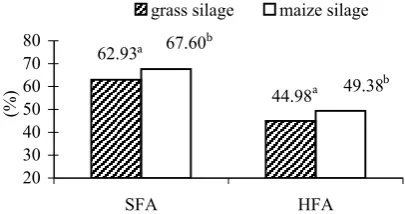
ABSTRACT: Ten Czech Pied cows in the mid-lactation stage were fed diets based on grass silage and maize silage. The composition of milk fats differed. The proportions of even-chain saturated fatty acids (SFAs) up to C14:0 were insignificant and the content of C16:0 was significantly higher (P < 0.05) when feeding a diet based on maize silage, while the proportions of the individual polyunsaturated fatty acids (PUFAs) were significantly (except for C18:2) higher when feeding a diet based on grass silage. The total SFA proportions were 67.60 and 62.93% (P < 0.05) of maize and grass silages, respectively, while an opposite relation was observed for the sum of PUFAs (3.56 and 4.74%; P < 0.001). Feeding of grass silage resulted in a significantly lower proportion of hypercholesterolaemic fatty acids C12:0, C14:0 and C16:0 (49.38 and 44.98%, respectively; P < 0.05) and in lower values of the atherogenic index (3.03 and 2.44; P < 0.05). Thus, the results could be used for the improvement of milk fat composition.
length (Martin et al., 2002; Floris et al., 2006). Feeding grass, red clover and clover-grass silages, Dewhurst et al. (2003) reported a significant in-crease in linolenic acid (C18:3) and a decrease in palmitic acid proportion in milk fat of cows re-ceiving clover silage.
In concentrates, their different treatments (e.g. thermal, grinding, extrusion, seed extraction) should be taken into consideration as they can
increase the proportion of UFAs and concurrently decrease the level of SFAs (Sarrazin et al., 2004; Liu et al., 2008). Significant changes in the milk fat composition followed feeding of additives based on fodder fats and oils (e.g. Loor et al., 2005; Strusińska et al., 2006).
[image:2.595.66.536.101.257.2]The aim of this study was to find out the extent to what fatty acid composition and atherogenic index of cow milk fat can be affected by diets widely used
Table 1. Characteristics of 10 Czech Pied cows – milk yield and composition
Diet with predominant
P
grass silage maize silage
–x sx xmin xmax –x sx xmin xmax
Parity 2.3 0.7 2 4 3.3 0.7 3 5 –
Days in milk 182 38 121 243 158 42 91 243 0.0528
Milk yield (kg/day) 17.76 6.47 11.80 34.00 23.17 7.35 12.30 38.60 0.1507
Fat (%) 4.49 0.87 2.94 5.93 4.66 0.68 3.73 5.98 0.6646
Protein (%) 3.57 0.27 2.96 3.97 3.26 0.46 2.79 4.06 0.1300
Lactose (%) 4.79 0.17 4.50 5.00 5.00 0.14 4.80 5.20 0.0004
Table 2. Chemical composition of used feeds
Maize silage Grass silage Hay1 Mashed oats Production feed
mixture2
1 2
Dry matter (DM; g/kg) 286 324 385 897 870 883
Composition (DM; g/kg)
Crude protein3 75.5 117.6 142.9 71.4 132.2 252.6
Crude fat 31.0 32.5 21.4 18.9 42.5 70.4
Crude fibre 250.7 280.6 259.3 309.2 141.4 67.5
Crude ash 44.8 75.3 91.0 63.2 33.6 72.3
NEL (MJ/kg)4 6.09 5.46 5.87 4.18 6.83 7.41
Ca 2.13 5.12 13.53 3.69 1.49 13.21
P 1.96 3.02 2.83 2.38 4.37 8.00
Na 0.07 0.25 0.10 0.21 0.46 6.18
Mg 1.33 1.98 2.99 1.20 1.38 6.74
1permanent grassland hay from late cut with prevailing Deschampsia cespitosa, Agrostis tenuis, Agrostis stolonifera,
Alo-pecurus pratensis;
2mixture consisted of 20, 20, 12, 25, 20 and 3% (w/w) of barley, wheat, oats, extracted rapeseed meal, extracted soybean meal
and a mixture of minerals and vitamins;
[image:2.595.65.539.454.672.2]in farming, based on different proportions of grass and maize silages.
MATERIAL AND METHODS
Sampling and feeding
Ten lactating Czech Pied cows together stabled in a byre with stanchions for 200 animals on the Čejkovice farm were used (Table 1). Raw milk for
the determination of milk and fatty acid compo-sition was sampled within the afternoon regular testing of milk efficiency during the winter period in January and November 2006.
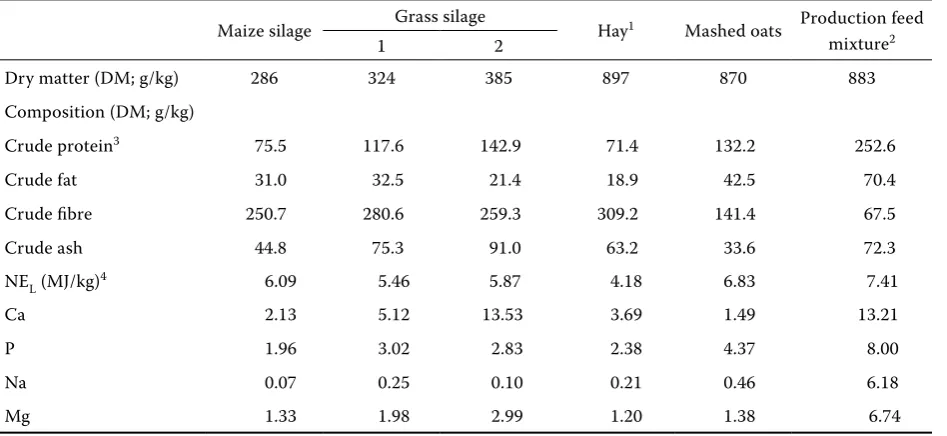
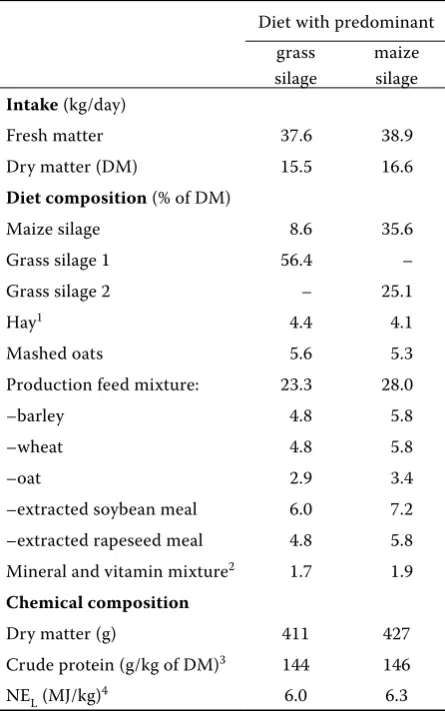
Diets were formulated according to the DLG-Futterwerttabellen, Wiederkäuer (1997) and cal-culated for the mean live weight of 600 kg, milk fat content of 4.2% and milk protein content of 3.5%. Diets consisted of silages widely used currently in Czech farming practice (maize and grass silages) – Table 2. The cows received primarily a diet based on grass silage (27 kg/day; 56.4% of dry matter) and then a diet based on maize silage (21 kg/day; 35.6% of dry matter) – Table 3. Both the diets were fed at least for six weeks before sampling.
Chemical and statistical analyses
The chemical composition of feeds used in the di-ets was analyzed using valid methods according to Decree No. 124/2001 of the Ministry of Agriculture of the Czech Republic (2001). The content of crude protein was determined according to the Kjeldahl method (N × 6.25). The value of NEL was estimated according to Sommer et al. (1994).
[image:3.595.65.288.283.639.2]Fat, protein and lactose contents in milk samples (n = 20) were determined spectrophotometrically using a Milcoscan 4000 device (Foss Electric). Milk fat was extracted with petroleum ether. Fatty ac-ids in isolated fat were reesterified to their methyl esters by a methanolic solution of potassium hy-droxide. Methyl esters of fatty acids were deter-mined by a gas-chromatographic method (GLC)
Table 3. Intake of matter and diet composition
Diet with predominant grass
silage
maize silage
Intake (kg/day)
Fresh matter 37.6 38.9
Dry matter (DM) 15.5 16.6
Diet composition (% of DM)
Maize silage 8.6 35.6
Grass silage 1 56.4 –
Grass silage 2 – 25.1
Hay1 4.4 4.1
Mashed oats 5.6 5.3
Production feed mixture: 23.3 28.0
–barley 4.8 5.8
–wheat 4.8 5.8
–oat 2.9 3.4
–extracted soybean meal 6.0 7.2 –extracted rapeseed meal 4.8 5.8 Mineral and vitamin mixture2 1.7 1.9 Chemical composition
Dry matter (g) 411 427
Crude protein (g/kg of DM)3 144 146
NEL (MJ/kg)4 6.0 6.3
1permanent grassland hay from late cut with prevailing Deschampsia cespitosa, Agrostis tenuis, Agrostis stolonifera, Alopecurus pratensis;
2mixture contained per kilogram: 210, 30, 100, 70 g of
cal-cium, phosphorus, sodium, magnesium, resp.; 750, 30, 80, 2 730 mg of copper, selenium, iodine, vitamin E, resp.; 500 000 and 75 000 IU of vitamin A and D3, resp.
3N × 6.25; 4net energy for lactation (Sommer et al., 1994)
Table 4. Parameters of chromatographic analysis of fat-ty acids
Parameter Value
Column omegawax 530; 30 m
Detector FID
Temperature:
– column
40°C for 3 min; 20°C/min up to 150°C; 2.5°C/min up to 240°C – injection 250°C
[image:3.595.305.531.591.757.2]using a Varian 3300 apparatus under conditions shown in Table4. The identification of fatty ac-ids was carried out using the analytical standards (Supelco). In total, 45 fatty acids were observed, out of which 33 were identified. The proportions of individual fatty acids were calculated from the ratio of their peak area to the total area of all the observed acids.
The analytical data were assessed statistically using Statistica CZ 6.1 program (Statsoft CR). For significance testing, t-test for dependent samples was used.
RESULTS AND DISCUSSION
Statistically insignificant differences (P = 0.1507) in daily milk yield (Table 1) were observed between the testing periods in January and November 2006 in ten cows of Czech Pied cattle. The differences could be caused by different parity (2.3 and 3.3 in January and November, respectively). As re-ported by Townsend et al. (1997) and Secchiari et al. (2003), parity had no effect on the fatty acid composition contrary to the stage of lactation. In our opinion, the changes in the spectrum of fatty acids of these ten lactating cows described below were caused primarily by different proportions of silages in diets.
Both the tested diets have been widely used in the Czech farming practice. The replacement of the diet based on grass silage (27 kg/day) by the diet with prevailing maize silage (21 kg/day) caused expected changes within all groups of milk fatty acids (Figures 1–3 and Table 5).
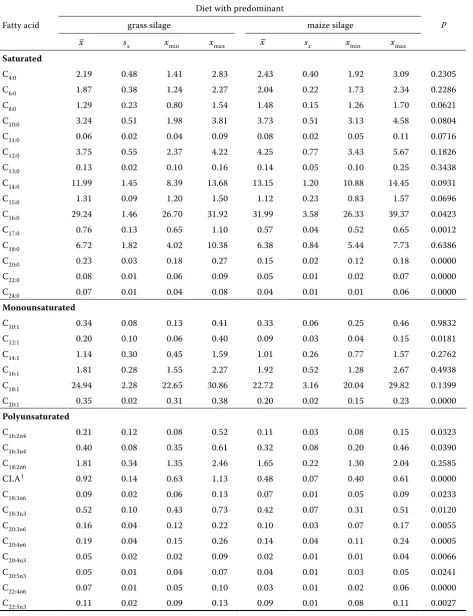
Feeding the diet based on grass silage resulted in a statistically significant (except for linoleic acid – C18:2n6) increase in contents of 12 identified poly-unsaturated fatty acids (PUFAs). Important chang-es were observed in the proportion of C18:2n6 (1.81 versus 1.65%) after feeding the diets based on grass silage and maize silage, respectively, and those of individual n-3 fatty acids (Table 5).
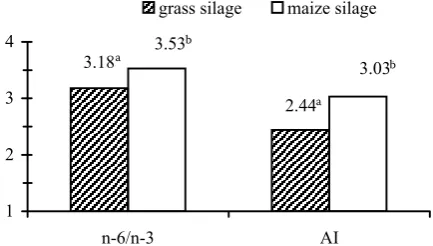
The ratio of n-6 to n-3 fatty acids in human nutri-tion should be maximally 5:1 (WHO/FAO, 2003). While the intake of n-6 fatty acids from plant oils was sufficient and even exceeded, dietary sources of n-3 acids were usually limited. In the tested milk fat the ratio values were 3.18 and 3.53 (P < 0.05) after feeding the diets based on grass silage and maize silage, respectively (Figure 1). Literature data of the ratio in milk fat vary more widely, e.g. between 1.16 and 4.37 (Komprda et al., 2000; Collomb et al., 2004). However, it should be taken into considera-tion that the number of identified n-3 and n-6 fatty acids was different in different papers. For instance, Leiber et al. (2005) used the contents of only three n-6 and four n-3 acids for the ratio calculation, while Collomb et al. (2004) used nine and seven acids, respectively.
[image:4.595.67.284.563.686.2]From the nutritional aspect, great attention has been focused on conjugated linoleic acids (CLA) with their preventive health roles (Parodi, 2004; Bauman et al., 2006). The determined proportions in milk fats were 0.92 and 0.48% (P < 0.001) after feeding the diets based on grass silage and maize silage, respectively (Table 5). Considerable differ-ences (P < 0.001) were also observed in total pro-portions of PUFAs, 4.74 and 3.56%, respectively (Figure 2).
2.44a
3.18a 3.53b 3.03b
1 2 3 4
n-6/n-3 AI
grass silage maize silage
4.74b 28.78
3.56a 26.27
0 10 20 30
MUFA PUFA
(%)
[image:4.595.308.517.565.687.2]grass silage maize silage
Figure 1. The ratio of polyunsaturated fatty acids n-6 to polyun-saturated fatty acids n-3(n-6/n-3) and the atherogenic index (AI = (C12:0 + (C14:0 × 4) + C16:0 )/UFA) in milk fat of Czech Pied cows fed diets based on grass and maize silage; a,bmeans with
different superscripts differ significantly at 0.05
Figure 2. Proportions of monounsaturated fatty acids (MUFA) and polyunsaturated fatty acids (PUFA) in milk fat of Czech Pied cows fed diets based on grass and maize silage; % of total fatty acids (w/w); a,bmeans with different
superscripts differ significantly at 0.001
a
a b
b
Table 5. Effects of feeding different diets on the fatty acid composition (% of the total 45 fatty acids, w/w) in milk fat of Czech Pied cows
Fatty acid
Diet with predominant
P
grass silage maize silage
x sx xmin xmax x sx xmin xmax
Saturated
C4:0 2.19 0.48 1.41 2.83 2.43 0.40 1.92 3.09 0.2305
C6:0 1.87 0.38 1.24 2.27 2.04 0.22 1.73 2.34 0.2286
C8:0 1.29 0.23 0.80 1.54 1.48 0.15 1.26 1.70 0.0621
C10:0 3.24 0.51 1.98 3.81 3.73 0.51 3.13 4.58 0.0804
C11:0 0.06 0.02 0.04 0.09 0.08 0.02 0.05 0.11 0.0716
C12:0 3.75 0.55 2.37 4.22 4.25 0.77 3.43 5.67 0.1826
C13:0 0.13 0.02 0.10 0.16 0.14 0.05 0.10 0.25 0.3438
C14:0 11.99 1.45 8.39 13.68 13.15 1.20 10.88 14.45 0.0931
C15:0 1.31 0.09 1.20 1.50 1.12 0.23 0.83 1.57 0.0696
C16:0 29.24 1.46 26.70 31.92 31.99 3.58 26.33 39.37 0.0423
C17:0 0.76 0.13 0.65 1.10 0.57 0.04 0.52 0.65 0.0012
C18:0 6.72 1.82 4.02 10.38 6.38 0.84 5.44 7.73 0.6386
C20:0 0.23 0.03 0.18 0.27 0.15 0.02 0.12 0.18 0.0000
C22:0 0.08 0.01 0.06 0.09 0.05 0.01 0.02 0.07 0.0000
C24:0 0.07 0.01 0.04 0.08 0.04 0.01 0.01 0.06 0.0000
Monounsaturated
C10:1 0.34 0.08 0.13 0.41 0.33 0.06 0.25 0.46 0.9832
C12:1 0.20 0.10 0.06 0.40 0.09 0.03 0.04 0.15 0.0181
C14:1 1.14 0.30 0.45 1.59 1.01 0.26 0.77 1.57 0.2762
C16:1 1.81 0.28 1.55 2.27 1.92 0.52 1.28 2.67 0.4938
C18:1 24.94 2.28 22.65 30.86 22.72 3.16 20.04 29.82 0.1399
C20:1 0.35 0.02 0.31 0.38 0.20 0.02 0.15 0.23 0.0000
Polyunsaturated
C16:2n4 0.21 0.12 0.08 0.52 0.11 0.03 0.08 0.15 0.0323
C16:3n4 0.40 0.08 0.35 0.61 0.32 0.08 0.20 0.46 0.0390
C18:2n6 1.81 0.34 1.35 2.46 1.65 0.22 1.30 2.04 0.2585
CLA1 0.92 0.14 0.63 1.13 0.48 0.07 0.40 0.61 0.0000
C18:3n6 0.09 0.02 0.06 0.13 0.07 0.01 0.05 0.09 0.0233
C18:3n3 0.52 0.10 0.43 0.73 0.42 0.07 0.31 0.51 0.0120
C20:3n6 0.16 0.04 0.12 0.22 0.10 0.03 0.07 0.17 0.0055
C20:4n6 0.19 0.04 0.15 0.26 0.14 0.04 0.11 0.24 0.0005
C20:4n3 0.05 0.02 0.02 0.09 0.02 0.01 0.01 0.04 0.0066
C20:5n3 0.05 0.01 0.04 0.07 0.04 0.01 0.03 0.05 0.0241
C22:4n6 0.07 0.01 0.05 0.10 0.03 0.01 0.02 0.06 0.0000
C22:5n3 0.11 0.02 0.09 0.13 0.09 0.01 0.08 0.11 0.0027
The diets affected also the contents of individual monounsaturated fatty acids (MUFAs). Feeding a diet based on grass silage caused the increased contents of all MUFAs except for palmitoleic acid (C16:1), the proportion of which decreased insig-nificantly. Proportions of C12:1 (0.20 and 0.09%, P < 0.05) and C20:1 (0.35 and 0.20%, P < 0.001) after feeding the diets based on grass silage and maize silage, respectively, were determined. Statistically insignificant differences were observed both in oleic acid (C18:1) proportions (24.94 and 22.72%) and in total MUFA proportions (28.78 and 26.27%, respectively) (Table 5 and Figure 2).
An increase in MUFA and PUFA proportions in milk fat is certainly compensated by a decrease in the SFA proportion (Figure 3). In this study, feeding of the diet based on grass silage resulted in an in-significant decrease in all even-chain acids between C4:0 and C14:0, and in a significant decrease in C16:0 (29.24 and 31.99; P < 0.05). The proportions of acids with longer chains increased significantly (P < 0.01 and P < 0.001). As mentioned above, changes in the proportion of hypercholesterolaemic acids C12:0, C14:0 and C16:0 can have a very detrimental health impact. As may be seen from Figure 3, the diet based on grass silage decreased significantly their sum value (44.98 and 49.38%; P < 0.05).
The determined decrease in hypercholesterolae-mic acids along with the increase in MUFA and PUFA proportions resulted in a significant decrease in the values of atherogenic index (2.44 and 3.03; P < 0.05) – Figure 1.
The comparison of our results with literature data was complicated due to different experimen-tal conditions and participating factors. However, the papers of Chilliard et al. (2001, 2007) reported
the following results and knowledge of the effects of maize silage feeding on the milk fat composi-tion. Maize silage as the main forage of a diet leads to the proportions 12–14%, 30–34% and 18–23% of C14:0, C16:0 and C18:1, respectively, in milk fat. Our results (Table 5) showed to be well compa-rable with those levels. Moreover, according to Chilliard et al. (2001), feeding of maize silage as compared with grass silage causes an increase in all SFAs between C6 and C12. This was also observed in our study (Table 5). And finally, the proportions of CLA determined in our study are consistent with results of Chouinard et al. (1998) and Bayourthe et al. (2000), who reported the CLA proportion of 0.4–0.6% when feeding maize silage, while the levels for grass silage feeding were twice higher.
According to Chilliard et al. (2001), the differ-ences in PUFA proportions between milk fats pro-duced by cows fed maize or grass silage are not very large. The linoleic acid proportion varies between 1.8 and 2.8% in maize silage feeding, while it is lower in grass silage feeding. Data in Table 5 dif-fer from these generalised conclusions. However, some other factors should be reasoned. The milk fat composition can be affected by different vegetation stages of ensiled forage (Vanhatalo et al., 2007), dif-ferent botanical composition and origin of ensiled grasses (Collomb et al., 1999; Leiber et al., 2005) or by different hybrids of ensiled maize (LaCount et al., 1995). For instance, Michalet-Doreau and Doreau (1999) reported the effect of maize silages containing up to 30–40% of grains with a high con-tent of linoleic acid. Such sources then increased the linoleic acid proportion in milk fat.
CONCLUSIONS
The content and composition of all identified fatty acids in milk fat of Czech Pied cows differed with feeding diets based on grass or maize silage. Significant differences were found mainly in PUFA proportions. The proportion of salubrious CLA was significantly higher when feeding the diet based on grass silage as compared with the diet based on maize silage (0.92 and 0.48, respectively, P < 0.001). Contents of even-chain SFAs up to C14:0 were insig-nificantly higher with maize silage feeding and the content of C16:0 was significantly higher (29.24 and 31.99; P < 0.05). Significantly higher values as compared with fat of cows fed grass silage were observed both in the total proportion of
hyper-Figure 3. Proportions of saturated fatty acids (SFA) and hy- percholesterolaemic fatty acids (HFA = C12:0 + C14:0 + C16:0) in milk fat of Czech Pied cows fed diets based on grass and maize silage; % of total fatty acids (w/w); a,bmeans with
different superscripts differ significantly at 0.05
44.98a 62.93a
49.38b 67.60b
20 30 40 50 60 70 80
SFA HFA
(%)
grass silage maize silage
a b
[image:6.595.66.269.585.692.2]cholesterolaemic fatty acids C12:0, C14:0 and C16:0 (44.98 and 49.38%, P < 0.05) and in the atheroge- nic index of milk fat (2.44 and 3.03; P < 0.05).
The results confirm the presumption that the feeding of appropriate forage can considerably re-duce the proportion of hypercholesterolaemic fatty acids in milk fat and the value of the atherogenic index. Thus, the information could be used for the improvement of milk fat composition for healthier nutrition.
REFERENCES
Ashes J.A., Gulati S.K., Scott T.W. (1997): Potential to alter the content and composition of milk fat through nutrition. Journal of Dairy Science, 80, 2204–2212. Bauman D.E., Mather I.H., Wall R.J., Lock A.L. (2006):
Major advances associated with the biosynthesis of milk. Journal of Dairy Science, 89, 1235–1243. Bayourthe C., Enjalbert F., Moncoulon R. (2000): Effects
of different forms of canola oil fatty acids plus canola meal on milk composition and physical properties of butter. Journal of Dairy Science, 83, 690–696.
Bobe G., Hammond E.G., Freeman A.E., Lindberg G.L., Beitz D.C. (2003): Texture of butter from cows with different milk fatty acid compositions. Journal of Dairy Science, 86, 3122–3127.
Chilliard Y., Ferlay A., Doreau M. (2001): Effect of differ-ent types of forages, animal fat or marine oils in cow’s diet on milk fat secretion and composition, especially conjugated linoleic acid (CLA) and polyunsaturated fatty acids. Livestock Production Science, 70, 31–48. Chilliard Y., Glasser F., Ferlay A., Bernard L., Rouel J.,
Doreau, M. (2007): Diet, rumen biohydrogenation and nutritional quality of cow and goat milk fat. European Journal of Lipid Science and Technology, 109, 828–855. Chouinard P.Y., Corneau L., Bauman D.E., Butler W.R.,
Chilliard Y., Drackley J.K. (1998): Conjugated linoleic acid content of milk from cows fed different sources of dietary fat. Journal of Animal Science, 76, 233. Collomb M., Bűtikofer U., Spahni M., Jeangros B., Bosset
J.O. (1999): Fatty acid and glyceride composition of cow´s milk fat in high- and lowland regions. Sciences des Aliments, 19, 97–110.
Collomb M., Sollberger H., Bűtikofer U., Sieber R., Stoll W., Schaeren W. (2004): Impact of basal diet of hay and fodder beet supplemented with rapeseed, linseed and sunflower seed on the fatty acid composition of milk fat. International Dairy Journal, 14, 549–559.
Decree of the Ministry of Agriculture of the Czech Repub-lic No. 124/2001 (2001): The requirements for feeds
sam-pling and principles of laboratory control methods of feeds, supplements and premixes and the mode of sample storage. Statute Book, No. 50, 3091–3216. (in Czech) Dewhurst R.J., Fisher W.J., Tweed J.K.S., Wilkins R.J.
(2003): Comparison of grass and legume silages for milk production. 1. Production responses with differ-ent levels of concdiffer-entrate. Journal of Dairy Science, 86, 2598–2611.
DLG-Futterwerttabellen, Wiederkäuer (1997): 7th ed.,
Frankfurt am Main: DLG-Verlag, Germany, 212 pp. (in German)
Floris R., Dekker R., Slangen Ch., Ellen G. (2006): Influ-ence of pasture feeding and stall feeding on CLA and other fatty acids in bovine milk fat. Australian Journal of Dairy Technology, 61, 13–20.
Komprda T., Dvořák R., Suchý P., Fialová M., Šustová K. (2000): Effect of heat-treated rapeseed cakes in dairy cow diet on yield, composition and fatty acid pattern of milk. Czech Journal of Animal Science, 45, 325–332.
LaCount D.W., Drackley J.K., Cicela T.M., Clark J.H. (1995): High oil corn as silage or grain for dairy cows during an entire lactation. Journal of Dairy Science, 78, 1745–1754.
Leiber F., Kreuzer M., Nigg D., Wettstein H.R., Richard M., Scheeder L. (2005): A study on the causes for the elevated n-3 fatty acids in cows’ milk of alpine origin. Lipids,40, 191–202.
Liu Z.L., Yang D.P., Chen P., Lin S.B., Jiang X.Y., Zhao W.S., Li. J.M., Dong W.X. (2008): Effect of dietary sources of roasted oilseeds on blood parameters and milk fatty acid composition. Czech Journal of Animal Science, 53, 219–226.
Lock A.L., Bauman D.E. (2004): Modifying milk fat com-position of dairy cows to enhance fatty acids beneficial to human health. Lipids, 39, 1197–1206.
Loor J.J., Ferlay A., Ollier A., Ueda K., Doreau M., Chil-liard Y. (2005): High-concentrate diets and polyun-saturated oils alter trans and conjugated isomers in bovine rumen, blood, and milk. Journal of Dairy Sci-ence, 88, 3986–3999.
Martin B., Ferlay A., Pradel P., Rock E., Grolier P., Dupont D., Gruffat D., Besle J.M., Ballot N., Chilliard Y., Cou-lon J.B. (2002): Variability of the composition of milk in components having a nutritional interest according to the cow´s diet. In: 9th Meeting on Ruminant research,
Paris, France, INRA, 347–350.
Michalet-Doreau B., Doreau M. (1999): Review: maize genotype and ruminant nutrition. Sciences des Ali-ments, 19, 349–365.
Perdrix M.F., Sutter F., Wenk C. (1996): Variation in the composition of fatty acids in cow milk fat.. Revue Suisse d’ Agriculture, 28, 71–76.
Pešek M., Samková E., Špička J. (2006): Fatty acids and composition of their important groups in milk fat of Czech Pied cattle. Czech Journal of Animal Science, 51, 181–188.
Pešek M., Samková E., Špička J. (2008): Evaluation of changes in the content of adverse saturated fatty acids in cow milk with a view to optimising the composition of milk fat. Milchwissenschaft, 63, 33–36.
Sarrazin P., Mustafa A.F., Chouinard P.Y., Raghavan G. S.V., Sotocinal S.A. (2004): Performance of dairy cows fed roasted sunflower seed. Journal of the Science of Food and Agriculture, 84, 1179–1185.
Secchiari P., Mele M., Serra A., Buccioni A., Paoletti F., Antongiovanni M., Summer A. (2003): Effect of breed, parity and stage of lactation on milk conjugated linoleic acid content in Italian Friesian and Reggiana cows. Ital-ian Journal of Animal Science, 2, 269–271.
Sommer A., Čerešňáková Z., Frydrych Z., Králík O., Králíková Z., Krása A., Pajtáš M., Petrikovič P., Pozdíšek J., Šimek M., Třináctý J., Vencl B., Zeman L. (1994): Nutrient requirements and tables of nutrient value of ruminant feeds. 1st ed. Pohořelice ČZS VÚVZ, CR,
198 pp. (in Czech)
Strusińska D., Minakowski D., Pysera B., Kaliniewicz J. (2006): Effects of fat-protein supplementation of diets for cows in early lactation on milk yield and composi-tion. Czech Journal of Animal Science, 51, 196–204. Townsend S.J., Siebert B.D., Pitchford W.S. (1997):
Vari-ation in milk fat content and fatty acid composition of Jersey and Friesian cattle. In: Proceedings of the 12th
Conference, Breeding responding to client needs. Dubbo, Australia, Part 1, 283–291.
Ulbricht T.L.V., Southgate D.A.T. (1991): Coronary heart disease: seven dietary factors. Lancet, 338, 985–992. Vanhatalo A., Kuoppala K., Toivonen V., Shingfield K.J.
(2007): Effect of forage species and stage of maturity on bovine milk fatty acid composition. European Jour-nal of Lipid Science and Technology, 109, 856–867. WHO/FAO (2003): Diet, Nutrition and the Prevention of
Chronic Disease. WHO Technical Report Series, 916. Geneva, Switzerland, 56 pp. Available at http://www.fao. org/docrep/005/AC911E/AC911E00.HTM#Contents Zock P.L., de Vries J.H.M., Katan M.B. (1994): Impact of
myristic acid versus palmitic acid on serum lipid and lipoprotein levels in healthy women and men. Arterio-sclerosis Thrombosis and Vascular Biology, 14, 5567–575.
Received: 2008–05–06 Accepted after corrections: 2008–11–04
Corresponding Author
Ing. Eva Samková, Ph.D., Faculty of Agriculture, University of South Bohemia, Studentská 13, 370 05 České Budějovice, Czech Republic