
Numerical Method for solving Volterra Integral
Equations with a Convolution Kernel
Changqing Yang, Jianhua Hou
Abstract—This paper presents a numerical method for solv-ing the Volterra integral equation with a convolution kernel. The integral equation was first converted to an algebraic equation using the Laplace transform, after which its numerical inversion was determined by power series. The Pad´e approximants were effectively used to improve the convergence rate and accuracy of the computed series. The method is described and illustrated with numerical examples. The results revealed that the method is accurate and easy to implement.
Index Terms—Volterra integral equation, Laplace transform, Taylor expansion, series solution, Pad´e approximant.
I. INTRODUCTION
V
OLTERRA integral equations have many applications in various areas, including mathematical physics, chem-istry, electrochemchem-istry, semi-conductors, scattering theory, seismology, heat conduction, metallurgy, fluid flow, chemical reaction and population dynamics[1], [2].This paper focuses on a class of Volterra integral equations with a convolution kernel given by
u(x) =f(x) +
Z x
0
k(x−t)u(t)dt, x∈[0, T], (1) where the source function f and the kernel function k are given, andu(x)is the unknown function. Several numerical methods are available for approximating the Volterra integral equation. In particular, Huang[3] used the Taylor expansion of unknown function and obtained an approximate solution. Yang[4] proposed a method for the solution of integral equation using the Chebyshev polynomials, while Yousefi[5] presented a numerical method for the Abel integral equation by Legendre wavelets. Khodabin [6] numerically solved the stochastic Volterra integral equations using triangular functions and their operational matrix of integration. Kamyad [7] proposed a new algorithm based on the calculus of variations and discretisation method, in order to solve linear and nonlinear Volterra integral equations. The Adomian de-composition [8], [9], [10], Homotopy perturbation [10], [11] and the Laplace decomposition methods[12] were proposed for obtaining the approximate analytic solution of the integral equation.
In this paper, Volterra integral equations were first reduced to algebraic equations using the Laplace transform. We obtained a series that was uniformly convergent to the exact solution after applying the Taylor expansion and the inverse Laplace transforms to the mentioned algebraic equations. The
Manuscript received May 13, 2013; revised July 02, 2013. This work was supported by Huaihai institute of technology under Grant Z2012021
C. Yang is with the Department of Science, Huaihai Institute of Technol-ogy, Lianyungang, Jiangsu, 222005 China e-mail: ([email protected]).
H. Hou is with the Department of Science, Huaihai Institute of Technol-ogy, Lianyungang, Jiangsu, 222005 China e-mail: ([email protected]).
main advantage of this method is its simplicity, such that only few of the terms of the expansion are needed to obtain good convergent numerical results.
II. LAPLACE TRANSFORM AND THEIR PROPERTIES This section provides the definition and properties of the Laplace transform[13].
Definition II.1. The Laplace transform of a function f(x), x >0 is defined as
L[f(x)] =F(s) =
Z +∞
0
e−sxf(x)dx,
wherescan either be real or complex.
The Laplace transform has several properties, as explained below:
1) Linearity property
L[af(x) +bg(x)] =aL[f(x)] +bL[g(x)], wherea, bare constants.
2) The convolution theorem
Let the Laplace transforms for the functionsf1(x)and f2(x) be given by
L[f1(x)] =F1(s), L[f2(x)] =F2(s).
The Laplace convolution product of these two functions is defined by
L
·Z x
0
f1(x−t)f2(t)dt
¸
=F1(s)F2(s), (2)
Theorem II.2. [13] Suppose F(s)is the Laplace transform off(x), which has a Maclaurin power series expansion in the form
f(x) =
∞ X
i=0 aix
i
i!. (3)
Taking the Laplace transform, it is possible to write formally
F(s) =
∞ X
i=0 ai
si+1. (4)
Conversely, we derive (3) form a given expansion (4).
III. PADE APPROXIMANT´
A Pad´e approximant refer to the ratio of two polynomials constructed from the coefficients of the Taylor series expan-sion of a function. The[L/M]Pad´e approximant to a formal power seriesy(t) =P∞i=0aiti is given by:
·
L M
¸
= PL(t) QM(t) =
p0+p1t+· · ·+pLtL
1 +q1t+· · ·+qMtM. (5)
IAENG International Journal of Applied Mathematics, 43:4, IJAM_43_4_03
The two polynomials in the numerator and denominator of (5) have no common factor, thus indicating the formal power series expressed by
y(t) = PL(t) QM(t)+O(t
L+M+1).
In this case, the Pad´e approximant[L/M]is uniquely deter-mined.
IV. SOLUTION OFVOLTERRA INTEGRAL EQUATION AND ERROR ESTIMATE
In this section we solved Volterra integral equation (1) by the Laplace transform and Taylor series. First, the Laplace transform is applied to both sides of Equation(1)
L[u(x)] =L[f(x)] +L
·Z x
0
k(x−t)u(t)dt
¸
Using the Laplace transform property (2), the equation below can be obtained
L[u] =L[f] +L[k]L[u]. Thus, the given equation is equivalent to
L[u] = L[f]
1− L[k] =F(s).
Applying Theorem(II.2), F(s)can be expanded as an abso-lutely convergent series, which is given by
L[u] = c1 s +
c2 s2 +
c3 s3 +· · ·
where c1, c2, c3,· · · are the known constants. Considering
the inverse Laplace transform on both sides of the above equation, we can then obtain
u(x) =c1+ c2 Γ(2)x+
c3 Γ(3)x
2+ c4
Γ(4)x
3· · · (6)
which is uniformly convergent to the exact solution. We approximate the solutionu(x)by using
un(x) =c1+ c2 Γ(2)x+
c3 Γ(3)x
2+· · ·+ cn
Γ(n)x
n−1.
Leten(x) =u(x)−un(x)be the error function, whereun(x) is the estimation of the true solution u(x). Using Taylor’s theorem and assuming that |u(n)(x)| ≤ M, the equation
below can be obtained
|en|=|u(x)−un(x)| ≤M
cn+1 Γ(n+ 1)|x
n|.
Pad´e approximants have the advantage of manipulating the polynomial approximation into a rational function in order to gain more information about u(x). Consequently, the series (6) should be manipulated to construct Pad´e approximants, such that the performance of the approximants shows supe-riority over the series solutions.
V. NUMERICAL EXAMPLES
In this section, the effectiveness and simplicity of the proposed method were demonstrated using three examples. All the results were calculated using the symbolic calculus software Mathematica.
Example V.1. Consider the Abel integral equation given by Z x
0 u(t)
√
x−tdt=e
−x−1, x∈[0,1]. (7) We using the Laplace transform and convolution property given by
L[u]L[x−1
2] =L[e−x−1],
so that
L[u] = √ −1
π√s(s+ 1) =F(s).
Expanding the right hand sideF(s)in the power of1/s, we obtain
L[u] = √1
π
Ã
−
µ
1 s
¶3 2
+
µ
1 s
¶5 2
−
µ
1 s
¶7 2
+
µ
1 s
¶9 2
· · ·
!
.
By taking the inverse Laplace transform of both sides of the above equation, the series solution can new be expressed as:
u(x) =−2
√
x π
µ
1−2
3x+ 4 15x
2− 8
105x 3
+ 16 945x
4− 32
10395x
5+ 64
135135x 6
− 128
2027025x
7− 256
34459425x 8· · ·

, (8)
which is consistent with the results obtained in a previous work[9].
Pad´e approximants also have the advantage of manipulat-ing the polynomial approximation into a rational function to gain more information about u(x). The Pad´e approximants
[3/3],[4/4] and[5/5] of u(x) were constructed in order to study the structure of the obtained solution(8). For example, the Pad´e approximants[4/4]is given by
u(x)≈−2 √
x
π ·
1−10
51x+x2−2320588 x3+114864752048 x4 1 + 8
17x+858x2+331532 x3+3646516 x4 .
The numerical results show in Fig.1.
Example V.2. Consider the Abel integral equation of second kind expressed as[5], [14]:
u(x) = 2√x−
Z x
0 u(t)
√
x−tdt, x∈[0,1]. (9) The exact solution is u(x) = 1−eπxerf c(√πx), where
erf c(√πx)is the complementary error function and defined as
erf c(x) = √2
π
Z ∞
x
e−t2dt.
Applying the Laplace transform and convolution property (2), we arrive at
L[u] =L[2√x]− L[x−1 2]L[u].
Hence,
L[u] = L[2
√
x] 1 +L[x−1
2] ,
IAENG International Journal of Applied Mathematics, 43:4, IJAM_43_4_03
0.5 0.6 0.7 0.8 0.9 1 −0.35
−0.345 −0.34 −0.335 −0.33 −0.325
x
u(x)
[3/3] [4/4] [5/5]
Fig. 1. Numerical results for Example1
or equivalently,
L[u] =
√
π
s(√s+π) =F(s).
The right hand side ofF(s)expanded in the power of 1/s as in
F(s) =π12
µ
1 s
¶3 2
−π
µ
1 s
¶2 +π32
µ
1 s
¶5 2
−π2
µ
1 s
¶3 +π52
µ
1 s
¶7 2
−π2
µ
1 s
¶4
+π72
µ
1 s
¶9 2
−π4
µ
1 s
¶5
· · ·.
(10)
By applying the inverse Laplace transform to (10), we obtain
u(x) =2x12 −πx+4π 3 x
3 2 −π
2
2 x 2+5π2
18 x 5 2
−π
3
6 x
3+16π3 105 x
5 2 −π
4
24x 4· · ·.
(11)
Similarly,t=x12 was first substituted, the Pad´e approximant [3/3]and[4/4]ofu(t)was constructed, and the approxima-tion [4/4]was provided to the solution:
u(x)≈ 2x
1
2 + 3.0829x+ 2.0808x32 + 0.5207x2
1 + 3.1123x12 + 3.8347x+ 2.2230x32 + 0.5235x2 .
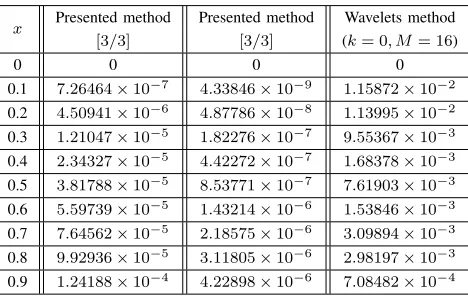
The results shown in Fig. 2 demonstrate that the approximate solutions obtained using the proposed method are in good agreement with the exact solutions. When the solutionu(x)
has a special form, the proposed method works well. Further-more, the numerical results in Table1 reveal that higher order accuracy can be achieved by increasing some terms of the expansion. In this way, more terms would enhance the level of accuracy of the numerical approximation. Moreover, by comparing the results of the table, the results of the presented method are more accurate than those of the wavelet method presented in a previous work[14].
Example V.3. Consider the Volterra integral with a convo-lution kernel given by[15]
u(x) +
Z x
0
cos(x−t)u(t)dt= sin(x). (12)
0 0.2 0.4 0.6 0.8 1
0 0.1 0.2 0.3 0.4 0.5 0.6 0.7 0.8
x
u(x)
Approximate solution exact solution
Fig. 2. Comparison of approximate solutions [4/4] and exact solution
TABLE I
COMPUTED ABSOLUTE ERRORS FOREXAMPLEV.2
x Presented method
[3/3]
Presented method
[3/3]
Wavelets method (k= 0, M= 16)
0 0 0 0
0.1 7.26464×10⁻⁷ 4.33846×10⁻⁹ 1.15872×10⁻² 0.2 4.50941×10⁻⁶ 4.87786×10⁻⁸ 1.13995×10⁻² 0.3 1.21047×10⁻⁵ 1.82276×10⁻⁷ 9.55367×10⁻³ 0.4 2.34327×10⁻⁵ 4.42272×10⁻⁷ 1.68378×10⁻³ 0.5 3.81788×10⁻⁵ 8.53771×10⁻⁷ 7.61903×10⁻³ 0.6 5.59739×10⁻⁵ 1.43214×10⁻⁶ 1.53846×10⁻³ 0.7 7.64562×10⁻⁵ 2.18575×10⁻⁶ 3.09894×10⁻³ 0.8 9.92936×10⁻⁵ 3.11805×10⁻⁶ 2.98197×10⁻³ 0.9 1.24188×10⁻⁴ 4.22898×10⁻⁶ 7.08482×10⁻⁴
The exact solution is u(x) = 2√3 3 sin(
√
3x/2)e−x
2. Taking
the Laplace transforms of both sides of (12) can yield
L[u] +L
·Z x
0
cos(x−t)u(t)dt
¸
=L[sin(x)]
Applying (2) we obtain
L[u] +L[cos(x)]L[u] =L[sin(x)], which provides
L[u] = L[sin(x)] 1 +L[cos(x)] =
1 s2+s+ 1.
Expanding the right hand side of the above equation in power of1/s, we obtain
L[u] = 1 s2 −
1 s3 +
1 s5 −
1 s6 +
1 s8−
1 s9 +
1 s11−
1 s12· · · .
Applying the inverse Laplace transform to the above equa-tion, we obtain
u(x) =x−x
2
2 + x4
4! − x5
5! + x7
7! − x8
8! + x10 10! −
x11 11! · · ·.
We construct the Pad´e approximants [3/3],[4/4] and [5/5]
IAENG International Journal of Applied Mathematics, 43:4, IJAM_43_4_03
[image:3.595.316.536.64.238.2] [image:3.595.310.544.301.449.2]TABLE II
ABSOLUTE ERRORS OF[3/3], [4/4]AND[5/5]FOREXAMPLEV.3
x [3/3] [4/4] [5/5]
0 0 0 0
0.1 2.47996×10⁻¹³ 2.12330×10⁻¹⁵ 4.16334×10⁻¹⁷ 0.2 6.34643×10⁻¹¹ 1.04025×10⁻¹² 3.05311×10⁻¹⁶ 0.3 1.62565×10⁻⁹ 3.81095×10⁻¹¹ 2.86993×10⁻¹⁴ 0.4 1.62261×10⁻⁸ 4.83148×10⁻¹⁰ 6.49258×10⁻¹³ 0.5 9.66243×10⁻⁸ 3.42285×10⁻⁹ 7.20879×10⁻¹² 0.6 4.14996×10⁻⁷ 1.67752×10⁻⁸ 5.10483×10⁻¹¹ 0.7 1.42247×10⁻⁶ 6.37358×10⁻⁸ 2.64983×10⁻¹⁰ 0.8 4.13357×10⁻⁶ 2.00938×10⁻⁷ 1.09561×10⁻⁹ 0.9 1.05880×10⁻⁵ 5.49231×10⁻⁷ 3.80688×10⁻⁹ 1 2.45509×10⁻⁵ 1.34114×10⁻⁶ 1.15307×10⁻⁸
of u(x): ·
3 3
¸
= x+x
2−9x3 20 1 +3x
2 +3x 2 10 +13x
3 120 ,
·
4 4
¸
= x−
48x2 223 −113x
3 1561 +149x
4 9366 1 +127x
446 +437x 2 6244 +173x
3 18732 + 470x
4 374640
,
·
5 5
¸
= x−
4205x2 12627 −775x
3
16836 +1285x 4
50508 − 49363x 5 21213360 1 +4217x
25254+473x 2 12627+11x
3
4392 + 1277x 4
4242672− 797x 5 42426720
.
The numerical results shown in Fig. 3 and Table 2 reveal that higher order accuracy can be achieved by increasing some terms of the expansion, that is, using more terms can enhance the level of accuracy of the numerical approximation. This fact ensures that the method is convergent.
VI. CONCLUSION
In this paper, we applied Laplace transform and Taylor series to solve the Volterra integral equation with a con-volution kernel. The properties of the Laplace transform, together with Taylor series, are used to reduce the integral equations to the algebraic equations. The method requires much less computational work compared with traditional methods. Although we only considered a model problem in this paper, the main ideas and techniques used here are also applicable to many other problems.
ACKNOWLEDGMENT
The authors are grateful to anonymous reviewers for their valuable comments.
REFERENCES
[1] H. J. Teriele, “Collocation method for weakly singular second kind Volterra integral equations with non-smooth solution,”IMA Journal of
Numerical Analysis, vol. 2, no. 4, pp. 437–449, 1982.
[2] P. K. Lamm and L. Eld´en, “Numerical solution of first-kind Volterra equations by sequential Tikhonov regularization,” SIAM Journal on
Numerical Analysis, vol. 34, no. 4, pp. 1432–1450, 1997.
[3] L. Huang, Y. Huang, and X. Li, “Approximate solution of Abel integral equation,”Computers&Mathematics with Applications, vol. 56, no. 7, pp. 1748–1757, 2008.
[4] C. Yang, “Chebyshev polynomial solution of nonlinear integral equa-tions,”Journal of the Franklin Institute, vol. 349, no. 3, pp. 947–956, 2012.
[5] S. A. Yousefi, “Numerical solution of Abel’s integral equation by using Legendre wavelets,”Applied Mathematics and Computation, vol. 175, no. 1, pp. 574–580, 2006.
[6] M. Khodabin, K. Maleknejad, and F. H. Shekarabi, “Application of triangular functions to numerical solution of stochastic Volterra inte-gral equations,”IAENG International Journal of Applied Mathematics, vol. 43, no. 1, pp. 1–9, 2013.
[7] A. V. Kamyad, M. Mehrabinezhad, and J. Saberi-Nadjafi, “A numerical approach for solving linear and nonlinear Volterra integral equations with controlled error,”IAENG International Journal of Applied
Math-ematics, vol. 40, no. 2, pp. 27–32, 2010.
[8] G. Adomian,Frontier Problem of Physics: The Decomposition Method. Kluwer Academic Publish, 1994.
[9] L. Bougoffa, R. C. Rach, and A. Mennouni, “A convenient technique for solving linear and nonlinear Abel integral equations by the Adomian decomposition method,” Applied Mathematics and Computation, vol. 218, no. 5, pp. 1785–1793, 2011.
[10] R. K. Pandey, O. P. Singh, and V. K. Singh, “Efficient algorithms to solve singular integral equations of Abel type,” Computers &
Mathematics with Applications, vol. 57, no. 4, pp. 664–676, 2009.
[11] J. H. He, “Homotopy perturbation technique,”Computer Methods in
Applied Mechanics and Engineering, vol. 178, no. 3-4, pp. 257–262,
1999.
[12] M. Khan and M. A. Gondal, “A reliable treatment of Abel’s second kind singular integral equations,”Applied Mathematics Letters, vol. 25, no. 11, pp. 1666–1670, 2012.
[13] L. Debnath and D. Bhatta,Integral Transforms and their Applications, 2nd ed. Chapmanand&Hall/CRC Press, 2007.
[14] S. Sohrabi, “Comparison Chebyshev wavelets method with BPFs method for solving Abel’s integral equation,”Ain Shams Engineering
Journal, vol. 2, no. 3-4, pp. 249–254, 2011.
[15] S. A. Isaacsona and R. M. Kirby, “Numerical solution of linear Volterra integral equations of the second kind with sharp gradients,”
Journal of Computational and Applied Mathematics, vol. 235, no.
14-15, pp. 4283–4301, 2011.
Changqing YangHe was born in Shanxi, China, in 1973. He received the
bachelor and master degrees in mathematics from Chengdu University of Technology in 1997 and 2004, respectively. His main research interests are in numerical methods on integral equations and spectral method.
Jianhua Hou She was born in Shanxi, China, in 1978. She received her
bachelor in computer science in 1998 from the Shanxi Normal University. Her master degree was obtained in 2004 from the Chengdu University of Technology, Sichuan, China. Her main research interests are in parallel numerical algorithms.
IAENG International Journal of Applied Mathematics, 43:4, IJAM_43_4_03
0
0.5
1
1.5
2
2.5
3
−0.1
0
0.1
0.2
0.3
0.4
0.5
0.6
x
u(x)
exact solution
[3/3]
[4/4]
[5/5]
Fig. 3. Comparison of approximate solutions [3/3],[4/4],[5/5] and exact solution
![TABLE II [3/3], [4/4]](https://thumb-us.123doks.com/thumbv2/123dok_us/384422.535957/4.595.47.291.65.363/table-ii.webp)
![Fig. 3.Comparison of approximate solutions [3/3],[4/4],[5/5] and exact solution](https://thumb-us.123doks.com/thumbv2/123dok_us/384422.535957/5.595.96.484.256.569/fig-comparison-of-approximate-solutions-and-exact-solution.webp)
