Recent Advances in Modeling Fission Cross Sections over Intermediate
Structures
Olivier Bouland1,2,a, J. Eric Lynn1, and Patrick Talou1
1 T-2 - Nuclear and Particle Physics, Astrophysics and Cosmology Group, Theoretical Division, Los Alamos National
Laboratory, Los Alamos, NM 87545, USA.
2 Laboratoire d’Etudes de Physique, DEN/DER/SPRC, Commisariat `a l’Energie Atomique, 13108 St-Paul-lez-Durance,
C.E. Cadarache - France.
Abstract. More accurate fission cross section calculations in presence of underlying intermediate structure are strongly desired. This paper recalls the common approximations used below the fission threshold and quantifies their impact. In particular, an exact expanded R-matrix Monte Carlo calculation of the intermediate structure, deeply mixed with the fluctuations of the class-I and II decay amplitudes, is shown. This paper also insists on the microscopic structure of the level densities as a function of the nucleus deformation and show preliminary neutron induced fission cross section calculations for239Pu and240Pu using newly calculated combinatorial level densities. Comparisons with recent evaluated and measured fission cross sections are made.
1 Introduction
The modelling of fission cross sections over intermediate structure has been challenging since the first experimen-tal discoveries in 1968 of the phenomenon of narrow in-termediate structure in slow neutron fission measurements on237Np and240Pu nuclei (respectively by Paya et al. [1]
and Migneco et al. [2]). This phenomenon, explained by the coupling between highly deformed vibrational class-II states (located in a secondary well of the nucleus po-tential energy) and the class-I states at ground-state de-formation, has required modifications to the R-matrix for-malism for interactions in the deformation channels. This extended R-matrix reaction theory involving the splitting of the reaction Hamiltonian into deformation, intrinsic and coupling terms was developed in particular by Lynn [3], and led to various asymptotic formulations of the average fission cross section depending of the strength of the cou-pling element. Ever increasing computing capabilities have made possible more exact calculations of the average fis-sion cross section, using a Monte Carlo sampling of ener-gies, fission and coupling widths of the class-II states as well as the characteristics of the class-I states from the statistical distribution of levels and partial widths. A few attempts were made in the past [4, 5], but the most signif-icant application of this method was performed in 2002 by Lynn and Hayes [6] over a wide range of actinide fis-sion cross sections. In addition to better predict the magni-tude of the cross section, this Monte Carlo approach paves the way for modeling genuine fluctuations in the Unre-solved Resonance energy Range (at the right energies and with correct fluctuation envelopes) and provides a more a e-mail: [email protected] or olivier.bouland
@cea.fr
fundamental background for evaluating meaningful fission width parameters in the Resolved Resonance Range. The present work aims at performing accurate fission cross sec-tion calculasec-tions on the basis of sound physics (less phe-nomenology, fitted parameters and dependency on experi-mental fits) in order to
– better model current applications but also better predict
cross sections for difficult or impossible to measure nu-clei,
– better estimate of related fission quantities (fission
frag-ments, fission spectra, etc.),
– reinforce our confidence in the estimation of parameter
uncertainties and associated covariance data.
This paper will summarize our current advances on cal-culated cross sections and illustrate them by preliminary results on neutron induced reactions on239Pu and240Pu with comparison to recent evaluations and fission data. Finally foreseen developments will be discussed.
2 Theoretical Background
2.1 Classic approaches in resonance range analyses
Low energy cross sections are well reproduced by classic R-matrix theory of nuclear reactions, which is based on the eigenfunctions and eigenvalues of the full nuclear Hamil-tonian in an internal region with boundary conditions im-posed to the reaction channels at the region surface. These conditions connect the external wave functions to the R-matrix internal states and so define an ensemble of eigen-functions in the inner region. It also introduces the con-cept of reaction channel defining the maximum of radial DOI:10.1051/epjconf/20100208001
© Owned by the authors, published by EDP Sciences, 2010
distance within which a nuclear force-type interaction be-tween the two ”bodies” involved may occur. An entrance or an exit reaction channel is defined by its quantum num-bersα, l, s, J which qualify respectively the nature and the number of nucleons of each component of the pair (α), the relative orbital angular momentum of the moving particle-target (or residual) nucleus pair (l), the channel spin (s) and the total angular momentum (J) of the system.
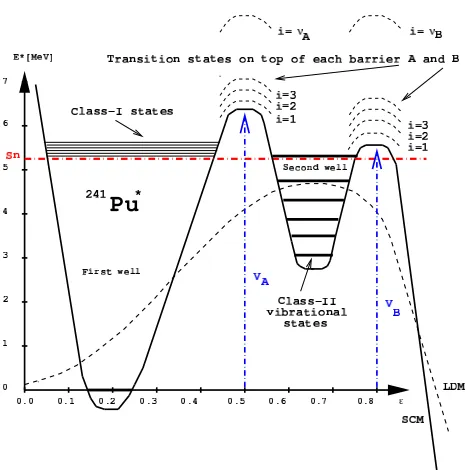
In the original R-matrix theory fission channels are as-sumed to be treated as true particle reaction channels, as just described, with the channel radii close to the saddle point. We refer to these as the fission product channels, each of which is denoted by the masses of the pair of prod-ucts, their states of excitation, their angular momenta and parities, etc. Bohr [7] pointed out, however, that in a phy-sical sense a fission channel should be regarded as being entered at the saddle point, where the deforming nucleus is relatively ”cold”, and a specific channel would be defined by the internal state of excitation of the deforming nucleus. It appeared that some of the properties of this internal ex-citation, notably the K quantum number (i.e.; the projec-tion of J on the elongaprojec-tion axis), could be ”frozen in” al-ready at the saddle point. This point of view has since dom-inated the analysis of cross sections such as Reich-Moore, in which only a few fission channels are stipulated. The re-duced width amplitudes of the fission product channels can be regarded as being correlated with the amplitude of the channel at the fission barrier, thus justifying the use of the barrier channel (or, ”transition state”) concept (illustrated in Fig. 1) in R-matrix theory. These channels require for their description a parameterηcharacterizing globally the deformation and a wave functionϕ(η) which satisfies the Schrodinger equation with suitable boundary condition at the channel entrance close to the saddle point deformation:
−−h
2
2B
∂2ϕ(η)
∂η +(υ(η)−E)ϕ(η)=0, (1)
with B the inertial parameter, including the effect of nu-clear interactions among the ”internal” degrees of freedom as the deformation changes.
In the Unresolved Resonance energy Range on which statistics applies, Hauser-Feschbach (HF) theory with width fluctuations, averaging R-matrix theory over the Gaussian orthogonal ensemble, is appropriately used for fission cross section measurement analyses. However HF theory is of-ten associated with effective single hump barrier penetra-bilities for many fissile nuclides studies (such as those con-strained by the current status of the SAMMY code). This approach allows a satisfactory reproduction of average fis-sion cross sections but relies heavily on the adjustment of phenomenological average fission widths, fission barrier heights.
2.2 Inclusion of Fission in ClassicR-matrix Theory
Experimental evidence of intermediate states and double-humped barrier has motivated the inclusion of fission de-formation modes in R-matrix theory in a more formal way.
Fig. 1. Potential energy of deformation of the241Pu∗system as a function of the elongation. Comparison between the single hump of the Liquid Drop Model (LDM) and the the double-hump bar-rier shape of the Shell Correction Method (SCM).
A generalized variableη, which describes the overall con-tinuous elongation of the system along the fission path, was introduced by Lynn [3]. The Hamiltonian operator:
H=Hη+Hint(ζ, η0)+Hc(η, ζ;η0), (2)
is decomposed into
– a collective component, Hη, depending explicitly on the deformation parameter,
– an intrinsic Hamiltonian component, Hint, that depends on the individual nucleon coordinates,ζ, and,
– a coupling Hamiltonian, Hc.
The eigenfunctions and eigenvalues of Hintand Hηare respectivelyχµ(η) andεµ(η) ≡ ǫµ(η)−ǫµ(η0); the
intrin-sic excitation energies relative to ”ground state” and,φν(η) and εν. It is convenient to expand the eigenstates Xλ of the generalized R-matrix of the internal region in terms of product pairs of the quasi-vibrational functionsφν(η) and the intrinsic functions χµ(η) defined at some special de-formationsη0such as those of the normal and meta-stable
values of the double hump fission barrier. These can be constituted of two groups of auxiliary states (XI
λI and X
II λII)
formed from expansions limited to vibrational states local-ized principally in either the primary or secondary well of the deformation potentialυ(η):
XλI =X νµ
Cλ(νµ)φIν(µ)χµ, (3)
these two sets of auxiliary states (expressed by the admix-ture coefficients Cλ(νµ) into eigenstatesλ). If the
interme-diate barrier between the two wells is high relative to the excitation energy the overlap between class-I and -II vi-brational states is small and the mixing of the two classes is weak, and the class-II compound states (with relatively high vibrational amplitudes at the outer barrier) then ap-pear as clear intermediate resonances.
Treatment of class-I and class-II states coupling. For a given class-II state,λII, the average over neighbor-ing class-I levels of the squared matrix elements between it and the class-I states, H2
c(λIIλI), is proportional to the mean coupling width,hΓλII(c)i:
hHc2(λIIλI)iα =hΓλII(c)iαDI/2π, (4)
withhΓλII(c)iαbeing deduced from the transmission coeffi
-cient TAacross an inner barrier channelα:
2πhΓλII(c)iα/DII=TA(α). (5)
Similarly, the partial fission component of the average class-II fission width across theβouter barrier channels is de-duced from the transmission coefficient TB
2πhΓλII( f )iβ/DII=TB(β). (6)
Determination ofEλandXλat sub-barrier energies. In the sub-barrier case, the assumption that the total fission width of a class-II state is always significantly less than the class-II level spacing, is reasonable. According to Ref. [3], in the most general case where the total fission width of the class-II state considered is smaller than a few class-I mean spacings (e.g.;ΓλII <4DI), an exact diagonalization
of the single class-II state considered (the contributions of the distant II are added later) with its discrete class-I neighbors must be performed to calculate the eigenval-ues, Eλ, of the Hamiltonian, Hc(Eq. 2), in the intermediate structure. The coefficients Cλ(λI)and Cλ(λII)are then:
Cλ(λI) =−
hH2
c(λIIλI)i
EλI −Eλ Cλ(λII) (7)
and,
C2λ(λ
II) =
h X
λI
| hHc(λIIλI)i |2 (EλI −Eλ)
2 +1
i−1
. (8)
Cλ(λI)and Cλ(λII)are used to calculate the partial resonance
parameters corresponding to open reactions in both wells. In particular the R-matrix fission width, entering in the ave-rage cross section formula in narrow resonance approxima-tion, is calculated as:
Γλ( f )=2Pf νmax
outer
X
ν=1
Cλ2(λ
II)×γ
2
λII,ν( f ) (9)
withνmax
outerbeing the maximum number of outer barrier fis-sion channels open or partially open, Pf, the barrier pene-tration factor from beyond the outer saddle point and,γλII,ν,
the class-II decay width amplitude by fission into an outer channelν.
3 Construction of Individual and
Continuum States
3.1 Individual compound nucleus and transition states
In the case of an even-even target (or fissioning) nucleus, only collective states exist at low energies. The existence of a two quasi-particle (2qp) intrinsic state is correlated to the breaking of the pairing energy force between two neutrons or two protons and its excited energy is the sum of the two independent quasi-particle energies:
Eexc2qp=Eν+Eν′
=
q
(eν−λn/p)2+∆2n/p+
q
(eν′−λn/p)2+∆2n/(10)p
with eνandλn/pbeing respectively the single-particle en-ergy and the Fermi enen-ergy. Associated spin and parity are respectively:
K2qp =|Kν±Kν′|, π2qp =πν∗πν′. (11)
This implies that only individual state band heads (on top of which rotational bands are built) of collective nature ex-ist at low energies:
Erot ={−h2/(2ℑ)}{J(J+1)−K(K+1)} (12) with,
Jπ =Kπ,(K+1)π,(K+2)π,... for K,0 =0+,2+,4+,... for K=0+ =1−,3−,5−,... for K=0−
Equation 10 clearly depicts the minimum energy gap value, two pairing energies (2∆n/p), encountered between the vibrational ground state and the lowest quasi-particle state. This picture is more complicated for odd-mass (Eexc1qp= En/p) and odd-odd nuclei (E2exc×1qp=En+Ep) which present respectively 1 neutron or proton quasi-particle state exci-tation and, 1 neutron and 1 proton quasi-particle state ex-citations in the ground state. The construction of the corre-sponding individual level sequence requires, prior to rota-tional enhancement building, a merging of the low energy vibrational and simple quasi-particle excitations to form combinatorial state band heads of energy, spin and parity:
EexcN =Eqpexc+Eexcvib
KN=|Kqp±Kvib |
πN=πqp∗πvib (13)
Low-lying collective levels are usually known exper-imentally up to about 1 MeV. The 240Pu vibrational
in-elastic levels [8] include a mass asymmetry vibration with Kπ =1−at E∗ =0.60 MeV, a beta-vibration, Kπ =0+at
E∗=0.86 MeV, a bending-vibration, Kπ =1−at E∗=0.94
MeV and a gamma vibration, Kπ =2+at E∗ =1.14 MeV.
5 5.5 6 6.5 7
Fission Barrier 2 Fission Barrier 1
E n e rg y ( M e V ) 0+ 0 -2+ 0+ 4+ 1 -2 -1 -3 -2+ 6+ 0+ 4+ 8+ 4 -2+ 6+ 0+ 0 -1 -1+ 2+ 2 -1 -3 -0+ 0+ 2+ 0 -2 -0 -(ground) (mass asym.) (gamma) (2 gamma) (2 gamma) (bending) (gamma+mass asym.) (gamma+bending) (gamma§+bending) (3 gamma) (3 gamma) (4 gamma)
(4 gamma) (4 gamma) (2 gamma+mass asym.) (5 gamma) (5 gamma)
Sn
EA= 5.80 MeV EB= 5.00 MeV
Pu-240* (ground) (mass asym.) (bending) (mass asym.+bending) (gamma ) (mass asym.+gamma ) (bending+gamma ) (bending+gamma )
(2 mass asym.) (2 bending)
(2 bending) (2bending+mass asym.) (2bending+mass asym.) (2 quasi-particles)
Fig. 2. Schematic of the240Pu∗individual low-lying vibrational sequence used at the inner and outer barriers.
MeV; Jπ = 6−, E∗ = 1.387 and 1.477 MeV were added
to ensure the consistency with the combinatorial level den-sity used above this individual state sequence. For an odd-n mass target nucleus such as239Pu , the inelastic spectrum also includes low energy single-particle neutron states [9]. The lowest single-particle levels for239Pu target nucleus
are respectively in [N,nz, Λ, Ω] asymptotic quantum num-bers notation 1/2+[631] at E∗ = 7.8 keV; 5/2+[622] at E∗ =285 keV, 7/2−[743] at E∗ =392 keV, 1/2−[631]∗0−
at E∗=470 keV, and 7/2+[624] at E∗=512 keV.
A similar approach is adopted to construct the transi-tion states on top of each barrier with the average level spacing adjusted to the deformation. A schematic of the individual low-lying vibrational sequence used for the in-ner barrier of the240Pu∗is shown in Fig. 2 (left-hand side)
which mostly exhibits combinations of gamma vibrations. The lowest single particle neutron state (2qp) appears at 1.39 MeV above the inner barrier, and so is not visible on this picture. The right-hand side of Fig. 2 shows a similar schematic for the outer barrier but exhibits at low energy a mass asymmetry vibration and at rather higher energy a bending vibration and then, simple combinations of them. The lowest single particle neutron state (2qp) shows up at 1.7 MeV above the outer barrier.
3.2 Construction of level densities
A combinatorial procedure was adopted to construct level densities as a function of the excitation energy and the nu-cleus deformation. This procedure is a generalization of the method used in section 3.1 for creating the sequence of individual states. It deals now with multi-combinations of neutron and/or proton quasi-particle states (leading to 1qp, 3qp, 5qp, etc. or 2qp, 4qp, 6qp, etc. states) and multi-combinations of mass asymmetry, bending, gamma, etc. vibrational states. Subsequent combinations of these multi-quasi-particle and multi-vibrational states are made, on the model of Eqs. 13 to form the combinatorial rotational band heads.
The main ingredients of this procedure are the pairing gaps, the moment of inertia h−2/(2ℑ) and, the vibrational
Fig. 3. Cumulated inelastic level densities (Total level density in-tegrated over the energy spectrum from 0 eV to the considered excitation energy Eexc) of the239Pu target nucleus as a function of Eexc. Our calculation (solid curve) is compared to the HF-BCS prediction (dashed-curve) tabulated in the RIPL-2 database. The plot displays at low energy the individual level density, matching the continuum level density calculation at 1.3 MeV, used in our calculation.
and the single-particle state sequences at barrier deforma-tions. The240Pu∗single-particle neutron and proton states
at the inner deformation are currently extracted from Nils-son et al. [10] (valid for the first hump and secondary min-imum only) and the states sequences at the outer deforma-tion are supplied by M¨oller et al. [11] slightly extrapolated for an additional degree of liberty in the shape of the nu-cleus. Another sensitive parameter, as energy increases, is the so-called blocking attenuation parameter (bn/p). This later insures the gradual collapse of the nucleon pairing gap (∆n/p) with energy because of the decrease of the num-ber of unoccupied single-particle states below the Fermi energy:
∆′n/p=∆n/pexp[−q2n/p,e f f/b
2
n/p], (14) with qn/p,e f f, the effective number of quasi-particles in a state following Gaussian distribution. This leads to a low-ering of the ground state excitation energy value (EN) with energy of the combinatorial level N:
E′N=EN− 1 4
X
x,p
ρxS[∆2x−∆
′2
x], (15)
withρxS, the nucleon single-particle state densities.
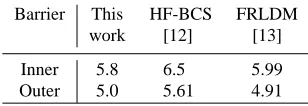
Table 1. Fundamental barrier values [MeV] used for the240Pu∗ compound nucleus in this preliminary work compared with data from HF-BCS predictions [12] and macroscopic-microscopic Fi-nite Range Liquid Drop Model calculations [13].
Barrier This HF-BCS FRLDM
work [12] [13]
Inner 5.8 6.5 5.99
Figure 3 shows the cumulated inelastic level densities of the239Pu target nucleus as a function of excitation
en-ergy, Eexc. Our calculation (solid curve) exhibits a similar shape but is different in magnitude than the HF-BCS mass model prediction of Goriely [12] (dashed curve) available from the RIPL-2 database. Similar cumulated level densi-ties, but at barrier deformations, are shown Fig. 4. The in-ner barrier calculations disagree in magnitude (thick solid curve compared to the thick dashed curve). However, the HF-BCS higher calculated level density might be compen-sated by a higher inner barrier value (Table 1). The outer barrier level densities agree in magnitude above 3.75 MeV (thin solid curve compared to the thin dashed curve), but the HF-BCS outer barrier value, smaller than the HF-BCS inner value, is still higher than our value (Table 1). Above the individual level density matching energy, our combina-torial level density calculation has been tuned to obtain a better agreement between our calculated fission cross sec-tion and the ENDF/B-VII.0 evaluation. A convenient ap-proach based on the breaking of the level density into en-ergy regions (or phases),φ, of simple exponential increase, each characterized by a numerical constant (Cφ), a tempe-rature (Tφ) and a spin-dispersion coefficient (σφ), has been adopted:
ρφ(Eexc)=Cφ
(2J+1) 4σ2
φ
exp(−J+
1 2)
2
2σ2
φ
exp (Eexc/Tφ) (16)
withσ2
φ = C
1
φ+C
2
φ. √
E+C3.E . This explains the non-regular shape changes observed in our calculation (Fig. 4).
Fig. 4. Cumulated transition states densities of the240Pu∗ com-pound nucleus as a function of the excitation energy. The solid curves correspond to our calculations which are compared to the HF-BCS predictions (dashed-curves) tabulated in the RIPL-2 database. The thick curves are relative to the inner barrier and the thin curves to the outer barrier. At low energies, our calculations are based on individual level sequences which match the contin-uum level density calculation at 1.5 and 1.3 MeV respectively for the inner and outer barriers.
4 Treatment of Underlying Intermediate
Structure in Fission Cross sections
4.1 Above barrier excitation energies
The presence of the inner barrier introduces a simple de-coupling effect between the normal and meta-stable re-gions of deformation. This decoupling is expressed by two independent fission barrier transmission coefficients TAand TB, with barriers commonly chosen as inverted parabolas. The resulting effective transmission coefficient for com-pound nucleus states of the primary well through specific outer deformation channel (µ) is simply:
Te f f(µ) = TATB(µ) TA+TB
. (17)
In this strong coupling approximation, Te f f(µ) is used directlly in the HF formalism as if there was one barrier only. To obtain a more accurate calculation, the fluctuations of the class-I and class-II fission widths (so-called S(I)n f and Sn f(II)) must be considered assuming a chi-square statistical distri-bution with an effective number of degrees of freedom dif-ferent for each barrier. The resulting average fission cross section is:
σn fJπ =σJnπ,(CN)Pf
=πλ−2(gJ)TI(n) µmax
outer
X
µ=1
TATB(µ)
TA+TB
S(I)n fS(II)n f . (18)
4.2 Sub-barrier excitation energies
Below the barriers, equation (18) is no more valid. Assum-ing that the couplAssum-ing between a sAssum-ingle class-II state and its class-I neighboring states is still quite strong (mode-rately weak coupling corresponding to high inner barrier andΓλII( f )∼DII), a Lorentzian energy dependence of the
fission width can be used to calculate the average fission cross section over a single resonance, with an average over a class-II resonance. Moreover assuming that the statistical fluctuations of widths, spacing and coupling elements can be ignored (so-called ”picket fence model”), the resulting average fission probability is:
Pf =1+
TI
T( f ) 2
+2TI T( f )
cothTA+TB 2
−1/2
, (19)
with TI, the total transmission coefficient over all radiation, elastic and inelastic channels and T( f ), the statistical fission
transmission coefficient of Eq. 18.
(and identified in section 2.2) are sampled from the appro-priate distribution functions and mean values. Preliminary results for239Pu and240Pu fission cross sections are shown
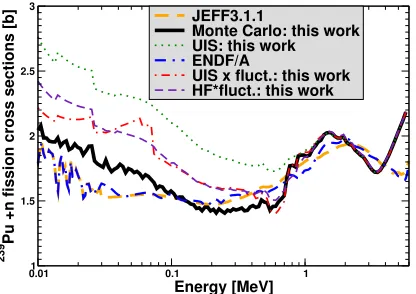
on Figs. 5 and 6 where the impact of the various approxi-mations on the fission transmission coefficient with respect to the exact Monte Carlo approach can be assessed.
The net effect of the fluctuations can be estimated from the Uniform Intermediate Structure formula without (UIS ≡ Eq. 19; dotted curve) and with (UIS × fluct.; dotted-dashed curve) fluctuation terms. The difference, decreas-ing with energy, on the average cross section is as much as 30% depending on the number of fission channels open.
The effect of the intermediate structure (UIS×fluct. ≡ Eq. 19 multiplied by fluctuation terms; dotted-dashed curve) is to lower the average cross section below the value obtained in the statistical model (HF × fluct. ≡ Eq. 18; dashed curve). This effect is expected to be larger for sub-threshold fission in fertile nuclides (240Pu ) rather than for
fissile isotopes (239Pu ).
The exact Monte Carlo treatment (thick solid curve), taking into account both fluctuations and intermediate struc-tures, reproduces quite well the experimental data below 200keV. Above this energy, an additional tuning of fission barrier parameters should be done to improve the agree-ment with the data.
Fig. 5.239Pu fission cross sections calculated under various ap-proximations (see text for details) and compared to recent eva-luated libraries.
5 Perspectives
The accurate, physics-based, and predictive modeling of fission cross sections above the resolved resonance range is the ultimate goal of our current efforts. Using Bjornholm-Lynn’s theory for the treatment of intermediate structures, model parameters extracted from modern theoretical nu-clear structure calculations, and a database of consistent parameters across isotopes, such modeling appears within reach. Our ongoing LANL-CEA collaboration is address-ing this topic with promisaddress-ing preliminary results, as shown in this paper. Obviously much work remains to encompass the full complexity (multi-dimensional, time-dependent, temperature-dependent) of the nuclear fission problem.
Fig. 6.240Pu fission cross sections calculated under various ap-proximations (see text for details) and compared to recent eva-luated libraries. Recent measurements by Tovesson et al.[15] and Laptev et al. [16] are also shown.
Acknowledgments One of the authors (O. Bouland) expresses his deep gratitude to the T-2 group of LANL for hosting and fund-ing complement. This work would have not been possible with-out the strong support of the Commissariat `a l’ ´Energie Atomique (Direction de l’ ´Energie Nucl´eaire).
This work was carried out under the auspices of the National Nuclear Security Administration of the U. S. Department of En-ergy at Los Alamos National Laboratory under Contract No. DE-AC52-06NA25396.
References
1. D. Paya et al., J. Phys. 29, (1968) 159.
2. E. Migneco and J.P. Theobald, Nucl. Phys. A112, (1968) 603.
3. J. E. Lynn, J. Phys. A: Math. Nucl. Gen., 6, (1973) 542. 4. G.D. James et al., Phys. Rev. C15 (1977) 2083. 5. H. Weigmann et al., Nucl. Phys. A438 (1985) 333. 6. J. E. Lynn and A. C. Hayes, Proc. of 3rdIntl. Conf. on
Fission and Properties of Neutron-Rich Nuclei, (Sanibel Island, FL 2002).
7. A. Bohr, Proc. Intl. Conf. on Peaceful Uses of At. Ener-gies 2 (New York, 1956) 151.
8. F. E. Chukreev and B. Singh, Nucl. Data Sheets 103, (2004) 325-388.
9. R. B. Firestone, Table of Isotopes CD-ROM, 8thedition (Frank Chu Ed., Berkeley, March 1996).
10. S. G. Nilsson et al., Nucl. Phys. A131, (1969) 1. 11. P. M¨oller et al., Nucl. Phys. A192, (1972) 529. 12. S. Goriely, F. Tondeur, J. M. Pearson, Atomic Data
Nuclear Data Tables 77, (2001) 311.
13. P. M¨oller et al., Phys. Rev. C 79,(2009) 064304. 14. J. E. Lynn, Harwell Report, AERE-R7468, (1974). 15. F. Tovesson et al., Phys. Rev. C 79, 014613 (2009). 16. A. Laptev et al., Proc. of 3rdIntl. Conf. on Fission and