Sunil et al. World Journal of Pharmaceutical Research
STUDY OF THE HETUS OF EK-KUSHTHA WITH SPECIAL
REFERENCE TO PSORIASIS
Dr. Desai Rajdatta1 M.D. (Rognidan), Dr. Chavan Sunil*2 M.D. (Agad Tantra), Dr. Patil Swapnil3 M.D. (Rognidan) and Dr. Pawaskar Rasik4 M.D. (Rognidan)
1,3
Asst. Professor, Dept. of Rognidan, Hon. Shri. Annasaheb Dange, Ayurved Medical
College, Ashta. 2
Asst. Professor, Dept. of Agadtantra, Hon. Shri. Annasaheb Dange, Ayurved Medical
College, Ashta.
4
Professor, Dept. of Rognidan.
ABSTRACT
In Ayurveda, skin diseases are included under the heading of Kushtha and Kshudra rogas. Out of them Kshudra Kushthas, Ek-kushtha is co-related with psoriasis. It is a common, chronic and non-infectious skin
disease of today‟s era. It is characterized by well defined slightly
raised, dry erythematous macules with silvery and typical extensor
distribution. In Ayurveda, it has been mentioned by asvedanamahava and matsyasaklopama. This disease is a burning problem of this era particularly in the treatment aspect. Hence this problem has been
selected to know all hetus in detail so that can treat this Ek-kushtha (Psoriasis) by breaking its pathogenesis by avoiding its hetus.
KEYWARDS: Ek-kushtha (Psoriasis), Hetu.
INTRODUCTION
"Ayurvedo Amrutanam" because it is well known that the ayurveda is a science of life. This science of life explain us, how to maintain health and how to cure diseased condition. Hence
to avoid diseases one should know hetus of that disease.
Hetus of specific disease will mostly affect on its aashraya sthana. In case of Ek-kushtha disease it is mostly affect twacha that is skin. In Ayurveda the word “twacha” or “charma’ is used for skin (Ch. Sha. 7/16).
World Journal of Pharmaceutical Research
SJIF Impact Factor 8.074
Volume 8, Issue 2, 723-748. Research Article ISSN 2277– 7105
Article Received on 29 November 2018,
Revised on 19 Dec. 2018, Accepted on 09 Jan. 2018
DOI: 10.20959/wjpr20192-13959
*Corresponding Author
Dr. Chavan Sunil
Asst. Professor, Dept. of
Agadtantra, Hon. Shri.
Annasaheb Dange, Ayurved
Skin is the first organ of the body interacting with the environmental agents like physical,
chemical and biological. Skin is the mirror that reflects internal and external pathology thus
helps in diagnosis of disease.
AIM AND OBJECTIVES Aim
To find out etiological factors of Ek-kushtha vyadhi.
Objectives
1) To study Ek-kushtha vyadhi as per Ayurveda literature. 2) To study Psoriasis as per modern literature.
3) To find out Aaharaj, Viharaj, manas and other hetu of Ek-kushtha vyadhi.
MATERIALS
Patient with signs and symptoms of Ek-Kushtha vyadhi was randomly selected from the O.P.D and I.P.D of our institute.
METHODS
1. Study of total 50 patients was carried out after appropriate consulting and with written
consent for participation in the project.
2. Special case paper Performa was prepared for clinical study.
3. Data was collected with the help of questionnaire.
Selection of Patients: 50 diagnosed patients of Ek-kushtha were randomly selected from our institute.
A] Inclusion Criteria
1. Patient was selected between the ages of 15 to 50 years.
2. Patient of either sex, irrespective of caste, religion and socio-economic status were
selected.
3. Patient having following sign and symptoms of Ek-kushthavyadhi was selected. Aswedanam
Mahavastum
Matsyashakalopam
Sunil et al. World Journal of Pharmaceutical Research
Assessment of hetu of Ek-kushtha will be done with the help of questionnaire.
(For viruddha Aahar hetu sevan : total nine questions were asked and gradation given on the basis of number of hetu sevan. Nil for no viruddha Ahar sevan, mild grade for 1-2 out of nine, moderate for 3-5 out of nine and severe grade for more than 5 hetu sevan).
Grading and scoring pattern for observation of sign & symptoms of Ek-kushtha are as
follows:
0 Normal
1 Mild
2 Moderate
3 Severe
Aswedanam: (dry & rough lesion)
0 Normal sweating
1 mild sweating after physical activity
2 Sweating after exercise
3 Sweating after seviour exercise Krushna-Aruna Varna: (Raised, erythematous, thick lesion become black in color)
0 Normal skin color
1 Reddish color lesion
2 Black reddish color lesion
3 Deep black reddish lesion
Matsyashakalopam: (Raised maculae‟s, papules & plaques with silvery scales)
0 No scaling
1 Scaling by slight rubbing
2 Scaling without rubbing
3 Heavy Scaling
Mahavastum: (lesions are all over body) 0 No lesion 1 2 to 5 lesions
2 5 to 10 lesion 3 More than 10 lesion
B] Exclusion Criteria 1. All types of maha kushtha.
OBSERVATIONS
The details of the descriptive statistical analysis of 50 patients, which were studied under this
subject as per age, sex, education, occupation, diet, economical status, prakruti etc. are as followed.
[image:4.595.190.410.208.342.2]1. Incidence of Age
Table No. 9: Incidence of Age.
Sr. No. Age Group Count %
1 15 – 20 00 00.00%
2 20 – 25 05 10.00%
3 25 – 30 10 20.00%
4 30 – 35 06 12.00%
5 35 – 40 12 24.00%
6 40 – 45 07 14.00%
7 45 – 50 10 20.00%
Total 50 100%
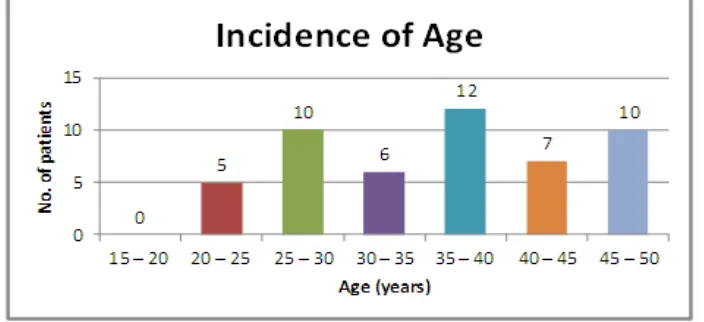
Out of 50 patients, 5 patients (10%) were with age between 20 – 25 years, 10 patients (20%)
were with age between 25 -35 years, 6 patients (12%) were with age between 30 – 35 years,
12 patients (24%) were with age between 35 – 40 years, 7 patients (14%) were with age
group 40 – 45 years while 10 patients (20%) were having age between 45 – 50 years.
Graph 1: Incidence of Age.
2. Incidence of Sex
Table 10: Incidence of Sex.
Sr. No Sex Count %
[image:4.595.122.474.454.615.2]Sunil et al. World Journal of Pharmaceutical Research
Out of 50 patients, 30 patients (60%) were male while remaining 20 patients (40%) were
female.
Graph 2: Incidence of Sex.
[image:5.595.157.443.314.416.2]3. Incidence of Occupation
Table 11: Incidence of Occupation.
Sr. No Occupation Count %
1 Business 01 02.00%
2 Farmer 04 08.00%
3 Housewife 09 18.00%
4 Service 22 44.00%
5 Student 14 28.00%
Total 50 100.00%
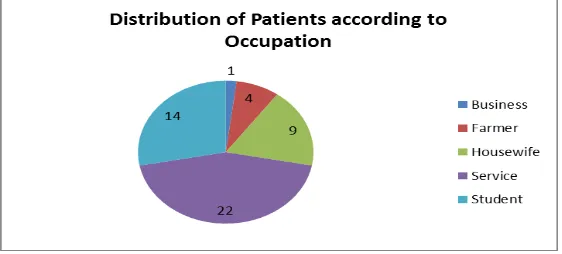
Out of 50 patients, 1 was in business (2%), 4 patients (8%) were farmer, 9 patients (18%)
were housewife, 22 patients (44%) were in service while 14 patients (28%) were student.
Graph 3: Incidence of Occupation.
[image:5.595.158.439.485.612.2]4. Incidence of Religion
Table 12: Incidence of Religion.
Sr. No Religion Count %
1 Hindu 45 90.00%
2 Muslim 03 06.00%
3 Christian 02 04.00%
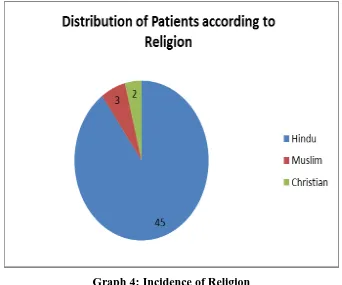
Out of 50 patients, 45 patients (90%) were Hindu, 3 patients (6%) were Muslim while 2
patients (4%) were Christian.
Graph 4: Incidence of Religion
[image:6.595.126.468.126.411.2]5. Incidence of Marital status
Table 13: Incidence of Marital status.
Sr. No Marital status Count %
1 Married 34 68.00%
2 Unmarried 16 32.00%
Total 50 100.00%
Out of 50 patients, 34 patients (68%) were married while remaining 16 patients (32%) were
Sunil et al. World Journal of Pharmaceutical Research
Graph 5: Incidence of Marital Status.
[image:7.595.154.447.526.730.2]6. Incidence of Socio-economic status. Table 14: Incidence of Socio-economic status.
Sr. No Socio-economic status Count %
1 Lower class 19 38.00%
2 Middle class 27 54.00%
3 Upper middle class 04 08.00%
Total 50 100.00%
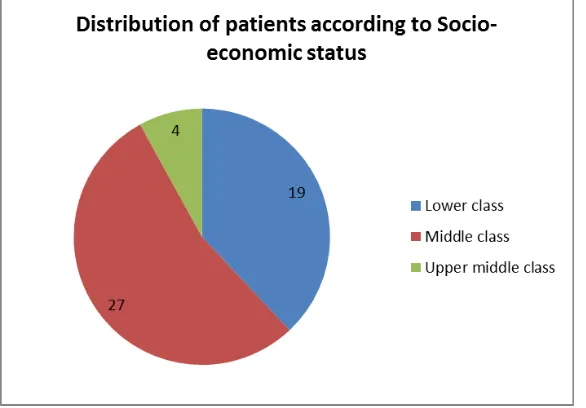
Out of 50 patients, 19 patients (38%) were from poor class, 27 patients (54%) were from
middle class while remaining 4 patients (8%) were from upper middle class.
[image:8.595.157.439.114.185.2]
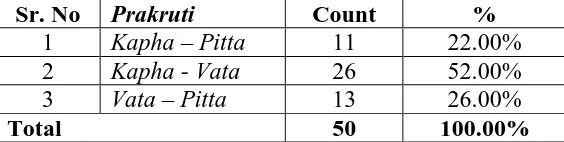
7. Incidence of Prakruti. Table 15: Incidence of Prakruti.
Sr. No Prakruti Count %
1 Kapha – Pitta 11 22.00% 2 Kapha - Vata 26 52.00% 3 Vata – Pitta 13 26.00%
Total 50 100.00%
Out of 50 patients, 11 patients (22%) were observed with kapha – pitta prakruti, 26 patients (52%) were having kapha – vata prakruti while 13 patients (26%) were of vata – pitta prakruti.
[image:8.595.163.438.565.625.2]Graph 7: Incidence of Prakruti. 8. Incidence of Education
Table 16: Incidence of Education.
Sr. No Education Count %
1 Literate 37 74.00%
2 Illiterate 13 26.00%
Total 50 100.00%
Out of 50 patients, 37 patients (74%) were literate while remaining 13 patients (26%) were
Sunil et al. World Journal of Pharmaceutical Research
Graph 8: Incidence of Education.
[image:9.595.162.432.420.479.2]9. Incidence of Diet
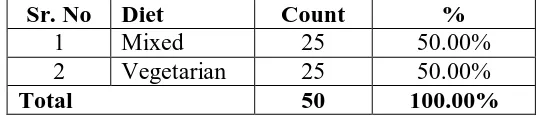
Table 17: Incidence of Diet.
Sr. No Diet Count %
1 Mixed 25 50.00%
2 Vegetarian 25 50.00%
Total 50 100.00%
Out of 50 patients, 25 patients (50%) were having mixed diet while remaining 25 patients
(50%) were vegetarian.
RESULTS
Statistical Analysis
[image:10.595.114.479.385.572.2]A) Assessment of signs and symptoms of Ek – kushtha Table 18: Assessment of signs and symptoms of Ek-kushtha.
Signs and symptoms
Summary statistics Wilcoxon signed rank
statistic
P-value (one-tailed) Mean S.D. Q1 Median Q3 n
Aswedanam 1.760 0.797 1.00 2.00 2.00 50 1225 < 0.001 Krushna Aruna Varna 1.840 0.766 1.00 2.00 2.00 50 1225 < 0.001 Matsyashakalopam 2.140 0.756 2.00 2.00 3.00 50 1275 < 0.001 Mahavastum 2.240 0.625 2.00 2.00 3.00 50 1275 < 0.001
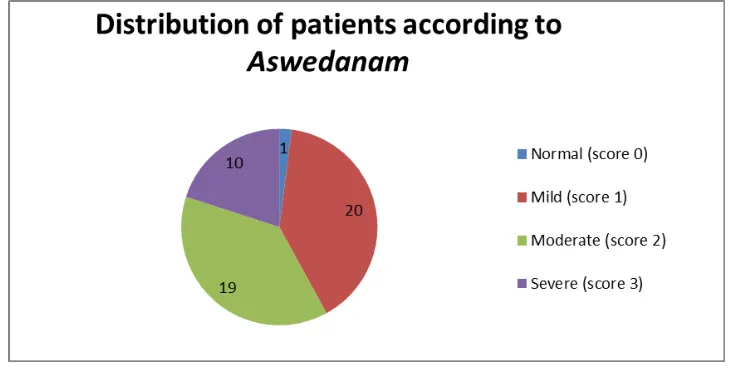
1) Aswedanam
Median score of aswedanam was significantly higher than zero (P-value < 0.001) at 5% level of significance as suggested by Wilcoxon signed rank test. The median score of aswedanam was 2 and mean score was 1.76 with S.D. of 0.797. i.e. there was significantly high incidence of aswedanam.
Graph 10: Distribution of Patients According To Aswedanam.
2) Krushna aruna varna
Median score of krushna aruna varna was significantly higher than zero (P-value < 0.001) at 5% level of significance as suggested by Wilcoxon signed rank test. The median score of
Sunil et al. World Journal of Pharmaceutical Research
Graph 11: Distribution of Patients According To Krushna Arun Varna.
3) Matsyashakalopam
Median score of matsyashakalopam was significantly higher than zero (P-value < 0.001) at 5% level of significance as suggested by Wilcoxon signed rank test. The median score of
matsyashakalopam was 2 and mean score of was 2.140 with S.D. of 0.756. I.e. there was significantly high incidence of matsyashakalopam.
Graph 12: Distribution of Patients According To Matsyashkalopam.
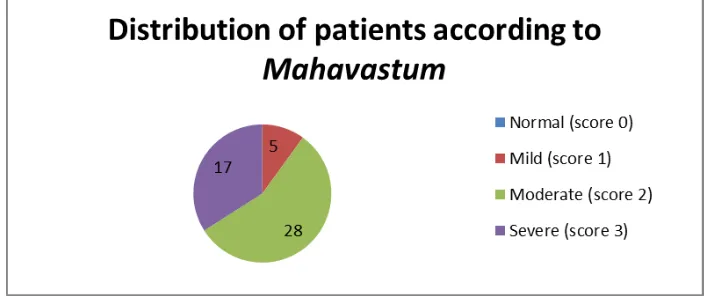
4) Mahavastum
Median score of mahavastum was significantly higher than zero (P-value < 0.001) at 5% level of significance as suggested by Wilcoxon signed rank test. The median score of
Graph 13: Distribution of Patients According To Mahavastum.
[image:12.595.120.476.75.224.2]B) Incidence of Hetus 1) Aaharaj Hetu.
Table 19: Incidence of Hetus. Aaharaj Hetus
(Rasa)
Summary statistics Wilcoxon signed rank statistic
P-value (one-tailed) Mean S.D. Q1 Median Q3 n
Madhur 1.300 0.839 1.00 1.00 2.00 50 903 < 0.001 Amla 1.500 0.863 1.00 1.00 2.00 50 1035 < 0.001 Lavan 1.600 0.833 1.00 2.00 2.00 50 1035 < 0.001 Katu 1.780 0.840 1.00 2.00 2.00 50 1176 < 0.001 Tikta 1.260 0.803 1.00 1.00 2.00 50 946 < 0.001 Kashay 1.760 0.960 1.00 2.00 2.00 50 990 < 0.001
Hetu -madhur rasa was observed with mean score of 1.3 and median score of 1. The Wilcoxon signed rank test suggested that there was significant incidence of Madhur rasa in patients (P-value < 0.001).
Patients were having amla rasa consumption with mean score 1.5 and median score 1. The incidence of amla rasa consumption was observed to be significant (P-value < 0.001) as suggested by Wilcoxon signed rank test.
There was significant incidence of Lavan rasa consumption observed (P-value < 0.001) with mean score of 1.6 and median score of 2.
Mean score for katu rasa consumption was 1.78 and median score was 2, the incidence was suggested to be significant (P-value < 0.001) by Wilcoxon signed rank test.
Sunil et al. World Journal of Pharmaceutical Research
Patients were having kashay rasa consumption with mean score 1.760 and median score 2. The incidence of amla rasa consumption was observed to be significant (P-value < 0.001) as suggested by Wilcoxon signed rank test.
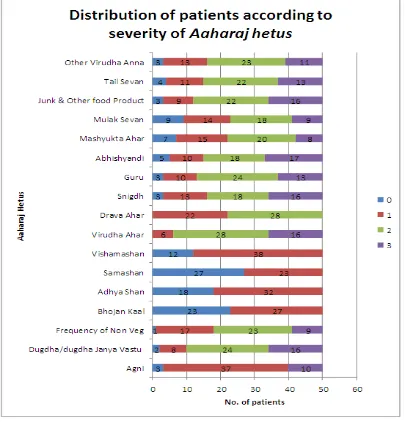
Table 20: Incidence of Aahraj Hetus.
Aaharaj Hetus Summary statistics Wilcoxon signed
rank statistic
P-value (one-tailed) Mean S.D. Q1 Median Q3 n
Agni 1.340 0.872 1.00 1.00 1.00 50 1128 < 0.001 Dugdha/dugdha Janya
Vastu 2.080 0.804 2.00 2.00 3.00 50 1176 < 0.001 Frequency of Non Veg 1.800 0.756 1.00 2.00 2.00 50 1225 < 0.001 Bhojan Kaal 0.540 0.503 0.00 1.00 1.00 50 378 < 0.001 Adhya Shan 0.640 0.485 0.00 1.00 1.00 50 528 < 0.001 Samashan 0.460 0.503 0.00 0.00 1.00 50 276 < 0.001 Vishamashan 0.760 0.431 1.00 1.00 1.00 50 741 < 0.001 Virudha Ahar 2.200 0.639 2.00 2.00 3.00 50 1225 < 0.001 Drava Ahar 1.560 0.501 1.00 2.00 2.00 50 1275 < 0.001 Snigdh 1.940 0.913 1.00 2.00 3.00 50 1128 < 0.001 Guru 1.940 0.843 1.25 2.00 2.75 50 1128 < 0.001 Abhishyandi 1.940 0.978 1.00 2.00 3.00 50 1035 < 0.001 Mashyukta Ahar 1.580 0.928 1.00 2.00 2.00 50 946 < 0.001 Mulak Sevan 1.540 0.994 1.00 2.00 2.00 50 861 < 0.001 Junk & Other food
Product 2.020 0.869 2.00 2.00 3.00 50 1128 < 0.001
Tail Sevan 1.880 0.895 1.00 2.00 2.75 50 1081 < 0.001
Other Virudha Anna 1.840 0.842 1.00 2.00 2.00 50 1128 < 0.001
Agni was observed with mean score of 1.340 and median score of 1. The Wilcoxon signed rank test suggested that there was significant incidence of Agni in patients (P-value < 0.001).
Patients were consuming dugdha or dugdhajanya aahar with mean score 2.08 and median score 2.00. The incidence of dugdhajanya aahar consumption was observed to be significant (P-value < 0.001) as suggested by Wilcoxon signed rank test.
There was significantly high frequency of non - veg consumption observed (P-value < 0.001)
with mean score of 1.8 and median score of 2.
Mean score for bhojan kaal was 0.540 and median score was 1, the incidence was suggested to be significant (P-value < 0.001) by Wilcoxon signed rank test.
Adhyasana was observed with mean 0.640 and median 1 which was significant (P-value < 0.001) as suggested by wilcoxon signed rank test.
Patients reported samashan with mean score 0.460 and median score 0. The samashan was significant (P-value < 0.001) as suggested by Wilcoxon signed rank test.
There was significant incidence of viruddha aahar intake observed (P-value < 0.001) with mean score of 2.2 and median score of 2.
Mean score dravya aahar consumption was 1.560 and median score was 2, the incidence was suggested to be significant (P-value < 0.001) by Wilcoxon signed rank test.
Consumption of snigdha aahar (Mean score=1.940, median score = 2) was significant as suggested by Wilcoxon signed rank test.
Sunil et al. World Journal of Pharmaceutical Research
Graph 15: Incidence of Aaharaj Hetus.
[image:15.595.96.501.77.499.2]2) Viharaj Hetu.
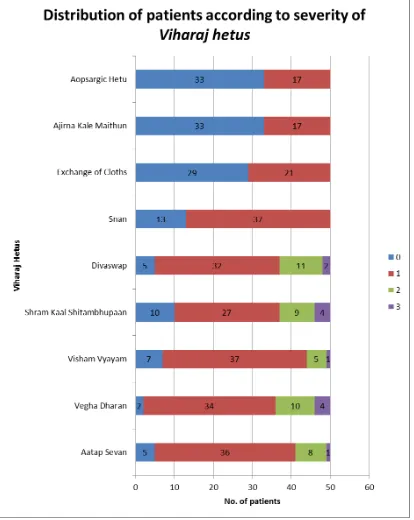
Table 21: Incidence of Viharaj Hetus.
Viharaj Hetus Summary statistics Wilcoxon signed
rank statistic
P-value (one-tailed) Mean S.D. Q1 Median Q3 n
Aatap sevan 1.100 0.580 1.00 1.00 1.00 50 1035 < 0.001 Vegha dharan 1.320 0.683 1.00 1.00 2.00 50 1176 < 0.001 vyayam 1.000 0.571 1.00 1.00 1.00 50 946 < 0.001 shram kaal shitambu
The mean score for aatap sevan was 1.10 while median score was 1. The Wilcoxon signed rank test suggested that there was significant incidence of aatap sevan in patients (P-value < 0.001).
The mean score for hetu vega dharan was 1.32 while median score was 1. The Wilcoxon signed rank test suggested that there was significant incidence of vega dharan in patients (P-value < 0.001).
The mean score for hetu vyayam was 1 while median score was 1. The Wilcoxon signed rank test suggested that there was significant incidence of vyayam in patients (P-value = 0.005).
The mean score for shram kaal shitambu paan was 1.14 while median score was 1. The Wilcoxon signed rank test suggested that there was significant incidence of shram kaal shitambu paan in patients (P-value < 0.001).
The mean score for divaswap was 1.2 while median score was 1. The Wilcoxon signed rank test suggested that there was significant incidence of divaswap in patients (P-value < 0.001).
The mean score for snan was 0.735 while median score was 1. The Wilcoxon signed rank test suggested that there was significant incidence of snan in patients (P-value < 0.001).
The mean score for exchange of cloths was 0.420 while median score was 0. The Wilcoxon
signed rank test suggested that there was significant incidence of exchange of cloths in
patients (P-value < 0.001).
Ajirna kale maithun was not observed with mean 0.34 and median 0. The Wilcoxon signed test showed significant incidence of Ajirna kale maithun (P-value < 0.001).
Sunil et al. World Journal of Pharmaceutical Research
Graph 16: Incidence of Viharaj Hetus.
[image:17.595.93.507.75.595.2]3) Mansik hetu
Table 22: Incidence of Mansik Hetus. Mansik
Hetus
Summary statistics Wilcoxon signed rank statistic
P-value (one-tailed) Mean S.D. Q1 Median Q3 n
The mean score for hetu krodha was 1.82 while median score was 2. The Wilcoxon signed rank test suggested that there was significant incidence of krodha in patients (P-value < 0.001).
The mean score for hetu tanav was 2.04 while median score was 2. The Wilcoxon signed rank test suggested that there was significant incidence of tanav in patients (P-value < 0.001).
Graph 17: Incidence of Mansik Hetus.
[image:18.595.91.507.204.450.2]Percentage of Incidence of Lakshanas
Table 23: Percentage of Incidence of Lakshanas.
Lakshanas No. of patients with Lakshanas Total no. of patients %
Aswedanam 49 50 98.00%
Krushna Aruna Varna 49 50 98.00%
Matsyashakalopam 50 50 100.00%
Sunil et al. World Journal of Pharmaceutical Research
[image:19.595.71.529.111.462.2]Percentage of Incidence of Hetu
Table 24: Percentage of Incidence of Hetu.
Aaharaj Hetu No. of patients with Hetu Total no. of patients %
Madhur 42 50 84.00%
Amla 45 50 90.00%
Lavan 45 50 90.00%
Katu 48 50 96.00%
Tikta 43 50 86.00%
Kashay 44 50 88.00%
Agni 47 50 94.00%
Dugdha/dugdha Janya Vastu 48 50 96.00% Frequency of Non Veg 49 50 98.00%
Bhojan Kaal 27 50 54.00%
Adhya Shan 32 50 64.00%
Samashan 23 50 46.00%
Vishamashan 38 50 76.00%
Virudha Ahar 50 50 100.00%
Drava Ahar 50 50 100.00%
Snigdh 47 50 94.00%
Guru 47 50 94.00%
Abhishyandi 45 50 90.00%
Mashyukta Ahar 43 50 86.00%
Mulak Sevan 41 50 82.00%
Junk & Other food Product 47 50 94.00%
Tail Sevan 46 50 92.00%
Other Virudha Anna 47 50 94.00%
DISCUSSION
Science is the intellectual process for using all of the mental and physical resources available
in order to better understand, explain and predict normal as well as unusual phenomena.
Thus, the scientific approach to understand anything involves observation, measurement of
entities that can be quantitated, the accumulation of data and analysis of the findings as
distinguished from an intuitive approach. In other words, science is the light thrown on silent
facts. Ayurveda as a science has lots of such silent or hidden facts. Discussion is a supreme
important part where the scholar has to try and throw light on such type of hidden facts and
break the silence of science.
As our Aacharyaas have clearly mentioned in the text that without the “Tarka and Yukti” one could not get the principle theme of the work. According to ancient research methodology,
prior to establishing any theory, Upanayana (Discussion) is the step preceding Nigamana (Conclusion). Discussion is a process of re-examining one and forms the base for conclusion.
discussion should not be victory, but progress, thereby moving towards the future with the
guidance from past and courage from the present. The discussion of this work has been
catalogued under specific subtitles.
Discussion on Age
Maximum numbers of patients were found in the age group of 30-40 years although it occurs
in all age group. Most peoples in this age are takes vidahi aahar, virudha ahar is very common in this age. Also most of peoples in this age get addicted to smoking, alcohol,
gutakha which may be the contributing factor for the genesis of ek-kushtha.
Next to this age group maximum numbers of patients were found in 45-50 years in this age
most of peoples get settle down and get more addicted to alcohol and mithya aahar which may be the contributing factor in the genesis of ek-kushtha.
Discussion on Sex
Majority of patients in the present study were males 60% although no relation has established
between sex and ek-kushtha in classics, as number of male patients were having sitting work, eating mithya aahar and taking divasvap daily which may be the contributing in the genesis of ek-kushtha.
Discussion on Occupation
Maximum numbers of patients were having service. In the present study students, service,
housewife and farmers also included. Reason being may be due to different occupational
contact like housewife exposing their body to chemicals like detergent, caustic soda etc. and
farmer exposing his body to metals and different kind of chemicals like pesticides etc. Study
the hetus of Ek-kushtha in modern era with special reference to Psoriasis. (Page no.40).
Discussion on Religion
Out of 50 patients, 45 patients (90%) were Hindu, 3 patients (6%) were Muslim while 2
patients (4%) were Christian. But there is no any kind of relation of Ek-kushtha with religion.
Discussion on Marital status
Out of 50 patients, 34 patients (68%) were married while remaining 16 patients (32%) were
Sunil et al. World Journal of Pharmaceutical Research
Discussion on Socio-economic status
Out of 50 patients, 19 patients (38%) were from poor class, 27 patients (54%) were from
middle class while remaining 4 patients (8%) were from upper middle class. This shows
middle class people were more prone to ek-kushtha.
Discussion on Prakruti
Out of 50 patients, 11 patients (22%) were observed with kapha – pitta prakruti, 26 patients (52%) were having kapha – vata prakruti while 13 patients (26%) were of vata – pitta prakruti. This shows kapha-vata prakruti patients more infected by ek-kushtha also vata-pitta prakruti patients are more prone to ek-kushtha.
Discussion on Education
Out of 50 patients, 37 patients (74%) were literate while remaining 13 patients (26%) were
illiterate. But there is no any relation between education and present disease.
Discussion on Diet
Out of 50 patients, 25 patients (50%) were having mixed diet while remaining 25 patients
(50%) were vegetarian. In this case also there is no relationship between veg and mixed diet.
But kapha vardhak, abhishyandi (mithya aahar) aahar and mainly non-veg food are predominant cause.
Discussion on Aaharaj and other Hetus
The main causative factor of Kushtha is Viruddha Ahara and Mithya Ahara. The different factors related to Viruddha Ahara may be
Summarized in two major groups
(1) Gunatah Viruddha (2) Samyoga Viruddha
Mithya Ahara
Achara Hetu
This is a very important factor and has been mentionedby all the Acharyas. Behavioural misconduct, antisocial activities, sinful Activities and other punishable activities are
considered under this heading. Due to Raja and Tama Doshas the Manas is always in search of materialistic pleasures and to satisfy its desires, it is always doing good and bad deeds
(Papakarma). And as the after effects of such bad deeds he suffers from diseases like Kushtha. Brihatrayi have mentioned Chinta, Bhaya, Krodha as Vata Prakopa Nidana and Bhaya, Krodha and Shoka also cause Dushti of Swedavaha Srotas (Ch. Vi. 5/22). Chinta causes Dushti of Rasavaha Srotas.
Others Nidana A) Samsargaja Hetu
The kushtha spreads from one man to another due to Prasanga, nihishwasat
Gatrasamsparsha, Sahabhojanat etc.
B) Kulaja Nidana
Kulaja Nidana is also known as Aanuvanshika Nidana i.e. due to Beejadushti. Sushruta has mentioned Kushtha as Adibalapravritta Vyadhi (Su. Ni. 5/27) i.e. the original cause of the disease is attributed to defects of Shukra and/or Shonita.
C) Krimija Hetu
Acharya Sushruta has mentioned that all types of Kushtha originate from Vata, Pitta, Kapha and Krimi (Su. NI.5/6). Charaka has also indicated that causative factors & treatement of Raktaja Krimi is as same as Kushtha (Ch.Vi. 7/11).
D) Chikitsa Vibharamsajanya Hetu
Sunil et al. World Journal of Pharmaceutical Research
As per rasa of aahar
i) Madhur rasa was observed significant incidence of Ek-kushtha Patients.
ii) Patients were having amla rasa consumption also having dominant rasa for present disease.
iii) There was significant incidence of Lavan rasa consumption also. iv) katu rasa and tikta rasa consumption also significant.
Patients were consuming dugdha or dugdhajanya aahar consumption was observed to be significant.
There was significantly high frequency of non-veg consumption observed.
Bhojan kaal also plays an important role in disease production such as adhyasana a samashan also important.
Person who were more prone to guru, snigdha, dravya, abhishyandi and virudha aahar were more affected by ek-kushtha disease.
Persons who were more eating taila and mulaka aahar also more affected by this disease. One should follow the Ahara to avoid kushtha disease:
Laghu Anna, Tikta Shaka, Purana Dhanya, Jangala Mamsa, Mudga, Patola, Food and Ghee prepared by Bhallataka, Triphala & Nimba, Purana Shali, Shashtika, Yava, Godhuma, Kordusha, Shyamaka, Udaalaka.
Discussion On Viharaj Hetu
Patients who were more prone to aatap sevan veg dharan, absence of exercise, shram kaal shitambu paan, divaswap, absence of snan, absence of clean cloth changing, ajirna kaal maithun are the some viharaj causes responsible for ek-kushtha disease.
As per mansik hetus krodha and tanav are the some psychological causes responsible for ek-kushtha vyadhi.
One should follow the vihar to avoid kushtha is:
Abhyanga with Karanja Taila, Utsadanam with Aaragvadhadi Kashaya, Pana, Parisheka, Avagaha etc. with Khadira Kashaya.
SUMMARY
Summary provides a whole theme of the study and anything in Research needs to be
summarized and put in a nutshell, so that a further progress in the subject or any part of the
A brief preface to the subject is given in the beginning of the article. Introduction gives the
information and importance of the study, today‟s life style and how to change traditional life
style. Aims and objectives in study are
1. To find out etiological factors of Ek-kushtha vyadhi. 2. To study Ek-kushtha vyadhi as per Ayurveda literature. 3. To study Psoriasis as per modern literature.
4. To find out Aaharaj, Viharaj, manas and other hetu of Ek-kushtha vyadhi.
Review of literature deals with brief collection of ayurvedic and modern literature available
on ek-kushtha. Collection of hetus of ek-kushtha from ayurvedic literature and compare it with present era. Review of disease deals with historical review in ayurvedic and modern
point of view, vyutpatti, nirukti of ek-kushtha, nidana, purvaprupa, rupa and samprapti. Study the hetus of ek-kushtha in modern era with special reference to psoriasis.
In materials and methods total 50 patients were carried out after appropriate consulting and
with written consent for participation in the project. Method deals with inclusion criteria,
exclusion criteria, and research methodology in with a standard case paper have prepared
with detail clinical history for diagnosis of ek-kushtha with special emphasis on the hetus and lakshanas and a special questionnaire according to aahar, vihar, manas hetus ek-kushtha and total data analyzed for conclusion. Diagnostic phase and assessment phase.
Observation and results is an important part of the article described with the tables and graphs
questionnaire gradation, showing the frequencies of the aahar, vihar and manas hetus of ek-kushtha.
CONCLUSIONS
The conclusions which can be drawn are as follows
i) Maximum patients are observed in the age of 30-40 years.
ii) People with kapha-vataj and vata-pittaj Prakruti, were observed more susceptible for suffering from ek-kushtha.
iii) Rasa and raktavaha strotas are the main dushya in the pathogenesis of ek-kushtha. Male populations are more suffering with ek-kushtha.
Sunil et al. World Journal of Pharmaceutical Research
Causes for the occurrence of ek-kushtha and can be consider as viprakrushta hetus. They are- a. Excess of abhishyandi ahar sevan
b. Excess of madhur, lavan, amla and katu rasa sevan c. Excess of guru ahar sevan
d. Milk products (kshirvikarani) e. Virudha ahar
f. Irregular meal timing
g. Divaswap h. krodha, tanav
REFERENCES
1. Research in Ayurveda, Dr. M.S. Baghel. 2nd Ed., Mrudu Ayurvedic Publication and Sales,
Jamnagar, 2005.
2. Yogaratnakara, Vd. Laksmipati sastri, 8th Ed., Chaukhamba Sanskrit Sansthan, Varanasi,
2004.
3. Madhav Nidan, Ayurvedacharya Shriyadunandopadhyaya, Choukhamba Prakashan,
Varanasi, 2012.
4. Shushrut samhita, Dr. Anant Ram Sharma-Choukhamba Surbharti Prakashan Varanasi,
2008.
5. Bhavprakash, BramhaShankar Mishra, 7th Ed. Choukhamba Sanskrut Sansthan, Varanasi,
Reprint, 2000.
6. Rogavijnan and Vikrutivijnan, Dr. Rekha n. Jain and Dr. N.Y. Thite, 1st Ed. Choukhamba
Sanskrut Pratishthan, 2011.
7. Davidson‟s Medicine -19th Ed. Churchill Livingstone, 2005.
8. Charaka Samhita of Agnivesha elaborated by Charaka and Redacted by Dridhabala with
Vaidyamanorama Hindi commentary Acharaya Vidyadhar Shukla and Prof. Ravi Dutt
Tripati foreworded by Priya vata Sharma-Chaukhambha Sanskrit Pratishthan, Delhi,
2007.
9. Harrison‟s principles of internal medicine, Dr. Fauci's and Dr. Longo's, 17th Ed., 2008.
10.Bhaisajya Ratnavali, Ambikadatta Shastri, 18th Chaukhamba Varanasi, Reprint, 2004. 10.Ashtang Hridayam, Bramhanand Tripathi- Chaukhamba sanskrut sansthan, Varanasi,
2003.
11.Ashtang Sangrah, Lal Chandra Shastri, 1st edition, Shri Baidyanath Ayurved Bhavan
12.Ayurvediya Shabda Kosha: Veni Madhav Shastri Joshi, Narayan Hari Joshi Maharashtra
Rajya Sahitya and Sanskriti Mandal, Mumbai, 1968.
13.Amarkosha, Shri Pandit Hargovind Shastri, 4th Ed. Chaukhamba sanskrut sansthan,
Varanasi, 2001.
14.Kaiyadev Nighantu Dr. Priyavat Sharma, Chaukhamba Orientalla- Methods in
biostatistics, B. K. Mahajan, 6th Ed. Jaypee Brother Medical Publishers, Delhi, 1999.
15.Abc Of Dermatology Paul K Buxton, 4th Ed., BMJ Publishing Group Ltd, 2003.
16.Clinical dermatology John Hunter, John Savin, Mark Dahl 3rd Ed. Blackwell Publishing
company, Reprint, 2003.
17.Ayurvediya Vikruti Vidnyan, Dr. Vidyadhar Shukla, 5th edition Choukhambha Sanskrit
Pratishthan, Varanasi, 1999.
18.Text book of Pathology: Harsha Mohan, 3rd edition Jaypee Brothers Medical Publishers
Limited, 1998.
19.Rogi Rog Pariksha Padhati, Dr. G.P. Upadhayay-Choukhambha Sanskrit series, Varanasi,
1997.
Internet Reference
1. http://counterwithayurveda.blogspot.in/2011/10/treatment-of-psoriasis- ek-kushtha-in.
html.