www.wjpr.net Vol 3, Issue 10, 2014. 777
METHOD DEVELOPMENT AND VALIDATION OF ITRACONAZOLE
BY UV-SPECTROPHOTOMETER
M. Koteswara Rao1*, K.V. Ramanjaneyulu1, SK. Reehana1, D. Narasimha Rao2,
D.L.Sujana2,, J.N.Suresh Kumar1
1
Department of pharmaceutical chemistry, Narasaraopeta Institute of Pharmaceutical Sciences, Narasaraopet, Guntur.
2
Dept of Pharmaceutical Analysis MAM College of Pharmacy Kesanupalli
Narasaraopet Guntur.
ABSTRACT
Itraconazole is a synthetic triazole antifungal agent. Itraconazole was formulated into several pharmaceutical forms through various routes of administration. Itraconazole capsules are used to treat fungal infections in the lungs that can spread throughout the body. For quality control and stability testing of Itraconazole in pharmaceutical formulations, limited methods have been published, because the drug is not yet official in any pharmacopoeia. The present work is have made an attempt to develop a more precise, simple and economical spectrophotometric method with greater precision, accuracy and sensitivity for the analysis of Itraconazole in bulk and capsule dosage forms. UV spectroscopic determination was carried out at an
absorption maximum of 267 nm using Chloroform as solvent. In the UV spectroscopic method linearity over the concentration range of Itraconazole was found to be 1-10 µg/ml with a correlation coefficient 0.999. Results of the analyses were validated statistically and by recovery studies. The method was validated by the parameters like linearity, precision, accuracy, limit of detection and limit of quantification were studied according to International Conference on Harmonization guidelines.
KEY WORDS: Itraconazole, pharmacopoeia, UV spectroscopic method, Quality control.
INTRODUCTION
Itraconazole is a synthetic triazole antifungal agent. Itraconazole is a 1:1:1:1 racemic mixture
Volume 3, Issue 10, 777-787. Research Article ISSN 2277– 7105
Article Received on 07 October 2014,
Revised on 29 Oct 2014, Accepted on 19 Nov 2014
*Correspondence for
Author
Mr. M. Koteswara Rao
Department of
Pharmaceutical Analysis,
MAM College of
Pharmacy Kesanupalli,
www.wjpr.net Vol 3, Issue 10, 2014. 778 of four diastereomers (two enantiomeric pairs), each possessing three chiral centers. It may be represented by the following nomenclature: 4-[4-[4-[4-[[2-(2, 4-dichlorophenyl)- 2- (1H- 1, 2, 4- triazol- 1-ylmethyl)- 1,3- dioxolan- 4- yl] methoxy]phenyl] piperazin-1- yl]phenyl]-2-(1-methylpropyl)-2, 4-dihydro-1, 2, 4-triazol- 3-one (Fig 1). It has a molecular formula is C35H38Cl2N8O4 and a molecular weight is 705.64. [1-4] It is a white to slightly yellowish powder. It is very slightly soluble in alcohols, and freely soluble in dichloromethane. Itraconazole is highly lipophilic in nature and practically insoluble in water. It is an extremely weak base (pKa =3.7) that is ionized only at very low pH. It is a hydrophobic anti mycotic drug with three chiral centers and is used clinically as a stereo isomeric mixture. [5] It is an orally active triazole antifungal agent, which demonstrates broad spectrum activity against a number of fungal species including dermatophytes, Malassesia further, Candida species, Aspergillus species, and Histoplasma capsulatum var. capsulatum. [6,7] The mechanism of action of itraconazole is it interacts with 14-α demethylase, a cytochrome P-450 enzyme necessary to convert lanosterol to ergosterol. As ergosterol is an essential component of the fungal cell membrane, inhibition of its synthesis results in increased cellular permeability causing leakage of cellular contents. Itraconazole may also inhibit endogenous respiration, interact with membrane phospholipids, inhibit the transformation of yeasts to mycelial forms, inhibit purine uptake, and impair triglyceride and/or phospholipid biosynthesis. Itraconazole is metabolized predominately by the cytochrome P450 3A4 isoenzyme system (CYP3A4) in the liver, resulting in the formation of several metabolites, including hydroxyl itraconazole, the major metabolite. [8] Its oral bioavailability was found to increase when taken with food, with plasma concentration approximately two times that taken in the fasting state. [9] It is extensively metabolized in the liver, mainly via an oxidative pathway, into the bioactive metabolite hydroxyl itraconazole. [10]
www.wjpr.net Vol 3, Issue 10, 2014. 779 long chromatographic run times and requirement for gradient analysis or use of an internal standard one spectrophotometric method [16] have also been reported Spectroflourimetry method has been used for assay of Itraconazole in raw material and in dosage forms. RP-HPLC method is used for determination of Itraconazole in human plasma. [17-21] Chromatographic separation in this method was performed on an octadecyl silane column using fluorescence detector. However, it has the disadvantage of being time consuming. All these studies have further emphasized the need to perform rapid and sensitive quality-control analysis of pharmaceutical formulations containing Itraconazole. As these methods are expensive, we have made an attempt to develop a more precise, simple and economical spectrophotometric method with greater precision, accuracy and sensitivity for the analysis of Itraconazole in bulk and dosage forms.
Experimental
Chemicals and reagents: Chloroform was used throughout UV spectrophotometric method
development and validation.
Instrumentation
UV spectrophotometric method was performed on double beam UV-visible spectrophotometer (Shimadzu, model 1700) having two matched quartz cells with 1 cm light path.
Selection of solvent
Chloroform was selected as ideal solvent for spectrophotometric analysis of Itraconazole
PREPARATION OF STANDARD STOCK SOLUTIONS
www.wjpr.net Vol 3, Issue 10, 2014. 780 Preparation of Sample stock solution
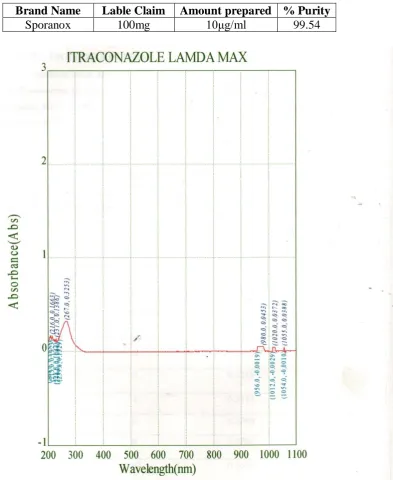
For analysis of drug in capsule dosage form, 10 capsules were weighed accurately and the powder triturated in the mortar to get a fine powder. The capsule powder equivalent to 10mg was weighed and transferred to 10ml volumetric flask and dissolved with chloroform. The capsule solution was diluted to get a final concentration of 10μg/ml. The absorbance of these solutions measured at 267 nm. The amount of Itraconazole per capsule was calculated using the calibration curve. The readings are shown in table.1
[image:4.595.128.522.283.763.2]Formula: %Purity=Sample absorbance / Standard absorbance X 100
Table 1: Assay of Itraconazole Capsule.
Brand Name Lable Claim Amount prepared % Purity
www.wjpr.net Vol 3, Issue 10, 2014. 781 METHOD VALIDATION
The method was validated according to International conference on Harmonization (ICH) Q2B guidelines 1996 for validation of analytical procedure in order to determine the linearity, limit of detection, accuracy and precision.
LINEARITY & RANGE
Under the experimental conditions, the calibration graphs of the absorbance versus concentration were found to be linear over the range of 0.2-1.0μg/ml for proposed method. The statistical analysis of data obtained for estimation of Itraconazole is indicated chloroform of accuracy for the proposed methods evidenced by the low values of standard deviation and coefficient of variation. The results are shown in table.2
Table 2: Linearity Data of Itraconazole.
S. No. Concentration
μg/ml Absorbance
1 0 0
2 2 0.1316
3 4 0.2419
4 6 0.3516
5 8 0.4615
6 10 0.5612
Slope:0.056 Regression:0.999
ACCURACY
www.wjpr.net Vol 3, Issue 10, 2014. 782 percentage recovery values are calculated . Test should be prepared in triplets at each spike level and assay should be done as per the test method. The values are shown in the table 3.
Table 3: Accuracy & % Recovery Reading.
S. No Amount Of Sample (μg) Amount of Standard Added(μg) Total Amount of Itraconazole Amount of Itraconazole found % Recovery % Mean
Recovery S.D %RSD
50% 10 5 15 14.95 99.6%
99.7% 0.0011 0.183
50% 10 5 15 14.98 99.8%
50% 10 5 15 14.96 99.7%
100% 10 10 20 20 100%
100% 0.0057 0.106
100% 10 10 20 20.25 101%
100% 10 10 20 20 100%
150% 10 15 25 24.7 99.1%
99.5% 0.0040 0.403
150% 10 15 25 24.9 99.6%
150% 10 15 25 25 100%
PRECISION
The precision of a method is defined as the closeness of agreement between independent test results obtained under optimum conditions. The precision of the ascertained by determination of six replicates of same concentration of sample and standard for method precision and system precision.
SYSTEM PRECISION
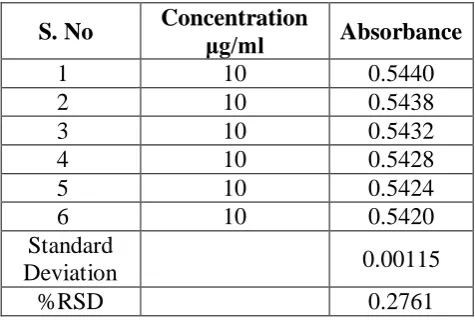
[image:6.595.179.417.587.747.2]The system precision of the proposed method was ascertained by determination of six replicates of same concentration of standard drug within the Beer’s range and finding out the absorbance. The absorbance, standard deviation, and %RSD were calculated. Results are shown in the table 4.
Table 4: System Precision Readings.
S. No Concentration μg/ml Absorbance
1 10 0.5440
2 10 0.5438
3 10 0.5432
4 10 0.5428
5 10 0.5424
6 10 0.5420
Standard
Deviation 0.00115
www.wjpr.net Vol 3, Issue 10, 2014. 783 METHOD PRECISION
[image:7.595.179.416.195.360.2]The method Precision of the proposed method was ascertained by determination of six replicates of same concentration of sample drug within the Beer’s range and finding out the absorbance. The absorbance, standard deviation and % RSD were calculated. Results are shown in the table.5
Table 5: Method Precision Readings.
S. No Concentration
μg/ml Absorbance
1 10 0.5390
2 10 0.5388
3 10 0.5385
4 10 0.5380
5 10 0.5378
6 10 0.5374
Standard
Deviation 0.000619
%RSD 0.1149
LIMIT OF DETECTION AND LIMIT OF QUANTITATION
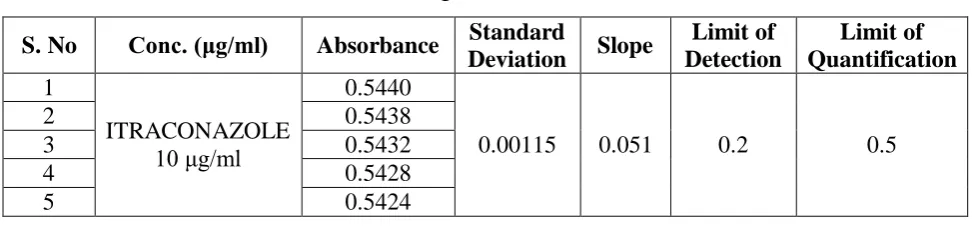
The detection limit of individual analytic procedure is the lowest amount of analyte in a sample which can be detected but not necessarily quantitated as an exact value. The quantification limit of an individual analytic procedure is the lowest amount of analyte in a sample which can be quantitatively determined with suitable precision and accuracy. The LOD and LOQ were calculated by using the relation 3.3 S and 10 S respectively, where is the standard error of estimate and S is the slope. Calculated values of LOD and LOQ for Itraconazole were found to be 0.14 μg/ml and 0.43 μg/ml respectively. The results are shown in table no: 6
Table 6: Limit of Detection and Limit of Quantitation.
S. No Conc. (μg/ml) Absorbance Standard
Deviation Slope
Limit of Detection
Limit of Quantification 1
ITRACONAZOLE 10 μg/ml
0.5440
0.00115 0.051 0.2 0.5
2 0.5438
3 0.5432
4 0.5428
5 0.5424
RUGGEDNESS
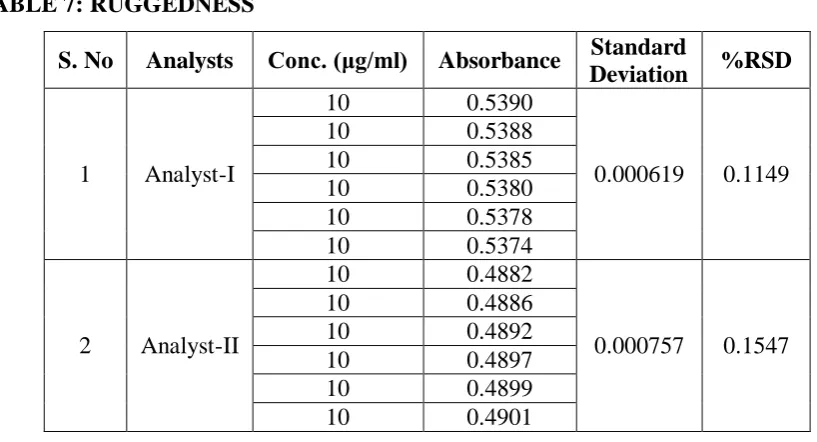
[image:7.595.65.552.590.710.2]www.wjpr.net Vol 3, Issue 10, 2014. 784 the same optimized conditions at different days. The obtained results were found to reproducible, since there was no significant difference between analysts. Thus, the proposed method could be considered rugged. The results are shown in table.7
TABLE 7: RUGGEDNESS
S. No Analysts Conc. (μg/ml) Absorbance Standard
Deviation %RSD
1 Analyst-I
10 0.5390
0.000619 0.1149
10 0.5388
10 0.5385
10 0.5380
10 0.5378
10 0.5374
2 Analyst-II
10 0.4882
0.000757 0.1547
10 0.4886
10 0.4892
10 0.4897
10 0.4899
10 0.4901
ROBUSTNESS
[image:8.595.84.493.153.374.2]The robustness of the method was determined by introducing small changes in UV parameters, such as changing in the wavelength ± 4. The results are shown in table.8
TABLE 8: RESULTS OF ROBUSTNESS
S. No Wavelength(nm) Absorbance 1 267 0.5280 2 271 0.5288 3 263 0.5272 ANALYSIS OF PHARMACEUTICAL FORMULATIONS
The optimized spectrophotometric method applied to the direct determination of Itraconazole in tablet using calibration curve method without any sample extraction or filtration. From the absorbance value, the drug content per tablet was calculated. The results are shown in table.9
Table 9: Analysis of Pharmaceutical Formulations.
Formulation Labeled
Amount (mg)
Amount Recovered (mg)
% Drug
Recovered Mean
Standard
Deviation %RSD
Sporanox 100 93.26 98.315
99.838 1.9398 1.9430
Sporanox 100 102.09 102.022
www.wjpr.net Vol 3, Issue 10, 2014. 785 RESULTS AND DISCUSSION
The goal of the study is to validate an Itraconazole in dosage form by UV-Spectrophotometric method it was carried out under optimized conditions. It was validated the result of the validation parameters were within acceptable limits. Itraconazole follow linearity within the concentration range of 1-10µg/ml. The observed linearity range fitted well Beer-Lambert’s law and corresponding regression coefficient (r=0.999) is an indicating of a high degree of method sensitivity the results were tabulated in Table.2.The percentage of the drug found in formulations and results of analysis shows that the amount of drug was in good agreement with the label claim of the formulation. The % RSD is less than to which shows that the system and method has good reproducibility. The results were tabulated. The percentage recovery values of pure drug from the analysed solution of formulation were in between 98-102 which indicated the proposed method were accurate. The results were tabulated in table.3.The validation of proposed method was verified by system precision and method precision the % RSD for system precision of Itraconazole was 0.5 and the data was tabulated in table.4. The method precision was conducted and the percentage average obtained for Itraconazole is shown in table.6.The results obtained from robustness studies i.e., on verified by changing parameters such as wavelength indicated that the analytical method remains unaffected. The study ruggedness made by conducting different systems and by two analysts the results was shows in table.8.The proposed method for Itraconazole in capsules were sample, precise, accurate, rapid and sensitive.
SUMMARY AND CONCLUSION
The method were found to be rapid, economical, accurate and precise for the determination of Itraconazole in bulk drug in capsule by UV-Spectrophotometer methods produce comparable results can be used for precise and accurate analysis of Itraconazole in its pure and capsule dosage form. Interference studies reviled that the common excipients and other activities usually present in the dose. The values of % recovery was close to 100% indicating reproducibility and accuracy of the proposed method successfully employed as a quality control tool for the analysis of Itraconazole in its capsule dosage form and in bulk drug.
REFERENCES
1. De Beule K, Van Gestel J. Pharmacology of Itraconazole, 2001; 61(S1): 27–37.
www.wjpr.net Vol 3, Issue 10, 2014. 786 3. Janssen Pharmaceutical Products (2002). Sporanox® (itraconazole) injection. US Food
and Administration.
4. Kramer M, Marshall S, Denning D et al. Cyclosporine and Itraconazole Interaction in Heart and Lung Transplant Recipients. Annals of Internal Medicine, 1990; 113: 327–329. 5. European Pharmacopoeia. Itraconazole, Strasbourg: France, 4thEd, 2005; 1852-1853. 6. Hay R.J, Dupont B, Graybill J.R. Review Infectious Disease, 1987; 9(Suppl.1): S1-3. 7. Saag M.S, Dismukes W.E. Antimicrobial Agents Chemotherapy, 1988.
8. Mechanism of action available online at URL http://www.drugbank.ca/drugs/DB01167. 9. Zimmermann T, Yeates R.A, Laufen H. European Journal of Clinical Pharmacology,
1994; 46: 147.
10.Haria M, Bryson H.M, Goa K.L Drugs, 1996; 51: 585-620.
11.Pharmaceutical applications available online at URLhttp://www.nlm.nih.gov.
12.Shalin K. Parikh, Ankit D. Patel, Dr. J. B. Dave, Dr. C. N. Patel and Dr. D. J. Sen, “Development and validation of UV Spectrophotometric method for estimation of itraconazole bulk drug and pharmaceutical formulation” International Journal of Drug Development and Research, 2011; 3(2): 324-328.
13.Stefanie Redmann, Bruce G. Charles, “A rapid HPLC method with fluorometric detection for determination of plasma itraconazole and hydroxy-itraconazole concentrations in cystic fibrosis children with allergic broncho pulmonary aspergillosis” Biomedical Chromatography, 2006; 20(4): 343–348.
14.D. Vijaya Bharathi, Kishore Kumar Hotha, P.V.Vidya Sagar, Sanagapati Sirish Kumar, Pandu Ranga Reddy, A. Naidu, Ramesh Mullangi, “Development and validation of a highly sensitive and robust LC–MS/MS with electrospray ionization method for simultaneous quantitation of itraconazole and hydroxyitraconazole in human plasma” Science Direct Journal, 2008; 868(1-2): 70-76.
15.Ming Yao, Laishun Chen, Nuggehally R Srinivas, “Quantitation of itraconazole in rat heparinized plasma by liquid chromatography–mass spectrometry” Journal of Chromatography B: Biomedical Sciences and Applications, 2001; 752(1)5: March 2001; 916.
www.wjpr.net Vol 3, Issue 10, 2014. 787 17.M. V. Kumudhavalli, “Isocratic RP-HPLC, UV Method Development and Validation Of Itraconazole In Capsule Dosage Form” International Journal of Pharmaceutical Research IJPSR, 2011; 2(12): 3269-3271.
18.Al-Rawithi H, Sameer M, Hussein A, Rajaa Al-Moshen, Ibrahim, Raines, Dale, et al. Determination of Itraconazole and Hydroxy itraconazole in Plasma by High-Performance Liquid Chromatography with Fluorescence Detection, Therapeutic Drug Monitoring, 2001; 23: 445-448.
19.Khoschsorur G, Frueehwirth F, Zelzer S.Isocratic High Performance Liquid Chromatographic Method with UV detection for simultaneous determination of voriconazole and itraconazole and its hydroxyl metabolite in human serum. Antimicrobial agents and Chemotherapy, 2005; 49: 3569-3571.
20.Srivatsan V, Dasgupta A, Kale P, Datla R, Soni D, Patel M, Patel R, and Mavadhiya, C. Simultaneous determination of itraconazole and hydroxyitraconazole in human plasma by high performance liquid chromatography, Journal of Chromatography, 2004; 1031: 307-313.