www.wjpr.net Vol 4, Issue 4, 2015. 912
COMPARATIVE PHYTOCHEMICAL STUDY OF STEM BARK
VERSUS SMALL BRANCHES OF
BOMBAX CEIBA
LINN USING
HPTLC- UV DETECTION METHOD
S. C. Verma*, S. Subhani, E. Vashishth, R. Singh, P. Pant, M. M. Padhiand A. Kumar
Central Council for Research in Ayurvedic Sciences, 61-65, Institutional Area, Opp.-D-Block, Janakpuri, New delhi-110058, India.
ABSTRACT
Bombax ceiba is commonly known as silk cotton tree and semal which belongs to family Bombacaceae. B. ceiba is an important medicinal plant of tropical and subtropical India. The plant name Bombax ceiba
is derived from Greek word “Bombax” meaning silkworm and the word “ceiba” is the South American vernacular name for silk cotton
tree. Its medicinal usage has been reported in the traditional systems of medicine such as Ayurveda, Siddha and Unani. It has wide range of medicinal and pharmacological application. Our results revealed that the chromatographic fingerprint combined with similarity measurement could efficiently identify and distinguish B. ceiba stem bark and small branches. The phytochemical fingerprint profiling of stem bark and small branches of B. ceiba were found similar as an official part of B. ceiba plant i.e. stem bark, therefore small branches may be used in place of stem bark and vice-versa after comparison and confirmation of same pharmacological activities. The method can also be used for identification of different B. ceiba species and
adulterants.
KEYWORDS: Bombax ceiba L., HPTLC–UV detection, phytochemical fingerprint profiling analysis.
Abbreviations: HPTLC–UV, high performance thin layer chromatography-ultra violet detection; Rf, retention factor; min., minutes; St. Bk., stem bark., Sm. Br.,small branches;
Volume 4, Issue 4, 912-922. Research Article ISSN 2277– 7105
Article Received on 20 Jan 2015,
Revised on 15 Feb 2015, Accepted on 11 Mar 2015
*Correspondence for
Author
Dr. S. C. Verma
Central Council for
Research in Ayurvedic
Sciences, 61-65,
Institutional Area,
Opp.-D-Block, Janakpuri, New
www.wjpr.net Vol 4, Issue 4, 2015. 913 INTRODUCTION
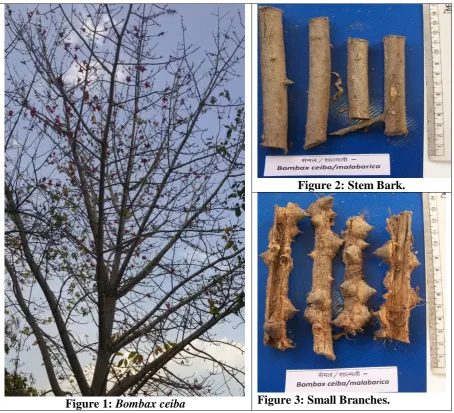
Bombax ceiba Linn (Fig.1) is a deciduous tree belongs to family Bombacaceae commonly known as silk cotton tree and semal. The plant name Bombax ceiba is derived from Greek word “Bombax” meaning silkworm and the word “ceiba” is the South American vernacular name for silk cotton tree.[1] This tree has its importance since ancient time. In 'Mahabharata' it is related to „Pitamaha‟ according to which after erection the world was situated or kept under the tree 'Salmali 'and in the 'Yajnavalkya' it is mentioned as one of the trees of the infernal regions. It is a large deciduous tree with tall trunk and spreading crown. The tree reaches up to 40 meter in height and 2 meter in diameter with the clear bole of 24-30 meter and girth up to 6 meter or more. Large trees are invariably buttressed at the base. Trunk and branches of young trees are covered with large woody conical, stout and hard prickles. Stem buttresses at
the base and go up to 5-6 meter in height. Bark is pale ashy to silver grey or brown in color and 1.8-2.5 cm thick. The leaves are large, palmate, spreading, glabrous, digitate with a common petiole. Leaves are 15-30 cm long in size with 3-7 leaflets. The leaflets are lanceolate, acuminate, more or less coriaceous and entirely glaborous. Flower are numerous, large, fleshy, bright crimson, yellow or orange containing many seeds with long, dense silky hairs appearing in the months of January to March. Flower has the thick, fleshy and cup shaped sepals. It bears five petals in one flower which are 7.5-15 cm long. Seeds are smooth, black or gray embedded in long white wool. The pods are oval in shape and about 10-18 cm in length. The plant produces the gum which is light brown in color resembling the galls, and gradually becomes opaque and dark brown in color. The various part of B. ceiba such as roots, leaves, seed, stem bark, flower, fruit and gum are documented to possess medicinal properties in ethnobotanical surveys conducted by ethno botanist and in traditional system of medicine such as Ayurveda.[2] It is one of the important medicinal plants in tropical and subtropical India and also occurs in Sri Lanka, Pakistan, Bangladesh, Myanmar, Malaysia, Java, Sumatra and Northern Australia. It is widely found in temperate Asia, tropical Asia, Africa and Australia. In India, it can be found at altitudes upto1500 m. In peninsular India,
www.wjpr.net Vol 4, Issue 4, 2015. 914
phenols, saponins, xathoproteins, triterpenoids, tannins and flavonoids.[6] Chemical investigation on the root bark of B. ceiba shows presence of sitosterol β -D-glucoside, β-sitosterol, lupeol, 7-hydroxycadalene, 1-methyl ether and 1, 2-dimethylether of isohemigossypol, 8-formyl-7-hydroxy-5-isopropyl-2-methoxy-3-methyl-l, 4-naphthaquinon, and the lactone of 8-carboxy-7-methyl-6-hydroxy-5-isopropyl-3-methyl-1-naphthol. The phytochemical studies on the roots of B. ceiba revealed the presence of lupeol , n -triacontanol, 7-hydroxy cadaleve -triacontanol, β-sitosterol, 3',4'5,7-tetrahydroxy-6-methoxyflavan-3-O-β-D glucopyranosyl-D-xylopyranoside, 1,6-dihydroxy-3-methyl-5-isopropyl-7-methy-8-naphthalene carboxylic acid (8→1) lactone, 5,7,3,4 tetrahydroxy-6-methoxy flavon-3-O-β-D glucopyranosyl-α-D-xylotyranoside sesquiterpenoids. From the stem bark Shamimicin, 1‟‟‟, 1‟‟”‟‟‟-bis-2-(3, 4- dihydroxyphenyl)-3, 4-dihydro-3,
7-dihydroxy-5-O-xylopyranosyloxy-2H-1-benzopyran along with lupeol and β-sitosterol were isolated. Isolation and characterization resulted in the identification of two compounds from the extracts of stem barks of B. ceiba these compounds were lup-20 (29) en-3b-ol and 2- hexyl-7, 8-dimethyl-1, 4-naphthaquinone.[7] Flowers of B. ceiba showed the presence of β-sitosterol, β-D-glucoside of β-β-sitosterol, hentriacontane, hentriacontanol, traces of essential oil, kaempferol, quercetin, polysaccharide-D-galactose, L-arabinose, L-rhamnose, pelargonidin-5-β-D-glucopyranoside,cyanidin-7-methylether-3-β-D-glucopyranoside, three biosides, viz., 24-β-ethylcholest-5-en-3-β-o-a-Larabinosyl-(1-→6)-β-D-glucopyranoside, 3,5-dihydroxy-4'-methoxyflavone-7-o-a-L-rhamnopyranosyl-(1→6)-P-D-glucopyranoside, 4',5,7-D-trihydroxyflavone-3-0-β-D-glucopyranosyl-(1→4)-a-L-rhamnopyranoside and 8-formyl-6, 7-dihydroxy-5-isopropyl-3-methyl-1-naphthol.[8-9] Fresh leaf contains shamimin (C-flavonol glycoside) and dried leaf extracts of the plant were subjected to chemical investigation, which led to the isolation of three new compounds 4-C-β-D Glucopyronosyl-1,3,6,8-tetrahydroxy-7-O-(4”-hydroxybenzoyl)-9H-xanthen-9-one, 2-C-β-D Glucopyronosyl-1, 6, trihydroxy-3-O-(4”-hydroxybenzoyl)-9H-xanthen-9-one, 4-C- β-D-Glucopyronosyl-1, 6, 8-trihydroxy-3,
7-di-O-(4”-hydroxybenzoyl)-9H-xanthen-9-one and one known compound mangiferin.[10-12]
www.wjpr.net Vol 4, Issue 4, 2015. 915
and 2,5-di-o-methyl-L-arabinose and aldobiuronic acid.[14] From the heart wood, 7-Hydroxy-5-isoproyl-2-methoxy-3-methyl-1, 4-naphthaquinone was isolated.[13, 15]
Almost all the parts of B. ceiba are of medicinal importance and used traditionally for the treatment of various ailments. B. ceiba having different pharmacological activities like anti-inflammatory, anti-diabetic, anti-obesity, hypotensive, antioxidant, antiangiogenic, antimicrobial, cytotoxicity, aphrodisiac and antipyretic. The plant is used in dysentery, menorrhagia, skin troubles, haemorrhoids, for the treatment of snake bite , scorpion sting, boils, leucorrhoea, internal bleeding, calculus affections, chronic inflammation, ulceration of bladder and kidney, gonorrhea, haemoptysis, influenza, enteritis, pulmonary tuberculosis, cystitis and catarrahal affections bleeding piles. Different parts of B. ceiba have been used in traditional Indian medicine. In Ayurvedic system of medicine plant of B. Ceiba is most admired and considered as good remedy for tvakdosa (skin disease), Asmari (urolithiasis), Raktarsa (bleeding piles), Daha (burning sensation), Vranasotha (wound), Atisara (Diarrhea), Arsa ( autosomal recessive), Dantavikara (crooked teeth), Mukhapaka-vrana (Inflammation of the mouth).[12]
Root of B. ceiba is used in treatment of sexual weakness including seminal disorder diarrhoea, impotency, abdominal pain, gonorrhea and also taken in deability and consumption.[11,16] Young roots are especially used in diarrhoea, dysentery, urinary troubles, gynaecological problems, bladder disorders, heart diseases, diabetes and impotence.[17] Root
bark is used as a tonic in case of sexual debility and also as nervine rejuvenator.[16] Stem bark is employed against inflammation, acrid, expectorant, diuretic demulcent, mucilaginous, emetic, slightly astringent and tonic. It is used superficially on face in facial complaints such as freckles, acne vulgeris, for skin eruptions and other cutaneous as well as pigmentation
www.wjpr.net Vol 4, Issue 4, 2015. 916
small-pox boils, treatment of serious skin diseases like Leprosy.[16] Seed oil used in the manufacture of soaps and lubrication substances.[3] Gum resin is used in uterine disorder in traditional medicine, acute dysentery, stimulant, tonic, demulcent, anti dysenteric, analgesic and useful in giardiasis and diarrhoea. Influenza, blood vomiting and menorrhagia.[11, 3]
[image:5.595.72.527.165.578.2]Figure 1: Bombax ceiba
Figure 2: Stem Bark.
Figure 3: Small Branches.
Taxonomic / Scientific Classification[11]
Kingdom Plantae
Division Magnioliophyta
Class Magniolipsida
Order Malvales
Family Malvaceae (Bombacaceae)
Genus Bombax
Species ceiba
www.wjpr.net Vol 4, Issue 4, 2015. 917 MATERIALS AND METHODS
Plant Materialsand Chemicals
Plant materials i.e stem barks (Fig. 2) and small branches of stem (Fig. 3) of B. ceiba were collected in December 2013 and authenticated by Dr. R. K. Tiwari, Research Officer, Pharmacognosy, National Veterinary Research Institute & Hospital, Lucknow. All chemicals (AR grade) and TLC plates were purchased from E. Merck Pvt. Ltd. (Mumbai, India).
Sample preparation
The plant parts were dried under a gentle stream of air in the laboratory till no loss in weight (temperature 30+ 20C and relative humidity 50 + 5%) and powdered in an electric grinder.
Conventional extraction of stem bark and small branches of stem of B. ceiba were performed at room temperature (28o ± 3oC) with a variety of solvents ranging from non-polar to polar ones, i.e. n-hexane, ethyl acetate and ethanol. Dried and powdered parts of B. ceiba (10 g each) were extracted three times (3 × 50 mL) for 18 h of each extraction with each of the above-mentioned solvents separately. Each extract was filtered by using Whatman filter paper no. 1 and the solvents were removed under vacuum at 50°C, separately and concentrated up to 10 mL to get the sample solution of 100 mg mL-1. 5 µL of each sample was applied separately to TLC plate for the development of fingerprints.
HPTLC-UV detection Method
High Performance Thin Layer Chromatography was performed on 10 cm × 10 cm TLC plates pre-coated with 0.25 μm thin layers of silica gel 60 F254 (E. Merck). Both samples (stem bark
and small branches) were applied on the plates as bands 10 mm wide by use of a Linomat-IV applicator (CAMAG, Switzerland) fitted with a 100 μL syringe (Hamilton, Switzerland). The
application positions X and Y were both 10 mm, to avoid edge effects. Linear ascending development to a distance of 80 mm with Toluene: Ethyl acetate 9:1 (v/v) and as mobile phase for both n-hexane extract was performed in a twin-trough glass chamber (20 cm × 10
cm) previously saturated with vapors of mobile phase for 20 min. The plates were dried in air and visualized under λ 254 nm and λ 366 nm for ultra violet detection and taken the
www.wjpr.net Vol 4, Issue 4, 2015. 918 Toluene: Ethyl acetate 6:4(v/v) and then visualized in λ 254 nm, λ 366 nm and white light
using CAMAG Reprostar and WinCATs software as shown in Figure 7-12.
[image:7.595.122.476.123.383.2]
1 2 1 2 1 2 254 nm 366 nm After derivatization
Figure 4 Figure 5 Figure 6
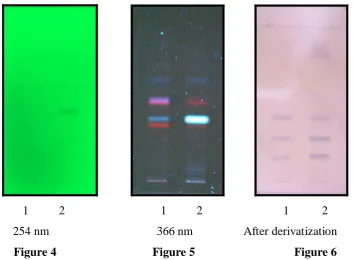
Figure 4-6: TLC fingerprint of n- hexane extract of B. ceiba (1= St. Bk.; 2= Sm. Br.)
[image:7.595.110.485.422.677.2]
1 2 1 2 1 2 254 nm 366 nm After derivatization
Figure 7 Figure 8 Figures 9
www.wjpr.net Vol 4, Issue 4, 2015. 919
[image:8.595.114.486.69.325.2]1 2 1 2 1 2 254 nm 366 nm After derivatization
Figure 10 Figure 11 Figures 12
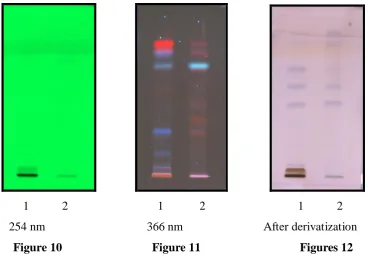
Figure 10-12: TLC fingerprint of ethanol extract of B. ceiba (1= St. Bk.; 2= Sm. Br.)
Table 1: Rf value of phytochemicals present in n-hexane, ethyl acetate and ethanol
extract of B. cieba (St. Bk. and Sm. Br.) at different wave-lengths.
Wave-length n- Hexane extract Ethyl acetate extract Ethanol extract Stem bark Small branches Stem bark Small branches Stem bark Small branches
254 No band 0.45 0.81 0.74 0.07 0.73
366 0.36,0.40
,0.51 ,0.64 0.08, 0.36, 0.40, 0.50, 0.64 0.18,0.34, 0.47,0.63, 0.67,0.71, 0.75,0.77, 0.81,0.86, 0.91 0.12,0.18, 0.34,0.40, 0.47,0.63, 0.67,0.71, 0.75,0.81, 0.88,0.91 0.15,0.30, 0.56,0.71, 0.78,0.80, 0.86 0.28,0.37, 0.44,0.49, 0.68,0.71, 0.80,0.86 Visible light after derivatization 0.15,0.28,0. 42 0.15,0.28,0. 42,0.81,0.85 0.38,0.58, 0.70,0.80, 0.93 0.38,0.58, 0.70,0.93 0.06,0.09, 0.47,0.57, 0.68,0.83 0.47,0.57, 0.68,0.83, 0.89
RESULTS AND DISCUSSION
No such type of study was found in literature for comparative phytochemical study of stem bark versus small branches of B. ceiba Linn by using High Performance Thin Layer Chromatographic-Ultra Violet detection Method. Comparative study of TLC fingerprints of stem bark and small branches of B. ceiba revealed that many similarities in phytochemical fingerprints were found and evident in Table-1 and Fig. 4-12.
www.wjpr.net Vol 4, Issue 4, 2015. 920
similar. Under 366 nm UV detection, stem bark and small branches showed four and five band respectively, out of which, three bands at Rf0.36 (red), 0.40 (red) and 0.64 (blue) were found similar. After TLC plate derivatized with Anisaldehyde sulphuric acid reagent and visualized under white light, stem bark and small branches both were showed three and five bands respectively, out of which, three bands at Rf 0.15 (violet), 0.28 (blue), 0.42 (violet) were found similar as represented in Table 1 and Fig. 4-6.
Ethyl acetate extract of stem bark and small branches (stem) under 254 nm, both extract showed one band at different Rf 0.81 and 0.74. Therefore, no similar bands were observed. Under 366 nm UV detection, stem bark and small branches showed eleven and twelve bands respectively, out of which, nine bands at Rf 0.18 (blue) ,0.34 (blue),0.47 (red), 0.63 (red), 0.67(blue) , 0.71 (red), 0.75 (red), 0.81(red) and 0.91(red) were found similar. After derivatized with Anisaldehyde sulphuric acid reagent and visualized under white light, stem bark and small branches showed five and four bands respectively, out of which four bands at
Rf 0.38 (blue), 0.58 (blue), 0.70 (blue) and 0.93 (blue) were found similar as showed in Table 1 and Fig. 7-9.
Phytochemical fingerprints of ethanol extract of stem bark and small branches under UV detection at 254 nm, showed no similar band. While under 366 nm UV detection, stem bark and small branches showed seven and eight bands respectively, out of which, three bands at
Rf 0.71 (blue), 0.80 (red) and 0.86 (red) were found similar. After TLC plate derivatized with
Anisaldehyde sulphuric acid reagent and visualized under white light, stem bark and small branches showed six and five bands respectively, out of which four bands at Rf 0.47, 0.57, 0.68 and 0.93 (all are blue) were similar in both parts (St. Bk. and Sm. Br.) as evident in Table 1 and Fig.10-12.
CONCLUSION
The phytochemical fingerprint profiling of stem bark and small branches of B. ceiba were
www.wjpr.net Vol 4, Issue 4, 2015. 921 ACKNOWLEDGMENTS
Authors are thankful to Director General, Central Council for Research in Ayurvedic Sciences, New Delhi to provide the financial support under IMR scheme for this research work. Authors are grateful to Dr. R. K. Tiwari, NVRI&H Lucknow for providing the genuine plant materials.
REFERENCES
1. Gupta R, Plant taxonomy: past, present, and future, TERI Press, 2012; 66.
2. Raw herbs of Bombax ceiba. Available from http://www.la-medicca.com/raw-herbs bombax- ceiba.html.site site assessed on 23/01/2015.
3. “The Wealth of India- a dictionary of Indian Raw Material and Industrial Products”. Vol-II, Bombay: Popular Prakashan, 1976; 175.
4. Verma R, Devre K, Gangrade T, Gore S, Gour S, A Pharmacognostic and pharmacological overview on Bombax ceiba, J Pharm, 2014; 3(2): 100-107.
5. Rastogi RP, Mahrotra BM, “Compendium of India Medicinal Plants”. Vol-I, II, CSIR Lucknow Publication and Information Directorate, New Delhi. 1980-84.
6. Gupta AK, Sharma M, Tandon N, Quality Standards of Indian Medicinal Plants, ICMR, 2004; (4): 125-133.
7. Sreeramulu K, Rao KV, Rao CV, Gunasekar D, A new naphthoquinone from Bombax malabaricum, J Asian Nat Prod Res, 2001; 3: 261-265.
8. Puckhaber LS, Stipanovic RD, Revised structure for a sesquiterpene lactone from
Bombax malbaricum, J Nat Prod, 2001; (64): 260-261.
9. You YJ, Nam NH, Kim Y, Bae KH, Ahn BZ, Antiangiogenic activity of lupeol from
Bombax ceiba, Phyto Res, 2003; 17(4): 341-344.
10.Chaudhary PH, Rai PD, Deore SL, Khadabadi SS, Pharmacognostical and phytochemical studies on roots of Bombax ceiba Linn, J Pharm Pharmacogn Res, 2014; 2 (6): 172-182. 11.Saleem R, Ahmad M, Hussain SA, Qazi AM, Ahmad SI, Hypotensive, hypoglycemic and
toxicology studies on the flavonol C-glycoside shamimin from Bombax ceiba, Planta Med, 1999; 65(4): 331-34.
12.Jamiahamdard.org, New York. Available from:
www.wjpr.net Vol 4, Issue 4, 2015. 922
13.Verma V, Jalalpure SS, Sahu A, Bhardwaj LK, Prakesh Y, Bombax ceiba Linn: Pharmacognostical, Phytochemistry, Ethnobotany and Pharmacology studies, Int Pharm Sci, 2011; (1): 62 – 68.
14.Antil V, Sinha BN, Pandey A, Diwan A, Saini PB. Malabaricum Dc: A Salutary Boon, Int J Pharm Inno, 2013; 3(2): 17-18.
15.Williamsons EM, Major Herbs of Ayurveda, Churchill Livingstone Publishers, 2002; 361.
16.Wahab S, Hussain A, Farooqui AHA, Ahmad MP, Hussain MS, Rizvi A, Ahmad MF, Ansari NH, In vivo Antioxidant and Immunomodulatory Activity of B. ceiba Bark - Focusing on its Invigorating Effects, American J Adv Drug Deli, 2014; 2(1): 1-13.
17.Chaudhary PH, Khadabadi SS, Bombax ceiba Linn: Pharmacognosy, Ethnobotany and
Phyto-pharmacology, Pharm Comm, 2012; 2(3): 2-9.
18.Rahmatullah M, Haque R Md, Sarder KI, Jamal F, Anwarul B, Rasheda A, Ishtiaq A, Rownak J, Ahsan S, Chowdhury MH, A survey on the use of medicinal plants by folk medicinal practitioners in three areas of pirojpur district, Bangladesh, American-Eurasian J Sus Agri, 2010; 4(2): 247-259.
19.Ripu KM, Uprety Y, Burlakoti C, Chowdhary CL, Bussmann RW, Indigenous Use and Ethnopharmacology of Medicinal Plants in Far-west Nepal, Ethno Res App, 2009; (7): 5-28.