A COMPARATIVE STUDY ON RECENT INTERNET ACCESS TECHNOLOGIES
*,1
Hitesh Panchal,
2
Govt. Polytechnic, Gandhinagar, Gujarat, India
3Govt. Polytechnic, Ahmedabad, Gujarat, India
ARTICLE INFO ABSTRACT
Internet is a Global system of interconnected servers and computers that uses standard protocols to link millions of devices worldwide using different technologies. Mainly, Servers are computers that stores large amount of information whose purpose is to s
computers. The devices in internet are linked through broad array of electronics, wireless and optical fiber networking technologies. Most common types of internet connections are Dial
DSL/ADSL, Wireless
broadband etc. This article demonstrates a Comparative study of recent internet access technologies for choosing best internet access method as per our requirement. In last net neutra
Copyright © 2015 Hitesh Panchalet al. This is an open access article distributed under the Creative Commons Att distribution, and reproduction in any medium, provided the original work is properly cited.
INTRODUCTION
Nowadays, internet can be accessed through PC, Laptop, Smartphone, tablets etc. Day by day use of internet and no. of users are increasing, which demands different technologies to come out to provide fast, reliable, cheaper internet connection. This paper demonstrates different technologies used to provide internet connection to the devices. Common methods of internet access by devices includes dial up connection to PC through MODEM on telephone line, broadband connection on coaxial cable, fibre optic cable, Fi,
Wi-cellular mobile telephony technologies (2G, 3G,4G). Among these, dial up, broadband, fibre optic cables are wired technologies and Wi-Fi, satellite, cellular mobile technology are wireless technologies. Next topics illustrat
technology in detail.
Dial-Up connection
Dial-up internet connection is a form of internet connection that uses the infrastructure of Public Switched Telephone Network (PSTN) to establish a connection to internet by dialing a telephone number on a conventional telephone line. Mainly, telephone lines are used to transfer voice signals, so these lines are analog in nature, while information over internet is in digital form. So, one device called Modem is used
*Corresponding author: Hitesh Panchal L. E. College, Morbi, Gujarat, India
ISSN: 0975-833X
Article History:
Received 10th June, 2015
Received in revised form 15th July, 2015
Accepted 23rd August, 2015
Published online 16th September,2015
Key words:
Internet access, dial-up, broadband, DSL, Wireless broadband, Wi-fi, Wi-Max, Net neutrality.
Citation: Hitesh Panchal, Ritesh Patankar, Kerolin Shah Journal of Current Research, 7, (9), 20077-20081
RESEARCH ARTICLE
A COMPARATIVE STUDY ON RECENT INTERNET ACCESS TECHNOLOGIES
Hitesh Panchal,
2Ritesh Patankar and
3Kerolin Shah
1
L. E. College, Morbi, Gujarat, India,
Govt. Polytechnic, Gandhinagar, Gujarat, India
Govt. Polytechnic, Ahmedabad, Gujarat, India
ABSTRACT
Internet is a Global system of interconnected servers and computers that uses standard protocols to link millions of devices worldwide using different technologies. Mainly, Servers are computers that stores large amount of information whose purpose is to serve the information needed by connected computers. The devices in internet are linked through broad array of electronics, wireless and optical fiber networking technologies. Most common types of internet connections are Dial
DSL/ADSL, Wireless broadband (Wi-fi, Wi-Max etc.), Mobile broadband, fiber optic, Satellite broadband etc. This article demonstrates a Comparative study of recent internet access technologies for choosing best internet access method as per our requirement. In last net neutra
is an open access article distributed under the Creative Commons Attribution License, which distribution, and reproduction in any medium, provided the original work is properly cited.
Nowadays, internet can be accessed through PC, Laptop, Smartphone, tablets etc. Day by day use of internet and no. of users are increasing, which demands different technologies to come out to provide fast, reliable, cheaper internet connection. demonstrates different technologies used to provide internet connection to the devices. Common methods of internet access by devices includes dial up connection to PC through MODEM on telephone line, broadband connection on
-Max, satellite and cellular mobile telephony technologies (2G, 3G,4G). Among these, dial up, broadband, fibre optic cables are wired Fi, satellite, cellular mobile technology are wireless technologies. Next topics illustrate each
up internet connection is a form of internet connection that uses the infrastructure of Public Switched Telephone Network (PSTN) to establish a connection to internet by dialing a telephone number on a conventional telephone line. nes are used to transfer voice signals, so these lines are analog in nature, while information over internet is in digital form. So, one device called Modem is used
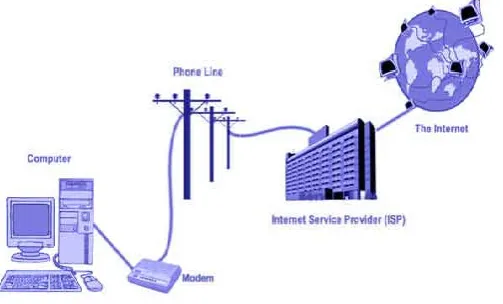
between user’s computer and telephone line to encode and decode into and from voice signals, respectively. Dial up is low speed internet access up to 56kbps (Tamara, 2010). Dial up internet access may be used where other forms of internet accesses are not available or it costs too high. Generally, dial up connections are used in some rural or remote areas for users with limited budgets or limited use of internet.
[image:1.595.310.562.552.704.2](Courtesy: http://imgarcade.com/1/dial
Fig. 1. Basic Dial up connection diagram
Figure 1 shows basic Dial up connect
Figure 1 internet is connected to the user’s Computer through
Available online at http://www.journalcra.com
International Journal of Current Research Vol. 7, Issue, 09, pp.20077-20081, September, 2015
INTERNATIONAL
Hitesh Panchal, Ritesh Patankar, Kerolin Shah, 2015. “A comparative study on recent internet access technologies 20081.
z
A COMPARATIVE STUDY ON RECENT INTERNET ACCESS TECHNOLOGIES
Kerolin Shah
Internet is a Global system of interconnected servers and computers that uses standard protocols to link millions of devices worldwide using different technologies. Mainly, Servers are computers that erve the information needed by connected computers. The devices in internet are linked through broad array of electronics, wireless and optical fiber networking technologies. Most common types of internet connections are Dial-up, cable, Max etc.), Mobile broadband, fiber optic, Satellite broadband etc. This article demonstrates a Comparative study of recent internet access technologies for choosing best internet access method as per our requirement. In last net neutrality is discussed.
ribution License, which permits unrestricted use,
’s computer and telephone line to encode and decode into and from voice signals, respectively. Dial up is low speed internet access up to 56kbps (Tamara, 2010). Dial up internet access may be used where other forms of internet it costs too high. Generally, dial up connections are used in some rural or remote areas for users with limited budgets or limited use of internet.
(Courtesy: http://imgarcade.com/1/dial-up-connection/)
Basic Dial up connection diagram
1 shows basic Dial up connection diagram. As shown in 1 internet is connected to the user’s Computer through
INTERNATIONAL JOURNAL OF CURRENT RESEARCH
established telephone network and Modem. Dial up requires time (up to several seconds, depending upon location) to establish connection to internet and also to perform configuration for protocol synchronization before actual data transfer can take place. The charges to dial up internet connection are incurred by ISP (Internet Service Provider) on the basis of duration of active connection or the data usage by user. Nowadays, dial up internet connections are cheaper option for rural areas.
Wired Broadband Connection
The broadband term includes many internet connection technologies (wired or wireless). Broadband connections provide high speed access of internet. Followings are some types of Broadband internet connection. ISDN (Integrated Services Digital Network) is one of the old methods for internet access which is a switched telephone service capable of transporting voice and digital data (William Stallings, 1999). ISDN has been used for voice, video conferencing and broadband data services. ISDN provides data rates up to 128kbps. Another technology in broadband is leased line (Ray Horak, 2008). Leased lines are dedicated lines from existing PSTN to provide internet access to ISP (Internet Service Provider), business campus, large organization to connect LAN or campus network with internet. Leased lines may me of optical fiber or RF to provide direct internet access. Leased lines provide data rates starting from 56kbps to 1.5Mbps (T1) or 2.0Mbps (E1).
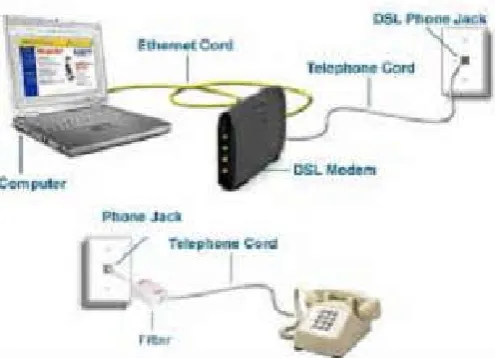
Cable internet access provides internet access through hybrid fiber coaxial cables which are originally implemented to carry television channels. Either fiber optic or coaxial copper cable is connected to the node at customer location end (Tamara, 2010). The download data rate towards user end can be 400Mbps for business or corporate sector and 250Mbps for residential areas. The upload data rates ranges from 350kbps to 2Mbps. This type of internet access is limited to the users who have existing cable TV connection. Digital subscriber line (DSL) service provides internet access through existing telephone network (Chris Woodford, 2008). DSL operates on single line without interrupting use of telephone for voice calls.
[image:2.595.306.557.354.512.2](Courtesy:- http://www.webband.com/tech/dsl/)
Fig. 2. Internet Access using DSL
DSL uses high frequencies for Internet data and low (audible) frequencies for voice communication over telephone network. The most common type of DSL is ADSL (Asymmetric Digital Subscriber Line). In ADSL the download rate (towards customer/user) ranges from 256kbps to 20Mbps and upload data rates (towards service provider) is lower than these rates. Because of this, this type of DSL is called ADSL. Another variety of DSL is SDSL (Symmetric Digital Subscriber Line), in which download and upload data rates are equal (Chris Woodford, 2008). The new standard or variety VDSL (Very high bit rate Digital subscriber line) of DSL provides data rates 52Mbps for download and up to 16Mbps for upload over copper cables. VDSL supports applications line High Definition Television, telephone service (voice over IP) and also Internet access using single physical connection. The newer version VDSL2 of VDSL provides data rates up to 100Mbps for download and upload direction. Another broadband wired technology is fiber to home (Steven Gorshe
et al., 2014) or fiber at user end. In this method, the fiber cable
is provided up to user end. The use fiber optic cable provides much higher rates for longer distances. Most of the countries are nowadays switching their existing coaxial cable networks to fiber optic cable networks to provide internet services up to user end.
[image:2.595.37.285.543.722.2](Courtesy: http://www.broadbandsoho.com/FTTx_Tutorial.htm/)
Fig. 3. Internet Access through Fiber optic network
The fiber optic cable consist core, cladding and buffer. The core and cladding both are made up of high quality Silica Glass or can also be made up by plastics as well. The data (electrical) signals are converted into light signals for transmitting through fiber optic cable in which light signal travels by refraction and reflection. Fiber optic cable networks have several advantages like: immunity towards electromagnetic interference, high electric resistance, no sparks, no electromagnetic radiations, resistance to corrosion due to non-metallic transmission medium (Glass) etc.
Wireless Broadband Access
Internet access through Wireless broadband includes following technologies.
Wi-Fi
Wi MAX
Satellite broadband
Mobile Broadband
Wi-fi (Steven Gorshe et al., 2014) is becoming preferred
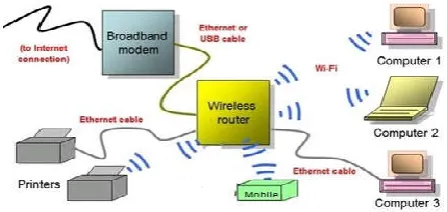
internet access method nowadays. Wi-fi is the trade name used for WLAN (Wireless Local Area Network). To access internet thorough wi-fi technology, one should have wireless adapter in computer or smart phone. Wi-fi uses frequencies from 2.4GHz to 5.0GHz locally to provide internet access. Areas which are enabled with Wi-fi connectivity are called hotspots.
[image:3.595.306.559.225.294.2](Courtesy: https://cyphorking.wordpress.com/2011/08/28/what-is-wifi-technology/)
Fig. 4. Wi-fiInternet Access
The Wi-fi network is connected to the wired broadband connections or any other internet technologies to provide internet access locally. Wi-fi is used to create campus-wide or city-wide wireless network. The speed or data rates ranges from 5 to 550Mbits/second for typically short distances from 20 to 250m. The data rates and range depends on many factors like location, frequency, interference from other devices, infrastructure of building etc. Like mobile phones, wi-fi uses radio waves (2.4GHz to 5.0GHz) to transmit information across network. The receiver or computer should have wireless adapter to receive these radio signals. Wi-Max (Carl Weinschenk, 2010) stands for worldwide interoperability for Microwave Access. Wi-Max enables wireless broadband internet access as an alternative to Cable or DSL network. The Wi-Max provides data rates up to 1Gbit/s. Wi-Max offers Metropolitan area network (MAN) with signal radius of around 50km. Wi-Max signals penetrates building walls much effectively compared to Wi-fi. Satellite internet service
(Steven Gorshe et al., 2014) provides fixed, portable or mobile
internet access. Parabolic reflector or dish antenna is used to receive signals from satellite. This requires clear line of sight or orientation of antenna towards satellite. The internet access through satellite is affected by rain, moisture, snow. However, this type of internet access is used where no other kind of internet access service reachable. Data rates ranges from 2kbps to 1Gbps for downstream and 2kbps to 10Mbps for upstream. Satellites which are located in geo-stationary orbit above 36,000km above earth’s surface generate the delay. This delay (latency) is large compared to other form of internet access typically in the range of 0.015 to 0.2 seconds. This latency
affects real time response particularly in online games, remote control devices etc. Lower altitude satellites are used to rectify this delay and real-time interactive internet applications are feasible. Mobile broadband is wireless internet access through mobile phone towers to computers, mobile phones (smart phones) or other similar devices (Mustafa Ergen, 2009). New mobile phone technology and infrastructure are introduced periodically which provides change in nature of service, non-backward compatible, higher data rates, wider bandwidth. These periodically transitions are referred to as generation in terms mobile internet technology. The internet service technologies according to generation are listed in following table.
Table 1. Mobile internet technologies generation wise
Second Generation (2G) Year-1991
Third Generation (3G) Year-2001
Fourth Generation (4G) Year-2006
GSM UMTS W-CDMA HSPA+
CDPD UMTS HSPA Mobile Wi-MAX
GSM GPRS(2.5G) UMTS TDD LTE
GSM EDGE(2.75G) CDMA 2000 LTE-Advanced
GSM EDGE-Evolution MBWA
The data rates ranges from 9kbps to 230kbps for second generation (2G), 0.4Mbps to 16Mbps for third generation (3G) and 21Mbps to 100Mbps for fourth generation (4G) technologies.
Comparison
Figure 5 shows the comparison of all above internet access technologies with reference to maximum speed provided by them. From the chart it is seen that highest speed is provided by fiber optic network. However cost of this technology is also very high. So which internet connection best suits to you is depends on certain factors like location where you resides, bandwidth you needed and pricing that you can afford. As per your location, you should search which are the nearby internet service providers and by which manner (internet access technologies) they are providing internet. After that you should decide about your bandwidth requirement like if you only want to check your emails or simply browsing websites or you want to stream video or download it. So depends on your requirement you can choose internet from low speed to high speed. Obviously high speed internet will charge more to you compare to low speed. So how much you can afford financially is also one of the factors for choosing internet connection. Some other factors are uptime and latency. Uptime means amount of time the internet network is functioning or available for use. Latency is number of milliseconds it takes data to travel from one location to another location in network. This is also called delay. Above all you should see for 24x7 good customer service of internet service provider. If you consider all factors for choosing internet connection, you will be equipped with best suitable internet connection for you and you will be saved from overpaying for this. Now let us see share of internet service provider in India for wired broadband internet service and wireless internet service.
Figure 6 and 7 respectively shows market share by different internet service providers (ISP) in India for wired broadband internet service and wireless internet service with reference to data provided by Telecom regulatory authority of India (TRAI) as on July 2013 and Feb 2012.
[image:3.595.52.276.259.365.2](Courtesy:-Based on information on provider websites as on October
Fig. 5. Comparison of different internet access technologies
[image:4.595.170.417.325.502.2](Courtesy: Based on data released by TRAI as on July 2013)
Fig. 6. Market share in wired broadband service in India
(Courtesy:Based on data released by TRAI as on Feb 2012)
Fig. 7. Market share in wireless internet service in India Based on information on provider websites as on October 2012)
Comparison of different internet access technologies
Based on data released by TRAI as on July 2013)
Market share in wired broadband service in India
(Courtesy:Based on data released by TRAI as on Feb 2012)
[image:4.595.163.425.550.748.2]Net Nuetrality
Network neutrality (also called net neutrality, internet neutrality, net equality) is the principle that internet service providers and governments should treat all data on the internet equally, not discriminating or charging differentially by user, content, site , platform, application, type of attached equipment, or mode of communication. Net neutrality means an Internet that enables and protects our right of free speech (see reference, http://www.savetheinternet.com). Just as your phone company should not decide who you can call and what you say on that call, your ISP should not be concerned with the content, application, site you view or post online. Without net neutrality, cable and phone companies could carve the Internet info fast and slow lanes. An ISP could slow down its competitors’ content or block political opinions it disagreed with. ISPs could charge extra fees to the few content companies that could afford to pay for preferential treatment. This would destroy the open Internet.
Net neutrality is crucial for small business owners, startups and entrepreneurs, who rely on the open Internet to launch their businesses, create a market, advertise their products and services, and distribute products to customers. Recently, Indian telecom ministry has taken survey on public opinions regarding net neutrality on mygov.in website. And according to the responses over website (http://telecom.economictimes.indiati mes.com) above 50,000 peoples have given opinion in favor of net neutrality for free internet for any applications, anywhere, equal and non-discriminatory access to all data, apps and services on internet.
REFERENCES
Albert A. Azzam, Maurice Niel Ransom, 1999, A book on Broadband Access technologies, ADSL/VDSL, Cable Modem, Fiber, LMDS, McGraw-Hill, 1999 ISBN NO.:-0071350608, 9780071350600
Carl Weinschenk 2010. "Speeding Up WiMax". IT Business Edge (url: http://en.wikipedia.org/wiki/WiMAX)
Chris Woodford (2008) "How Broadband Works", Explain that Stuff, 20 August 2008.
http://telecom.economictimes.indiatimes.com/news/policy/over -50000-recommend-full-net-neutrality-on-government-portal/48505292
http://www.savetheinternet.com/net-neutrality-what-you-need-know-now
Mustafa Ergen 2009. Mobile Broadband: including WiMAX and LTE. Springer Science+Business Media.ISBN 978-0-387-68189-4.
Ray Horak 2008, Telecommunications and Data
Communications Handbook, 2nd edition, Wiley-Inter science, 2008, 791 p., ISBN 0-470-39607-5
Steven Gorshe, Arvind Raghavan, Thomas Starr, Stefano Galli, 2014 Broadband Access: Wireline and Wireless - Alternatives for Internet Services
Tamara 2010, Network+ Guide to Networks, 5th Ed.
William Stallings 1999. ISDN and Broadband ISDN with Frame Relay and ATM (4th ed.). Prentice Hall. p. 542.ISBN 0139737448.