ISSN Print: 2327-5952
DOI: 10.4236/jss.2018.68009 Aug. 21, 2018 115 Open Journal of Social Sciences
An Overview of Functional Components of
Artificial Intelligence Financial Decision
Support System
Qi Wang
Accounting School, Nanfang College of Sun Yat-sen University, Guangzhou, China
Abstract
The development of artificial intelligence technology makes the intelligent decision-making of enterprise finance possible. Combined with the tradition-al enterprise financitradition-al decision support system, this paper summarizes and introduces the structure and function of the enterprise Financial Decision Support System and its subsystems under the development of artificial intel-ligence in detail.
Keywords
Artificial Intelligence, Financial Decision Support System, Structure and Function
1. Introduction
With the development of society, the company runs in a rapidly changing and unstable economy, and the enterprise faces the difficult of recording large amounts of management and operation data. The intensification of competition and the development of e-commerce require enterprises to have more accurate, timely and critical information, more in-depth financial analysis, more effective and timely communication and higher quality decision-making. Therefore, an enterprise financial decision support System (FDSS) was born at right moment. With the development of artificial intelligence technology, the FDSS combined with artificial intelligence technology becomes a research hotspot [1] [2]. In 2005, Jiangsu Land Reclamation Group developed an advanced FDSS, which in-tegrated the reporting standardization, intelligent decision and information network. The FDSS provided convenient and effective financial information support for making decision of enterprise. Artificial intelligence financial deci-How to cite this paper: Wang, Q. (2018)
An Overview of Functional Components of Artificial Intelligence Financial Decision Support System. Open Journal of Social Sciences, 6, 115-126.
https://doi.org/10.4236/jss.2018.68009
Received: July 31, 2018 Accepted: August 18, 2018 Published: August 21, 2018
Copyright © 2018 by author and Scientific Research Publishing Inc. This work is licensed under the Creative Commons Attribution International License (CC BY 4.0).
DOI: 10.4236/jss.2018.68009 116 Open Journal of Social Sciences sion support system (AIFDSS) has been attracted many attention and applied for large enterprise groups.
Decision Support System (DSS) is a computer application system that can as-sist and support managers to make decisions and improve the effectiveness of decisions [3]. FDSS is a computer system formed by applying DSS design ideas and methods to financial management. FDSS is a computer system used by fi-nancial personnel to assist decision-making in fifi-nancial management, fifi-nancial control, financial analysis, financial forecasting and decision-making. The main decision-making problems in FDSS include [1]:
1) Structural decision making. Routine repetitive decision-making, with cer-tain rules to follow, can make an orderly arrangement in advance to achieve the desired results and goals. It is usually possible to describe and solve problems by conventional quantitative mathematical methods.
2) Unstructured decision-making. It has never happened before, or the deci-sion-making process structure is too complex to follow the rules, or it is espe-cially difficult to describe and solve the decision-making problems that must be solved immediately once the key problems appear.
3) Semi-structured decision-making is a decision-making problem between structured decision-making and unstructured decision-making, which has two decision-making characteristics.
The traditional financial decision support system mainly consists of two parts: database and model library [3]. There is often little that can be done about semi-structured or unstructured problems.
Whereas, AIFDSS has a breakthrough in solving semi-structured or unstruc-tured problems. The main difference between FDSS of artificial intelligence and the traditional FDSS structures is that the former joins knowledge-based systems and other business intelligence technologies to simulate human's peculiar think-ing ability. It can not only solve the problem of conventional quantitative nature, but also can help decision-makers to recognize the decision environment, clear targets and solve the semi-structured or unstructured problems by providing background materials, helping clear the problem, modifying and perfecting the model, enumerating the possible schemes and analyzing and comparing [4]. Its features are as follows: 1) it has inference structure and can simulate the think-ing process of decision makers; 2) it has learnthink-ing function and increases the knowledge automatically. Therefore, it can be improved slowly with little or without intermediate maintenance; 3) solve semi-structured unstructured prob-lems of financial decision-making more effectively; 4) it can track the solution process of the problem, prove the correctness of the financial model scheme, and enhance the credibility of the financial decision-making model scheme [5].
DOI: 10.4236/jss.2018.68009 117 Open Journal of Social Sciences role in the subsequent development of DSS. In 1981, Bonczek proposed a three systems structure, namely the language system (LS), the problem processing system (PPS) and the knowledge system (KS). This structure has its characteris-tic in dealing with problem, which makes it have a better effect, and henceforth lay the foundation for intelligent decision-making system development. In the late 1980s, with the rise of artificial neural network and machine learning tech-nology, integrated the artificial intelligence into the DSS to form traditional in-telligent decision support system. With the application of expert systems tech-nology, DSS can be used better in human’s knowledge, such as problem descrip-tion knowledge, process knowledge and deductive knowledge for solving prob-lem [6]. In addition, the development of artificial intelligence technology, expert system technology, database technology and internet/intranet technology pro-vides powerful technical support for intelligent decision support system. Thus, some representative decision support technical tools were produced, including data warehouses [7] [8] [9], on-line analytical processing, data mining [10], ANN [11], genetic algorithm and fuzzy logic [12], which had a great influence on the evolution and development of the structure of intelligent decision support system.
The above literatures mainly focus on the design and function of one part. Few research studies all the components of the structure systematically. There-fore, in order to make up the literature gap, this paper studies the influence of each component and its sub-components on decision-making in the practical application of enterprises.
2. Artificial Intelligence Financial Decision Support System
(AIFDSS)
From the perspective of the logical structure, intelligent decision support system generally can be divided into three parts: database, model base and knowledge base [13]. In the 1990s, the concept of data Warehouse, which combined with the traditional Intelligent FDSS further improved the effect of the auxiliary deci-sion-making [8].
Intelligent decision support systems are integrated by model bases, data warehouses, OLAP technologies, data mining, expert system and interactive in-terfaces. The data warehouse can realize the storage and synthesis of decision topics. OLAP technologies implement multidimensional data analysis, data mining is used to mine knowledge in database and data warehouse, model base realizes the combined aid decision of multiple generalized models, and expert system uses knowledge reasoning to achieve qualitative analysis. They comple-ment each other, rely on each other, give full play to their respective auxiliary decision-making advantages and realize more effective auxiliary deci-sion-making.
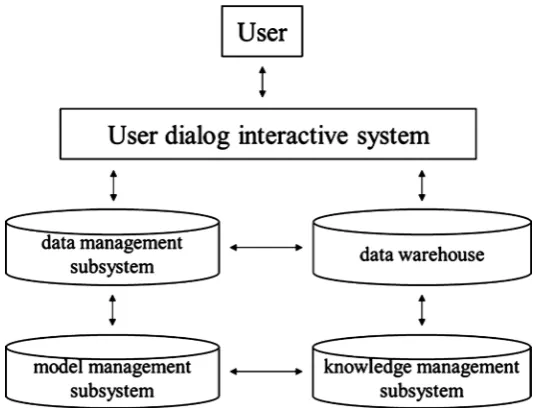
DOI: 10.4236/jss.2018.68009 118 Open Journal of Social Sciences decisions [8] [14], and this paper mainly studies the requirements of AIFDSS on its components in the operation process. therefore, get rid of the business intel-ligence technology (OLAP and data mining), basing on the Efraim & Jay [5] proposed the basic structure of the decision support system, added data ware-house module, AIFDSS can be divided into data management subsystem, data Warehouse and model management subsystem and knowledge management subsystem of four parts, as shown in Figure 1.
Each component will be discussed in detail in the following sections.
3. Data Management Subsystem
Data management subsystem is the basis of decision analysis of AIFDSS.A sys-tem that stores relevant data for a particular situation consists of the following elements: database, database management system, data catalog and query func-tion.
1) Database
The database collects relevant data to meet the needs and structures of the or-ganization and can be used by more users for more purposes. Data can be raw or generalized, including documents, images, maps, sound, video, and animations, concepts and ideas. Data sources can be divided into internal data sources, ex-ternal data sources and personal data sources. The storage structure of database can be roughly divided into three categories: relational database, hierarchical database and network database [15]. In fact, the backstage of most management information systems is carried out in relational databases, such as Oracle and MS.
2) Data base management system
[image:4.595.239.508.502.706.2]DBMS creates, users, and updates databases. An effective database and its management can support many management activities. Typical examples are browsing records, creating and maintaining a diverse set of data relationships,
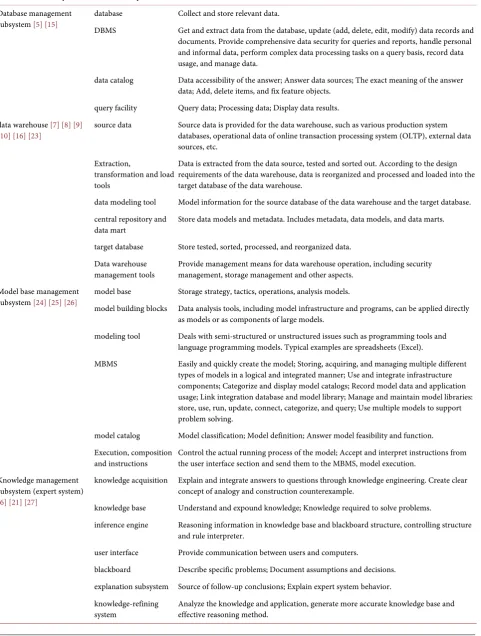
DOI: 10.4236/jss.2018.68009 119 Open Journal of Social Sciences and generating reports. The specific functions of the database management sys-tem are shown in Table 1.
3) Data catalog
A data catalog is a directory of all the data in a database. And it is a place where the database server stores data files, including not only the files on the ta-ble, but also the data files and server options files. The main function is to an-swer questions about data availability and the exact meaning of data source. Liking other directories, this directory supports adding new items, deleting items, and restoring information about specific objects.
4) Query function
The main tasks of the query function are to use, process, and query data. It accepts data requests from other DSS components, determines how those re-quests are met, explicitly expresses detailed rere-quests and returns the results to the requester.
4. Data Warehouse
In essence, data warehouse technology is an information integration technology. The data warehouse obtains the original data from multiple information sources. These raw data are stored in the internal database of the data warehouse after sorting and processing, providing users with a unified, coordinated and inte-grated information environment, supporting the overall decision-making process of the enterprise and in-depth and comprehensive analysis of enterprise operation and management [7] [8] [9]. To achieve this goal, a data warehouse generally consists of the following seven main components [16]:
1) Source data
Source data is provided for the data warehouse, such as operational data of various production system databases, online transaction processing system (OLTP) and external data sources, which can all be used as data sources of the data warehouse.
2) Extraction, transformation and load tools
Its function is to extract data from the data source, check and organize the data, reorganize and process the data according to the design requirements of the data warehouse, and load it into the target database of the data warehouse.
3) Data modeling tool
The modeling tool establishes an information model for the source database of the data warehouse and the target database.
4) Central repository and data mart
DOI: 10.4236/jss.2018.68009 120 Open Journal of Social Sciences specific business requirement. The data in the data mart still has the characteris-tics of data warehouse, except that the data in the data mart is customized for a certain department or a specific business need [17].
5) Target database
The target database is used to store tested, sorted, processed, and reorganized data.
6) Front-end data access and analysis tools
Front-end data access and analysis tools provide business analysts and deci-sion makers with access to data in the target database for further in-depth analy-sis.
7) Data warehouse management tools
Data warehouse management tools provide management means for data warehouse operation, including security management, storage management and other aspects.
We can see that in a data warehouse, the source data comes from the existing production system. As long as the data warehouse can provide the necessary in-formation for the decision-making and analysis process supported by the data warehouse, it may become the data source of the data warehouse. Therefore, the data warehouse needs tools to extract data from the data source. Data must be validated before it can enter the data warehouse to eliminate errors that may be hidden in the data. In order to meet the need of decision support and in-depth analysis, data should pass special processing and reorganize, after inspection, sorting, processing and reorganizing, the data will be loaded into one or more of the data warehouse database, all these works are made by data extraction and conversion tools. In order to describe the requirements for data validation, colla-tion, processing as well as the corresponding processes and steps, there must be data modeling tools.
5. Model Management Subsystem
The model management subsystem consists of the following elements: model base, model management system, modeling language, model directory, model execution, composition and instruction processor [18] [19].
1) Model base
The model library includes general and specialized statistical, financial, fore-casting, management science, and other types of quantitative models. These models provide analytical capability for DSS. The model base has ability to in-voke, run, modify, compose, and examine models. The models in the model base are divided into four types: strategic, tactical, operational, and analytical. In ad-dition, there are model infrastructure artifacts and programs.
DOI: 10.4236/jss.2018.68009 121 Open Journal of Social Sciences larger model.
2) Modeling tool
When encountering semi-structured or unstructured problems, some model tools are needed, such as programming tools and language programming mod-els, such as C++, Java, OLAP software, or spreadsheet (Excel).
3) Model base management system
The function of model base management system software is to use program-ming language, DSS tools or subroutines and other basic components to create models, generate new programs and reports, replace and transform models, and control model data. The specific functions are shown in Table 1.
4) Model catalog
The role of the model catalog is similar to that of the data catalog, which is the classification of all models. It includes model definition. The main function is to answer questions about the feasibility and function of the model.
5) Execution, composition and instructions
Model execution controls the actual operation of the model. Model composi-tion includes the operacomposi-tion of integrating some models as needed (for example, managing the output of a model; For example, predictions are processed by another model, such as the linear programming model). The model instruction is used to accept and interpret instructions from the user interface portion and transmit them to the MBMS, model execution, or integration functions. Because in many cases, DSS systems do not know which models are used for which situa-tions, these operations are typically assisted by knowledge system components and humans in intelligent financial DSS [20].
6. Knowledge Management Subsystem
The knowledge management subsystem provides professional knowledge to solve many unstructured and even semi-structured problems, which is the big-gest difference between the traditional FDSS and the AIFDSS. The knowledge management subsystem can also solve problems that cannot be solved by other decision support system components before and improve their operational ex-ecution ability. Its core system is the expert system [21] [22].
The name expert system derives from the term knowledge-based expert sys-tem. Expert systems use human knowledge acquired in computers to solve problems that usually require human expertise [6]. In every expert system, there are three main components: knowledge base, inference engine and user inter-face. The expert system that communicates with users may also include the fol-lowing additional components: the knowledge acquisition subsystem, black-board structure, explain subsystem, knowledge-refining system.
1) Knowledge acquisition
DOI: 10.4236/jss.2018.68009 122 Open Journal of Social Sciences
Table 1. Components and Technology of AIFDSS.
Financial DSS components Sub-components Definitions and Functions
Database management
subsystem [5][15] database DBMS Collect and store relevant data. Get and extract data from the database, update (add, delete, edit, modify) data records and
documents. Provide comprehensive data security for queries and reports, handle personal and informal data, perform complex data processing tasks on a query basis, record data usage, and manage data.
data catalog Data accessibility of the answer; Answer data sources; The exact meaning of the answer data; Add, delete items, and fix feature objects.
query facility Query data; Processing data; Display data results. data warehouse [7][8][9]
[10][16][23] source data Source data is provided for the data warehouse, such as various production system databases, operational data of online transaction processing system (OLTP), external data sources, etc.
Extraction,
transformation and load tools
Data is extracted from the data source, tested and sorted out. According to the design requirements of the data warehouse, data is reorganized and processed and loaded into the target database of the data warehouse.
data modeling tool Model information for the source database of the data warehouse and the target database. central repository and
data mart Store data models and metadata. Includes metadata, data models, and data marts. target database Store tested, sorted, processed, and reorganized data.
Data warehouse
management tools Provide management means for data warehouse operation, including security management, storage management and other aspects. Model base management
subsystem [24][25][26] model base model building blocks Data analysis tools, including model infrastructure and programs, can be applied directly Storage strategy, tactics, operations, analysis models.
as models or as components of large models.
modeling tool Deals with semi-structured or unstructured issues such as programming tools and language programming models. Typical examples are spreadsheets (Excel).
MBMS Easily and quickly create the model; Storing, acquiring, and managing multiple different types of models in a logical and integrated manner; Use and integrate infrastructure components; Categorize and display model catalogs; Record model data and application usage; Link integration database and model library; Manage and maintain model libraries: store, use, run, update, connect, categorize, and query; Use multiple models to support problem solving.
model catalog Model classification; Model definition; Answer model feasibility and function. Execution, composition
and instructions Control the actual running process of the model; Accept and interpret instructions from the user interface section and send them to the MBMS, model execution. Knowledge management
subsystem (expert system)
[6][21][27]
knowledge acquisition Explain and integrate answers to questions through knowledge engineering. Create clear concept of analogy and construction counterexample.
knowledge base Understand and expound knowledge; Knowledge required to solve problems.
inference engine Reasoning information in knowledge base and blackboard structure, controlling structure and rule interpreter.
user interface Provide communication between users and computers.
blackboard Describe specific problems; Document assumptions and decisions. explanation subsystem Source of follow-up conclusions; Explain expert system behavior. knowledge-refining
DOI: 10.4236/jss.2018.68009 123 Open Journal of Social Sciences human experts, textbooks, multimedia files, databases (public or private), special research reports, and information available from the web. Acquiring knowledge through experts is a very complex task. In the process of building a large system, we need a knowledge engineering or knowledge enlightening expert to commu-nicate with one or more human experts. Typically, knowledge engineering helps experts build problem areas by interpreting and integrating the answers to hu-man problems, proposing analogies, and constructing counterexamples to counter conceptual clarity.
2) Knowledge base
The knowledge base contains the knowledge needed to understand, explain, and solve problems. It includes two essential elements: a) Facts, such as prob-lems and theories in the problem domain; b) Special heuristic algorithms or rules guiding knowledge to be applied in special fields to solve specific problems.
3) Inference engine
The “brain” of an expert system is an inference engine, also known as a con-trol structure or rule interpreter. The component is essentially a computer pro-gram that provides a way to reason about information in the knowledge base and blackboard structures and draw conclusions.
4) User interface
The expert system provides a language processor for friendly problem com-munication between users and computers. This comcom-munication can be carried out through natural language. Due to the limitations of technology, most current systems use questions-and-answers to communicate with users. Sometimes it is supplemented by menus, spreadsheets, and graphics.
5) Blackboard
Blackboard architecture belongs to the field of working memory. It is used as a database to make a specific description of the current problem by entering da-ta. It is also used to record the assumptions and decisions in the middle. Three types of decisions can be recorded in the blackboard structure: planning (how to solve a problem), agenda (potential action to be executed), and solution (candi-date assumptions and action processes generated by the system so far).
6) Explanation subsystem
The ability to track the sources of conclusions is critical in the process of ex-perience transfer and problem solving. The interpretation subsystem can track this responsibility and explain the behavior of the expert system through inter-active questioning, asking the following questions: why does the expert system ask a question? How does a conclusion come about? Why would you reject other options? What is the plan to get the solution?
7) Knowledge-refining system
DOI: 10.4236/jss.2018.68009 124 Open Journal of Social Sciences accurate knowledge base and more efficient reasoning.
In conclusion, the functional structure of Financial Intelligence DSS can be listed in Table 1.
7. Conclusion
Due to the rapid development of artificial intelligence technology and the trend of promoting artificial intelligence in China in recent years, this paper mainly summarizes the functional structure and sub-components of enterprise financial decision support system under artificial intelligence. The main difference be-tween AIFDSS and traditional FDSS is that the knowledge management subsys-tem (expert syssubsys-tem) component is added to enable it to have some human rea-soning and learning ability, so as to solve some structural or semi-structural problems. Therefore, when introducing the AIFDSS structure, this paper intro-duces the expert system in detail on the basis of introducing the basic construc-tion and elaborates the relaconstruc-tionship between them. The addiconstruc-tion of expert sys-tem makes a qualitative leap in the auxiliary role of enterprise FDSS to the man-agement decision maker, which can make the decision maker to solve the prob-lem more clearly and quickly. In China, AIFDSS is still in the theoretical con-ceptual stage, and many technologies have not been applied and popularized. The research in this paper can provide some theoretical basis for researchers and pave the way for future practical research.
Conflicts of Interest
The authors declare no conflicts of interest regarding the publication of this pa-per.
References
[1] Feng, J. (1998) Research on Enterprise Financial Management Decision Support System.China Education Informatization, 8-10+17.
[2] Pan, H.P. (2016) Application Research of Intelligent Financial Decision Support System.Fujian Computer, 32, 100-101.
[3] Gorry, G.A. and Morton, M.S.S. (1970) Management Decision Systems: A Fram-work for Management Information Systems.International Journal of Energy Re-search, 35, 781-794.
[4] Xie, K. (2003) Research on Financial and Accounting Intelligence Systems. Finan-cial and Accounting Journal, 2b, 59-60.
[5] Turban, E., Aronson, J.E. and Liang, T.-P. (2009) Decision Support Systems and In-telligent Systems. Machinery Industry Press, Beijing.
[6] Liao, S.H. (2005) Expert System Methodologies and Applications—A Decade Re-view from 1995 to 2004.Expert Systems with Applications, 28, 93-103.
https://doi.org/10.1016/j.eswa.2004.08.003
[7] Agosta, L. (2000) The Essential Guide to Data Warehousing. Prentice Hall PTR, Upper Saddle River.
DOI: 10.4236/jss.2018.68009 125 Open Journal of Social Sciences
[9] O'Brien, J. and Marakas, G. (2009) Management Information Systems.Systems Ap-proaches for Sustainable Agricultural Development, 5, 439-446.
[10] Albashrawi, M. (2016) Detecting Financial Fraud Using Data Mining Techniques: A Decade Review from 2004 to 2015.Journal of Data Science, 14, 553-570.
[11] Kraus, M. and Feuerriegel, S. (2017) Decision Support from Financial Disclosures with Deep Neural Networks and Transfer Learning.Decision Support Systems, 104, 38-48. https://doi.org/10.1016/j.dss.2017.10.001
[12] Korczak, J., Hernes, M. and Bac, M. (2015) Fuzzy Logic in the Multi-Agent Finan-cial Decision Support System. Federated Conference on Computer Science and In-formation Systems, Łódź, 13-16 September 2015, 1367-1376.
[13] Turban, E. and Aronson, J. (2000) Decision Support Systems and Intelligent Sys-tems . Tsinghua University Press, Beijing.
[14] Peng, M.G. (2002) Data Warehouse Technology and Implementation. Electronic Industry Press, Beijing.
[15] Castelli, V. and Bergman, L.D. (2002) Chapter 10, Introduction to Content-Based Image Retrieval—Overview of Key Techniques. John Wiley & Sons, Inc., New York City.
[16] Tang, S.W. and Pei, J. (1998) Data Warehouse Technology Seminar (3) Data Warehouse Architecture. China Financial Computer, 10-14.
[17] Yang, G., Zhang, L. and Ai, B. (2000) Data Warehouse and On-Line Analytical Processing Technology. Computer Engineering and Science, 22, 39-42.
[18] Han, J. and Kamber, M. (2006) Data Mining: Concepts and Techniques. 2nd Edi-tion, 5, 1-18.
[19] Han, J., Kamber, M. and Pei, J. (2011) Data Mining: Concepts and Techniques. Morgan Kaufmann, Burlington, 5, 394-395. (In Chinese)
[20] Respício, A., Captivo, M.E. and Rodrigues, A.J. (2002) A DSS for Production Plan-ning and Scheduling in the Paper Industry. In: Adam, F., Brezillon, P., Humphreys, P. and Pomerol, J.-C., Eds., Decision Making and Decision Support in the Internet Age, Oak Tree Press, Cork, 298-308.
[21] Nedović, L. and Devedžić, V. (2002) Expert Systems in Finance—A Cross-Section of the Field.Expert Systems with Applications, 23, 49-66.
https://doi.org/10.1016/S0957-4174(02)00027-1
[22] Nurminen, J.K., Karonen, O. and Hätönen, K. (2003) What Makes Expert Systems Survive over 10 Years—Empirical Evaluation of Several Engineering Applications. Expert Systems with Applications, 24, 199-211.
https://doi.org/10.1016/S0957-4174(02)00149-5
[23] Nemati, H.R. and Barko, C.D. (2008) Organizational Data Mining (ODM): An In-troduction. In:Nemati, H. and Barko, C.D., Eds., Organizational Data Mining: Le-veraging Enterprise Data Resources for Optimal Performance, IGI Global, Hershey, 1-8.
[24] Sprague, R.H. (1980) A Framework for the Development of Decision Support tems; Society for Information Management and the Management Information Sys-tems Research Center.
[25] Hand, D.J., Mannila, H. and Smyth, P. (2001) Principles of Data Mining (Adaptive Computation and Machine Learning). MIT Press, Cambridge.
DOI: 10.4236/jss.2018.68009 126 Open Journal of Social Sciences