HEAD DEFLECTIONS DURING WALKING AND RUNNING
D. H. Pletta Professor of Engineering (Emeritus), Department of Civil and Environmental Engineering,
Virginia Tech, Blacksburg, VA 24061, U.S.A.
ARTICLE INFO ABSTRACT
Deflections of the head during level, straight, steady
literature is reviewed regarding the relationships between the forward speed, the step frequency, and the vertical, lateral, and fore
vertical ampl
amplitude increases as the speed of walking increases, reaches a maximum value in the jogging range (relatively slow running), and then decreases as the running speed increa
amplitude (relative to the average forward motion) is small and does not vary significantly with speed. Based on the results presented in the literature, formulas are proposed for these three dynamic components of head motion.
Copyright©2016, Dr. Raymond H. Plaut. This is an open access article distributed under the Creative Commons Att
use, distribution, and reproduction in any medium, provided the original work is properly cited.
INTRODUCTION
During level, straight, steady-state walking or running, the deflections of a person's head possesses three oscillatory components. One is vertical, one is lateral (medial sideways), and one is fore-aft (forward-backward, anterior posterior) about the average speed in the direction o progression. During walking, the motion of the head in the coronal plane (frontal plane) that is perpendicular to the direction of progression forms a Lissajous figure, like a sideways (lazy) figure eight with the sides pushed upward. During running, the motion may resemble a thinner and taller U shape. Fore-aft motion exhibits a relatively small oscillation. Knowledge of the head motion may be useful in the development of devices such as implantable hearing systems, which could utilize this motion to provide energy for their operation (Goll et al., 2011). In the next section, the relationship between the average speed of walking or running and the step frequency will be described, and the walk and run-to-walk transitions will be discussed. In th
section, vertical and lateral motions of the head will be considered. Fore-aft motion of the head will be examined in the subsequent section, followed by conclusions.
*Corresponding author: Dr. Raymond H. Plaut
D. H. Pletta Professor of Engineering (Emeritus), Department of Civil and Environmental Engineering, Virginia Tech, Blacksburg, VA 24061, U.S.A.
ISSN: 0975-833X
Article History: Received 15th May, 2016
Received in revised form 14th June, 2016
Accepted 10th July, 2016
Published online 31st July,2016
Key words:
Gait Analysis, Head Motions, Human Locomotion, Running, Walking.
Citation: Dr. Raymond H. Plaut, 2016. “Head deflections during walking and running
RESEARCH ARTICLE
HEAD DEFLECTIONS DURING WALKING AND RUNNING
*Dr. Raymond H. Plaut
Professor of Engineering (Emeritus), Department of Civil and Environmental Engineering,
Virginia Tech, Blacksburg, VA 24061, U.S.A.
ABSTRACT
Deflections of the head during level, straight, steady-state walking and running are considered. The literature is reviewed regarding the relationships between the forward speed, the step frequency, and the vertical, lateral, and fore-aft components of head motion for healthy adults. Typically: (i) the vertical amplitude of the head decreases as the speed of locomotion increases; (ii) the lateral amplitude increases as the speed of walking increases, reaches a maximum value in the jogging range (relatively slow running), and then decreases as the running speed increa
amplitude (relative to the average forward motion) is small and does not vary significantly with speed. Based on the results presented in the literature, formulas are proposed for these three dynamic components of head motion.
is an open access article distributed under the Creative Commons Attribution License, which use, distribution, and reproduction in any medium, provided the original work is properly cited.
walking or running, the deflections of a person's head possesses three oscillatory components. One is vertical, one is lateral (medial-lateral, backward, anterior-posterior) about the average speed in the direction of
During walking, the motion of the head in the coronal plane (frontal plane) that is perpendicular to the a Lissajous figure, like a sideways (lazy) figure eight with the sides pushed upward. e motion may resemble a thinner and taller aft motion exhibits a relatively small oscillation. Knowledge of the head motion may be useful in the development of devices such as implantable hearing systems, rovide energy for their In the next section, the relationship between the average speed of walking or running and the step frequency will be described, and the walk-to-run walk transitions will be discussed. In the following section, vertical and lateral motions of the head will be aft motion of the head will be examined in the subsequent section, followed by conclusions.
Professor of Engineering (Emeritus), Department of Civil and Environmental Engineering, Virginia Tech, Blacksburg, VA
Vertical and lateral deflections during walking and running
Books that focus on the characteristics of human walking include Inman et al. (1981), Kirtley (2006), Perry and Burnfield (2010), Rose and Gamble (2006), Whittle (2007), and Winter (1991, 2009). General articles that discuss the kinematics of walking and/or running include Dicharry (2010), Dugan and Bhat (2005), Novacheck (1998), Vaughan (1984), and Williams (1985). Instruments used in clinical evaluation of gait kinematics are described in
Venguidaragavane (2013). The "step time" is the length of time between initial contact of one foot with the gro
subsequent initial contact of the other foot with the ground. The term "stride" sometimes refers to a step and sometimes refers to two consecutive steps, which can lead to confusion when comparing different studies in the literature. Because of this, the term "stride" will be avoided and the step rate the reciprocal of the step time) will be used. Sometimes called the cadence, especially if its units are steps per minute. Here, numerical values of f
(steps/s), which is often utilized in reported data. The average walking or running speed (sometimes called velocity) will be denoted V, with numerical values in m/s. Many papers have examined the relationship between
the differences on biomechanical behavior between running on a treadmill and "overground" running has been considered in a number of studies, e.g., Hirasaki
International Journal of Current Research
Vol. 8, Issue, 07, pp.34799-34804, July, 2016
INTERNATIONAL
Head deflections during walking and running”, International Journal of Current Research
HEAD DEFLECTIONS DURING WALKING AND RUNNING
Professor of Engineering (Emeritus), Department of Civil and Environmental Engineering,
walking and running are considered. The literature is reviewed regarding the relationships between the forward speed, the step frequency, and aft components of head motion for healthy adults. Typically: (i) the as the speed of locomotion increases; (ii) the lateral amplitude increases as the speed of walking increases, reaches a maximum value in the jogging range (relatively slow running), and then decreases as the running speed increases; and (iii) the fore-aft amplitude (relative to the average forward motion) is small and does not vary significantly with speed. Based on the results presented in the literature, formulas are proposed for these three dynamic
ribution License, which permits unrestricted
ertical and lateral deflections during walking and
Books that focus on the characteristics of human walking . (1981), Kirtley (2006), Perry and Burnfield (2010), Rose and Gamble (2006), Whittle (2007), and Winter (1991, 2009). General articles that discuss the kinematics of walking and/or running include Dicharry (2010), Novacheck (1998), Vaughan (1984), and Williams (1985). Instruments used in clinical evaluation of gait kinematics are described in Surendar and The "step time" is the length of time between initial contact of one foot with the ground and subsequent initial contact of the other foot with the ground. The term "stride" sometimes refers to a step and sometimes refers to two consecutive steps, which can lead to confusion when comparing different studies in the literature. Because of he term "stride" will be avoided and the step rate f (i.e., the reciprocal of the step time) will be used. Sometimes f is called the cadence, especially if its units are steps per minute. f will be in steps per second hich is often utilized in reported data. The average walking or running speed (sometimes called velocity) will be , with numerical values in m/s. Many papers have examined the relationship between f and V. A comparison of chanical behavior between running on a treadmill and "overground" running has been considered in a number of studies, e.g., Hirasaki et al. (1999), Murray et al.
INTERNATIONAL JOURNAL OF CURRENT RESEARCH
(1985), Nelson et al. (1972), Van Caekenberghe et al. (2010a), Williams (1985), Yam et al. (2004), and Zanetti and Schieppatti (2007).With regard to the relationship f(V) of the step frequency to the speed, the differences tend to be small and will be neglected here. It is noted that there is considerable variability in test results for biomechanical quantities associated with walking and running, such as step frequency, step length, and head motion; e.g., see Bollens et al. (2012), Dingwell and Cusumano (2010), Dingwell et al. (2010), Kao and Ringenbach (2004), Terrier et al. (2005), and Fig. 1. Standard deviations from mean values may be significant.
Step frequency during walking
For the walking range, a commonly used expression relating f and V has the form
f = (V/H) (1)
where H is the height of the subject. (The ratio V/H is typically called the "relative speed" and denoted V', and H is often called the "stature" and denoted S.) Various combinations of values } have been proposed, based on mean values from experiments. For adult women, with f in steps/s and V/H in 1/s, the data from Grieve and Gear (1966) lead to = {2.29, 0.61}for walking without shoes, Rosenrot et al. (1980) reported } = {2.22, 0.60} with shoes, Hirokawa (1989) obtained = {2.44, 0.66} without shoes, Yamasaki et al. (1991) found = {2.28, 0.53} with shoes, and Macellari et al. (1999) reported = {2.13, 0.4} without shoes.
Grieve and Gear (1966) claimed that the step frequency is 2-7% higher for walkers with shoes than without shoes. Some
additional data for adult women can be found, for example, in Bertram and Ruina (2001), Chao et al. (1983), Dean (1965), Elliott and Blanksby (1979), Grieve (1968), Staszkiewicz et al. (2010), and Waters et al. (1988).For adult women wearing shoes, = {2.4, 0.6} may be a good overall approximation, and with an assumed mean height of 1.63 m, this leads to
f = 1.8 V0.6 (2)
with f in steps/s and V in m/s. For adult men wearing shoes, one could use {} = {2.1, 0.5} with a mean height of 1.78 m, and then
f = 1.6 V0.5 (3)
Transition between walking and running
As a person increases the speed of walking, he or she reaches the walk-to-run transition (WRT) and begins to run (i.e., to periodically have both feet off the ground). This transition has been discussed in many papers, including Alexander (2002), Beuter and Lalonde (1988), De Smet et al. (2009), Diedrich and Warren (1998), Hreljac (1993), Hreljac et al. (2007), Labini et al. (2011), Lamoth et al. (2009), Li (2000), Minetti et al. (1994), Ranisavljev et al. (2014), Segers et al. (2007), Sentija et al. (2012), Thorstensson and Roberthson (1987), and Van Caekenberghe et al. (2010a,b). A corresponding run-to-walk transition (RWT) occurs if the person is running and
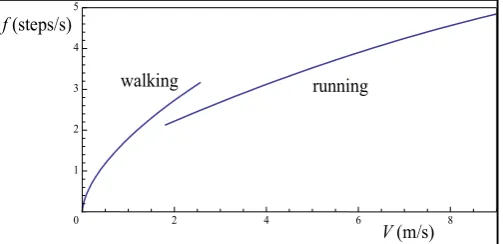
reduces speed sufficiently. The speed at which the RWT occurs is usually lower than that for the WRT, and this phenomenon is called "hysteresis"; e.g., see Diedrich and Warren (1998), Hreljac et al. (2007), Lamoth et al. (2009), Li (2000), Ranisavljev et al. (2014), and Turvey et al. (1999). Based on results in the literature, which contain quite a bit of variation, the WRT for a typical person tends to occur around V = 2.2 m/s (4.9 mph). According to some studies, e.g., De Smet et al. (2009), Diedrich and Warren (1998), Minetti et al. (1994), and Van Caekenberghe et al. (2010a), the WRT is accompanied by a sudden jump to a higher speed V and lower step frequency f. For example, in a study of 19 women reported in Van Caekenberghe et al. (2010a), mean values during the WRT were as follows: for running on a treadmill, V increased from 2.21 to 2.61 m/s while f decreased from 2.38 to 2.25 steps/s; for overground running, V increased from 2.34 to 2.85 m/s while f decreased from 2.41 to 2.22 steps/s.
Step frequency during running
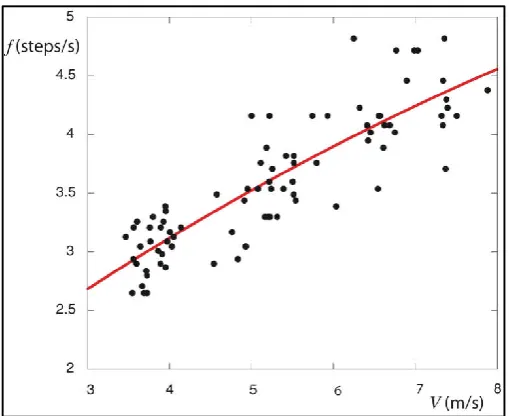
For the running range, curves depicting the relationship f(V) for men have been presented in Cavagna et al. (1991), Dillman (1975), Fukunaga et al. (1980), and Luhtanen and Komi (1978). Additional data are listed in Cavanagh and Kram (1989) and Nelson et al. (1972) for men, Elliott and Blanksby (1979) and Nelson et al. (1977) for men and women, and Teeple (1968) for women. The test results in Teeple (1968) for 28 women at three speeds each, ranging from V = 3.5 to 7.9 m/s, are presented in Fig. 1, along with a quadratic curve derived with the method of least squares. The curve is slightly concave downward, unlike the convex curves for men in Cavagna et al. (1991), Dillman (1975), Fukunaga et al. (1980), and Luhtanen and Komi (1978). Its formula is given by
f = 1.2 + 0.54V – 0.015 V2 (4)
[image:2.595.306.561.491.699.2]with f in steps/s and V in m/s. A quadratic that approximates the mean values in the literature for men is
Fig. 1. Step frequency as a function of running speed; data from Teeple (1968), and quadratic curve
Nelson et al. (1977) presented data for men and women in the range 4.8 m/s <V< 6.8 m/s. The mean frequencies for women were typically 0.14 steps/s higher than those for men. At a given running speed, women tend to have a smaller step length than men, and hence require a higher step frequency (Racic et al., 2009; Yamasaki et al., 1991). The 21 women tested in Nelson et al. (1977) were elite runners, and their step frequencies are close to the lowest data points in Fig. 1. In Elliott and Blanksby (1979), the mean data points for 10 non-competitive women runners at V= 2.5, 3.5, 4.5, and 5.5 m/s are, respectively, 9% higher, 1% lower, 6% lower, and 7% lower than the corresponding value given by Eq. (4). In Fig. 2, the curve given by Eq. (2) is plotted for 0 V 2.5 m/s, and the curve defined by Eq. (4) is plotted for 1.8 m/s V 9 m/s. The upper end point of the first curve is chosen to include most of the range of reported data for the WRT, and the lower end point of the second curve is below most of the data for the RWT.
Fig. 2. Step frequency as a function of walking speed from Eq. (2) and running speed from Eq. (4)
Vertical and lateral head deflections
Deflections at the center of the back of the head are considered. At that location, the total horizontal (lateral) excursion in the coronal plane will be denoted 2A, and the total vertical excursion will be 2B. Data and plots have been reported in a number of papers. The walking range will be considered first. Murray et al. (1970) tested 30 women walking at a comfortable speed (free walking) and also as fast as possible (fast walking). For free and fast walking, respectively, the mean values of 2A were about 3.6 and 3.0 cm, and for 2B they were about 4.4 and 5 cm. For five male subjects, Waters et al. (1973) reported values of 2A as 5.0 and 5.4 cm for V = 1.22 and 1.62 m/s, respectively, and values of 2B as 2.6, 4.0, and 4.8 cm at V = 0.81, 1.22, and 1.62 m/s, respectively. Cappozzo (1981) tested five men. For slow walking, 2A was about 6 cm and 2B was about 5 cm. As V increased, 2A decreased slightly and 2B increased slightly. For seven women, Murray et al. (1984) gathered data at V = 0.83, 1.42, and 1.92 m/s, and respectively found 2A to be about 4.2, 3.2, and 2.7 cm, and 2B to be about 2.8, 4.1, and 5.4 cm. For one subject, Hirasaki et al. (1999) obtained values of 2B approximately equal to 3, 5, and 8 cm, respectively, at V = 0.8, 1.4, and 2.0 m/s. Therefore, as the walking speed increases, all of these investigations except Waters et al. (1973) concluded that the lateral amplitude of the head decreases, and all found that the vertical amplitude of the head increases.
For running, Cavanagh et al. (1977) tested 22 men, of whom 14 were categorized as elite runners and eight as good runners. For V from 4.96 to 6.44 m/s, mean values of 7.6 and 8.0 cm were reported for the elite and good runners, respectively, for the vertical excursion of the center of gravity. Luhtanen and Komi (1978) tested six men at 40, 60, 80, and 100% of their maximum running speeds, and found mean values for the vertical excursion of the center of gravity to be 10.9, 8.6, 7.0, and 6.7 cm, respectively. Finally, nine men and one woman were tested by Pozzo et al. (1990), and 2B ranged from 7 cm to 16 cm. Functions are proposed here for A and B in terms of step frequency f. They are based on the results in the literature, with the characteristics that with increasing f, A should decrease and B should increase in the walking range, and both A and B could be expected to decrease slightly during running. The assumed functions are fourth-order polynomials given by
A = 3 + 0.03f – 0.65f2 + 0.206f3 – 0.0186f4 (6)
B = 0.063 – 0.0217f + 1.08f2 – 0.365f3 + 0.033f4 (7)
[image:3.595.309.558.313.470.2]with f in steps/s and A and B in cm.
Fig. 3. Amplitudes A of lateral head motion from Eq. (6) and B of vertical head motion from Eq. (7) as functions of step frequency
These functions are plotted in Fig. 3 for 0 f 5. The frequency f = 2.9 steps/s corresponds to the assumed walk-to-run transition speed of V = 2.2 m/s in Eq. (2), and the end value f = 5 steps/s corresponds to V = 9.6 m/s using Eq. (4). The functions are not necessarily accurate for very small values of f, but the effect of this in applications may be unimportant since head motions are small for very low walking speeds. Trajectories of the center of mass (CoM) of a human during walking are depicted in Tesio et al. (2010, 2011). The projection of the trajectory onto the coronal plane is shown in Tesio et al. (2010) and is a Lissajous figure. Similar figures are presented in Inman et al. (1981, 2006) and Orendurff et al. (1976) and for the CoM, in Gard et al. (1996) and Lamoreux (1971) for the pelvis, and in Cappozzo (1981) for the head, shoulders, and pelvis. Based on those studies, deflections of the head in the coronal plane are proposed here. Let and T denote time (in seconds), X(T) the horizontal (lateral) motion
(in cm), positive if to the right when viewing the back of the head and Y(T) the vertical motion (in cm), positive if downward, and the angular frequency for steps (in rad/s). The functions X(T) and Y(T) are chosen to be (Gard et al., 1996)
2 4 6 8
1 2 3 4 5
0
V (m/s) f (steps/s)
walking running
0 1 2 3 4 5
0.5 1.0 1.5 2.0 2.5 3.0
f (steps/s)
A, B (cm)
A
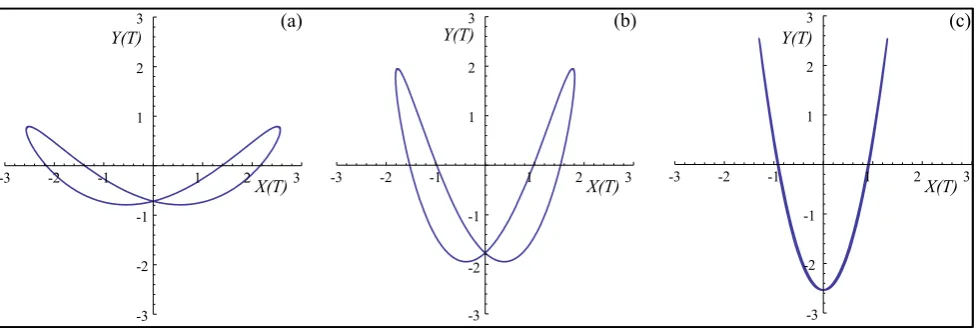
X(T) = A sin(T + ) , Y(T) = –B sin(2T) wheref.(8)
The amplitudes A and B are given by Eqs. (6) and (7), respectively. The phase is chosen to have the value 1 for f
2.9 and 0.8 for f> 2.9. The vibration frequency for vertical motion (i.e., for steps) is twice that for lateral motion.
The associated Lissajous figures are depicted in Figs. 4(a), (b), and (c) for f = 1, 2, and 3 steps/s, respectively. For walking (f< 2.9 steps/s), the shapes "resemble a slightly distorted lazy 8" (Inman et al., 1981, 2006). They become taller and thinner as the walking speed increases. For running (f> 2.9 steps/s), the shape is like a U, as seen in Fig. 4(c).
Fore-aft motion
During each step of steady-state walking or running, the forward speed varies with time. This variation has been neglected above, where only the average speed V was involved. However, it is included now in modeling fore-aft head motion. The forward speed is maximum close to the toe-off time when a foot leaves the ground (Herman et al., 1976). At that time, the vertical displacement of the head is almost at its minimum value (Cappozzo, 1991; Whittle, 2007).
In the fore-aft direction, it is proposed that the dynamic speed Vdyn(T) of the head may be represented as
Vdyn(T) = V – 0.08 sin(2fT) (9)
in m/s, where V is the average speed as used previously. This choice is based on head velocities and/or accelerations reported in Cappozzo (1984,1991), Herman et al. (1976), Kavanagh et al. (2004), Mazza et al. (2008,2009), Menz et al. (2003), Waters et al. (1973), and Williams (1985). Most of the information in those studies applies to the walking range. It is noted in Cappozzo (1991) and Waters et al. (1973) that head accelerations in the fore-aft direction are much smaller than those at the pelvis and at the center of gravity of the body.
Forward motion of the head is obtained by integrating Eq. (9) with respect to time T.
Equations (2)-(5) can be used with V replaced by Vdyn, and Eqs.
(6) and (7) are also applicable.
Conclusion
The deflections of a person's head during walking and running have been investigated. The head oscillates vertically and laterally, and also in the fore-aft direction about the average speed. Measured data in the literature demonstrate a large amount of variability in these head motions. Relationships between a healthy adult woman's and man's average speed of progression and the frequency of steps were proposed for the walking and running ranges, with discontinuities at the walk-to-run and run-to-walk transitions. Also, formulas for the vertical, lateral, and fore-aft deflections of the head as a function of step frequency were proposed. These formulas may be useful in various types of investigations involving human locomotion, and in applications such as energy harvesting.
REFERENCES
Alexander, R.M. 2002. Energetics and optimization of human walking and running: The 2000 Raymond Pearl Memorial Lecture. American Journal of Human Biology, 14: 641-648.
Bertram, J.E.A. and Ruina, A. 2001. Multiple walking speed-frequency relations are predicted by constrained optimization. Journal of Theoretical Biology, 209:445-453. Beuter, A. and Lalonde, F. 1988. Analysis of a phase transition in human locomotion using singularity theory. Neuroscience Research Communications, 3: 127-132. Bollens, B., Crevecoeur, F., Detrembleur, C., Guillery, E. and
Lejeune, T. 2012. Effects of age and walking speed on long-range autocorrelations and fluctuation magnitude of stride duration. Neuroscience, 210: 234-242.
Cappozzo, A. 1981. Analysis of the linear displacement of the head and trunk during walking at different speeds. Journal of Biomechanics, 14: 411-425.
Cappozzo, A. 1984. Gait analysis methodology. Human Movement Science, 3: 27-50.
[image:4.595.57.547.55.219.2]Cappozzo, A. 1991. The mechanics of human walking. In: Patla AE (ed) Adaptability of Human Gait: Implications for the Control of Locomotion. Amsterdam: North-Holland, pp. 167-186.
Fig. 4. Lissajous figures for projection of head motion in coronal plane for (a) f = 1 step/s, (b) f = 2 steps/s, and (c) f = 3 steps/s
-3 -2 -1 1 2 3
-3 -2 -1 1 2 3
-3 -2 -1 1 2 3
-3 -2 -1 1 2 3
-3 -2 -1 1 2 3
-3 -2 -1 1 2 3
(a) (b) (c)
X(T) X(T) X(T)
Cavagna, G.A., Willems, P.A., Franzetti, P. and Detrembleur, C. 1991. The two power limits conditioning step frequency in human running. Journal of Physiology, 437: 95-108. Cavanagh, P.R., Pollock, M.L. and Landa, J. 1977. A
biomechanical comparison of elite and good distance runners. In: Milvy P (ed) The Marathon: Physiological, Medical, Epidemiological, and Psychological Studies. New York: New York Academy of Sciences, pp. 328-345. Cavanagh, P.R. and Kram, R. 1989. Stride length in distance
running: Velocity, body dimensions, and added mass effects. Medicine and Science in Sports and Exercise, 21: 467-479.
Chao, E.Y., Laughman, R.K., Schneider, E. and Stauffer, R.N. 1983. Normative data of knee joint motion and ground reaction forces in adult level walking. Journal of Biomechanics, 16:219-233.
De Smet, K., Segers, V., Lenoir, M. and De Clercq, D. 2009. Spatiotemporal characteristics of spontaneous overground walk-to-run transition. Gait & Posture, 29: 54-58.
Dean, G.A. 1965. An analysis of the energy expenditure in level and grade walking. Ergonomics, 8: 31-47.
Dicharry, J. 2010. Kinematics and kinetics of gait: From lab to clinic. Clinics in Sports Medicine, 29: 347-364.
Diedrich, F.J. and Warren, Jr., W.H. 1998. Dynamics of human gait transitions. In: Rosenbaum DA, Collyer CE (eds), Timing of Behavior: Neural, Psychological, and Computational Perspectives. Cambridge, MA: MIT Press, pp. 323-343.
Dillman, C.J. 1975. Kinematic analyses of running. In: Wilmore JH, Keogh JF (eds) Exercise and Sport Sciences Reviews, Vol. 3. New York: Academic Press, pp. 193-218. Dingwell, J.B., John, J. and Cusumano, J.P. 2010. Do humans
optimally exploit redundancy to control step variability in walking? PLoS Computational Biology, 6: e1000856. Dingwell, J.B. and Cusumano, J.P. 2010. Re-interpreting
detrended fluctuation analyses of stride-to-stride variability in human walking. Gait & Posture, 32: 348-353.
Dugan, S.A. and Bhat, K.P. 2005. Biomechanics and analysis of running gait. Physical Medicine and Rehabilitation Clinics of North America, 16: 603-621.
Elliott, B.C. and Blanksby, B.A. 1979. Optimal stride length considerations for male and female recreational runners. British Journal of Sports Medicine, 13: 15-18.
Fukunaga, T., Matsuo, A., Yuasa, K., Fujimatsu, H. and Asahina, K. 1980. Effect of running velocity on external mechanical power output. Ergonomics, 23: 123-136. Gard, S.A., Knox, E.H. and Childress, D.S. 1996.
Two-dimensional representation of three-Two-dimensional pelvic motion during human walking: An example of how projections can be misleading. Journal of Biomechanics, 29: 1387-1391.
Goll, E., Zenner, H.P. and Dalhoff, E. 2011. Upper bounds for energy harvesting in the region of the human head. IEEE Transactions on Biomedical Engineering, 58:3097-3103. Grieve, D.W. 1968. Gait patterns and the speed of walking.
Bio-Medical Engineering, 3: 119-122.
Grieve, D.W. and Gear, R.J. 1966. The relationships between length of stride, step frequency, time of swing and speed of walking for children and adults. Ergonomics, 9: 379-399. Herman, R., Wirta, R., Bampton, S. and Finley, F.R. 1976.
Human solutions for locomotion. In: Herman RM, Grillner
S, Stern SPSG, Stuart DG (eds), Neural Control of Locomotion. New York: Plenum Press, pp. 13-49.
Hirasaki, E., Moore, S.T., Raphan, T. and Cohen, B. 1999. Effects of walking velocity on vertical head body movements during locomotion. Experimental Brain Research, 127: 117-130.
Hirokawa, S. 1989. Normal gait characteristics under temporal and distance constraints. Journal of Biomedical Engineering, 11: 449-456.
Hreljac, A. 1993. Preferred and energetically optimal gait transition speeds in human locomotion. Medicine and Science in Sports and Exercise, 25: 1158-1162.
Hreljac, A., Imamura, R., Escamilla, R.F. and Edwards, W.B. 2007. Effects of changing protocol, grade, and direction on the preferred gait transition speed during human locomotion. Gait & Posture, 25: 419-424.
Inman, V.T., Ralston, H.J. and Todd, F. 1981. Human Walking. Baltimore: Williams and Wilkins.
Inman, V.T., Ralston, H.J. and Todd, F. 2006. Human locomotion. In: Rose J., Gamble JG (eds), Human Walking, 3rd ed. Philadelphia: Lippincott Williams and Wilkins, pp. 1-18.
Kao, J.C. and Ringenbach, S.D.R. 2004. Variability in head movement during gait transitions. Perceptual and Motor Skills, 99, 1217-1229.
Kavanagh, J.J., Barrett, R.S. and Morrison, S. 2004. Upper body accelerations during walking in healthy young and elderly men. Gait & Posture, 20: 291-298.
Kirtley, C. 2006. Clinical Gait Analysis: Theory and Practice. Edinburgh: Elsevier.
Labini, F.S., Ivanenko, Y.P., Cappellini, G., Gravano, S. and Lacquaniti, F. 2011. Smooth changes in the EMG patterns during gait transitions under body weight unloading. Journal of Neurophysiology, 106: 1525-1536.
Lamoreux, L.W. 1971. Kinematic measurements in the study of human walking. Bulletin of Prosthetics Research, 10: 3-84.
Lamoth, C.J.C., Daffertshofer, A., Huys, R. and Beek, P.J. 2009. Steady and transient coordination structures of walking and running. Human Movement Science, 28: 371-386.
Li, L. 2000. Stability landscapes of walking and running near gait transition speed. Journal of Applied Biomechanics, 16: 428-435.
Luhtanen, P. and Komi, P.V. 1978. Mechanical factors influencing running speed. In: Asmusen E, Krgensen (eds), Biomechanics VI-B. Baltimore: University Park Press, pp. 23-29.
Macellari, V., Giacomozzi, C. and Saggini, R. 1999. Spatial-temporal parameters of gait: Reference data and a statistical method for normality assessment. Gait & Posture, 10: 171-181.
Mazza, C., Iosa, M., Pecoraro, F. and Cappozzo, A. 2008. Control of the upper body accelerations in young and elderly women during level walking. Journal of Neuro- Engineering and Rehabilitation, 5: 10 pp.
Menz, H.B., Lord, S.R. and Fitzpatrick, R.C. 2003. Acceleration patterns of the head and pelvis when walking on level and irregular surfaces. Gait & Posture, 18: 35-46. Minetti, A.E., Ardigo, L.P. and Saibene, F. 1994. The
transition between walking and running in humans: Metabolic and mechanical aspects at different gradients. Acta Physiologica Scandinavica, 150: 315–323.
Murray, M.P., Kory, R.C. and Sepic, S.B. 1970. Walking patterns of normal women. Archives of Physical Medicine and Rehabilitation, 51: 637-650.
Murray, M.P., Mollinger, L.A., Gardner, G.M. and Sepic, S.B. 1984. Kinematic and EMG patterns during slow, free, and fast walking. Journal of Orthopaedic Research, 2: 272-280. Murray, M.P., Spurr, G.B., Sepic, S.B., Gardner, G.M. and Mollinger, L.A. 1985. Treadmill vs. floor walking: Kinematics, electromyogram, and heart rate. Journal of Applied Physiology, 59: 87-91.
Nelson, R.C., Brooks, C.M. and Pike, N.L. 1977. Biomechanical comparison of male and female distance runners. Annals of the New York Academy of Sciences, 301: 793-807.
Nelson, R.C., Dillman, C.J., Lagasse, P. and Bickett, P. 1972. Biomechanics of overground versus treadmill running. Medicine and Science in Sports, 4: 233-240.
Novacheck, T.F. 1998. The biomechanics of running. Gait & Posture, 7: 77-95.
Orendurff, M.S., Segal, A.D., Klute, G.K., Berge, J.S., Rohr, E.S. and Kadel, N.J. 1976. The effect of walking speed on center of mass displacement. Journal of Rehabilitation Research and Development, 41: 829-834.
Perry, J. and Burnfield, J.M. 2010. Gait Analysis: Normal and Pathological Function (2nd ed.). Thorofare, NJ: Slack Inc. Pozzo, T., Berthoz, A. and Lefort, L. 1990. Head stabilization
during various locomotor tasks in humans: I. Normal subjects. Experimental Brain Research, 82: 97-106. Racic, V., Pavic, A. and Brownjohn, J.M.W. 2009.
Experimental identification and analytical modelling of human walking forces: Literature review. Journal of Sound and Vibration, 326: 1-49.
Ranisavljev, I., Ilic, V., Markovic, S., Soldatovic, I., Stefanovic, D. and Jaric, S. 2014. The relationship between hip, knee and ankle muscle mechanical characteristics and gait transition speed. Human Movement Science, 38:47-57. Rose, J.and Gamble, J.G. 2006. Human Walking. Philadelphia:
Lippincott Williams and Wilkins.
Rosenrot, P., Wall, J.C. and Charteris, J. 1980. The relationship between velocity, stride time, support time and swing time during normal walking. Journal of Human Movement Studies, 6: 323-335.
Segers, V., Lenoir, M., Aerts, P. and De Clercq, D. 2007. Kinematics of the transition between walking and running when gradually changing speed. Gait & Posture, 26: 349-361.
Sentija, D., Rakovac, M. and Babic, V. 2012. Anthropometric characteristics and gait transition speed in human locomotion. Human Movement Science, 31: 672-682. Staszkiewicz, R., Ruchlewicz, T., Forczek, W. and Laska, J.
2010. The impact of changes in gait speed and step frequency on the extent of the center of mass displacements. Acta of Bioengineering and Biomechanics, 12: 13-20.
Surendar, S.P. and Venguidaragavane, R.S. 2013. Gait kinematics - a review. International Journal of Current Research, 5: 1142-1146.
Teeple, J.B. 1968. A Biomechanical Analysis of Running Patterns of College Women. M.S. Thesis, Pennsylvania State University.
Terrier, P., Turner, V. and Schutz, Y. 2005. GPS analysis of human locomotion: Further evidence for long-range correlations in stride-to-stride fluctuations of gait parameters. Human Movement Science, 24: 97-115. Tesio, L., Rota, V., Chessa, C. and Perucca, L. 2010. The 3D
path of the body centre of mass during adult human walking on force treadmill. Journal of Biomechanics, 43: 938-944.
Tesio, L., Rota, V. and Perucca, L. 2011. The 3D trajectory of the body centre of mass during adult human walking: Evidence for a speed-curvature power law. Journal of Biomechanics, 44: 732-740.
Thorstensson, A. and Roberthson, H. 1987. Adaptations to changing speed in human locomotion: Speed of transition between walking and running. Acta Physiologica Scandinavica, 131: 211–214.
Turvey, M.T., Holt, K.G., LaFlandra, M.E. and Fonseca, S.T. 1999. Can the transitions to and from running and the metabolic cost of running be determined from the kinetic energy of running? Journal of Motor Behavior, 31: 265-278.
Van Caekenberghe, I., De Smet, K., Segers, V. and De Clercq, D. 2010a. Overground vs. treadmill walk-to-run transition. Gait & Posture, 31: 420-428.
Van Caekenberghe, I., Segers, V., De Smet, K., Aerts, P. and De Clercq, D. 2010b. Influence of treadmill acceleration on actual walk-to-run transition. Gait & Posture, 31: 52-56. Vaughan, C.L. 1984. Biomechanics of running gait. CRC
Critical Reviews in Biomedical Engineering, 12: 1-48. Waters, R.L., Lunsford, B.R., Perry, J. and Byrd, R. 1988.
Energy-speed relationship of walking: Standard tables. Journal of Orthopaedic Research, 6: 215-222.
Waters, R.L., Morris, J. and Perry, J. 1973. Translational motion of the head and trunk during normal walking. Journal of Biomechanics, 6: 167-172.
Whittle, M.W. 2007. Gait Analysis: An Introduction (4th ed.). Oxford: Butterworth-Heinemann.
Williams, K.R. 1985. Biomechanics of running. Exercise and Sport Sciences Reviews, 13: 389-442.
Winter, D.A. 1991. The Biomechanics and Motor Control of Human Gait: Normal, Elderly and Pathological (2nd ed.). Waterloo, Ontario: University of Waterloo Press.
Winter, D.A. 2009. Biomechanics and Motor Control of Human Movement (4th ed.). New York: Wiley.
Yam, C.Y., Nixon, M.S. and Carter, J.N. 2004. Automated person recognition by walking and running via model-based approaches. Pattern Recognition, 37: 1057-1072. Yamasaki, M., Sasaki, T. and Torii, M. 1991. Sex difference in
the pattern of lower limb movement during treadmill walking. European Journal of Applied Physiology, 62: 99-103.
Zanetti, C. and Schieppatti, M. 2007. Quiet stance control is affected by prior treadmill but not overground locomotion. European Journal of Applied Physiology, 100: 331-339.