UV-VISIBLE SPECTROPHOTOMETRIC METHOD
ITRACONAZOLE IN BULK AND CAPSULE FORMULATION
*
Poonam A. Salunke, Kamlesh Ingale, Pooj
Shital
Shree Sureshdada Jain Institute of Pharmaceutical Education and Research, Jamner, (M.S.) India
ARTICLE INFO ABSTRACT
A simple, rapid, accurate and precise UV method was developed and validated for the estimation of Itraconazole in pharmaceutical dosage form. Spectroscopic method was carried out by using acidic ethanol as solvent. Itraconazole detection wavelength was set at 262nm for validation purpose linearity, accuracy, repeatability, precision, LOD, LOQ, and rugg
linearity was found to be in the range of 2
Copyright©2017, Poonam A. Salunke et al. This is an open access
unrestricted use, distribution, and reproduction in any medium, provided the original work is properly cited.
INTRODUCTION
UV spectroscopy involves the promotion of electrons from the ground state to higher energy state. It is very useful to measure the number of conjugated double bonds and also aromatic conjugation within the various molecules. For visible and ultra-violet spectrum, electronic excitation occurs in the range 200-800 nm and involve the promotion of electrons to the higher energy molecule orbital. A record of the amount of light absorbed by sample as a function of the wavelength of light in nm units is called absorption spectrum which is generally consist of absorption bonds. UV spectroscopy is based on absorption law in which absorption of light by the molecules. These are
1.Lambert’s law 2.Beer’s law
1.Lambert’s law: “When a beam of monochromatic radiation passes through a homogeneous absorbing medium, the rate of decrease of intensity of radiation with thickness of absorbing medium is proportion to the incident radiation.” Mathematically, law is expressed as ; − =
*Corresponding author: Poonam A. Salunke,
Shree Sureshdada Jain Institute of Pharmaceutical Education and Research, Jamner, (M.S.) India.
ISSN: 0975-833X
Article History:
Received 18th October, 2016
Received in revised form
09th November, 2016
Accepted 15th December, 2016
Published online 31st January,2017
Citation: Poonam A. Salunke, Kamlesh Ingale, Pooja
Spectrophotometric method development and validation of Itraconazole in bulk and capsule formulation 45435-45439.
Key words:
Itraconazole, Analytical Validation,
UV-Spectroscopy,Antifungal agent.
RESEARCH ARTICLE
VISIBLE SPECTROPHOTOMETRIC METHOD DEVELOPMENT AND VALIDATION OF
ITRACONAZOLE IN BULK AND CAPSULE FORMULATION
Poonam A. Salunke, Kamlesh Ingale, Pooja Gondhankhede, Kanchan Ghate,
Shital S. Patil and Dr. S. D. Barhate
Shree Sureshdada Jain Institute of Pharmaceutical Education and Research, Jamner, (M.S.) India
ABSTRACT
A simple, rapid, accurate and precise UV method was developed and validated for the estimation of Itraconazole in pharmaceutical dosage form. Spectroscopic method was carried out by using acidic ethanol as solvent. Itraconazole detection wavelength was set at 262nm for validation purpose linearity, accuracy, repeatability, precision, LOD, LOQ, and ruggedness parameters were studied. The linearity was found to be in the range of 2-12 µg/ml.
is an open access article distributed under the Creative Commons Att use, distribution, and reproduction in any medium, provided the original work is properly cited.
UV spectroscopy involves the promotion of electrons from the ground state to higher energy state. It is very useful to measure the number of conjugated double bonds and also aromatic conjugation within the various molecules. For visible and ectrum, electronic excitation occurs in the range 800 nm and involve the promotion of electrons to the higher energy molecule orbital. A record of the amount of light absorbed by sample as a function of the wavelength of light in orption spectrum which is generally consist of absorption bonds. UV spectroscopy is based on absorption law in which absorption of light by the molecules.
“When a beam of monochromatic radiation passes through a homogeneous absorbing medium, the rate of decrease of intensity of radiation with thickness of absorbing medium is proportion to the incident radiation.”
=
Shree Sureshdada Jain Institute of Pharmaceutical Education and Research,
2.Beer’s law: “When a beam of monochromatic radiation is passed through a solution of an absorbing substance, the rate of decrease of intensity of radiation with thickness of absorbing solution is proportion to the intensity of incident radiation as well as the concentration of solution.”
Mathematically, law is expressed as;
Validation: Validation yields a developed process, the product of which should do what the user expects it to do. It is nothing but reproducibility of result validation according to various agencies is spelled as ; As per FDA.
the collection and evaluation of data from the process design stage throughout production, in which establishes scientific evidence that a process is capable of consistently delivering quality product.” As per WHO
providing that any procedure, pro
system actually leads to the expected result.
Analytical Validation: Validation of analytical method may
be defined as “The process by which it is established, by laboratory studies, that the performance characteristics of the method meet the requirement for the intended analytical application”. One of the triazole antifungal agent that inhibit cytochrome P-450 dependent enzyme resulting in impairment of ergosterol synthesis. It has been used against histoplasmosis,
International Journal of Current Research
Vol. 9, Issue, 01, pp.45435-45439, January, 2017
INTERNATIONAL
OF CURRENT RESEARCH
Poonam A. Salunke, Kamlesh Ingale, Pooja Gondhankhede, Kanchan Ghate, Shital S. Patil and Dr. S. D. Barhate
Spectrophotometric method development and validation of Itraconazole in bulk and capsule formulation”, International Journal of Current Research
DEVELOPMENT AND VALIDATION OF
ITRACONAZOLE IN BULK AND CAPSULE FORMULATION
Gondhankhede, Kanchan Ghate,
Shree Sureshdada Jain Institute of Pharmaceutical Education and Research, Jamner, (M.S.) India
A simple, rapid, accurate and precise UV method was developed and validated for the estimation of Itraconazole in pharmaceutical dosage form. Spectroscopic method was carried out by using acidic ethanol as solvent. Itraconazole detection wavelength was set at 262nm for validation purpose edness parameters were studied. The
article distributed under the Creative Commons Attribution License, which permits
“When a beam of monochromatic radiation is passed through a solution of an absorbing substance, the rate of decrease of intensity of radiation with thickness of absorbing solution is proportion to the intensity of incident radiation as
ration of solution.”
Mathematically, law is expressed as; − = ′
Validation yields a developed process, the product of which should do what the user expects it to do. It is nothing but reproducibility of result validation according to various agencies is spelled as ; As per FDA. “Validation is defined as and evaluation of data from the process design stage throughout production, in which establishes scientific evidence that a process is capable of consistently delivering As per WHO – The documented act of providing that any procedure, process, equipment, activity or system actually leads to the expected result.
Validation of analytical method may be defined as “The process by which it is established, by laboratory studies, that the performance characteristics of the method meet the requirement for the intended analytical One of the triazole antifungal agent that inhibit 450 dependent enzyme resulting in impairment of ergosterol synthesis. It has been used against histoplasmosis,
INTERNATIONAL JOURNAL OF CURRENT RESEARCH
Gondhankhede, Kanchan Ghate, Shital S. Patil and Dr. S. D. Barhate, 2017. “UV-Visible
blastomycosis, cryptococcal meningitis and aspergillosis. Itraconazole is a synthetic triazole antifungal agent. Itraconazole is a 1:1:1:1 racemic mixture of four diastereomers (two enantiomeric pairs), each possessing three chiral centers. It may be represented by the following nomenclature: 4-(4-(4-(4-((2-(2, 4-dichlorophenyl)- 2- (1H- 1, 2, 4- triazol- 1-ylmethyl)- 1,3- dioxolan- 4- yl) methoxy)phenyl) piperazin-1- yl)phenyl)-2-(1-methylpropyl)-2, 4-dihydro-1, 2, 4-triazol- 3-one (Fig 1). It has a molecular formula is C35H38Cl2N8O4 and a molecular weight is 705.64. (Manohar A.potdar et al., 2013; Ramesh sawant and SandipHapse, 2011; Supriya S. Mahajan, 2010; Mahajan, 2006) It is a white to slightly yellowish powder. It is very slightly soluble in alcohols, and freely soluble in dichloromethane. Itraconazole is highly lipophilic in nature and practically insoluble in water. It is an extremely weak base (pKa =3.7) that is ionized only at very low pH. It is a hydrophobic anti mycotic drug with three chiral centers and is used clinically as a stereo isomeric mixture. (Mehdham et al., 2007) It is an orally active triazole antifungal agent, which demonstrates broad spectrum activity against a number of fungal species including dermatophytes, Malassesia further, Candida species, Aspergillus species, and Histoplasma capsulatum var. capsulatum. (KoteswaraRao et al., 2014; Trinadha Rao et al., 2015) The mechanism of action of itraconazole is it interacts with 14-α demethylase, a cytochrome P-450 enzyme necessary to convert lanosterol to ergosterol. As ergosterol is an essential component of the fungal cell membrane, inhibition of its synthesis results in increased cellular permeability causing leakage of cellular contents. Itraconazole may also inhibit endogenous respiration, interact with membrane phospholipids, inhibit the transformation of yeasts to mycelial forms, inhibit purine uptake, and impair triglyceride and/or phospholipid biosynthesis. Itraconazole is metabolized predominately by the cytochrome P450 3A4 isoenzyme system (CYP3A4) in the liver, resulting in the formation of several metabolites, including hydroxyl itraconazole, the major metabolite. (ShalinK.Parikh et al., 2011) Its oral bioavailability was found to increase when taken with food, with plasma concentration approximately two times that taken in the fasting state. (PrasunaSundari et al., 2013) It is extensively metabolized in the liver, mainly via an oxidative pathway, into the bioactive metabolite hydroxyl itraconazole. (Garg et al., 2013) Itraconazole was formulated into several pharmaceutical forms through various routes of administration. Itraconazole capsules are used to treat fungal infections in the lungs that can spread throughout the body. Used to treat fungal infections of the fingernails. Tablets and capsules are used to treat fungal infections of the toenails. Itraconazole oral solution (liquid) is used to treat yeast infections of the mouth and throat or of the esophagus (tube that connects the throat to the stomach) (Thangabalan et al., 2013) Several HPLC (Kumudhavalli et al., 2011), and LC/MS-MS (Savant, 2008; ICH harmonised triparatite guideline, 1994; Mehdham et al., 2007) methods have been reported for the analysis of Itraconazole in plasma that suffer from either undesirably
Need and objective of work
1. To develop and validate analytical method of Itraconazole capsule.
2. The development and validation of simple, accurate and precise analytical method of Itraconazole in bulk drug and in pharmaceutical dosage forms by UV-Visible spectrophotometric method.
MATERIALS AND METHODS
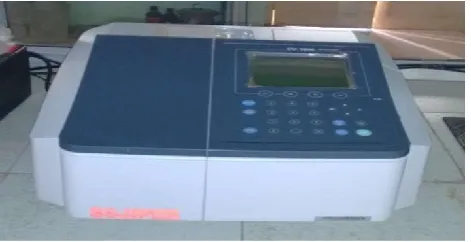
[image:2.595.319.555.263.384.2]Itraconazole bulk drug and capsule (CANDIFORCE 100) purchased from market, Hydrochloric acid and ethanol obtained from college. UV spectrophotometric method was performed on double beam UV-visible spectrophotometer (Shimadzu, model 1600) having two matched quartz cells with 1 cm light path.
Figure 2. Instrument: UV-Visible spectrophotometer
Methodology
Selection of solvent
Acidic ethanol was selected as ideal solvent for spectrophotometric analysis of Itraconazole.
Preparation of standard stock solution (1000μg/ml)
Accurately weighed 100 mg Itraconazole was volumetric flask and dissolved and diluted up to the mark with 0.1N acidic ethanol to give a stock solution having strength 1000μg/ml. 100 μg/ml working standard solution was prepared by diluting 1 ml of stock solution to 10 ml with 0.1N acidic ethanol.
Preparation of (100μg/ml)
To measure the Itraconazole content of capsule (label claim100 mg Itraconazole per capsule, Itaspor capsules), twenty capsules were weighed, the mean weight was determined. A weight of the powder equivalent to100 mg Itraconazole was transferred to a 100 ml volumetric flask containing 50 ml 0.1N acidic ethanol and the mixture was sonicated for 30 min then diluted to 100 ml with0.1N acidic ethanol (1000 μg/ml). The solution was filtered and 1 ml of filtered solution was diluted tenfold to furnish a concentration of 100μg/ml.
Validation of UV spectrophotometric method
Determination of wavelength
solution was scanned in UV spectrometer under the range of 200-400nm. The absorbance maximum was found at wavelength about 262nm.
Figure 3. UV Spectra of Itraconazole
Linearity and range
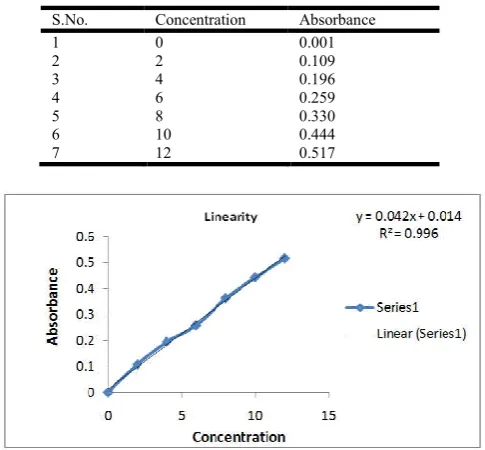
[image:3.595.40.289.102.243.2]The linearity was determined by analyzing 6 independent levels of calibration curve in the range of 2-12μg/ml. Absorbance of each solution against methanol was recorded at curve of absorbance vs. concentration was plotted and correlation co-efficient and regression line equation for Itraconazole were determined.
Table 1. Linearity
S.No. Concentration Absorbance
1 0 0.001
2 2 0.109
3 4 0.196
4 6 0.259
5 8 0.330
6 10 0.444
7 12 0.517
Figure 4. Linearity curve of Itraconazole
Accuracy: Accuracy was determined by performing recovery studies by spiking different concentrations of pure drug in the pre-analyzed powder for infusion samples within the analytical concentration range of the proposed method at three different set at level of 80%, 100% and 120%. The amount of Itraconazole was calculated at each level and % Recoveries were computed.
Precision
Intra-day precision was determined by analyzing Itraconazole (2-6μg/ml) at three different time points of the same day and
determined by analyzing Itraconazole (2-6μg/ml) at three different time points on different days and %RSD was calculated.
Table 2. Accuracy 1
80%
S.No. Conc. Amount added Abs. Amount found Recovered Amount Recovered %
1 6 4.8 0.207 4.60 4.82 100.36
2 6 4.8 0.205 4.55 4.77 99.37
3 6 4.8 0.206 4.57 4.79 99.87
Mean 4.57 4.79 99.87
SD 0.02 0.02 0.50
%RSD 0.52 0.50 0.50
Table 3. Accuracy 2
100%
S.No. Conc. Amount added Abs. Amount found Recovered Amount Recovered %
1 6 6 0.259 5.83 6.06 100.93
2 6 6 0.258 5.81 6.03 100.53
3 6 6 0.258 5.81 6.03 100.53
Mean 5.82 6.04 100.66
SD 0.01 0.01 0.23
%RSD 0.24 0.23 0.23
Table 4. Accuracy 3
120%
S.No. Conc. Amount
added Abs.
Amount found
Amount Recovered
% Recovered
1 6 7.2 0.31 7.05 7.27 100.97
2 6 7.2 0.309 7.02 7.25 100.64
3 6 7.2 0.314 7.14 7.37 102.29
Mean 7.07 7.29 101.30
SD 0.06 0.06 0.87
%RSD 0.89 0.86 0.86
Table 5. Intraday Precision
S. No. Conc. Abs. I II III MEAN SD %RSD
1 2 0.111 0.107 0.109 0.11 0.00 1.83
2 4 0.2 0.206 0.206 0.20 0.00 1.70
3 6 0.263 0.257 0.259 0.26 0.00 1.18
Table 6. Intraday Precision
S. No. Conc. Abs. I II III MEAN SD %RSD
1 2 0.101 0.1 0.102 0.10 0.00 0.99
2 4 0.133 0.13 0.131 0.13 0.00 1.16
3 6 0.163 0.157 0.159 0.16 0.00 1.91
Repeatability
[image:3.595.42.285.399.624.2]Repeatability was carried out by using a minimum of 6 determinations at one of the test concentration.
Table 6. Repeatability
S.No. Conc. Peak Area Amt Found %Amt Found
1 6 0.262 5.90 98.41
2 6 0.263 5.93 98.81
3 6 0.262 5.90 98.41
4 6 0.263 5.93 98.81
5 6 0.261 5.88 98.02
6 6 0.265 5.98 99.60
Mean 5.92 98.68
SD 0.03 0.54
[image:3.595.320.545.701.800.2]LOD AND LOQ
Detection limit was determined based on the standard deviation of the response & slope of calibration curve.
LOD= 3.3*σ/S and LOQ= 10*σ/S
Where,
σ = the standard deviation of y-intercepts of regression lines S = the slope of the calibration curve
Table 7. LOD AND LOQ
S.No. Conc. Area I II III Mean SD %RSD
1 2 0.109 0.105 0.108 0.11 0.00 1.94
2 4 0.198 0.199 0.192 0.20 0.00 1.93
3 6 0.269 0.279 0.271 0.27 0.01 1.94
4 8 0.375 0.388 0.387 0.38 0.01 1.89
5 10 0.444 0.432 0.428 0.43 0.01 1.92
6 12 0.517 0.498 0.509 0.51 0.01 1.88
Avrg SD 0.01
LOD = 3.3 * Avrg SD/ Slope 0.785
LOQ = 10 * Avrg SD / Slope 2.38
Ruggedness
[image:4.595.313.552.134.271.2]The evaluation of Ruggedness should be considered during the development phase and depends on the type of procedure under study. It should show the reliability of an analysis with respect to external factors in method parameters such as instrument, analyst variation.
Table 8.Ruggedness
ANALYST I ANALYST II
S. No. Conc. Area S. No. Conc. Area
1 6 0.258 1 6 0.256
2 6 0.256 2 6 0.262
3 6 0.265 3 6 0.253
4 6 0.256 4 6 0.256
5 6 0.258 5 6 0.258
6 6 0.262 6 6 0.256
Mean 0.26 Mean 0.26
SD 0.00 SD 0.00
%RSD 1.39 %RSD 1.17
Robustness
Robustness is determined by making small but deliberate variations in method parameters. The evaluation of robustness should be considered during the development phase and depends on the type of procedure under study. It should show the reliability of an analysis with respect to deliberate variations in method parameters such temperature.
[image:4.595.49.277.444.553.2]
Table 9. Robustness
S.
No. Temperature Conc. Absorbance Mean SD
% RSD
1 25 6 0.258
2 25 6 0.256 0.26 0.00 1.82
3 25 6 0.265
4 30 6 0.256
5 30 6 0.258 0.26 0.00 1.18
6 30 6 0.262
7 35 6 0.269
8 35 6 0.279 0.27 0.01 1.94
9 35 6 0.271
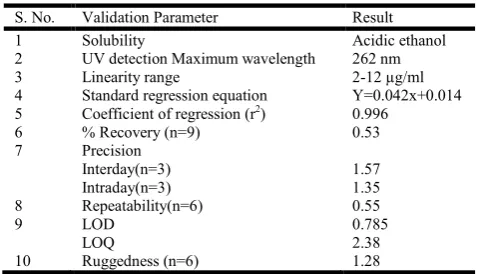
RESULTS DISCUSSION
The UV method has been developed for the estimation of Itraconazole in bulk & pharmaceutical dosage formulation.
Table 10. Result discussion
S. No. Validation Parameter Result
1 Solubility Acidic ethanol
2 UV detection Maximum wavelength 262 nm
3 Linearity range 2-12 µg/ml
4 Standard regression equation Y=0.042x+0.014
5 Coefficient of regression (r2) 0.996
6 % Recovery (n=9) 0.53
7 Precision
Interday(n=3) Intraday(n=3)
1.57 1.35
8 Repeatability(n=6) 0.55
9 LOD
LOQ
0.785 2.38
10 Ruggedness (n=6) 1.28
Conclusion
The developed method was simple, accurate, precise and economic in nature and can be used for analysis of marketed formulations.
REFERENCES
Dr. Supriya S. Mahajan 2010. “Instrumental method of analysis”, first edition, Published by Ramdas Bhatkal for popular prakashan, Mumbai, page no. 11,12,23,24,56-62. Garg, A.K., R.K.Sachdeva and G.Kapoor, et al. 2013.
“Comparison of crystalline and amorphous carriers to improve the dissolution profile of water insoluble drug Itraconazole” International Journal of Pharma and
Bio-Science, Jan; 4(1), page no. 934-948.
ICH harmonised triparatite guideline. “International conferences on harmonisation of technical requirement of pharmaceuticals for human use” validation of analytical procedure :Text and methodology Q2(R1) current step and version, 27 obc. 1994.
KoteswaraRao, M., K.V. Ramanjaneyulu, SK.Reehana, D.NarasimhaRao, D.L.SureshKumar, et al. 2014. “Methoddevelopment and validation of Itraconazole by UV-Spectrophotometer” World Journal of Pharmaceutical
Research, Volume 3, Oct. Issue 10, page no. 777-787.
Kumudhavalli, M.V. et al. 2011. “Isocratic RP-HPLC, UV-Method Development and validation of Itraconazole in capsule dosage form” International Journal of
Pharmaceutical Sciences and Research, Vol-2, Issue-12,
June, page no.3269-3271.
Mahajan B.K. 2006. “Method in Biostatistics for medical students and research worker”, sixth edition, reprint, Jaypee brothers medical publishers, New Delhi, page no.63-76. Manohar A.potdar, 2013. “Pharmaceutical quality assurance”,
third edition, oct. Niraliprakashan, Pune, page no.8.28-8.31.
Mehdham, J., R.C. Denney, J.D. Barnes, M.J.K. Thomas, 2007. “Vogels textbook of Quantitative chemical analysis”, sixth edition, Dorling Kindersley publication, Delhi, page no. 161-166.
Mehdham, J., R.C.Denney, J.D.Barnes, M.J.K. Thomas, 2007. “Vogels textbook of Quantitative chemical analysis”
[image:4.595.32.292.690.796.2]PrasunaSundari, P.J. and VijayaShanthi et al. 2013. “A Review:Analytical Methods for Determination of Itraconazole in Pharmaceutical and Biological samples”
International Journal of Chemical and Natural Science,
Volume 1, No.1, page no. 21-24 .
Ramesh Sawant and SandipHapse, 2011. “Fundamental of quality assurance techniques”, first edition, Dec. Career publication, Nashik, page no. 74-78.
Savant, D.A. 2008. “The pharmaceuticals sciences pharma pathway pure and Apllied pharmacy” 6th edition, Oct-2008, pragti book publication, Pune, Page no.2.23-2.33.
Shalin K.Parikh, Ankit D.Patel, Dr.J.B.Dave, Dr.C.N.Patel and Dr.D.J.Sen, et al. 2011. “Development and Validation of UV Spectrophotometric method for estimation of
Itraconazole bulk drug and pharmaceutical formulation” International Journal of Drug Development and Research, April-June, Volume 3, Issue 2, ISSN 0975-9344.
Thangabalan B., M.Salomi, N.Sunitha, S.ManoharBabu, et al. 2013. “Development of validation. RP-HPLC method for the estimation of Itraconazole in pure and pharmaceutical dosage form” Asian. Journal Pharma. Ana., Volume-3, Issue -4 page no.119-123.
Trinadha Rao M, Vijaya Ratna J, Srinivas Rao Y, Hemant Kumar T, et al. 2015. “Development and Validation of RP-HPLC Method for the Determination of Itraconazole in Bulk and Capsule Dosage Form”, International Journal
Pharma. Sci. Rev.Res., 31(2), March-April No, Article No.
39, Page no.221-225.