Optimal Allocation of Radio Resource in Cellular LTE
Downlink Based on Truncated Dynamic Programming
under Uncertainty
Abayomi M. Ajofoyinbo, Kehinde O. Orolu
Department of Systems Engineering, Faculty of Engineering Complex, University of Lagos, Lagos, Nigeria Email: [email protected], [email protected], [email protected]
Received December 2, 2011; revised January 19, 2012; accepted February 3,2012
ABSTRACT
In the Cellular Long-Term Evolution (LTE) downlink, the smallest radio resource unit a Scheduler can assign to a user is a Resource Block (RB). Each RB consists of twelve (12) adjacent Orthogonal Frequency Division Multiplexing (OFDM) sub-carriers with inter-subcarrier spacing of 15 kHz. Over the years, researchers have investigated the problem of radio resource allocation in cellular LTE downlink and have made useful contributions. In an earlier paper for exam-ple, we proposed a deterministic dynamic programming based technique for optimal allocation of RBs in the downlink of multiuser Cellular LTE System. We found that this proposed methodology optimally allocates RBs to users at every transmission instant, but the computational time associated with the allocation policy was high. In the current work, we propose a truncated dynamic programming based technique for efficient and optimal allocation of radio resource. This paper also addresses uncertainty emanating from users’ mobility within a Cell coverage area. The objective is to sig-nificantly reduce the computational time and dynamically select applicable modulation scheme (i.e., QPSK, 16QAM, or 64QAM) in response to users’ mobility. We compare the proposed scheme with the Fair allocation and the earlier pro-posed dynamic programming based techniques. It is shown that the propro-posed methodology is more efficient in allocat-ing radio resource and has better performance than both the Fair Allocation and the deterministic dynamic programmallocat-ing based techniques.
Keywords: Optimal Allocation; Resource Block; Truncated; Dynamic Programming; Uncertainty
1. Introduction
In the 3rd Generation Partnership Project (3GPP) Long- Term Evolution (LTE), Orthogonal Frequency Division Multiplexing (OFDM) is chosen as the radio transmis-sion scheme. Packet scheduling is one of the LTE Radio Resource Management (RRM) functions, which is re-sponsible for allocating resources to users. In taking scheduling decisions, RRM takes into account the Chan-nel Quality Information (CQI) from the User Equipment (UE), the Quality of Service (QoS) requirements and the buffer status. The downlink of LTE Cellular System is based on Orthogonal Frequency Division Multiple Ac-cess (OFDMA), which provides efficient multi-user ac-cess and intra-cell interference avoidance. The smallest radio resource unit that the scheduler can assign to a user is a Resource Block (RB) [1]. In the downlink of LTE Cellular System, radio resources are partitioned in both the frequency and time domains. Access to radio re-source is controlled in terms of frames and frequency channels. These frames and frequency channels are re-ferred to as the OFDM Resource Blocks (RBs). Each RB
which reduces to solving a convex optimisation problem in each time slot. The work considered scheduling and resource allocation for the downlink of a Cellular OFDM system, with various practical considerations including integer tone allocations, different sub-channelization schemes, maximum signal-to-noise ratio constraint per tone, and “self-noise” due to channel estimation errors and phase noise. The authors proposed an algorithm that automatically yields an integer carrier allocation. Kasier and Ahmed [5] proposed a priority based resource allo-cation algorithm for heterogeneous services in the relay enhanced Orthogonal Frequency Division Multiple Ac-cess (OFDMA) downlink systems. The aim of the re-search was to maximise the system throughput while satisfying the Quality of Service (QoS) of the heteroge-neous services comprising Real Time (RT) and Non- Real-Time (NRT) services. The proposed algorithm re-duces the outage probability of the system and increases the system throughput. Anding et al. [6] presented an adaptive sub-carrier and power allocation scheme for OFDMA systems according to their different QoS re-quirement(s) and traffic type. The proposed algorithm maximised the transmission data rate while satisfying total power constraint and a certain Bit Error Rate (BER) requirement. This algorithm first allocates sub-carriers and bits to high priority users according to their rates and Bit Error Rate (BER) requirement, and then distributes the residual resources to the ordinary users in terms of the proportional fairness principle. Simulation results show that the proposed method has better performance than the existing algorithms. In [7], Kumar et al. proposed new heuristic algorithms to solve the sub-carrier, bit, and power allocation in polynomial computational complex-ity. The two-stage allocation algorithms include the ini-tial sub-carrier assignment and the iterative improvement two-steps. Simulation results show that the performance of the proposed heuristic algorithm is close to that of the optimum solution. Li and Liu [8] proposed a two-level resource allocation scheme, where the first level coordi-nates Cells while the second level performs per-Cell op-timisation. Moreover, Koutsopoulos and Tassiulas [9] presented two classes of centralised heuristic algorithms. The first one considers each sub-carrier in each Cell. The results obtained show that the first class of heuristics performs better and quantify the input of different pa-rameters on system performance. Thonabalasingham et al. [10] worked on joint allocation of various radio re-sources and concluded that joint allocation of various radio resources has a clear potential over methodologies that allocate single resource. In [11], Koutsimanis and Fodor worked on the elastic nature of data applications. In this work, each user is associated with a minimum and maximum Resource Block requirements and the resource allocation problem consists of maximising the overall
throughput such that these requirements are met. Wong and Evans [12] developed optimal resource allocation algorithms for OFDMA systems assuming the availabil-ity of only partial (imperfect) Channel State Information (CSI). The authors considered both continuous and dis-crete weighted sum rate maximisation subject to total power constraints, and average bit error rate constraints for the discrete rate case. The work of Hosein [13] fo-cused on the optimal allocation of power and bandwidth with the objective of maximising the sector-wide through- put. The work determined the regions within which 1) a frequency reuse factor of unity is optimal; 2) orthogonal frequency allocation is optimal; and 3) joint processing of signals from both sectors is optimal. Zhou et al. [14] proposed a Genetic Algorithm (GA) based cross-layer resource allocation for the downlink multiuser wireless OFDM system with heterogeneous traffic. The GA was used to maximise the sum of weighted capacities of mul-tiple traffic queues at the Physical layer, where the weights are determined by the Medium Access Control (MAC) layer. In [15], Ergen et al. proposed a fair sched-uling scheme that allocates sub-carriers to users and then determine the number of bits transmitted on each sub- carrier. In an earlier paper, Ajofoyinbo and Orolu [16] proposed a dynamic programming based technique for optimal allocation of radio resource in the downlink of multi-user LTE Cellular System. The main contribution of this work is optimal allocation of RBs to users. Indeed, this optimal allocation of RBs yields maximum cumula-tive contribution to the overall network throughput at every transmission instant, but the associated computa-tional time is normally high. In the current work, a trun-cated dynamic programming based technique is proposed for efficient and optimal allocation of radio resource in the downlink of a multi-user LTE Cellular System. The methodology also addresses uncertainty emanating from users’ mobility within a Cell coverage area.
The proposed technique maximises instantaneous chan- nel throughput by efficiently and optimally allocating RBs to users, using less computational time.
The remainder of the paper is organized as follows. Problem formulation is presented in Section 2. This in-cludes systems modelling and allocation policy. The problem solution and simulation of the proposed model is presented in Section 3. This is followed by a discus-sion of simulation results in Section 4. Section 5 con-cludes the paper.
This paper contributes to knowledge in the field of op-timal allocation of RBs to achieve maximum instantane-ous throughput in the downlink of multi-user LTE Cellu-lar System.
2. Problem Formulation
allocation policy for the proposed Truncated Dynamic Programming (TDP) based technique.
2.1. Systems Modelling for the TDP Technique
The proposed TDP under uncertainty model consists of fifty-one (51) states, namely: 0, 2, 4, …, 98, 100. These states represent the number of allocated RBs. The RBs are allocated in multiples of 2 RBs, starting with zero RB. We note that in the earlier proposed deterministic dy-namic programming based technique; the system con-sisted of six (6) states. Moreover, the proposed model consists of n stages, which represent the scheduled users on the LTE downlink. In developing the recursive opti-misation procedure, we obtain a solution of the overall n- stage problem by first solving a one-stage problem, and by sequentially including one stage at a time, solving one-stage problems until the overall optimum is reached. The applicable dynamic programming procedure is the Back Induction (BI) process wherein the first stage to be analysed is the final stage of the problem and the n-stage problem is solved moving backwards one stage at a time until all stages are included to obtain optimal solution (Hillier and Lieberman [17]). We define the following variables:
k
x = Possible allocation of RBs
j k = Throughput obtainable from possible allo-cation of
p x
k
x RBs to user j. j
os N
mod
= Number of OFDM symbols for user j. j
N = Number of bits per OFDM Symbol for user j.
RE
N m n
= Number of Resource Elements (RE). = Total number of RBs.
= Total number of users.
s = Number of RBs still available for allocation. The objective is to choose xk so as to
Maximize
1
n j k j
Z p x
50 0 k k (1)Subject to x m
0,1, 2, , 50
0, 2, 4,,100
2, ,
j n
12 modj j
(2)
where
k (3)
k x 1, (4) (5)
We note that
j k os k
p x N N x
50 0 100 k k x
(6) and (7)2.2. Allocation Policy and Recursion for the Proposed Truncated Dynamic Programming (TDP) Technique
We note that the truncated dynamic programming analy-sis starts from the last user (i.e., j = n, the final stage of the problem), but actual allocation of RBs starts with the first user (i.e., j = 1).
In this proposed model, the computations leading to the allocation of RBs follow a recursive procedure. We define fj
s x, k
j
as the cumulative contribution of user to the objective function, given s available RBs and
k
x allocated RBs to user j. j n For the last user (i.e., ),
*
1 0
j k
f sx (8)
Thus,
,
fj s xk pj xk (9)
From the last-but-one-user (i.e., j = n – 1) to the first user (i.e., j = 1), we apply Equation (10).
*
1
,
fj s xk pj xk fj sxk (10)
2.3. Motivation for Truncating the Dynamic Programming (DP) Procedure
The motivation for truncating the dynamic programming procedure is the determination of the point, beyond which it is no longer efficient to allocate RBs to a par-ticular user given available RBs. To achieve this, we compare current computed cumulative throughput with the last two consecutive preceding cumulative through-puts. If the current cumulative throughput is less than or equal to the last two consecutive preceding cumulative throughputs, then the procedure is terminated (or trun-cated). The decision is to choose the maximum cumula-tive contribution to total channel throughput among computed cumulative contributions (or throughputs).
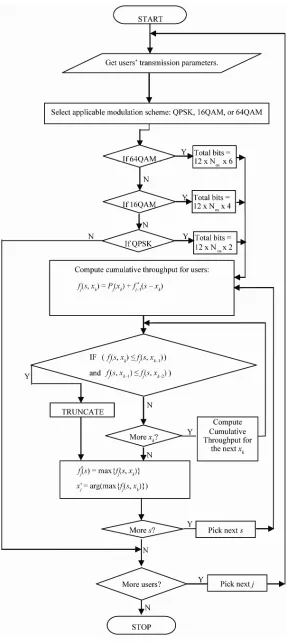
In computing throughput of individual user given available RBs, we invoke Equation (10) and execute the following truncated dynamic programming procedure. In the course of executing this procedure, the truncation conditions are checked before every computation of cu-mulative contribution (or throughput).
Computation of Cumulative Throughput and Truncation Procedure
For j = 19, 18, …, 1 BEGIN
For k = 0, 1, 2, …, 50 BEGIN
*
1
,
j k j k j k
f s x p x f sx (11)
fj
s x, k
fj
s x, k1
and
fj
s x, k1
fj s x, k2
allocation of RBs would have positive effects on time ofscheduling decisions. THEN Truncate
ELSE
3. Problem Solution and Simulation Results
Compute cumulative throughput for next xk
END END
, j , k
x s
The optimal allocation decision for user j, in relation to s and xk, is the maximum of the cumulative
contribu-tions to the total throughput. This is given by:
*
0,2, max
k
j
f s
f s x
fj s x, k
(12)
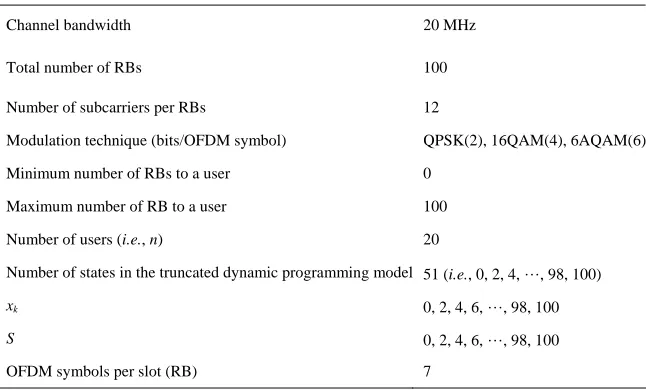
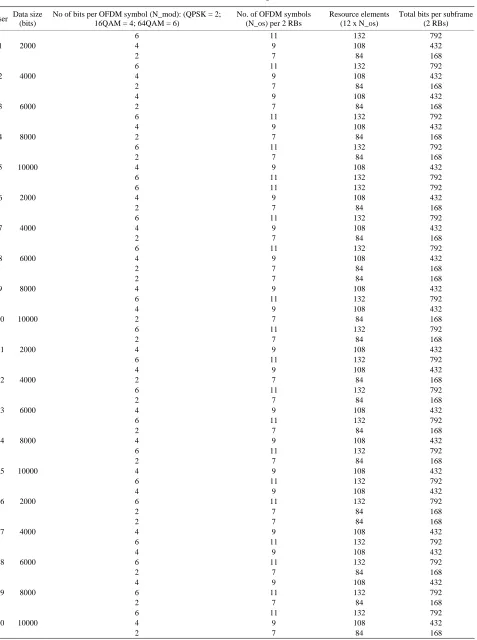
The simulation and users’ transmission parameters are presented in Tables 1 and 2 respectively. At every sched- uling instant, three modulation schemes are available to every user, namely: QPSK, 16QAM and 64QAM. The applicable modulation scheme depends on user’s location within a Cell coverage area. Uncertainty regarding user’s location is encapsulated in the truncated dynamic pro-gramming model at this stage. For example, a user with good signal strength may start transmission using 64QAM, and subsequently change at later transmission instant(s) to QPSK (or 16QAM) modulation scheme in response to change in location. The proposed truncated dynamic programming based technique was simulated on a Per-sonal Computer using MATLAB Ver 7.10.0.449 (R2010a). Simulation results based on the proposed truncated and the existing dynamic programming techniques are ob-tained for the 20 network users. We are however con-strained by limited space in this paper to present results for only the 18th user (i.e., j = 18) to demonstrate the efficiency and effectiveness of the proposed technique. Thus, the corresponding allocated RBs is given by:
*
0,2, , arg max
k
k
x s
x
(13)
2.4. Effect of Truncation on Recursion
Without truncation, the back induction dynamic pro-gramming process computes cumulative contributions for all possible allocation of RBs (i.e., xk), given available
RBs (i.e., s). The Scheduler takes decision on optimal allocation of RBs at the end of all computations. With the truncation procedure however, the recursion is termi-nated when the truncation conditions are met; thereby reducing computational time and usage of other compu-tational resources. Thus, in terms of contribution to the total network throughput, the truncation exercise enables the Scheduler to determine the point beyond which it is no longer efficient to allocate RBs to users much earlier than without truncation. The advantage to the network is that the time and other resources that would have been committed to computations beyond the truncation point are saved. In LTE, new scheduling decisions are taken in every Transmission Time Interval (TTI), which is 1 ms. The reduced computational time and timely decision on
In the current paper, Option 1 represents data in Row 1 (i.e., from columns 3 to 6) for all users in Table 2. Simi-larly, Options 2 and 3 represent data in Rows 2 and 3 respectively (i.e., from Columns 3 to 6) for all users in
Table 2. The management of uncertainty regarding dy-namic selection of a modulation scheme shows the ro-bustness of the proposed technique.
3.1. System Flowchart
[image:4.595.137.460.538.733.2]The system flowchart for the implementation of the pro-posed technique is presented in Figure 1.
Table 1. Simulation parameters.
Channel bandwidth 20 MHz
Total number of RBs 100
Number of subcarriers per RBs 12
Modulation technique (bits/OFDM symbol) QPSK(2), 16QAM(4), 6AQAM(6)
Minimum number of RBs to a user 0
Maximum number of RB to a user 100
Number of users (i.e., n) 20
Number of states in the truncated dynamic programming model 51 (i.e., 0, 2, 4, …, 98, 100)
xk 0, 2, 4, 6, …, 98, 100
S 0, 2, 4, 6, …, 98, 100
Table 2. Users’ transmission parameters.
User Data size
(bits)
No of bits per OFDM symbol (N_mod): (QPSK = 2; 16QAM = 4; 64QAM = 6)
No. of OFDM symbols (N_os) per 2 RBs
Resource elements (12 x N_os)
Total bits per subframe (2 RBs)
6 11 132 792
1 2000 4 9 108 432
2 7 84 168
6 11 132 792
2 4000 4 9 108 432
2 7 84 168
4 9 108 432
3 6000 2 7 84 168
6 11 132 792
4 9 108 432
4 8000 2 7 84 168
6 11 132 792
2 7 84 168
5 10000 4 9 108 432
6 11 132 792
6 11 132 792
6 2000 4 9 108 432
2 7 84 168
6 11 132 792
7 4000 4 9 108 432
2 7 84 168
6 11 132 792
8 6000 4 9 108 432
2 7 84 168
2 7 84 168
9 8000 4 9 108 432
6 11 132 792
4 9 108 432
10 10000 2 7 84 168
6 11 132 792
2 7 84 168
11 2000 4 9 108 432
6 11 132 792
4 9 108 432
12 4000 2 7 84 168
6 11 132 792
2 7 84 168
13 6000 4 9 108 432
6 11 132 792
2 7 84 168
14 8000 4 9 108 432
6 11 132 792
2 7 84 168
15 10000 4 9 108 432
6 11 132 792
4 9 108 432
16 2000 6 11 132 792
2 7 84 168
2 7 84 168
17 4000 4 9 108 432
6 11 132 792
4 9 108 432
18 6000 6 11 132 792
2 7 84 168
4 9 108 432
19 8000 6 11 132 792
2 7 84 168
6 11 132 792
20 10000 4 9 108 432
2 7 84 168
3.2. Simulation Results
Simulation results for the proposed Truncated Dynamic Programming (TDP) under uncertainty are presented in
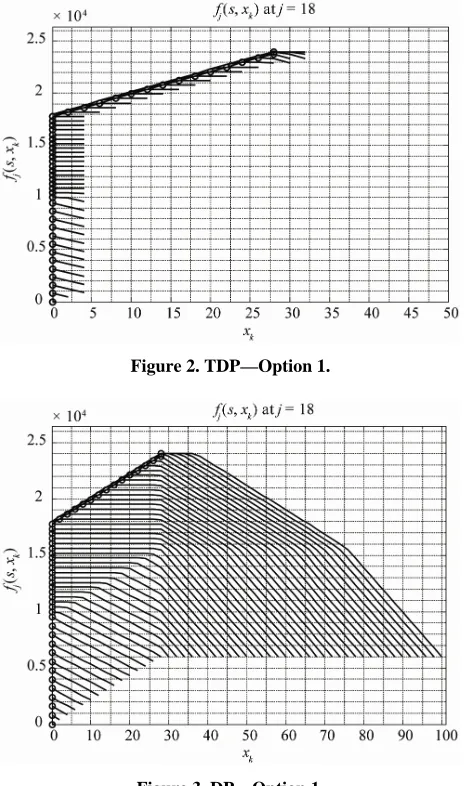
Figures 2, 4 and 6. We also present comparative results for the corresponding Dynamic Programming (DP) based technique in Figures 3, 5 and 7.
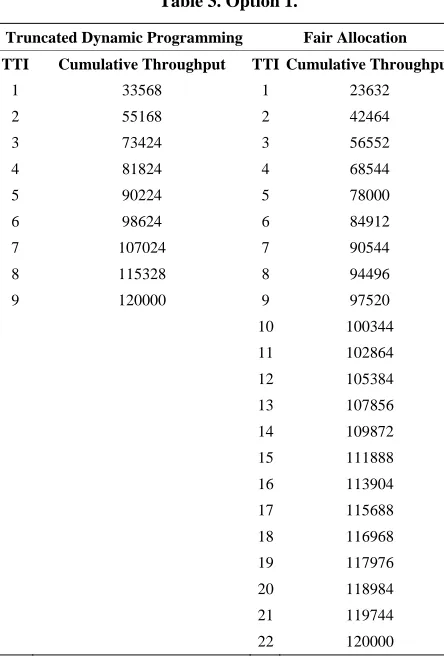
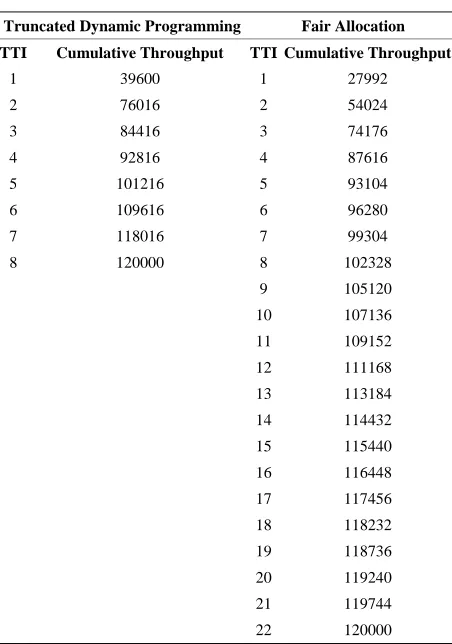
We further compare the performance of the proposed TDP technique with that of the Fair Allocation technique. The instantaneous cumulative throughputs for both tech-niques, based on Options 1, 2 and 3, are presented in
Tables 3-5 respectively. The Fair allocation technique ensures fairness in allocation of resources to network users independent of traffic characteristics. The tech-nique requires that each network user is allocated some
amount of available radio resource for transmission. Figure 4. TDP—Option 2. To ensure realistic comparison and fairness, we
allo-cate 6 RBs to users with good signal strength (i.e., users using 64QAM modulation scheme) and 4 RBs to users with poor signal strength (i.e., users using 16QAM or
[image:7.595.306.540.85.678.2]Figure 5. DP—Option 2.
Figure 2. TDP—Option 1.
Figure 6. TDP—Option 3.
QPSK modulation scheme).
The graphs showing comparative cumulative through- puts for the TDP and Fair Allocation techniques are pre- sented in Figure 8.
[image:7.595.57.289.336.729.2]Figure 7. DP—Option 3.
Table 3. Option 1.
Truncated Dynamic Programming Fair Allocation
TTI Cumulative Throughput TTI Cumulative Throughput
1 33568 1 23632
2 55168 2 42464
3 73424 3 56552
4 81824 4 68544
5 90224 5 78000
6 98624 6 84912
7 107024 7 90544
8 115328 8 94496
9 120000 9 97520
10 100344
11 102864
12 105384
13 107856
14 109872
15 111888
16 113904
17 115688
18 116968
19 117976
20 118984
21 119744
22 120000
4. Discussion of the Simulation Results
In the proposed truncated dynamic programming under uncertainty technique, the system can adapt dynamically to changing locations of users (corresponding to chang-ing signal strength) as a result of users’ mobility. The computations of instantaneous cumulative throughputs are based on the applicable modulation scheme (i.e., QPSK, 16QAM or 64QAM). Since the location of user
Table 4. Option 2.
Truncated Dynamic Programming Fair Allocation
TTI Cumulative Throughput TTI Cumulative Throughput
1 28464 1 22352
2 50064 2 41792
3 71664 3 58856
4 91728 4 71832
5 100128 5 82384
6 108528 6 91264
7 116928 7 98480
8 120000 8 104016
9 107456
10 109272
11 110784
12 112296
13 113760
14 114768
15 115776
16 116784
17 117792
18 118400
19 118904
20 119408
21 119912
22 120000
Figure 8. Network throughput for the Fair Allocation and Truncated Dynamic Programming based techniques.
within a Cell coverage area is uncertain, selection of ap-plicable modulation scheme is also uncertain. Thus, the optimal decision at each stage can be taken only after the outcome of the uncertain event (i.e., selection of the ap-plicable modulation scheme).
[image:8.595.58.280.284.612.2]Table 5. Option 3.
Truncated Dynamic Programming Fair Allocation
TTI Cumulative Throughput TTI Cumulative Throughput
1 39600 1 27992
2 76016 2 54024
3 84416 3 74176
4 92816 4 87616
5 101216 5 93104
6 109616 6 96280
7 118016 7 99304
8 120000 8 102328
9 105120
10 107136
11 109152
12 111168
13 113184
14 114432
15 115440
16 116448
17 117456
18 118232
19 118736
20 119240
21 119744
22 120000
to the resulting state from the current decision must be an optimal policy. The optimality of the proposed allocation scheme is assured by the applicable dynamic program-ming procedure. For the current work, the applicable dynamic programming procedure is the Back Induction (BI) process wherein the first stage to be analysed is the final stage of the problem and the n-stage problem is solved moving backwards one stage at a time until all stages are included to obtain optimal solution.
In this paper, we assume 20 network users within a Cell coverage area. Cells are geographical areas that are covered by radio signals from a Base Station. Allocated RBs ranges from 0 to 100, in multiples of 2 RBs (i.e., xk:
0, 2, 4, 6, …, 98, 100). In computing cumulative contri-butions using the proposed technique, the system com-pares current cumulative contribution with the last two preceding consecutive cumulative contributions. If the current computed cumulative contribution is less than or equal to the first preceding cumulative contribution and the first preceding cumulative contribution is less than or equal to the second preceding cumulative contribution, then further computations with respect to the chosen s (i.e., available RBs) are truncated. The system then picks the next available RBs (i.e., next s), and use possible allocated RBs (i.e., xk: 0, 2, 4, 6, …, 100) to compute
cumulative contributions to the total throughput; while checking the truncation conditions. This recursive proc-ess continues for all available RBs (i.e., s), for all possi-ble allocated RBs (i.e., xk) and for all scheduled users within a Cell coverage area.
Whereas the optimal decision on maximum cumula-tive contribution to the total throughput is taken at xk =
28 in Figure 2, and truncation is effected at xk = 32;
same decision is taken in Figure 3 after computing cu-mulative contributions for all xk, (i.e., xk= 0, 2, …, 100).
Similarly in Figure 4, the dynamic programming proce-dure is truncated after computing cumulative throughput (or contribution) for xk= 20, since maximum cumulative
contribution is obtained at xk= 16. However, for the
cor-responding dynamic programming based graphs pre-sented in Figure 5, the computations are carried out for all xk (i.e., xk = 0, 2, …, 100). In Figure 6 on the one
hand, the truncated dynamic programming based graph is truncated at xk = 4, as the instantaneous maximum
cu-mulative contribution is obtained at xk = 0. On the other
hand, for the corresponding dynamic programming pro-cedure in Figure 7, the computations are carried out for all xk (i.e., xk= 0, 2, …, 100).
To further confirm the effectiveness and efficiency of the proposed truncated dynamic programming technique, we compare its performance with the Fair Allocation technique. For the Fair allocation technique, 6 RBs are allocated to users with good signal strength and 4 RBs are allocated to users with poor signal strength. Relevant data on the comparative analysis are presented in Tables 3-5. The graphs in Figure 8 for Options 1, 2, and 3, show that the Truncated Dynamic Programming technique performs better than the Fair Allocation technique.
5. Conclusion
performed better than the Fair allocation methodology. Moreover, the Truncated Dynamic Programming and the earlier proposed Dynamic Programming based techni- ques achieved same throughput, but the Truncated Dy-namic Programming based technique was more efficient as the computational time involved was significantly lower. Thus, it is shown by the results obtained that the proposed technique is more efficient in allocating radio resource and has better performance than both the Fair Allocation and deterministic dynamic programming based techniques for scheduling in Cellular LTE downlink. Besides, the proposed technique has the added advantage of managing uncertainty in selecting applicable modula-tion scheme (i.e., QPSK, 16QAM or 64QAM) as a result of users’ mobility within a Cell coverage area.
REFERENCES
[1] 3GPP TS 36.211. “Evolved Universal Terrestrial Radio Access (EUTRA); Physical Channel and Modulation (Re- lease 8),” Technical Report, 3GPP-TSG R1, September 2007.
[2] O. Iosif and I. Banica, “On the Analysis of Packet Sched- uling in Downlink 3GPP LTE System,” Proceedings of the 4th International Conference on Communication The- ory, Reliability and Quality of Service, Budapest, 17-22 April 2011, pp. 99-102.
[3] H. Holma and A. Toskala, “LTE for UMTS: OFDMA and SC-FDMA Based Radio Access,” John Wiley & Sons, New York, 2009.
[4] J. Huang, V. G. Subramanian, R. Agrawal and R. A. Berry, “Downlink Scheduling and Resource Allocation for OFDM Systems,” IEEE Transactions on Wireless Communications, Vol. 8, No.1, 2009, pp. 288-296. doi:10.1109/T-WC.2009.071266
[5] M. S. Kaiser and K. M. Ahmed, “Radio Resource Alloca- tion for Heterogeneous Services in Relay Enhanced OFDMA Systems,” Journal of Communications, Vol. 5, No. 6, 2010, pp. 447-454.
[6] A. Wang, Y.-Y. Qiu, L. Lin and S. Li, “An Adaptive Sub-Carrier and Power Allocation Algorithm with QoS Guarantee for OFDMA System,” 10th IEEE Conference on High Performance Computing and Communications, Dalian, 25-27 September 2008, pp. 492-497.
[7] G. H. Kumar, P. H. Krishnarao and K. S. R. Krishna, “Two-Stage Algorithm for Sub-Carrier, Bit and Power Allocation in OFDMA Systems,” International Journal of Computer Science and Communications, Vol. 1, No. 2,
2010, pp. 51-54.
[8] G. Li and H. Liu, “Downlink Radio Resource Allocation for Multi-Cell OFDMA System,” IEEE Transactions on Wireless Communications, Vol. 5, No. 12, 2006, pp. 3451- 3459. doi:10.1109/TWC.2006.256968
[9] I. Koutsopoulos and L. Tassiulas, “Cross-Layer Adaptive Techniques for Throughput Enhancement in Wireless OFDM-Based Networks,” IEEE/ACM Transactions on Networking, Vol. 14, No. 5, 2006, pp. 1056-1066. doi:10.1109/TNET.2006.882842
[10] T. Thonabalasinghan, S. Hanley, L. L. H. Andrew and J. Papandripoulos, “Joint Allocation of Sub-Carriers and Transmit Powers in a Multi-User OFDM Cellular Net- work,” IEEE International Conference on Communica- tions, Istanbul, 11-15 June 2006, pp. 269-274.
doi:10.1109/ICC.2006.254739
[11] C. Koutsimanis and G. Fodor, “A Dynamic Resource Allocation Scheme for GBR Services in OFDMA Net- works,” Proceedings of the IEEE Conference of Commu- nications, Beijing, 19-23 May 2008, pp. 2524-2530.
[12] I. C. Wong and B. L. Evans, “Optimal Resource Alloca- tion in OFDMA Systems with Imperfect Channel Knowl- edge,” IEEE Transactions on Communications, Vol. 57, No. 1, 2009, pp. 232-241.
doi:10.1109/TCOMM.2009.0901.060546
[13] P. Hosein, “Coordinated Radio Resource Management for the LTE Downlink: The Two-Sector Case,” IEEE Inter- national Conference on Communications, Cape Town, 23-27 May 2010, pp. 1-5.
[14] N. Zhou, X. Zhu and Y. Huang, “Genetic Algorithm Based Cross-Layer Resource Allocation for Wireless OFDM Networks with Heterogeneous Traffic,” 17th European Signal Processing Conference (EUSIPCO), Glasgow, 24- 28 August 2009, pp. 1656-1659.
[15] M. Ergen, S. Coleri and P. Varaiya, “QoS Aware Adap- tive Resource Allocation Techniques for Fair Scheduling in OFDMA Based Broadband Wireless Access Systems,” IEEE Transactions on Broadcasting, Vol. 49, No. 4, 2003, pp. 362-370. doi:10.1109/TBC.2003.819051
[16] A. M. Ajofoyinbo and K. Orolu, “A Dynamic Program- ming Based Technique for Optimal Allocation of Radio Resource in Multi-User Cellular Long-Term Evolution (LTE) Downlink,” 10th WSEAS International Conference on Telecommunications and Informatics (TELE-INFO’11), Lanzarote, Spain, 27-29 May 2011, pp. 107-113.