EVALUATION OF IMMUNIZATION SERVICES IN A RURAL BLOCK OF DISTRICT
Department of Community Medicine, Pt. B.D. Sharma PGIMS Rohtak, Haryana
ARTICLE INFO ABSTRACT
Background:
decrease morbidity and mortality rates in children. In the past 50 years, vaccination has saved more lives worldwide than any other medical products or procedures.
evaluate immunization services at sub worker Females (MPHW
Material and Methods:
centres under rural block of Rohtak, Haryana during June 2015 by carefully observing immunization services through a
immunization sessions and then determining knowledge of MPHW a semi
Results:
found to unsatisfactory sessions, 3
hub-cutter for syringe disposal immediately a tracking drop
(47.62%) and practice of filling and issue of MCP cards to new beneficiaries (38.09%) were observed.
Conclusion unsatisfactory
deficiencies in logistic supply, knowledge and practice rega to the mothers.
Copyright©2017, Sahil Goyal and Vijay Kumar.This
unrestricted use, distribution, and reproduction in any medium, provided the original work is properly cited.
INTRODUCTION
Vaccination is the most important preventive and cost
intervention to decrease morbidity and mortality rates in children. Approximately 17% of deaths in children under five are vaccine-preventable. An estimated 1.5 million children die annually from diseases that can be prevented by immunization. The very low risk of an adverse event caused by a vaccine outweighs the risk and cost of illness and complications caused by natural infections (WHO, 2016). In the past 50 years, vaccination has saved more lives worldwide than any other medical products or procedures (Vashishtha
poorest, most vulnerable children who need immunization the most, continue to be the least likely to get it (https://www.unicef.org/immunization/index_how.html inappropriate vaccination impacts adversely especially on the
*Corresponding author: Sahil Goyal,
Department of Community Medicine, Pt. B.D. Sharm Rohtak, Haryana.
ISSN: 0975-833X
Article History:
Received 11th February, 2017
Received in revised form 04th March, 2017 Accepted 08th April, 2017
Published online 23rd May,2017
Key words:
Immunization, Cross-sectional,
Multipurpose-Healthworker, Key-messages.
Citation: Sahil Goyal and Vijay Kumar. 2017. “Evaluation of immunization services in a rural block of district Rohtak, Haryana
Current Research, 9, (05), 50742-50746.
RESEARCH ARTICLE
EVALUATION OF IMMUNIZATION SERVICES IN A RURAL BLOCK OF DISTRICT
ROHTAK, HARYANA
*Sahil Goyal and Vijay Kumar
Department of Community Medicine, Pt. B.D. Sharma PGIMS Rohtak, Haryana
ABSTRACT
Background: Vaccination is the most important preventive and cost
decrease morbidity and mortality rates in children. In the past 50 years, vaccination has saved more lives worldwide than any other medical products or procedures.
evaluate immunization services at sub-centres and to determine knowledge of Multipurpose Health worker Females (MPHW-Fs) regarding immunization.
Material and Methods: Community-based cross sectional study was conducted at all the 21 sub centres under rural block of Rohtak, Haryana during June 2015-May 2016. Information was collected by carefully observing immunization services through a single visit at all sub
immunization sessions and then determining knowledge of MPHW a semi-structured interview schedule.
Results: Knowledge and practice regarding four key messages of vaccination to found to unsatisfactory- 1st key message was given in around 5% sessions, 2
sessions, 3rd key message in 90% sessions and 4th key message in 58% sessions. Practice of using cutter for syringe disposal immediately after use (38.09%), Practice of updating counterfoils for tracking drop-outs (19.05%), correct biomedical waste segregation and disposal in color
(47.62%) and practice of filling and issue of MCP cards to new beneficiaries (38.09%) were observed.
Conclusion: The overall quality of immunization services at sub
unsatisfactory particularly in the areas of practice of updating counterfoils for tracking drop deficiencies in logistic supply, knowledge and practice regarding 4
to the mothers.
This is an open access article distributed under the Creative Commons Att use, distribution, and reproduction in any medium, provided the original work is properly cited.
Vaccination is the most important preventive and cost-effective intervention to decrease morbidity and mortality rates in of deaths in children under five preventable. An estimated 1.5 million children die annually from diseases that can be prevented by immunization. The very low risk of an adverse event caused by a vaccine
nd complications caused In the past 50 years, vaccination has saved more lives worldwide than any other
Vashishtha, 2014). The
poorest, most vulnerable children who need immunization the most, continue to be the least likely to get it
https://www.unicef.org/immunization/index_how.html).
Age-inappropriate vaccination impacts adversely especially on the
Department of Community Medicine, Pt. B.D. Sharma PGIMS
effectiveness of India’s measles immunization program due to sub-optimal sero-conversion, if given premature, and increased vulnerability to vaccine preventable diseases, if delayed. been realized that merely providing
targets for complete immunization coverage without giving adequate attention to quality of immunization services does not guarantee a reduction in disease morbidity and mortality rates. Full course of potent vaccines given at right
interval, by right technique with a valid documentation constitute quality criteria of immunization services. For successful implementation of routine immunization services, all its components– planning of immunization sessions, cold chain and logistics management, community mobilization, appropriate technique of vaccination etc. should be carefully looked into. This requires an in
2011). Thus, the present study was conducted with an objective to evaluate the process of routine immunization sessions with a special focus on quality of health services imparted at sub centres.
International Journal of Current Research Vol. 9, Issue, 05, pp.50742-50746, May, 2017
INTERNATIONAL
OF CURRENT RESEARCH
Evaluation of immunization services in a rural block of district Rohtak, Haryana
EVALUATION OF IMMUNIZATION SERVICES IN A RURAL BLOCK OF DISTRICT
Department of Community Medicine, Pt. B.D. Sharma PGIMS Rohtak, Haryana
Vaccination is the most important preventive and cost-effective intervention to decrease morbidity and mortality rates in children. In the past 50 years, vaccination has saved more lives worldwide than any other medical products or procedures. The objectives of the study were to centres and to determine knowledge of Multipurpose Health
based cross sectional study was conducted at all the 21 sub-May 2016. Information was collected single visit at all sub-centres during routine immunization sessions and then determining knowledge of MPHW-Fs regarding immunization using
Knowledge and practice regarding four key messages of vaccination to the mothers was key message was given in around 5% sessions, 2nd key message in 57% key message in 58% sessions. Practice of using fter use (38.09%), Practice of updating counterfoils for outs (19.05%), correct biomedical waste segregation and disposal in color-coded bags (47.62%) and practice of filling and issue of MCP cards to new beneficiaries (38.09%) were
The overall quality of immunization services at sub-centres was found to be particularly in the areas of practice of updating counterfoils for tracking drop-out cases, rding 4-key messages by health-workers
is an open access article distributed under the Creative Commons Attribution License, which permits
effectiveness of India’s measles immunization program due to conversion, if given premature, and increased vulnerability to vaccine preventable diseases, if delayed. It has been realized that merely providing vaccines just to achieve targets for complete immunization coverage without giving adequate attention to quality of immunization services does not guarantee a reduction in disease morbidity and mortality rates. Full course of potent vaccines given at right age, at right interval, by right technique with a valid documentation constitute quality criteria of immunization services. For successful implementation of routine immunization services, planning of immunization sessions, cold-nd logistics management, community mobilization, appropriate technique of vaccination etc. should be carefully looked into. This requires an in-depth process evaluation (Patel, Thus, the present study was conducted with an objective process of routine immunization sessions with a special focus on quality of health services imparted at
sub-INTERNATIONAL JOURNAL OF CURRENT RESEARCH
MATERIAL AND METHODS
Study design: This was a community-based cross-sectional
study.
Study area: The study was conducted at all the 21 sub-centres under CHC Chiri, Block Lakhanmajra, which is the rural field practice area of Department of Community Medicine, PGIMS Rohtak, Haryana and is used for the purpose of teaching, training and research activities.
Study period: The study was carried out during 1st June 2015 to
31st May 2016.
Data Collection
The interview was started with general discussion with health-workers to build a rapport in order to gain their confidence. The single visits to sub-centres were conducted at the time of outreach routine immunization session which was mostly held
either on the 3rd or 4th Wednesday of every month. The
interview was meant to check the knowledge of Multipurpose Healthworker-Females (MPHW-Fs) regarding immunization services by using pre-designed semi-structured schedule after taking informed written consent from them.
The definition of the term ‘Key messages on immunization’ used in the study refers to (http://www.mohfw.nic.in)
First key message: What vaccine was given and what
disease it prevents.
Second key message: When and where to come for the next
visit.
Third key message: What minor adverse events could occur
and how to deal with them.
Fourth key message: To keep the immunization card safe
and bring it along for the next visit.
Along with this, evaluation of presence of all the necessary logistics related to immunization as well as vaccine cold chain maintenance throughout the session were carefully observed and recorded. At the end of the session, the health-workers were communicated regarding any deficiencies if found and were made to rectify. In case any queries were asked by health-workers regarding immunization, they were resolved so as to ensure quality and timeliness of services being imparted to the beneficiaries.
Data Analysis
The collected data was entered in Microsoft Excel and analyzed using SPSS (Statistical Package for Social Science) software for Windows version 20.0. Categorical data was presented as percentages and proportions.
Ethical consideration
The ethical clearance was taken from the Institutional Ethics Committee.
RESULTS
Table 1 shows various parameters which were evaluated to assess quality of immunization services imparted to the
[image:2.595.307.560.131.220.2]beneficiaries by MPHW(F). It was found that atleast one mobilizer was present at every sub-centre for bringing children from their houses.
Table 1. Status of presence of various parameters related to immunization services at sub-centres
S.No. Different parameters Number
(N=21)
Percent
1. Due list of beneficiaries available 21 100
2. Session site held as per RI* micro-plan in
last 1 month
15 71.43
3. Mobilizer present** 25** -
4. IEC*** materials displayed 43** -
5. Vaccine carrier timely brought to session site 11 52.38
6. Any visit by supervisor in last 1month 6 28.57
*Routine Immunization; **multiple responses; *** IEC- Information, Education and Communication
It was found that various Information, Education and Communication (IEC) materials in the form of poster, wall writing, banner or tinplate were displayed at all the sub-centres. The due-list of beneficiaries was available with MPHW(F) at all the sub-centres during the session. (Figure 1) Vaccine carrier was brought to session site by MPHW(F) in 80.95% (17/21) sub-centres whereas by hired persons in 19.05% (4/21) sub-centres on the date of the interview. But only in about 52.38% (11/21) of the sub-centres, vaccine carriers were timely brought to the session site. However, it was observed that supervisor visit to the place of immunization (either at sub-centres or anganwadi sub-centres) in last 1 month from the date of interview was present only in about 28.57% (6/21) of the cases.
Table 2. Status of vaccine vials and other logistic supply availability at sub-centres
S.No. Different parameters Number
(N=21) Percent
1. BCG vial 20 95.24
2. Pentavalent vial 21 100
3. OPV vial 21 100
4. Measles vial 21 100
5. DPT vial 21 100
6. Vitamin-A syrup bottle 7 33.33
7. Functional hub cutter 16 76.19
8. Diluent for BCG vaccine 20 95.24
9. Diluent For Measles vaccine 21 100
10. Tracking bag 19 90.48
11. Blank Immunization cards 14 66.67
12. 0.1 ml/ 0.5ml AD syringes 21 100
13. 5ml disposable syringes 21 100
14. Black disposal bag 18 85.71
15. Red disposal bag 17 80.95
16. Tablet Paracetamol 17 80.95
17. Vaccine carrier with 4 conditioned
ice-packs
18 85.71
18. Presence of plastic zipper bag for vaccine
vials and diluents inside vaccine carrier
21 100
Pentavalent vaccination was not available. The hub-cutter for syringe disposal was available only in about 76.19% (16/21) of sub-centres during the session (Figure-1).
Figure 1. Description of availability of vaccine vials and other logistic supply for the immunization session at all the sub-centres.
(n=21)
Table 3. Status of vaccine administration process during immunization session based on standard parameters at all the
sub-centres
S.No. Different parameters Number
(N=21)
Percent
1. Correct administration technique 21 100
2. Correct site of administration 21 100
3. Correct dose of vaccine 21 100
4. Time of reconstitution written on vial 21 100
5. Any needle-stick injury incident observed 3 14.29
Table-3 shows correct administration techniques of
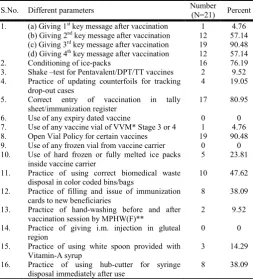
immunization at correct sites and in correct doses of vaccines by MPHW(F) to all the children who attended immunization sessions at all the sub-centres. Needle-stick injury incidents were observed in about 14.29% (3/21) of sessions. (Figure-2) Timely vaccinations as per National Immunization Schedule (NIS) were observed to be satisfactory in majority of children attending sessions in only about one-third of sub-centres (7/21) Table-4 shows knowledge of MPHW(F) regarding various parameters related to immunization services at all the sub-centres. (Figure-3) It was found that knowledge and practice regarding what minor adverse events can occur with vaccine
and how to deal with them (3rdkey message) was satisfactory at
most of the centres (90.48%), whereas what vaccine was given
to prevent which disease (1st key message)was given to most of
the mothers in only about 4.76% of the sessions. This was probably due to lack of periodical trainings to health-care workers on imparting all key messages of immunization to the beneficiaries. It was also observed that mothers were not advised to wait for at least 30 minutes to look for any Adverse Events Following Immunization (AEFI) after immunizing the
child (5th key message) at any of the sessions. It was also
observed that practice of hand-washing before and after immunization session by MPHW(F) was followed only in about 9.52% (2/21) of sessions.
[image:3.595.39.284.95.342.2]Figure 2. Status of parameters related to vaccine administration process during session at all the sub-centres. (n=21)
Table 4. Knowledge and practice of MPHW(F) regarding various parameters related to immunization services during immunization
session at all the sub-centres. (n=21)
S.No. Different parameters Number
(N=21) Percent
1. (a) Giving 1st key message after vaccination
(b) Giving 2nd key message after vaccination
(c) Giving 3rd key message after vaccination
(d) Giving 4th key message after vaccination
1 12 19 12
4.76 57.14 90.48 57.14
2. Conditioning of ice-packs 16 76.19
3. Shake –test for Pentavalent/DPT/TT vaccines 2 9.52
4. Practice of updating counterfoils for tracking
drop-out cases
4 19.05
5. Correct entry of vaccination in tally
sheet/immunization register
17 80.95
6. Use of any expiry dated vaccine 0 0
7. Use of any vaccine vial of VVM* Stage 3 or 4 1 4.76
8. Open Vial Policy for certain vaccines 19 90.48
9. Use of any frozen vial from vaccine carrier 0 0
10. Use of hard frozen or fully melted ice packs
inside vaccine carrier
5 23.81
11. Practice of using correct biomedical waste
disposal in color coded bins/bags
10 47.62
12. Practice of filling and issue of immunization
cards to new beneficiaries
8 38.09
13. Practice of hand-washing before and after
vaccination session by MPHW(F)**
2 9.52
14. Practice of giving i.m. injection in gluteal
region
0 0
15. Practice of using white spoon provided with
Vitamin-A syrup
3 14.29
16. Practice of using hub-cutter for syringe
disposal immediately after use
8 38.09
*VVM- Vaccine Vial Monitor; ** MPHW(F)- Multipurpose Health-worker(Female)
[image:3.595.307.561.349.629.2]Figure 3. Knowledge of MPHW(F) regarding various parameters related to immunization services at all the sub-centres. (n=21)
DISCUSSION
In the present study it was found that vaccine carriers were timely brought to the session sites as per microplan in about 52.38% of the sub-centres. The session sites were held as per Routine Immunization (RI) micro-plan in about 71.43% (15/21) of the centres in the past one month from the day of interview. It was found that supervisor visit at place of immunization in last 1 month from the date of interview was found only in about 28.57% (6/21) of the sub-centres. Singh et at (2015) in their study observed that about 81.6% sessions were conducted as per the microplan. The supervision by the higher authority was done only in 13.3% of session sites. The similar findings under different settings suggest that there is a need to update microplan on periodical basis so that delivery of vaccines and other logistics can reach the heath centres for the estimated number of beneficiaries at right time without any delay.
Availability of logistics
The present study findings found that all the centres had adequate number of auto disabled (AD) syringes of 0.1 ml and 0.5ml.Vitamin-A syrup bottles were available in only one-third of the sessions (7/21). Blank MCP cards were present in sufficient quantity in only about 66.67% (14/21) of the sessions. The hub-cutter for syringe disposal was available only in about 76.19% (16/21) of centres during the session. About 80 % of the sub-centres were equipped with color-coded bags for disposal of biomedical waste. Our study findings were almost similar to
the study by Nath et al (2015)in which all the cold chain points
were supplied with adequate number of AD syringes of 0.1and 0.5ml, and had 1 month vaccine stock. There was no shortage of vaccines except vitamin A since past 1 year. There was no supply of the paracetamol syrup or tablets in the subcenters. Only 36% (9/25) of the subcenters were equipped with color coded bins.
Biradar et al (2013, Karnataka): in their study found that the
availability of vaccines was satisfactory except for Hepatitis-B in 95.7% cases. Vitamin A solution was available in 56.5%
cases, Blank MCP Cards in 71.7% cases, functional Hub Cutter was available in 63.1% cases. The Red and Black bags were present in 54.4% cases indicating neglect towards proper disposal of biomedical waste at session sites. The findings highlight that regular supply of adequate logistics at peripheral level is not an uncommon issue and thus due to which satisfactory immunization services cannot be imparted to the beneficiaries most of the times.
Vaccine administration process: In the present study, correct administration techniques of immunization at correct sites and in correct doses of vaccines by MPHW(F) were observed in all of the immunization sessions at sub-centres. Our study findings
were almost similar to the study done by Singh et al (2015) in
which it was found that Auxiliary Nurse Midwives (ANM) was administrating the vaccines by correct technique in 91.6% session sites, adequate dose of vaccine was given in 100% cases and correct age of administration was found in 95% session sites.
Knowledge and practice on immunization services: In our study it was observed that in one of the sessions (4.76%), OPV vial in Vaccine Vial Monitor (VVM) Stage-3 was used but no use of expiry dated vaccine vials were found to be used. The use of hard frozen or fully melted ice packs inside vaccine carrier was found in 23.81%. The practice of hand-washing before and after immunization session by MPHW(F) was followed only in about 9.52% (2/21) of sessions. No practice of giving intramuscular injection in gluteal region was however observed.
Nath et al (2015): in their study found two frozen DPT vials
and 10 vials of polio vaccine were in VVM Stage 3 and 4. The lack of hand washing practice was found in 86% cases and practice of giving intramuscular (IM) injection in gluteal region in about 28% cases. The reasons as mentioned in the study were due to gaps in the cold chain maintenance and lack of adequate training of staff. This lead to under-utilization of healthcare services by the community due to lack of counseling from the health staff, lack of awareness, and social determinants such as low literacy level. In the present study, the practice of using hub-cutter for syringe disposal immediately after use was followed only in about 38.09%
(8/21) of immunization sessions. Biradar et al (2013,
Karnataka) in their study has mentioned the importance to use
AD syringe and hub cutter for cutting the needles, in order to reduce the needle stick injuries. The knowledge regarding shake test for reconstitution vials and conditioning of ice-packs was present in 9.52% and 76.19% of MPHW(F) respectively, whereas practice of updating counterfoils for tracking drop-out cases and correct entry of vaccinations in immunization registers were observed in 19.05% and 80.95% of cases respectively.
It was observed in our study that knowledge about open vial policy was present in 90.48% of MPHW(F) and practice of filling and issuing MCP cards to new beneficiaries in 38.09% sessions. The knowledge regarding proper biomedical waste segregation during the sessions was present in about 47.62%. In the present study in only one of the sessions (4.76%),
MPHW(F) was satisfactory giving 1st key message to most of
the mothers, 2nd and 4th key messages were given satisfactory
in 57.14% (12/21) sessions whereas 3rd key message was given
in the majority of sessions (90.48%). Biradar et al (2013,
were given to parents in about 76.1% session sites. Singh et al
(2015)and Nath et al (2015)in their studies found that four key
messages by ANM were given in only 38.3% and 28% of session sites respectively. All ANMs informed the mothers about not massaging the site of injection and to apply vicks or ice in case of local swelling in the area. The mothers of children who had been given DPT were advised to give the child one-fourth of Paracetamol tablet for fever. The present study has been conducted under different setting as compared to other studies but it has brought almost a similar picture of unsatisfactory immunization services at health centres particularly in the areas of practice of updating counterfoils for tracking drop-out cases, deficiencies in logistic supply, knowledge and practice regarding 4-key messages by health-workers to the mothers. This highlights the need of strengthening health services by periodical trainings of health-workers along with commitment of the government in ensuring adequate supply of necessary logistics and manpower at primary health care level. The limitation of this study could be that only a single immunization session was observed at each of the sub-centres due to constraints of time and thus only once-a-month immunization session could be studied in a period of one year. The study however tried to highlight that quality of immunization services is equally important as achieving targets for immunization coverage in the community. The study has also tried to highlight importance of timeliness of vaccination among children during field study.
Conclusions
Thus, it can be concluded from the observations made by the present study towards a pressing need to accelerate efforts in improving the quality of immunization services in the area. The overall quality of immunization services at sub-centres was found to be unsatisfactory particularly in the areas of practice of updating counterfoils for tracking drop-out cases, deficiencies in logistic supply, knowledge and practice regarding 4-key messages by health-workers to the mothers. This highlights the need of strengthening health services by periodical trainings of health-workers.
REFERENCES
Biradar, S.M., Biradar, M.K. 2013. Session sites monitoring of routine immunization program in Bijapur district.
International Journal of Life Sciences Biotechnology and
Pharma Research. Oct; 2(4).
Ministry of Health and Family Welfare. Immunization
Handbook for Medical Officers. 3rd ed [ebook].New Delhi,
India; 2016. [cited 2016 Nov 23]. Available from: http://www.mohfw.nic.in.
Nath, L., Kaur, P., Tripathi, S. 2015. Evaluation of the Universal Immunization Program and Challenges in Coverage of Migrant Children in Haridwar, Uttarakhand, India. IJCM. Oct-Dec; 40(4): 239–245.
Patel, T., Raval, D., Pandit, N. 2011. Process evaluation of routine immunization in rural areas of Anand District of Gujarat. Healthline. Jan-June; 2(1): 17-20.
Singh, A., Chaudhari, A., Mansuri, S., Talsania, N. 2015. Process Evaluation of Special Immunization Weeks in
Rural Areas of Ahmedabad District. Int J Sci Stud
[Internet]. 2015 July;3(4):111-114. [cited 2016 Sep 8].
Available from: http://www.ijss-sn.com/uploads/2/ 0/1/5/ 20153321/ijss_jul_oa24.pdf/doi: 10.17354/ijss/2015/317. United Nations International Children’s Emergency Fund.
How does immunization work? UNICEF [Internet; cited 2016 Nov 23]. Available from: https://www.unicef.org/ immunization/index_how.html
Vashishtha, V.M., Agrawal, R., Sukumaran, T.U. 2014. IAP Textbook of Vaccines. New Delhi: Jaypee Brothers Medical Publishers (P) Ltd; Chapter 1; p.3.
World Health Organization. WHO vaccine safety basics learning module. Geneva, Switzerland: WHO [Internet]
2013 [cited 2016 Dec 12]. Available from:
http://ww.who.int/vaccinesafety/initiative/tech_support/vac cine-safety-E-course-manual.pdf.