Breeding for Enhanced Drought Resistance in Barley
and Wheat – Drought-associated Traits, Genetic Resources
and their Potential Utilization in Breeding Programmes
Klára KOSOVÁ
1, Pavel VÍTÁMVÁS
1, Milan Oldřich URBAN
1,
Jana KHOLOVÁ
2and Ilja Tom PRÁŠIL
11Department of Plant Genetics, Breeding and Crop Quality, Crop Research Institute, Prague-Ruzyně, Czech Republic; 2Crop Physiology Laboratory, International Crops Research
Institute for Semi-Arid Tropics (ICRISAT), Patancheru, Hyderabad, Andhra Pradesh, India
Abstract
Kosová K., Vítámvás P., Urban M.O., Kholová J., Prášil I.T. (2014): Breeding for enhanced drought resistance in barley and wheat – drought-associated traits, genetic resources and their potential utilization in breeding programmes. Czech J. Genet. Plant Breed., 50: 247–261.
Drought represents the most devastating abiotic stress factor worldwide. It severely limits plant growth and development as well as agricultural characteristics including the final yield. The aim of this review is to sum-marise recent results of the breeding of barley (Hordeum vulgare) and wheat (Triticum aestivum; T. durum) for improved resistance to drought stress. First, drought-associated terms and definitions are outlined and plant strategies to cope with drought are presented. A brief overview of plant physiological mechanisms involved in water uptake and release is provided. Photosynthesis-related parameters (CO2 availability and associated fea-tures such as ribulose-1,5-bisphosphate carboxylase/oxygenase activity, 13C discrimination activity, water use
efficiency) are discussed due to the crucial role of plant leaf stomata in both photosynthesis and water manage-ment. The second part describes the present state of research on drought resistance-associated traits in barley and wheat. Different strategies of plant water management aimed at maximising the final yield under various types of drought stress are discussed. Possibilities of the detection, identification and characterization of quan-titative trait loci (QTLs) in barley and wheat germplasm are discussed and the future approaches to breeding for enhanced drought resistance as a complex physiological and agronomical trait are outlined.
Keywords: cereals; drought resistance; genetic mapping; genetic materials; plant water regime; QTL analysis
Common wheat (Triticum aestivum L.) and barley (Hordeum vulgare L.) represent the most important cereal crops worldwide whose production is severely limited by drought in many production areas. It is estimated that ca 65 million ha of wheat production area are affected by drought (FAO 2013). Recently, several summarising reviews on crop breeding for drought environments have been published (Cat-tivelli et al. 2008; Fleury et al. 2010; Passioura & Angus 2010). Our review focuses on problems and challenges associated with breeding for an enhanced drought resistance in small-grain cereals, namely barley (Hordeum vulgare L.), common wheat (
Triti-cum aestivum L.) and durum wheat (Triticum durum
Desf.). An overview of recent mapping studies aimed at detection of quantitative trait loci (QTLs) associ-ated with drought resistance and drought-affected yield parameters in barley and wheat is provided in the second part of the review.
shoot over water uptake by root (Reynolds et al. 2005). Therefore, meteorological drought does not always correspond with physiological drought and vice versa, i.e. a plant can have a sufficient water supply due to an exploitation of deep soil water reserves from previous periods by its root system. Moreover, stress factors do not usually affect plants independently but in various combinations under field conditions and the effect of joint stress factor action (for example drought and heat) does not equate the sum of separate stress factor effects (Mittler 2002, 2006). According to the plant phenological phase affected by drought, three types of drought (water-deficit) stress can occur: (1) pre-flowering water deficit (regions of South America); (2) grain-filling (post-anthesis) water deficit (Mediter-ranean and Australian regions); (3) continuous water deficit (regions of South Asia) (Reynolds et al. 2005). Plants have generally evolved three basic strategies how to cope with a lack of water (Levitt 1980; Chaves
et al. 2003; Larcher 2003). The first approach lies in a drought escape strategy, i.e. minimizing the effect of adverse drought conditions on a plant. This includes a short life cycle utilizing the soil moisture in the most favourable season and a survival of drought periods in a metabolically inactive stage such as seeds or desic-cated vegetative tissues. Escape strategy is also often associated with an early vigour, i.e. an acceleration of plant development. The second approach, drought resistance strategy, means that the plant adapts itself to survive drought in a metabolically active state. Two types of strategies leading to drought resistance can be distinguished – drought avoidance and drought tolerance. Drought avoidance strategy is based on minimizing the tissue dehydration, i.e. maintenance of high water potential in plant cells under limited water supply. Plants try to maximize water uptake by roots and to minimize water release by leaves. Drought tolerance represents an adaptation of plant physiological functions to a limited water supply and a decreased plant cell water potential in order to reach a sustainable balance between water uptake by roots and water release by shoots. This represents the major strategy in poikilohydric plants and resurrec-tion plants. In cereals, drought resistance strategies are mainly based on maintenance of the cell water potential, i.e. drought avoidance.
Plant physiological mechanisms associated with drought resistance
Water transport in the soil–plant–atmosphere con-tinuum represents a passive process from a physical
point of view which is, however, actively regulated by a plant. Physiological traits associated with wa-ter regime and drought resistance are described by Tuberosa (2012). Here, only a brief overview of the most important phenotypic traits affecting plant water uptake and release is given.
Changes in the osmotic potential of cell cytoplasm are sensed by membrane two-component histidine kinases homoeologous to AtHK1 in Arabidopsis thaliana (Urao et al. 1999). The signal is transferred by phosphorylation (MAPK signalling cascades) and calcium signalling from plasmalemma to nucleus where it induces changes in gene expression. A co-ordinate action of abscisic acid (ABA)-dependent and ABA-independent pathways results in an up-regulation of several genes involved in biosynthesis of novel compounds associated with drought response such as organic osmolytes, proteins, etc. (reviewed in Chaves et al. 2003; Yamaguchi-Shinozaki & Shinozaki 2006). Osmotic adjustment (OA) of root cell cytoplasm represents a high-energy-cost strategy how to ensure water uptake by roots. However, this strategy only seems efficient at relatively low water potential gradients between plant root cells and am-bient soil (Serraj & Sinclair 2002; Lawlor 2013). Compatible solute accumulation is species-specific, i.e. a given plant species accumulates preferably only some osmolytes. In barley and wheat, the major low-molecular osmolytes are water-soluble carbohydrates (WSC) such as glucose in durum wheat and sucrose in barley (Kameli & Lösel 1995). High-molecular osmolytes include hydrophilic proteins such as late embryogenesis abundant (LEA) proteins including dehydrins (Battaglia et al. 2008; Kosová et al.
2010). OA can be quantified as a difference between osmotic potential (OP) values at two different water treatments, i.e. control and water-stressed conditions (Ludlow & Muchov 1990). Studies on Australian wheat cultivars have revealed a positive effect of OA on final yield (Morgan 1983; Blum et al. 1999).
application of lysimetric method in sorghum revealed a large genotypic variation in water extraction capac-ity from the soil profile and can also be used for a gravimetric screening of transpiration efficiency (TE) (Vadez et al. 2008, 2011, 2013; Vadez 2014). The method can also be applied to other cereals such as wheat and barley.
Plant water release is regulated by evapotranspira-tion in the shoots. Transpiraevapotranspira-tion represents a passive process governed by a gradient in the water potential between the leaf cell cytoplasm and ambient air. It is affected by plant leaf morphology including epidermal layers such as cuticle and trichomes, and by stomatal density, patchiness and openness. Stomata have a dual role in plants – they serve not only for plant water release, but also for CO2 uptake. Upon a low CO2 in-ternal concentration (Ci) in the leaf mesophyll due to the stomatal closure, photosynthesis becomes limited and, moreover, competed by photorespiration due to a dual carboxylase/oxygenase activity of ribulose-1,5-bisphosphate carboxylase/oxygenase (RubisCO). The reduced RubisCO carboxylation activity leads to a disbalance between the rate of photosynthetic electron transport processes and carbon assimilation resulting in a photooxidative stress which represents a major concomitant stress to drought in natural environments (Mittler 2002; Chaves et al. 2003). Plants in arid and semi-arid climates evolved a mechanism of dual CO2 fixation to overcome restricted CO2 availability (C4 and Crassulaceae acid metabolism (CAM) plants). However, cereals from the tribe Triticeae are C3 plants which have to cope with the dilemma of a trade-off between CO2 fixation and transpiration.
In C3 plants, stomatal openness and thus drought stress can be indirectly monitored via RubisCO 13C
discrimination activity. Carbon isotope discrimina-tion (Δ13C) is positively correlated with the ratio
of internal leaf CO2 concentration to ambient CO2 concentration (Ci/Ca) and negatively correlated with TE (Farquhar & Richards 1984). Therefore, Δ13C
can be used as an indirect marker of the severity of drought stress in C3 plants. However, the resulting Δ13C in plant tissues seems to be more affected by
discrimination at a RubisCO level, i.e. carboxylation efficiency of RubisCO, than at a stomata level, i.e. stomatal conductance and Ci/Ca ratio (Farquhar
et al. 1989).
At the whole canopy level, plant evapotranspiration is affected by temperature. Transpiration results in a decrease in the canopy temperature up to 8°C with respect to ambient temperature, the phenomenon known as canopy temperature depression (CTD).
Thus, the extent of CTD may be used as an indirect marker of the plant transpiration rate. Another impor-tant canopy parameter affecting the leaf transpiration rate is leaf area index (LAI; Watson 1947). The higher the LAI, the higher the transpiration from a given area (Lawlor 2013). At the canopy level, shading the soil surface resulting in an elimination of soil water evaporation is also important. It can be achieved by thinner, wider leaves and a more prostrate growth habit (Richards et al. 2002).
The complex regulatory role of stomata in water release and CO2 uptake is reflected in plant water use efficiency (WUE). There are several definitions of WUE based on the aims and practical needs of plant biologists, agronomists and others. Basically, WUE can be defined as an amount of water needed for the production of one unit amount of plant dry matter. The parameter WUE thus reflects the ability of a plant to resolve the dilemma between the states of “being hungry” or “being thirsty”, i.e. to retain water or to ensure a sufficient CO2 supply. From an agronomical point of view WUE means an amount of water needed for the production of one unit amount of crop yield. It has to be kept in mind that agrono-mists and farmers are interested in crop yield, not in WUE, and that WUE does not always positively correlate with crop yield (Tuberosa 2012). Several studies have shown that breeding for an enhanced WUE or its component TE means a reduced sto-matal transpiration and thus a reduced yield under optimum or mild stress conditions (Condon et al.
has led to a prediction of the lower yield potential in low Δ13C genotypes (Hubick & Farquhar 1989).
However, high WUE or TE can help the crop spare water during critical developmental stages such as grain-filling period (Vadez et al. 2014). Studies from dry environments show that the final yield is highly dependent on water availability and plant ability for its utilisation during these periods, which is, indeed, the most limiting factor (Vadez et al. 2014). For example, every extra millimetre of water extracted from soil during the grain-filling period increased the final yield in wheat by 55 to 59 kg/ha (Manschadi
et al. 2006; Kirkegaard et al. 2007).
Reynolds et al. (2005) defined four major groups of physiological mechanisms involved in an enhanced wheat drought resistance:
(1) Traits associated with plant access to water: root morphology; OA to facilitate water uptake by a plant; seedling vigour (large seed and embryo). (2) Early growth in a pre-anthesis period: develop-ment of shoot biomass enables plants (canopy) to shade the soil surface, minimizing water loss due to evaporation and shading out weeds that could compete for soil water resources. The development of a sufficiently deep root system enables plants to utilize deep soil moisture and to redistribute water from deeper to shallower parts of the soil profile via hydraulic lift in accordance with a gradient in the soil water potential (Jackson
et al. 2000).
(3) Traits associated with leaf photoprotection and minimizing transpiration: these include traits associated with leaf morphology (pale colour due to reduced chlorophyll; erect leaf posture to minimize the absorption of solar radiation
which could lead to an increased temperature and transpiration; cuticle waxes, trichomes, sto-matal density).
(4) Traits associated with WUE: low Δ13C, high
har-vest index (HI).
Plant drought resistance mechanisms have a sig-nificant impact on characteristics associated with plant growth and final yield. These characteristics are also assessed in genetic mapping studies aimed at an investigation of drought resistance in wheat and barley. An overview of phenotypic characteristics associated with drought resistance at root, shoot, whole plant and canopy levels as well as drought-af-fected yield characteristics are given in Table 1. Novel high-throughput phenotyping platforms (HTPPs) utilising robotics and remote sensing approaches are emerging for sampling the sets of phenotypic data in large mapping populations. An overview of modern phenotyping methods which can be utilized in the assessment of drought-associated characteristics is given in Araus and Cairns (2014).
Genetic determination of drought resistance in barley and wheat
[image:4.595.65.530.581.692.2]Drought resistance represents a complex quanti-tative trait determined by a multitude of genes and QTLs which depend on the composition of a given population, plant growth stage, environmental con-ditions and other factors. Agronomic yield under drought-stressed conditions is affected by both con-stitutive QTLs, i.e. QTLs affecting yield irrespective of environmental conditions, and drought-responsive QTLs, i.e. QTLs affecting yield only under drought conditions (Collins et al. 2008). Cereals including
Table 1. An overview of phenotypic traits assessed in genetic mapping studies with respect to drought resistance and drought-affected yield in barley (Hordeum vulgare) and common wheat (Triticum aestivum)
Drought-affected traits Examples of evaluated traits Plant root level Root morphology, root length, OA
Plant shoot level Δ13C, g
s, RWC, TE, WSC
Whole plant level GrH, OA, EUW, WUE
Canopy level CTD, LAI
Plant growth and development FLS, HD, NFT, PH, TN Yield-associated characteristics EP, GE, KW, NGE, TGW
barley and wheat reveal large genotypic variability as well as the effect of genotype × environment (G × E) interactions in several traits (Δ13C, OA, TE, WUE;
characteristics associated with the timing of flower-ing) affecting the resulting drought resistance.
Barley (Hordeum vulgare) is rather well-tolerant to drought, salinity and other dehydrative stresses. It is characterized by a relatively simple genome structure possessing only a diploid set of chromosomes (7 basic chromosomes of Triticeae, H genome). Recently, a complete barley genome annotation has been pub-lished (The International Barley Genome Sequenc-ing Consortium 2012). Common wheat (Triticum aestivum) is an allohexaploid species with three genome sets (A, B and D genomes) whose genome sequencing represents a great challenge and is cur-rently in progress (www.wheatgenome.org). The availability of the complete genome sequence will increase our chances to identify candidate genes underlying drought resistance-associated QTLs de-termined in the mapping populations derived from a cross between contrasting genotypes.
Both barley and common wheat have a very large and diverse genotype pool including several land-races adapted to arid and semi-arid climates. Both species had been domesticated in the area called Fertile Crescent, a region ranging from Israel and Jordan to Syria, southeastern Turkey and Iraq, about 10 000 years ago (Araus et al. 2007). Domestication of barley and wheat represented an event associ-ated with a significant reduction in allelic diversity including traits (QTLs) underlying an enhanced resistance to abiotic and biotic stress factors (Pow-ell et al. 1997). Wild progenitors and relatives of cultivated wheat and barley, wild barley (Hordeum vulgare ssp. spontaneum), einkorn wheat (Triticum monococcum), wild emmer (Triticum dicoccum ssp.
dicoccoides) and others represent important sources of QTLs underlying an enhanced resistance to several stressors, especially abiotic stressors with a strong dehydrative component such as drought, heat, salinity, as well as pathogens such as powdery mildew, leaf rust (Nevo 1992), Fusarium head blight (reviewed in Kosová et al. 2009) and others.
The major aims in breeding for an enhanced drought resistance and yield under drought-stressed condi-tions lie first in the knowledge of the target envi-ronment, i.e. soil characteristics with respect to water regime (soil depth, particle size, chemical composition, retention and infiltration capacity), timing and severity of drought stress with respect to the crop life cycle. The knowledge of the target
environment is necessary to construct a crop ideotype and to design the optimum breeding strategy for maximizing drought resistance and the final yield. Then, identification of crucial phenotypic traits and their quantitative values is necessary. Selection of the most suitable genetic resources and identifica-tion of QTLs underlying desirable phenotypic traits should follow as the next step. Transfer of the pro-posed QTL underlying drought resistance-associated traits has to be followed by evaluation of the effect of the transferred QTL on plant phenotype. Genetic interactions with other QTLs and G × E interac-tions have to be considered (reviewed in Tardieu & Tuberosa 2010).
Overview of studies on mapping drought-associated QTLs in barley and wheat
QTL mapping studies in barley
Studies utilizing barley landraces adapted to arid and semi-arid environments. An overview of genetic mapping studies aimed at drought resistance-associated QTL detection in barley (Hordeum vulgare
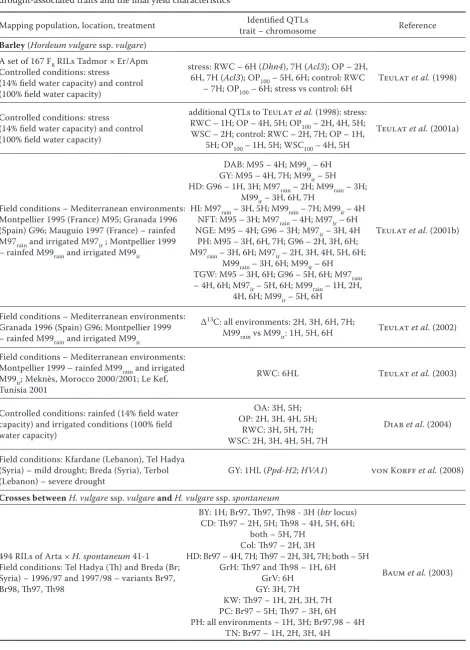
ssp., vulgare; H. vulgare ssp. spontaneum), common wheat (Triticum aestivum) and durum wheat (T. du-rum) is provided in Table 2.
In many studies of drought-associated QTLs in barley, mapping populations derived from the cultivar Tadmor are used. Tadmor represents a black-seeded barley cultivar selected by International Center for Agricultural Research in the Dry Areas (ICARDA) from a Syrian landrace Arabi Aswad. It represents a very drought- and salt-tolerant genotype suitable as a genetic source for an incorporation of beneficial alleles and QTLs into elite modern barley cultivars (Teulat et al. 1998). A set of 167 F8 recombinant inbred lines (RILs) derived from a cross between Tadmor and Er/Apm (a genotype originating from the Mediterranean basin, but adapted only to specific dry environments) has been investigated for drought-associated QTLs under different environments (di-verse field locations across the Mediterranean basin; growth chamber experiments) by several authors (Teulat et al. 1998, 2001a, b, 2002, 2003; Diab et al. 2004). The studies were focused on determination of QTLs associated with drought-related traits (OA, OP, osmotic potential at full turgor OP100, relative water content (RWC), relative water content at full turgor RWC100, WSC, water-soluble carbohydrates at full turgor WSC100, Δ13C). The detected QTLs
Table 2. An overview of genetic mapping studies in barley (Hordeum vulgare), wild barley (H. vulgare ssp. spontaneum), common wheat (Triticum aestivum) and durum wheat (T. durum) aimed at determination of major QTLs affecting drought-associated traits and the final yield characteristics
Mapping population, location, treatment trait – chromosomeIdentified QTLs Reference
Barley (Hordeum vulgare ssp. vulgare) A set of 167 F8 RILs Tadmor × Er/Apm
Controlled conditions: stress
(14% field water capacity) and control (100% field water capacity)
stress: RWC – 6H (Dhn4), 7H (Acl3); OP – 2H, 6H, 7H (Acl3); OP100 – 5H, 6H; control: RWC
– 7H; OP100 – 6H; stress vs control: 6H Teulat et al. (1998)
Controlled conditions: stress (14% field water capacity) and control (100% field water capacity)
additional QTLs to Teulat et al. (1998): stress: RWC – 1H; OP – 4H, 5H; OP100 – 2H, 4H, 5H;
WSC – 2H; control: RWC – 2H, 7H; OP – 1H, 5H; OP100 – 1H, 5H; WSC100 – 4H, 5H
Teulat et al. (2001a)
Field conditions – Mediterranean environments: Montpellier 1995 (France) M95; Granada 1996 (Spain) G96; Mauguio 1997 (France) – rainfed M97rain and irrigated M97ir ; Montpellier 1999
– rainfed M99rain and irrigated M99ir
DAB: M95 – 4H; M99ir – 6H GY: M95 – 4H, 7H; M99ir – 5H
HD: G96 – 1H, 3H; M97rain – 2H; M99rain – 3H; M99ir – 3H, 6H, 7H
HI: M97rain – 3H, 5H; M99rain – 7H; M99ir – 4H NFT: M95 – 3H; M97rain – 4H; M97ir – 6H
NGE: M95 – 4H; G96 – 3H; M97ir – 3H, 4H PH: M95 – 3H, 6H, 7H; G96 – 2H, 3H, 6H; M97rain – 3H, 6H; M97ir – 2H, 3H, 4H, 5H, 6H;
M99rain – 3H, 6H; M99ir – 6H
TGW: M95 – 3H, 6H; G96 – 5H, 6H; M97rain – 4H, 6H; M97ir – 5H, 6H; M99rain – 1H, 2H,
4H, 6H; M99ir – 5H, 6H
Teulat et al. (2001b)
Field conditions – Mediterranean environments: Granada 1996 (Spain) G96; Montpellier 1999 – rainfed M99rain and irrigated M99ir
Δ13C: all environments: 2H, 3H, 6H, 7H;
M99rain vs M99ir: 1H, 5H, 6H Teulat et al. (2002)
Field conditions – Mediterranean environments: Montpellier 1999 – rainfed M99rain and irrigated
M99ir; Meknès, Morocco 2000/2001; Le Kef, Tunisia 2001
RWC: 6HL Teulatet al. (2003)
Controlled conditions: rainfed (14% field water capacity) and irrigated conditions (100% field water capacity)
OA: 3H, 5H; OP: 2H, 3H, 4H, 5H;
RWC: 3H, 5H, 7H; WSC: 2H, 3H, 4H, 5H, 7H
Diab et al. (2004)
Field conditions: Kfardane (Lebanon), Tel Hadya (Syria) – mild drought; Breda (Syria), Terbol
(Lebanon) – severe drought GY: 1HL (Ppd-H2; HVA1) von Korff et al. (2008)
Crosses betweenH. vulgare ssp. vulgare andH. vulgare ssp. spontaneum
494 RILs of Arta × H. spontaneum 41-1 Field conditions: Tel Hadya (Th) and Breda (Br; Syria) – 1996/97 and 1997/98 – variants Br97, Br98, Th97, Th98
BY: 1H; Br97, Th97, Th98 - 3H (btr locus) CD: Th97 – 2H, 5H; Th98 – 4H, 5H, 6H;
both – 5H, 7H Col: Th97 – 2H, 3H
HD: Br97 – 4H, 7H; Th97 – 2H, 3H, 7H; both – 5H GrH: Th97 and Th98 – 1H, 6H
GrV: 6H GY: 3H, 7H KW: Th97 – 1H, 2H, 3H, 7H PC: Br97 – 5H; Th97 – 3H, 6H PH: all environments – 1H, 3H; Br97,98 – 4H
TN: Br97 – 1H, 2H, 3H, 4H
of G × E interactions. Several additive and epistatic effects were detected between the QTLs. Several QTLs were also associated with multiple traits. Some
[image:7.595.66.533.103.626.2]QTLs colocalized with known candidate genes. For example, the QTL region on the long arm of 6H chromosome for OA coincided with Dhn4 locus
Table 2 to be continued
Mapping population, location, treatment trait – chromosomeIdentified QTLs Reference
123 DH lines derived from BC1F2 plants of Barke
× H. spontaneum 11508
Field conditions: Cadriano (Italy), Meknès (Morocco), Le Kef (Tunisia) – 2000/01
EL: 7H GrH: 1HL, 3HL, 6HL
GY: 2H, 5H HD: 3H, 7H KW: 7H
PH: 3H
Talamè et al. (2004)
Common wheat (Triticum aestivum) 48 DH lines from F1 of Beaver × Soissons Field conditions: Gleadthorpe, UK –1999/2000
(control) and 2000/01 (drought) FLS: 2B, 2D Verma et al. (2004)
95 DH lines from F1 of Chinese Spring × SQ1
Field conditions: Norwich, UK (1994, 1997, 1998); Zajecar, Serbia (1999,2000); Almaty, Kazakhstan (1998, 1999, 2000); Zaragoza, Spain (1998, 1999) – rainfed vs irrigated treatments per each location and season
yield components:
EP: 1AS, 1BL, 2BS, 3DL, 4AL, 4BS, 4BL, 5AL, 5DL GE: 1AS, 1BL, 2BS, 4AL, 4AS, 4BS, 4BL, 5AL,
5BS, 5BL, 5DS, 5DL, 7AL, 7BS, 7BL TGW: 1BL, 3DL, 4AL, 4AS, 4BL, 4DL, 5AL,
5BL, 5DL, 6BL, 7BS
Quarrie et al. (2005)
GE: 7AL, 7BL Quarrie et al. (2006) Dharwar Dry × Sitta – Obregon, Sonora,
Mexi-co; growing seasons 1998–99 and 1999–2000 GY: 4AL (Xwmc89) Kirigwi et al. (2007) 460 RILs from F1 of Chuan-Mai18 (Chinese
semi-dwarf wheat carrying dwarfing gene Rht8) × Vigour18
Seedling growth traits: leaf width, coleoptile
length – 6A Spielmeyer et al. (2007)
192 RILs from a reciprocal cross between Seri M 82 × Babax – north-eastern Australia 2002-2006
GY: 1D Mathews et al. (2008) GY: 7A
WSC: 6D McIntyre et al. (2010) 161 to 190 DH lines from F1 of Cranbrook ×
Halberd, Sunco × Tasman, CD87 × Katepwa Δ13C: 1BL, 2BS, 3BS, 4AS, 4BS, 5AS, 7AS, 7BS Rebetzke et al. (2008)
Durum wheat (Triticum durum)
249 RILs from F7 of Kofa × Svevo – Mediterra-nean countries (Italy, Lebanon, Morocco, Spain, Syria, Tunisia) 2004/2005
16 growth environments (10 rainfed and 6 irrigated)
GY: 2BL, 3BS HD: 2AS, 2BL, 7BS PH: 1BS, 3AL, 7AS
Maccaferri et al.
(2008)
152 RILs from F6 of durum wheat Langdon × wild emmer (T. turgidum ssp. dicoccoides) accession G18-16 - Israel 2004/2005
Col: 1A, 1B, 2B, 4A, 5A, 5B GY: 2B, 4A, 4B, 5A, 7B HD: 1B, 2B, 3A, 4B, 5A, 7B HI: 1B, 2A, 2B, 5A, 5B, 6A, 6B OA: 2A, 2B, 3A, 3B, 5A, 5B, 6B Δ13C: 1A, 2A, 4A, 5A, 5B, 6A, 6B
Peleg et al. (2009)
and explained 17.7% of the phenotypic variation (Teulat et al. 1998, 2003). QTLs for OP and RWC co-segregated with specific loci with known can-didate genes such as chromosome 7H Acl3 locus coding for barley acyl carrier protein III (Hansen & von Wettstein-Knowles 1991). This protein encodes a cofactor of plant fatty acid synthetase involved in the de novo synthesis of fatty acyl chain, especially in chloroplasts, and revealing an effect on the membrane fluidity. Other QTLs were detected in the vicinity of Ss1B, Dhn4 and KG1348 loci coding for sucrose synthase, dehydrin 4 and thionin. Dhn4
reveals an allelic variation in the copy number of hydrophilic φ segments and the resulting molecular weight (Campbell & Close 1997; Choi et al. 1999); this variation could exhibit a quantitative effect on OA. In the study of Teulat et al. (2001b), a QTL for thousand grain weight (TGW) was mapped on the long arm of chromosome 5H near the Dhn1 locus. The most stable QTLs detected across multiple en-vironments included the QTL on chromosomes 3H and 6H affecting plant height (PH) and TGW. Several overlaps were detected between QTLs for different traits. For example, a total of eight QTLs affecting grain Δ13C were identified by Teulat et al. (2002),
revealing overlaps with QTLs for water status and yield-associated characteristics such as a QTL for TGW mapped near EBmac0684 on chromosome 2H, QTL for PH close to BCD266 on chromosome 2H, QTLs controlling HD on chromosomes 3H and 5H located near Bmag0013 and Bmag0223, respectively, as well as ca 13 areas on chromosome 7H where QTLs controlling RWC and OP were mapped. A large region on chromosome 2H between BCD1069 and Bmag0125 collocated with QTLs affecting OA, a region on chromosome 4H collocated with QTL described for WSC100, the QTL mapped on the long arm of chromosome 1H collocated with QTLs for OP and OP100, and finally, two regions on chromo-somes 7H (nearby ac13) and 2H (between O7.1 and Bmag0125) collocated with QTLs for RWC, OA and agronomic traits. The region on chromosome 2H between O7.1 and Bmag0125 contained overlapping QTLs for Δ13C, OA and WSC indicating an
impor-tant role of this region in genetic determination of carbohydrate metabolism (Teulat et al. 2002).
QTLs for yield and yield components in dry versus mild Mediterranean conditions were mapped on 1HL in the vicinity of the flowering regulating gene
Ppd-H1 and dehydration stress-related Lea gene
HVA1 indicating an important role of the timing of flowering and accumulation of dehydration-induced
LEA proteins in barley drought resistance under severe Mediterranean environments (von Korff
et al. 2008).
Studies utilizing wild barley (Hordeum vulgare
ssp. spontaneum). The population of RILs derived from a cross of Arta × Hordeum vulgare ssp. spon-taneum line 41-1 was investigated by Baum et al.
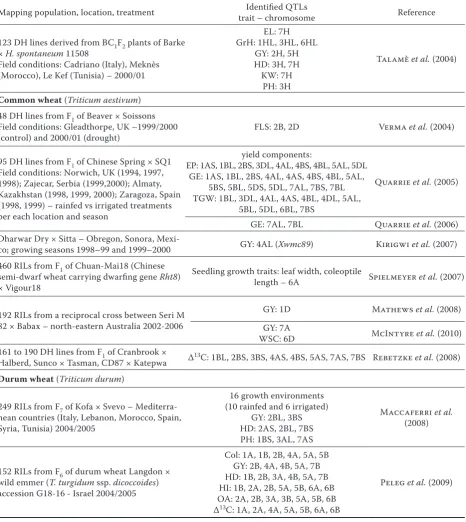
(2003). Drought-associated traits were evaluated at two ICARDA research stations Tel Hadya and Breda in Syria. Mapped QTLs for drought resistance asso-ciated traits were identified for plant morphological and developmental traits (growth habit GrH, growth vigour GrV, heading date HD, PH, tiller number TN), yield associated traits (biological yield BY, grain yield GY, TGW) and stress resistance-associated traits (cold damage; Table 2). Some of the identified QTLs showed also pleiotropic effects on multiple important agronomic traits, e.g. the QTL on 3HS coinciding with btr (non-brittle rachis) locus and revealing also a pleiotropic effect on other traits such as HD, BY and GY. Advanced backcross QTL (AB-QTL) analysis was used to obtain a population of 123 double haploid (DH) lines derived from BC1F2 plants derived from a cross between Barke, a European two-rowed barley cultivar, and wild barley line HOR11508 (Talamè et al. 2004). The DH lines were tested in environments with different water availability in Italy, Morocco and Tunisia, and 80 putative QTLs associated with one or more out of the 7 analysed traits (GrH – erect or pros-trated, HD, PH, ear length, ear extrusion, GY, kernel weight KW) were identified. The allele increasing the value of the trait was contributed by H. spontaneum
in 42 QTLs. For example, the alleles increasing GY at six regions on chromosomes 2H, 3H, 5H and 7H were contributed by H. spontaneum and two of these QTLs (QTLs associated with Bmac0093 on chromo-some 2H and Bmac0684 on chromosome 5H) were detected in all three environments and revealed the highest additive effects.
QTL mapping studies in wheat
in order to obtain high-density genetic maps (Röder
et al. 1998; Messmer et al. 1999).
Quarrie et al. (2005) carried out a large QTL map-ping study on the population of 95 DH lines derived from F1 plants of Chinese Spring × SQ1 (a high ABA-expressing breeding line) cross. QTL analysis was performed based on the data from 24 site × treatment × year combinations, including nutrient, drought and salt stress factors (locations: Norwich, the UK; Zajecar, Serbia; Almaty, Kazakhstan; Zarago-za, Spain). Seventeen clusters of yield-affecting QTLs were mapped to the wheat genome, two of which were mapped to group 1 chromosomes, one to group 2, one to group 3, five to group 4, four to group 5, one to group 6 and three to group 7. The strongest yield-affecting QTLs were mapped to chromosomes 7AL and 7BL, mainly due to their effect on the number of grains per ear (NGE). Comparative mapping us-ing a collinearity between wheat and rice genomes has identified candidate genes AINTEGUMENTA
and G-protein subunit affecting the lateral cell divi-sion at 7AL locus (Quarrie et al. 2006). Three of the yield-affecting QTLs were coincident with the positions of the dwarfing gene Rht-B1 on 4BS and with vernalisation genes Vrn-A1 on 5AL and Vrn-D1
on 5DL. Two additional yield-affecting QTLs were identified on chromosomes 1D and 5A in drought-stressed environments.
In a mapping population derived from Mexican wheat cultivars, a region on chromosome 4AL as-sociated with SSR locus Xwmc89 was found to have a significant effect on GY and yield-associated com-ponents (grain fill rate, spike density, biomass pro-duction, drought susceptibility index DSI; Kirigwi
et al. 2007). Further studies have revealed a strong dependence of yield-associated QTL on QTLs asso-ciated with anthesis (date of flowering) and further characteristics such as grain number and grain size (Mathews et al. 2008; McIntyre et al. 2010).
Carbon isotope discrimination (Δ13C) significantly
affects wheat yield in dry environments. Genetic analysis of three wheat mapping populations with respect to Δ13C has revealed a relatively high number
of QTLs affecting Δ13C revealing stability across
dif-ferent genetic materials and environments. Some of these QTL were associated with a variation in HD and PH confirming an association between Δ13C and
GY. However, small effects of the individual QTLs may reduce the utilization of Δ13C in breeding
pro-grammes (Rebetzke et al. 2008).
Shading the soil early during plant development helps young plants spare water. Greater seedling
leaf area and longer coleoptiles represent the major determinants of early vigour, wheat ability to form a closed canopy early enough to diminish water losses by the soil surface evaporation. A QTL on chromo-some 6A was determined in the breeding population derived from a cross between Chinese semi-dwarf wheat Chuan-Mai 18 and tall breeding line Vigour 18 by Spielmeyer et al. (2007). This QTL was as-sociated with SSR marker NW3106 and accounted for up to 8% of the variation in coleoptile length and 14% of seedling leaf width.
The timing of flag leaf senescence (FLS) represents an important determinant of yield under terminal drought conditions due to an increase in cumulative photosynthesis. Verma et al. (2004) investigated QTLs involved in the regulation of FLS in a popula-tion of 48 DH lines derived from a cross between Beaver, a photoperiod-sensitive variety, and Soissons, a photoperiod-insensitive variety. The major QTLs involved in the regulation of FLS were mapped on chromosomes 2B and 2D. The dynamics of FLS was evaluated as a percentage of green flag leaf area re-maining in 14 days and 35 days after anthesis. Flag leaf senescence revealed a positive correlation with yield under variable environments.
In durum wheat (Triticum durum), an extensive mapping study was carried out by Maccaferri et al. (2008) on a population of 249 RILs derived from a cross between cultivars Kofa and Svevo. The lines were grown in 16 environments characterised by large differences in water availability. Sixteen QTLs affecting GY were detected, out of which two major QTLs on chromosomes 2BL and 3BS showed signifi-cant effects in 8 and 7 environments, respectively. Plant height associated QTLs were identified on chromosomes 1BS, 3AL and 7AS. Heading date as-sociated QTLs were detected on chromosomes 2AS, 2BL and 7BS. Moreover, an overlap for GY and PH QTLs was detected on 2BL and 3BS revealing a sig-nificant epistatic effect on these traits across several environments. In a population of 152 RILs derived from a cross between durum wheat cv. Langdon and wild emmer (Triticum turgidum ssp. dicoccoides), a total of 110 QTLs were mapped by Peleg et al.
(2009) for 11 growth and yield-related traits under drought. Major QTLs affecting yield were mapped to chromosomes 2B, 4A, 5A and 7B and were as-sociated with QTLs for drought resistance-related traits such as Δ13C and OA indicating a significant
Breeding approaches to improve drought resistance in barley and wheat
Breeding programs aimed at an improvement of wheat and barley resistance to drought are established at institutions focused on dryland agriculture such as ICARDA, International Crops Research Institute for Semi-arid Tropics (ICRISAT), International Maize and Wheat Improvement Center (CIMMYT), etc. Wide crossing approaches using interspecific and interge-neric hybridisation represent a promising way of stress resistance enhancement based on the exploitation of secondary and tertiary gene pools, respectively. Wild relatives and landraces are used in wheat breeding programmes carried out at CIMMYT. Alleles associ-ated with an enhanced stress resistance which were lost due to the bottleneck of domestication can be thus introduced into modern germplasm. Interspe-cific hybridisation includes the techniques associated with preparation and exploitation of resynthesized wheat lines. Wild relatives of wheat, wild emmer with genome AB, and Aegilops tauschii with genome D, were employed to construct synthetic or resynthesized hexaploid wheat. The resynthesized hexaploid wheats are then used in crosses with elite breeding wheat cultivars in order to introduce novel alleles into the relatively poor genetic background of these materials. Four lines derived from the crosses between synthetic hexaploid wheat and elite materials (d67.2/p66.270/Ae. squarrosa (320)/3/Cunningham; Croc_1/Ae. squarrosa
(210)//2*Excalibur; Croc_1/Ae. squarrosa (224)//Opata; Sokoll) were employed in the study of Reynolds et al. (2007) and used for comparison of their ability to adapt themselves to drought with respect to their elite parents (Cunningham, Excalibur). The crosses between resynthesized hexaploid wheats and elite materials, the so-called synthetic derived (SYN-DER) lines, in comparison with their recurrent parents (REC-PAR), revealed a better adaptation of their root system to drought. However, this was not associated with sim-ply a larger overall investment in root dry weight, but rather with an increased partitioning of root biomass to deeper soil profiles (between 60 and 120 cm) and an increased ability to extract moisture from these depths. The studied SYN-DER lines also revealed with respect to REC-PAR a relatively higher biomass under drought combined with a relatively high level of WSC, increased WUE and TE which resulted in a higher GY. Around 800 different synthetic hexaploids have been produced by CIMMYT to date, out of which 95 lines are further used in breeding programs globally (Reynolds et al. 2005).
Intergeneric hybridisation tries to exploit stress resistance-associated traits also from wild related genera such as Thinopyrum (Th. elongatum, Th. pon-ticum). Crossing with wheat leads to production of amphiploids and formation of lines with alien chromosome additions, substitutions, translocations or introgressions. An introgression of chromosome 4D from Aegilops tauschii in durum wheat cv. Lang-don via homologous recombination leading to the substitution of durum wheat chromosome 4A by
Ae. tauschii chromosome 4D and an improved salin-ity resistance can be given as an example (Dvořák & Gorham 1992).
Another strategy of the introduction of new alleles into elite breeding germplasm lies in utilization of landraces grown in harsh environments. Prior to breeding, prescreening tests are usually carried out to select the most promising genotypes. Comparison of selected landraces and modern cultivars of durum wheat from the Mediterranean region has revealed significant differences in many traits between the two groups. Modern cultivars exhibited higher yields under both rainfed and irrigated conditions, higher grain weight by about 2 mg, and four more grains per spike on average than landraces. In contrast, landraces flowered on average 1 day later and were about 20 cm taller than their modern counterparts (Araus et al. 2007). However, the utilisation of wild germplasm such as landraces and secondary and tertiary gene pools for the improvement of stress resistance in modern cultivars represents a contro-versial process. Besides desirable drought resistance-related alleles, other alleles with adverse effects on important agronomic characteristics such as grain quality and yield parameters can be introduced into elite breeding materials. Advanced backcross QTL analysis represents a promising approach to transfer valuable QTLs from an unadapted germplasm into elite breeding lines (Tanksley & Nelson 1996).
of carefully selected germplasm based on a cooperation of breeders, modellers and plant biologists can be used to accumulate desirable alleles underlying multiple phenotypic traits to achieve a superior enhancement in drought resistance (Reynolds et al. 2005).
Marker-assisted selection (MAS) utilizes knowledge of the position of drought-associated QTLs gained via genetic mapping studies. However, in the case of abiotic stress factors such as drought, most QTLs depend both on a given genetic background and a given environment. Thus, first of all, the identifica-tion of stable QTLs is necessary for breeders (Col-lins et al. 2008). Association of drought-related QTLs with molecular markers or even candidate genes enables the breeders to detect the presence or absence of a given QTL in selected plant mate-rial during breeding. Utilisation of MAS approaches also enables QTL pyramiding, i.e. an introduction of multiple QTLs associated with different drought-related phenotypic traits into one plant material to improve multiple drought- and yield-associated traits. QTL pyramiding can be utilised to produce an elite genetic material encompassing suitable alleles from diverse genetic resources in one breeding material. The strategy of QTL pyramiding has been effective in genes underlying resistance to pathogens, i.e. traits determined by a few genes with major effects. In the case of multigenic traits, utilisation of this approach is more complicated due to a large number of QTLs affecting the resulting trait and often complicated genetic interactions (additive, dominant, overdomi-nant, epistatic effects) between the individual QTLs (reviewed in Tuberosa & Salvi 2006).
Publication of the whole genome sequencing results will facilitate the search for candidate genes underly-ing QTLs identified in genetic mappunderly-ing studies aimed at the search for drought resistance-related alleles. Candidate gene identification could then open the way to direct transfer of a desirable allele via modern molecular approaches (e.g. cisgenesis) without a risk of concomitant transfer of several adverse alleles from an unadapted germplasm (Schouten et al.
2006; Jacobsen & Schouten 2007).
Breeding for an improved drought resistance still remains a great challenge due to a complex nature of the trait. In cereals, drought resistance is usually based upon a drought avoidance strategy, i.e. achieving a balance between plant water uptake and release aimed at the maintenance of a high cellular water potential to retain plant growth under adverse environmental conditions. There are many ways how to achieve this aim. Selection of the most suitable breeding strategies
depends on both the plant developmental phase and the severity of environmental conditions. Under a severe lack of water, the most efficient way of water utilization lies in a “conservative strategy”, i.e. maximizing WUE as observed in low Δ13C cereals such as Australian wheat
cultivars Drysdale and Rees (Rebetzke et al. 2002). However, under mild stress conditions or under arti-ficial irrigation, maximizing WUE could lead to yield penalty due to restricted stomatal transpiration and CO2 fixation. Strategies based on maximizing EUW, i.e. maximizing plant water uptake without reducing water release via stomatal transpiration as observed in high Δ13C cereals, seem to represent a more efficient
way with respect to the final yield than conservative strategies based on maximizing WUE (Araus et al.
2002; Condon et al. 2004). However, total water use and cumulative photosynthesis over the whole crop life cycle seem to represent more relevant criteria with respect to the final yield than WUE or TE (Va-dez et al. 2014). The plant developmental phase when drought stress occurs also affects the target traits for breeding programmes. When drought affects young plants, breeding for an early vigour leading to early canopy closure and elimination of soil water evapora-tion represents an efficient strategy leading to drought avoidance. On the other hand, when drought affects plants during the grain filling period, a “stay-green” phenotype resulting in a delay of FLS represents an efficient strategy leading to an increase in cumulative photosynthesis and in the final yield (Borrell et al.
2001). An overview of various scenarios for different environmental conditions was given in Tardieu and Tuberosa (2010) and Tardieu (2012).
CONCLUSION
Drought remains the most severe abiotic stress fac-tor for a global cereal production in the 21st century.
Drought resistance represents a polygenic trait with multiple components associated with plant water status, cellular metabolism, growth and develop-mental characteristics affecting the final crop yield whose values depend on many interacting genetic and environmental factors. Intensive genetic map-ping programmes aimed at detection and further characterization of stable QTLs affecting key yield characteristics under a broad range of environments have already been launched.
The key steps in the breeding programmes aimed at an improvement of drought resistance in small-grain cereals (barley, wheat) can be described as follows:
First, improvement of agricultural practices, i.e. improvement of crop management (date of sowing, fertilization) and soil characteristics (soil retention and infiltration capacity) leading to enhanced water utilization by the crop has to be considered.
Approaches aimed at genetic improvement of the crop with respect to drought resistance should first consider the knowledge of the target environment and identi-fication of key phenotypic traits and strategies aimed at maximizing crop yield in the given environment.
Further steps should include: (1) modelling of crop ideotype encompassing all key phenotypic traits af-fecting the resulting drought resistance and the final yield under the given environment; (2) search for the most suitable genetic resources possessing QTLs which can contribute to the improvement of key phenotypic traits of the target plant material; (3) transfer of the selected QTLs from genetic resources via MAS or QTL pyramiding, development of multiple crosses between the locally adapted germplasm and parent possessing the drought-adaptive mechanism (e.g. BCNAM, this also allows the identification of QTLs in “multiple RILs populations”); (4) identification of candidate gene(s) and desirable alleles underlying drought resistance-associated QTLs; this will be hopefully enabled by the knowledge of barley (and in the near future also common wheat) genome sequence; (5) candidate gene transfer can be achieved by genetic engineering techniques (e.g. cisgenesis); (6) the resulting progenies possessing transferred QTL have to be tested for the effects of the transferred QTL on the resulting phe-notype. Genetic interactions of the transferred QTL with respect to the novel genetic background have also to be investigated. Testing has to be cheap and rapid, otherwise it is of no use for breeders.
This is an ideal situation; however, the investiga-tion of drought resistance brings several obstacles which may complicate the breeding effort. The first obstacle lies in the complexity of studied traits and drought resistance strategies and their dependence on timing and severity of drought stress. The second obstacle lies in the complexity of G × E interactions. The third obstacle lies in the successful introgression of a stable drought resistance-associated QTL into elite breeding germplasm and testing its effect in a new genetic background under the field conditions. Moreover, interactions between multiple stress factors in the field conditions have to be taken into account (Mittler 2002, 2006). However, a rapid progress in novel genetic mapping and breeding approaches (marker-assisted recurrent selection MARS, MAS, RILs, BCNAM) together with increasing knowledge of wheat and barley genome structure, candidate genes underlying QTLs detected in the mapping studies and their mutual genetic interactions can represent a source of optimism for the breeders focused on drought resistance improvement in wheat and barley.
Acknowledgements. The work was supported by Projects No. QJ1310055 and No. MZE RO0414 of Ministry of Agri-culture of the Czech Republic.
References
Agre P., Preston G.M., Smith B.L., Jung J.S., Raina S., Moon C., Guggino W.B., Nielsen S. (1993): Aquaporin chip: the archetypal molecular water channel. American Journal of Physiology, 265: 463–476.
Araus J.L., Cairns J.E. (2014): Field high-throughput phenotyping: the new crop breeding frontier. Trends in Plant Science, 19: 52–61.
Araus J.L., Slafer G.A., Reynolds M.P., Royo C. (2002): Plant breeding and drought in C3 cereals: What should
we breed for? Annals of Botany, 89: 925–940.
Araus J.L., Ferrio J.P., Buxó R., Voltas J. (2007): The his-torial perspective of dryland agriculture: lessons learned from 10 000 years of wheat cultivation. Journal of Experi-mental Botany, 58: 131–145.
Battaglia M., Olvera-Carillo Y., Garciarrubio A., Campos F., Covarrubias A.A. (2008): The enigmatic LEA proteins and other hydrophilins. Plant Physiology,
148: 6–24.
Blum A. (2009): Effective use of water (EUW) and not water-use efficiency (WUE) is the target of crop yield improvement under drought stress. Field Crops Research,
112: 119–123.
Blum A. (2011): Drought resistance – is it really a complex trait? Functional Plant Biology, 38: 753–757.
Blum A., Zhang J., Nguyen H.T. (1999): Consistent dif-ferences among wheat cultivars in osmotic adjustment and their relationship to plant production. Field Crops Research, 64: 287–291.
Borrell A., Hammer G., Van Oosterom E. (2001): Stay-green: a consequence of the balance between supply and demand for nitrogen during grain filling? Annals of Ap-plied Biology, 138: 91–95.
Campbell S.A., Close T.J. (1997): Dehydrins: genes, pro-teins, and associations with phenotypic traits. New Phy-tologist, 137: 61–74.
Cattivelli L., Rizza F., Badeck F.W., Mazzucotelli E., Mastrangelo A.M., Francia E., Marè C., Tondel-li A., Stanca A.M. (2008): Drought tolerance improve-ment in crop plants: an integrated view from breeding to genomics. Field Crops Research, 105: 1–14.
Chaves M.M., Maroco J.P., Pereira J.S. (2003): Under-standing plant responses to drought – from genes to the whole plant. Functional Plant Biology, 30: 239–264. Choi D.W., Zhu B., Close T.J. (1999): The barley (Hordeum
vulgare L.) dehydrin multigene family: sequences, allele types, chromosome assignments, and expression charac-teristics of 11 Dhn genes of cv Dicktoo. Theoretical and Applied Genetics, 98: 1234–1247.
Collins N.C., Tardieu F., Tuberosa R. (2008): Quantita-tive trait loci and crop performance under abiotic stress: Where do we stand? Plant Physiology, 147: 469–486. Condon A.G., Richards R.A., Rebetzke G.J., Farquhar
G.D. (2004): Breeding for high water-use efficiency. Jour-nal of Experimental Botany, 55: 2447–2460.
Diab A.A., Teulat-Merah B., This D., Ozturk N., Benscher D., Sorrells M.E. (2004): Identification of drought-inducible genes and differentially expressed sequence tags in barley. Theoretical and Applied Genet-ics, 109: 1417–1425.
Dvořák J., Gorham J. (1992): Methodology of gene trans-fer by homoeologous recombination into Triticum tur-gidum: transfer of K+/Na+ discrimination from Triticum
aestivum. Genome, 35: 639–646.
FAO (2013): World Food and Agriculture. Statistical Year-book. Food and Agriculture Organization of the United States, Rome.
Farquhar G.D., Richards R.A. (1984): Isotopic composi-tion of plant carbon correlates with water-use-efficiency of wheat genotypes. Australian Journal of Plant Physiol-ogy, 11: 539–552.
Farquhar G.D., Ehleringer J.R., Hubick K.T. (1989): Carbon isotope discrimination and photosynthesis.
An-nual Review of Plant Physiology and Plant Molecular Biology, 40: 503–537.
Fleury D., Jefferies S., Kuchel H., Langridge P. (2010): Genetic and genomic tools to improve drought tolerance in wheat. Journal of Experimental Botany, 61: 3211–3222. Hansen L., von Wettstein-Knowles P. (1991): The
barley Acl1- and Acl3-encoding acyl carrier proteins I and III are located on different chromosomes. Molecular and General Genetics, 229: 467–478.
Hubick K.T., Farquhar G.D. (1989): Genetic variation in carbon isotope discrimination and the ratio of carbon gained to water lost in barley. Plant Cell and Environ-ment, 12: 795–804.
Jackson R.B., Sperry J.S., Dawson T.E. (2000): Root water uptake and transport: using physiological processes in global predictions. Trends in Plant Science, 5: 482–488. Jacobsen E., Schouten H.J. (2007): Cisgenesis strongly
improves introgression breeding and induced translocation breeding of plants. Trends in Biotechnology, 25: 219–223. Kameli A., Lösel D.M. (1995): Contribution of carbohy-drates and other solutes to osmotic adjustment in wheat leaves under water stress. Journal of Plant Physiology,
145: 363–366.
Kirigwi F.M., Van Ginkel M., Brown-Guedira G., Gill B.S., Paulsen G.M., Fritz A.K. (2007): Markers associ-ated with a QTL for grain yield in wheat under drought. Molecular Breeding, 20: 401–413.
Kirkegaard J.A., Lilley J.M., Howe G.N., Graham J.M. (2007): Impact of subsoil water use on wheat yield. Australian Journal of Agricultural Research, 58: 303–315. Kosová K., Chrpová J., Šíp V. (2009): Cereal resistance to
Fusarium head blight and possibilities of its improvement through breeding. Czech Journal of Genetics and Plant Breeding, 45: 87–105.
Kosová K., Prášil I.T., Vítámvás P. (2010): Role of dehy-drins in plant stress response. In: Pessarakli M. (ed.): Handbook of Plant and Crop Stress. 3rd Ed. revised and
expanded. CRC Press, Taylor and Francis, Boca Raton, 239–285.
Larcher W. (2003): Physiological Plant Ecology. 4th Ed.
Springer Verlag, Berlin–Heidelberg.
Lawlor D.W. (2013): Genetic engineering to improve plant performance under drought: physiological evaluation of achievements, limitations, and possibilities. Journal of Experimental Botany, 64: 83–108.
Levitt J. (1980): Responses of Plants to Environmental Stress. Volume II: Water, Radiation, Salt, and Other Stresses. 2nd Ed. Academic Press, New York.
Ludlow M.M., Muchow R.C. (1990): A critical evalua-tion of traits for improving crop yield in water-limited environments. Advances in Agronomy, 43: 107–153. Maccaferri M., Sanguineti M.C., Corneti S., Ortega
Maal-ouf F., Machlab H., Martos V., Moragues M., Mo-tawaj J., Nachit M., Nserallah N., Ouabbou H., Royo C., Slama A., Tuberosa R. (2008): Quantitative trait loci for grain yield and adaptation of durum wheat (Triticum durum Desf.) across a wide range of water availability. Genetics, 178: 489–511.
Manschadi A.M., Christopher J., Devoil P., Hammer G.L. (2006): The role of root architectural traits in adapta-tion of wheat to water-limited environments. Funcadapta-tional Plant Biology, 33: 823–837.
Mathews K.L., Malosetti M., Chapman S., McIn-tyre L., Reynolds M., Shorter R., van Eeuwijk F. (2008): Multi-environment QTL mixed models for drought stress adaptation in wheat. Theoretical and Ap-plied Genetics, 117: 1077–1091.
McIntyre L.C., Mathews K.L., Rattey A., Chapman S.C., Drenth J., Ghaderi M., Reynolds M., Shorter R. (2010): Molecular detection of genomic regions associated with grain yield and yield-related components in an elite bread wheat cross evaluated under irrigated and rainfed condi-tions. Theoretical and Applied Genetics, 120: 527–541. Messmer M.M., Keller M., Zanetti S., Keller B. (1999):
Genetic linkage map of a wheat x spelt cross. Theoretical and Applied Genetics, 98: 1163–1170.
Mittler R. (2002): Oxidative stress, antioxidants and stress tolerance. Trends in Plant Science, 7: 405–410.
Mittler R. (2006): Abiotic stress, the field environment and stress combination. Trends in Plant Science, 11: 15–19. Morgan J.M. (1983): Osmoregulation as a selection
crite-rion for drought tolerance in wheat. Australian Journal of Agricultural Research, 34: 607–614.
Nevo E. (1992): Origin, evolution, population genetics and resources for breeding of wild barley, Hordeum sponta-neum, in the Fertile Crescent. In: Shewry P. (ed): Barley: Genetics, Molecular Biology and Biotechnology. CABI, Wallingford, 19–43.
Passioura J.B., Angus J.F. (2010): Improving productivity of crops in water-limited environments. In: Sparks D.L. (ed.): Advances in Agronomy. Volume 106, Academic Press, Burlington, 37–55.
Peleg Z., Fahima T., Krugman T., Abbo S., Yakir D., Korol A.B., Saranga Y. (2009): Genomic dissection of drought resistance in durum wheat × wild emmer wheat recombinant inbred line population. Plant, Cell and En-vironment, 32: 758–779.
Powell W., Thomas W.T.B., Baier E., Lawrence P., Booth A., Harrower B., McNicol J.W., Waugh R. (1997): Analy-sis of quantitative trait in barley by the use of Amplified Fragment Length Polymorphism. Heredity, 79: 48–59. Quarrie S.A., Steed A., Calestani C., Semikhodskii
A., Lebreton C., Chinoy C., Steele N., Pljevljaku-sic D., Waterman E., Weyen J., Schondelmaier J., Habash D.Z., Farmer P., Saker L., Clarkson D.T., Abugalieva A., Yessimbekova M., Turuspekov Y.,
Abugalieva S., Tuberosa R., Sanguineti M.C., Hol-lington P.A., Aragués R., Royo A., Dodig D. (2005): A high density genetic map of hexaploid wheat (Triticum aestivum L.) from the cross Chinese Spring × SQ1 and its use to compare QTLs for grain yield across a range of envi-ronments. Theoretical and Applied Genetics, 110: 865–880. Quarrie S.A., Pekic Quarrie S., Radosevic R., Rancic D., Kaminska A., Barnes J.D., Leverington M., Ceoloni C., Dodig D. (2006): Dissecting a wheat QTL for yield pre-sent in a range of environments: from the QTL to candidate genes. Journal of Experimental Botany, 57: 2627–2637. Rebetzke G.J., Condon A.G., Richards R.A., Farquhar
G.D. (2002): Selection for reduced carbon isotope dis-crimination increases aerial biomass and grain yield of rainfed bread wheat. Crop Science, 42: 739–745. Rebetzke G.J., Condon A.G., Farquhar G.D., Appels R.,
Richards R.A. (2008): Quantitative trait loci for carbon isotope discrimination are repeatable across environ-ments and wheat mapping populations. Theoretical and Applied Genetics, 118: 123–137.
Reynolds M.P., Mujeeb-Kazi A., Sawkins M. (2005): Pros-pects for utilizing plant-adaptive mechanisms to improve wheat and other crops in drought- and salinity-prone environments. Annals of Applied Biology, 146: 239–259. Reynolds M., Dreccer F., Trethowan R. (2007): Drought-adaptive traits derived from wheat wild relatives and lan-draces. Journal of Experimental Botany, 58: 177–186. Richards R.A., Rebetzke G.J., Condon A.G., van
Her-waarden A.F. (2002): Breeding opportunities for in-creasing the efficiency of water use and crop yield in temperate cereals. Crop Science, 42: 111–121.
Röder M.S., Korzun V., Wedehake K., Plaschke J., Tixier M.H., Leroy P., Ganal M.W. (1998): A micros-atellite map of wheat. Genetics, 149: 2007–2023. Schouten H.J., Krens F.A., Jacobsen E. (2006): Cisgenic
plants are similar to traditionally bred plants – interna-tional regulations for genetically modified organisms should be altered to exempt cisgenesis. EMBO Reports,
7: 750–753.
Serraj R., Sinclair T.R. (2002): Osmolyte accumulation: can it really help increase crop yield under drought condi-tions? Plant, Cell and Environment, 25: 333–341. Spielmeyer W., Hyles J., Joaquim P., Azanza F.,
Bon-nett D., Ellis M.E., Moore C., Richards R.A. (2007): A QTL on chromosome 6A in bread wheat (Triticum aestivum) is associated with longer coleoptiles, greater seedling vigour and final plant height. Theoretical and Applied Genetics, 115: 59–66.
Tanksley S.D., Nelson J.C. (1996): Advanced backcross QTL analysis: a method for the simultaneous discovery and transfer of valuable QTLs from unadapted germplasm into elite breeding lines. Theoretical and Applied Genet-ics, 92: 191–203.
Tardieu F. (2012): Any trait or trait-related allele can confer drought tolerance: just design the right drought scenario. Journal of Experimental Botany, 63: 25–31.
Tardieu F., Tuberosa R. (2010): Dissection and modelling of abiotic stress tolerance in plants. Current Opinion in Plant Biology, 13: 206–212.
Teulat B., This D., Khairallah M., Borries C., Ragot C., Sourdille P., Leroy P., Monneveux P., Charrier A. (1998): Several QTLs involved in osmotic-adjustment trait variation in barley (Hordeum vulgare L.). Theoretical and Applied Genetics, 96: 688–698.
Teulat B., Borries C., This D. (2001a): New QTLs iden-tified for plant water status, water-soluble carbohydrate and osmotic adjustment in a barley population grown in a growth-chamber under two water regimes. Theoretical and Applied Genetics, 103: 161–170.
Teulat B., Merah O., Souyris I., This D. (2001b): QTLs for agronomic traits from a Mediterranean barley progeny grown in several environments. Theoretical and Applied Genetics, 103: 774–787.
Teulat B., Merah O., Sirault X., Borries C., Waugh R., This D. (2002): QTLs for grain carbon isotope discrimi-nation in field-grown barley. Theoretical and Applied Genetics, 106: 118–126.
Teulat B., Zoumarou-Wallis N., Rotter B., Ben Salem M., Bahri H., This D. (2003): QTL for relative water content in field-grown barley and their stability across Mediterranean environments. Theoretical and Applied Genetics, 108: 181–188.
The International Barley Genome Sequencing Consortium (2012): A physical, genetic and functional sequence assembly of the barley genome. Nature, 491: 711–717.
Tuberosa R. (2012): Phenotyping for drought tolerance of crops in the genomics era. Frontiers in Physiology, 3: 347. Tuberosa R., Salvi S. (2006): Genomics-based approaches to improve drought tolerance of crops. Trends in Plant Science, 11: 405–412.
Tyerman S.D., Niemietz C.M., Bramley H. (2002): Plant aquaporins: multifunctional water and solute channels with expanding roles. Plant Cell and Environment, 25: 173–194.
Urao T., Yakubova B., Satoha R., Yamaguchi-Shi-nozaki K., Sekib M., Hirayamab T., ShiYamaguchi-Shi-nozakib K. (1999): A transmembrane hybrid-type histidine kinase in Arabidopsis functions as an osmosensor. The Plant Cell, 11: 1743–1754.
Vadez V. (2014): Root hydraulics: The forgotten side of roots in drought adaptation. Field Crops Research, 165: 15–24.
Vadez V., Rao S., Kholova J., Krishnamurthy L., Kashi-wagi J., Ratnakumar P., Sharma K.K., Bhatnagar-Mathur P., Basu P.S. (2008): Roots research for legume tolerance to drought. Quo vadis? Journal of Food Leg-umes, 21: 77–85.
Vadez V., Krishnamurthy L., Hash C.T., Upadhyaya H.D., Borrell A.K. (2011): Yield, transpiration effi-ciency, and water-use variations and their interrelation-ships in the sorghum reference collection. Crop Pasture Science, 62: 645–655.
Vadez V., Kholova J., Zaman-Allah M., Belko N. (2013): Water: the most important „molecular“ compo-nent of water stress tolerance research. Functional Plant Biology, 40: 1310–1322.
Vadez V., Kholova J., Medina S., Kakkera A., Ander-berg H. (2014): Transpiration efficiency: new insights into an old story. Journal of Experimental Botany, in press, DOI: 10.1093/jxb/eru040.
Verma V., Foulkes M.J., Worland A.J., Sylvester-Bradley R., Caligari P.D.S., Snape J.W. (2004): Map-ping quantitative trait loci for flag leaf senescence as a yield determinant in winter wheat under optimal and drought-stressed environments. Euphytica, 135: 255–263. Von Korff M., Grando S., Del Greco A., This D.,
Baum M., Ceccarelli S. (2008): Quantitative trait loci associated with adaptation to Mediterranean dryland conditions in barley. Theoretical and Applied Genetics,
117: 653–669.
Watson D.J. (1947): Comparative physiological studies in the growth of field crops. I. Variation in net assimilation rate and leaf area between species and varieties, and within and between years. Annals of Botany, 11: 41–76. Yamaguchi-Shinozaki K., Shinozaki K. (2006): Tran-scriptional regulatory networks in cellular responses and tolerance to dehydration and cold stresses. Annual Review of Plant Biology, 57: 781–803.
Received for publication May 27, 2014 Accepted after corrections August 26, 2014
Corresponding author: