research communications
Acta Cryst.(2017). E73, 713–715 https://doi.org/10.1107/S2056989017005266
713
Received 17 January 2017Accepted 6 April 2017
Edited by M. Weil, Vienna University of Technology, Austria
Keywords:crystal structure; quasi-one-dimen-sional structure; mixed-metal trisulfide.
CCDC reference:1542709
Supporting information:this article has supporting information at journals.iucr.org/e
Crystal structure of the mixed-metal trisulfide
BaCu
1/3Ta
2/3S
3Kejun Bu,aJianqiao He,aDong Wang,bChong Zhengc* and Fuqiang Huanga*
aState Key Laboratory of High Performance Ceramics and Superfine Microstructure, Shanghai Institute of Ceramics,
Chinese Academy of Sciences, Shanghai 200050, People’s Republic of China,bSchool of Materials Science and Engineering, Shanghai University, Shangda Road, No. 99, Shanghai 200444, People’s Republic of China, and
c
Department of Chemistry and Biochemistry, Northern Illinois University, USA. *Correspondence e-mail: [email protected], [email protected]
The mixed-metal title compound, BaCu1/3Ta2/3S3 [barium copper(II)
tanta-lum(V) trisulfide], was prepared through solid-state reactions. The crystal structure adopts the BaTaS3structure type and consists of face-sharing [MS6] (M
= Ta,Cu) octahedra (point-group symmetry 3m.) that are condensed into infinite chains along [001]. Adjacent chains are linked through the barium cations (site symmetry 6m2), which exhibit a coordination number of twelve. TheMsite is occupied by 2/3 of TaVand 1/3 of CuII, whereby the averageM—S distances are
slightly longer than those of ordered BaTaS3. The classical charge balance of the
title compound can be represented by [Ba2+] [(Ta/Cu)4+] [S2 ]3.
1. Chemical context
Barium vanadium trisulfide, BaVS3(Takanoet al., 1977), with
which BaTaS3(Gardneret al., 1969) crystallizes isotypically in
space group P63/mmc, has a chain structure. The observed
conductivity was attributed to the formation of conduction bands via vanadium vanadium d-orbital overlap. It shows three phase transitions and exhibits a number of intriguing physical properties (Nakamuraet al., 1994). While both BaVS3
and BaTaS3are composed of the same type of linear chains,
BaTaS3shows metallic conductivity and a Curie–Weiss
beha-viour of the magnetic susceptibility (Gardneret al., 1969). To explore the physical properties of BaTaS3 and related
[image:1.610.52.458.537.712.2]ISSN 2056-9890
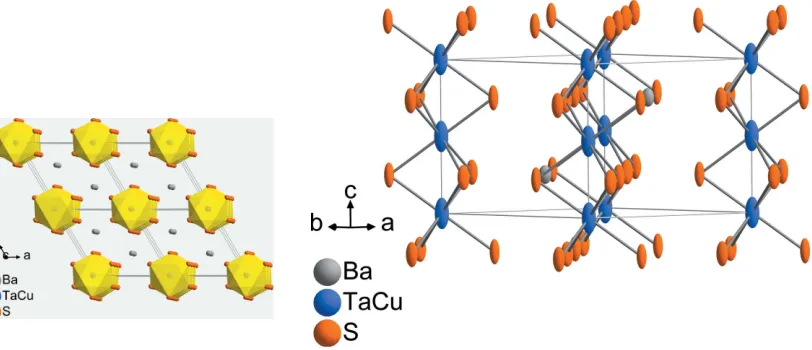
Figure 1
Face-sharing ofMS6(M= Cu, Ta) octahedra in the structure of BaCu1/3
compounds, we have introduced copper and studied mixed-metal phases Ba(Ta/Cu)S3. Here we report on the synthesis
and structural characterization of the mixed-metal trisulfide with composition BaCu1/3Ta2/3S3.
2. Structural commentary
BaCu1/3Ta2/3S3 adopts the BaTaS3 structure type in space
groupP63/mmc. A detailed description of this structure type
has been given previously (Gardner et al., 1969). The asym-metric unit of BaCu1/3Ta2/3S3contains one Ba site (Wyckoff
position 2c), one mixed-occupied (Cu/Ta) site (2a) and one S site (6h). The structure contains face-sharing octahedral [MS6]
(M= Cu, Ta) units, which construct infinite chains along [001] (Fig. 1). In the crystal structure, these chains are linked through Ba cations (coordination number 12) to adjacent chains (Fig. 2).
TheMsite is occupationally disordered and contains 1/3 Cu and 2/3 Ta. It is surrounded by six S atoms with anM—S bond length of 2.475 (4) A˚ , which is slightly longer than that of ordered BaTaS3(2.461 A˚ ; Gardneret al., 1969). This trend is in
agreement with the different ionic radii of Ta (0.64 A˚ for TaV with coordination number of six) and CuII(0.73 A˚ ) using the data provided by Shannon (1976).
The (Cu,Ta) (Cu,Ta) distance within a chain is 2.9159 (3) A˚ , which is much shorter than the interchain (Cu,Ta) (Cu,Ta) distance of 6.8437 (18) A˚ . The Ba—S interactions between adjacent metal sulfide chains are reflected by one shorter [3.422 (6) A˚ ] and one longer distance [3.523 (3) A˚ ], in good agreement with those found in other barium tantalum sulfides (Onoda & Saeki, 1989).
The classical charge balance of the title compound can be represented by the formula [Ba2+] [(Ta/Cu)4+] [S2 ]3.
3. Synthesis and crystallization
The title compound was prepared using solid-state reactions between the elements Cu, Ta, S and BaS. Ta powder (99.999%,
Alfa Aesar Puratronic), Cu powder (99.999%, Alfa Aesar Puratronic), S powder (99.999%, Alfa Aesar Puratronic), and BaS powder (99.999%, Alfa Aesar Puratronic) were mixed in a fused-silica tube in an Ta:Cu:S:BaS molar ratio of 0.67:0.33:2:1. The tube was evacuated to 0.1 Pa, sealed and heated gradually (60 K h 1) to 973 K, where it was kept for 2 d. The tube was then cooled to 673 K at a rate of 3 K h 1and then quenched to room temperature. The crystals are stable in air and alcohol.
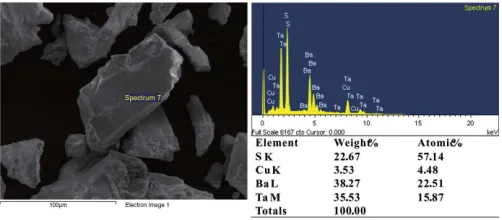
Scanning electron microscopy (SEM) images of selected crystals were taken on a Hitachi S-4800 microscope equipped with an electron microprobe analyzer for a semiquantitative elemental analysis in the energy dispersive X-ray spectroscopy (EDX) mode. The presence of both copper and tantalum was confirmed (Fig. 3).
714
Buet al. BaCu1/3Ta2/3S3 Acta Cryst.(2017). E73, 713–715
[image:2.610.45.294.66.248.2]research communications
Figure 2
The crystal structure of BaCu1/3Ta2/3S3, viewed down [001].
Figure 3
[image:2.610.313.561.89.349.2]SEM image and EDX spectrum of BaCu1/3Ta2/3S3.
Table 1
Experimental details.
Crystal data
Chemical formula BaCu1/3Ta2/3S3
Mr 375.14
Crystal system, space group Hexagonal,P63/mmc
Temperature (K) 297
a,c(A˚ ) 6.8350 (6), 5.8318 (5)
V(A˚3) 235.94 (5)
Z 2
Radiation type MoK
(mm 1) 26.34
Crystal size (mm) 0.040.030.01
Data collection
Diffractometer Bruker D8 QUEST
Absorption correction Multi-scan (SADABS; Bruker, 2015)
Tmin,Tmax 0.44, 0.86
No. of measured, independent and observed [I> 2(I)] reflections
4312, 125, 106
Rint 0.042
(sin/)max(A˚ 1) 0.645
Refinement
R[F2> 2(F2)],wR(F2),S 0.043, 0.113, 1.25
No. of reflections 125
No. of parameters 11
No. of restraints 2
max,min(e A˚ 3
) 1.50, 1.50
Computer programs:APEX3andSAINT(Bruker, 2015),SHELXT(Sheldrick, 2015a),
SHELXL2014/7 (Sheldrick, 2015b), DIAMOND (Brandenburg, 2007) andpublCIF
[image:2.610.315.566.615.725.2]4. Refinement
Crystal data, data collection and structure refinement details are summarized in Table 1. The refinement of the model with occupational disorder on the Msite resulted in a significant decrease of the reliability factors in comparison with a fully occupied Ta site (R1 = 0.73,wR= 0.197). No evidence,e.g. in the form of superstructure reflections, was found for an ordering of this site and thus a statistically disordered model was considered. In the final model, atoms of the disordered site were restrained to have the same displacement para-meters, with a fixed Cu:Ta ratio of 1/3:2/3 required for charge neutrality and in good agreement with the EDX measurement. The remaining maximum and minimum electron densities are located 1.06 A˚ from the (Cu,Ta)1 site and 1.96 A˚ from the S1, respectively.
Funding information
Funding for this research was provided by: State Key Laboratory of High Performance Ceramics and Superfine Microstructure, Shanghai Institute of Ceramics, Chinese Academy of Sciences, Shanghai 200050, People’s Republic of
China. (award No. XDB04040200); CAS Center for Excel-lence in Superconducting Electronics, National key research and development program (award No. 2016YFB0901600); NSF of China (award Nos. 11404358, 51402341); Science and Technology Commission of Shanghai (award Nos. 13JC1405700, 14520722000).
References
Brandenburg, K. (2007).DIAMOND. Crystal Impact GbR, Bonn, Germany.
Bruker (2015). APEX3, SAINT and SADABS. Bruker AXS Inc.,
Madison, Wisconsin, USA.
Gardner, R. A., Vlasse, M. & Wold, A. (1969).Inorg. Chem.8, 2784– 2787.
Nakamura, M., Sekiyama, A., Namatame, H., Fujimori, A., Yoshihara, H., Ohtani, T., Misu, A. & Takano, M. (1994). Phys. Rev. B,49, 16191–16201.
Onoda, M. & Saeki, M. (1989).Mater. Res. Bull.24, 625–631. Shannon, R. D. (1976).Acta Cryst.A32, 751–767.
Sheldrick, G. M. (2015a).Acta Cryst.A71, 3–8. Sheldrick, G. M. (2015b).Acta Cryst.C71, 3–8.
Takano, M., Kosugi, H., Nakanishi, N., Shimada, M., Wada, T. & Koizumi, M. (1977).J. Phys. Soc. Jpn,43, 1101–1102.
Westrip, S. P. (2010).J. Appl. Cryst.43, 920–925.
research communications
Acta Cryst.(2017). E73, 713–715 Buet al. BaCu
supporting information
sup-1 Acta Cryst. (2017). E73, 713-715
supporting information
Acta Cryst. (2017). E73, 713-715 [https://doi.org/10.1107/S2056989017005266]
Crystal structure of the mixed-metal trisulfide BaCu
1/3Ta
2/3S
3Kejun Bu, Jianqiao He, Dong Wang, Chong Zheng and Fuqiang Huang
Computing details
Data collection: APEX3 (Bruker, 2015); cell refinement: SAINT (Bruker, 2015); data reduction: SAINT (Bruker, 2015);
program(s) used to solve structure: SHELXT (Sheldrick, 2015a); program(s) used to refine structure: SHELXL2014/7
(Sheldrick, 2015b); molecular graphics: DIAMOND (Brandenburg, 2007); software used to prepare material for
publication: publCIF (Westrip, 2010).
Barium copper(II) tantalum(V) trisulfide
Crystal data
BaCu0.33Ta0.67S3 Mr = 375.14
Hexagonal, P63/mmc a = 6.8350 (6) Å
c = 5.8318 (5) Å
V = 235.94 (5) Å3 Z = 2
F(000) = 325
Dx = 5.280 Mg m−3
Mo Kα radiation, λ = 0.71073 Å Cell parameters from 1738 reflections
θ = 3.4–25.9°
µ = 26.34 mm−1 T = 297 K Plate, black
0.04 × 0.03 × 0.01 mm
Data collection
Bruker D8 QUEST diffractometer
Detector resolution: 10.4167 pixels mm-1
phi and ω scans
Absorption correction: multi-scan
(SADABS; Bruker, 2015)
Tmin = 0.44, Tmax = 0.86
4312 measured reflections
125 independent reflections 106 reflections with I > 2σ(I)
Rint = 0.042
θmax = 27.3°, θmin = 3.4° h = −8→8
k = −8→8
l = −7→6
Refinement
Refinement on F2
Least-squares matrix: full
R[F2 > 2σ(F2)] = 0.043 wR(F2) = 0.113 S = 1.25 125 reflections 11 parameters
2 restraints
w = 1/[σ2(F
o2) + (0.0503P)2 + 4.8137P]
where P = (Fo2 + 2Fc2)/3
(Δ/σ)max < 0.001
Δρmax = 1.50 e Å−3
supporting information
sup-2 Acta Cryst. (2017). E73, 713-715
Special details
Geometry. All esds (except the esd in the dihedral angle between two l.s. planes) are estimated using the full covariance
matrix. The cell esds are taken into account individually in the estimation of esds in distances, angles and torsion angles; correlations between esds in cell parameters are only used when they are defined by crystal symmetry. An approximate (isotropic) treatment of cell esds is used for estimating esds involving l.s. planes.
Fractional atomic coordinates and isotropic or equivalent isotropic displacement parameters (Å2)
x y z Uiso*/Ueq Occ. (<1)
Ba 0.6667 0.3333 0.75 0.0341 (7)
Ta 0 0 0.5 0.0707 (12) 0.6666 (8)
Cu 0 0 0.5 0.0707 (12) 0.3334 (18)
S 0.1689 (4) 0.3378 (8) 0.75 0.0449 (15)
Atomic displacement parameters (Å2)
U11 U22 U33 U12 U13 U23
Ba 0.0246 (7) 0.0246 (7) 0.0529 (13) 0.0123 (4) 0 0
Ta 0.0306 (8) 0.0306 (8) 0.151 (3) 0.0153 (4) 0 0
Cu 0.0306 (8) 0.0306 (8) 0.151 (3) 0.0153 (4) 0 0
S 0.0217 (18) 0.015 (2) 0.096 (4) 0.0074 (10) 0 0
Geometric parameters (Å, º)
Ba—Si 3.4176 (3) Ta—S 2.475 (4)
Ba—Sii 3.4176 (3) Ta—Sxiii 2.475 (4)
Ba—Siii 3.4176 (3) Ta—Svii 2.475 (4)
Ba—Siv 3.4176 (3) Ta—Sxiv 2.475 (4)
Ba—S 3.4176 (3) Ta—Taxv 2.9159 (3)
Ba—Sv 3.4176 (3) Ta—Cuxvi 2.9159 (3)
Ba—Svi 3.506 (3) Ta—Cuxv 2.9159 (3)
Ba—Svii 3.506 (3) Ta—Taxvi 2.9159 (3)
Ba—Sviii 3.506 (3) S—Cuxv 2.475 (4)
Ba—Six 3.506 (3) S—Taxv 2.475 (4)
Ba—Sx 3.506 (3) S—Baxvii 3.4176 (3)
Ba—Sxi 3.506 (3) S—Bavi 3.506 (3)
Ta—Sxii 2.475 (4) S—Baix 3.506 (3)
Ta—Siii 2.475 (4)
Si—Ba—Sii 60.89 (16) Sxii—Ta—Siii 180.0
Si—Ba—Siii 120.0010 (10) Sxii—Ta—S 91.18 (10)
Sii—Ba—Siii 59.11 (17) Siii—Ta—S 88.82 (10)
Si—Ba—Siv 59.11 (17) Sxii—Ta—Sxiii 88.82 (10)
Sii—Ba—Siv 120.0010 (10) Siii—Ta—Sxiii 91.18 (10)
Siii—Ba—Siv 179.11 (16) S—Ta—Sxiii 180.0
Si—Ba—S 179.11 (17) Sxii—Ta—Svii 88.82 (10)
Sii—Ba—S 120.0000 (10) Siii—Ta—Svii 91.18 (10)
supporting information
sup-3 Acta Cryst. (2017). E73, 713-715
Siv—Ba—S 119.9990 (10) Sxiii—Ta—Svii 88.82 (10)
Si—Ba—Sv 120.0000 (10) Sxii—Ta—Sxiv 91.18 (10)
Sii—Ba—Sv 179.11 (17) Siii—Ta—Sxiv 88.82 (10)
Siii—Ba—Sv 119.9990 (10) S—Ta—Sxiv 88.82 (10)
Siv—Ba—Sv 60.89 (17) Sxiii—Ta—Sxiv 91.18 (10)
S—Ba—Sv 59.11 (17) Svii—Ta—Sxiv 180.0
Si—Ba—Svi 89.75 (5) Sxii—Ta—Taxv 126.10 (7)
Sii—Ba—Svi 118.88 (3) Siii—Ta—Taxv 53.90 (7)
Siii—Ba—Svi 118.88 (3) S—Ta—Taxv 53.90 (7)
Siv—Ba—Svi 61.40 (8) Sxiii—Ta—Taxv 126.10 (7)
S—Ba—Svi 89.75 (5) Svii—Ta—Taxv 126.10 (7)
Sv—Ba—Svi 61.40 (8) Sxiv—Ta—Taxv 53.90 (7)
Si—Ba—Svii 118.88 (3) Sxii—Ta—Cuxvi 53.90 (7)
Sii—Ba—Svii 89.75 (5) Siii—Ta—Cuxvi 126.10 (7)
Siii—Ba—Svii 61.40 (8) S—Ta—Cuxvi 126.10 (7)
Siv—Ba—Svii 118.88 (3) Sxiii—Ta—Cuxvi 53.90 (7)
S—Ba—Svii 61.40 (8) Svii—Ta—Cuxvi 53.90 (7)
Sv—Ba—Svii 89.75 (5) Sxiv—Ta—Cuxvi 126.10 (7)
Svi—Ba—Svii 147.76 (6) Taxv—Ta—Cuxvi 180.0
Si—Ba—Sviii 118.88 (3) Sxii—Ta—Cuxv 126.10 (7)
Sii—Ba—Sviii 89.75 (5) Siii—Ta—Cuxv 53.90 (7)
Siii—Ba—Sviii 61.40 (8) S—Ta—Cuxv 53.90 (7)
Siv—Ba—Sviii 118.88 (3) Sxiii—Ta—Cuxv 126.10 (7)
S—Ba—Sviii 61.40 (8) Svii—Ta—Cuxv 126.10 (7)
Sv—Ba—Sviii 89.75 (5) Sxiv—Ta—Cuxv 53.90 (7)
Svi—Ba—Sviii 57.48 (11) Taxv—Ta—Cuxv 0
Svii—Ba—Sviii 112.55 (14) Cuxvi—Ta—Cuxv 180.0
Si—Ba—Six 89.75 (5) Sxii—Ta—Taxvi 53.90 (7)
Sii—Ba—Six 118.88 (3) Siii—Ta—Taxvi 126.10 (7)
Siii—Ba—Six 118.88 (3) S—Ta—Taxvi 126.10 (7)
Siv—Ba—Six 61.40 (8) Sxiii—Ta—Taxvi 53.90 (7)
S—Ba—Six 89.75 (5) Svii—Ta—Taxvi 53.90 (7)
Sv—Ba—Six 61.40 (8) Sxiv—Ta—Taxvi 126.10 (7)
Svi—Ba—Six 112.55 (14) Taxv—Ta—Taxvi 180.0
Svii—Ba—Six 57.48 (11) Cuxvi—Ta—Taxvi 0
Sviii—Ba—Six 147.76 (6) Cuxv—Ta—Taxvi 180.0
Si—Ba—Sx 61.40 (8) Ta—S—Cuxv 72.2
Sii—Ba—Sx 61.40 (8) Ta—S—Taxv 72.19 (13)
Siii—Ba—Sx 89.75 (5) Cuxv—S—Taxv 0
Siv—Ba—Sx 89.75 (5) Ta—S—Ba 89.64 (7)
S—Ba—Sx 118.88 (3) Cuxv—S—Ba 89.64 (7)
Sv—Ba—Sx 118.88 (3) Taxv—S—Ba 89.64 (7)
Svi—Ba—Sx 57.48 (11) Ta—S—Baxvii 89.64 (7)
Svii—Ba—Sx 147.76 (6) Cuxv—S—Baxvii 89.64 (7)
Sviii—Ba—Sx 57.48 (11) Taxv—S—Baxvii 89.64 (7)
Six—Ba—Sx 147.76 (6) Ba—S—Baxvii 179.11 (16)
Si—Ba—Sxi 61.40 (8) Ta—S—Bavi 159.82 (13)
supporting information
sup-4 Acta Cryst. (2017). E73, 713-715
Siii—Ba—Sxi 89.75 (5) Taxv—S—Bavi 87.629 (7)
Siv—Ba—Sxi 89.75 (5) Ba—S—Bavi 90.25 (5)
S—Ba—Sxi 118.88 (3) Baxvii—S—Bavi 90.25 (5)
Sv—Ba—Sxi 118.88 (3) Ta—S—Baix 87.629 (7)
Svi—Ba—Sxi 147.76 (6) Cuxv—S—Baix 159.82 (13)
Svii—Ba—Sxi 57.48 (11) Taxv—S—Baix 159.82 (13)
Sviii—Ba—Sxi 147.76 (6) Ba—S—Baix 90.25 (5)
Six—Ba—Sxi 57.48 (11) Baxvii—S—Baix 90.25 (5)
Sx—Ba—Sxi 112.55 (13) Bavi—S—Baix 112.55 (13)
Symmetry codes: (i) x+1, y, z; (ii) −y+1, x−y, z; (iii) −x+y, −x, z; (iv) −x+y+1, −x+1, z; (v) −y+1, x−y+1, z; (vi) −x+1, −y+1, −z+2; (vii) y, −x+y, −z+1; (viii) y, −x+y, −z+2; (ix) −x+1, −y+1, −z+1; (x) x−y+1, x, −z+2; (xi) x−y+1, x, −z+1; (xii) x−y, x, −z+1; (xiii) −x, −y, −z+1; (xiv) −y, x−y, z; (xv) −x, −y,