warwick.ac.uk/lib-publications
Manuscript version: Author’s Accepted Manuscript
The version presented in WRAP is the author’s accepted manuscript and may differ from the
published version or Version of Record.
Persistent WRAP URL:
http://wrap.warwick.ac.uk/121256
How to cite:
Please refer to published version for the most recent bibliographic citation information.
If a published version is known of, the repository item page linked to above, will contain
details on accessing it.
Copyright and reuse:
The Warwick Research Archive Portal (WRAP) makes this work by researchers of the
University of Warwick available open access under the following conditions.
Copyright © and all moral rights to the version of the paper presented here belong to the
individual author(s) and/or other copyright owners. To the extent reasonable and
practicable the material made available in WRAP has been checked for eligibility before
being made available.
Copies of full items can be used for personal research or study, educational, or not-for-profit
purposes without prior permission or charge. Provided that the authors, title and full
bibliographic details are credited, a hyperlink and/or URL is given for the original metadata
page and the content is not changed in any way.
Publisher’s statement:
Please refer to the repository item page, publisher’s statement section, for further
information.
Network Intrusion Detection Using Neural
Networks on FPGA SoCs
Lenos Ioannou and Suhaib A. Fahmy
School of Engineering
University of Warwick, Coventry, UK
{l.ioannou, s.fahmy}@warwick.ac.uk
Abstract—Network security is increasing in importance as systems become more interconnected. Much research has been conducted on large appliances for network security, but these do not scale well to lightweight systems such as those used in the Internet of Things (IoT). Meanwhile, the low power processors used in IoT devices do not have the required performance for detailed packet analysis. We present an approach for network intrusion detection using neural networks, implemented on FPGA SoC devices that can achieve the required performance on embedded devices. The design is flexible, allowing model updates in order to adapt to emerging attacks.
I. INTRODUCTION
The Internet of Things (IoT) is driving an exponential growth in connectivity between lightweight embedded sys-tems. These devices are often severely computationally con-strained, being designed to fulfil a single task well. This increased networking presents a challenge in terms of network security since these devices can expose a wider attack surface on account of not being as rigorously engineered as more complex systems. Indeed, the use of IoT devices as a tool in cyberattacks was exemplified by the Mirai malware in 2016, among other cases.
Traditional network security has aimed to provide confi-dentiality, integrity and availability of resources to authorized users. This has often occurred in more controlled network environments such as corporate networks, where firewalls serve as a secure point of interface with open networks. Even in such cases, the possibility of an internal system being compromised requires monitoring for attacks of all traffic, even from within the network.
Intrusion Detection Systems (IDSs) collect and analyse information from the systems within a network for malicious attack detection. Detection can be logged as an event of interest or trigger a defence mechanism to deal with the event in real-time. Mainstream IDSs use pattern matching, string matching, multi-match packet classification and regular expressions for operation [1]. These computationally complex approaches are often implemented using hardware accelerators on FPGAs or ASICs, or run on highly parallel multi-core processors or GPUs to enable them to process network traffic at the high rates required. Hence, such complex systems are usually integrated within the network infrastructure of large organisations.
The limited computing power of embedded systems means IoT devices will often not incorporate significant security
capabilities at the nodes, making them an ideal target for malicious attacks. With such devices being deployed in less controlled environments, and without access to significant infrastructure, more lightweight approaches to such security mechanisms are required.
In this paper we explore a Network Intrusion Detection approach based on Machine Learning, specifically Artificial Neural Networks (ANNs), that provides flexibility to evolve to emerging attacks. We demonstrate how this can be imple-mented on a lightweight Xilinx Zynq FPGA SoC, designed to act as an IoT gateway, that processes packets at line rate while enabling model parameter updates to adapt to changing requirements.
II. BACKGROUND
Intrusion Detection Systems (IDSs) can be divided into two categories, according to the detection method used:
• Signature (or misuse) based:Captured data is compared against a database containing signatures of known attacks. • Anomaly based: Captured data is compared against a model of the expected normal behaviour of the system. If a deviation is observed then an attack has been detected. Signature based IDSs are widely used in commercial sys-tems because of their accurate detection of known attacks, while anomaly based systems are prone to generating false classifications. Signature based IDSs, however, fail to detect unknown (zero-day) attacks. There can also be a significant delay for a new attack to be detected and its signature generated and distributed in an update [2]. Moreover, signature based systems must consider a large database of signatures, re-quiring substantial memory and computational power. Hybrid implementations of signature and anomaly based IDSs present a more robust approach since one method complements the other, though these still require significant computing power.
themselves evolving, and hence an adaptable approach to intrusion detection is needed.
As the functionality of Machine Learning models is defined during training, the dataset used becomes very important. Algorithms in this domain extract patterns from the training dataset that are subsequently used to classify new, previously unseen data. Datasets used for intrusion detection fall into two broad categories, private (or custom) and public datasets. Private datasets may contain more realistic data for training and testing as in most of the cases they are created from the specific scenario under consideration. Moreover, they can be tailored to a specific attack detection by manipulating the number of records in each class accordingly. Proprietary and commercially sensitive datasets, however, are not available to researchers. Publicly available datasets, on the other hand, are widely used and, as a result, thoroughly tested [3]. They constitute a safer choice to avoid potential flaws and, more importantly, they provide a means to compare with previous work using the same datasets.
III. RELATEDWORK
Network security has sustained interest in the research community and IDSs using a variety of approaches have been proposed. Acceleration of pattern matching on FPGAs has been explored in [4, 5]. The authors in [6] proposed an approach using Principal Component Analysis (PCA) with features extracted from network traffic, which was tested on the publicly available KDD Cup 1999 dataset. The IDS was implemented on a Xilinx Virtex II Pro FPGA and achieved a 23.76 Gb/s throughput with an attack detection rate of over 99%. In [7], the authors explored an energy efficient implementation on an Altera Cyclone IV using Decision Trees (DTs). The authors present two test cases: the first classifies the NSL-KDD dataset using 9 manually selected features out of 41, achieving a 96.5% accuracy on the train set and 77.8% on the test set. The second detects probe attacks on a custom dataset, misclassifying only 3 out of 37548 instances in the test set. The hardware implementation of the probe attack detection DT is 15.4×better in throughput while consuming only 0.03% the energy of its software equivalent executed on an Intel Atom CPU. The authors further expanded their work using their custom dataset to evaluate 3 ML classifiers (Decision Tree, Naive Bayes, and k-Nearest Neighbours) in a similar manner [8]. In this case, the fastest classifier in hardware was 926× faster while consuming 0.05% the energy of its equivalent in software. The work in [9] showed how security primitives could be built into network controllers to enable enhanced security.
In broader work in neural network implementations, the ANN developed in [10] detects Distributed Denial of Service (DDoS) and DoS attacks. The authors use a custom dataset to train a three-layer (shallow) ANN for binary classification (normal-DoS/DDoS) and test it in a simulated IoT network, demonstrating 99.4% accuracy. The work in [11] presents two ANNs trained on the UNSW-NB15 and NSL-KDD datasets to detect DoS attacks. The authors use only input features
relevant to such attacks, obtaining at best a detection accuracy of 99% on the NSL-KDD and 97% on the UNSW-NB15.
The work in [12] presents two ANNs trained on the NSL-KDD dataset to detect all 4 types of attacks in the dataset (DoS, Probe, R2L and U2R). The first ANN categorizes records between normal and malicious (binary classification), while the second classifies the malicious records into types (5-categories). On the test set, for binary classification, the best accuracy of 81.2% was obtained using a subset of the input features, while for attack classification the best accuracy of 79.9% was obtained using all features. The work in [2], similarly uses two shallow ANNs trained on the KDD Cup 1999 dataset for binary and attack type classification. The ANNs use 36 of the 41 features, demonstrating an average precision of 98.86% for binary classification and 95.05% for the attack type classification.
The authors in [13] review IDSs that utilize Deep Learning approaches, the most relevant of them to our work found in [14, 15, 16]. The work in [14] uses a Recurrent Neural Network (RNN) to the NSL-KDD dataset using all provided input features for binary and attack type classification. For binary classification, the authors obtained 99.81% and 83.28% accuracy on the train and test set respectively using 80 hidden nodes. Regarding the 5-category classification, they demonstrate 99.53% and 81.29% accuracy on the train and test set respectively using 80 hidden nodes. Although CNNs are primarily used for image classification tasks, an approach that uses CNNs to classify the NSL-KDD dataset is proposed in [15]. The authors utilize an image conversion technique that maps all the input features of each record to an image. They implement 2 popular CNN models, ResNet 50 and GoogleNet, obtaining 79.14% and 77.04% on the test set for binary classification respectively. The Deep Neural Network (DNN) approach presented in [16] uses 6 raw features of the NSL-KDD dataset to achieve 91.62% and 75.5% accuracy on the train and test set respectively. Using the same number of raw features, the authors applied their methodology to Deep RNNs in [17] obtaining 89% accuracy on the test set.
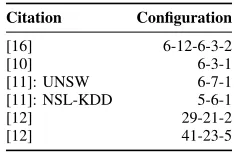
[image:3.612.378.495.553.630.2]The topology configurations of the aforementioned NNs are summarised in Table I, where available.
TABLE I: Network configurations in related work.
Citation Configuration
[16] 6-12-6-3-2 [10] 6-3-1 [11]: UNSW 6-7-1 [11]: NSL-KDD 5-6-1 [12] 29-21-2 [12] 41-23-5
IV. EXPERIMENTALMETHODOLOGY
A. Artificial Neural Networks
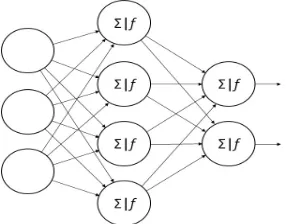
from automotive [18], to healthcare [19]. Each artificial neuron calculates the weighted sum of its inputs and adds this to an offset value (bias), passing the result to an activation function. ANNs comprise a sequence of neuron layers propagating results between them. Duringtraining, the functionality of the network is defined using back-propagation to determine the weights and biases that optimally classify the training data. Once these are set, the ANN can be used for inferencewhere it processes new data to determine a classification. Inputs to the ANN are represented numerically and so symbolic (or categorical) inputs must be converted to suitable formats before being applied. An indicative structure of an ANN is shown in Fig. 1.
Fig. 1: Artificial neural network structure.
Training can be very time consuming and typically occurs offline using highly parallel computing systems. Trained model parameters are used to perform online classification, and as such, inference hardware needs to be optimised. We use a three-layer (shallow) ANN for intrusion detection in this work. While DNNs and RNNs are growing in importance, they entail more complex computation making the real time processing on embedded hardware extremely difficult.
In Section III we saw that tailoring an ANN to detect only a single type of attack or all the attacks in one category can result in better accuracy. Moreover, selecting the most relevant features from the dataset decreases the dimensionality and this in turn enables ANNs to perform better in simple classification [12]. Hence, the proposed ANN is trained to detect all types of attacks in one category (Normal-Anomaly), using a selected subset of the available features.
B. NSL-KDD Dataset
We use the publicly available NSL-KDD dataset, a labelled dataset for supervised learning. It is an updated version of the KDD Cup 1999 dataset, addressing its shortcomings [20]. While the dataset is not directly related to IoT applications, it is widely used, enabling comparisons with previous work. The approach presented here can be applied to any future dataset which can be used to retrain the network for IoT specific traffic patterns. The dataset is divided into the train and test sets which contain data for normal and malicious traffic. Each entry comprises 41 features categorized into 3 groups [20]:
• Basic features:features that are extracted from a TCP/IP connection.
• Traffic features: features that are generated within a window of the last 100 connections, to enable detection of longer probe attacks. These features provide an ele-ment of time-domain memory. Traffic features are further categorized into service and host based.
• Content features: features that are extracted from the packets’ data and provide the means to detect attacks with infrequent sequential patterns.
The train set contains 22 attack types, divided into 4 main categories: DoS (Denial of Service), Probe, R2L (Remote to Local) and U2R (User to Root). In the test set, there are 17 additional attacks that fall into the same 4 categories. In this way, the ability of the ANN to generalize its learned pattern to unknown data is put under test.
In order to fairly train the model, categorical features are mapped to one-hot encoded representation for the training phase, mitigating the possible bias introduced by ad-hoc numerical mapping.
C. Software Implementation
We used TensorFlow [21] to train an ANN with 29 input features, 21 hidden neurons and 2 output neurons, similar to that in [12]. Of the 41 input features, the authors in [22] concluded that 8 of them have little or no impact in attack detection, while the work in [12] highlights that the values of 4 other features are close to 0. The selected features span all types of features in the dataset. This enables the ANN to extract patterns in the time domain using Traffic Features, thus avoiding the use of more computationally complex machine learning models that do so with raw features, such as Recurrent Neural Networks. Out of the 29 selected features, 3 are categorical, increasing the number of inputs to 110 after one-hot encoding. We use the relatively simple and inexpensive Rectified Linear Unit (ReLU) activation function, that can be easily implemented with a comparator instead of more complex functions that include divisions and exponents, such as the sigmoid function.
The proposed ANN was trained with the Adam optimizer, using the cross entropy loss function (that also includes softmax) with weights and biases randomly initialized. We further determine some training parameters experimentally, such as the learning rate and batch size. For fair comparison, the same randomly initialized weights and biases are used in all our experiments. We run our experiments using 3 learning rates (0.01, 0.001, 0.0001) on four different batch sizes (32, 64, 128, 256) for a total of 5 epochs. We evaluate the classification performance of each run using:
accuracy = 100∗ T P+T N
T P +T N+F P +F N (1)
where:
• TP:True Positive, corresponds to an attack that has been correctly detected.
• FP:False Positive, corresponds to normal traffic that has been classified as an attack.
• FN: False Negative, corresponds to an attack classified as normal traffic.
[image:5.612.66.285.187.264.2]We summarize the highest accuracies obtained after the pass of one epoch in Table II. While we train the proposed ANN on the train set and test it on the test set, the results in Table II are selected by prioritizing the accuracy obtained from the test set across runs.
TABLE II: Accuracy results for training parameters.
Batch Size
Learning Rate
0.01 0.001 0.0001
Test Train Test Train Test Train
32 77.61 89.15 80.52 96.02 80.37 89.09 64 73.16 94.71 80.64 94.05 80.29 93.62 128 76.65 93.09 79.01 96.62 79.80 91.99 256 77.56 94.49 80.84 94.22 77.47 94.06
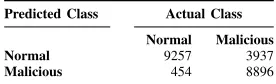
[image:5.612.313.570.291.473.2]From the results in Table II, we see that learning rate of 0.001 and batch size of 32 provides the optimal combined accuracy across the test and train sets. This results in the confusion matrix of the test set in Table III.
TABLE III: Test set classification results.
Predicted Class Actual Class
Normal Malicious
Normal 9257 3937
Malicious 454 8896
Compared to other work in the literature that use the NSL-KDD dataset, with which a direct comparison can be made, the proposed model is close to that in [12], where the authors reported 99.3% and 81.2% accuracy on the train and test sets respectively. It is worth noting that the authors in this case normalized the dataset prior to its use. While data normal-ization has been proven to enhance the accuracy of ANNs, it also entails additional workload during inference. The authors in [16] use a DNN with 6 input features, reporting 91.62% and 75.75% accuracy on the train and test sets respectively. This shows that deep models that use a small subset of the input features do not necessarily outperform shallow models that use more features. All the referenced implementations in this paper that use the NSL-KDD dataset are summarized in Table IV, along with their configurations.
TABLE IV: Accuracy comparisons on the NSL-KDD dataset.
Citation ML Model Classification # Features Accuracy %
(out of 41) Train Set Test Set
[7] DT N/A 9 96.5 77.8
[12] ANN Binary 29 99.3 81.2
[12] ANN 5-Cat. 41 98.9 79.9
[16] DNN Binary 6 91.62 75.75
[17] D-RNN Binary 6 N/A 89
[14] RNN Binary 41 99.81 83.28
[14] RNN 5-Cat. 41 99.53 81.29
[15] CNN-ResNet50 Binary 41 N/A 79.14
[15] CNN-GoogleNet Binary 41 N/A 77.04
Proposed ANN Binary 29 96.02 80.52
D. Hardware Implementation
[image:5.612.105.243.353.395.2]Unlike previous work, our aim is to build a fully functional embedded IDS to perform these classifications in real time. Hence, the trained ANN was used to build a working system for this purpose. We used Xilinx Vivado HLS 2016.4 target-ing the Xilinx Zynq Z-7020 FPGA as found on the Xilinx Zedboard. This is a modest FPGA SoC device that includes flexible Programmable Logic (PL) tightly coupled with an Arm Cortex-A9 Processing System (PS), as shown in Fig. 2. This system is designed to act as an IoT gateway, securing the network for a group of less capable devices. The peripherals, e.g. Ethernet Phy and SD card, are connected through Multi-plexed I/O (MIO) interconnect to the Arm core and 512 MB of DRAM is also available. This flexible connectivity enables runtime processing of network data by forwarding packets to the accelerator, or processing them in software. For testing and verification, it allows the test set and model coefficients to be stored in an SD card, transferred to the memory and then to the accelerator over DMA.
Fig. 2: Overview of the Xilinx Zynq based system architecture.
Most work on optimising FPGA implementations of neural networks considers fixed network parameters. Network prun-ing, data quantization, and reduced arithmetic precision can be exploited to trade off performance, power consumption, and detection accuracy [23, 24, 25]. However, this comes at the cost of flexibility as any change in network parameters re-quires a new design exploration and hardware implementation process. The architecture we present is designed to be flexible, by allowing the coefficients to be modified at runtime, thereby enabling the same hardware to be used to detect different or evolving attacks without the need for additional design space exploration or hardware optimisation.
[image:5.612.50.299.619.718.2]retain flexibility to accept newly trained model parameters. The accelerator operates in one of three modes: IDLE, LOAD, or COMP. It starts in the IDLE mode where it can make a transition to LOAD or COMP. Transitions between states are triggered from the Arm core over AXI-Lite since these are not time critical operations.
In LOAD mode, the coefficients (weights and biases) of the model are modified to update the ANN at runtime, which is done over AXI-Lite using the 4 accelerator inputs:
• mem sel:selects the memory bank to configure. (i.e. first layer weights, first layer biases, etc.)
• dimA:indexes the first dimension of the weights, or the only dimension of the biases.
• dimB: indexes the second dimension of the weights. • coeff in:value of the coefficient to be stored.
FPGAs support flexibility through reconfiguration by load-ing alternative bitstreams that modify the hardware on the FPGA [26]. One method for using different NN models would be to generate multiple bitstreams and load them as needed. However, this would entail the separate design and compilation of these optimised hardware models and would not allow for easy modification of model parameters to deal with emerging attacks. The Xilinx Zynq allows the PL configuration to be changed by the PS in software, taking around 30 milliseconds. Alternatively, Partial Reconfiguration (PR) can be used with an optimised reconfiguration controller [27] to reduce the time to below 10 milliseconds. We choose to retain full flexibility by implementing a general datapath with reprogrammable coefficients, rather than tightly optimising the datapath around a fixed set of coefficients.
We measured the time needed for the configuration of all 2375 coefficients to be 2.273 ms. This includes the time needed for the Arm core to iterate through the data, increment its indexing variables, configure the accelerator accordingly and make the appropriate checks. Updating coefficients is not considered a time-critical operation as one configuration of the IDS is expected to be active for a large volume of network data. Nonetheless, the proposed approach offers competitive configuration time compared to reconfiguring the hardware, while offering a much more flexible implementation that allows coefficients to be updated directly, without the need for vendor tools and a full hardware compilation.
The intrusion detection process takes place in the COMP state. To mitigate the increased complexity due to the one-hot encoding, we take advantage of the fact that only one input of each one-hot encoded feature is used at a time. During inference, integer representation is used for each attribute and in each case only the index of the active attribute is needed. The index of the active attribute is used as an address to a Look-Up-Table, that outputs the corresponding weight. This restores the number of input features needed for inference from 110 to 29, while also avoiding redundant multiplications by 0 caused by the inactive attributes in each one-hot encoded feature. Meanwhile, any multiplication by 1 of each active attribute is replaced with a low latency table look-up. The 29 input features along with the 2 output results (corresponding to
the normal/malicious score), are interfaced with the Arm core through 2 separate AXI-Stream ports with the data transferred sequentially in consecutive clock cycles.
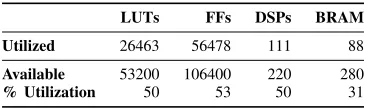
The timing results of the implemented design from HLS are shown in Table V while the resource utilization on the Xilinx Zynq device is shown in Table VI.
TABLE V: Timing results on the Xilinx Zynq Z-7020.
Frequency Latency Initiation Interval (MHz) (Clock Cycles) (Clock Cycles)
76 237 29
[image:6.612.346.531.261.315.2]The initiation interval of 29 clock cycles is bounded by the number of input features that need to be read through the AXI-Stream port.
TABLE VI: Resource utilization on the Xilinx Zynq Z-7020.
LUTs FFs DSPs BRAM
Utilized 26463 56478 111 88
Available 53200 106400 220 280
% Utilization 50 53 50 31
The proposed system, shown in Fig. 2, uses 2 FIFOs on each AXI-Stream port of the accelerator to act as buffers. Data is transferred to and from the AXI-Stream ports through the AXI-DMA that is interfaced with the PS using the HP0 (High Performance 0) port. The HP0 port, in turn, using the DRAM controller, transfers data to and from DRAM. The configuration of the accelerator coefficients as well as the configuration of the DMA take place using AXI-Lite ports, which are interfaced with the PS through the GP0 (General Purpose 0) port.
V. RESULTS ANDEVALUATION
The authors used 43748 records to test their ANN. For a fair comparison, we normalize their obtained test time of 0.466 seconds according to the number of test records in the NSL-KDD (22544). The execution time of the three methods for the classification of the test set is shown in Table VII.
TABLE VII: Execution time.
Arm-A9a Arm-A9b Acceleratorb Idhammad et al. @667MHz @667MHz @76MHz [11] (normalized)
4751.440ms 1458.1ms 9.018ms 240.136ms
aUnoptimised, 110 inputs. bOptimised, Look-Up-Table.
The execution time of the accelerator includes the time needed for the input data to be transferred to the accelerator from the DRAM and the results to be written back to the same memory. The utilization of a Look-Up-Table mechanism yields a 69% reduction in the software execution time. A straightforward comparison between the proposed accelerator, operating as a streaming engine in this case, and the optimised execution on the Arm Cortex-A9 shows a 161.7× improve-ment in the execution time. Compared to the unoptimized software version, the HW implementation is 526.9×faster.
If we naively compare the execution time of the proposed ANN, considering our proposed optimised implementation with a 29-21-2 configuration, and the work in [11], our proposed accelerator performs about 26.6×faster. Meanwhile, our optimised model on the Arm core is about 6× slower. In this case, however, the workload of the ANN in [11] with a 6-7-1 configuration is significantly smaller compared to the proposed ANN’s configuration. Taking into account the number of multiplications and additions in each layer, as those are the most computationally intensive operations, we estimate 49 multiplications and 57 additions for the ANN in [11]. Meanwhile for our work, a total of 651 multiplications and 674 additions are required. This amounts to 13.3× the multiplications and 11.8× the additions of the ANN used in [11], while delivering 26.6×its performance. Overall, our proposed approach is able to detect more types of attack: DoS, Probe, R2L and U2R, at a faster detection rate compared to the work in [11].
A. Network Throughput and Detection Rate
[image:7.612.65.281.139.179.2]A considerable aspect of an IDS is whether it can make decisions on packets at a suitable rate to ensure detection does not lag the start of an attack significantly. Ideally, such a system should be able to flag malicious packets before many of them have entered the network, so that evasive action can be taken. We determined the time required to classify a single data record on both the Arm core and the accelerator by normalizing execution time in Table VII. We take into consideration the required minimum transmission size for IPv4 which is 576 bytes according to the Internet Protocol [28]. We observe the results in Table VIII.
TABLE VIII: Detection rate in packets.
Transfer Rate Platform Latency Detection Rate (Packets/Second) (µs) (Packets/Classification)
1Gbps Arm-A9 64.678 14.036
(217,014) Accel 0.4 0.0868
10Gbps Arm-A9 64.678 140.360
(2,170,139) Accel 0.4 0.8680
At 1Gbps, 217,014 packets per second of the minimum packet size can be transferred when the network is saturated. The accelerator offers a detection rate within a small fraction of a packet (0.0868 packets). On the other hand, the Arm core can only process one in 14 packets. While the Zedboard does not offer a 10G Ethernet interface, we also evaluated the performance for such a setup that might be deployed in an edge datacenter interacting with IoT devices. Newer Zynq UltraScale+ development boards do offer 10G Ethernet, meaning our design could be ported to such boards for more complex networks. At 10Gbps, a maximum of 2,170,139 packets per second can be transferred. The detection rate in this case is still within a single packet (0.8680 packets), which is 16.2×faster than the Arm core at 1Gbps and 161.7×faster at 10Gbps. The Arm core at 10Gbps only processes one in 140 packets.
These results demonstrate the benefit of our hardware ac-celerated ANN detection mechanism in terms of scaling to faster networks, while still offering the flexibility needed to accept updated model parameters for emerging threats. Porting to newer FPGA SoC devices such as the Zynq UltraScale+ would also likely offer significant runtime improvements.
VI. CONCLUSION
This paper presented an approach for network intrusion de-tection using ANNs on FPGA SoCs. The topology of the ANN maintains moderate computational complexity for a hardware implementation that can be deployed on a modest Xilinx Zynq device. It also allows runtime configuration of neural network parameters to allow for updates to address emerging attacks We used TensorFlow [21] to train the proposed ANN using the NSL-KDD dataset, obtaining at best 80.52% accuracy on the test dataset. The proposed hardware accelerator is 161.7×faster than software execution on the Zynq Arm core, allowing it to detect malicious packets within a single packet window for 1Gbps and 10Gbps. In the future, we plan to investigate deeper and alternative neural network topologies for comparison in terms of performance and accuracy, as well as extending network testing to alternative datasets and more varied live traffic patterns in 10G networks. Finally, we aim to explore approaches to reduce latency by processing data directly in the PL to circumvent the PS network stack using the method in [29].
ACKNOWLEDGEMENT
REFERENCES
[1] R. Abdulhammed, M. Faezipour, and K. M. Elleithy, “Network intrusion detection using hardware techniques: A review,” inProc. IEEE Long Island Systems, Applications and Technology Conference, 2016. [2] B. Subba, S. Biswas, and S. Karmakar, “A neural network based system
for intrusion detection and attack classification,” in Proc. National Conference on Communication, 2016.
[3] A. Gharib, I. Sharafaldin, A. H. Lashkari, and A. A. Ghorbani, “An eval-uation framework for intrusion detection dataset,” inProc. International Conference on Information Science and Security, 2016.
[4] S. Yusuf, W. Luk, M. K. N. Szeto, and W. Osborne, “Unite: Uniform hardware-based network intrusion detection engine,” inReconfigurable Computing: Architectures and Applications, 2006, pp. 389–400. [5] R. Proudfoot, K. Kent, E. Aubanel, and N. Chen, “Flexible
software-hardware network intrusion detection system,” inProc. International Symposium on Rapid System Prototyping, 2008, pp. 182–188. [6] A. Das, D. Nguyen, J. Zambreno, G. Memik, and A. Choudhary, “An
FPGA-based network intrusion detection architecture,”IEEE Transac-tions on Information Forensics and Security, vol. 3, no. 1, pp. 118–132, 2008.
[7] A. L. P. de Franca, R. P. Jasinski, V. A. Pedroni, and A. O. Santin, “Moving network protection from software to hardware: An energy efficiency analysis,” inProc. IEEE Computer Society Symposium on VLSI, July 2014, pp. 456–461.
[8] A. L. P. de Franca, R. P. Jasinski, P. Cemin, V. A. Pedroni, and A. O. Santin, “The energy cost of network security: A hardware vs. software comparison,” inProc. International Symposium on Circuits and Systems (ISCAS), 2015, pp. 81–84.
[9] S. Shreejith and S. A. Fahmy, “Security aware network controllers for next generation automotive embedded systems,” in Proc. Design Automation Conference (DAC), 2015.
[10] E. Hodo, X. Bellekens, A. Hamilton, P. L. Dubouilh, E. Iorkyase, C. Tachtatzis, and R. Atkinson, “Threat analysis of iot networks using artificial neural network intrusion detection system,” inProc. Interna-tional Symposium on Networks, Computers and Communications, 2016. [11] M. Idhammad, K. Afdel, and M. Belouch, “DoS detection method based on artificial neural networks,”International Journal of Advanced Computer Science and Applications, vol. 8, no. 4, 2017.
[12] B. Ingre and A. Yadav, “Performance analysis of NSL-KDD dataset using ANN,” inProc. International Conference on Signal Processing and Communication Engineering Systems, 2015, pp. 92–96.
[13] K. Kim, M. E. Aminanto, and H. C. Tanuwidjaja,Network Intrusion De-tection using Deep Learning: A Feature Learning Approach. Springer Singapore, 2018, pp. 35–45.
[14] C. Yin, Y. Zhu, J. Fei, and X. He, “A deep learning approach for intrusion detection using recurrent neural networks,” IEEE Access, vol. 5, pp. 21 954–21 961, 2017.
[15] Z. Li, Z. Qin, K. Huang, X. Yang, and S. Ye, “Intrusion detection using convolutional neural networks for representation learning,” in
Proc. International Conference Neural Information Processing, 2017, pp. 858–866.
[16] T. A. Tang, L. Mhamdi, D. McLernon, S. A. R. Zaidi, and M. Ghogho, “Deep learning approach for network intrusion detection in software defined networking,” in Proc. International Conference on Wireless Networks and Mobile Communications, 2016, pp. 258–263.
[17] T. Tang, S. Zaidi, D. McLernon, L. Mhamdi, and M. Ghogho, “Deep re-current neural network for intrusion detection in SDN-based networks,” inProc. International Conference on Network Softwarization, 2018. [18] S. Shreejith, B. Anshuman, and S. A. Fahmy, “Accelerated artificial
neural networks on FPGA for fault detection in automotive systems,” in
Proc. Design, Automation Test in Europe Conference Exhibition (DATE), 2016, pp. 37–42.
[19] O. Karan, C. Bayraktar, H. G¨um¨ukaya, and B. Karlk, “Diagnosing diabetes using neural networks on small mobile devices,”Expert Systems with Applications, vol. 39, no. 1, pp. 54–60, 2012.
[20] M. Tavallaee, E. Bagheri, W. Lu, and A. A. Ghorbani, “A detailed analysis of the KDD CUP 99 data set,” in Proc. IEEE International Conference on Computational Intelligence for Security and Defense Applications, 2009, pp. 53–58.
[21] M. Abadi et al., “TensorFlow: Large-scale machine learning on heterogeneous systems,” 2015. [Online]. Available: https://www. tensorflow.org/
[22] K. Bajaj and A. Arora, “Improving the intrusion detection using dis-criminative machine learning approach and improve the time complexity by data mining feature selection methods,” International Journal of Computer Applications, vol. 76, no. 1, pp. 5–11, August 2013. [23] S. I. Venieris, A. Kouris, and C.-S. Bouganis, “Toolflows for mapping
convolutional neural networks on FPGAs: A survey and future direc-tions,”ACM Computing Surveys, vol. 51, no. 3, pp. 56:1–56:39, 2018. [24] V. Sze, Y. Chen, T. Yang, and J. S. Emer, “Efficient processing of deep
neural networks: A tutorial and survey,”Proceedings of the IEEE, vol. 105, no. 12, pp. 2295–2329, Dec 2017.
[25] K. Guo, S. Zeng, J. Yu, Y. Wang, and H. Yang, “[DL] A survey of FPGA-based neural network inference accelerators,” ACM Trans. Reconfigurable Technol. Syst., vol. 12, no. 1, pp. 2:1–2:26, Mar. 2019. [26] K. Vipin and S. A. Fahmy, “FPGA dynamic and partial reconfiguration:
A survey of architectures, methods, and applications,”ACM Computing Surveys, vol. 51, no. 4, pp. 72:1–72:39, Jul. 2018.
[27] K. Vipin and S. A. Fahmy, “ZyCAP: Efficient partial reconfiguration management on the Xilinx Zynq,” IEEE Embedded Systems Letters, vol. 6, no. 3, pp. 41–44, Sep. 2014.
[28] J. Postel, “Internet protocol,”RFC, vol. 791, pp. 1–51, 1981. [29] S. Shreejith, R. A. Cooke, and S. A. Fahmy, “A smart network interface