doi:10.4236/ojdm.2011.12011 Published Online July 2011 (http://www.SciRP.org/journal/ojdm)
Lattice Paths and Rogers Identities
Ashok Kumar Agarwal, Megha Goyal
Center for Advanced Study in Mathematics, Panjab University, Chandigarh, India E-mail: [email protected], meghagoyal2021@gmail.com
Received April 21, 2011; revised May 21, 2011; accepted June 2, 2011
Abstract
Recently we interpreted five q-series identities of Rogers combinatorially by using partitions with “n + t copies of n” of Agarwal and Andrews [1]. In this paper we use lattice paths of Agarwal and Bressoud [2] to provide new combinatorial interpretations of the same identities. This results in five new 3-way combinato-rial identities.
Keywords:Lattice Paths, Colored Partitions, Generating Functions, Combinatorial Interpretations
1. Introduction Definitions and the Main
Results
In the literature we find that several -identities such as given in Slater’s compendium [3] have been interpreted combinatorially using ordinary partitions by several authors (for example, see Connor [4], Subbarao [5], Subbarao and Agarwal [6] and Agarwal and Andrews [7]). In the early nineteen eighties Agarwal and Andrews introduced a new class of partitions called “
q
n t -color partitions” or partitions with “ copies of ”. Using these new partitions many more -identities have been interpreted combinatorially in [8-12].
n t
nq
Recently in [13] we interpreted combinatorially the following -identities of Rogers [14] by using colored partitions:
q
2 3 5 7 10
3
2 4 4 4 6 10
=0
, , ;
= ,
; ; , ;
n
n
n n
q q q q q
q q q q q q q
(1.1)
2 5 9 10
3 2
2 4 4 2 8 10
=0
, , ;
=
; ; , ;
n n
n
n n
q q q q
q
q q q q q q q
, (1.2)
2 3 7 11 14
2
2 4 4 2 6 8 12 14
=0
, , ;
=
; ; , , , ;
n
n
n n
q q q q
q
q q q q q q q q q
, (1.3)
5 7 9 14
2 1
2 4 4 4 6 8 10 14
=0
, , ;
=
; ; , , , ;
n n
n
n n
q q q q
q
q q q q q q q q q
, (1.4)and
7 13 14
2 1
2 4 4 2 4 10 12 14
=0
1
, , ;
= .
; ; , , , ;
n n
n
n n
q q q q
q
q q q q q q q q q
(1.5)In Equations (1.1)-(1.5), n is a rising -fac- torial which in general is defined as follows :
q q; q
=0
1
; =
1 i
n n i
i
aq a q
aq
.If n is a positive integer, then obviously
1
; = 1 1 1 n
n
a q a aq aq , and
2
; = 1 1 1
a q a aq aq , and
a a1, 2,,a zt;
is defined by
1 2
=1
, , , ; = ; .
t
t j
j
a a a z
a z We remark that Identities (1.1) and (1.2) were also derived by Bailey [15] and appear in [1], Identities (1.3)-(1.5) are also referred as Rogers-Selberg identities (see [3,14,16]).
In this paper we interpret the left-hand sides of (1.1)- (1.5) as generating functions for certain weighted lattice path functions defined by Agarwal and Bressoud in [17]. First we recall the definitions of the partitions with “ n t copies of n ” (also called
n t
-color partitions) and their weighted difference from [12]:Definition 1. A partition with “ copies of ”, is a partition in which a part of size , , can come in
n t n
0
0,
t n n
1, 2, , n t.
n n n
Thus, for example, the partitions of 2 with “n1 copies of n” are
2
2
2
m
1, 210 , 11 11 , 11 1 11 0 ,1 2, 220 , 11 21 , 11 2 11 0 ,1 3, 230 , 11 21 , 12 2 12 0 .1
Note that zeros are permitted if and only if is greater than or equal to one.
t
Definition 2. The weighted difference of two elements i and nj, , is defined by and is denoted by .
mn
minj
m n i j
Next, we recall the following description of lattice paths from [17] which we shall be considering in this paper:
All lattice paths will be of finite length lying in the first quadrant. All paths will begin on the y-axis and terminate on the x-axis. Only three moves are allowed at each step:
northeast: from
i j, to
i1,j1
,southeast: from
i j,
to
i1,j1
, only allowed if j> 0,horizontal: from to , only allowed along x-axis.
i, 0
i1, 0
All lattice paths are either empty or terminate with a southeast step: from
i,1 to
i1, 0
.In describing lattice paths, we shall use the following terminology:
PEAK: Either a vertex on the y-axis which is followed by a southeast step or a vertex preceded by a northeast step and followed by a southeast step.
VALLEY: A vertex preceded by a southeast step and followed by a northeast step. Note that a southeast step followed by a horizontal step followed by a northeast step does not constitute a valley.
MOUNTAIN: A section of the path which starts on either the x- or y-axis, which ends on the x-axis, and which does not touch the x-axis anywhere in between the end points. Every mountain has at least one peak and may have more than one.
PLAIN: A section of path consisting of only hori- zontal steps which starts either on the y-axis or at a vertex preceded by a southeast step and ends at a vertex followed by a northeast step.
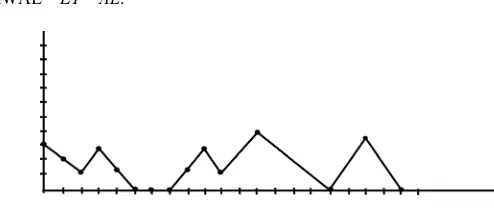
Example: The following path has five peaks, three valleys, three mountains and one plain.
The HEIGHT of a vertex is its y-coordinate. The
Weight of a vertex is its x-coordinate. The WEIGHT OF A PATH is the sum of the weights of its peaks.
[image:2.595.290.537.63.168.2]In the example given above, there are two peaks of height three and three of height two, two valleys of height one and one of height zero.
Figure 1. Contains five peaks, three valleys, three moun-
tains and one plane.
The weight of this path is 0 3 9 12 17 = 41. Recently in [13] we showed that the identities (1.1)- (1.5) have their colored partition theoretic interpretations in the following theorems, respectively:
Theorem 1. Let A1
denote the number of -color partitions of
n
such that even parts appear with even subscripts and odd with odd, all subscripts are greater than 2, if i is the smallest or the only part in the partition, then
m
mod 4
mi and the weighted difference of any two consecutive parts is nonnegative and is 0 mod
4
. Let
1 1 1
=0
= ,
k
B
C k D
k
where C1
is the number of partitions of intoparts 4 m
od10
and D1
denotes the number ofpartitions of into distinct parts 3, 5
mod10 .
Then
1 = 1 , for all .
A B
Example. A1
1511 157
= 6, since the relevant partitions
are 15, , , , , .
Also,
15 15 153 12633 11344
15
1 1 1
=0
1 1 1 1 1 1
15 =
= 15 0 14 1 0 15
= 0 1 2 0 0 0 2 1 0 0 1 1 0 0
1 1 0 1 1 0 0 1 1 0 0 1
0 1 0 0 1 2 = 6.
k
B C k D k
C D C D C D
Theorem 2. Let A2
denote the number of-color partitions of
n such that even parts appear
with even subscripts and odd with odd, if i is the smallest or the only part in the partition, then
m
mod 4
mi and the weighted difference of any two consecutive parts is 4 and is 0 mod 4
. Let
2 2 2
=0
= ,
k
B C k D
kwhere C2
is the number of partitions of intoof partitions of into distinct parts 1, 5 mod10
r all .
. Then
2 = 2 , fo
A B
Theorem 3. Let A3
denote the number of -color partitions of
n
such that even parts appear with even subscripts and odd with odd , if i is the smallest or the only part in the partition, then
and the weighted difference of any two consecutive parts is nonnegative and is
> 1 m
mod 4mi
0 mod 4 .
3
= D k ,
Let
3 3 =0
k
B C k
where C3
is the number of partitions of into partsand
6 mod
2, 14
D3
denotes the number of partitions of into distinct parts 3, 7 mod14 .
.
Then
3 = 3 , for all
A B
Theorem 4. Let A4
denote the number of -color partitions of
n
such that even parts appear with even subscripts and odd with odd, all subscripts are , if i is the smallest or the only part in the partition, then and the weighted difference of any two consecutive parts is and is Let
> 3
0 mod 4 .
4
= D k ,
m
modmi
4
4
4 4 =0
k
B
C kwhere C4
is the number of partitions of intoparts 4, 6
mod14
and D4
denotes the num- ber of partitions of into distinct partsThen
mod14
. 5, 7
4 = 4 , for
A B all .
Theorem 5. Let A5
denote the number ofpartitions of with “ copies of ” such that the even parts appear with even subscripts and odd with odd, all subscripts are if is the smallest or the only part in the partition, then for some
2
i is a part and the weighted difference of any two consecutive parts is nonnegative and is
2
n
i m
n
4 , i,
> 1,
modmi i
0 mod 4 .
5
= D k ,
Let
5 5 =0
k
B C k
where C5
is the number of partitions of intoparts 2, 4
mod14
and D5
denotes the num- ber of partitions of into distinct partsThen
mod14
. 1, 7
5 = 5 , for all
A B .
In this paper we prove the following combinatorial
interpretations of the identities (1.1)-(1.5) in terms of lattice paths:
Theorem 6. Let E1
denote the number of latticepaths of weight which start from , have no valley above height 0, the lengths of the plains, if any, are
0, 0
0 mod 4
and the height of each peak is greater than 2. Then
1 = 1 , for all .
E B
Example. E1
15 6, since the relevant lattice pathsare:
Theorem 7. Let E2
denote the number of latticepaths of weight which start from , have no valley above height 0, the lengths of the plains are
0, 0
0 mod 4
and there is a plain of length between any two peaks. Then
4
2 = 2 , for all .
E B
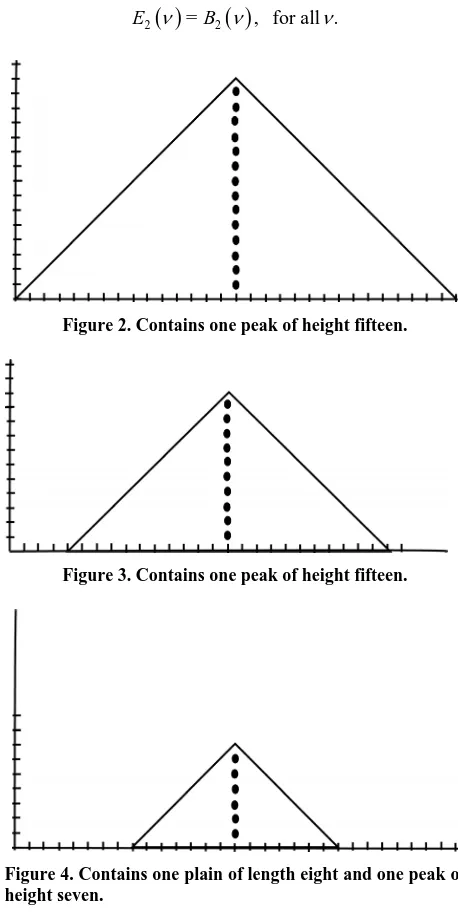
Figure 2. Contains one peak of height fifteen.
[image:3.595.306.535.270.732.2]Figure 3. Contains one peak of height fifteen.
Figure 5.Contains one plain of length eight and one peak of height seven.
Figure 6. Contains one plain of length eight and one peak of height seven.
Figure 7. Contains two peaks of height four, three and one valley at height zero.
Theorem 8. Let E3
denote the number of latticepaths of weight which start from , have no valley above height 0, the lengths of the plains, if any, is
and the height of each peak is greater than 1. Then
0, 0
0 mod 4
3 = 3 , for all .
E B
Theorem 9. Let E4
denote the number of latticepaths of weight which start from , have no valley above height 0, the height of each peak is , there is a plain of length
0, 0
> 1
2 mod 4
in the beginning of the path and the lengths of the other plains, if any, are
Then
0 mod 4
4 = 4 , for all .
E B
Theorem 10. Let E5
denote the number of latticepaths of weight which start from , have no valley above height 0, the height of each peak is , the lengths of the plains, if any, are Then
0, 2
od 4
> 1 0 m
5 = 5 , for all .
E B
Theorems 6-10 lead to the following 3-way extension of Theorems 1-5:
Theorem 11. For 1 k 5, we have
=
=
, for all .k k k
A B E
5
In [13] we have shown that for 1 the left- hand side of the Equation generates
k
1.k Ak
and consequently Ak
=Bk
. Here we shall prove that the left-hand side of equation 1.k
generates Ek
also. We shall also show bijectively that Ak
=Ek
.Furthermore, since each of these five cases is proved in a similar way, we provide the details for in our next section and sketch the changes required to treat the remainder in Section 3.
= 1
k
2. Proof of Theorem 6
In
2
3
2 4 4
; ;
m
m m
q
q q q q the factor
q3m2 generates the lat-
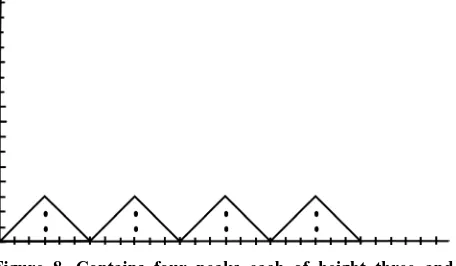
tice path of m peaks each of height 3 starting at (0,0) and terminating at
6 , 0m
.If m = 4, the path begins as: The factor 1
4; 4
m
q q generates m-nonnegative mul- tiples of 4, say 1 2 , which are encoded
by inserting horizontal steps in front of the first mountain and i i1
0
m a a a
a a m a
horizontal steps in front of the
m i 1
st mountain, 1 i m.If a1 = 8, a2 = 4, a3 = 4, a4 = 0, then our above graph
becomes:
The factor 1
; 2
m
[image:4.595.312.540.572.705.2]q q generates nonnegative multiples of (2i1), 1 i m, say, b11, b23,,bm
2m1
. This is encoded by having the ith peak grow to heightFigure 9. Contains two plains each of length four and four peaks each of height three and one valley at height zero.
1 . Each increase by one in the height of a given
peak increases its weight by one and the weight of each subsequent peak by two.
3
m i b
If b1 = 3, b2 = 1, b3 = 2, b4 = 0, then our example
becomes:
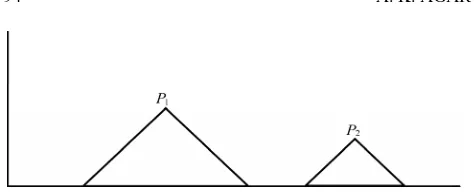
In the Graph-8, we consider two successive peaks, say th and th and denote them by and , respectively
i
i1
1
P P2
Now, due to the impact of the factor 1
4; 4m q q , the
Figure 11 changes to Figure 12
Again by taking into consideration, the impact of the factor 1
; 2
m
q q , the Figure 12 changes to Figure 13
or Figure 14 depending on whether 1 or
1 In the case when , the new
graph will look like Figure 12.
>
m i m i b b
1
m i b
<
m i m i
b b . bm i =
Every lattice path enumerated by E1
is uniquelygenerated in this manner. This proves that the L.H.S. of (1.1) generates E1
.We now establish a correspondence between the lattice paths enumerated by
1 1
1
E and the -color partitions enumerated by
n
1
A .
We do this by encoding each path as the sequence of the weights of the peaks with each weight subscripted by the height of the respective peak.
Thus, if we denote the two peaks in Figure 13 (or
Figure 14) by Ax and By, respectively, then
1
1 2
= 6 3 m i 2 m m m i m i
A i a b b b b 1
.
1
= m i 3
x b
1 1
= 6 3 m i 2 m m m i m i
B i a b b b b
= m i 3
y b
If we look at the n-color part Ax, we find that the parity of both A and x is determined by bm i 1. If
is odd, then both
1
m i
b A and x are even and if
1
m i is even, then both
b A and x are odd. This
proves that even parts appear with even subscripts and odd with odd. Clearly, all subscripts x are > 2.
The weighted difference of these two consecutive parts is
Figure 10. Contains two plains each of length four and four peaks of height three, five, four, six respectively and one valley at height zero.
Figure 11. Contains two peaks of same height.
Figure 12. Contains two peaks separated by a plane and length of the plane is a multiple of four.
Figure 13. Contains two peaks of which height differs by an odd number and separated by a plane, P2 has more height than P1.
1 1
1 1 2
1 1
=
= 6 3 2
6 3 2
3 3
= 0 mod 4 .
y x
m i m m m i m i m i m m m i m i m i m i
m i m i
B A B A x y
i a b b b b
i a b b b b
b b
a a
1
Obviously, if
A x,
is the first peak in the lattice path then it will correspond to the smallest part in the corresponding -color partition or to the singleton part if the -color partition has only one part and in both casesn n
= m 0 mod 4
Figure 14. Contains two peaks of which height differs by an odd number and separated by a plane, P1 has more height than P2.
To see the reverse implication, we consider two -color parts of a partition enumerated by
n E1
, say,and . u
C Dv
Let and be the corres-
ponding peaks in the associated lattice path.
1 ,
Q C u
Q2
D v,
The length of the plain between the two peaks is which is the weighted difference between the two parts and and is therefore nonnegative
and
D C u v
0 mod
4 .C
uv
D
Also, there can not be a valley above height 0. This can be proved by contradiction.
Suppose, there is a valley V of height r
r> 0
between the peaks 1 and Q2.
In this case there is a descent of from Q1 to V
and an ascent of from V to . This implies
Q
ur
2
Q vr
=
= 2 .
D C u r v r
D C u v r
1
But since the weighted difference is nonnegative, therefore r0.
Also, imply that the height of each peak is atleast 3. This completes the proof of Theorem 6.
, > 2
u v
3. Sketch of the proofs of Theorems 7-10
Case is treated in exactly the same manner as the first case except that now the path begins with peaks each of height 1 and with a plain of length ,
= 2
k
m
4i
1 i m between ith and
i1
th peak.In the Case , the only point of departure from the first case is that the path begins with peaks each of height 2.
= 3
k
m
Case is treated in exactly the same manner as the previous case except that the extra factor puts a plain of length of 2 in front of the first peak. This increases the weight of each peak by 2 and so the weight of the lattice path is increased by .
= 4
k
2m
q
2m
Comparing the case with the case , we see that in this case there are two extra factors, viz.,
= 5
k k= 3
2m
q
and
2 1 1. The extra factor puts two south1 m
q
2mq
east steps: (0,2) to (1,1) and (1,1) to (2,0). Thus there are now m1 peaks starting from (0,2) and the extra factor
[image:6.595.306.542.75.279.2]Figure 15. Contains two peaks separated by a plain.
Figure 16. Contains two peaks and a valley at height r.
12 1
1qm
introduces a nonnegative multiple of 2m1, say bm1
2m1
. This is encoded by havingthe first peak grow to height bm12. Clearly,
bm1
bm12 which is of the form will be the colo-red part corresponding to the first peak.
2
i
i
4. Conclusions
The sum-product identities like (1.1) to (1.5) are gene- rally known as Rogers-Ramanujan type identities. They have applications in different areas such as Orthogonal polynomials, Lie-algebras, Combinatorics, Particle phy- sics and Statistical mechanics.
The most obvious question arising from this work is: Do Theorems 1.6-1.10 admit generalization analo- gous to the generalized results of [12,17]?
5. References
[1] A. K. Agarwal and G. E. Andrews, “Rogers-Ramanujan Identities for Partitions with ‘n Copies of n’,” Journal of Combinatorial Theory, Vol. 45, No. 1, 1987, pp. 40-49.
doi:10.1016/0097-3165(87)90045-8
[2] A. K. Agarwal and D. M. Bressoud, “Lattice Paths and Multiple Basic Hypergeometric Series,” Pacific Journal of Mathematics, Vol. 136, No. 2, 1989, pp. 209-228. [3] L. J. Slater, “Further Identities of the Rogers-Ramanujan
Type,” Proceedings of the London Mathematical Society, Vol. s2-54, No. 1, 1952, pp. 147-167.
doi:10.1112/plms/s2-54.2.147
[4] W. G. Connor, “Partition Theorems Related to some Id- entities of Rogers and Watson,” Transactions of the Ame- rican Mathematical Society, Vol. 214, 1975, pp. 95-111.
[11] A. K. Agarwal, “New Classes of Infinite 3-Way Partition Identities,” ARS Combinatoria, Vol. 44, 1996, pp. 33-54. [5] M. V. Subbarao, “Some Rogers-Ramanujan Type
Parti-tion Theorems,” Pacific Journal of Mathematics, Vol.
120, 1985, pp. 431-435. [12] A .K. Agarwal and G. E. Andrews, “Rogers-Ramanujan
Identities for Partitions with ‘n Copies of n’,” Journal of Combinatorial Theory, Series A, Vol. 45, No. 1, 1987, pp. 40-49. doi:10.1016/0097-3165(87)90045-8
[6] M. V. Subbarao and A. K. Agarwal, “Further Theorems of the Rogers-Ramanujan Type,” Canadian Mathemati-cal Bulletin, Vol. 31, No. 2, 1988, pp. 210-214.
doi:10.4153/CMB-1988-032-3
[13] M. Goyal and A. K. Agarwal, “Further Rogers-Rama- nujan Identities for n-Color Partitions,” Utilitas Methe-matica,Winnipeg. (In Press)
[7] A. K. Agarwal and G. E. Andrews, “Hook Differences and Lattice Paths,” Journal of Statistical Planning and Inference, Vol. 14, No. 1, 1986, pp. 5-14.
doi:10.1016/0378-3758(86)90004-2 [14] L. J. Rogers, “Second Memoir on the Expansion of
Cer-tain Infinite Products,” Proceedings of the London Ma- thematical Society, Vol. s1-25, No. 1, 1894, pp. 318-343.
doi:10.1112/plms/s1-25.1.318
[8] A. K. Agarwal, “Partitions with ‘n copies of n’, Lec-ture Notes in Math.,” Proceedings of the Colloque de Combinatoire Énumérative, Université du Québec à Montréal, Berlin, May 28-June 1, 1985, No. 1234, pp. 1-4.
[15] W. N. Bailey, “Some Identities in Combinatory Analy-sis,” Proceedings of the London Mathematical Society, Vol. s2-49, No. 1, 1947, pp. 421-435.
doi:10.1112/plms/s2-49.6.421
[9] A. K. Agarwal, “Rogers-Ramanujan Identities for n- Color Partitions,” Journal of Number Theory, Vol. 28, No. 3, 1988, pp. 299-305.
doi:10.1016/0022-314X(88)90045-5
[16] A. Selberg, “Über Einige Arithmetische Identitäten,” Av- handlinger Norske Akad, Vol. 8, 1936, pp. 1-23.
[17] A. K. Agarwal and D. M. Bressoud, “Lattice Paths and Multiple Basic Hypergeometric Series,” Pacific Journal of Mathematics, Vol. 136, No. 2, 1989, pp. 209-228. [10] A. K. Agarwal, “New Combinatorial Interpretations of
Two Analytic Identities,” Proceedings of the American Mathematical Society, Vol. 107, No. 2, 1989, pp. 561-567.