ISSN Online: 2162-5794 ISSN Print: 2162-5786
DOI: 10.4236/oja.2019.93004 Sep. 30, 2019 39 Open Journal of Acoustics
Efficiency of Coir Particle Board for Acoustic &
Thermal Applications
M. C. Kiran, B. S. Mamatha, N. Anand, V. Prakash, Narasimha Murthy
IPIRTI, Tumkur Road, Bangalore, Karnataka, India
Abstract
Coir fibre is extracted from the husk of coconut and is used in products such as floor mats, door mats, brushes and mattresses and in many applications. Here coir fibres are used to make particle boards of densities 300, 400 and 500 kg/m3 using UF resin to determine its efficiency for interior applications like acoustic and thermal properties and also tested for Indian standard 3129. Noise Reduction Coefficient (NRC) of all the boards decreases with an in-crease in density. Maximum sound absorption coefficient for all three densi-ties was found in the frequency range of 2500 to 30,000 Hz. Among three densities, 300 kg/m3 board shows the maximum absorption coefficient at frequency 3000 Hz. The thermal conductivity results of all three densities boards increase with an increase in density. Modulus of Rupture for all three densities were meeting the requirement of standard. Results reveal that par-ticle board manufactured from coir fibre can be used for acoustic and thermal insulation applications.
Keywords
Thermal Conductivity, Sound Absorption Coefficient
1. Introduction
From ancient time, natural fiber material is used for day to day applications and in the recent inventions, it is also noticed that fibre composite materials can be used in building & furniture applications also [1]. Due to the light weight, high strength to weight ratio, corrosion resistance and other advantages, natural fi-bre-based composites are becoming important composite materials in construc-tion field in case of synthetic fibre-based composites, despite the usefulness in service, these are difficult to be recycled after designed service life. However,
How to cite this paper: Kiran, M.C., Ma-matha, B.S., Anand, N., Prakash, V. and Murthy, N. (2019) Efficiency of Coir Par-ticle Board for Acoustic & Thermal Appli-cations. Open Journal of Acoustics, 9, 39-47.
https://doi.org/10.4236/oja.2019.93004
Received: August 26, 2019 Accepted: September 27, 2019 Published: September 30, 2019
Copyright © 2019 by author(s) and Scientific Research Publishing Inc. This work is licensed under the Creative Commons Attribution International License (CC BY 4.0).
DOI: 10.4236/oja.2019.93004 40 Open Journal of Acoustics natural fibre-based composites are environment friendly to a great extent.
Flax board has less hygroscopicity than solid timber and wooden chipboard. Linear thickness swelling in water, however, with the density classes 0.60 g/cm3 and 0.65 g/cm3 as well as water absorption are a little greater than in the case of wooden chipboard [2]. Rice-straw particle boards with density of 0.4 and 0.6 gr/cm3 have high sound absorption coefficient [3]. Boards made from bagasse with a density of 190 kg/m3 & 370 kg/m3 have better sound absorption. Depith Bagasse Particle Board can be used as an alternative to synthetic-based commer-cial products for acoustic applications in building construction [4] [5]. Wheat straw can be used as a promising raw material for panel production with the use of a tannin-modified PF adhesive [6]. Sound transmission loss and sound transmission class values of medium density bamboo particle board of 800 kg/m3 were better than the low density bamboo particle board, i.e. higher the density, higher the sound transmission.
In past decade there have been many efforts to develop composites to replace the petroleum and other non-decaying materials-based products. The abundant availability of natural fibre in India gives attention to the development of natural fibre composites primarily to explore value-added application avenues. Reinforce-ment with natural fibre in composites has recently gained attention due to low cost, easy availability, low density, acceptable specific properties, ease of separation, en-hanced energy recovery, CO2 neutrality, biodegradability and recyclable in nature.
In the present scenario, technical progress in manufacturing the modern equipment, generating higher sound pressure, implies the need to search for new sound absorbing materials to improve the human comfort [7]. Composite mate-rials from lignocellulosic fillers can be recommended for application in building industry because of their good sound absorptive power [7].
Agricultural wastes can be used to prepare fibre reinforced polymer compo-sites for commercial use. Although glass and other synthetic fibre-reinforced plastics possess high specific strength, their fields of application are very limited because of their inherent higher cost of production. Large amount of agro wastes are produced annually world over. If left unattended, these wastes occupy fertile, useful lands and possess serious environmental and health problems like water contamination by leaching, bad odour, microbial growths etc. Generally, they are burned in the field itself resulting in increased amount of greenhouse gases. The use of sustainable materials is now becoming a common practice for the noise and heat transfer reduction in construction and civil engineering due to the increasing health risk concern associated with materials such as glass and mineral fibre [8].
DOI: 10.4236/oja.2019.93004 41 Open Journal of Acoustics absorbing material and for thermal applications.
2. Materials and Methods
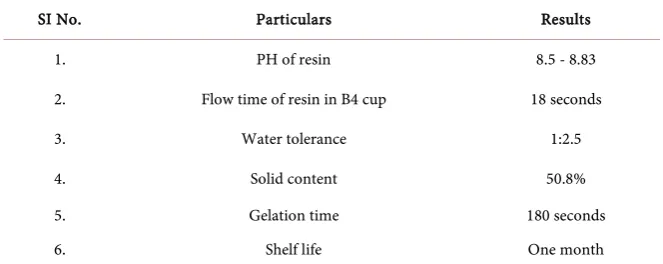
Coir was procured from coir board, Peenya has a specific gravity of 0.55 with a moisture content of 10%. Coir of length 2 - 3 mm available was used as it is for the manufacture of board. The particles were dried in Hot Air Oven at 62˚C ± 2˚C to get requisite moisture content of 3% to 4%. Melamine Urea formaldehyde resin (MUF) synthesized at in-house laboratory was used for preparation of low density coir particle board. MUF resin with 1:1 weight ratio of urea and mela-mine were synthesized at pH 8.5 and at 85˚C till getting water tolerance of 1:4. The properties of the resin used for the manufacture of particle board are as shown in Table 1.
2.1. Manufacturing Process of Particle Board
[image:3.595.208.540.503.635.2]Sixteen sets of single layered Coir particle boards of dimension 300 mm × 300 mm × 12 mm for a targeted density of 300 kg/m3, 400 kg/m3 and 500 kg/m3 were manufactured using MUF resin adhesive. The adhesive formulation having Ammonium chloride hardener (0.4%) and wax emulsion (1%) on the liquid re-sin was made. The particles were blended with 10% MUF adhesive on dry solid basis. The glue blended particles were placed into a mat forming box with base dimensions of 330 mm × 330 mm. The formulations for the manufacturing of boards are as shown in Table 2. Prepressing and compression of the particles were done by pressing a matching wooden plate on the mat in the forming box by applying manual pressure. Supporting rods to control the thickness to 12 mm were placed on either ends of the assembly. The assembly was then loaded into a hot press of size 350 mm × 350 mm wherein temperature of the platens was
Table 1. Properties of MUF Resin.
SI No. Particulars Results
1. PH of resin 8.5 - 8.83
2. Flow time of resin in B4 cup 18 seconds
3. Water tolerance 1:2.5
4. Solid content 50.8%
5. Gelation time 180 seconds
6. Shelf life One month
Table 2. Formulations of boards.
300 kg/m3 400 kg/m3 500 kg/m3
Particles (g) 290 400 500
DOI: 10.4236/oja.2019.93004 42 Open Journal of Acoustics maintained at 160˚C for particle board. Pressure of 20 kg/cm2 for compression cycle and 12 kg/cm2 for curing cycle with requisite curing time for respective re-sin systems were employed. The boards were kept for stabilization for about 24 - 48 hours to attain equilibrium moisture content and then trimmed. The trimmed boards were further dimensioned to required sizes and subjected for testing as per relevant specifications.
2.2. Testing of Boards
All the test specimens were exposed to an atmosphere maintained at a relative humidity of 65 ± 5 %t and at a temperature of 27˚C ± 2˚C until their masses are nearly constant. The test specimens were kept in this controlled atmosphere un-til they are required for testing.
Physical properties of the boards viz; Moisture content, swelling due to sur-face absorption & water absorption (2 h) were tested as per IS: 2380 (Methods of test for wood particle boards and boards from other lignocellulosic materials) and compared with values prescribed in IS: 3129 (Specification for Low Density Particle Boards).
Modulus of Rupture the mechanical property carried out in UTM (Universal testing machine) available at the in-house laboratory as per Indian Standard 2380 and compared with Indian Standard 3129.
Sound absorption coefficient was calculated by the method as per IS: 10420-1982 (Determination of sound absorption coefficient of timber by stand-ing wave method) usstand-ing acoustic Pulse tester available at in-house laboratory. Three sets of samples of diameters 100 mm and 30 mm were prepared for stud-ying acoustic properties for frequencies ranging from 125 Hz to 1500 Hz and 1500 Hz to 5000 Hz respectively. The sound absorption coefficient of the sam-ples was recorded. The average values of three sets were noted for all the three (300, 400 & 500 kg/m3) density samples. The noise reduction coefficient (NRC) was also calculated as the average of the absorption coefficients at 250, 500, 1000 and 2000 Hz frequencies.
DOI: 10.4236/oja.2019.93004 43 Open Journal of Acoustics During testing of samples, readings were taken only after steady state condi-tion.
The thermal conductivity is computed by the equation as given below:
( )
{
QD}
k
A T
=
∆ , in W/m-K
where:
Q is the heat supplied through a medium, in W. A is the cross-section of the sample, in m2.
∆T is the temperature differential across the medium, in K.
D is the length of the medium through which heat flows (thickness of sample), in m.
k is the thermal conductivity of the medium, W/m-K.
3. Results and Discussion
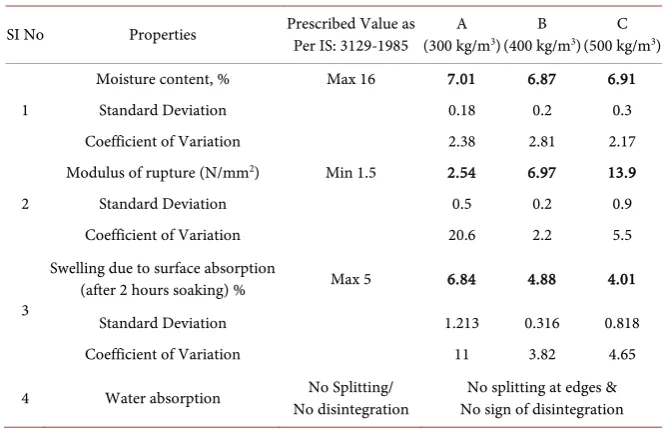
[image:5.595.207.540.510.728.2]The average density of the coir particle boards manufactured was found to be 299 kg/m3, 410 kg/m3 and 502 kg/m3 respectively. The Moisture content, MOR and thickness swelling due to surface absorption values are reflected in Table 3. The average Moisture content values were found to be 7.01%, 6.87% & 6.91% for the three targeted density boards of 300, 400, 500 kg/m3 respectively. MOR value for all densities was meeting the requisite value of Indian standard (IS) 3129. Swelling due to surface absorption of 400 & 500 kg/m3 boards was conforming to the requirement and 300 kg/m3 board was showing little higher thickness swel-ling. Generally, there will be more space available for the water to move in a lower density particle board due to the low compaction ratio but water absorp-tion results show that all samples after testing were in intact posiabsorp-tion and no any sign of disintegration or splitting at the edges.
Table 3. Average test results of Moisture content, MOR and Swelling due to surface
ab-sorption with standard deviation and coefficient of variation.
SI No Properties Prescribed Value as Per IS: 3129-1985 (300 kg/mA 3) (400 kg/mB 3) (500 kg/mC 3)
1
Moisture content, % Max 16 7.01 6.87 6.91
Standard Deviation 0.18 0.2 0.3
Coefficient of Variation 2.38 2.81 2.17
2
Modulus of rupture (N/mm2) Min 1.5 2.54 6.97 13.9
Standard Deviation 0.5 0.2 0.9
Coefficient of Variation 20.6 2.2 5.5
3
Swelling due to surface absorption
(after 2 hours soaking) % Max 5 6.84 4.88 4.01
Standard Deviation 1.213 0.316 0.818
Coefficient of Variation 11 3.82 4.65
DOI: 10.4236/oja.2019.93004 44 Open Journal of Acoustics The absorption coefficient is a common quantity used for measuring the sound absorption of a material and is known to be the function of the frequency of the incident wave. It is defined as the ratio of energy absorbed by a material to the energy incident upon its surface. Sound absorption coefficient of all three densities boards was measured till 5000 Hz. Figure 1 shows the Sound absorp-tion coefficient of all three density boards. Table 4 indicates the Average values of Thermal conductivity with Standard deviation and coefficient of variation. From Figure 1, it can be seen that the values of all three boards increased with increase in frequency up to 3000 Hz and gradually the values decreased for higher frequencies starting from 3500 Hz to 5000 Hz. This increase and decrease were due to the specific characteristic of coir material. As the frequency increas-es above 3000 Hz, sound absorption decreasincreas-es, a porous material which allow the passage of the wave with greater or lesser efficiency sound absorption. The porosity of any panel depends on the raw material used, density of the composite and also the empty spaces between them, which opposes the air pressure caused by the sound wave. 300 kg/m3 shows a higher absorption of 0.80 at 3000 Hz and gives the best absorption compared to other two boards B 400 kg/m3 & C 500 kg/m3. Standard deviation and Coefficient of variation shows there is no much significant variation between the set of samples results.
Noise Reduction Coefficient (NRC) is an average rating of how much sound an acoustic board can absorb. It is the average values of absorption coefficients for a specific material at the octave band center frequencies of 250, 500, 1000 and 2000 Hz. Noise reduction coefficients (NRC) of three density boards calculated were 0.29, 0.26 and 0.24 all the three values are comparable with NRC values of wadding material (30 mm thick, 0.31), Fiber board (25 mm thick, 0.258) and wood wool building slab (25 mm thick, 0.3) [9]. From Figure 2, NRC values de-crease with an inde-crease in density and follow linear trend line equation y = −0.0003x + 0.3633 with coefficient of determination 0.9868 (R2).
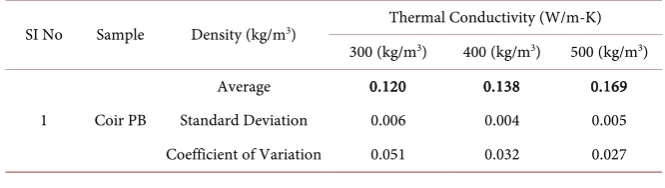
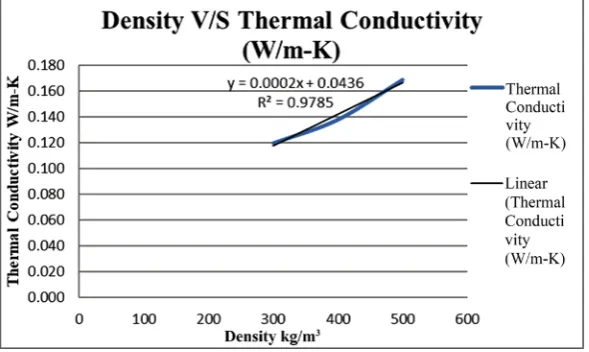
[image:6.595.207.540.636.730.2]As shown in Figure 3, at a density of 300, 400 and 500 kg/m3, the k values of the boards were 0.120, 0. 140 and 0.170 W/mK, respectively. Thermal conductiv-ity of coir boards varies from 0.120 to 0.169 W/m-K for densconductiv-ity range 300 to 500 kg/m3. Table 4 shows thermal conductivity values of all three density coir boards with standard deviation and coefficient of variation. The effect of density on thermal conductivity of coir boards is as shown in Figure 3. Thermal conductivity
Table 4. Average values of Thermal conductivity with Standard deviation and coefficient
of variation.
SI No Sample Density (kg/m3) Thermal Conductivity (W/m-K)
300 (kg/m3) 400 (kg/m3) 500 (kg/m3)
1 Coir PB
Average 0.120 0.138 0.169
Standard Deviation 0.006 0.004 0.005
DOI: 10.4236/oja.2019.93004 45 Open Journal of Acoustics
[image:7.595.226.522.302.474.2]Figure 1. Sound absorption coefficient of all three density boards.
Figure 2. Density versus noise reduction coefficient with linear trend equation and
coef-ficient of Determination (R2).
Figure 3. Density versus thermal conductivity with linear trend equation and coefficient
[image:7.595.227.522.520.696.2]DOI: 10.4236/oja.2019.93004 46 Open Journal of Acoustics increases as the density of the board increases and follows linear trend line rela-tionship y = 0.0002x + 0.0436 with coefficient of determination 0.9785 (R2).
It is seen that the thermal conductivity values are directly related to the densi-ty of the board, the highest densidensi-ty boards having the least insulating effect. This is due to the fact that the low-density board contains a large number of voids filled with air, which is one of the poorest conductors [10]. Thus the lower den-sity boards conduct less heat than the higher denden-sity boards.
Note that, materials with the thermal conductivity less than 0.25 W/mK are generally seen as thermal insulations [10]. Therefore, it can be concluded that the coir particleboards are excellent materials for thermal insulators. The ma-terial is comparable with other mama-terials such as coffee husk and hulls boards of (0.110 W/mK) [11], lightweight concrete (0.155 W/mK) [12].
4. Conclusion
Experiment illustrates that particle board made from coir fiber particles can be used in acoustic application as sound absorbent material. Density of board 400 kg/m3 conforms all requirements of IS-3129 with better MOR and indicates that it can also take loads as prescribed in Indian standard 3129 for low density ap-plication. Particle boards with densities 400 kg/m3 & 500 kg/m3 conform to the requirement of swelling due to surface absorption as per IS 3129. With an in-crease in density, thermal conductivity also inin-creases and coir particle boards can also be used for heat sink applications. Still the scope of applications can be extended by mixing other agro residues waste with coir to know how best it per-forms as insulator for thermal and acoustic applications.
Acknowledgements
The authors would like to sincerely thank to Director, IPIRTI-Bangalore for providing necessary research facilities and timely support.
Conflicts of Interest
The authors declare no conflicts of interest regarding the publication of this paper.
References
[1] Verma, D., Gope, P.C., Shandilyal, A., Guptal, A. and Maheshwari, M.K. (2013) Coir Fibre Reinforcement and Application in Polymer Composites: A Review.
Journal of Materials and Environmental Science, 4, 263-276.
[2] Lawniezak, M. and Zielinshes, S. (1961) Mechanical and Technological Properties of Flaxboard. Holz als Roh- und Werkstoff, 19, 232-239.
https://doi.org/10.1007/BF02612519
[3] Yang, H, Kim,D.-J. and Kim, H.-J. (2003) Rice Straw-Wood Particle Composite for Sound Absorbing Wooden Construction Materials. Journal of Bioresource Tech-nology, 86, 117-121. https://doi.org/10.1016/S0960-8524(02)00163-3
DOI: 10.4236/oja.2019.93004 47 Open Journal of Acoustics
[5] Tabarsaa, T., Jahanshahia, S. and Ashorib, A. (2011) Mechanical and Physical Prop-erties of Wheat Straw Boards Bonded with a Tannin Modified Phenol-Formaldehyde Adhesive. Journal of Composites Part B: Engineering, 42, 176-180.
https://doi.org/10.1016/j.compositesb.2010.09.012
[6] Karlinasari, L. and Hermawan, D. (2012) Acoustical Properties of Particle Boards Made from Betung Bamboo (Dendrocalamus asper) as Building Constructional Material. Journal of Bioresource Technology, 7, 5700-5709.
https://doi.org/10.15376/biores.7.4.5700-5709
[7] Markiewicz, E., Paukszta, D. and Borysiak, S. (2012) Acoustic and Dielectric Prop-erties of Polypropylene-Lignocellulosic Materials Composites. In: Polypropylene, Chapter 12, InTech, London, 193-216.
[8] Fatima, S. and Mohanty, A.R. (2011) Acoustical and Fire-Retardant Properties of Jute Composite Materials. Journal of Applied Acoustics, 72, 108-114.
https://doi.org/10.1016/j.apacoust.2010.10.005
[9] Nandanwar, A., Kiran, M.C. and Varadarajulu, K.C. (2017) Influence of Density on Sound Absorption Coefficient of Fibre Board. Open Journal of Acoustics, 7, 1-9.
https://doi.org/10.4236/oja.2017.71001
[10] Zhou, X.Y., Zheng, F., Li, H.G. and Lu, C.L. (2010) An Environment-Friendly Thermal Insulation Material from Cotton Stalk Fibers. Energy and Buildings, 42, 1070-1074. https://doi.org/10.1016/j.enbuild.2010.01.020
[11] Bekalo, S.A. and Reinhardt, H.W. (2010) Fibers of Coffee Husk and Hulls for the Production of Particleboard. Materials and Structures, 43, 1049-1960.
https://doi.org/10.1617/s11527-009-9565-0